Lehman
Propping Up a House of Cards
AIG, Bear Stearns, BofA, Citi, Credit Default Swaps, Derivatives, Financial Instruments, Lehman, MerrillTalking Business

Next week, perhaps as early as Monday, the American International Group is going to report the largest quarterly loss in history. Rumors suggest it will be around $60 billion, which will affirm, yet again, A.I.G.’s sorry status as the most crippled of all the nation’s wounded financial institutions. The recent quarterly losses suffered by Merrill Lynch and Citigroup — “only” $15.4 billion and $8.3 billion, respectively — pale by comparison.
At the same time A.I.G. reveals its loss, the federal government is also likely to announce — yet again! — a new plan to save A.I.G., the third since September. So far the government has thrown $150 billion at the company, in loans, investments and equity injections, to keep it afloat. It has softened the terms it set for the original $85 billion loan it made back in September. To ease the pressure even more, the Federal Reserve actually runs a facility that buys toxic assets that A.I.G. had insured. A.I.G. effectively has been nationalized, with the government owning a hair under 80 percent of the stock. Not that it’s worth very much; A.I.G. shares closed Friday at 42 cents.
Donn Vickrey, who runs the independent research firm Gradient Analytics, predicts that A.I.G. is going to cost taxpayers at least $100 billion more before it finally stabilizes, by which time the company will almost surely have been broken into pieces, with the government owning large chunks of it. A quarter of a trillion dollars, if it comes to that, is an astounding amount of money to hand over to one company to prevent it from going bust. Yet the government feels it has no choice: because of A.I.G.’s dubious business practices during the housing bubble it pretty much has the world’s financial system by the throat.
If we let A.I.G. fail, said Seamus P. McMahon, a banking expert at Booz & Company, other institutions, including pension funds and American and European banks “will face their own capital and liquidity crisis, and we could have a domino effect.” A bailout of A.I.G. is really a bailout of its trading partners — which essentially constitutes the entire Western banking system.
I don’t doubt this bit of conventional wisdom; after the calamity that followed the fall of Lehman Brothers, which was far less enmeshed in the global financial system than A.I.G., who would dare allow the world’s biggest insurer to fail? Who would want to take that risk? But that doesn’t mean we should feel resigned about what is happening at A.I.G. In fact, we should be furious. More than even Citi or Merrill, A.I.G. is ground zero for the practices that led the financial system to ruin.
“They were the worst of them all,” said Frank Partnoy, a law professor at the University of San Diego and a derivatives expert. Mr. Vickrey of Gradient Analytics said, “It was extreme hubris, fueled by greed.” Other firms used many of the same shady techniques as A.I.G., but none did them on such a broad scale and with such utter recklessness. And yet — and this is the part that should make your blood boil — the company is being kept alive precisely because it behaved so badly.
•
When you start asking around about how A.I.G. made money during the housing bubble, you hear the same two phrases again and again: “regulatory arbitrage” and “ratings arbitrage.” The word “arbitrage” usually means taking advantage of a price differential between two securities — a bond and stock of the same company, for instance — that are related in some way. When the word is used to describe A.I.G.’s actions, however, it means something entirely different. It means taking advantage of a loophole in the rules. A less polite but perhaps more accurate term would be “scam.”
As a huge multinational insurance company, with a storied history and a reputation for being extremely well run, A.I.G. had one of the most precious prizes in all of business: an AAA rating, held by no more than a dozen or so companies in the United States. That meant ratings agencies believed its chance of defaulting was just about zero. It also meant it could borrow more cheaply than other companies with lower ratings.
To be sure, most of A.I.G. operated the way it always had, like a normal, regulated insurance company. (Its insurance divisions remain profitable today.) But one division, its “financial practices” unit in London, was filled with go-go financial wizards who devised new and clever ways of taking advantage of Wall Street’s insatiable appetite for mortgage-backed securities. Unlike many of the Wall Street investment banks, A.I.G. didn’t specialize in pooling subprime mortgages into securities. Instead, it sold credit-default swaps.
These exotic instruments acted as a form of insurance for the securities. In effect, A.I.G. was saying if, by some remote chance (ha!) those mortgage-backed securities suffered losses, the company would be on the hook for the losses. And because A.I.G. had that AAA rating, when it sprinkled its holy water over those mortgage-backed securities, suddenly they had AAA ratings too. That was the ratings arbitrage. “It was a way to exploit the triple A rating,” said Robert J. Arvanitis, a former A.I.G. executive who has since become a leading A.I.G. critic.
Why would Wall Street and the banks go for this? Because it shifted the risk of default from themselves to A.I.G., and the AAA rating made the securities much easier to market. What was in it for A.I.G.? Lucrative fees, naturally. But it also saw the fees as risk-free money; surely it would never have to actually pay up. Like everyone else on Wall Street, A.I.G. operated on the belief that the underlying assets — housing — could only go up in price.
That foolhardy belief, in turn, led A.I.G. to commit several other stupid mistakes. When a company insures against, say, floods or earthquakes, it has to put money in reserve in case a flood happens. That’s why, as a rule, insurance companies are usually overcapitalized, with low debt ratios. But because credit-default swaps were not regulated, and were not even categorized as a traditional insurance product, A.I.G. didn’t have to put anything aside for losses. And it didn’t. Its leverage was more akin to an investment bank than an insurance company. So when housing prices started falling, and losses started piling up, it had no way to pay them off. Not understanding the real risk, the company grievously mispriced it.
Second, in many of its derivative contracts, A.I.G. included a provision that has since come back to haunt it. It agreed to something called “collateral triggers,” meaning that if certain events took place, like a ratings downgrade for either A.I.G. or the securities it was insuring, it would have to put up collateral against those securities. Again, the reasons it agreed to the collateral triggers was pure greed: it could get higher fees by including them. And again, it assumed that the triggers would never actually kick in and the provisions were therefore meaningless. Those collateral triggers have since cost A.I.G. many, many billions of dollars. Or, rather, they’ve cost American taxpayers billions.
The regulatory arbitrage was even seamier. A huge part of the company’s credit-default swap business was devised, quite simply, to allow banks to make their balance sheets look safer than they really were. Under a misguided set of international rules that took hold toward the end of the 1990s, banks were allowed use their own internal risk measurements to set their capital requirements. The less risky the assets, obviously, the lower the regulatory capital requirement.
How did banks get their risk measures low? It certainly wasn’t by owning less risky assets. Instead, they simply bought A.I.G.’s credit-default swaps. The swaps meant that the risk of loss was transferred to A.I.G., and the collateral triggers made the bank portfolios look absolutely risk-free. Which meant minimal capital requirements, which the banks all wanted so they could increase their leverage and buy yet more “risk-free” assets. This practice became especially rampant in Europe. That lack of capital is one of the reasons the European banks have been in such trouble since the crisis began.
•
At its peak, the A.I.G. credit-default business had a “notional value” of $450 billion, and as recently as September, it was still over $300 billion. (Notional value is the amount A.I.G. would owe if every one of its bets went to zero.) And unlike most Wall Street firms, it didn’t hedge its credit-default swaps; it bore the risk, which is what insurance companies do.
It’s not as if this was some Enron-esque secret, either. Everybody knew the capital requirements were being gamed, including the regulators. Indeed, A.I.G. openly labeled that part of the business as “regulatory capital.” That is how they, and their customers, thought of it.
There’s more, believe it or not. A.I.G. sold something called 2a-7 puts, which allowed money market funds to invest in risky bonds even though they are supposed to be holding only the safest commercial paper. How could they do this? A.I.G. agreed to buy back the bonds if they went bad. (Incredibly, the Securities and Exchange Commission went along with this.) A.I.G. had a securities lending program, in which it would lend securities to investors, like short-sellers, in return for cash collateral. What did it do with the money it received? Incredibly, it bought mortgage-backed securities. When the firms wanted their collateral back, it had sunk in value, thanks to A.I.G.’s foolish investment strategy. The practice has cost A.I.G. — oops, I mean American taxpayers — billions.
Here’s what is most infuriating: Here we are now, fully aware of how these scams worked. Yet for all practical purposes, the government has to keep them going. Indeed, that may be the single most important reason it can’t let A.I.G. fail. If the company defaulted, hundreds of billions of dollars’ worth of credit-default swaps would “blow up,” and all those European banks whose toxic assets are supposedly insured by A.I.G. would suddenly be sitting on immense losses. Their already shaky capital structures would be destroyed. A.I.G. helped create the illusion of regulatory capital with its swaps, and now the government has to actually back up those contracts with taxpayer money to keep the banks from collapsing. It would be funny if it weren’t so awful.
I asked Mr. Arvanitis, the former A.I.G. executive, if the company viewed what it had done during the bubble as a form of gaming the system. “Oh no,” he said, “they never thought of it as abuse. They thought of themselves as satisfying their customers.”
That’s either a remarkable example of the power of rationalization, or they were lying to themselves, figuring that when the house of cards finally fell, somebody else would have to clean it up.
That would be us, the taxpayers.
Government Bailout Hits $8.5 trillion
Adjustable Rate Mortgages, AIG, Alan Greenspan, bailout, Banking Regulation, Banks, Ben Bernanke, Bernie Madoff, BofA, Citi, Credit, Credit Default Swaps, Fannie Mae, Federal Reserve, Finance, Freddy Mac, Henry Paulson, Lehman, Merrill, Mrs. Andrea Mitchell, Treasury, Wachovia, Wall Street, World Savings
Kathleen Pender
November 26, 2008
The federal government committed an additional $800 billion to two new loan programs on Tuesday, bringing its cumulative commitment to financial rescue initiatives to a staggering $8.5 trillion, according to Bloomberg News.
That sum represents almost 60 percent of the nation’s estimated gross domestic product.
Given the unprecedented size and complexity of these programs and the fact that many have never been tried before, it’s impossible to predict how much they will cost taxpayers. The final cost won’t be known for many years.
The money has been committed to a wide array of programs, including loans and loan guarantees, asset purchases, equity investments in financial companies, tax breaks for banks, help for struggling homeowners and a currency stabilization fund.
Most of the money, about $5.5 trillion, comes from the Federal Reserve, which as an independent entity does not need congressional approval to lend money to banks or, in “unusual and exigent circumstances,” to other financial institutions.
To stimulate lending, the Fed said on Tuesday it will purchase up to $600 billion in mortgage debt issued or backed by Fannie Mae, Freddie Mac and government housing agencies. It also will lend up to $200 billion to holders of securities backed by consumer and small-business loans. All but $20 billion of that $800 billion represents new commitments, a Fed spokeswoman said.
About $1.1 trillion of the $8.5 trillion is coming from the Treasury Department, including $700 billion approved by Congress in dramatic fashion under the Troubled Asset Relief Program.
The rest of the commitments are coming from the Federal Deposit Insurance Corp. and the Federal Housing Administration.
Only about $3.2 trillion of the $8.5 trillion has been tapped so far, according to Bloomberg. Some of it might never be.
Relatively little of the money represents direct outlays of cash with no strings attached, such as the $168 billion in stimulus checks mailed last spring.
Where it’s going
Most of the money is going into loans or loan guarantees, asset purchases or stock investments on which the government could see some return.
“If the economy were to miraculously recover, the taxpayer could make money. That’s not my best guess or even a likely scenario,” but it’s not inconceivable, says Anil Kashyap, a professor at the University of Chicago’s Booth School of Business.
The risk/reward ratio for taxpayers varies greatly from program to program.
For example, the first deal the government made when it bailed out insurance giant AIG had little risk and a lot of potential upside for taxpayers, Kashyap said. “Then it turned out the situation (at AIG) was worse than realized, and the terms were so brutal (to AIG) that we had to renegotiate. Now we have given them a lot more credit on more generous terms.”
Kashyap says the worst deal for taxpayers could be the Citigroup deal announced late Sunday. The government agreed to buy an additional $20 billion in preferred stock and absorb up to $249 billion in losses on troubled assets owned by Citi.
Given that Citigroup’s entire market value on Friday was $20.5 billion, “instead of taking that $20 billion in preferred shares we could have bought the company,” he says.
It’s hard to say how much the overall rescue attempt will add to the annual deficit or the national debt because the government accounts for each program differently.
If the Treasury borrows money to finance a program, that money adds to the federal debt and must eventually be paid off, with interest, says Diane Lim Rogers, chief economist with the Concord Coalition, a nonpartisan group that aims to eliminate federal deficits.
The federal debt held by the public has risen to $6.4 trillion from $5.5 trillion at the end of August. (Total debt, including that owed to Social Security and other government agencies, stands at more than $10 trillion.)
However, a $1 billion increase in the federal debt does not necessarily increase the annual budget deficit by $1 billion because it is expected to be repaid over time, Rogers said.
Annual deficit
A deficit arises when the government’s expenditures exceed its revenues in a particular year. Some estimate that the federal deficit will exceed $1 trillion this fiscal year as a result of the economic slowdown and efforts to revive it.
The Fed’s activities to shore up the financial system do not show up directly on the federal budget, although they can have an impact. The Fed lends money from its own balance sheet or by essentially creating new money. It has been doing both this year.
The problem is, “if you print money all the time, the money becomes worth less,” Rogers says. This usually leads to higher inflation and higher interest rates. The value of the dollar also falls because foreign investors become less willing to invest in the United States.
Today, interest rates are relatively low and the dollar has been mostly strengthening this year because U.S. Treasury securities “are still for the moment a very safe thing to be investing in because the financial market is so unstable,” Rogers said. “Once we stabilize the stock market, people will not be so enamored of clutching onto Treasurys.”
At that point, interest rates and inflation will rise. Increased borrowing by the Treasury will also put upward pressure on interest rates.
Deflation a big concern
Today, however, the Fed is more worried about deflation than inflation and is willing to flood the market with money if necessary to prevent an economic collapse.
Federal Reserve Chairman Ben Bernanke “has ordered the helicopters to get ready,” said Axel Merk, president of Merk Investments. “The helicopters are hovering and the first cash is making it through the seams. Soon, a door may be opened.”
Rogers says her biggest fear is not hyperinflation and the social unrest it could unleash. “I’m more worried about a lot of federal dollars being committed and not having much to show for it. My worst fear is we are leaving our children with a huge debt burden and not much left to pay it back.”
Economic rescue
Key dates in the federal government’s campaign to alleviate the economic crisis.
March 11: The Federal Reserve announces a rescue package to provide up to $200 billion in loans to banks and investment houses and let them put up risky mortgage-backed securities as collateral.
March 16: The Fed provides a $29 billion loan to JPMorgan Chase & Co. as part of its purchase of investment bank Bear Stearns.
July 30: President Bush signs a housing bill including $300 billion in new loan authority for the government to back cheaper mortgages for troubled homeowners.
Sept. 7: The Treasury takes over mortgage giants Fannie Mae and Freddie Mac, putting them into a conservatorship and pledging up to $200 billion to back their assets.
Sept. 16: The Fed injects $85 billion into the failing American International Group, one of the world’s largest insurance companies.
Sept. 16: The Fed pumps $70 billion more into the nation’s financial system to help ease credit stresses.
Sept. 19: The Treasury temporarily guarantees money market funds against losses up to $50 billion.
Oct. 3: President Bush signs the $700 billion economic bailout package. Treasury Secretary Henry Paulson says the money will be used to buy distressed mortgage-related securities from banks.
Oct. 6: The Fed increases a short-term loan program, saying it is boosting short-term lending to banks to $150 billion.
Oct. 7: The Fed says it will start buying unsecured short-term debt from companies, and says that up to $1.3 trillion of the debt may qualify for the program.
Oct. 8: The Fed agrees to lend AIG $37.8 billion more, bringing total to about $123 billion.
Oct. 14: The Treasury says it will use $250 billion of the $700 billion bailout to inject capital into the banks, with $125 billion provided to nine of the largest.
Oct. 14: The FDIC says it will temporarily guarantee up to a total of $1.4 trillion in loans between banks.
Oct. 21: The Fed says it will provide up to $540 billion in financing to provide liquidity for money market mutual funds.
Nov. 10: The Treasury and Fed replace the two loans provided to AIG with a $150 billion aid package that includes an infusion of $40 billion from the government’s bailout fund.
Nov. 12: Paulson says the government will not buy distressed mortgage-related assets, but instead will concentrate on injecting capital into banks.
Nov. 17: Treasury says it has provided $33.6 billion in capital to another 21 banks. So far, the government has invested $158.6 billion in 30 banks.
Sunday: The Treasury says it will invest $20 billion in Citigroup Inc., on top of $25 billion provided Oct. 14. The Treasury, Fed and FDIC also pledge to backstop large losses Citigroup might absorb on $306 billion in real estate-related assets.
Tuesday: The Fed says it will purchase up to $600 billion more in mortgage-related assets and will lend up to $200 billion to the holders of securities backed by various types of consumer loans.
Source: Associated Press
Net Worth runs Tuesdays, Thursdays and Sundays. E-mail Kathleen Pender at kpender@sfchronicle.com.
The 20 Senators Who Voted For Wall Street Bailout But Against Auto Industry Rescue
AIG, bailout, Bear Stearns, Ben Bernanke, Biden, Citi, Congress, Credit Default Swaps, D.C. Lobbyists, Detroit, District Of Corruption, Douchebaggery, Federal Reserve, Greenspan, Hank Paulson, Hedge Funds, Kerry. Auto Industry, Lehman, Merrill, Summers, Tim Geitner, Treasury, Wall StreetTHINK PROGRESS DEC 12, 2008
Last night, the Senate failed to approve the auto rescue package, voting 52-35 in favor of proceeding on the bill — just eight short of the 60 votes that were needed. Over on the Wonk Room, Dan Weiss takes a look at the 20 senators who voted for the Wall Street bailout but voted against the auto rescue last night (as well as the 10 others who skipped the vote last night, but voted for the financial bailout):
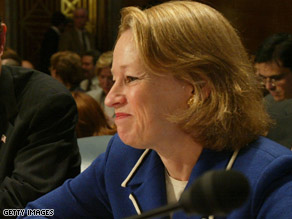
New SEC Chief Mary Schapiro/Getty
| Yes to TARP, No to auto | Yes to TARP, Absent for auto |
| Sen. Max Baucus (D-MT) Sen. Robert Bennett (R-UT) Sen. Richard Burr (R-NC) Sen. Saxby Chambliss (R-GA) Sen. Tom Coburn (R-OK) Sen. Norm Coleman (R-MN) Sen. Bob Corker (R-TN) Sen. John Ensign (R-NV) Sen. Chuck Grassley (R-IA) Sen. Judd Gregg (R-NH) Sen. Orrin Hatch (R-UT) Sen. Kay Hutchison (R-TX) Sen. John Isakson (R-GA) Sen. Jon Kyl (R-AZ) Sen. Blanche Lincoln (D-AR) Sen. Mel Martinez (R-FL) Sen. John McCain (R-AZ) Sen. Mitch McConnell (R-KY) Sen. Lisa Murkowski (R-AK) Sen. John Thune (R-SD) |
Sen. Lamar Alexander (R-TN) Sen. Joe Biden (D-DE) Sen. John Cornyn (R-TX) Sen. Larry Craig (R-ID) Sen. Lindsey Graham (R-SC) Sen. Chuck Hagel (R-NE) Sen. John Kerry (D-MA) Sen. Gordon Smith (R-OR) Sen.Ted Stevens (R-AK) Sen. John Sununu (R-NH) |
Biden was tending to transition duties, while Kerry was in Poznan, Poland, participating in U.N. climate change talks. Alexander was home recovering from surgery. Why did these other Senators feel auto workers weren’t as deserving as Wall Street? We’d like to know. If you see statements from them, please let us know by email or in the comments section.
UpdateSen. Jim Bunning (R-KY), a Hall of Fame baseball pitcher in his heyday, was scheduled to appear Sunday at a sports card show in Taylor, Michigan to sign autographs. “But Bunning was kicked off the schedule after he helped derail an auto-industry loan package in the Senate Thursday night.” (HT: TP commenter cali)
Guess What? That Whole "Limit on Executive Pay" Thingy in Bailout is Bunk
401k, AIG, bailout, Banking, Bankruptcy, Barack Obama, Barney Frank, Bear Stearns, Bernanke, Bernie Madoff, Citi, Congress, Corporate Greed, D.C., Executive Pay, Lehman, Merrill, Morgan Stanley, Mortgage Backed Securities, U.S. Congress, U.S. Senate, U.S. Treasury, Wall StreetExecutive Pay Limits May Prove Toothless
Loophole in Bailout Provision Leaves Enforcement in Doubt
By Amit R. Paley
Washington Post Staff Writer
Monday, December 15, 2008; A01

Congress wanted to guarantee that the $700 billion financial bailout would limit the eye-popping pay of Wall Street executives, so lawmakers included a mechanism for reviewing executive compensation and penalizing firms that break the rules.
But at the last minute, the Bush administration insisted on a one-sentence change to the provision, congressional aides said. The change stipulated that the penalty would apply only to firms that received bailout funds by selling troubled assets to the government in an auction, which was the way the Treasury Department had said it planned to use the money.
Now, however, the small change looks more like a giant loophole, according to lawmakers and legal experts. In a reversal, the Bush administration has not used auctions for any of the $335 billion committed so far from the rescue package, nor does it plan to use them in the future. Lawmakers and legal experts say the change has effectively repealed the only enforcement mechanism in the law dealing with lavish pay for top executives.
“The flimsy executive-compensation restrictions in the original bill are now all but gone,” said Sen. Charles E. Grassley (Iowa), ranking Republican on of the Senate Finance Committee.
The modification reflects how the rapidly shifting nature of the crisis and the government’s response to it have led to unexpected results that are just now beginning to be understood. The Government Accountability Office, the investigative arm of Congress, issued a critical report this month about the financial industry rescue package that said it was unclear how the Treasury would determine whether banks were following the executive-compensation rules.
Michele A. Davis, spokeswoman for the Treasury, said the agency is working to develop a policy for how it will enforce the executive-compensation rules. She would not say when the guidance would be issued or what penalties it might impose. But she said the companies promised to follow the rules in contracts with the department.
The final legislation contained unprecedented restrictions on executive compensation for firms accepting money from the bailout fund. The rules limited incentives that encourage top executives to take excessive risks, provided for the recovery of bonuses based on earnings that never materialize and prohibited “golden parachute” severance pay. But several analysts said that perhaps the most effective provision was the ban on companies deducting more than $500,000 a year from their taxable income for compensation paid to their top five executives.
That tax provision, which amended the Internal Revenue Code, was the only part of the law that contained an explicit enforcement mechanism. The provision means the IRS must review the pay of those executives as part of its normal review of tax filings. If a company does not comply, the IRS can impose a tax penalty. The law did not create an enforcement mechanism for reviewing the other restrictions on executive pay.
If a firm violates the executive-compensation limits, department officials said, the Treasury could seek damages, go to court to force compliance, or even rescind the contracts and recover the bailout money. “We therefore have all the remedies available to us for a breach of contract,” Davis wrote in an e-mail.
Legal experts said those efforts could be complicated if the Treasury outlines the penalties after companies have received bailout money. David M. Lynn, former chief counsel of the Securities and Exchange Commission‘s division of corporation finance, said courts have sometimes placed limits on the government’s ability to impose penalties if there was no fair warning.
“Treasury might find its hands tied down the road,” said Lynn, who is also co-author of “The Executive Compensation Disclosure Treatise and Reporting Guide.”
Congressional leaders are also concerned that the Treasury might simply choose not to enforce the rules or be unwilling to impose financial penalties that could further weaken a firm and send the economy deeper into a tailspin.
The Bush administration at first opposed any restrictions on executive pay, congressional aides said. The original three-page bailout proposal presented to lawmakers in September contained no mention of such limits. “Treasury was pretty clear that they thought doing this exec-comp stuff would limit the effectiveness of the program,” said a Democratic congressional aide involved in the negotiations, who, like others interviewed for this story, spoke on condition of anonymity. “They felt companies might not take part if we put in these rules.”
Congressional leaders disagreed. By the morning of Saturday, Sept. 27, the final day of marathon negotiations on the bill, draft language relating to taxes and containing the enforcement provision applied to all companies participating in the bailout programs, Democratic and Republican congressional aides said. But then Treasury Secretary Henry M. Paulson Jr. and his deputies began pushing for the compensation rules to differentiate between companies whose assets are purchased at auction and those whose assets or equity are purchased directly by the government, the aides said.
Congressional leaders from both parties thought Paulson wanted the distinction for extraordinary cases like American International Group, which the government seized in September. He wanted to be able to push executives out of companies that the government controlled and have the flexibility to bring in strong new executives, said one senior congressional aide.
“The argument that they were making at the time is that the direct investment was going to be used only in circumstances where the company was AIGed, so to speak,” said a senior Democratic congressional aide.
Davis, the Treasury spokeswoman, confirmed that the Treasury pushed to place fewer restrictions on executives at companies receiving capital infusions, but she gave a different explanation. She said many of those firms are more stable and are being encouraged to participate in the bailout to strengthen the overall system. “The provisions for failing institutions should come with more onerous conditions than those for healthy institutions whose participation benefits the entire system,” she said.
Lawmakers agreed to the Treasury’s request that the measure apply only to executives at companies whose assets were bought by the government through auctions. In the executive-compensation tax section, a new sentence saying that eventually was inserted.
Meanwhile, Paulson repeatedly told lawmakers that he did not plan to use bailout funds to inject capital directly into financial institutions. Privately, however, his staff was developing plans to do just that, Paulson acknowledged in an interview.
Although lawmakers hailed the rules as unprecedented new limits on executive pay, several were unhappy that the law was not stricter.
Under pressure from Congress, the Treasury issued regulations in October on executive compensation and applied the tax-deduction limits to all companies receiving bailout funds, although the legislation did not require it for firms that received direct capital injections. But the Treasury failed to issue guidelines requiring the IRS or any other agency to enforce the rules, and it also failed to explain how the restrictions would be enforced.
The Treasury’s regulations also instructed firms to disclose more compensation information to the Securities and Exchange Commission. But officials at the SEC do not think they have the authority to force companies to disclose the kind of pay information required by the bailout law, according to people familiar with the matter, though they hope companies will cooperate. John Nester, an SEC spokesman, declined to comment.
Senators on the Finance Committee have expressed concern to Paulson and are now considering whether they should amend the law to apply the enforcement mechanism to all firms participating in the bailout.
The End of The Ownership Society
Banking, Broadcatching, Credit Default Swaps, George W. Bush, Hedge Funds, Lehman, Ownership Society, Politics, Wall Street
End of the ‘Ownership Society’
From the magazine issue dated Oct 20, 2008
Remember the ownership society? President George W. Bush championed the concept when he was running for re-election in 2004, envisioning a world in which every American family owned a house and a stock portfolio, and government stayed out of the way of the American Dream.
These families were, of course, conservative, or at a minimum traditional and nuclear, consisting of a heterosexual married couple and at least two kids living in a stand-alone home with a yard, a car or two and a multimedia room with a flat-screen television. The latter was a new addition to this 21st-century simulacrum of the 1950s “Leave It to Beaver” idyll. But the dream was the same.
Such a country would be more stable, Bush argued, and more prosperous. “America is a stronger country every single time a family moves into a home of their own,” he said in October 2004. To achieve his vision, Bush pushed new policies encouraging homeownership, like the “zero-down-payment initiative,” which was much as it sounds—a government-sponsored program that allowed people to get mortgages without a down payment. More exotic mortgages followed, including ones with no monthly payments for the first two years. Other mortgages required no documentation other than the say-so of the borrower. Absurd though these all were, they paled in comparison to the financial innovations that grew out of the mortgages—derivatives built on other derivatives, packaged and repackaged until no one could identify what they contained and how much they were, in fact, worth.
As we know by now, these instruments have brought the global financial system, improbably, to the brink of collapse. And as financial strains drive husbands and wives apart, Bush’s ownership ideology may end up having the same effect on the stable nuclear families conservatives so badly wanted to foster.
The dream of a better society through homeownership didn’t originate with George W. Bush. It’s as American as Manifest Destiny. The Homestead Act in 1862 offered acres to anyone willing to brave the Western frontier. During Reconstruction, freed slaves were promised “40 acres and a mule.” And after World War II, with Levittown and its cousins, affordable homes were a reward of victory. But until very recently, those hopes and dreams were connected to actual income and gainful employment. No longer.
The giddiness of the Bush years built on the promise of the New Economy era, a promise perfectly encapsulated by a 1999 billboard advertising a shiny new subdivision in Scroggins, Texas, filled with homes that most of their owners couldn’t really afford: YES, YOU CAN HAVE IT ALL! That dream took a sharp hit with the collapse of the Internet stock bubble in 2000-2001 and then with 9/11, both of which destroyed billions of dollars of wealth. But it came roaring back in 2002, encouraged by Bush’s post-9/11 exhortation that Americans could do their patriotic duty by going shopping and paying lower taxes, even as government spending exploded. Shop they did, and homes they bought.
The spree wasn’t confined to the United States. Britain has its own version of the ownership society, which received a boost from Margaret Thatcher, who promoted “a property-owning democracy” that her Labour successors, Tony Blair and Gordon Brown, endorsed. Blair liked to talk of building a “stakeholder economy” with a big role for the ordinary property-owning citizen. More recently, Brown has spoken of creating a “homeowning, asset-owning, wealth-owning democracy.” Millions were happy to buy into the vision. Tenants of government-owned properties gladly took up Thatcher’s offer to sell them their homes at knockdown prices. More than 70 percent of Britons now own their homes, compared with 40 percent of Germans and 50 percent of French.
In Britain as in the United States, the vision was about more than owning a home. It was about being a better person. With a home came traditional values, an appreciation of hard work, prudent living, civic-mindedness, patriotism and ultimately a more stable society. Or so the rhetoric went.
But eventually, it all went sour. By the turn of the century, the proliferation of easy credit and universal stock ownership combined to create anything but a conservative society of thrift. Average household debt levels are now higher in Britain than in any other major country in the developed world. In the United States, the shift away from corporate pensions to 401(k) retirement accounts plunged millions more into the equity markets and loosened the traditional connection between companies and workers, which was one element of that 1950s dream that conservatives like Bush conveniently forgot. The ownership society of the 1950s was anchored by a labor movement that made sure that workers received something resembling their share—remember Truman’s Fair Deal? The deal for the past eight years has been fair to merchants of capital, and then some. But to the tens of millions on the receiving rather than originating end of those mortgages, fairness has been in short supply.
No, this can’t be reduced to a swindle. We all bear some burden for the current morass. You can’t peddle what people don’t want to buy, and for a while it seemed a decent trade-off: Wall Street got rich, and Main Street got homes. The easy terms—and that is putting it lightly—of mortgages gave many a chance to own a home who never would have qualified for a mortgage in years past. But it also gave others the option to buy, sell and flip. Every speculator a home? That wasn’t supposed to be part of the equation.
The irony is that more homeownership and stock ownership has actually weakened traditional bonds. For the past decade, as homeownership went up, marriages continued to fail. As a percentage of the population, fewer people are getting married now than 10 years ago. Single-parent homes are on the rise. So is unemployment, which has increased to 6.1 percent, up from 4.5 percent in 2000. With foreclosures now running at more than 300,000 a month, and stock portfolios and retirement savings shrinking with the global-equity sell-off, there has been a notable increase in demand for mental-health services—which is a problem, given that many health-care plans, the ones left to the private sector, cover only a few visits. Studies have also shown a link between difficult economic straits and declining health and higher mortality. And as the editor and writer Tina Brown, a sharp tracker of social trends, recently said at NEWSWEEK’s Women & Leadership conference, “I think the financial crisis is going to put a lot of marriages under great stress. There really isn’t enough to go around, and there are choices to be made. When men lose their job they frequently feel a great loss of manly self-confidence, and that has great impact on a marriage.”
The final referendum on the ownership society will be the November election. The rhetoric of both parties and candidates for president suggests that regardless of who wins, the vision of the past eight years is being rejected in favor of hunkering down, paying off debt, regulating the anarchic world of credit and derivatives, and unraveling systemic knots that have assumed Gordian complexity. As Barack Obama recently said, “in Washington they call this the ownership society, but what it really means is, you’re on your own.”
This crisis will pass, eventually, and on the other side there will still be global electronic exchanges and computer-enhanced models; there will still be mortgages; and there will still be a deep cultural yearning for a place of one’s own. There may be less froth and more discipline in the coming years—combined with reduced circumstances and less money. Lean times are their own source of hopes and desires, and drive people to find new ways to satisfy old yearnings. There may be more prudent ways to create a world where families are stable and living in their own homes. But the gap between that dream and messy reality isn’t likely to close any time soon. Let’s hope that we have learned something about how much we can have and how quickly. For Americans in particular, that would be a real revolution.
Karabell is president of RiverTwice Research and senior adviser for Business for Social Responsibility.
 The New York Herald Sun