Nascar Suspends Seven Members of Joe Gibbs Racing

Stories
August 20, 2008

By Reid Spencer
Sporting News NASCAR Wire Service

As anticipated, the penalties announced to Joe Gibbs Racing’s No. 18 and No. 20 Nationwide Series teams Wednesday by NASCAR were severe indeed.

Finding that the two JGR teams had attempted to manipulate chassis dynamometer horsepower readings after Saturday’s Carfax 250 Nationwide Series race at Michigan International Speedway, NASCAR suspended seven members of the Gibbs organization indefinitely, including Dave Rogers, crew chief of the No. 20 Toyota driven by Tony Stewart, and Jason Ratcliff, crew chief of the No. 18 Toyota driven by Joey Logano.

Stewart and Logano were docked 150 Nationwide driver championship points each — a moot penalty, because neither is competing for the series championship — but Stewart and Logano were placed on probation through the end of the season. Joe Gibbs, who owns both cars, was docked 150 car owner points for each entry.

NASCAR slapped Rogers and Ratcliff each with $50,000 fines and imposed indefinite suspensions on car chiefs Dorian Thorsen (No. 18) and Richard Bray (No. 20), engine tuners Michael Johnson (No. 18) and Dan Bajek (No. 20) and crew member Toby Bigelow (No. 18). Both teams will remain on probation through Dec. 31.

During dyno testing after Saturday’s race, NASCAR discovered magnetic shims placed behind the throttle pedals of both Gibbs cars, a move designed to prevent the pedals from being fully depressed and thereby reducing the peak horsepower readings from the two engines.

In late July, NASCAR had instituted an engine rule change designed to bring Toyota’s power more in line with that of other manufacturers’. Before the rule change was made, Toyota’s horsepower had measured consistently higher than that of the other car makes during prior dyno testing.

After the shims were removed at Michigan, the peak number of the Gibbs’ Toyotas (640 horsepower) was still higher than that of the Chevrolets (636), Fords (634) and Dodges (632).

In a statement released Wednesday, Gibbs apologized profusely for the violations and said he would add to the penalties imposed by NASCAR.

“In 17 years we have never had any representative of Joe Gibbs Racing knowingly act outside of NASCAR’s rules, and that is something we consider essential to how we operate on a daily basis,” Gibbs said. “What we have determined is that these individuals involved used extremely poor judgment in attempting to alter the results of NASCAR’s dyno test following Saturday’s Nationwide Series race in Michigan. Although in no way was anything done that might have altered the race outcome, these JGR employees attempted to circumvent the NASCAR rule book and that is unacceptable.

“We take full responsibility and accept the penalties NASCAR has levied against us today. We had come to the conclusion that we would add to any NASCAR imposed penalties with the minimum being suspension for the remainder of the season for those involved, including our two Nationwide Series crew chiefs. There will also be an additional monetary fine beyond the amount announced by NASCAR earlier today, which will be the responsibility of those involved.

“We are, however, disappointed that NASCAR chose to place our drivers on probation, as they had no knowledge or involvement of this incident.”

Though Chevrolet driver Brad Keselowski admitted he might have been tempted to do what the Gibbs teams did under similar circumstances, he viewed their actions as far worse than trying to cheat in a single race.

“They attempted to cheat in the next two seasons by doing what they did in that dyno test,” Keselowski said Tuesday. “It’s worse than cheating in that one race. They attempted to cheat for the next whatever session that was going to be before the next dyno session, before NASCAR could prove it.

“I almost wish they were just cheating in that one race, because I would have felt better about it. But what they attempted to do was cheat us for the rest of the season, all the way up to probably Atlanta of next year, before another dyno test was done. That’s what makes it even worse.”

The owner-point penalty to the No. 20 car, which tops the Nationwide standings, reduced its lead from 318 points to 168 over the No. 2 Richard Childress Racing Chevrolet driven by Clint Bowyer. Stewart, Logano, Kyle Busch and Denny Hamlin have combined to win nine races in the No. 20, and Gibbs cars have won 14 of 25 Nationwide races this year.

Note: NASCAR also announced a Sprint Cup Series penalty Wednesday: a $25,000 fine levied against Donnie Wingo, crew chief of the No. 41 Chip Ganassi Racing Dodge driven by Reed Sorenson, for improperly attached weight. The violation was discovered after Sunday’s 3M Performance 400 at Michigan.
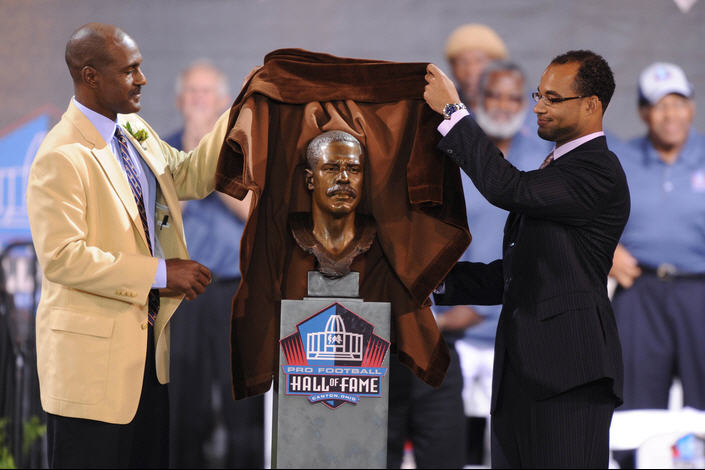
Hail To The Redskins at the Pro Football Hall Of Fame

Stories

“Hail To The Redskins- Hail Victory….

Braves On The Warpath- Fight For Old D.C.!

A Class Reunion in Canton

Partisan Crowd Cheers Monk, Green On Induction Day

By Mike Wise
Washington Post Staff Writer
Sunday, August 3, 2008; D01

CANTON, Ohio, Aug. 2 — They came from the District and beyond to see them. Way beyond. Some of the pilgrimages began in Orange County, Calif., and others in Murphy, N.C., where a white-haired couple began driving through the Blue Ridge Mountains some nine hours earlier.

“After all the memories, we had to see them go in,” Bill Garrod said as his wife, Nancy, nodded in agreement, hours before Art Monk and Darrell Green were to be enshrined in the Pro Football Hall of Fame on Saturday.

And the moment the last Class of 2008 inductee took the stage, their patience was rewarded for those $4 gallons of gas and hours on sweltering freeways — just as Monk’s patience the past eight years was rewarded.

For 4 minutes 4 seconds before Monk spoke — an applause lasting nearly three times as long as that for any other honoree — the steadiest and most reliable wide receiver to play pro football in Washington took in the chants, smiles and unconditional love heaped upon him.

“Thank you, thank you,” Monk kept saying, happily unable to quiet the applause from the announced crowd of 16,654 at Fawcett Stadium, about 15,000 of whom wore burgundy and gold.

Green had spoken nearly an hour earlier, drawing a monstrous ovation as fireworks cascaded behind him. He was the third inductee to be honored and the first Redskin introduced.

Bill Garrod wore one of those Super Bowl T-shirts with the caricatured mugs of Redskins players from another era. There was Charles Mann, Earnest Byner, Ricky Sanders and, of course, the ebullient and grinning Green. Bill spoke of seeing Eddie LeBaron play at Griffith Stadium in the 1950s the way others spoke of the magic and majesty of RFK in the 1980s and early 1990s.

They overwhelmed this lush, northeastern Ohio town about an hour south of Cleveland with numbers and passion, thousands of fans clad in burgundy and gold hats, jerseys, assorted paraphernalia and, yes, Halloween masks. They dwarfed other Hall of Fame inductees’ fans, transforming Canton into a rollicking yet respectful RFK tailgate.

Soon after the national anthem, 2007 inductee Michael Irvin took the podium and was booed long and lustily, as if the former Dallas Cowboys wideout were still standing across the line of scrimmage from Green. According to NFL broadcaster and former coach Steve Mariucci, the crowd was “95 percent Washington Redskin jerseys!”

The fans’ journey to the cradle of professional football to pay homage to Monk and Green began less in a place than a time, when the Redskins were frequently atop the NFL, led by groups of men nicknamed the Fun Bunch and the Hogs. Among the most skilled were Green, the loquacious, lightning-quick cornerback who played longer for the Redskins than any player, and Monk, the sure-handed wide receiver who let his solid play speak for him.

Monk and Green were enshrined with former New England Patriots linebacker Andre Tippett; Gary Zimmerman, an offensive lineman for the Minnesota Vikings and Denver Broncos; Fred Dean, the pass-rushing demon of the San Diego Chargers and San Francisco 49ers; and Kansas City Chiefs cornerback Emmitt Thomas, who also mentored Green and Monk for eight seasons as a Redskins assistant.

Monk’s selection in February to Canton was the culmination of a rejection process that went on for almost a decade, as other, more showy wide receivers and less-accomplished players received enough votes for enshrinement. Monk resigned himself to being known as the durable yet often unspectacular pro, the guy who did not have enough go-long highlights to impress a suddenly pass-happy league.

Never mind Monk held the NFL’s career record for receptions for two years, had five seasons with more than 1,000 receiving yards and that he caught seven passes for 113 yards in Super Bowl XXVI. For seven years, it didn’t matter.

“I think the first year was probably the worst, because there was so much anticipation from my community, all the fans, just saying, ‘Oh, you’ve got it made, you’re a shoo-in,’ ” Monk said Friday during an interview session. “And when you start hearing that and you start believing it and when it didn’t happen, it was a disappointment.”

“It’s taken eight years,” Monk added. “But regardless of how long it’s taken, it’s good to be here.”

Green’s induction came almost as quickly as the blinding speed of the player four times named the NFL’s fastest man. He was enshrined the first year he was eligible.

Before every split time was news at an NFL combine and every team had an army of strength and speed coaches, Green once ran a 40-yard dash in an unheard-of time of 4.17 seconds.

He played 20 years with the Redskins, an NFL record for years spent with one team equaled only by former Rams offensive lineman Jackie Slater. Monk’s 295 games with Washington remains a milestone for a player with one team in one city. His seven Pro Bowl selections were buttressed by 54 career interceptions.

The fans who invaded Canton this weekend all had their favorite Green and Monk moments, ranging from Green’s spectacular punt return against the Chicago Bears in a 1988 playoff game — he winced in pain from a rib injury as he crossed the goal line — to Monk’s record-setting reception against the Denver Broncos at RFK Stadium on “Monday Night Football” in 1992, after which Monk’s teammates interrupted the game to carry him on their shoulders.

“So I guess that would be the most memorable for me,” Monk said.

A Los Angeles Rams fan, standing near Redskins fans, volunteered he had never imagined Eric Dickerson being caught from behind by any player in his prime, but that he remembered Green tracking down the tailback and dragging him to the ground.

Dan Bee, who came from Orange County, Calif., with his wife, Stephanie, said the play that sticks in his mind is Green knocking away a pass against the Minnesota Vikings on fourth down near the goal line at the end of a playoff game, sending the Redskins to Super Bowl XXII in 1988.

Keith McCoy and David Sutherland, both 24 and best friends growing up in Northern Virginia, simply remember attending Monk’s camp four straight summers, how gracious the three-time Pro Bowl wide receiver was to impressionable youths like themselves. “He signed autographs, took pictures, talked to us, everything,” McCoy said.

Monk was presented by his son, James Arthur Monk Jr. Green’s presenter was also his son, Jared, whom he and his wife were going to name Darrell Green Jr. before changing their minds a month before he was born.

“I’m so grateful because he’s his own man,” Green said. “I’m more proud of my son being my son than I am being in the Hall of Fame.”

Inside the Hall of Fame, through the maze of exhibits and grainy NFL Films, thousands more burgundy-and-gold-clad people made their way to the bronzed-bust room, where they snapped photos of Joe Gibbs’s likeness. This, too, was part of the journey to pro football’s Mecca. For this day, they wouldn’t be anywhere else.