The End of The Ownership Society

Banking, Broadcatching, Credit Default Swaps, George W. Bush, Hedge Funds, Lehman, Ownership Society, Politics, Wall Street
End of the ‘Ownership Society’
Zachary Karabell
From the magazine issue dated Oct 20, 2008

Remember the ownership society? President George W. Bush championed the concept when he was running for re-election in 2004, envisioning a world in which every American family owned a house and a stock portfolio, and government stayed out of the way of the American Dream.

These families were, of course, conservative, or at a minimum traditional and nuclear, consisting of a heterosexual married couple and at least two kids living in a stand-alone home with a yard, a car or two and a multimedia room with a flat-screen television. The latter was a new addition to this 21st-century simulacrum of the 1950s “Leave It to Beaver” idyll. But the dream was the same.

Such a country would be more stable, Bush argued, and more prosperous. “America is a stronger country every single time a family moves into a home of their own,” he said in October 2004. To achieve his vision, Bush pushed new policies encouraging homeownership, like the “zero-down-payment initiative,” which was much as it sounds—a government-sponsored program that allowed people to get mortgages without a down payment. More exotic mortgages followed, including ones with no monthly payments for the first two years. Other mortgages required no documentation other than the say-so of the borrower. Absurd though these all were, they paled in comparison to the financial innovations that grew out of the mortgages—derivatives built on other derivatives, packaged and repackaged until no one could identify what they contained and how much they were, in fact, worth.

As we know by now, these instruments have brought the global financial system, improbably, to the brink of collapse. And as financial strains drive husbands and wives apart, Bush’s ownership ideology may end up having the same effect on the stable nuclear families conservatives so badly wanted to foster.

The dream of a better society through homeownership didn’t originate with George W. Bush. It’s as American as Manifest Destiny. The Homestead Act in 1862 offered acres to anyone willing to brave the Western frontier. During Reconstruction, freed slaves were promised “40 acres and a mule.” And after World War II, with Levittown and its cousins, affordable homes were a reward of victory. But until very recently, those hopes and dreams were connected to actual income and gainful employment. No longer.

The giddiness of the Bush years built on the promise of the New Economy era, a promise perfectly encapsulated by a 1999 billboard advertising a shiny new subdivision in Scroggins, Texas, filled with homes that most of their owners couldn’t really afford: YES, YOU CAN HAVE IT ALL! That dream took a sharp hit with the collapse of the Internet stock bubble in 2000-2001 and then with 9/11, both of which destroyed billions of dollars of wealth. But it came roaring back in 2002, encouraged by Bush’s post-9/11 exhortation that Americans could do their patriotic duty by going shopping and paying lower taxes, even as government spending exploded. Shop they did, and homes they bought.

The spree wasn’t confined to the United States. Britain has its own version of the ownership society, which received a boost from Margaret Thatcher, who promoted “a property-owning democracy” that her Labour successors, Tony Blair and Gordon Brown, endorsed. Blair liked to talk of building a “stakeholder economy” with a big role for the ordinary property-owning citizen. More recently, Brown has spoken of creating a “homeowning, asset-owning, wealth-owning democracy.” Millions were happy to buy into the vision. Tenants of government-owned properties gladly took up Thatcher’s offer to sell them their homes at knockdown prices. More than 70 percent of Britons now own their homes, compared with 40 percent of Germans and 50 percent of French.

In Britain as in the United States, the vision was about more than owning a home. It was about being a better person. With a home came traditional values, an appreciation of hard work, prudent living, civic-mindedness, patriotism and ultimately a more stable society. Or so the rhetoric went.

But eventually, it all went sour. By the turn of the century, the proliferation of easy credit and universal stock ownership combined to create anything but a conservative society of thrift. Average household debt levels are now higher in Britain than in any other major country in the developed world. In the United States, the shift away from corporate pensions to 401(k) retirement accounts plunged millions more into the equity markets and loosened the traditional connection between companies and workers, which was one element of that 1950s dream that conservatives like Bush conveniently forgot. The ownership society of the 1950s was anchored by a labor movement that made sure that workers received something resembling their share—remember Truman’s Fair Deal? The deal for the past eight years has been fair to merchants of capital, and then some. But to the tens of millions on the receiving rather than originating end of those mortgages, fairness has been in short supply.

No, this can’t be reduced to a swindle. We all bear some burden for the current morass. You can’t peddle what people don’t want to buy, and for a while it seemed a decent trade-off: Wall Street got rich, and Main Street got homes. The easy terms—and that is putting it lightly—of mortgages gave many a chance to own a home who never would have qualified for a mortgage in years past. But it also gave others the option to buy, sell and flip. Every speculator a home? That wasn’t supposed to be part of the equation.

The irony is that more homeownership and stock ownership has actually weakened traditional bonds. For the past decade, as homeownership went up, marriages continued to fail. As a percentage of the population, fewer people are getting married now than 10 years ago. Single-parent homes are on the rise. So is unemployment, which has increased to 6.1 percent, up from 4.5 percent in 2000. With foreclosures now running at more than 300,000 a month, and stock portfolios and retirement savings shrinking with the global-equity sell-off, there has been a notable increase in demand for mental-health services—which is a problem, given that many health-care plans, the ones left to the private sector, cover only a few visits. Studies have also shown a link between difficult economic straits and declining health and higher mortality. And as the editor and writer Tina Brown, a sharp tracker of social trends, recently said at NEWSWEEK’s Women & Leadership conference, “I think the financial crisis is going to put a lot of marriages under great stress. There really isn’t enough to go around, and there are choices to be made. When men lose their job they frequently feel a great loss of manly self-confidence, and that has great impact on a marriage.”

The final referendum on the ownership society will be the November election. The rhetoric of both parties and candidates for president suggests that regardless of who wins, the vision of the past eight years is being rejected in favor of hunkering down, paying off debt, regulating the anarchic world of credit and derivatives, and unraveling systemic knots that have assumed Gordian complexity. As Barack Obama recently said, “in Washington they call this the ownership society, but what it really means is, you’re on your own.”

This crisis will pass, eventually, and on the other side there will still be global electronic exchanges and computer-enhanced models; there will still be mortgages; and there will still be a deep cultural yearning for a place of one’s own. There may be less froth and more discipline in the coming years—combined with reduced circumstances and less money. Lean times are their own source of hopes and desires, and drive people to find new ways to satisfy old yearnings. There may be more prudent ways to create a world where families are stable and living in their own homes. But the gap between that dream and messy reality isn’t likely to close any time soon. Let’s hope that we have learned something about how much we can have and how quickly. For Americans in particular, that would be a real revolution.


Karabell is president of RiverTwice Research and senior adviser for Business for Social Responsibility.
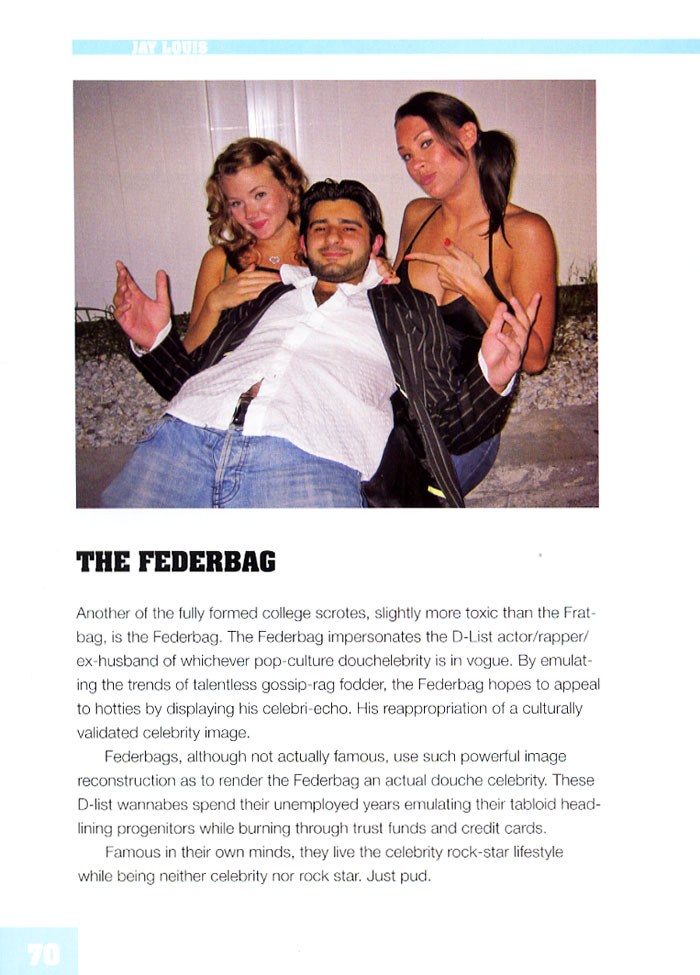

Hot Chicks With Douchebags Sue Hot Chicks With Douchebags

Hot Chicks With Douchebags

THE SMOKING GUN

OCTOBER 23–Angered that their photos appear in “Hot Chicks with Douchebags,” three New Jersey women have sued the book’s author and publisher, claiming that the “vulgar” title has unfairly tarred them as “females who date dubious men.”

According to a New Jersey Superior Court lawsuit, the women–Yvette Gorzelany, 22; Joanna Obiedzinski, 21; and Paulina Pakos, 24–have been forced to undergo medical treatment and psychological therapy, and have suffered financial damages as a result of their inclusion in author Jay Louis’s book, which was published in July.

Like Louis’s web site (hotchickswithdouchebags.com), the book caustically lampoons male clubgoers and the women with whom they are photographed. As seen below, Obiedzinski (left) and Gorzelany are pictured in Louis’s book with a man who purportedly represents the “Federbag” subspecies of douchebag. Obdzienski contends that, as a result of her appearance in the Simon & Schuster book, she was rejected for a job at a New Jersey country club. Pakos is pictured in a section of the book that offers men various “de-douchification” tips.

Pakos, a Ramapo College student, claims that she was “dating a person who broke up with her as a result of [her] appearance in the book,” according to the October 14 lawsuit, which was first reported by Courthouse News Service. An excerpt from the complaint can be found here. The two photos were taken last year at Bliss, a Clifton, N.J. nightclub, and originally appeared on a web site devoted to nightclub photography.

First U.S. Army Battalion to Be Stationed Inside American Borders

Army, Government, Homeland Security, Politics, Security State, US

Brigade homeland tours start Oct. 1


3rd Infantry’s 1st BCT trains for a new dwell-time mission. Helping ‘people at home’ may become a permanent part of the active Army
By Gina Cavallaro – Staff writer ARMY TIMES
Posted : Tuesday Sep 30, 2008 16:16:12 EDT

The 3rd Infantry Division’s 1st Brigade Combat Team has spent 35 of the last 60 months in Iraq patrolling in full battle rattle, helping restore essential services and escorting supply convoys.

Now they’re training for the same mission — with a twist — at home.

Beginning Oct. 1 for 12 months, the 1st BCT will be under the day-to-day control of U.S. Army North, the Army service component of Northern Command, as an on-call federal response force for natural or manmade emergencies and disasters, including terrorist attacks.

It is not the first time an active-duty unit has been tapped to help at home. In August 2005, for example, when Hurricane Katrina unleashed hell in Mississippi and Louisiana, several active-duty units were pulled from various posts and mobilized to those areas.

But this new mission marks the first time an active unit has been given a dedicated assignment to NorthCom, a joint command established in 2002 to provide command and control for federal homeland defense efforts and coordinate defense support of civil authorities.

After 1st BCT finishes its dwell-time mission, expectations are that another, as yet unnamed, active-duty brigade will take over and that the mission will be a permanent one.

“Right now, the response force requirement will be an enduring mission. How the [Defense Department] chooses to source that and whether or not they continue to assign them to NorthCom, that could change in the future,” said Army Col. Louis Vogler, chief of NorthCom future operations. “Now, the plan is to assign a force every year.”

The command is at Peterson Air Force Base in Colorado Springs, Colo., but the soldiers with 1st BCT, who returned in April after 15 months in Iraq, will operate out of their home post at Fort Stewart, Ga., where they’ll be able to go to school, spend time with their families and train for their new homeland mission as well as the counterinsurgency mission in the war zones.

Stop-loss will not be in effect, so soldiers will be able to leave the Army or move to new assignments during the mission, and the operational tempo will be variable.

Don’t look for any extra time off, though. The at-home mission does not take the place of scheduled combat-zone deployments and will take place during the so-called dwell time a unit gets to reset and regenerate after a deployment.

The 1st of the 3rd is still scheduled to deploy to either Iraq or Afghanistan in early 2010, which means the soldiers will have been home a minimum of 20 months by the time they ship out.

In the meantime, they’ll learn new skills, use some of the ones they acquired in the war zone and more than likely will not be shot at while doing any of it.

They may be called upon to help with civil unrest and crowd control or to deal with potentially horrific scenarios such as massive poisoning and chaos in response to a chemical, biological, radiological, nuclear or high-yield explosive, or CBRNE, attack.

Training for homeland scenarios has already begun at Fort Stewart and includes specialty tasks such as knowing how to use the “jaws of life” to extract a person from a mangled vehicle; extra medical training for a CBRNE incident; and working with U.S. Forestry Service experts on how to go in with chainsaws and cut and clear trees to clear a road or area.

The 1st BCT’s soldiers also will learn how to use “the first ever nonlethal package that the Army has fielded,” 1st BCT commander Col. Roger Cloutier said, referring to crowd and traffic control equipment and nonlethal weapons designed to subdue unruly or dangerous individuals without killing them.

The package is for use only in war-zone operations, not for any domestic purpose.

“It’s a new modular package of nonlethal capabilities that they’re fielding. They’ve been using pieces of it in Iraq, but this is the first time that these modules were consolidated and this package fielded, and because of this mission we’re undertaking we were the first to get it.”

The package includes equipment to stand up a hasty road block; spike strips for slowing, stopping or controlling traffic; shields and batons; and, beanbag bullets.

“I was the first guy in the brigade to get Tasered,” said Cloutier, describing the experience as “your worst muscle cramp ever — times 10 throughout your whole body.

“I’m not a small guy, I weigh 230 pounds … it put me on my knees in seconds.”

The brigade will not change its name, but the force will be known for the next year as a CBRNE Consequence Management Response Force, or CCMRF (pronounced “sea-smurf”).

“I can’t think of a more noble mission than this,” said Cloutier, who took command in July. “We’ve been all over the world during this time of conflict, but now our mission is to take care of citizens at home … and depending on where an event occurred, you’re going home to take care of your home town, your loved ones.”

While soldiers’ combat training is applicable, he said, some nuances don’t apply.

“If we go in, we’re going in to help American citizens on American soil, to save lives, provide critical life support, help clear debris, restore normalcy and support whatever local agencies need us to do, so it’s kind of a different role,” said Cloutier, who, as the division operations officer on the last rotation, learned of the homeland mission a few months ago while they were still in Iraq.

Some brigade elements will be on call around the clock, during which time they’ll do their regular marksmanship, gunnery and other deployment training. That’s because the unit will continue to train and reset for the next deployment, even as it serves in its CCMRF mission.

Should personnel be needed at an earthquake in California, for example, all or part of the brigade could be scrambled there, depending on the extent of the need and the specialties involved.

Other branches included

The active Army’s new dwell-time mission is part of a NorthCom and DOD response package.

Active-duty soldiers will be part of a force that includes elements from other military branches and dedicated National Guard Weapons of Mass Destruction-Civil Support Teams.

A final mission rehearsal exercise is scheduled for mid-September at Fort Stewart and will be run by Joint Task Force Civil Support, a unit based out of Fort Monroe, Va., that will coordinate and evaluate the interservice event.

In addition to 1st BCT, other Army units will take part in the two-week training exercise, including elements of the 1st Medical Brigade out of Fort Hood, Texas, and the 82nd Combat Aviation Brigade from Fort Bragg, N.C.

There also will be Air Force engineer and medical units, the Marine Corps Chemical, Biological Initial Reaction Force, a Navy weather team and members of the Defense Logistics Agency and the Defense Threat Reduction Agency.

One of the things Vogler said they’ll be looking at is communications capabilities between the services.

“It is a concern, and we’re trying to check that and one of the ways we do that is by having these sorts of exercises. Leading up to this, we are going to rehearse and set up some of the communications systems to make sure we have interoperability,” he said.

“I don’t know what America’s overall plan is — I just know that 24 hours a day, seven days a week, there are soldiers, sailors, airmen and Marines that are standing by to come and help if they’re called,” Cloutier said. “It makes me feel good as an American to know that my country has dedicated a force to come in and help the people at home.”

———

Correction:

A non-lethal crowd control package fielded to 1st Brigade Combat Team, 3rd Infantry Division, described in the original version of this story, is intended for use on deployments to the war zone, not in the U.S., as previously stated.

US, NY probing credit-default swap market

Credit Default Swaps, Hedge Funds, Wall Street

NEW YORK (AP) — Federal prosecutors and New York’s attorney general said Monday they had taken the unusual step of joining forces to probe the multitrillion-dollar credit-default swap market, an unregulated area of finance blamed for helping to fuel the credit crisis.

The offices of U.S. Attorney Michael Garcia and New York Attorney General Andrew Cuomo acknowledged the unique arrangement in separate statements.

“The attorney general believes that these unprecedented times call for unprecedented levels of effort and cooperation to ensure that our markets are stable, free of fraud and purged of corruption,” Cuomo spokesman Alex Detrick said.

He said the joint probe was “aimed at restoring and promoting confidence and stability in the market” and avoiding multiple competing investigations.

Yusill Scribner, a Garcia spokeswoman, said prosecutors wanted to determine if federal laws were violated.

The announcements came after The New York Times reported on the investigation in its Monday editions.

A credit-default swap is a contract that offers insurance for lenders worried about a borrower’s ability to repay loans. Banks have used credit-default swaps to cover the risk of default in mortgage and other debt securities. Many credit-default swaps collapsed in value along with the mortgage-backed securities they were meant to protect.

Fear of what would happen if the swaps fully unraveled prompted the government in September to lend $85 billion to insurer American International Group Inc.

An official in Cuomo’s office who asked not to be indentified by name because he was not authorized to speak about the matter publicly said the joint investigation began about three weeks ago after a meeting between Garcia and Cuomo.

As part of the arrangement, some investigators from Cuomo’s office will become special assistant U.S. attorneys, a designation that will allow them to present evidence to a grand jury should the investigation reach that stage.

“We’re not at that stage yet,” the official said, acknowledging that criminal charges may never result. “At this point, we have been receiving documents and we are sharing them with the U.S. attorney’s office and are meeting on a regular basis.”

The probe will focus in part on finding out whether the credit-default market, which is estimated to be worth tens of trillions of dollars, was manipulated, the official said.

“Our concern is that areas of misconduct that we used to see in the major markets moved to the credit default market because of that market’s opaqueness and lack of regulatory oversight,” the official said.

The investigation will focus on all of the large financial firms including banks and hedge funds that made use of the credit-default swaps.

Although the default-swap market operated primarily in New York and London, banks in Switzerland and elsewhere were also likely to be part of the probe, the official said.

Dead Bear Covered With Obama Signs Found at School

Election 2008, Racism

Racism On The Campaign Trail

Yahoo! News

Mon Oct 20, 10:03 pm ET

CULLOWHEE, N.C. – Police at Western Carolina University and wildlife officials were investigating the discovery early Monday of a dead bear cub draped with a pair of Barack Obama campaign signs.

Leila Tvedt, associate vice chancellor for public relations, said Monday night that maintenance workers found the 75-pound bear cub shot to death in front of the school’s administration building at the entrance to campus. The Obama yard signs were stapled together and placed over the bear’s head, Tvedt said.

The bear had been shot in the head, Tvedt said.

“Western Carolina University deplores the inappropriate behavior that has led to this troubling incident,” Tvedt said. “We cannot speculate on the motives of the people involved nor who those people might be. Campus police are cooperating fully with authorities to investigate this matter.”

University police called in state Wildlife Resources officials to remove the body and help in the investigation.

Bear season is under way in western North Carolina.

John McCain Calls Tullycast a Commie

Barack Obama, Broadcatching Blog, Election 2008, John McCain, John Tully, Karl Rove, Lee Atwater, New York Herald Sun, Politics, Tina Fey, Tullycast

New Rules From Bill Maher For October 17, 2008

Barack Obama, Broadcatching, Comedy, Credit Default Swaps, Financial Crisis, Hedge Funds, John McCain, Politics, Sarah Palin, Tullycast, Video, Wall Street

Sarah Palin Pals Around With Secessionists | Maher 10/17/08

Barack Obama, Broadcatching, Comedy, Credit Default Swaps, Financial Crisis, Hedge Funds, John McCain, Politics, Sarah Palin, Tullycast, Video, Wall Street

Frank Luntz Tries The P.O.W. Card One More Time-Maher-Oct 17

Barack Obama, Broadcatching, Comedy, Credit Default Swaps, Financial Crisis, Hedge Funds, John McCain, Politics, Sarah Palin, Tullycast, Video, Wall Street