HOW MANY WAYS IS JONAH GOLDBERG AN ASSFACE?

Stories

countdown-ww-jonah.jpg

It appears Keith picked up on the pathetically wrong prediction/bet Jonah Goldberg made two years ago and calls him out on it on national television.

video_wmv Download (5499) | Play (4966)  video_mov Download (2114) | Play (2999)

Jonah Goldberg…less prophetic than pathetic”

THE PENTAGON LIED AND GOT WAR

Stories


By ROBERT BURNS, AP Military

Pentagon officials undercut the intelligence community in the run-up
to the U.S. invasion of Iraq by insisting in briefings to the White
House that there was a clear relationship between Saddam Hussein and
al-Qaida, the Defense Department’s inspector general said Friday.

Acting Inspector General Thomas F. Gimble told the Senate Armed
Services Committee that the office headed by former Pentagon policy
chief Douglas J. Feith took “inappropriate” actions in advancing
conclusions on al-Qaida connections not backed up by the nation’s
intelligence agencies.

Gimble said that while the actions of the Office of the Under
Secretary of Defense for Policy “were not illegal or unauthorized,”
they “did not provide the most accurate analysis of intelligence to
senior decision makers” at a time when the White House was moving
toward war with Iraq.

“I can’t think of a more devastating commentary,” said Armed
Services Committee Chairman Sen. Carl Levin (news, bio, voting record),
D-Mich.

He cited Gimble’s findings that Feith’s office was, despite doubts
expressed by the intelligence community, pushing conclusions that Sept.
11 hijacker Mohammed Atta had met an Iraqi intelligence officer in
Prague five months before the attack, and that there were “multiple
areas of cooperation” between Iraq and al-Qaida, including shared
pursuit of weapons of mass destruction.

“That was the argument that was used to make the sale to the
American people about the need to go to war,” Levin said in an
interview Thursday. He said the Pentagon’s work, “which was wrong,
which was distorted, which was inappropriate … is something which is
highly disturbing.”

Rep. Ike Skelton (news, bio, voting record), D-Mo., chairman of the
House Armed Services Committee, said Friday the report “clearly shows
that Doug Feith and others in that office exercised extremely poor
judgment for which our nation, and our service members in particular,
are paying a terrible price.”

Republicans on the panel disagreed. Sen. Jim Inhofe, R-Okla., said
the “probing questions” raised by Feith’s policy group improved the
intelligence process.

“I’m trying to figure out why we are here,” said Sen. Saxby
Chambliss (news, bio, voting record), R-Ga., saying the office was
doing its job of analyzing intelligence that had been gathered by the
CIA and other intelligence agencies.

Gimble responded that at issue was that the information supplied by
Feith’s office in briefings to the National Security Council and the
office of Vice President Dick Cheney was “provided without caveats”
that there were varying opinions on its reliability.

Gimble’s report said Feith’s office had made assertions “that were
inconsistent with the consensus of the intelligence community.”

At the White House, spokesman Dana Perino said President Bush has
revamped the U.S. spy community to try avoiding a repeat of flawed
intelligence affecting policy decisions by creating a director of
national intelligence and making other changes.

“I think what he has said is that he took responsibility, and that
the intel was wrong, and that we had to take measures to revamp the
intel community to make sure that it never happened again,” Perino told
reporters.

Defense Department spokesman Bryan Whitman denied that the office
was producing its own intelligence products, saying they were
challenging what was coming in from intelligence-gathering
professionals, “looking at it with a critical eye.”

Some Democrats also have contended that Feith misled Congress about
the basis of the administration’s assertions on the threat posed by
Iraq, but the Pentagon investigation did not support that.

In a telephone interview Thursday, Levin said the IG report is “very
damning” and shows a Pentagon policy shop trying to shape intelligence
to prove a link between al-Qaida and Saddam.

Levin in September 2005 had asked the inspector general to determine
whether Feith’s office’s activities were appropriate, and if not, what
remedies should be pursued.

The 2004 report from the Sept. 11 commission found no evidence of a
collaborative relationship between Saddam and Osama bin Laden’s
al-Qaida terror organization before the U.S. invasion.

Asked to comment on the IG’s findings, Feith said in a
telephone interview that he had not seen the report but was pleased to
hear that it concluded his office’s activities were neither illegal nor
unauthorized. He took strong issue, however, with the finding that some
activities had been “inappropriate.”

“The policy office has been smeared for years by allegations
that its pre-Iraq-war work was somehow ‘unlawful’ or ‘unauthorized’ and
that some information it gave to congressional committees was deceptive
or misleading,” said Feith, who left his Pentagon post in August 2005.

Feith called “bizarre” the inspector general’s conclusion that
some intelligence activities by the Office of Special Plans, which was
created while Feith served as the undersecretary of defense for policy
— the top policy position under then-Defense Secretary Donald H.
Rumsfeld — were inappropriate but not unauthorized.

CHRIS SHAYS BULLIES CONTRACTOR'S WIVES, WHINES UNTIL WAXMAN PULLS THE PLUG

Stories


DON’T INTERRUPT ME, DON’T INTERRUPT ME!


Rep. Chris Shays is a real class act.

Here’s
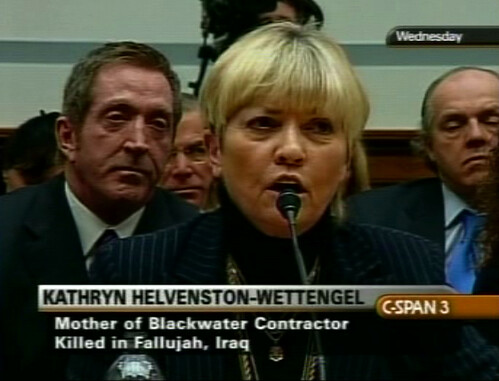
the pride and joy of the 4th District repeatedly admonishing Katy
Helvenston-Wettengel (who was only trying to answer Shays questions
within his endless and shameless rant).

Who
is Katy Helvenston-Wettengel you ask? Well, she just happens to be one
of the relatives of the four American contractors who providing private
security in Iraq that were ambushed by a mob and their bodies dragged through the streets of Fallujah.
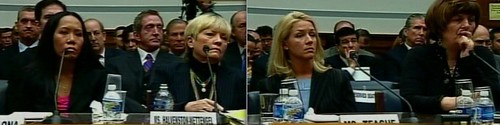
Helvenston-Wettengel, and three other relatives of the victims,
testified before the House Committee on Oversight and Government Reform
about the outrageous conditions the contractors were forced to deal
with while in Iraq (i.e., lack of body armour, lack of amour ed cars,
no maps, etc).

After
these individuals fought back tears testifying about the recounting how
the contractors, were sent out into the meat grinder called Iraq
without the protective equipment they were promised, the Republicans
wasted no time and doing what they do best…attack the messenger.
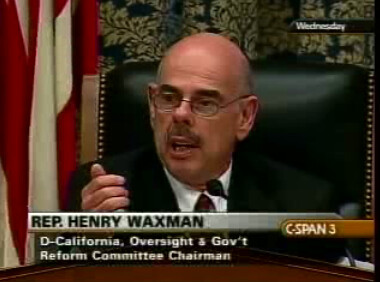
Shays grilling and belittling of Helvenston-Wettengel was so offensive
that Rep. Henry Waxman apparently had enough of the 4th District
Congressman and pulled the plug on him.

Watch and puke.

ConnecticutBLOG

Joe Lieberman:Horse's Ass

Stories

Joe Lieberman: A Horse’s Ass

Doug Mills/The New York Times

Senator Joseph I. Lieberman, center, an independent, with two
Republican colleagues Wednesday: John McCain, left, and Lindsey Graham.

By KATE ZERNIKE

Published: February 8, 2007

WASHINGTON, Feb. 6 — It came as little surprise that when Senate Republicans
blocked debate Monday on a resolution that would have opposed President
Bush’s plan to increase troop levels in Iraq, Senator Joseph I. Lieberman, erstwhile Democrat, sided with them.

Skip to next paragraph

But Mr. Lieberman also went
further, accusing Democrats of giving strength to the enemy and
abandoning the troops, and arguing that an alternative resolution that
he and many Republicans backed was “a statement of support to our
troops.”

That was too much even for one Republican member, Senator John W. Warner of Virginia, a sponsor of the bipartisan resolution against the president’s policy.

“I
forcefully argue that ours is in support of the troops,” Mr.
Warner said tersely. “And there is no suggestion that one is less
patriotic than the other.”

Defeated last year in the
Democratic senatorial primary in Connecticut but then elected as an
independent to a fourth term, Mr. Lieberman has kept a promise to
caucus with the Democrats, giving them a majority of only 51 to 49 and
earning for him a designation as “the most influential man in the
Senate.”

But on Iraq, the issue that made the last year the
most difficult of his political life, he has moved farther and farther
from the party, winding up to the right of many Republicans who now
embrace what six months ago was almost solely a Democratic position on
the war.

Mr. Lieberman’s enthusiasm for the troop
increase has become a talking point for Republicans trying to shore up
support for the president’s plan. It infuriates the bloggers who
first tried to defeat him. Some of his best friends on either side of
the aisle take issue with him publicly. But given his importance as the
lawmaker who ensures Democratic control of the Senate, members of the
majority say there is little they can do.

Joe Lieberman, independent, sees himself as Joe Lieberman unchained.

“I feel liberated, free somehow,” he said during an interview in his office.

“As
I look back,” he said, “I have always tried to do what I
thought was right, regardless of where a majority of members of my
party are. But there’s always pressure on you. I just feel free
of that pressure. And I think my Democratic colleagues know that
I’m not going to do — on this, of all questions which I
think is so important to our country’s future, to our success in
the war on terrorism — I’m not going to do anything here
just to be a good member of the team.”

His forays across
the aisle have begun to extend past the Iraq debate. When he was asked
on Fox News recently which Democrat he would support in 2008, Mr.
Lieberman, the party’s vice-presidential nominee in 2000, offered
instead that he might vote for a Republican.

“I would not have said that three years ago,” Mr. Lieberman said. “No chance.”

Even
Democrats who have come to expect his siding with the president on the
war thought this was going a bit far. “Did you see that?”
one Democratic senator asked, incredulous. But he, like others,
criticized only privately. “The bottom line,” the senator
said, “is we need him.”

To those who supported Ned Lamont, the victor over Mr. Lieberman in the Democratic primary, this is an “I told you so” moment.

“He
was re-elected because he fooled enough people into believing he really
was against the war and not for an escalation, but I think this is his
true colors,” said David Sirota, a Lamont consultant who recalled
that during the campaign, Mr. Lieberman said he wanted to bring the
troops home “as fast as anyone.”

“It’s
everything Ned Lamont was saying: that you can’t listen to this
guy’s words, you have to watch his actions,” Mr. Sirota
said. “I think it shows a disdain for the public. It’s like
the public to him is just a nuisance, an obstacle for him doing what he
wants to do.”

Mr. Lieberman’s talk of supporting a
Republican in 2008, Mr. Sirota said, suggests that he is still toying
with the idea of switching to the Senate Republican Caucus.

Mr.
Lieberman could always prove to be an unpredictable ally for the
Republicans, too, as when he suggested last Thursday a “war on
terrorism tax” to make Americans understand the sacrifice that he
said the fight demanded.

Still, Republicans have missed few
opportunities to embrace his support. Mr. Bush said in a recent speech
that he was acting on “the good advice of Senator Joe
Lieberman” in proposing a bipartisan Congressional working group
on Iraq. (Democrats scoffed that the president had already had plenty
of ways to consult with Congress and had never shown much interest in
doing so.) The president and Vice President Dick Cheney also quote Mr. Lieberman in arguing the White House’s view on the troop increase, and the Senate Republican leader, Mitch McConnell of Kentucky, repeatedly notes how happy the minority is to have Mr. Lieberman’s backing.

“I wish I were being quoted by some Democrats, too,” Mr. Lieberman said.

But he does not seem very worried about appearing cozy with the other side. When one Republican, Senator John McCain of Arizona, squabbled with Senator Carl Levin
of Michigan, the chairman of the Armed Services Committee, at a hearing
about the troop increase, Mr. Levin abruptly walked out. Mr. Lieberman
walked over and chuckled with Mr. McCain, patting him on the back.

At
hearings on Iraq, Mr. Lieberman frequently leads witnesses to testimony
in support of the president. Isn’t it true, he asked Gen. George
W. Casey Jr., the departing commander of American forces there, that
over all, the policy in Iraq has been a success? Doesn’t Mr.
Bush’s strategy offer “a higher probability of working than
any other plan?”

Such arguments have prompted friends like Senator Susan Collins,
a Maine Republican who opposes the troop increase, to challenge him
publicly. Still, Ms. Collins said in an interview, “the fact that
he takes a position that’s contrary to the vast majority of the
members of his caucus I think speaks to his strong principles.”

“I
enjoy seeing him in this position of power, given the very difficult
political year he’s gone through,” she said. “I think
he’s enjoying this.”

The midterm election, Mr.
Lieberman argues, was a call to bipartisanship, and his mandate is to
get Democrats to look beyond party lines.

Yes, he concedes, the
election was also a call for a change in Iraq; he just believes the
president’s plan offers the best chance of that.

“I’m
a feisty, happy warrior,” he said. “And I’m going to
continue to fight for what I think is right for the security of our
country.”

New York Times

The Trouble with Propaganda — Part 11,243

Stories

“Once Upon a Time”
with your host Arthur Silber:

The Trouble with Propaganda — Part 11,243

The trouble is that it works:

Many
adults in the United States believe their country will enter a conflict
against Iran, according to a poll by Rasmussen Reports. 57 per cent of
respondents think it is very or somewhat likely that the U.S. will be
at war with Iran within the next year.

Note these other numbers from the poll:

How likely is it that Iran will soon develop nuclear weapons?

Very likely 42%

Somewhat likely 33%

Not very likely 11%

Not at all likely 2%

“Soon.” Note that the word is very helpfully left undefined. In addition, no evidence whatsoever
has been presented, publicly or privately, that Iran is in fact
pursuing the development of nuclear weapons. To the contrary, all
knowledgeable experts agree that any “Iranian threat” continues to recede farther into the future. Well, never mind. We have a wider war to get started. No time to lose.

So more than half of Americans believe we may be at war with Iran within the next year, and three-quarters of them think Iran will “soon” develop nuclear weapons. Yet public life goes on in its uninterrupted stupor. As I recently wrote:

[T]he
war chants rise once again, this time directed at Iran. If we should
attack Iran in the near future, much of the world will treat us as we
will fully deserve: as a barbarian, pariah nation, which no one can trust and which will join the most monstrous countries in history.

Is
there a massive protest from Americans about the route we may follow?
No. Are the Democrats who now control Congress at least trying to avert this catastrophe,
which may be the last? No — because they fully share the belief in
American “exceptionalism” and in our “right” to worldwide hegemony. Is
there even one prominent voice in America regularly explaining the horror of what we have already done, and what we may still do? No.

If this remains unchanged, and if we launch another war of blatant, unforgivable aggression,
we will deserve everything we get — and more. Historians, if there are
any in the years to come, will see what we were and what we did, and
they will judge us accordingly.

It’s as if the last five years never even happened.

Remarkable. Horrifying. Stupefying. Utterly unbelievable.

And unforgivable.

See: Becoming a Barbarian, Pariah Nation: What Are You Waiting For?

Morality, Humanity and Civilization: “Nothing remains…but memories”

The Missing Moral Center: Murdering the Innocent

Time Has Run Out — and the Choice Is Yours

"…when an improvised explosive device detonated…"

Stories

Alan Smithee

01/01/07 – 01/31/07

February 5, 2007

…from an Improvised Explosive Device…

…when an improvised explosive device…

…when an improvised explosive device…

…when an improvised explosive device detonated…

…when an improvised explosive device detonated…

…when an improvised explosive device detonated…

…when an improvised explosive device detonated…

…came in contact with enemy forces using small arms fire…

…when an improvised explosive device detonated…

…as a result of a road traffic accident…

…came in contact with enemy forces using small arms fire…

…a vehicle-borne improvised explosive device…

…a vehicle-borne improvised explosive device…

…a vehicle-borne improvised explosive device…

…vehicle rolled over…

…following a road traffic accident…

…a non-hostile cause…

…when an improvised explosive device detonated…

…in contact with enemy forces using small arms fire…

…sustained during route security operations…

…enemy forces using small arms fire…

…when an improvised explosive device detonated…

…enemy forces using small arms fire…

…when shot by small arms fire…

…when an improvised explosive device detonated…

…when an improvised explosive device detonated…

…improvised explosive device detonated…

…when an improvised explosive device detonated…

…when an improvised explosive device detonated…

…when an improvised explosive device detonated…

…when an improvised explosive device…

…came in contact with enemy forces using grenades…

…in a non-combat related incident…

…when an improvised explosive device……

[More]

Blog

Arianna Huffington's Six-Point Reaction to Joe Klein's Seven-Point Response

Stories

Arianna HuffingtonArianna Huffington

02.06.2007

READ MORE: Arianna Huffington, Iraq, Hollywood

I agree with Joe Klein’s assessment that there are “far more important
things going on in the world” than a clarification of his position on
the war in Iraq. But I can’t resist reacting to his seven-point response to my post on him:

1. Klein kicks off his seven-point defense (did I say seven-point?)
of his pre-invasion stance on the war by saying, “Arianna Huffington,
the doyenne of the Hollywood left, has taken time from her busy
schedule to attack me for something I said on Meet the Press three years ago.” Actually, Joe, I was taking you to task for something you wrote on your Time blog two days ago,
namely that you opposed the Iraq war from the beginning. I wasn’t
trolling around in Lexis Nexis looking for “stupid” remarks prominent
journalists made in support of the war. There aren’t enough hours in
the day for that (hell, there aren’t enough hours in the decade for
that). I only did my quick Internet search after reading your attempt
to rewrite history. Again.

2. Speaking of “the doyenne of the Hollywood left” (one of six times
in his post Klein spits out a reference to “the left”), isn’t it time
for him to stop looking at the world through his musty right/left
glasses, where triangulation between the two is seen as “delicious” and
the height of political sophistication?

3. As a student of the dark art of sophistry, I particularly loved
this Kleinian gem: “I had my doubts about my skepticism about the
war…” I know English is my second language, but let me get this
straight: you weren’t actually, as you have claimed,
“opposed to the war” since 2002 — you were “skeptical” of the war?
And, what’s more, you had “doubts” about your “skepticism.” Wow, talk
about taking a bold stand. Could you possibly cover all your bases any
more thoroughly (and inelegantly)?

4. While I’m more than willing to accept your claim
that, in October 2002, in the privacy of his Senate office, you told
John Kerry that you wouldn’t vote to give the president the authority
to invade Iraq, this only makes your unwillingness to say the same
thing publicly all the more cowardly, and your attempt to, in
hindsight, make it seem like you did, all the more pathetic. You had
the platform, you just lacked the spine.

5. This isn’t about what you dismiss as “a moment of stupid weakness
on the brink of war.” This is about a willful, ongoing attempt to claim
credit for insight you didn’t have and courage you didn’t exhibit.

6. Give it up.

Page 1 of 5 >
»

Editors at newspapers supervise journalists and improve their work

Stories

Newspapers

Editors at newspapers supervise journalists and improve their work. Newspaper editing encompasses a variety of titles and functions. These include:

  • Copy editors
  • Department editors
  • Managing editors and assistant or deputy managing editors (the managing editor is often second in line after the top editor)
  • News editors, who oversee the news desks
  • Photo or picture editors
  • Section editors and their assistants, such as for business, features, and sports
  • Editorial Page Editor who oversees the coverage on the editorial page. This includes chairing the Editorial Board and assigning editorial writing responsibilities. The editorial page editor may also oversee the op-ed page or those duties are assigned to a separate op-ed editor.
  • Top editors, who may be called editor in chief or executive editor
  • Readers’ editors, sometimes known as the ombudsman, who arbitrate complaints
  • Wire editors, who choose and edit articles from various international wire services, and are usually part of the copy desk
  • Administrative editors (who actually don’t edit but perform duties such as recruiting and directing training)

The term city editor is used differently in North America,
where it refers to the editor responsible for the news coverage of a
newspaper’s local circulation area (also sometimes called metro editor), and in the United Kingdom, where (normally with a capital C) it refers to the editor responsible for coverage of business in the City of London and, by extension, coverage of business and finance in general.

Editing – Wikipedia

JOE KLEIN IS, ER, UNHELPFUL

Stories

For what it’s worth, Joe Klein’s son Chris is a great guy. -ed

 “Listening to the leftists, though, it’s easy to assume that they are rooting for an American failure.”

Ah yes…where have I heard that before? Let’s see…Hannity,
O’Reilly, Limpbaugh, etc? Outside of a few “I’m outraged Bush…” and
“I opposed the Iraq war…” you just parroted a bunch right-wing
extremist talking points about liberals. Saying I, as a proud liberal
or leftist even, am “rooting for an American” failure is an incredible
insult…much more than any juvenile name calling that takes place in
blog comments.

How’s this: You can support the troops, and also want them alive and
out of harm’s way. See how that works? It’s really quite a simple
concept if you think about it. We want our military strong so it can do
what it is supposed to do – defend our Republic. Most liberals I know
don’t feel the US Military should be invading countries that pose no
threat to us, and then stay there for 4, 6, 10+ years to nation and
base-build. God help us if an actual threat presents itself to America
while our troops are giving Iraq “peace and stability” through the
barrels of their guns.

So, does it ever cross my mind that General (du jour) Patraeus might
calm Baghdad? Of course that would be fantastic, and our troops can
come home and the Chimperor-in-Chief can eat pretzels all the way back
to Kennebunkport. Problem is…that’s not the point.

The point is that our troops are being killed everyday there. Do you
and Lieberman really think the McCain Doctrine can work? 140,000 troops
haven’t been even close to enough to bring stability to Iraq. Y’all
think 20,000-40,000 more will do it, and you’re willing to wager the
lives of potentially thousands more of our brave soldiers? Therein lies
the difference in opinion between “leftists” like me, and you Mr. Klein.

Notice how I haven’t questioned your patriotism. Please stop questioning mine.