Media Control
by Noam Chomsky
Seven Stories Press, 2002EARLY HISTORY OF PROPAGANDA
p11
… the first modern government propaganda operation … was under the Woodrow Wilson Administration. Woodrow Wilson was elected President in 1916 on the platform “Peace Without Victory.” That was right in the middle of the World War I. The population was extremely pacifistic and saw no reason to become involved in a European war. The Wilson administration was actually committed to war and had to do something about it. They established a government propaganda commission, called the Creel Commission, which succeeded, within six months, in turning a pacifist population into a hysterical, war-mongering population which wanted to destroy everything German, tear the Germans limb from limb, go to war and save the world. That was a major achievement, and it led to a further achievement. Right at that time and after the war the same techniques were used to whip up a hysterical Red Scare, as it was called, which succeeded pretty much in destroying unions and eliminating such dangerous problems as freedom of the press and freedom of political thought. There was very strong support from the media, from the business establishment, which in fact organized, pushed much of this work, and it was, in general, a great success.
Among those who participated actively and enthusiastically in Wilson’s war were the progressive intellectuals, people of the John Dewey circle, who took great pride, as you can see from their own writings at the time, in having shown that what they called the “more intelligent members of the community,” namely, themselves, were able to drive a reluctant population into a war by terrifying them and eliciting jingoist fanaticism. The means that were used were extensive. For example, there was a good deal of fabrication of atrocities by the Huns, Belgian babies with their arms torn off, all sorts of awful things that you still read in history books. Much of it was invented by the British propaganda ministry, whose own commitment at the time, as they put it in their secret deliberations, was “to direct the thought of most of the world.” But more crucially they wanted to control the thought of the more intelligent members of the community in the United States, who would then disseminate the propaganda that they were concocting and convert the pacifistic country to wartime hysteria. That worked. It worked very well. And it taught a lesson: State propaganda, when supported by the educated classes and when no deviation is permitted from it, can have a big effect. It was a lesson learned by Hitler and many others, and it has been pursued to this day.
p14
… liberal democratic theorists and leading media figures, like, for example, Walter Lippmann, who was the dean of American journalists, a major foreign and domestic policy critic and also a major theorist of liberal democracy. If you take a look at his collected essays, you’ll see that they’re subtitled something like “A Progressive Theory of Liberal Democratic Thought. ” Lippmann was involved in these propaganda commissions and recognized their achievements. He argued that what he called a “revolution in the art of democracy,” could be used to “manufacture consent, ” that is, to bring about agreement on the part of the public for things that they didn’t want by the new techniques of propaganda. He also thought that this was a good idea, in fact, necessary. It was necessary because, as he put it, “the common interests elude public opinion entirely” and can only be understood and managed by a “specialized class “of “responsible men” who are smart enough to figure things out. This theory asserts that only a small elite, the intellectual community that the Deweyites were talking about, can understand the common interests, what all of us care about, and that these things “elude the general public.” This is a view that goes back hundreds of years. It’s also a typical Leninist view. In fact, it has very close resemblance to the Leninist conception that a vanguard of revolutionary intellectuals take state power, using popular revolutions as the force that brings them to state power, and then drive the stupid masses toward a future that they’re too dumb and incompetent to envision for themselves. The liberal democratic theory and Marxism-Leninism are very close in their common ideological assumptions. I think that’s one reason why people have found it so easy over the years to drift from one position to another without any particular sense of change. It’s just a matter of assessing where power is. Maybe there will be a popular revolution, and that will put us into state power; or maybe there won’t be, in which case we’ll just work for the people with real power: the business community. But we’ll do the same thing. We’ll drive the stupid masses toward a world that they’re too dumb to understand for themselves.
Lippmann backed this up by a pretty elaborated theory of progressive democracy. He argued that in a properly functioning democracy there are classes of citizens. There is first of all the class of citizens who have to take some active role in running general affairs. That’s the specialized class. They are the people who analyze, execute, make decisions, and run things in the political, economic, and ideological systems. That’s a small percentage of the population. Naturally, anyone who puts these ideas forth is always part of that small group, and they’re talking about what to do about those others. Those others, who are out of the small group, the big majority of the population, they are what Lippmann called “the bewildered herd.” We have to protect ourselves from “the trampling and roar of a bewildered herd”. Now there are two “functions” in a democracy: The specialized class, the responsible men, carry out the executive function, which means they do the thinking and planning and understand the common interests. Then, there is the bewildered herd, and they have a function in democracy too. Their function in a democracy, he said, is to be “spectators,” not participants in action. But they have more of a function r than that, because it’s a democracy. Occasionally they are allowed to lend their weight to one or another member of the specialized class. In other words, they’re allowed to say, “We want you to be our leader” or “We want you to be our leader.” That’s because it’s a democracy and not a totalitarian state. That’s called an election. But once they’ve lent their weight to one or another member of the specialized class they’re supposed to sink back and become spectators of action, but not participants. That’s in a properly functioning democracy.
And there’s a logic behind it. There’s even a kind of compelling moral principle behind it. The compelling moral principle is that the mass of the public are just too stupid to be able to understand things. If they try to participate in managing their own affairs, they’re just going to cause trouble. Therefore, it would be immoral and improper to permit them to do this. We have to tame the bewildered herd, not allow the bewildered herd to rage and trample and destroy things. It’s pretty much the same logic that says that it would be improper to let a three-year-old run across the street. You don’t give a three-year-old that kind of freedom because the three-year-old doesn’t know how to handle that freedom. Correspondingly, you don’t allow the bewildered herd to become participants in action. They’ll just cause trouble.
So we need something to tame the bewildered herd, and that something is this new revolution in the art of democracy: the manufacture of consent. The media, the schools, and popular culture have to be divided. For the political class and the decision makers they have to provide them some tolerable sense of reality, although they also have to instill the proper beliefs. Just remember, there is an unstated premise here. The unstated premise-and even the responsible men have to disguise this from themselves-has to do with the question of how they get into the position where they have the authority to make decisions. The way they do that, of course, is by serving people with real power. The people with real power are the ones who own the society, which is a pretty narrow group. If the specialized class can come along and say, I can serve your interests, then they’ll be part of the executive group. You’ve got to keep that quiet. That means they have to have instilled in them the beliefs and doctrines that will serve the interests of private power. Unless they can master that skill, they’re not part of the specialized class. So we have one kind of educational system directed to the responsible men, the specialized class. They have to be deeply indoctrinated in the values and interests of private power and the state-corporate nexus that represents it. If they can achieve that, then they can be part of the specialized class. The rest of the bewildered herd basically just have to be distracted. Turn their attention to something else. Keep them out of trouble. Make sure that they remain at most spectators of action, occasionally lending their weight to one or another of the real leaders, who they may select among.
This point of view has been developed by lots of other people. In fact, it’s pretty conventional. For example, the leading theologian and foreign policy critic Reinhold Niebuhr, sometimes called “the theologian of the establishment,” the guru of George Kennan and the Kennedy intellectuals, put it that rationality is a very narrowly restricted skill. Only a small number of people have it. Most people are guided by just emotion and impulse. Those of us who have rationality have to create “necessary illusions” and emotionally potent “oversimplifications” to keep the naive simpletons more or less on course. This became a substantial part of contemporary political science. In the 1920s and early 1930s, Harold Lasswell, the founder of the modern field of communications and one of the leading American political scientists, explained that we should not succumb to “democratic dogmatisms about men being the best judges of their own interests.” Because they’re not. We’re the best judges of the public interests. Therefore, just out of ordinary morality, we have to make sure that they don’t have an opportunity to act on the basis of their misjudgments. In what is nowadays called a totalitarian state, or a military state, it’s easy. You just hold a bludgeon over their heads, and if they get out of line you smash them over the head. But as society has become more free and democratic, you lose that capacity. Therefore you have to turn to the techniques of propaganda. The logic is clear. Propaganda is to a democracy what the bludgeon is to a totalitarian state. That’s wise and good because, again, the common interests elude the bewildered herd. They can’t figure them out.
Author: JT
The Top Ten Stories You Missed in 2006:
StoriesForeign Policy: The Top Ten Stories You Missed in 2006:
United States Funds the Taliban

 The Taliban’s resurgence brought the ongoing war in Afghanistan back onto the front pages in 2006. From record opium production to suicide bombings, the outlook has only grown dimmer in the past 12 months. What you probably didn’t hear is that some of the money the United States is spending to combat theresurgence of the Taliban is winding up in the hands of . . . the Taliban.
As recently as November, the Institute for War and Peace Reporting revealed that villagers in Afghanistan’s war-torn south were handing over U.S. cash meant for reconstruction projects to Taliban fighters, who then use the money to purchase weapons, cell phones, and explosives. As part of an effort to stimulate economic development in the country, the United States had committed $43.5 million for reconstruction as of September. One Canadian officer charged with helping to distribute cash said that “millions” has already gone missing in the five years since coalition troops arrived. Why? According to the report, local mullahs have urged residents to fight the foreign occupation and hand over the money in the hopes of gaining back the security they’ve lost. Others say it’s simple extortion from Taliban thugs. Either way, the United States may inadvertently be aiding the enemy in a fight that will almost certainly become more costly in the year ahead.
Meanwhile back in Kabul……
StoriesNew Taliban rules target Afghan teachers – Yahoo! News:
KABUL, Afghanistan – The Taliban gunmen who murdered two teachers in eastern
Afghanistan early Saturday were only following their rules: Teachers receive a warning, then a beating, and if they continue to teach must be killed.The new list of 30 rules, decided on during a high Taliban meeting in September or October and since circulated over the Internet, span from the organizational — no jihad equipment may be used for personal means — to the health conscious — militants are not supposed to smoke.
They also contain a grave warning for aid workers and educators.
Rule No. 24 forbids anyone to work as a teacher “under the current puppet regime, because this strengthens the system of the infidels.” One rule later, No. 25, says teachers who ignore Taliban warnings will be killed.
We are without salvation, understanding or even the intelligence God provided us to begin with…Laura told me so
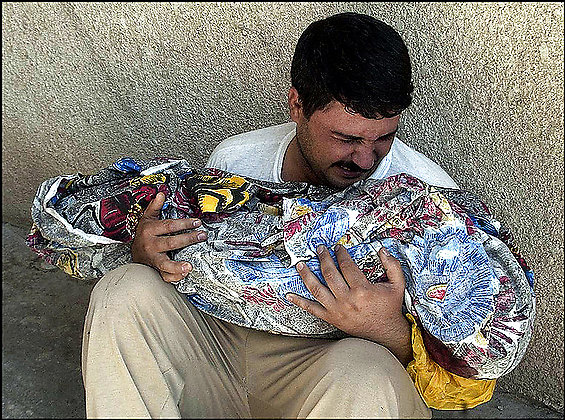
StoriesAnimalsWhile the boy wonder was busy “listening” to people in the know about how best to continue fucking up the lives of millions in Iraq, he had the presense of mind to address a dip in the polls by dispatching Laura to inform you and I, that the piles of headless bodies (Sunni), those full of holes made by murderers with power tools (Shia) and the multitude of mothers and children barely managing to exist from day to day as the hell that surrounds them grows more gruesome by the day, has little to do with the public’s lack of confidence in her husband, but rather it is the media that continues to get the story of this war wrong day after day, callously shirking their responsibility to report on all the “good things” happening, out of laziness I suppose, or perhaps it is true that the thousands of people who have risked their lives to bring us the story had it in for Laura’s man all along…just like she and the 25% of Americans, who seemingly don’t fear for the safety of anything not attached to an umbilical cord, had suspected all along.
That’s right, it’s YOUR FAULT for buying into this anti-Bush rhetoric, this news, cooked up in the heads of traitors who understand psychology and unleased throughout the country for the purpose of turning your stupid brain into an organ of evil, much like the inside of a smoker’s lung, black and sticky without the ability to function like it once used to, leading to the necessary convulsions for survival with hatred and death expelled outward in the form of idiotic lies about our president and his devine path we were at one point lucky enough to walk alongside him on towards the glory that was just over the next hill if we’d had the strength or the character to not abandon faith and christ once things got tough. And so now we are without salvation, understanding or even the intelligence God provided us to begin with…Laura told me so.
She’s not the only one looking for an appology either, as there are plenty of stupid white men whose desire was a war, which they got, only not the outcome they expected along with it because of how stupid everyone involved was about carrying it out, and a fellow like Richard Pearle wants us to know that he is owed an appology from the soldiers and their bosses and their bosses’ bosses for draging his brilliance through the mud, like a band of arrogant vandals they persecuted his vision and striped away all the important parts, leaving him without an oil tanker bearing his moniker, no high speaking fees, just the burden of stupid people and their failures unjustly attached to his name.
Forget about the fatherless, homeless children who are afraid and the smell of burning garbage and the roving bands of murders killing at will day after day…it’s about these people we see on television and read about in Vanity Fair, and what this war has done to them, how it has tarnished their image and spoiled their legacies. These poor people and all the bad things that have been done to them. Boy wonder hasn’t been happy in so long now…we should all be ashamed of ourselves!
Waxman on warpath over Blackwater payments
StoriesWaxman on warpath over Blackwater payments:

Joseph Neff and Jay Price, Staff Writers
The Democrat slated to be the U.S. House’s lead watchdog next year demanded answers Thursday about why Blackwater USA was paid so much for security work in Iraq — and why, in fact, the North Carolina company was paid at all.
Taxpayers paid exorbitant prices for Blackwater’s services, U.S. Rep. Henry Waxman wrote in a letter to outgoing Defense Secretary Donald Rumsfeld. Waxman said it wasn’t clear precisely how much taxpayers overpaid because the Army hasn’t provided answers to questions first raised two years ago,
The California congressman said that Blackwater’s services were not just pricey, but prohibited, because the Army never authorized Blackwater or any other Halliburton subcontractors to guard convoys or carry weapons. Houston-based Halliburton has been paid at least $16 billion to provide food, lodging and other support for troops in Iraq, and $2.4 billion to work on Iraqi oil infrastructure.
Waxman demanded “whether and how the Army intends to recover taxpayer funds paid to Halliburton and Blackwater for services prohibited under [Halliburton’s] contract.”
The high cost of private military contractors and the use of multiple layers of subcontractors surfaced after four Blackwater men were massacred in Fallujah in March 2004. Wesley Batalona, Scott Helvenston, Michael Teague and Jerry Zovko were guarding a convoy for ESS, a food supplier to the military, when they were ambushed. A mob dragged their charred corpses through the streets and hung the remains of two from a bridge over the Euphrates River. The grotesque images were broadcast around the world and triggered a deadlier phase of the war.
Waxman, the next chairman of the House Government Reform Committee, has tried to get answers about the Blackwater and Halliburton contracts for two years, since The News & Observer detailed how multiple layers of contracts inflated war costs.
At the lowest level, Blackwater security guards were paid $600 a day. Blackwater added a 36 percent markup, plus overhead costs, and sent the bill to a Kuwaiti company that ordinarily runs hotels, according to the contract.
Tacked on costs, profit
That company, Regency Hotel, tacked on costs and profit and sent an invoice to ESS. The food company added its costs and profit and sent its bill to Kellogg Brown & Root, a division of Halliburton, which added overhead and profit and presented the final bill to the Pentagon.
In his letter Thursday, Waxman said he had not received accurate answers from the Army and Blackwater when their officials testified under oath before his committee.
Tina Ballard, an undersecretary of the Army, testified in September that the Army had never authorized Halliburton or its subcontractors to carry weapons or guard convoys. Ballard testified that Blackwater provided no services for Halliburton or its subcontractors.
Waxman said ESS had sent him a memo saying the food company had hired Blackwater to provide security services under the Halliburton contract.
“If the ESS memo is accurate, it appears that Halliburton entered into a subcontracting arrangement that is expressly prohibited by the contract itself,” Waxman wrote. “After more than two years, we still do not know how much ESS and Halliburton charged for these security services.”
At a hearing in June, Blackwater vice president Chris Taylor testified that Blackwater’s 36 percent markup included all the company’s costs. Rep. Christopher Shays, a Connecticut Republican, interrupted, reminded Taylor he was under oath and ordered Blackwater to provide the documents to back up his testimony. Blackwater has not provided any of the contracts and other documents requested by the committee.
In Thursday’s letter, Waxman said Taylor’s testimony was wrong: Blackwater’s contracts posted on The N&O’s Web site showed that Blackwater billed separately for insurance, room and board, travel, weapons, ammunition, vehicles and office space, as The N&O article reported.
A spokeswoman for Ballard did not immediately return a call Thursday. Joseph C. Schmitz, chief operating officer and general counsel for Blackwater’s parent company, The Prince Group, said he would have to defer comment until he could obtain and read the documents referred to in Waxman’s letter.
Kellogg Brown & Root, the Halliburton subsidiary, released a statement: “All information available to KBR confirms that Blackwater’s work for ESS was not in support of KBR and not under a KBR subcontract.”
Skype founders to launch broadband TV service
Stories
Skype founders to launch broadband TV service:
Skype founders to launch broadband TV service
The founders of Skype, the free internet phone service, have just announced their plan to launch a broadband television service early next year. Janus Friis and Niklas Zennstrom, the entrepreneurs who were also behind the Kazaa file-sharing service, are said to have invested part of the money they made from the sale of Skype to eBay last year in developing the new project, which is still code-named The Venice Project.In an interview with the Financial Times, Friis claimed, “At the time we launched Skype, broadband capacity was extremely ripe for communication. Now three years later it’s the same thing for video: you can do TV over the internet in a really good way. TV is a huge medium – that’s something we’d like to be part of.”At present, some 6000 users are said to be testing the service, which utilises IPTV technology, or Internet Protocol Television. While this term may still be unfamiliar to most users, it has attracted much attention from media and telecoms companies, as the use of IPTV on sites like YouTube and MySpace has proved successful.
In fact, 2006 has seen a mini-revolution in the online video and television experience since the world’s leading search engine, Google, bought YouTube for a staggering $1.65 bn earlier this year. It was announced last week that British Sky Broadcasting (BSkyB) would be teaming up with Google in the UK in order to provide their customer base with a range of products, including a user-generated video service. Furthermore, bigmouthmedia reported last week that four of the USA’s largest media companies were discussing the possibility of a joint venture to implement a video service as a rival to YouTube.
However, the broadband TV offered by the Skype team will be fundamentally different from the hugely popular YouTube service. While YouTube allows any of its users to upload videos onto the web, Skype’s TV service will offer professionally produced content, which will be uploaded by content owners and encrypted before being released. In fact, British television station Channel 4 is already reputed to be in talks to supply content for the project.
Friis further commented in the FT, “We’re also bringing something back from that old TV – of having a shared experience with your friends, something you can talk about, rally around and enjoy with others.”
The service is capable of displaying high quality and full-screen videos on a computer screen. Through the service, users must download software onto their PC or Mac, and can search through channels from a menu on the left hand side of their screen. Users will even be able to pause, rewind or fast-forward the video they are viewing, as well as being permitted to share video playlists with friends. What’s more, Skype users will be able to use their conference call facility to chat to others watching the same programme.
In the UK, it appears that The Venice Project’s main competitors will be the BBC’s planned catch-up TV service, and BT’s latest video-on-demand project. It remains to be seen, however, in which direction the entrance of Skype’s TV project will propel the online video and television experience. And as the stratospheric rise of YouTube proves, it will really lie with users to make or break this particular product – after all, Time didn’t name ‘you’ the person of the year for nothing.
The Woodward Scandal Should Not Blow Over
StoriesThe Woodward Scandal Should Not Blow Over:
by Norman Solomon
Bob Woodward probably hoped that the long holiday weekend would break the momentum of an uproar that suddenly confronted him midway through November. But three days after Thanksgiving, on NBC’s “Meet the Press,” a question about the famed Washington Post reporter provoked anything but the customary adulation.
“I think none of us can really understand Bob’s silence for two years about his own role in the case,” longtime Post journalist David Broder told viewers. “He’s explained it by saying he did not want to become involved and did not want to face a subpoena, but he left his editor, our editor, blind-sided for two years and he went out and talked disparagingly about the significance of the investigation without disclosing his role in it. Those are hard things to reconcile.”
An icon of the media establishment, Broder is accustomed to making excuses for deceptive machinations by the White House and other centers of power in Washington. His televised rebuke of Woodward on Nov. 27 does not augur well for current efforts to salvage Woodward’s reputation as a trustworthy journalist.
The Woodward saga is a story of a reporter who, as half of the Post duo that broke open Watergate, challenged powerful insiders — and then, as years went by, became one of them. He used confidential sources to expose wrongdoing at the top levels of the U.S. government — and then, gradually, became cozy with high-placed sources who effectively used him.
Now, Woodward is scrambling to explain why, for more than two years, he didn’t disclose that a government official told him the wife of Bush war-policy critic Joe Wilson was undercover CIA employee Valerie Plame. Even after the Plame leaks turned into a big scandal rocking the Bush administration, Woodward failed to tell any Post editor about his own involvement — though he may have been the first journalist to receive one of those leaks. And, in media appearances, he disparaged the investigation by Special Counsel Patrick Fitzgerald without so much as hinting at his own stake in disparaging it.
Interviewed several months ago on NPR’s “Fresh Air” program, Woodward portrayed the investigation as little more than a tempest in a teapot. “The issues don’t really involve national security or people’s lives or jeopardy,” he commented, adding that “I think in the end, we will find there’s not really corruption here.”
Woodward also told the national radio audience: “The woman who was the CIA undercover operative was working in CIA headquarters. There was no national security threat, there was no jeopardy to her life, there was no nothing. When I think all of the facts come out in this case, it’s going to be laughable because the consequences are not that great.”
But there was never anything laughable about Fitzgerald’s investigation into the Plame scandal. And Woodward had learned to take it a lot more seriously by the time he appeared as the only guest on CNN’s hour-long “Larry King Live” the night of Nov. 21.
After days of bad publicity, Woodward was in a spinning mood. He seemed eager to run out the clock as he filled time with digressions and minor details. When in a corner, he often brought up Watergate, as though his days of indisputable glory could draw light away from his recent indefensible behavior.
Larry King is rarely a vigorous interviewer; his customary mode of questioning is much closer to Oprah than “60 Minutes.” But King, who has featured Woodward on his show many times over the years, seemed agitated during the latest interview. And that’s understandable. After all, Woodward had previously gone on the show and dismissed the importance of the Plamegate scandal while withholding relevant firsthand information.
Woodward has written best-selling books heavily reliant on interviews granted by top administration officials. During the Nov. 21 interview, the unusually engaged King zeroed in on a dynamic that often pollutes the work of big-name journalists in Washington: They get and retain access to the powerful because they don’t go out of bounds.
Noting that Woodward was able to avail himself of lengthy interviews with President Bush for a recent book, King said: “He’s given you three hours. He’ll help you with the next book. Doesn’t that give him an edge with you?” And, King pointed out, the benefits of such arrangements run in both directions, for author and president alike: “He’s not going to come out looking terrible because you want him for your next book and you’d like to have that in.”
Bob Woodward wasn’t grilled by Larry King. But the questions were vigorous enough to make America’s most renowned reporter seem evasive and self-absorbed.
During the long interview, Woodward gave various explanations for his careful silence that misled Post editors and the public. He did not want to get dragged into the Plame-leak investigation with a subpoena, and anyway he was preoccupied with gathering information that would be revealed later in a book.
Overall, Bob Woodward’s priorities seemed to center on Bob Woodward. Yet near the end of the interview, he offered this platitude with a straight face and without a hint of self-reproach: “I think the biggest mistake you can make in this sort of situation as a reporter is to worry about yourself.”
Norman Solomon is the author of “War Made Easy: How Presidents and Pundits Keep Spinning Us to Death.” For information and excerpts from the book, go to: http://www.WarMadeEasy.com.
Reuters Photo Slide Show:
StoriesGovernment Of the Corrupt, By the Corrupt and For the Corrupt:
StoriesWar Criminals List: Part Two
StoriesDan Burton, Bob Dornan, John Cornyn, Tom Delay, Jean Schmidt, Rush Limbaugh, David Limbaugh, Bill O’Reilly, Michael Reagan, Ann Coulter, Laura Ingraham, Michelle Malkin, John Gibson, Neil Cavuto, Sean Hannity, Oliver North, Bob Novak, Cal Thomas, Glenn Beck, Mancow, John Fund, Peggy Noonan, Larry Kudlow, Joe Scarborough, Tucker Carlson, Kate O’Beirne, Rich Lowry, Byron York, Chris Wallace, Fred Barnes, Bill Kristol, Charles Krauthammer…and on and on.

