The Central Intelligence Agency must turn over records regarding detainee interrogation tapes the agency destroyed in an alleged effort to protect the identity of its officers.
A federal judge rejected the CIA’s attempt to withhold records relating to the agency’s destruction of 92 videotapes that depicted interrogation of CIA prisoners in a ruling Friday afternoon. The tapes were said to have shown some detainees’ torture.
The American Civil Liberties Union is suing for the documents’ release under the Freedom of Information Act, and aims to have the agency held in contempt of court for refusing to provide them.
The ACLU has been remarkably successful at obtaining previously secret government documents. President Barack Obama was recently forced to release Bush administration memos which outlined torture techniques to be employed on detainees.
ACLU staff attorney Amrit Singh lauded the court’s decision.
“We welcome the court’s recognition that the ACLU’s contempt motion against the CIA must be promptly resolved,” Singh said in a release. “Recent disclosures about the CIA’s torture methods further confirm that there is no basis for the agency to continue to withhold records relating to the content of the destroyed videotapes or documents that shed light upon who authorized their destruction and why.
“The public has a right to this information and the CIA must be held accountable for its flagrant disregard for the rule of law,” Singh added.
In a release, the civil liberties group noted “the CIA had previously said it would only turn over documents from August 2002 that relate to the content of the videotapes. But U.S. District Court Judge Alvin K. Hellerstein of the Southern District of New York today ordered the CIA to produce records from April through December 2002 that relate to the content of the tapes, as well as documents from April 2002 through June 2003 that related to the destruction of the tapes and information about the persons and reasons behind their destruction.”
“Judge Hellerstein also ordered the government to reconsider the extent of redactions it intends to make to the documents in light of last week’s release, also as part of the ACLU’s FOIA litigation, of four secret memos used by the Bush administration to justify torture,” the release adds. “In addition, the court ordered the government to explain whether contempt proceedings would interfere with a federal criminal investigation into the destruction of the tapes led by prosecutor John Durham.”
George W. Bush
The Curious Case of Scooter Libby
Dick Cheney, Douglas Feith, Eliot Abrams, George W. Bush, Iraq, Joseph Wilson, Judith Miller, Matt Cooper, Meet The Press, Muhammed Atta, Neocons, New York Times, Prague Meeting, Robert Luskin, Scooter Libby, Think-Tanks, Tim Russert, Valerie Plame, Viveca Novak, Yellowcake UraniumObama Takes Bush Secrecy on Wiretaps and Doubles Down
Alberto Gonzales, Barack Obama, Dick Cheney, George W. Bush, Illegal Wiretapping, Justice Department, NSAGovernment opts for secrecy in wiretap suit
Tuesday, April 7, 2009
(04-06) 15:26 PDT SAN FRANCISCO — The Obama administration is again invoking government secrecy in defending the Bush administration’s wiretapping program, this time against a lawsuit by AT&T customers who claim federal agents illegally intercepted their phone calls and gained access to their records.
Disclosure of the information sought by the customers, “which concerns how the United States seeks to detect and prevent terrorist attacks, would cause exceptionally grave harm to national security,” Justice Department lawyers said in papers filed Friday in San Francisco.
Kevin Bankston of the Electronic Frontier Foundation, a lawyer for the customers, said Monday the filing was disappointing in light of the Obama presidential campaign’s “unceasing criticism of Bush-era secrecy and promise for more transparency.”
In a 2006 lawsuit, the AT&T plaintiffs accused the company of allowing the National Security Agency to intercept calls and e-mails and inspect records of millions of customers without warrants or evidence of wrongdoing.
The suit followed President George W. Bush’s acknowledgement in 2005 that he had secretly authorized the NSA in 2001 to monitor messages between U.S. residents and suspected foreign terrorists without seeking court approval, as required by a 1978 law.
Congress passed a new law last summer permitting the surveillance after Bush allowed some court supervision, the extent of which has not been made public. The law also sought to grant immunity to AT&T and other telecommunications companies from suits by customers accusing them of helping the government spy on them.
Nearly 40 such suits from around the nation, all filed after Bush’s 2005 disclosure, have been transferred to San Francisco and are pending before Chief U.S. District Judge Vaughn Walker. He is now reviewing a constitutional challenge to last year’s immunity law, which the Obama administration is defending.
Walker is also considering a challenge to the surveillance program by the Al-Haramain Islamic Foundation, a now-defunct charity that was inadvertently given a government document in 2004, reportedly showing that its lawyers had been wiretapped during an investigation that landed the group on the government’s terrorist list.
The Obama administration is also opposing that suit and has challenged Walker’s order to let Al-Haramain’s lawyers examine the still-classified surveillance document.
The administration’s new filing asks Walker to dismiss a second suit filed in September by AT&T customers that sought to sidestep the telecommunications immunity law by naming only the government, Bush and other top officials as defendants.
Like the earlier suit, the September case relies on a former AT&T technician’s declaration that he saw equipment installed at the company’s San Francisco office to allow NSA agents to copy all incoming e-mails. The plaintiffs’ lawyers say the declaration, and public statements by government officials, revealed a “dragnet” surveillance program that indiscriminately scooped up messages and customer records.
The Justice Department said Friday that government agents monitored only communications in which “a participant was reasonably believed to be associated with al Qaeda or an affiliated terrorist organization.” But proving that the surveillance program did not sweep in ordinary phone customers would require “disclosure of highly classified NSA intelligence sources and methods,” the department said.
Individual customers cannot show their messages were intercepted, and thus have no right to sue, because all such information is secret, government lawyers said. They also said disclosure of whether AT&T took part in the program would tell the nation’s enemies “which channels of communication may or may not be secure.”
E-mail Bob Egelko at begelko@sfchronicle.com.
Karl Rove Discusses His Second Subpoena From House Judiciary Committee
David Iglesias, Dick Cheney, Don Siegelman, George W. Bush, Justice Department, Karl RoveDick Cheney is a man of principles. Disastrous principles
Alan Greenspan, Ben Bernanke, Bin Laden, Cheney Energy Task Force, Condoleezza Rice, Dick Cheney, Donald Rumsfeld, George W. Bush, Gerald Ford, Iraq, John Snow, Karl Rove, Larry Lindsey, Molly Tully, National Economic Council, Office of Homeland Security, Paul O'Neill, Saddam Hussein, Scooter Libby, Torture, U.N., WyomingVICE GRIP
THE WASHINGTON MONTHLY :: FEB/MARCH 2003
JOSHUA MICAH MARSHALL
Early last December, Vice President Dick Cheney was dispatched to inform his old friend, Treasury Secretary Paul O’Neill, that he was being let go. O’Neill, the president’s advisers felt, had made too many missteps, given too much bad advice, uttered too many gaffes. He had become a liability to the administration. As Cheney himself once said in a different context, it was time for him to go. It couldn’t have been a fun conversation–especially since it was Cheney who had picked O’Neill two years earlier.
O’Neill stormed off to Pittsburgh and within days the White House had announced his replacement. Yet the new treasury secretary nominee turned out not to be much of an improvement. Like O’Neill, John Snow was a veteran of the Ford administration who ran an old-economy titan (the railroad firm CSX) and seemed to lack the global market financial experience demanded of modern day treasury secretaries. Like other Bush appointees, Snow came from a business that traded heavily on the Washington influence game. And–again typical of the president and his men–the size of Snow’s compensation package seemed inversely proportional to the returns he made for his shareholders. Of the three new members of the president’s economic team nominated in early December, Snow was the only one to get almost universally poor reviews. He was also Dick Cheney’s pick.
Week after week, one need only read the front page of The Washington Post to find similar Cheney lapses. Indeed, just a few days after Cheney hand-picked Snow, Newsweek magazine featured a glowing profile of National Security Adviser Condoleezza Rice that began with an anecdote detailing her deft efforts to clean up another Cheney mess. In a July speech, the vice president had argued that weapons inspections in Iraq were useless and shouldn’t even be tried. That speech nearly upended the administration’s careful late-summer repositioning in favor of a new United Nations-backed inspections program. As the article explained, Rice–the relatively junior member of the president’s inner circle of foreign policy advisers–had to take the vice president aside and walk him through how to repair the damage he’d done, with a new statement implicitly retracting his earlier gaffe. Such mistakes–on energy policy, homeland security, corporate reform–abound. Indeed, on almost any issue, it’s usually a sure bet that if Cheney has lined up on one side, the opposite course will turn out to be the wiser.
Yet somehow, in Washington’s collective mind, Cheney’s numerous stumbles and missteps have not displaced the reputation he enjoys as a sober, reliable, skilled inside player. Even the Newsweek article, so eager to convey Rice’s competence, seemed never to explicitly note the obvious subtext: Cheney’s evident incompetence. If there were any justice or logic in this administration as to who should or shouldn’t keep their job, there’d be another high-ranking official in line for one of those awkward conversations: Dick Cheney.
Overruling Dick
Consider the evidence. Last year, Cheney’s White House energy task force produced an all-drilling-and-no-conservation plan that failed not just on policy grounds but as a political matter as well, saddling the administration with a year-long public relations headache after Cheney insisted on running his outfit with a near-Nixonian level of secrecy. (To this day, Cheney and his aides have refused to provide the names of most of those industry executives who “advised” him on the task force’s recommendations, though a federal judge has now rejected the Government Accounting Office’s effort to make them do so.) During the spring of 2001, rather than back congressional efforts to implement the findings of the Hart-Rudman commission that called for forceful action to combat terrorism (including the creation of a department of homeland security), Cheney opted to spearhead his own group–not because he disagreed with the commission’s proposals, but to put the administration’s stamp on whatever anti-terrorism reforms did get adopted. Cheney’s security task force did nothing for four months, lurching into action only after terrorists actually attacked America on September 11. In the months that followed, Cheney was one of several key advisers arguing that the White House should keep Tom Ridge’s Office of Homeland Security within the White House rather than upgrade it to a cabinet department and thus open it to congressional scrutiny. Cheney’s obstinacy ensured that the administration’s efforts were stuck in neutral for nearly eight months.
Cheney has not fared much better in the diplomatic arena. Last March, he went on a tour of Middle Eastern capitals to line up America’s allies for our war against Saddam. He returned a week later with the Arabs lining up behind Saddam and against us–a major embarrassment for the White House. Much of the success of the administration’s Iraq policy came only after it abandoned the strategy of unilateral action against Saddam, the strategy Cheney championed, to one of supporting a U.N. inspections regime–a necessary and successful course correction that Cheney resisted and almost halted. Indeed, broadly speaking, the evolution of White House Iraq policy might be described fairly as a slow process of overruling Dick Cheney.
And there’s more. Remember those corporate scandals that came close to crippling Bush? Last summer, White House advisers were pondering whether to back the sort of tough corporate accountability measures that Democrats and the press were demanding. The president was scheduled to deliver a big speech on Wall Street in early July. His advisers were divided. Some argued that strong reforms were at the least a political necessity. But Cheney, along with National Economic Council chair Larry Lindsey, opposed the idea, arguing that new restrictions on corporations would further weaken the economy. The president took Cheney’s advice, and gave a speech on Wall Street that recommended only mild and unspecific reforms. “He mentioned a lot of things in the speech that the Securities and Exchange Commission already does,” one non-plussed Wall Streeter told The Washington Post with a yawn. The day after the president’s speech, the Dow shed 282 points, the biggest single-day drop since the post-terrorist tailspin of Sept. 20. Within days the president was backpedaling and supporting what Cheney had said he shouldn’t. Lindsey got the boot later in the year. Cheney is still in the West Wing shaping economic policy.
Cartel Capitalists
Much of the reason Cheney so often calls things wrong–even on those business issues that would seem his area of expertise–can be traced to the culture in which he’s spent most of his professional life. Despite his CEO credentials and government experience, Dick Cheney has been surprisingly insulated from the political and financial marketplace. He began his career as a Nixon-administration functionary under Donald Rumsfeld. Later, he joined the Ford administration as a deputy assistant to the president before becoming White House chief of staff. From there he moved into elective office, but to the ultra-safe House seat from Wyoming, a post only slightly less shielded from the tides of American politics than were his posts in the Ford administration.
Cheney resigned his House seat in 1989 and moved back to the executive branch where he belonged, serving–with distinction–as defense secretary under the first President Bush. From there he moved to the corporate suite at Halliburton, where he eventually earned tens of millions of dollars. But Halliburton is a peculiar kind of enterprise. It doesn’t market shoes or design software. Rather, its business–providing various products and services to the oil industry and the military–is based on securing lucrative contracts and concessions from a handful of big customers, primarily energy companies and the U.S. and foreign governments. Success in that business comes not by understanding and meeting the demands of millions of finicky customers, but by cementing relationships with and winning the support of a handful of powerful decision-makers.
Indeed, that’s why Halliburton came to Cheney in the first place. His ties with the Bush family, his post-Gulf War friendships with Arab emirs, and the Rolodex he’d compiled from a quarter century in Washington made him a perfect rainmaker. And though he did rather poorly on the management side–he shepherded Halliburton’s disastrous merger with Dresser Industries, which saddled the new company with massive asbestos liabilities–he handled the schmoozing part of the enterprise well.
Cheney is conservative, of course, but beneath his conservatism is something more important: a mindset rooted in his peculiar corporate-Washington-insider class. It is a world of men–very few women–who have been at the apex of both business and government, and who feel that they are unique in their mastery of both. Consequently, they have an extreme assurance in their own judgment about what is best for the country and how to achieve it. They see themselves as men of action. But their style of action is shaped by the government bureaucracies and cartel-like industries in which they have operated. In these institutions, a handful of top officials make the plans, and then the plans are carried out. Ba-da-bing. Ba-da-boom.
In such a framework all information is controlled tightly by the principals, who have “maximum flexibility” to carry out the plan. Because success is measured by securing the deal rather than by, say, pleasing millions of customers, there’s no need to open up the decision-making process. To do so, in fact, is seen as governing by committee. If there are other groups (shareholders, voters, congressional committees) who agree with you, fine, you use them. But anyone who doesn’t agree gets ignored or, if need be, crushed. Muscle it through and when the results are in, people will realize we were right is the underlying attitude.
The danger of this mindset is obvious. No single group of people has a monopoly on the truth. Whether it be plumbers, homemakers, or lobbyist bureaucrats, any group will inevitably see the world through its own narrow, mostly self-interested, prism. But few groups are so accustomed to self-dealing and self-aggrandizement as the cartel-capitalist class. And few are more used to equating their own self-interest with the interests of the country as a whole.
Not since the Whiz Kids of the Kennedy-Johnson years has Washington been led by men of such insular self-assurance. Their hierarchical, old economy style of management couldn’t be more different from the loose, non-hierarchical style of, say, high-tech corpor-ations or the Clinton White House, with all their open debate, concern with the interests of “stake-holders,” manic focus on pleasing customers (or voters), and constant reassessment of plans and principles. The latter style, while often sloppy and seemingly juvenile, tends to produce pretty smart policy. The former style, while appearing so adult and competent, often produces stupid policy.
Over time, people in the White House have certainly had to deal with enough examples of Cheney’s poor judgment. It’s fallen to the White House’s political arm, led by the poll-conscious Karl Rove, to rein in or overrule him. Yet the vice president has apparently lost little stature within the White House. That may be because his get-it-done-and-ignore-the-nay-sayers attitude is one that others in the administration share. Cheney stands up for the cartel-capitalist principles they admire. He is right, in a sense, even when he’s wrong.
Why, though, has the press failed to grasp Cheney’s ineptitude? The answer seems to lie in the power of political assumptions. The historian of science Thomas Kuhn famously observed that scientific theories or “paradigms”–Newtonian physics, for instance–could accommodate vast amounts of contradictory evidence while still maintaining a grip on intelligent people’s minds. Such theories tend to give way not incrementally, as new and conflicting data slowly accumulates, but in sudden crashes, when a better theory comes along that explains the anomalous facts. Washington conventional wisdom works in a similar way. It doesn’t take long for a given politician to get pegged with his or her own brief story line. And those facts and stories that get attention tend to be those that conform to the established narrative. In much the same way, Cheney’s reputation as the steady hand at the helm of the Bush administration–the CEO to Bush’s chairman–is so potent as to blind Beltway commentators to the examples of vice presidential incompetence accumulating, literally, under their noses. Though far less egregious, Cheney’s bad judgment is akin to Trent Lott’s ugly history on race: Everyone sort of knew it was there, only no one ever really took notice until it was pointed out in a way that was difficult to ignore. Cheney is lucky; as vice president, he can’t be fired. But his terrible judgment will, at some point, become impossible even for the Beltway crowd not to see.
Joshua Micah Marshall, author of the Talking Points Memo, is a Washington Monthly contributing writer.
The White Van: Were Israelis Detained on Sept. 11 Spies?
9/11, 9/11 Crime Investigation, Bin Laden, Dick Cheney, George W. Bush, Israel, Manhattan, Mossad, New York City, Saudi Arabia, Twin Towers, WTC, wtc7
Were Israelis Detained on Sept. 11 Spies?
June 21 —2002
Millions saw the horrific images of the World Trade Center attacks, and those who saw them won’t forget them. But a New Jersey homemaker saw something that morning that prompted an investigation into five young Israelis and their possible connection to Israeli intelligence.
Maria, who asked us not to use her last name, had a view of the World Trade Center from her New Jersey apartment building. She remembers a neighbor calling her shortly after the first plane hit the towers.
She grabbed her binoculars and watched the destruction unfolding in lower Manhattan. But as she watched the disaster, something else caught her eye.
Maria says she saw three young men kneeling on the roof of a white van in the parking lot of her apartment building. “They seemed to be taking a movie,” Maria said.
The men were taking video or photos of themselves with the World Trade Center burning in the background, she said. What struck Maria were the expressions on the men’s faces. “They were like happy, you know … They didn’t look shocked to me. I thought it was very strange,” she said.
She found the behavior so suspicious that she wrote down the license plate number of the van and called the police. Before long, the FBI was also on the scene, and a statewide bulletin was issued on the van.
The plate number was traced to a van owned by a company called Urban Moving. Around 4 p.m. on Sept. 11, the van was spotted on a service road off Route 3, near New Jersey’s Giants Stadium. A police officer pulled the van over, finding five men, between 22 and 27 years old, in the vehicle. The men were taken out of the van at gunpoint and handcuffed by police.
The arresting officers said they saw a lot that aroused their suspicion about the men. One of the passengers had $4,700 in cash hidden in his sock. Another was carrying two foreign passports. A box cutter was found in the van. But perhaps the biggest surprise for the officers came when the five men identified themselves as Israeli citizens.
‘We Are Not Your Problem’
According to the police report, one of the passengers told the officers they had been on the West Side Highway in Manhattan “during the incident” — referring to the World Trade Center attack. The driver of the van, Sivan Kurzberg, told the officers, “We are Israeli. We are not your problem. Your problems are our problems. The Palestinians are the problem.” The other passengers were his brother Paul Kurzberg, Yaron Shmuel, Oded Ellner and Omer Marmari.
When the men were transferred to jail, the case was transferred out of the FBI’s Criminal Division, and into the bureau’s Foreign Counterintelligence Section, which is responsible for espionage cases, ABCNEWS has learned.
One reason for the shift, sources told ABCNEWS, was that the FBI believed Urban Moving may have been providing cover for an Israeli intelligence operation.
After the five men were arrested, the FBI got a warrant and searched Urban Moving’s Weehawken, N.J., offices.
The FBI searched Urban Moving’s offices for several hours, removing boxes of documents and a dozen computer hard drives. The FBI also questioned Urban Moving’s owner. His attorney insists that his client answered all of the FBI’s questions. But when FBI agents tried to interview him again a few days later, he was gone.
Three months later 2020’s cameras photographed the inside of Urban Moving, and it looked as if the business had been shut down in a big hurry. Cell phones were lying around; office phones were still connected; and the property of dozens of clients remained in the warehouse.
The owner had also cleared out of his New Jersey home, put it up for sale and returned with his family to Israel.
‘A Scary Situation’
Steven Gordon, the attorney for the five Israeli detainees, acknowledged that his clients’ actions on Sept. 11 would easily have aroused suspicions. “You got a group of guys that are taking pictures, on top of a roof, of the World Trade Center. They’re speaking in a foreign language. They got two passports on ’em. One’s got a wad of cash on him, and they got box cutters. Now that’s a scary situation.”
But Gordon insisted that his clients were just five young men who had come to America for a vacation, ended up working for a moving company, and were taking pictures of the event.
The five Israelis were held at the Metropolitan Detention Center in Brooklyn, ostensibly for overstaying their tourist visas and working in the United States illegally. Two weeks after their arrest, an immigration judge ordered them to be deported. But sources told ABCNEWS that FBI and CIA officials in Washington put a hold on the case.
The five men were held in detention for more than two months. Some of them were placed in solitary confinement for 40 days, and some of them were given as many as seven lie-detector tests.
Plenty of Speculation
Since their arrest, plenty of speculation has swirled about the case, and what the five men were doing that morning. Eventually, The Forward, a respected Jewish newspaper in New York, reported the FBI concluded that two of the men were Israeli intelligence operatives.
Vince Cannistraro, a former chief of operations for counterterrorism with the CIA who is now a consultant for ABCNEWS, said federal authorities’ interest in the case was heightened when some of the men’s names were found in a search of a national intelligence database.
Israeli Intelligence Connection?
According to Cannistraro, many people in the U.S. intelligence community believed that some of the men arrested were working for Israeli intelligence. Cannistraro said there was speculation as to whether Urban Moving had been “set up or exploited for the purpose of launching an intelligence operation against radical Islamists in the area, particularly in the New Jersey-New York area.”
Under this scenario, the alleged spying operation was not aimed against the United States, but at penetrating or monitoring radical fund-raising and support networks in Muslim communities like Paterson, N.J., which was one of the places where several of the hijackers lived in the months prior to Sept. 11.
For the FBI, deciphering the truth from the five Israelis proved to be difficult. One of them, Paul Kurzberg, refused to take a lie-detector test for 10 weeks — then failed it, according to his lawyer. Another of his lawyers told us Kurzberg had been reluctant to take the test because he had once worked for Israeli intelligence in another country.
Sources say the Israelis were targeting these fund-raising networks because they were thought to be channeling money to Hamas and Islamic Jihad, groups that are responsible for most of the suicide bombings in Israel. “[The] Israeli government has been very concerned about the activity of radical Islamic groups in the United States that could be a support apparatus to Hamas and Islamic Jihad,” Cannistraro said.
The men denied that they had been working for Israeli intelligence out of the New Jersey moving company, and Ram Horvitz, their Israeli attorney, dismissed the allegations as “stupid and ridiculous.”
Mark Regev, the spokesman for the Israeli Embassy in Washington, goes even further, asserting the issue was never even discussed with U.S. officials.
“These five men were not involved in any intelligence operation in the United States, and the American intelligence authorities have never raised this issue with us,” Regev said. “The story is simply false.”
No ‘Pre-Knowledge’
Despite the denials, sources tell ABCNEWS there is still debate within the FBI over whether or not the young men were spies. Many U.S. government officials still believe that some of them were on a mission for Israeli intelligence. But the FBI told ABCNEWS, “To date, this investigation has not identified anybody who in this country had pre-knowledge of the events of 9/11.”
Sources also said that even if the men were spies, there is no evidence to conclude they had advance knowledge of the terrorist attacks on Sept. 11. The investigation, at the end of the day, after all the polygraphs, all of the field work, all the cross-checking, the intelligence work, concluded that they probably did not have advance knowledge of 9/11,” Cannistraro noted.
As to what they were doing on the van, they say they read about the attack on the Internet, couldn’t see it from their offices and went to the parking lot for a better view. But no one has been able to find a good explanation for why they may have been smiling with the towers of the World Trade Center burning in the background. Both the lawyers for the young men and the Israeli Embassy chalk it up to immature conduct.
According to ABCNEWS sources, Israeli and U.S. government officials worked out a deal — and after 71 days, the five Israelis were taken out of jail, put on a plane, and deported back home.
While the former detainees refused to answer ABCNEWS’ questions about their detention and what they were doing on Sept. 11, several of the detainees discussed their experience in America on an Israeli talk show after their return home.
Said one of the men, denying that they were laughing or happy on the morning of Sept. 11, “The fact of the matter is we are coming from a country that experiences terror daily. Our purpose was to document the event.” 
ABCNEWS’ Chris Isham, John Miller, Glenn Silber and Chris Vlasto contributed to this report.
George W. Bush and His White House Stoked the Mortgage Poop Fire
Credit Default Swaps, Derivatives, Economy, George W. Bush, Mortgage Crisis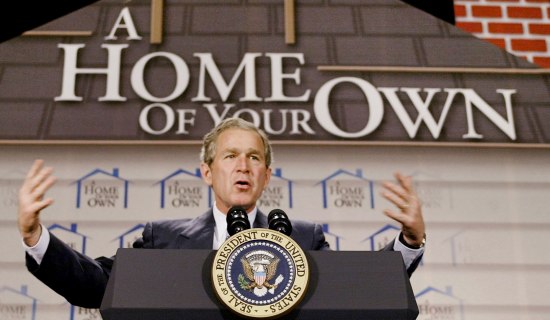

White House philosophy stoked mortgage bonfire
By Jo Becker, Sheryl Gay Stolberg and Stephen Labaton
Sunday, December 21, 2008
WASHINGTON : “We can put light where there’s darkness, and hope where there’s despondency in this country. And part of it is working together as a nation to encourage folks to own their own home.” President George W. Bush, Oct. 15, 2002
It was Sept. 18. Lehman Brothers had just gone belly-up, overwhelmed by toxic mortgages. Bank of America had swallowed Merrill Lynch in a hastily arranged sale. Two days earlier, Bush had agreed to pump $85 billion into the failing insurance giant American International Group.
The president listened as Ben Bernanke, chairman of the Federal Reserve, laid out the latest terrifying news: The credit markets, gripped by panic, had frozen overnight, and banks were refusing to lend money.
Then his Treasury secretary, Henry Paulson Jr., told him that to stave off disaster, he would have to sign off on the biggest government bailout in history.
Bush, according to several people in the room, paused for a single, stunned moment to take it all in.
“How,” he wondered aloud, “did we get here?”
Eight years after arriving in Washington vowing to spread the dream of homeownership, Bush is leaving office, as he himself said recently, “faced with the prospect of a global meltdown” with roots in the housing sector he so ardently championed.
There are plenty of culprits, like lenders who peddled easy credit, consumers who took on mortgages they could not afford and Wall Street chieftains who loaded up on mortgage-backed securities without regard to the risk.
But the story of how we got here is partly one of Bush’s own making, according to a review of his tenure that included interviews with dozens of current and former administration officials.
From his earliest days in office, Bush paired his belief that Americans do best when they own their own home with his conviction that markets do best when let alone.
He pushed hard to expand homeownership, especially among minorities, an initiative that dovetailed with his ambition to expand the Republican tent and with the business interests of some of his biggest donors. But his housing policies and hands-off approach to regulation encouraged lax lending standards.
Bush did foresee the danger posed by Fannie Mae and Freddie Mac, the government-sponsored mortgage finance giants. The president spent years pushing a recalcitrant Congress to toughen regulation of the companies, but was unwilling to compromise when his former Treasury secretary wanted to cut a deal. And the regulator Bush chose to oversee them an old prep school buddy pronounced the companies sound even as they headed toward insolvency.
As early as 2006, top advisers to Bush dismissed warnings from people inside and outside the White House that housing prices were inflated and that a foreclosure crisis was looming. And when the economy deteriorated, Bush and his team misdiagnosed the reasons and scope of the downturn; as recently as February, for example, Bush was still calling it a “rough patch.”
The result was a series of piecemeal policy prescriptions that lagged behind the escalating crisis.
“There is no question we did not recognize the severity of the problems,” said Al Hubbard, Bush’s former chief economics adviser, who left the White House in December 2007. “Had we, we would have attacked them.”
Looking back, Keith Hennessey, Bush’s current chief economics adviser, says he and his colleagues did the best they could “with the information we had at the time.” But Hennessey did say he regretted that the administration did not pay more heed to the dangers of easy lending practices. And both Paulson and his predecessor, John Snow, say the housing push went too far.
“The Bush administration took a lot of pride that homeownership had reached historic highs,” Snow said in an interview. “But what we forgot in the process was that it has to be done in the context of people being able to afford their house. We now realize there was a high cost.”
For much of the Bush presidency, the White House was preoccupied by terrorism and war; on the economic front, its pressing concerns were cutting taxes and privatizing Social Security. The housing market was a bright spot: ever-rising home values kept the economy humming, as owners drew down on their equity to buy consumer goods and pack their children off to college.
Lawrence Lindsay, Bush’s first chief economics adviser, said there was little impetus to raise alarms about the proliferation of easy credit that was helping Bush meet housing goals.
“No one wanted to stop that bubble,” Lindsay said. “It would have conflicted with the president’s own policies.”
Today, millions of Americans are facing foreclosure, homeownership rates are virtually no higher than when Bush took office, Fannie and Freddie are in a government conservatorship, and the bailout cost to taxpayers could run in the trillions.
As the economy has shed jobs 533,000 last month alone and his party has been punished by irate voters, the weakened president has granted his Treasury secretary extraordinary leeway in managing the crisis.
Never once, Paulson said in a recent interview, has Bush overruled him. “I’ve got a boss,” he explained, who “understands that when you’re dealing with something as unprecedented and fast-moving as this we need to have a different operating style.”
Paulson and other senior advisers to Bush say the administration has responded well to the turmoil, demonstrating flexibility under difficult circumstances. “There is not any playbook,” Paulson said.
The president declined to be interviewed for this article. But in recent weeks Bush has shared his views of how the nation came to the brink of economic disaster. He cites corporate greed and market excesses fueled by a flood of foreign cash “Wall Street got drunk,” he has said and the policies of past administrations. He blames Congress for failing to reform Fannie and Freddie. Last week, Fox News asked Bush if he was worried about being the Herbert Hoover of the 21st century.
“No,” Bush replied. “I will be known as somebody who saw a problem and put the chips on the table to prevent the economy from collapsing.”
But in private moments, aides say, the president is looking inward. During a recent ride aboard Marine One, the presidential helicopter, Bush sounded a reflective note.
“We absolutely wanted to increase homeownership,” Tony Fratto, his deputy press secretary, recalled him saying. “But we never wanted lenders to make bad decisions.”
A policy gone awry
Darrin West could not believe it. The president of the United States was standing in his living room.
It was June 17, 2002, a day West recalls as “the highlight of my life.” Bush, in Atlanta to unveil a plan to increase the number of minority homeowners by 5.5 million, was touring Park Place South, a development of starter homes in a neighborhood once marked by blight and crime.
West had patrolled there as a police officer, and now he was the proud owner of a $130,000 town house, bought with an adjustable-rate mortgage and a $20,000 government loan as his down payment just the sort of creative public-private financing Bush was promoting.
“Part of economic security,” Bush declared that day, “is owning your own home.”
A lot has changed since then. West, beset by personal problems, left Atlanta. Unable to sell his home for what he owed, he said, he gave it back to the bank last year. Like other communities across America, Park Place South has been hit with a foreclosure crisis affecting at least 10 percent of its 232 homes, according to Masharn Wilson, a developer who led Bush’s tour.
“I just don’t think what he envisioned was actually carried out,” she said.
Park Place South is, in microcosm, the story of a well-intentioned policy gone awry. Advocating homeownership is hardly novel; the Clinton administration did it, too. For Bush, it was part of his vision of an “ownership society,” in which Americans would rely less on the government for health care, retirement and shelter. It was also good politics, a way to court black and Hispanic voters.
But for much of Bush’s tenure, government statistics show, incomes for most families remained relatively stagnant while housing prices skyrocketed. That put homeownership increasingly out of reach for first-time buyers like West.
So Bush had to, in his words, “use the mighty muscle of the federal government” to meet his goal. He proposed affordable housing tax incentives. He insisted that Fannie Mae and Freddie Mac meet ambitious new goals for low-income lending.
Concerned that down payments were a barrier, Bush persuaded Congress to spend up to $200 million a year to help first-time buyers with down payments and closing costs.
And he pushed to allow first-time buyers to qualify for federally insured mortgages with no money down. Republican congressional leaders and some housing advocates balked, arguing that homeowners with no stake in their investments would be more prone to walk away, as West did. Many economic experts, including some in the White House, now share that view.
The president also leaned on mortgage brokers and lenders to devise their own innovations. “Corporate America,” he said, “has a responsibility to work to make America a compassionate place.”
And corporate America, eyeing a lucrative market, delivered in ways Bush might not have expected, with a proliferation of too-good-to-be-true teaser rates and interest-only loans that were sold to investors in a loosely regulated environment.
“This administration made decisions that allowed the free market to operate as a barroom brawl instead of a prize fight,” said L. William Seidman, who advised Republican presidents and led the savings and loan bailout in the 1990s. “To make the market work well, you have to have a lot of rules.”
But Bush populated the financial system’s alphabet soup of oversight agencies with people who, like him, wanted fewer rules, not more.
Like minds on laissez-faire
The president’s first chairman of the Securities and Exchange Commission promised a “kinder, gentler” agency. The second was pushed out amid industry complaints that he was too aggressive. Under its current leader, the agency failed to police the catastrophic decisions that toppled the investment bank Bear Stearns and contributed to the current crisis, according to a recent inspector general’s report.
As for Bush’s banking regulators, they once brandished a chain saw over a 9,000-page pile of regulations as they promised to ease burdens on the industry. When states tried to use consumer protection laws to crack down on predatory lending, the comptroller of the currency blocked the effort, asserting that states had no authority over national banks.
The administration won that fight at the Supreme Court. But Roy Cooper, North Carolina’s attorney general, said, “They took 50 sheriffs off the beat at a time when lending was becoming the Wild West.”
The president did push rules aimed at forcing lenders to more clearly explain loan terms. But the White House shelved them in 2004, after industry-friendly members of Congress threatened to block confirmation of his new housing secretary.
In the 2004 election cycle, mortgage bankers and brokers poured nearly $847,000 into Bush’s re-election campaign, more than triple their contributions in 2000, according to the nonpartisan Center for Responsive Politics. The administration did not finalize the new rules until last month.
Among the Republican Party’s top 10 donors in 2004 was Roland Arnall. He founded Ameriquest, then the nation’s largest lender in the subprime market, which focuses on less creditworthy borrowers. In July 2005, the company agreed to set aside $325 million to settle allegations in 30 states that it had preyed on borrowers with hidden fees and ballooning payments. It was an early signal that deceptive lending practices, which would later set off a wave of foreclosures, were widespread.
Andrew Card Jr., Bush’s former chief of staff, said White House aides discussed Ameriquest’s troubles, though not what they might portend for the economy. Bush had just nominated Arnall as his ambassador to the Netherlands, and the White House was primarily concerned with making sure he would be confirmed.
“Maybe I was asleep at the switch,” Card said in an interview.
Brian Montgomery, the Federal Housing Administration commissioner, understood the significance. His agency insures home loans, traditionally for the same low-income minority borrowers Bush wanted to help. When he arrived in June 2005, he was shocked to find those customers had been lured away by the “fool’s gold” of subprime loans. The Ameriquest settlement, he said, reinforced his concern that the industry was exploiting borrowers.
In December 2005, Montgomery drafted a memo and brought it to the White House. “I don’t think this is what the president had in mind here,” he recalled telling Ryan Streeter, then the president’s chief housing policy analyst.
It was an opportunity to address the risky subprime lending practices head on. But that was never seriously discussed. More senior aides, like Karl Rove, Bush’s chief political strategist, were wary of overly regulating an industry that, Rove said in an interview, provided “a valuable service to people who could not otherwise get credit.” While he had some concerns about the industry’s practices, he said, “it did provide an opportunity for people, a lot of whom are still in their houses today.”
The White House pursued a narrower plan offered by Montgomery that would have allowed the FHA to loosen standards so it could lure back subprime borrowers by insuring similar, but safer, loans. It passed the House but died in the Senate, where Republican senators feared that the agency would merely be mimicking the private sector’s risky practices a view Rove said he shared.
Looking back at the episode, Montgomery broke down in tears. While he acknowledged that the bill did not get to the root of the problem, he said he would “go to my grave believing” that at least some homeowners might have been spared foreclosure.
Today, administration officials say it is fair to ask whether Bush’s ownership push backfired. Paulson said the administration, like others before it, “over-incented housing.” Hennessey put it this way: “I would not say too much emphasis on expanding homeownership. I would say not enough early focus on easy lending practices.”
‘We told you so’
Armando Falcon Jr. was preparing to take on a couple of giants.
A soft-spoken Texan, Falcon ran the Office of Federal Housing Enterprise Oversight, a tiny government agency that oversaw Fannie Mae and Freddie Mac, two pillars of the American housing industry. In February 2003, he was finishing a blockbuster report that warned the pillars could crumble.
Created by Congress, Fannie and Freddie called GSE’s, for government-sponsored entities bought trillions of dollars’ worth of mortgages to hold or sell to investors as guaranteed securities. The companies were also Washington powerhouses, stuffing lawmakers’ campaign coffers and hiring bare-knuckled lobbyists.
Falcon’s report outlined a worst-case situation in which Fannie and Freddie could default on debt, setting off “contagious illiquidity in the market” in other words, a financial meltdown. He also raised red flags about the companies’ soaring use of derivatives, the complex financial instruments that economic experts now blame for spreading the housing collapse.
Today, the White House cites that report and its subsequent effort to better regulate Fannie and Freddie as evidence that it foresaw the crisis and tried to avert it. Bush officials recently wrote up a talking points memo headlined “GSE’s We Told You So.”
But the back story is more complicated. To begin with, on the day Falcon issued his report, the White House tried to fire him.
At the time, Fannie and Freddie were allies in the president’s quest to drive up homeownership rates; Franklin Raines, then Fannie’s chief executive, has fond memories of visiting Bush in the Oval Office and flying aboard Air Force One to a housing event. “They loved us,” he said.
So when Falcon refused to deep-six his report, Raines took his complaints to top Treasury officials and the White House. “I’m going to do what I need to do to defend my company and my position,” Raines told Falcon.
Days later, as Falcon was in New York preparing to deliver a speech about his findings, his cellphone rang. It was the White House personnel office, he said, telling him he was about to be unemployed.
His warnings were buried in the next day’s news coverage, trumped by the White House announcement that Bush would replace Falcon, a Democrat appointed by Bill Clinton, with Mark Brickell, a leader in the derivatives industry that Falcon’s report had flagged.
It was not until 2003, when Freddie became embroiled in an accounting scandal, that the White House took on the companies in earnest. Bush decided to quit the long-standing practice of rewarding supporters with high-paying appointments to the companies’ boards “political plums,” in Rove’s words. He also withdrew Brickell’s nomination and threw his support behind Falcon, beginning an intense effort to give his little regulatory agency more power.
Falcon lacked explicit authority to limit the size of the companies’ mammoth investment portfolios, or tell them how much capital they needed to guard against losses. White House officials wanted that to change. They also wanted the power to put the companies into receivership, hoping that would end what Card, the former chief of staff, called “the myth of government backing,” which gave the companies a competitive edge because investors assumed the government would not let them fail.
By the spring of 2005 a deal with Congress seemed within reach, Snow, the former Treasury secretary, said in an interview.
Michael Oxley, an Ohio Republican and then-chairman of the House Financial Services Committee, had produced what Snow viewed as “a pretty darned good bill,” a watered-down version of what the president sought. But at the urging of Card and the White House economics team, the president decided to hold out for a tougher bill in the Senate.
Card said he feared that Snow was “more interested in the deal than the result.” When the bill passed the House, the president issued a statement opposing it, effectively killing any chance of compromise. Oxley was furious.
“The problem with those guys at the White House, they had all the answers and they didn’t think they had to listen to anyone, including the Treasury secretary,” Oxley said in a recent interview. “They were driving the ideological train. He was in the caboose, and they were in the engine room.”
Card and Hennessey said they had no regrets. They are convinced, Hennessey said, that the Oxley bill would have produced “the worst of all possible outcomes,” the illusion of reform without the substance.
Still, some former White House and Treasury officials continue to debate whether Bush’s all-or-nothing approach scuttled a measure that, while imperfect, might have given an aggressive regulator enough power to keep the companies from failing.
Snow, for one, calls Oxley “a hero,” adding, “He saw the need to move. It didn’t get done. And it’s too bad, because I think if it had, I think we could well have avoided a big contributor to the current crisis.”
Unheeded warnings
Jason Thomas had a nagging feeling.
The New Century Financial Corp., a huge subprime lender whose mortgages were bundled into securities sold around the world, was headed for bankruptcy in March 2007. Thomas, an economic analyst for Bush, was responsible for determining whether it was a hint of things to come.
At 29, Thomas had followed a fast-track career path that took him from a Buffalo meatpacking plant, where he worked as a statistician, to the White House. He was seen as a whiz kid, “a brilliant guy,” his former boss, Hubbard, says.
As Thomas began digging into New Century’s failure that spring, he became fixated on a particular statistic, the rent-to-own ratio.
Typically, as home prices increase, rental costs rise proportionally. But Thomas sent charts to top White House and Treasury officials showing that the monthly cost of owning far outpaced the cost to rent. To Thomas, it was a sign that housing prices were wildly inflated and bound to plunge, a condition that could set off a foreclosure crisis as conventional and subprime borrowers with little equity found they owed more than their houses were worth.
It was not the Bush team’s first warning. The previous year, Lindsay, the former chief economics adviser, returned to the White House to tell his old colleagues that housing prices were headed for a crash. But housing values are hard to evaluate, and Lindsay had a reputation as a market pessimist, said Hubbard, adding, “I thought, ‘He’s always a bear.’ “
In retrospect, Hubbard said, Lindsay was “absolutely right,” and Thomas’s charts “should have been a signal.”
Instead, the prevailing view at the White House was that the problems in the housing market were limited to subprime borrowers unable to make their payments as their adjustable mortgages reset to higher rates. That belief was shared by Bush’s new Treasury secretary, Paulson.
Paulson, a former chairman of the Wall Street firm Goldman Sachs, had been given unusual power; he had accepted the job only after the president guaranteed him that Treasury, not the White House, would have the dominant role in shaping economic policy. That shift merely continued an imbalance of power that stifled robust policy debate, several former Bush aides say.
Throughout the spring of 2007, Paulson declared that “the housing market is at or near the bottom,” with the problem “largely contained.” That position underscored nearly every action the Bush administration took in the ensuing months as it offered one limited response after another.
By that August, the problems had spread beyond New Century. Credit was tightening, amid questions about how heavily banks were invested in securities linked to mortgages. Still, Bush predicted that the turmoil would resolve itself with a “soft landing.”
The plan Bush announced on Aug. 31 reflected that belief. Called “FHA Secure,” it aimed to help about 80,000 homeowners refinance their loans. Montgomery, the housing commissioner, said that he knew the modest program was not enough the White House later expanded the agency’s rescue role and that he would be “flying the plane and fixing it at the same time.”
That fall, Representative Rahm Emanuel, a leading Democrat, former investment banker and now the incoming chief of staff to President-elect Barack Obama, warned the White House it was not doing enough. He said he told Joshua Bolten, Bush’s chief of staff, and Paulson in a series of phone calls that the credit crisis would get “deep and serious” and that the only answer was big, internationally coordinated government intervention.
“You got to strangle this thing and suffocate it,” he recalled saying.
Instead, Bush developed Hope Now, a voluntary public-private partnership to help struggling homeowners refinance loans. And he worked with Congress to pass a stimulus package that sent taxpayers $150 billion in tax rebates.
In a speech to the Economic Club of New York in March 2008, he cautioned against Washington’s temptation “to say that anything short of a massive government intervention in the housing market amounts to inaction,” adding that government action could make it harder for the markets to recover.
Dominoes Start to Fall
Within days, Bear Sterns collapsed, prompting the Federal Reserve to engineer a hasty sale. Some economic experts, including Timothy Geithner, the president of the New York Federal Reserve Bank (and Obama’s choice for Treasury secretary) feared that Fannie Mae and Freddie Mac could be the next to fall.
Bush was still leaning on Congress to revamp the tiny agency that oversaw the two companies, and had acceded to Paulson’s request for the negotiating room that he had denied Snow. Still, there was no deal.
Over the previous two years, the White House had effectively set the agency adrift. Falcon left in 2005 and was replaced by a temporary director, who was in turn replaced by James Lockhart, a friend of Bush from their days at Andover, and a former deputy commissioner of the Social Security Administration who had once run a software company.
In an Oval Office meeting on March 17, however, Paulson barely mentioned the idea, according to several people present. He wanted to use the troubled companies to unlock the frozen credit market by allowing Fannie and Freddie to buy more mortgage-backed securities from overburdened banks. To that end, Lockhart’s office planned to lift restraints on the companies’ huge portfolios a decision derided by former White House and Treasury officials who had worked so hard to limit them.
But Paulson told Bush the companies would shore themselves up later by raising more capital.
“Can they?” Bush asked.
“We’re hoping so,” the Treasury secretary replied.
That turned out to be incorrect, and did not surprise Thomas, the Bush economic adviser. Throughout that spring and summer, he warned the White House and Treasury that, in the stark words of one e-mail message, “Freddie Mac is in trouble.” And Lockhart, he charged, was allowing the company to cover up its insolvency with dubious accounting maneuvers.
But Lockhart continued to offer reassurances. In a July appearance on CNBC, he declared that the companies were well managed and “worsts were not coming to worst.” An infuriated Thomas sent a fresh round of e-mail messages accusing Lockhart of “pimping for the stock prices of the undercapitalized firms he regulates.”
Lockhart defended himself, insisting in an interview that he was aware of the companies’ vulnerabilities, but did not want to rattle markets.
“A regulator,” he said, “does not air dirty laundry in public.”
Soon afterward, the companies’ stocks lost half their value in a single day, prompting Congress to quickly give Paulson the power to spend $200 billion to prop them up and to finally pass Bush’s long-sought reform bill, but it was too late. In September, the government seized control of Freddie Mac and Fannie Mae.
In an interview, Paulson said the administration had no justification to take over the companies any sooner. But Falcon disagreed: “They absolutely could have if they had thought there was a real danger.”
By Sept. 18, when Bush and his team had their fateful meeting in the Roosevelt Room after the failure of Lehman Brothers and the emergency rescue of AIG, Paulson was warning of an economic calamity greater than the Great Depression. Suddenly, historic government intervention seemed the only option. When Paulson spelled out what would become a $700 billion plan to rescue the nation’s banking system, the president did not hesitate.
“Is that enough?” Bush asked.
“It’s a lot,” the Treasury secretary recalled replying. “It will make a difference.” And in any event, he told Bush, “I don’t think we can get more.”
As the meeting wrapped up, a handful of aides retreated to the White House Situation Room to call Vice President Dick Cheney in Florida, where he was attending a fund-raiser. Cheney had long played a leading role in economic policy, though housing was not a primary interest, and like Bush he had a deep aversion to government intervention in the market. Nonetheless, he backed the bailout, convinced that too many Americans would suffer if Washington did nothing.
Bush typically darts out of such meetings quickly. But this time, he lingered, patting people on the back and trying to soothe his downcast staff. “During times of adversity, he bucks everybody up,” Paulson said.
It was not the end of the failures or government interventions; the administration has since stepped in to rescue Citigroup and, just last week, the Detroit automakers. With 31 days left in office, Bush says he will leave it to historians to analyze “what went right and what went wrong,” as he put it in a speech last week to the American Enterprise Institute.
Bush said he was too focused on the present to do much looking back.
“It turns out,” he said, “this isn’t one of the presidencies where you ride off into the sunset, you know, kind of waving goodbye.”
The global financial system was teetering on the edge of collapse when President George W. Bush and his economics team huddled in the Roosevelt Room of the White House for a briefing that, in the words of one participant, “scared the hell out of everybody.”
Former Republican Senator Pete Domenici of New Mexico Has His Records Subpoenaed in David Iglesias, U.S. Attorneys Scandal
Dick Cheney, George W. Bush, Justice Department, Pete Domenici, U.S. Attorney, U.S. Attorney ScandalEx-lawmaker’s records subpoenaed in firings probe
Associated Press – February 11, 2009
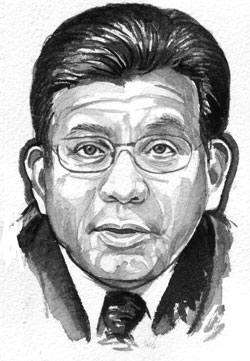
WASHINGTON (AP) – A federal grand jury has subpoenaed records of former Republican Senator Pete Domenici of New Mexico.
Career federal prosecutor Nora R. Dannehy is looking into whether former Attorney General Alberto Gonzales, other Bush administration officials or Republicans in Congress should face criminal charges in the dismissals of U.S. Attorneys.
The grand jury subpoena for some of Domenici’s records has been confirmed by two private attorneys who spoke on condition of anonymity because they were not representing the former senator.
Domenici’s attorney, K. Lee Blalack, has declined to comment.
Domenici made three phone calls to Gonzales in 2005 and 2006 complaining about the performance of U.S. Attorney David Iglesias. Iglesias was fired for what the Justice Department’s inspector general said were political reasons.
Thomas Ricks Plays Propaganda Point-Man on Pentagon Plan for Permanent U.S. Bases in Iraq
Admiral Fallon, AEI, Bechtel. Halliburton, Blackwater, Carlyle Group, Colin Powell, Condi Rice, Dick Cheney, Don Rumsfeld, Douglas Feith, Erik Prince, General Keane, General Odierno, General Patraeus, George W. Bush, Iraq, KBR, Military Industrial Complex, Neocons, Oil, Paul Wolfowitz, PNAC, Propaganda, Raytheon, Richard Perle, Steven Hadley, Think-TanksFormer White House Spokesman Ari Fleischer Conveniently Forgets About George W. Bush's Favorite Gay Escort : Jeff Gannon / James Dale Guckert
Ari Fleischer, CIA, Gay GOP, George W. Bush, GOPUSA, Howard Kurtz, Jeff Gannon/James Guckert, Joe Wilson, Niger, Politics, Talon News, YellowcakeTHINK PROGRESS has this piece up today mentioning the elusive and shadowy figure- Jeff Gannon..
Here’s an excerpt:
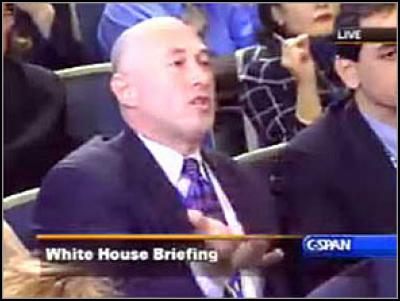
If Bush was relying on Fleischer to screen the “dotcoms and oddballs,” he was poorly served. Take, for example, case of Jeff Gannon, the male escort-turned-White House correspondent for the right-wing news outlet Talon News. The White House press office granted Gannon access to the White House under an assumed name and with no background check. Once Gannon got in the door under Fleischer’s watch in 2003, he was called on by Bush at a press conference in January 2005. Gannon lobbed Bush a softball:
GANNON: Senate Democratic leaders have painted a very bleak picture of the U.S. economy. … Yet in the same breath they say that Social Security is rock solid and there’s no crisis there. … [H]ow are you going to work with people who seem to have divorced themselves from reality?
Here’s my piece from 2005:
BY JOHN TULLY
THE LOS ANGELES SUN
FEB 23 2005
A weekend journalism-school reporter, using a fake name, was given access to the President of the United States at White House press briefings before he even worked for any news organization.
He claims that he has seen a confidential, so-called C.I.A. document which reveals the name of former Ambassador Joseph Wilson’s wife and shows her recommending him for the trip to Niger to investigate yellowcake uranium sales to the Iraqis.
It turns out that Secret Service has been waving James Guckert by the guardhouse for two and a half years and once inside, he became Jeff Gannon. He wrote for a fake website, Talon News, run by Republican strategist Bobby Eberle and the organization GOPUSA.
To understand how something like this could Not be a story, that this could happen to begin with, is to understand how The District of Columbia really runs. However, one can only watch and wait as the laws of physics begin to rear their ugly head. Try as they might and for whatever reason, The Mainstream Media (as good of a description as any) just can’t keep this monster down.
Howard Kurtz, the longtime and wise sage media critic with The Washington Post, trusted by little old Quaker ladies in Cleveland Park D.C. and lobbyists alike, just could not figure out what the big fuss was all about and immediately chalked it up to over-eager WWW types and their preoccupation with the salacious part of the story.
Oh that.The Great Diversion and the reason why non-political junkies in America are apparently not talking about this story is that this fella’ publicly advertised his services as a male prostitute on numerous sites on the Internet and registered and launched numerous gay male pornographic websites.
Really.
CNN’s Aaron Brown, so brilliant in his earlier years on the old ABC overnight news program, pooh-poohed the scandal as a bit of “so what”. On Wolf Blitzer’s “Hard News” program, Mr. Guckert/Gannon was treated almost softly, as if not to upset.
The New York Times finally ran the story, deep in the back pages on Friday, Feb 11th, more than a week after website journalists began to fully reveal this fake journalist’s deceptions.The shockjock mentality came out instantly in the groupthink mainstream media with a curious mix of apathy and frat-boy jokes.
There was no outrage to be outraged over. Meanwhile, writers on web sites like The Daily Kos, David Brock’s Media Matters and John Aravosis’s America Blog, among others, had been doing their own journalism and found out that Mr. Guckert was not who or what he appeared to be. They started their dig after witnessing a press briefing by the President back in late January. A strange reporter asked a clearly partisan question / pronouncement that, among other things, stated that the Democrats were “divorced from reality”.
They got dirt all right.
Columnists Frank Rich and Maureen Dowd finally had to write cute pieces about the mess nearing the end of last week. Katie, Matt, and The Today Show eventually did a quick three- minute story in the first hour last Wednesday. Radio man Don Imus couldn’t get anyone to bite and wondered aloud about the titillating aspect of the thing.
This was now more than ten days since the story had broken, or hadn’t broken. No one was even discussing, outside of the Web, the nasty business of the C.I.A. memo that Mr.Guckert had claimed to have seen or knew about right there on Mr. Blitzer’s show.
Links to web sites where Mr. Guckert solicited clients for sex were widely available at the very same time Mr. Blitzer was tripping all over himself to give Mr. Guckert an Easypass.Ultimate Washington insider Mary Matalin, Vice President Cheney’s sometimes consultant, told Imus that she just wished Ms. Dowd would just come in from the cold and get with the program.
Why did President Bush and Scott McClellan, the President’s spokesman, call on Mr. Guckert/Gannon so often in those two and a half years and how could other reporters not write about Talon News and GOPUSA’s illegitimacy? Veterans of the White House beat sometimes don’t see a question for years. Was he a plant?
But just like the high school sophomores that they are, the Washington Press Corps have hemmed and hawed and giggled their way for weeks now through a real-live genuine scandal unfurling at the White House. Waving their collective finger, they dismissed the whole affair in full. It was simply The Bloggers and their liberal retribution for the Rather/CBS assassination and a lurid fascination with the X-rated angle thrown in for good measure.
Now the simply idiotic Bush-Tapes story, along with a long weekend and a brilliant fake-outrage campaign over a congressman’s comments about Karl Rove, is threatening to bury forever a story that the entire profession of journalism would like to pretend was never born to begin with.
Everyone seems to be looking around at each other and tsk-tsking the lack of outrage on each other’s part, as if to say “This is terrible -someone do some real reporting”.
“Someone did – as Mr. Bush would say, on the “Internets”.
Stay Tuned.
ALSO IN:
More Tully:
 The New York Herald Sun