The Madness of Jim Cramer – Day After Pathetic Evisceration by “Comedian”
Vodpod videos no longer available.
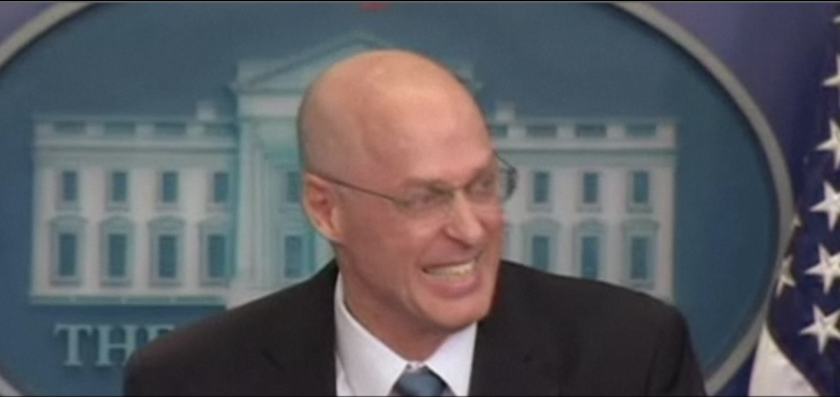
Henry Paulson
What We Should Learn from Jim Cramer vs. The Daily Show’s Jon Stewart
AIG, Bear Stearns, Ben Bernanke, Citibank, CNBC, Cramer+Stewart, Credit Default Swaps, Deep Capture, Derivatives, Dick Fuld, Gradient Analytics, Hedge Funds, Henry Paulson, Jim Cramer, Jon Stewart, Lehman Brothers, Maria Bartiromo, Mortgage Crisis, Overstock, Patrick Byrne::What We Should Learn from Jim Cramer vs. the Daily Show’s Jon Stewart::
March 12th, 2009 by Patrick Byrne
What should we learn from the fact that “The Daily Show’s” Jon Stewart has in four evenings (1 2 3 and 4) exposed Jim Cramer in a way that, in any sane world, he would have been exposed a decade ago? To answer that, consider these associated facts: while the Jim Cramer constellation of journalists (Mitchell’s Media Mob) backed each other up while covering-up the subject of criminally abusive short selling by hedge funds to whom they were close, four channels of the media broke rank:
- Two years ago Bloomberg did a half-hour documentary that broke away from the Party Line;
- Liz Moyer at Forbes has covered the real issues fairly and diligently, and another Forbes reporter named Nathan Vardi took a good swipe at the story (”Sewer Pipes“);
- Rolling Out Magazine (”an UrbanStyle Weekly serving the African American community”) called me up a couple years ago and did precisely the fair, non-disorted interview of which the remainder of the New York financial media was entirely incapable;
- Now, “The Daily Show” has broken ranks by stating the obvious: there are journalists shilling for favored hedge funds.
Could the lesson be that the first news organizations that can break ranks with the Party Line are either fringe (”Rolling Out Magazine” and “The Daily Show”) or the properties of billionaires (Bloomberg and Forbes) who cannot be intimidated?
Perhaps someday, a journalist will look into the pressures that were brought on news organizations (e.g., on Bloomberg leading up to their running “Phantom Shares”). Just a few weeks ago I got the story, again, from a journalist: “I was working on a story about naked short selling and Deep Capture. Then, suddenly I was stopped. It’s weird because I have been a journalist here for 9 years. I have built a great reputation with my editor, and have never had a story interfered with. But I got a couple months into this story, and suddenly I was stopped from above. I’ve never seen that happen before.” I replied, If you only knew how many times a journalist has said that to me in the last couple years….
The Real Scandal That Will Bring Jim Cramer Down: The Story of Deep Capture
AIG, Bear Stearns, Ben Bernanke, Citibank, CNBC, Cramer+Stewart, Credit Default Swaps, Deep Capture, Derivatives, Dick Fuld, Gradient Analytics, Hedge Funds, Henry Paulson, Jim Cramer, Jon Stewart, Lehman Brothers, Maria Bartiromo, Mortgage Crisis, Overstock, Patrick ByrneThe Columbia School of Journalism is our nation’s finest. They grant the Pulitzer Prize, and their journal, The Columbia Journalism Review, is the profession’s gold standard. CJR reporters are high priests of a decaying temple, tending a flame in a land going dark.
In 2006 a CJR editor (a seasoned journalist formerly with Time magazine in Asia, The Wall Street Journal Europe, and The Far Eastern Economic Review) called me to discuss suspicions he was forming about the US financial media. I gave him leads but warned, “Chasing this will take you down a rabbit hole with no bottom.” For months he pursued his story against pressure and threats he once described as, “something out of a Hollywood B movie, but unlike the movies, the evil corporations fighting the journalist are not thugs burying toxic waste, they are Wall Street and the financial media itself.”
His exposé reveals a circle of corruption enclosing venerable Wall Street banks, shady offshore financiers, and suspiciously compliant reporters at The Wall Street Journal, Fortune, CNBC, and The New York Times. If you ever wonder how reporters react when a journalist investigates them (answer: like white-collar crooks they dodge interviews, lie, and hide behind lawyers), or if financial corruption interests you, then this is for you. It makes Grisham read like a book of bedtime stories, and exposes a scandal that may make Enron look like an afternoon tea.
By Patrick M. Byrne
Make a pot of strong coffee and read this incredible story
Unedited | Cramer Vs. Stewart | Part Three
AIG, Bear Stearns, Ben Bernanke, Citibank, CNBC, Cramer+Stewart, Credit Default Swaps, Deep Capture, Derivatives, Dick Fuld, Gradient Analytics, Hedge Funds, Henry Paulson, Jim Cramer, Jon Stewart, Lehman Brothers, Maria Bartiromo, Mortgage Crisis, Overstock, Patrick ByrnePart Two | Cramer Vs. Stewart | Unedited
AIG, Bear Stearns, Ben Bernanke, Citibank, CNBC, Cramer+Stewart, Credit Default Swaps, Derivatives, Dick Fuld, Gradient Analytics, Hedge Funds, Henry Paulson, Jim Cramer, Jon Stewart, Lehman Brothers, Maria Bartiromo, Mortgage Crisis, Overstock, Patrick ByrnePart One | Cramer Vs. Stewart | Unedited
AIG, Bear Stearns, Ben Bernanke, Citibank, CNBC, Cramer+Stewart, Credit Default Swaps, Derivatives, Dick Fuld, Gradient Analytics, Hedge Funds, Henry Paulson, Jim Cramer, Jon Stewart, Lehman Brothers, Maria Bartiromo, Mortgage Crisis, Overstock, Patrick ByrneIntro | Cramer Vs. Stewart | Unedited
AIG, Bear Stearns, Ben Bernanke, Citibank, CNBC, Cramer+Stewart, Credit Default Swaps, Deep Capture, Derivatives, Dick Fuld, Gradient Analytics, Hedge Funds, Henry Paulson, Jim Cramer, Jon Stewart, Lehman Brothers, Maria Bartiromo, Mortgage Crisis, Overstock, Patrick ByrneGovernment Bailout Hits $8.5 trillion
Adjustable Rate Mortgages, AIG, Alan Greenspan, bailout, Banking Regulation, Banks, Ben Bernanke, Bernie Madoff, BofA, Citi, Credit, Credit Default Swaps, Fannie Mae, Federal Reserve, Finance, Freddy Mac, Henry Paulson, Lehman, Merrill, Mrs. Andrea Mitchell, Treasury, Wachovia, Wall Street, World Savings
Kathleen Pender
November 26, 2008
The federal government committed an additional $800 billion to two new loan programs on Tuesday, bringing its cumulative commitment to financial rescue initiatives to a staggering $8.5 trillion, according to Bloomberg News.
That sum represents almost 60 percent of the nation’s estimated gross domestic product.
Given the unprecedented size and complexity of these programs and the fact that many have never been tried before, it’s impossible to predict how much they will cost taxpayers. The final cost won’t be known for many years.
The money has been committed to a wide array of programs, including loans and loan guarantees, asset purchases, equity investments in financial companies, tax breaks for banks, help for struggling homeowners and a currency stabilization fund.
Most of the money, about $5.5 trillion, comes from the Federal Reserve, which as an independent entity does not need congressional approval to lend money to banks or, in “unusual and exigent circumstances,” to other financial institutions.
To stimulate lending, the Fed said on Tuesday it will purchase up to $600 billion in mortgage debt issued or backed by Fannie Mae, Freddie Mac and government housing agencies. It also will lend up to $200 billion to holders of securities backed by consumer and small-business loans. All but $20 billion of that $800 billion represents new commitments, a Fed spokeswoman said.
About $1.1 trillion of the $8.5 trillion is coming from the Treasury Department, including $700 billion approved by Congress in dramatic fashion under the Troubled Asset Relief Program.
The rest of the commitments are coming from the Federal Deposit Insurance Corp. and the Federal Housing Administration.
Only about $3.2 trillion of the $8.5 trillion has been tapped so far, according to Bloomberg. Some of it might never be.
Relatively little of the money represents direct outlays of cash with no strings attached, such as the $168 billion in stimulus checks mailed last spring.
Where it’s going
Most of the money is going into loans or loan guarantees, asset purchases or stock investments on which the government could see some return.
“If the economy were to miraculously recover, the taxpayer could make money. That’s not my best guess or even a likely scenario,” but it’s not inconceivable, says Anil Kashyap, a professor at the University of Chicago’s Booth School of Business.
The risk/reward ratio for taxpayers varies greatly from program to program.
For example, the first deal the government made when it bailed out insurance giant AIG had little risk and a lot of potential upside for taxpayers, Kashyap said. “Then it turned out the situation (at AIG) was worse than realized, and the terms were so brutal (to AIG) that we had to renegotiate. Now we have given them a lot more credit on more generous terms.”
Kashyap says the worst deal for taxpayers could be the Citigroup deal announced late Sunday. The government agreed to buy an additional $20 billion in preferred stock and absorb up to $249 billion in losses on troubled assets owned by Citi.
Given that Citigroup’s entire market value on Friday was $20.5 billion, “instead of taking that $20 billion in preferred shares we could have bought the company,” he says.
It’s hard to say how much the overall rescue attempt will add to the annual deficit or the national debt because the government accounts for each program differently.
If the Treasury borrows money to finance a program, that money adds to the federal debt and must eventually be paid off, with interest, says Diane Lim Rogers, chief economist with the Concord Coalition, a nonpartisan group that aims to eliminate federal deficits.
The federal debt held by the public has risen to $6.4 trillion from $5.5 trillion at the end of August. (Total debt, including that owed to Social Security and other government agencies, stands at more than $10 trillion.)
However, a $1 billion increase in the federal debt does not necessarily increase the annual budget deficit by $1 billion because it is expected to be repaid over time, Rogers said.
Annual deficit
A deficit arises when the government’s expenditures exceed its revenues in a particular year. Some estimate that the federal deficit will exceed $1 trillion this fiscal year as a result of the economic slowdown and efforts to revive it.
The Fed’s activities to shore up the financial system do not show up directly on the federal budget, although they can have an impact. The Fed lends money from its own balance sheet or by essentially creating new money. It has been doing both this year.
The problem is, “if you print money all the time, the money becomes worth less,” Rogers says. This usually leads to higher inflation and higher interest rates. The value of the dollar also falls because foreign investors become less willing to invest in the United States.
Today, interest rates are relatively low and the dollar has been mostly strengthening this year because U.S. Treasury securities “are still for the moment a very safe thing to be investing in because the financial market is so unstable,” Rogers said. “Once we stabilize the stock market, people will not be so enamored of clutching onto Treasurys.”
At that point, interest rates and inflation will rise. Increased borrowing by the Treasury will also put upward pressure on interest rates.
Deflation a big concern
Today, however, the Fed is more worried about deflation than inflation and is willing to flood the market with money if necessary to prevent an economic collapse.
Federal Reserve Chairman Ben Bernanke “has ordered the helicopters to get ready,” said Axel Merk, president of Merk Investments. “The helicopters are hovering and the first cash is making it through the seams. Soon, a door may be opened.”
Rogers says her biggest fear is not hyperinflation and the social unrest it could unleash. “I’m more worried about a lot of federal dollars being committed and not having much to show for it. My worst fear is we are leaving our children with a huge debt burden and not much left to pay it back.”
Economic rescue
Key dates in the federal government’s campaign to alleviate the economic crisis.
March 11: The Federal Reserve announces a rescue package to provide up to $200 billion in loans to banks and investment houses and let them put up risky mortgage-backed securities as collateral.
March 16: The Fed provides a $29 billion loan to JPMorgan Chase & Co. as part of its purchase of investment bank Bear Stearns.
July 30: President Bush signs a housing bill including $300 billion in new loan authority for the government to back cheaper mortgages for troubled homeowners.
Sept. 7: The Treasury takes over mortgage giants Fannie Mae and Freddie Mac, putting them into a conservatorship and pledging up to $200 billion to back their assets.
Sept. 16: The Fed injects $85 billion into the failing American International Group, one of the world’s largest insurance companies.
Sept. 16: The Fed pumps $70 billion more into the nation’s financial system to help ease credit stresses.
Sept. 19: The Treasury temporarily guarantees money market funds against losses up to $50 billion.
Oct. 3: President Bush signs the $700 billion economic bailout package. Treasury Secretary Henry Paulson says the money will be used to buy distressed mortgage-related securities from banks.
Oct. 6: The Fed increases a short-term loan program, saying it is boosting short-term lending to banks to $150 billion.
Oct. 7: The Fed says it will start buying unsecured short-term debt from companies, and says that up to $1.3 trillion of the debt may qualify for the program.
Oct. 8: The Fed agrees to lend AIG $37.8 billion more, bringing total to about $123 billion.
Oct. 14: The Treasury says it will use $250 billion of the $700 billion bailout to inject capital into the banks, with $125 billion provided to nine of the largest.
Oct. 14: The FDIC says it will temporarily guarantee up to a total of $1.4 trillion in loans between banks.
Oct. 21: The Fed says it will provide up to $540 billion in financing to provide liquidity for money market mutual funds.
Nov. 10: The Treasury and Fed replace the two loans provided to AIG with a $150 billion aid package that includes an infusion of $40 billion from the government’s bailout fund.
Nov. 12: Paulson says the government will not buy distressed mortgage-related assets, but instead will concentrate on injecting capital into banks.
Nov. 17: Treasury says it has provided $33.6 billion in capital to another 21 banks. So far, the government has invested $158.6 billion in 30 banks.
Sunday: The Treasury says it will invest $20 billion in Citigroup Inc., on top of $25 billion provided Oct. 14. The Treasury, Fed and FDIC also pledge to backstop large losses Citigroup might absorb on $306 billion in real estate-related assets.
Tuesday: The Fed says it will purchase up to $600 billion more in mortgage-related assets and will lend up to $200 billion to the holders of securities backed by various types of consumer loans.
Source: Associated Press
Net Worth runs Tuesdays, Thursdays and Sundays. E-mail Kathleen Pender at kpender@sfchronicle.com.
The Douchebag Who Conned The World
Ben Bernanke, Bernie Madoff, Chris Cox, Citibank, Fairfield, Funds of Funds, Greenspan, Hedge Funds, Henry Paulson, Merrill, Spielberg, SummersStephen Foley (From New York)
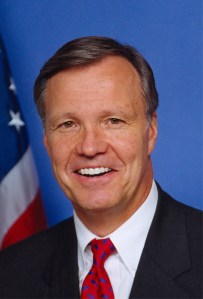 CHRIS COX
Investors around the world are counting the spiralling cost of the biggest fraud in history, a $50bn scam that has ensnared billionaire businessmen and tiny charities alike and whose tentacles have stretched further and deeper than anyone imagined.
The fallout from the arrest of the Wall Street grandee Bernard Madoff was continuing to grow last night, as institution after institution detailed the extent of their possible losses, and the victims in the UK were headlined by HSBC and the Royal Bank of Scotland, which is majority-owned by the British Government.
A charity set up by the Hollywood director Steven Spielberg was among those revealed to be among the victims, along with a foundation set up by Mort Zuckerman, one of the richest media and property magnates in the United States, dozens of Jewish organisations, sports team owners and a New Jersey senator.
But the biggest confessions were coming from Wall Street, from the City of London and from the headquarters of European banks and from banks around the world. They have poured billions of dollars into Mr Madoff’s too-good-to-be-true investment fund, which appeared to post double-digit annual returns come rain or shine.
RBS said that it could take a hit of £400m if American authorities find there is nothing left of the money Mr Madoff had pretended to be investing for many years. HSBC, Britain’s largest bank, said a “small number” of its clients had exposure totalling $1bn in Mr Madoff’s funds.
The Spanish bank Santander, which owns Abbey and the savings business of Bradford & Bingley in the UK, could be on the hook for $3.1bn. Japan’s Nomura said it has hundreds of millions of dollars at risk. City analysts said that even banks who invested only on behalf of clients could end up on the hook, because clients are almost certain to sue for bad advice.
Mr Madoff confessed last week that his business was “all one great big lie”. The investment returns were fake, and he had been paying old clients with money from new ones. In its conception, the scam is a classic. In its size, it is breathtaking, eclipsing anything seen before. He personally estimated the losses at $50bn, according to the FBI, and as investors owned up to their exposure yesterday that did not seem impossible. For 48 years, until Thursday morning, Mr Madoff was one of Wall Street’s best-respected investment managers, able to harvest money from a vast network of contacts and to trade on his name as a former chairman of the Nasdaq stock exchange.
His arrest has further shaken confidence in the barely regulated hedge fund industry, which is already suffering some of the worst times in its short history. Mr Madoff – who is now on a $10m bail and under orders not to leave the New York area – was able to operate his fraud under the noses of regulators for many years.
Mort Zuckerman, the owner of the New York Daily News and one of the 200 richest Americans, said that one of the managers of his charitable trust had been so taken by Mr Madoff that he invested $9bn with him, including all the money from Mr Zuckerman’s trust. “These are astonishing numbers to be placed with one fund manager,” he said. “I think we have another break in whatever level confidence needs to exist in money markets.”
Nicola Horlick, the British fund manager known as Superwoman for juggling her high-flying City career with bringing up five children, turned her fire on US regulators. Her Bramdean Alternatives investment fund had put 9 per cent – about £10m – with Mr Madoff. She told BBC Radio: “This is the biggest financial scandal, probably in the history of the markets.”
 The New York Herald Sun