Max Baucus
Dday Explains the Baucus Health Care Plan : Winner = Insurance Companies
Barack Obama, Big Pharma, Charles Grassley, Health Care Debate, Insurance Companies, Max Baucus
The Reviews Are In!
by dday
Everybody’s talking about Max Baucus’ plan for health care!
Mostly, people don’t like it!
Republicans don’t like it because… it’s a health care bill. Democrats don’t like it because… it’s a bad health care bill designed to kowtow to Republicans who won’t even vote for it. Health care advocacy groups don’t like it because it “would give a government-subsidized monopoly to the private insurance industry to sell their most profitable plans – high-deductible insurance – without having to face competition from a public health insurer.” A good reason not to like it! And unions don’t like it because there’s no employer mandate and it would “tax health plans.”
A bill of particulars:
• The bill spends too little on coverage subsidies. While putting a price tag on something that is paid for inside the budget window is misleading, the fact is that Baucus artificially lowered that price tag to meet some conception of centrism, and the lowered subsidies have a direct impact on affordability.

People in Massaschusetts are by and large satisfied with the Connector. It’s toughest on the fairly small number of families earning just over 300% of FPL (of which there aren’t that many), and on the larger number of young individuals who make just over 300% of FPL (which is $32,320 for an individual, so there are a decent number of those folks). Working class families earning up to 200% of FPL have fairly low premiums. $90 per month is going to pinch, but for uninsured households, they’ll get some real value out of that: Commonwealth Care plans include dental insurance, wellness checkups have low co-payments; chronic disease care is especially well covered, and so forth. Likewise, three hundred pre-tax dollars a month for a family with a gross income of $60,000 per year is Real Money, but it’s not going to break the bank. It’s less than what they should be saving for college, for instance.
But as you can see from the graph, the Baucus bill doesn’t fare as well. It’s not even close to faring as well. The eight million individuals without insurance who earn between 200% and 300% of FPL will pay more than twice what similar households in Massachusetts currently pay. And working class families will feel a real pinch; $250 per month ($3,000 per year) for a family of four with an income of $38,000 is going to hurt.
• The community rating provision, mandating that insurers offer the same price to everyone regardless of medical history, comes with a tremendous loophole that will allow them to change five times as much for a policy based on age, which is just another way to discriminate against the sick.
• The employer “free rider” problem, called “one of the worst policy ideas I’ve ever seen” by Ezra Klein, would penalize employers for hiring anyone who qualifies for subsidies, encouraging them to find people who get coverage through a spouse or illegal immigrants. It also gives large employers like Wal-Mart a competitive advantage for paying crappy wages. And you can’t opt out
• The excise tax for violating the individual mandate could cost up to $3,800 but wouldn’t kick in if the individual could not find coverage that costs more than 10% of his income. In which case, you’ve built a robust architecture for a useless plan, because if millions opt out the coverage gets less universal and insurers want to stop come-as-you-are guaranteed issue.
• The co-ops are even weaker than imaginable:
of the garbage insurance that giant employer – let’s call them Ball Bart – might offer you.
The co-ops can only compete in the small group and individual markets. That is to say, if the co-ops prove effective, and The Washington Post would like to offer co-op coverage as an option to its workers, it can’t. The co-ops are not allowed to contract with large employers, which is to say, they can’t compete with private insurers in the largest market, and they can’t get the purchasing power that would come from a serious foothold among corporate customers.
Not only is their size restricted, so too is what they can do with their size. The co-ops can band together to increase their purchasing power, but they can’t set national payment rates for their members, a la Medicare. As I understand it, they have to bargain with each provider and drug manufacturer and hospital and so forth separately, meaning they’re denied one of the main advantages of size. The insurance industry is, in other words, being protected from not just public competition, but co-op competition.
Jay Rockefeller today sent a letter proving, based on tons of research, that co-ops were a complete sham that have failed in the marketplace on a number of occasions, saying that “I believe it is irresponsible to invest over $6 billion in a concept that has not proven to provide quality, affordable health care, when we know that a public health insurance option will rein in costs and save taxpayers billions of dollars.”
Marcy Wheeler has a lot more. There’s one promising sign that the exchanges look expandable and available to all businesses, a neat way to gradually wean the system off of exclusive employer-based insurance, but that’s about the only silver lining. Kent Conrad’s gambit of increasing the budget window to make the Senate Finance bill look better did work, as the deficit reduction aspects look improved for the bill over the House bill. But crucially, that’s a function of the funding, not the outlay in subsidies. Those will be too stingy to make the bill work for people, only for the bean-counters. In fact, the bill will start taking more and more from the middle class, much like the alternative minimum tax, and political reality will force scalebacks, so the budget picture doesn’t look as rosy as advertised.
But it also suggests some real dangers in the bill’s second decade. The unpopular elements of the bill become a lot bigger and more onerous. The excise tax on high-cost insurance plans begins affecting insurance plans that aren’t particularly high-cost. The Medicare and Medicaid savings begin to tighten. That said, there are a lot of potential savings that the CBO isn’t taking into account here, so that might ease the pain. Plus, at some point, we are going to have to start cutting costs in the system, and you can’t escape some eventual hurt in that. But you can be sure the GOP is going to run these numbers aggressively and spin them viciously.
The good news is that this is in no way “the bill” that will get signed by the President. It has to go through a significant amount of changes, and key Democrats are already balking at it. In fact, lil’ ol’ Roland Burris said he wouldn’t vote for anything without a public option, and with the numbers so tight, every Senator is in a bargaining position. Baucuscare is an abomination. But it doesn’t have to be the endpoint, only the beginning.
I should say that one group really, really likes the Baucus bill – insurance companies.
.
dday 9/16/2009 08:00:00 PM // // Comments (55) | // Trackback (0)


How About That Change ? ~ Jane Hamsher on Barack Obama and the Healthcare Debate
Barack Obama, Big Pharma, Billy Tauzin, Blue Dogs, Charles Grassley, Firedoglake, Healthcare Industry, Healthcare Reform, Howard Dean, Insurance Companies, Jane Hamsher, Kent Conrad, Max Baucus, Orrin Hatch, Public Option, Single -PayerBill Maher on Conan Part Two
Anthony Weiner, Barack Obama, Betsy McConaughey, Big Pharma, Blue Dogs, Broadcatching, California, Charles Grassley, Conan O'Brian, Glenn Beck, Healthcare Industry, Hlth Care Reform, Howard Dean, Insurance Companies, Kent Conrad, Marijuana, Max Baucus, Orrin Hatch, Politics, Public Option, Real Time, Rick Scott, Rush Limbaugh, Ted Kennedy, Tonight ShowBill Maher on Conan
Anthony Weiner, Barack Obama, Betsy McConaughey, Big Pharma, Blue Dogs, Broadcatching, California, Charles Grassley, Conan O'Brian, Glenn Beck, Healthcare Industry, Hlth Care Reform, Howard Dean, Insurance Companies, Kent Conrad, Marijuana, Max Baucus, Orrin Hatch, Politics, Public Option, Real Time, Rick Scott, Rush Limbaugh, Ted Kennedy, Tonight ShowPresident Barack Obama's Health Care Town Hall in New Hampshire August 11, 2009
Astroturfing, Barack Obama, GOP, Health Care Reform, Max Baucus, New Hampshire Town Hall, Rick Scott


FreedomWorks President Admits it Urges People to be "Agressive" at Health Care Town Halls
Bill Kristol, Blanche Lincoln, Chuck Grassley, Daily Show, Eric Cantor, GOP Shenanigans, Health Care Reform, Jim DeMint, John Kyl, Max Baucus, Politics, Susan Collins, Town HallsRepublicans Propagating Falsehoods in Attacks on Health-Care Reform
Bill Kristol, Blanche Lincoln, Chuck Grassley, Daily Show, Eric Cantor, GOP Shenanigans, Health Care Reform, Jim DeMint, John Kyl, Max Baucus, Politics, Susan Collins, Town HallsWASHINGTON POST

By Steven Pearlstein
Friday, August 7, 2009
As a columnist who regularly dishes out sharp criticism, I try not to question the motives of people with whom I don’t agree. Today, I’m going to step over that line.
The recent attacks by Republican leaders and their ideological fellow-travelers on the effort to reform the health-care system have been so misleading, so disingenuous, that they could only spring from a cynical effort to gain partisan political advantage. By poisoning the political well, they’ve given up any pretense of being the loyal opposition. They’ve become political terrorists, willing to say or do anything to prevent the country from reaching a consensus on one of its most serious domestic problems.
There are lots of valid criticisms that can be made against the health reform plans moving through Congress — I’ve made a few myself. But there is no credible way to look at what has been proposed by the president or any congressional committee and conclude that these will result in a government takeover of the health-care system. That is a flat-out lie whose only purpose is to scare the public and stop political conversation.
Under any plan likely to emerge from Congress, the vast majority of Americans who are not old or poor will continue to buy health insurance from private companies, continue to get their health care from doctors in private practice and continue to be treated at privately owned hospitals.
The centerpiece of all the plans is a new health insurance exchange set up by the government where individuals, small businesses and eventually larger businesses will be able to purchase insurance from private insurers at lower rates than are now generally available under rules that require insurers to offer coverage to anyone regardless of health condition. Low-income workers buying insurance through the exchange — along with their employers — would be eligible for government subsidies. While the government will take a more active role in regulating the insurance market and increase its spending for health care, that hardly amounts to the kind of government-run system that critics conjure up when they trot out that oh-so-clever line about the Department of Motor Vehicles being in charge of your colonoscopy.
There is still a vigorous debate as to whether one of the insurance options offered through those exchanges would be a government-run insurance company of some sort. There are now less-than-even odds that such a public option will survive in the Senate, while even House leaders have agreed that the public plan won’t be able to piggy-back on Medicare. So the probability that a public-run insurance plan is about to drive every private insurer out of business — the Republican nightmare scenario — is approximately zero.
By now, you’ve probably also heard that health reform will cost taxpayers at least a trillion dollars. Another lie.
First of all, that’s not a trillion every year, as most people assume — it’s a trillion over 10 years, which is the silly way that people in Washington talk about federal budgets. On an annual basis, that translates to about $140 billion, when things are up and running.
Even that, however, grossly overstates the net cost to the government of providing universal coverage. Other parts of the reform plan would result in offsetting savings for Medicare: reductions in unnecessary subsidies to private insurers, in annual increases in payments rates for doctors and in payments to hospitals for providing free care to the uninsured. The net increase in government spending for health care would likely be about $100 billion a year, a one-time increase equal to less than 1 percent of a national income that grows at an average rate of 2.5 percent every year.
The Republican lies about the economics of health reform are also heavily laced with hypocrisy.
While holding themselves out as paragons of fiscal rectitude, Republicans grandstand against just about every idea to reduce the amount of health care people consume or the prices paid to health-care providers — the only two ways I can think of to credibly bring health spending under control.
When Democrats, for example, propose to fund research to give doctors, patients and health plans better information on what works and what doesn’t, Republicans sense a sinister plot to have the government decide what treatments you will get. By the same wacko-logic, a proposal that Medicare pay for counseling on end-of-life care is transformed into a secret plan for mass euthanasia of the elderly.
Government negotiation on drug prices? The end of medical innovation as we know it, according to the GOP’s Dr. No. Reduce Medicare payments to overpriced specialists and inefficient hospitals? The first step on the slippery slope toward rationing.
Can there be anyone more two-faced than the Republican leaders who in one breath rail against the evils of government-run health care and in another propose a government-subsidized high-risk pool for people with chronic illness, government-subsidized community health centers for the uninsured, and opening up Medicare to people at age 55?
Health reform is a test of whether this country can function once again as a civil society — whether we can trust ourselves to embrace the big, important changes that require everyone to give up something in order to make everyone better off. Republican leaders are eager to see us fail that test. We need to show them that no matter how many lies they tell or how many scare tactics they concoct, Americans will come together and get this done.
If health reform is to be anyone’s Waterloo, let it be theirs.
Steven Pearlstein can be reached at pearlsteins@washpost.com.
What's Not to Love About Having Our Healthcare Decisions Made by Insurance Company Accountants?
Big Pharma, Birthers, Blanche Lincoln, Charles Grassley, GOP, Health Care Lobbyists, Health Care Reform, Insurance Companies, Kent Conrad, Lynn Samuels, Max Baucus, Salon, Tom Tommorrow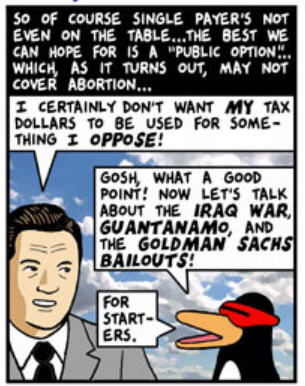
Bill Kristol 's Ego Tells Him to Go on Jon Stewart Again and We Are All Better For it
Bill Kristol, Blanche Lincoln, Chuck Grassley, Daily Show, Eric Cantor, Health Care Reform, Jim DeMint, John Kyl, Max Baucus, Politics, Susan CollinsNote to Kristol:
Hire Publicist.
Fire Publicist.
jt
 The New York Herald Sun