Politics
Inside the Mind of the G.O.P. | J.D. Hayworth Blames Soros and Schumer For Financial Meltdown
bailout, Banking, Chris Matthews, Chuck Schumer, Financial Meltdown, George Soros, GOP, Politics, Right-Wing Talking Points, Stimulus Package, Those Wacky RepublicansStimulus: How to Know If It's Working
Barack Obama, D.C. Groupthink, Economic Stimulus, GOP, Jobs, Media Misinformation, PoliticsFebruary 11, 2009
Consumer confidence and job creation may be slow to emerge and hard to measure, but boosts in umemployment benefits and food stamps will be fast acting
By Moira Herbst
At his first prime-time press conference, President Obama was asked a central question about the $800 billion-plus economic stimulus package: How will Americans know if it’s working? “My initial measure of success is creating or saving 4 million jobs,” Obama answered.
That was on Feb. 9, a day before the Senate passed an $838 billion version of the bill by a vote of 61-37, following the Jan. 28 passage of an $819 billion version in the House. The House and Senate have begun negotiations to reconcile the measures, which Obama would like to sign into law by Feb. 16, the federal Presidents’ Day holiday. When people have a job, Obama explained, they purchase and invest, allowing companies to do the same and, in turn, to hire more workers as business expands.
Indicators of Success
Yet while job creation is arguably the most important goal of the stimulus package, other parts of the bill will have a much more immediate and visible impact. Food stamp increases and extensions of unemployment benefits will be among the first noticeable effects of the package. Tax credit payments for individuals and families would follow, along with other tax breaks and incentives. Rising consumer confidence and lower unemployment will be far more gradual, and aren’t likely to surface until late 2009 at the earliest.
There’s an understanding among many economists that the sooner a government intervenes in an economic crisis, the more effective it tends to be in getting the economy back on track. That doesn’t mean that precise measurement of success is easy, however. “The problem is, we don’t know what trajectory the economy would take without the stimulus package,” says J. Bradford DeLong, an economics professor at the University of California-Berkeley. “We can’t enter a Star Trek-like divided universe in which we compare what’s happening with the stimulus versus without it. It’s hard to precisely judge its impact.”
DeLong says that looking at interest rates will provide a clearer idea of whether the stimulus plan is working. “If interest rates stay extremely low, the plan is definitely working,” he says. “If Treasury interest rates do start to rise by more than normal levels, then we worry that [the spending] is crowding out private economic activity and discouraging investment.” Specifically, he says that if medium- to long-term Treasury bond interest rates climb two or three percentage points higher in the next year and inflation sets in, the stimulus package is not having its intended effect.
Swift Help for the Neediest
Of course, how one benefits from the stimulus package depends on several factors, including income, professional skills, and where you live. “What you’ll see [in benefit] and when you see it depends on who you are,” says Steve Ellis, vice-president at Taxpayers for Common Sense, a taxpayer advocacy group. “If you are living hand-to-mouth, you should have greater access to food stamps and other assistance right away. If you’re employed and not doing as well but hanging on, you won’t see much change unless a [federally funded] construction project starts up nearby. For them, the government hand will be less visible and less direct.”
Direct assistance for the poor and unemployed, considered as among the most effective stimulus measures, will be the first to take effect. Both the House and Senate bills offer an additional $20.2 billion to extend emergency unemployment benefits for more than 3 million people whose state benefits are set to run out after March. They also offer an extra $25 a week in jobless benefits to millions of workers through the end of the year; the current average weekly benefit is $293.
The packages also would give $7 billion to states that adopt reforms that make it easier for part-time workers, low-wage earners, and women to qualify for benefits. The proposals vary in the amounts by which they would increase food stamp benefits and additional medical assistance for low-income, unemployed workers under Medicaid, but both include spending for these items. An additional $17 billion in the stimulus bills would boost the maximum Pell Grant for higher education by $400 per applicant and provide other financial aid. Along with extended benefits, the unemployed may start to see shorter lines at the unemployment office. Both stimulus bills give states $500 million to help process unemployment applications, which have been overwhelming state systems across the country.
Tax Credits and State Aid
Working and middle-income Americans will benefit from the $82.1 billion in tax credit payments the plans offer. The House plan would give individuals earning up to $75,000 a year a tax credit of $500 and couples earning up to $150,000 a year a tax credit of $1,000. (The Senate bill lowers the income cap to $70,000 for individuals and $140,000 for couples, which critics say would reduce the stimulus effect.) Taxpayers can receive this credit either by claiming a credit on their 2009 and 2010 tax returns or by reducing their withholding from their paychecks. Other tax incentives to encourage auto and home purchases, included in the Senate bill, would be experienced by consumers at the time of purchase.
Later this year, the effects of other spending will become more visible. The bills offer states tens of billions in “state stabilization” money, to fund grants for education and to patch holes that have emerged in many state budgets. (The House bill sets aside $79 billion in state stabilization funds, the Senate bill cuts that to $39 billion.) Another $3 billion is earmarked for state and local law enforcement.
In the meantime, the stimulus plans are expected to create or save jobs in various sectors of the economy. The nonpartisan Congressional Budget Office estimated that the House version of the bill would create between 1.3 million and 3.9 million jobs by the end of 2010. While police officers and teachers might feel the effect immediately, other workers would find jobs later this year on such projects as modernizing electrical grids, building highways, and weatherizing federal buildings.
Metrics May Prove Elusive
Mark Zandi, chief economist at Moodys.com (MCO), says that if the package works according to Washington’s plan, unemployment insurance claims should start to drop in the summer and continue through the fall. He warns, however, that the unemployment rate will be slower to fall because layoffs will offset some of the gains. Some economists say that even as the unemployment rate does begin to fall, it will be hard to measure what would have happened without the economic stimulus plan.
The stimulus is likely to provoke heated “Did it work?” debates for years to come among politicians, economists, and the public. “We are throwing a rock into our nation’s economic pond, and the ripple effects will spread throughout the economy,” says Ellis of the taxpayer group. Still, he says the impact might be more muted than many would hope: the annual U.S. gross domestic product is $13 trillion, while the stimulus package is about $900 billion over several years. Says Ellis: “It’s a big rock, but it’s a very big pond.”
Herbst is a reporter for BusinessWeek in New York.
The Crimes of George W. Bush [Video]
9/11, Ari Fleisher, Barack Obama, Bechtel, Bin Laden, Blackwater USA, Broadcatching, Carlyle, CPA, Dan Senor, David addinton, Elliot Abrams, Erik Prince, Extraordinary Rendition. Illegal, FISA, Frodo, Gonzalez, Guantanamo, Halliburton, Iraq, John Ashcroft, John Yoo, Karl Rove, KBR, Kristol, Military Commisions, Paul Bremer, Perle, PNAC, Politics, Rice, Rumsfeld, Scooter Libby, Torture, Truth Commision, Tullycast, U.S. Attorney Scandal, Valerie Plame, Vengeance Cnard, Wall Street, Waterboarding, Wiretapping, WolfowitzFormer White House Spokesman Ari Fleischer Conveniently Forgets About George W. Bush's Favorite Gay Escort : Jeff Gannon / James Dale Guckert
Ari Fleischer, CIA, Gay GOP, George W. Bush, GOPUSA, Howard Kurtz, Jeff Gannon/James Guckert, Joe Wilson, Niger, Politics, Talon News, YellowcakeTHINK PROGRESS has this piece up today mentioning the elusive and shadowy figure- Jeff Gannon..
Here’s an excerpt:
If Bush was relying on Fleischer to screen the “dotcoms and oddballs,” he was poorly served. Take, for example, case of Jeff Gannon, the male escort-turned-White House correspondent for the right-wing news outlet Talon News. The White House press office granted Gannon access to the White House under an assumed name and with no background check. Once Gannon got in the door under Fleischer’s watch in 2003, he was called on by Bush at a press conference in January 2005. Gannon lobbed Bush a softball:
GANNON: Senate Democratic leaders have painted a very bleak picture of the U.S. economy. … Yet in the same breath they say that Social Security is rock solid and there’s no crisis there. … [H]ow are you going to work with people who seem to have divorced themselves from reality?
Here’s my piece from 2005:
BY JOHN TULLY
THE LOS ANGELES SUN
FEB 23 2005
A weekend journalism-school reporter, using a fake name, was given access to the President of the United States at White House press briefings before he even worked for any news organization.
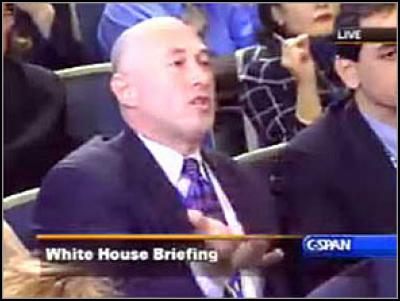
He claims that he has seen a confidential, so-called C.I.A. document which reveals the name of former Ambassador Joseph Wilson’s wife and shows her recommending him for the trip to Niger to investigate yellowcake uranium sales to the Iraqis.
It turns out that Secret Service has been waving James Guckert by the guardhouse for two and a half years and once inside, he became Jeff Gannon. He wrote for a fake website, Talon News, run by Republican strategist Bobby Eberle and the organization GOPUSA.
To understand how something like this could Not be a story, that this could happen to begin with, is to understand how The District of Columbia really runs. However, one can only watch and wait as the laws of physics begin to rear their ugly head. Try as they might and for whatever reason, The Mainstream Media (as good of a description as any) just can’t keep this monster down.
Howard Kurtz, the longtime and wise sage media critic with The Washington Post, trusted by little old Quaker ladies in Cleveland Park D.C. and lobbyists alike, just could not figure out what the big fuss was all about and immediately chalked it up to over-eager WWW types and their preoccupation with the salacious part of the story.
Oh that.The Great Diversion and the reason why non-political junkies in America are apparently not talking about this story is that this fella’ publicly advertised his services as a male prostitute on numerous sites on the Internet and registered and launched numerous gay male pornographic websites.
Really.
CNN’s Aaron Brown, so brilliant in his earlier years on the old ABC overnight news program, pooh-poohed the scandal as a bit of “so what”. On Wolf Blitzer’s “Hard News” program, Mr. Guckert/Gannon was treated almost softly, as if not to upset.
The New York Times finally ran the story, deep in the back pages on Friday, Feb 11th, more than a week after website journalists began to fully reveal this fake journalist’s deceptions.The shockjock mentality came out instantly in the groupthink mainstream media with a curious mix of apathy and frat-boy jokes.
There was no outrage to be outraged over. Meanwhile, writers on web sites like The Daily Kos, David Brock’s Media Matters and John Aravosis’s America Blog, among others, had been doing their own journalism and found out that Mr. Guckert was not who or what he appeared to be. They started their dig after witnessing a press briefing by the President back in late January. A strange reporter asked a clearly partisan question / pronouncement that, among other things, stated that the Democrats were “divorced from reality”.
They got dirt all right.
Columnists Frank Rich and Maureen Dowd finally had to write cute pieces about the mess nearing the end of last week. Katie, Matt, and The Today Show eventually did a quick three- minute story in the first hour last Wednesday. Radio man Don Imus couldn’t get anyone to bite and wondered aloud about the titillating aspect of the thing.
This was now more than ten days since the story had broken, or hadn’t broken. No one was even discussing, outside of the Web, the nasty business of the C.I.A. memo that Mr.Guckert had claimed to have seen or knew about right there on Mr. Blitzer’s show.
Links to web sites where Mr. Guckert solicited clients for sex were widely available at the very same time Mr. Blitzer was tripping all over himself to give Mr. Guckert an Easypass.Ultimate Washington insider Mary Matalin, Vice President Cheney’s sometimes consultant, told Imus that she just wished Ms. Dowd would just come in from the cold and get with the program.
Why did President Bush and Scott McClellan, the President’s spokesman, call on Mr. Guckert/Gannon so often in those two and a half years and how could other reporters not write about Talon News and GOPUSA’s illegitimacy? Veterans of the White House beat sometimes don’t see a question for years. Was he a plant?
But just like the high school sophomores that they are, the Washington Press Corps have hemmed and hawed and giggled their way for weeks now through a real-live genuine scandal unfurling at the White House. Waving their collective finger, they dismissed the whole affair in full. It was simply The Bloggers and their liberal retribution for the Rather/CBS assassination and a lurid fascination with the X-rated angle thrown in for good measure.
Now the simply idiotic Bush-Tapes story, along with a long weekend and a brilliant fake-outrage campaign over a congressman’s comments about Karl Rove, is threatening to bury forever a story that the entire profession of journalism would like to pretend was never born to begin with.
Everyone seems to be looking around at each other and tsk-tsking the lack of outrage on each other’s part, as if to say “This is terrible -someone do some real reporting”.
“Someone did – as Mr. Bush would say, on the “Internets”.
Stay Tuned.
ALSO IN:
More Tully:
Paul Krugman: "On the Edge"
Barack Obama, D.C., Economy, Federal Reserve, Finance, GOP, Larry Summers, Media, Paul Krugman, Politics, Republicans, Stimulus Bill, Tim GeithnerOp-Ed Columnist
A not-so-funny thing happened on the way to economic recovery. Over the last two weeks, what should have been a deadly serious debate about how to save an economy in desperate straits turned, instead, into hackneyed political theater, with Republicans spouting all the old clichés about wasteful government spending and the wonders of tax cuts.
It’s as if the dismal economic failure of the last eight years never happened — yet Democrats have, incredibly, been on the defensive. Even if a major stimulus bill does pass the Senate, there’s a real risk that important parts of the original plan, especially aid to state and local governments, will have been emasculated.
Somehow, Washington has lost any sense of what’s at stake — of the reality that we may well be falling into an economic abyss, and that if we do, it will be very hard to get out again.
It’s hard to exaggerate how much economic trouble we’re in. The crisis began with housing, but the implosion of the Bush-era housing bubble has set economic dominoes falling not just in the United States, but around the world.
Consumers, their wealth decimated and their optimism shattered by collapsing home prices and a sliding stock market, have cut back their spending and sharply increased their saving — a good thing in the long run, but a huge blow to the economy right now. Developers of commercial real estate, watching rents fall and financing costs soar, are slashing their investment plans. Businesses are canceling plans to expand capacity, since they aren’t selling enough to use the capacity they have. And exports, which were one of the U.S. economy’s few areas of strength over the past couple of years, are now plunging as the financial crisis hits our trading partners.
Meanwhile, our main line of defense against recessions — the Federal Reserve’s usual ability to support the economy by cutting interest rates — has already been overrun. The Fed has cut the rates it controls basically to zero, yet the economy is still in free fall.
It’s no wonder, then, that most economic forecasts warn that in the absence of government action we’re headed for a deep, prolonged slump. Some private analysts predict double-digit unemployment. The Congressional Budget Office is slightly more sanguine, but its director, nonetheless, recently warned that “absent a change in fiscal policy … the shortfall in the nation’s output relative to potential levels will be the largest — in duration and depth — since the Depression of the 1930s.”
Worst of all is the possibility that the economy will, as it did in the ’30s, end up stuck in a prolonged deflationary trap.
We’re already closer to outright deflation than at any point since the Great Depression. In particular, the private sector is experiencing widespread wage cuts for the first time since the 1930s, and there will be much more of that if the economy continues to weaken.
As the great American economist Irving Fisher pointed out almost 80 years ago, deflation, once started, tends to feed on itself. As dollar incomes fall in the face of a depressed economy, the burden of debt becomes harder to bear, while the expectation of further price declines discourages investment spending. These effects of deflation depress the economy further, which leads to more deflation, and so on.
And deflationary traps can go on for a long time. Japan experienced a “lost decade” of deflation and stagnation in the 1990s — and the only thing that let Japan escape from its trap was a global boom that boosted the nation’s exports. Who will rescue America from a similar trap now that the whole world is slumping at the same time?
Would the Obama economic plan, if enacted, ensure that America won’t have its own lost decade? Not necessarily: a number of economists, myself included, think the plan falls short and should be substantially bigger. But the Obama plan would certainly improve our odds. And that’s why the efforts of Republicans to make the plan smaller and less effective — to turn it into little more than another round of Bush-style tax cuts — are so destructive.
So what should Mr. Obama do? Count me among those who think that the president made a big mistake in his initial approach, that his attempts to transcend partisanship ended up empowering politicians who take their marching orders from Rush Limbaugh. What matters now, however, is what he does next.
It’s time for Mr. Obama to go on the offensive. Above all, he must not shy away from pointing out that those who stand in the way of his plan, in the name of a discredited economic philosophy, are putting the nation’s future at risk. The American economy is on the edge of catastrophe, and much of the Republican Party is trying to push it over that edge.
Numerous Myths and Falsehoods Advanced by the Media in Their Coverage of the American Recovery and Reinvestment Act
American Recovery and Reinvestment Act, Banking, Beltway Groupthink, D.C., Finance, GOP, Infrastructure, Jobs, Media, Media Matters, Politics, Propaganda, Republicans, Stimulus Bill
Media Matters for America previously identified numerous myths and falsehoods advanced by the media in their coverage of the American Recovery and Reinvestment Act. As debate on the bill continues in Congress, other myths and falsehoods advanced by the media about the recovery package have risen to prominence. These myths and falsehoods include: the assertion that the bill will not stimulate the economy — including the false assertion that the Congressional Budget Office (CBO) said the bill will not stimulate the economy; that spending in the bill is not stimulus; that there is no reason for stimulus after an economic turnaround begins; that corporate tax rate cuts and capital gains tax rate cuts would provide substantial stimulus; and that undocumented immigrants without Social Security numbers could receive the “Making Work Pay” tax credit provided in the bill.

1. The bill will not stimulate the economy
In a February 1 article, The Associated Press reported an assertion by Senate Minority Leader Mitch McConnell (R-KY) that the recovery bill will not stimulate the economy without noting that the CBO disagrees. ABC World News anchor Charles Gibson echoed this assertion during his February 3 interview with President Obama, stating: “And as you know, there’s a lot of people in the public, a lot of members of Congress who think this is pork-stuffed and that it really doesn’t stimulate.” Additionally, on the January 28 edition of his show, nationally syndicated radio host Rush Limbaugh allowed Rep. Eric Cantor (R-VA) to falsely claim of the bill: “Even the Congressional Budget Office, controlled by the Democrats now, says it is not a stimulative bill.” Fox News host Sean Hannity repeated this claim on the February 2 broadcast of Fox News’ Hannity, asserting that the CBO “say[s] it’s not a stimulus bill.”
In fact, in analyzing the House version of the bill, H.R. 1, and the proposed Senate version, the CBO stated that it expects both measures to “have a noticeable impact on economic growth and employment in the next few years.” Additionally, in his January 27 written testimony before the House Budget Committee, CBO director Douglas Elmendorf said that H.R. 1 would “provide massive fiscal stimulus that includes a combination of government spending increases and revenue reductions.” Elmendorf further stated: “In CBO’s judgment, H.R. 1 would provide a substantial boost to economic activity over the next several years relative to what would occur without any legislation.”
2. Government spending in the bill is not stimulus
Several media figures, including CNN correspondent Carol Costello, CBS Evening News correspondent Sharyl Attkisson, and ABC World News anchor Charles Gibson, have all uncritically reported or aired the Republican claim that, in Gibson’s words, “it’s a spending bill and not a stimulus,” without noting that economists have said that government spending is stimulus. Indeed, in his January 27 testimony, Elmendorf explicitly refuted the suggestion that some of the spending provisions in the bill would not have a stimulative effect, stating: “[I]n our estimation — and I think the estimation of most economists — all of the increase in government spending and all of the reduction in tax revenue provides some stimulative effect. People are put to work, receive income, spend that on something else. That puts somebody else to work.” Additionally, Dean Baker, co-director of the Center for Economic and Policy Research, has said, “[S]pending is stimulus. Any spending will generate jobs. It is that simple.”
3. There is no reason for stimulus after a turnaround begins
McCain Not So Much in Support of Palin For 2012
GOP, John McCain, Politics, Sarah Palin
(CNN) — Sen. John McCain said Sunday he would not necessarily support his former running mate if she chose to run for president.
Speaking to ABC’s “This Week,” McCain was asked whether Alaska Gov. Sarah Palin could count on his support.
“I can’t say something like that. We’ve got some great other young governors. I think you’re going to see the governors assume a greater leadership role in our Republican Party,” he said.

He then mentioned governors Tim Pawlenty of Minnesota and Jon Huntsman of Utah.
McCain said he has “the greatest appreciation for Gov. Palin and her family, and it was a great joy to know them.”
“She invigorated our campaign” against Barack Obama for the presidency, he said.
McCain was pressed on why he can’t promise support for the woman who, just months ago, he named as the second best person to lead the nation.
“Have no doubt of my admiration and respect for her and my view of her viability, but at this stage, again … my corpse is still warm, you know?” he replied.
In his first Sunday political TV appearance since November 4, McCain also promised to work to build consensus in tackling America’s challenges, and criticized his own party for its latest attack on Obama.
McCain rejected complaints from the Republican National Committee that Obama has not been transparent about his contacts with Illinois Gov. Rod Blagojevich.
“I think that the Obama campaign should and will give all information necessary,” McCain told ABC’s “This Week.”
“You know, in all due respect to the Republican National Committee and anybody — right now, I think we should try to be working constructively together, not only on an issue such as this, but on the economy, stimulus package, reforms that are necessary.”
McCain‘s answer came in response to a question about comments from RNC Chairman Mike Duncan. The RNC also released an Internet ad last week, titled “Questions Remain,” suggesting Obama is failing to provide important information about potential links between his associates and Blagojevich.
Blagojevich was arrested Tuesday and charged with trying to trade Obama’s Senate seat for campaign contributions and other favors.
“I don’t know all the details of the relationship between President-elect Obama’s campaign or his people and the governor of Illinois,” McCain told ABC. “But I have some confidence that all the information will come out. It always does, it seems to me.”
McCain said he, like Obama and many other lawmakers, believes Blagojevich should resign.
Despite the heated nature of the race and attacks both former candidates lobbed at each other, McCain emphasized that he plans to focus on pushing lawmakers past partisan politics.
“I think my job is, of course, to be a part of, and hopefully exert some leadership, in the loyal opposition. But I emphasize the word loyal,” McCain said.
“We haven’t seen economic times like this in my lifetime. We haven’t seen challenges abroad at the level that we are experiencing, certainly since the end of the Cold War, and you could argue in some respects that they’re certainly more complex, many of these challenges. So let’s have our first priority where we can work together…
“Will there be areas of disagreement? Of course. We are different parties and different philosophy. But the nation wants us to unite and work together.”
McCain said he wouldn’t comment on whether he thought he had a good chance of winning the presidency, given the Bush administration and the GOP were perceived to be responsible for the economy’s problems. McCain said he would “leave that question” for others “to make that kind of judgment.”
He pointed out that his poll numbers dropped along with the Dow.
“That would sound like I am detracting from President-elect Obama’s campaign. I don’t want to do that… Nobody likes a sore loser.”
The key to moving past the stinging defeat, he said, is to, “Get busy and move on. That’s the best cure for it. I spent a period of time feeling sorry for myself. It’s wonderful. It’s one of the most enjoyable experiences that you can have.
“But the point is: You’ve got to move on… I’m still a senator from the state of Arizona. I still have the privilege and honor of serving this country, which I’ve done all my life, and it’s a great honor to do so.”
Congresswoman Wants To Bring Fairness Doctrine To Cable; Hannity/Hume Spontaneously Combust
Brit Hume, Cable, Chris Wallace, Douchebags, Fairness Doctrine, FOX News, Media, Politics, Radio, Roger Ailes, Rupert Murdoch, Sean Hannity, TelevisionSan Francisco Peninsula Press Club
Congresswoman Anna Eshoo, D-Palo Alto, said Monday she will work to restore the Fairness Doctrine and have it apply to cable and satellite programming as well as radio and TV.
“I’ll work on bringing it back. I still believe in it,” Eshoo told the Daily Post in Palo Alto.
The Fairness Doctrine required TV and radio stations to balance opposing points of view. It meant that those who disagreed with the political slant of a commentator were entitled to free air time to give contrasting points of view, usually in the same time slot as the original broadcast.
The doctrine was repealed by the Reagan administration’s Federal Communications Commission in 1987, and a year later, Rush Limbaugh’s show went national, ushering in a new form of AM radio.
Conservative talk show hosts fear the doctrine will result in their programs being canceled because stations don’t want to offer large amounts of air time to opponents whose response programs probably wouldn’t get good ratings.
Eshoo said she would recommend the doctrine be applied not only to radio and TV broadcasts, but also to cable and satellite services.
“It should and will affect everyone,” she said.
She called the present system “unfair,” and said “there should be equal time for the spoken word.” (Photo credit: Ian Port, Daily Post)

President-Elect Obama's Nuclear Decision
Barack Obama, Nuclear, PoliticsNuclear weapons decision awaits Obama
OAK RIDGE, Tenn. — One of the most important national security decisions facing President-elect Barack Obama will unfold in this remote valley of aging factories, where workers enriched uranium for the first atomic bomb of World War II.
The site is a linchpin in a hotly contested Bush administration plan to build the first new U.S. warheads since the end of the Cold War. Following Congress’ demand that decisions on new warheads be deferred until an assessment of U.S. nuclear weapons needs is finished next year, the issue is set to come to a head early in Obama’s presidency.
The outcome will determine whether Oak Ridge focuses on maintaining existing warheads and storing uranium from weapons pulled out of a shrinking arsenal — or whether it becomes a cornerstone in a new production enterprise. The implications go far beyond Oak Ridge and the seven other research and manufacturing compounds nationwide that make up the U.S. nuclear weapons production complex.
“This is not just a decision about the future of U.S. nuclear weapons, but about how the United States will address the challenges of … nuclear terrorism, nuclear proliferation and our entire 21st-century nuclear strategy,” says Clark Murdock, a senior adviser at the Center for Strategic and International Studies.
“These challenges have been maturing for some time, and the Obama administration is going to have to deal with them,” adds Murdock, a former staffer for the Pentagon and Congress.
During the campaign, Obama said that he seeks “a world without nuclear weapons,” but he also said that the nation must “always maintain a strong (nuclear) deterrent as long as nuclear weapons exist.”
Among other things, Obama has promised to strengthen non-proliferation programs, reach disarmament deals with Russia and bolster sanctions against North Korea, Iran and other states with rogue nuclear programs. He has vowed to seek a verifiable global ban on production of nuclear weapons material — and to “stop the development of new nuclear weapons.”
Obama’s statements offer no definitive stance on the Bush plan to build a new breed of warheads. His transition office declined to elaborate further.
Those on both sides of the issue say his comments leave room for him to support their positions.
Debating deterrence
The Bush plan focuses on producing a “Reliable Replacement Warhead,” or RRW, which the administration touts as a better, more durable substitute for warheads in the U.S. stockpile. The new warhead would have features to ensure it could not be detonated if stolen by terrorists or other foes.
The warhead “is about the future credibility of our nuclear deterrent,” Defense Secretary Robert Gates said in an October speech.
Great Britain, France, Russia and China are modernizing their nuclear arsenals, Gates said, and the United States must follow suit. As a signer of the nuclear test ban treaty, the United States cannot detonate its nuclear weapons to see whether age has weakened them. That means, he said, that sharp cuts in U.S. warheads required by disarmament treaties raise questions about the power of remaining weapons.
“There is no way we can maintain a credible deterrent and reduce the number of weapons in our stockpile without either resorting to testing …or pursuing a modernization program,” Gates said.
Gates’ comments, made before he agreed to stay on as Defense secretary for Obama, don’t necessarily reflect the new administration’s views.
Congress is skeptical. After providing money previously for warhead research, it refused this year to pay for further development. Lawmakers cited recent studies that found no immediate threat that the aging of warheads and other critical weapons components has significantly eroded their capabilities.
Members of both parties said it would be wrong to embark on a major, multibillion-dollar program to produce a new warhead without determining what sort of nuclear weapons the nation will need in future years, how many will be required and how they will be used. So Congress required the independent review that’s due next year.
“We have to make certain that our nuclear deterrent is reliable … but the decision (on new production) has to be made in the context of all the national security issues we face, including non-proliferation,” says Sen. Byron Dorgan, D-N.D., head of a Senate appropriations subcommittee that controls nuclear weapons spending.
Building the warhead could affect Obama’s goal of getting other nations to curb nuclear programs, he says. “It’s our responsibility to be a leader in trying to, first, stop the spread of nuclear weapons, and second, in reducing the number of nuclear weapons on the planet.”
Indeed, any move on warhead production will come in the context of several other big, international decisions Obama will face on nuclear weapons policy during his first term. Among them: whether to extend or renegotiate the Strategic Arms Reduction Treaty with Russia, which expires at the end of 2009, and whether to push for ratification of the Comprehensive Nuclear Test Ban Treaty, which the United States complies with voluntarily.
Obama’s challenge
Obama has signaled he will give great weight to the implications that resuming warhead production might have on his non-proliferation agenda.
In an article in the July/August issue of Foreign Affairs, then-candidate Obama wrote of “de-emphasizing” the role of nuclear weapons worldwide and said “America must not rush to produce a new generation of nuclear warheads.” More recently, he chose former Georgia senator Sam Nunn, an ardent advocate of reducing global nuclear weapons inventories, to advise his transition team.
The question of whether to adopt the Bush administration’s plans “will be one of the most momentous (nuclear policy) decisions since the end of the Cold War … and Obama has spoken in support of moving toward a nuclear weapons-free world,” says Susan Gordon, president of the Alliance for Nuclear Accountability, a coalition of nuclear watchdog groups.
The new warhead has more capabilities than current warheads, she adds, and would “move us further down this road of a world of nuclear haves and have-nots.”
Advocates of the new warhead say it can help Obama’s agenda to prevent the spread of nuclear weapons.
“This isn’t about building new weapons — exotic bunker busters or suitcase bombs — but reliable, more secure and less costly weapons,” says Sen. Pete Domenici, R-N.M. The warhead “would allow deeper cuts in our nuclear stockpile” because remaining weapons would be more dependable.
“If you believe nuclear weapons are still relevant, RRW is a good thing. If you believe they should go away, it’s a great thing,” says Robert Smolen, deputy administrator of the National Nuclear Security Administration, which runs the weapons complex.
Some lawmakers who will review any decision Obama makes aren’t ready to back that argument.
“My fear is, for all our talk and our actions (on non-proliferation), the international perception will be that we simply want to proceed with a new weapon,” says Rep. Pete Visclosky, D-Ind., who chairs a House panel that oversees the weapons complex.
Obama’s challenge is working with Congress to set a weapons policy that is consistent with U.S. security needs and broader goals of limiting nuclear weapons, he adds. “It’s not just a burden, it’s a fundamental opportunity.”
 The New York Herald Sun