Conservative Democrats Signal They Won’t Block Public Option

Aetna, Alan Grayson, Barack Obama, Betsy McCaughey, Bill Nelson, Broadcatching, Charles Grassley, Cigna, Congress, Dylan Ratigan, FOX News, GOP, Health Care Reform, Howard Dean, Kent Conrad, Max Baucus, Rahm Emmanuel, Republicans, Rick Scott, Senate, Shepherd Smith, United Health

R A W  S T O R Y
By John Byrne
Friday, October 23rd, 2009 — 8:07 am

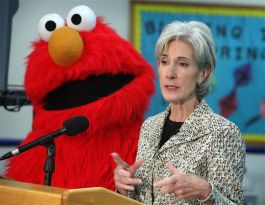
elmo-swine-flu-ads

Conservative Democrats signal they wont block public optionSupport for including some version of a public option in the Senate’s version of a healthcare overhaul appears to be solider than initially believed.

In a series of comments that have received little attention, conservative Democratic senators — even those who’ve publicly said they oppose a public option — say they are unlikely to join a Republican filibuster to block it. Under Senate rules, Democrats would need to convince 60 members to support the ability to vote on healthcare legislation with the public option (cloture), and then just 51 to pass it.

Sen. Mary Landrieu (D-LA) told a reporter earlier this week that she wouldn’t join Republicans in voting against cloture.

“I’m not right now inclined to support any filibuster,” Landrieu said.

“For the Republican Party to kind of step out of the game is very unfortunate,” she added, referring to the Senate Republicans’ intransigence on healthcare reform proposals. “I’m not going to be joining people that don’t want progress.”
Story continues below…

Indeed, Landrieu’s sentiment — that joining foes of healthcare reform would be an impediment to progress — may be the catnip that keeps Democrats on board.

Sen. Mark Pryor (R-AR), a moderate Democrat from the South, said Thursday he was open to some form of a government-run health insurance competitor.

“It depends on how it’s structured on whether I can support it,” Pryor remarked. “I just haven’t decided.”

But regardless of how he votes on the final package, he says he won’t join Republicans in filibustering the bill. Tellingly, he also signaled that he didn’t believe any other Democrats would either.

“I don’t think you’ll see me or any other Democrats do that,” Pryor told liberal blogger Mike Stark.

One conservative Democrat refused to tip his hand. Nebraska Sen. Ben Nelson (D-NE) occasionally joins Republicans on controversial issues.

“I believe in playing chess, but that’s about three moves ahead of me, and I’m not prepared to make those moves until I see some other moves in between,” Nelson told a reporter this week.

Jake Thompson, Nelson’s Communications Director, told Raw Story that he “would decline to comment” about how Nelson will react to a potential Republican filibuster.

Arlen Specter (D-PA) has said he’ll support a public option as well. Specter defected from the Republican Party to the Democrats earlier this year, against the backdrop of a tough primary challenge from his right. In an interview Thursday evening with MSNBC’s Ed Schultz (video below), he sounded confident that Democrats had the 60 votes to prevail.

“We have 60 votes without Sen. Snowe, so we can still invoke cloture and move to a vote on the public option,” Specter said. “With 50 votes plus the Vice President and my vote is going to be for the public option, robust public option, we can get it passed, even without Sen. Snowe. I hope we have her, but we may be able to do it without her.”

Sen. Olympia Snowe (R-ME) was the only Republican to join ranks with Democrats in approving a version of healthcare legislation that passed through the Senate Finance Committee. That version didn’t include a public option.

That said, Democrats need lose only one member to lose the battle for the public option. A 60-vote majority would also need to include independent Sen. Joe Lieberman (I-CT), who’s tangled with Democrats on various issues in the past.

Senate Majority Leader Harry Reid (D-NV) won’t say how many votes he has in his arsenal on a government run plan. In a statement Thursday evening, he said only that he was looking to pass a bill with as many votes as possible.

“We’ll continue to work together to seek broad consensus on the key issues before us and to craft the strongest possible bill that can garner 60 votes,” Reid said. “We will also continue to do our best to represent the views of all members of the Senate who have a genuine desire to see reform succeed. But our mission is clear: the American people want quality, affordable health insurance and failure is not an acceptable option. I am optimistic that we are close to laying a proposal before the full Senate that will do just that.”

In the House, some version of a public option is almost certain to pass. The version will likely be more liberal than that of the Senate’s, as Democrats hold a larger majority in the lower chamber.

President Obama’s position on the public option remains unclear. A Politico report Friday said that Obama prefers a “trigger option,” under which a public insurer would only be created if private insurers fail to meet key pricing standards. The White House, however, says Obama hasn’t taken a position either way.

The following video is from MSNBC’s The Ed Show, broadcast Oct. 22, 2009.

This is Our Last Chance

Aetna, Alan Grayson, Barack Obama, Betsy McCaughey, Bill Nelson, Broadcatching, Charles Grassley, Cigna, Congress, Dylan Ratigan, FOX News, GOP, Health Care Reform, Howard Dean, Kent Conrad, Max Baucus, Rahm Emmanuel, Republicans, Rick Scott, Senate, Shepherd Smith, United Health

Add to FacebookAdd to DiggAdd to Del.icio.usAdd to StumbleuponAdd to RedditAdd to BlinklistAdd to TwitterAdd to TechnoratiAdd to FurlAdd to Newsvine

Why the White House Probably Doesn’t Want a Public Option

Aetna, Alan Grayson, Barack Obama, Betsy McCaughey, Bill Nelson, Broadcatching, Charles Grassley, Cigna, Congress, Dylan Ratigan, FOX News, GOP, Health Care Reform, Howard Dean, Kent Conrad, Max Baucus, Rahm Emmanuel, Republicans, Rick Scott, Senate, Shepherd Smith, United Health

Why the White House Probably Doesn’t Want a Public Option
By: Scarecrow Tuesday October 20, 2009 9:26 pm
F I R E D O G L A K E D O T C O M

The question many health reform advocates have been asking about the public option debate is “what’s the problem”??? Why isn’t the President demanding it, pushing it, selling it? Well, maybe he doesn’t want it.
Why, given strong Congressional majorities in favor of a public option, continuing strong polling support across the country, and overwhelming support from Democratic voters, is Harry Reid treating the matter as though it were a close call?

ap8008120407

To be sure, getting 60 votes for cloture is a challenge, but that is not the same as needing 60 votes for a public option, no matter how many times the media equates the two. Only 5 or 6 Senate Democrats are even opposed in concept. Yet not one of these holdouts has publically declared that he/she would join a filibuster to keep a public option from getting a simple majority-rule vote. Sen. Harkin correctly asks, why should these five be empowered to force over fifty to give in?

Everyone also knows that if Harry Reid puts a viable public option in the Senate bill, there aren’t 60 votes to remove it. So why is Harry Reid behaving as though Democrats had something to fear if they demand party loyalty on a cloture vote and then push through a measure that has more voter support than any health reform measure they’ve proposed outside banning insurers from denying coverage to the sick?

Night after night, we are reminded (thanks to Nancy Pelosi prodding CBO) that a strong public option will save tens of billions, give consumers a choice in an industry that is dangerously concentrated and lacking in competition, and put pressure on insurers to lower premiums in the face of their promises/threats to raise them. Everyone now realizes a strong public plan could provide a credible, government-guaranteed alternative even if the private insurers succeed in evading new government regulations banning their most outrageous practices — practices whose evil effects we see repeated on a daily basis. So what’s the problem?

The Beltway conventional wisdom, steeped in cynicism, is that the White House is being disingenuous when it repeatedly says the President supports a public option. WH officials claim Obama believes it is “the best way” to provide an affordable choice and reduce costs. But then why is he not working to get it adopted in the Senate, and explicitly directing his OFA troops to help that effort? Why has he ducked every opportunity to make even the logical argument that the burden is on detractors to show there’s a better measure? No one has seriously attempted such a case.

In House and Senate leadership efforts to merge their respective bills, it’s curious that no one has noticed that House Speaker Pelosi does not seem to need the White House to tell her how to merge three House bills while improving them. But apparently, Harry Reid is not capable — or cannot be trusted — to merge two Senate bills without having Rahm Emanuel, Peter Orszag and Kathleen Sebelius present every meeting.

There’s nothing wrong with the Senate consulting with the White House about what they’re willing to push and pay for. But the White House told reporters that all the key decisions would be made by Harry Reid. So why are these senior White House people, including the man who sees himself as the center of the universe, there if not to tell Harry Reid what he can and cannot decide?

It is hard to avoid the fear that this White House has now become a principal obstacle to getting meaningful health care reform. It claims it wants major cost reductions in Medicare, via a semi-autonomous cost-cutting commission. But the White House has already bargained away the savings it can achieve from most of the major providers: PhRMa ($80 billion), hospitals ($155 billion) so they can give it back to the doctors (for whom AMA is demanding $240+ billion more over ten years in relief from automatic Medicare reductions).

Why should we not also believe that the White House has a deal to shield insurers from competition by preventing the creation of a public option in exchange for the insurers agreeing to reforms on guaranteed issue and limited community ratings (with the flexibility Baucus provided) and to support this framework with tv ads? (Read Ignagni’s WaPo op-ed today; while defending the PwC study, she says they made a deal, but Baucus broke it; she didn’t say the deal’s off.)

The White House isn’t taking up most of the chairs in Harry’s Reid’s meetings just to watch him make decisions on his own. They’re there to make sure Harry Reid doesn’t undo the White House deals and wander off the reservation.

This President has filled the White House with people who have no inclination to pose any major challenge to the economic power of America’s dominant financial industries (GM being an exception). We’ve already seen this in their dealings with Wall Street investment banks and their too-big-to-fail is too-big-to-challenge approach to financial regulation. We’re seeing it now with efforts to shield the major health and insurance industries from any fundamental challenge.

Sure, there are changes being offered, new regulations being proposed, and more people will be insured than before. But there is no framework being laid for a new structure for how health care is delivered and paid for in America. That is the pattern of this White House, and there is little basis to expect otherwise.

Watch the decisions Harry “makes” in coming days. My bet is they’ll shore up the underlying deals — they’ll make mandated insurance modestly more affordable and fix the mandates a bit, while protecting the insurers from a viable, functioning public option. The industry will still control a system in which consumers will be forced to buy their unreliable products with government subsidies.

And seeing this coming, Nancy Pelosi will push a more reform-minded House to fight back as hard as they can. The House now carries the hopes for even limited reform. Sadly, her opposition is not just the Senate’s 60 vote barrier; it’s in the White House.

Why Do The Insurance Companies Have Anti-Trust Exemption? ~ Rep. Alan Grayson on Olbermann

Aetna, Alan Grayson, Barack Obama, Betsy McCaughey, Bill Nelson, Broadcatching, Charles Grassley, Cigna, Congress, Dylan Ratigan, FOX News, GOP, Health Care Reform, Howard Dean, Kent Conrad, Max Baucus, Rahm Emmanuel, Republicans, Rick Scott, Senate, Shepherd Smith, United Health

Add to FacebookAdd to DiggAdd to Del.icio.usAdd to StumbleuponAdd to RedditAdd to BlinklistAdd to TwitterAdd to TechnoratiAdd to FurlAdd to Newsvine

Need Health Care Reform Blocked? There's an App/Rep. For That

Aetna, Alan Grayson, Barack Obama, Betsy McCaughey, Bill Nelson, Broadcatching, Charles Grassley, Cigna, Congress, Dylan Ratigan, FOX News, GOP, Health Care Reform, Howard Dean, Kent Conrad, Max Baucus, Rahm Emmanuel, Republicans, Rick Scott, Senate, Shepherd Smith, United Health

Shepherd Smith Vs. Bill Nelson

Aetna, Alan Grayson, Barack Obama, Betsy McCaughey, Bill Nelson, Broadcatching, Charles Grassley, Cigna, Congress, Dylan Ratigan, FOX News, GOP, Health Care Reform, Howard Dean, Kent Conrad, Max Baucus, Rahm Emmanuel, Republicans, Rick Scott, Senate, Shepherd Smith, United Health

Add to FacebookAdd to DiggAdd to Del.icio.usAdd to StumbleuponAdd to RedditAdd to BlinklistAdd to TwitterAdd to TechnoratiAdd to FurlAdd to Newsvine

Daschle Withdraws His Nomination to Health and Human Services

Barack Obama, Charles Schumer, Edward Kennedy, HHS, John Kerry, Patrick Leahy, Robert Gibbs, Senate, South Dakota, Taxes, Tom Daschle

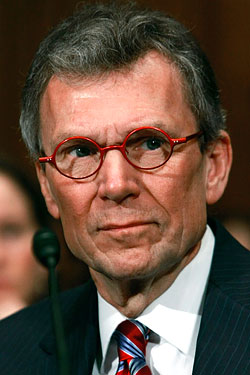
20090202_tom_250x375

(CNN) — Former Sen. Tom Daschle has withdrawn his nomination to head the Department of Health and Human Services, according to a statement Tuesday from the White House.

Daschle had been fighting to save his nomination as HHS secretary following controversy over his tax records and questions over his work in a field that some consider lobbying.

In a statement announcing his withdrawal, Daschle said it was an honor to be chosen to lead the reform of America’s health care system.

“But if 30 years of exposure to the challenges inherent in our system has taught me anything, it has taught me that this work will require a leader who can operate with the full faith of Congress and the American people, and without distraction,” he said.

“Right now, I am not that leader, and will not be a distraction. The focus of Congress should be on the urgent business of moving the president’s economic agenda forward, including affordable health care for every American.”

The Obama administration had stood by his side, and fellow Democrats lined up behind him, but Daschle’s problems, coupled with other nominees’ issues, gave critics ammunition to question President Obama’s call for a “new era of responsibility.”

The president said Tuesday he accepts Daschle’s decision “with sadness and regret.”

“Tom made a mistake, which he has openly acknowledged. He has not excused it, nor do I. But that mistake, and this decision, cannot diminish the many contributions Tom has made to this country, from his years in the military to his decades of public service. Now we must move forward, with our plan to lift this economy and put people back to work,” Obama said in a statement.

Daschle’s resignation came hours after Nancy Killefer’s withdrawal as Obama’s chief performance officer, a new post in the administration.

Officials said privately the reason for Killefer’s withdrawal was unspecified tax issues. The much-touted post was designed to scrub the federal budget.

Daschle, the former Senate majority leader, apologized Monday for failing to pay his taxes in full. He said earlier he was “deeply embarrassed” for a series of errors that included failing to report $15,000 in charitable donations, unreported car service and more than $80,000 in unreported income from consulting.

Daschle recently filed amended tax returns and paid more than $140,000 in back taxes and interest for 2005-2007.

A New York Times editorial on Tuesday called for Daschle to withdraw.

The paper’s editorial board particularly took issue with Daschle saying he identified the unpaid taxes in June but did not pay them until his nomination for the top post at the Department of Health and Human Services.

The editorial also criticized Daschle for generating a sizable income from health-related industries while working in the private sector.

“Mr. Daschle is another in a long line of politicians who move cozily between government and industry. We don’t know that his industry ties would influence his judgments on health issues, but they could potentially throw a cloud over health care reform,” the editorial said.

Shortly after news of the tax quandary broke, a number of Democratic senators released statements expressing their support for Daschle, including Sens. John Kerry of Massachusetts, Charles Schumer of New York, Patrick Leahy of Vermont and Edward Kennedy of Massachusetts. In their opinions, Daschle identified the problem and corrected it.

Daschle’s supporters said that given his record of three decades of public service, he was still the right man for the job.

“One cannot underestimate how widely admired Tom Daschle is in Washington for his integrity, for his public service. And many, many Democrats look to him as one of the favorite people. He’s got a lot of support in this White House, starting with the president,” said David Gergen, a senior political analyst for CNN.

Obama and Daschle have a longstanding relationship. Daschle endorsed Obama for the Democratic presidential nomination in February 2007 — nearly 11 months before the first contest. Daschle was also considered to be a contender for Obama’s No. 2 spot.

Daschle also has a history with members of Congress. He represented South Dakota in the House of Representatives for four terms, and he served in the Senate for three terms. He was the Senate majority leader from June 2001 to January 2003, and was the minority leader before losing his re-election bid in 2004.

Daschle’s work in his post-Senate years was also a point of contention on his path to confirmation.

After leaving the Senate, Daschle went on to serve as a special public policy adviser at the law firm Alston & Bird.

According to the firm’s Web site, Daschle advised clients on “issues related to financial services, health care, energy, telecommunications and taxes.”

His work, for which he reportedly made millions, seemed to contradict Obama’s strict rules on lobbyists working in his administration.

Promising “a new era of openness in our country,” Obama signed executive orders relating to ethics guidelines for staff members as one of his first acts in office.

“If you are a lobbyist entering my administration, you will not be able to work on matters you lobbied on, or in the agencies you lobbied during the previous two years,” the president said.

The administration had defended its choice of Daschle, pointing out that he was not technically a lobbyist.

“If you’re not registered to lobby, you can’t be a lobbyist,” said White House press secretary Robert Gibbs, according to Time.com. Time.com: When is a lobbyist not a lobbyist?

Daschle and Kellifer were not the first of Obama’s nominees to come under scrutiny.

Before Tim Geithner was confirmed as treasury secretary, he was questioned over concerns involving his personal taxes and the immigration status of a former housekeeper.

New Mexico Gov. Bill Richardson also withdrew his nomination to be commerce secretary, citing the distraction of a federal investigation into ties to a company that has done business with his state.

Given Obama’s pledge for “unprecedented transparency, rigorous oversight and clear accountability,” some said the controversy surrounding Obama’s appointments are calling into question the president’s vetting process.

“Mr. President, your picks to help run the federal government don’t have to be perfect, but is it too much to ask that they pay like everyone else, to keep that same government functioning? And more importantly, that they don’t wait until everyone, including you, is watching?” CNN’s Campbell Brown wrote in a commentary. Read the commentary

Asked if the president is embarrassed by the slew of appointment problems, Gibbs was quick to negate that idea.

“No, I don’t think that — that we believe there’s any problem in the vetting,” Gibbs said Monday.


The Official Failures of Rebuilding Iraq

Bechtel, Blackwater, CACI, Commission on Wartime Contracting, Congress, Dick Cheney, DOD, Erik Prince, George W. Bush, Halliburton, Irag, Iraqi Infrastructure, KBR, Lobbyists, Pentagon, Senate, Stuart Bowen Jr., Water
Official history details failures of rebuilding Iraq
Sunday, December 14, 2008
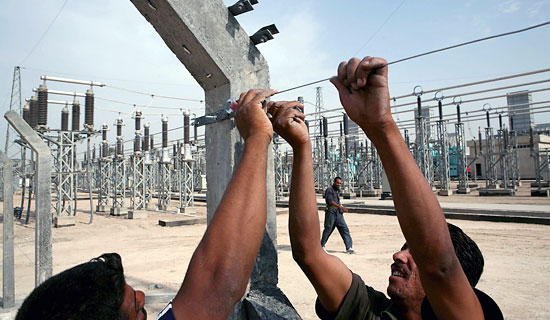
14iraq550

BAGHDAD: An unpublished, 513-page federal history of the U.S.-led reconstruction of Iraq depicts an effort crippled before the invasion by Pentagon planners who were hostile to the idea of rebuilding a foreign country, and then molded into a $100 billion failure by bureaucratic turf wars, spiraling violence and ignorance of the basic elements of Iraqi society and infrastructure.

“Hard Lessons: The Iraq Reconstruction Experience,” the first official account of its kind, is circulating in draft form here and in Washington among a tight circle of technical reviewers, policy experts and senior officials. It also concludes that when the reconstruction began to lag – particularly in the critical area of rebuilding the Iraqi police and army – the Pentagon simply put out inflated measures of progress to cover up the failures.

In one passage, for example, former Secretary of State Colin Powell is quoted as saying that in the months after the 2003 invasion, the Defense Department “kept inventing numbers of Iraqi security forces – the number would jump 20,000 a week! ‘We now have 80,000, we now have 100,000, we now have 120,000.”‘

Powell’s assertion that the Pentagon inflated the number of competent Iraqi security forces is backed up by Lieutenant General Ricardo Sanchez, the former commander of ground troops in Iraq, and L. Paul Bremer 3rd, the top civilian administrator until an Iraqi government took over in June 2004.

Among the overarching conclusions of the history is that five years after embarking on its largest foreign reconstruction project since the Marshall Plan in Europe after World War II, the U.S. government has in place neither the policies and technical capacity nor the organizational structure that would be needed to undertake such a program on anything approaching this scale.

The bitterest message of all for the reconstruction program may be the way the history ends. The hard figures on basic services and industrial production compiled for the report reveal that for all the money spent and promises made, the rebuilding effort never did much more than restore what was destroyed during the invasion and the convulsive looting that followed.

By mid-2008, the history says, $117 billion had been spent on the reconstruction of Iraq, including some $50 billion in U.S. taxpayer money.

The history contains a catalog of new revelations that show the chaotic and often poisonous atmosphere prevailing in the reconstruction effort.

When the Office of Management and Budget balked at the U.S. occupation authority’s abrupt request for about $20 billion in new reconstruction money in August 2003, a veteran Republican lobbyist working for the authority made a bluntly partisan appeal to Joshua Bolten, then the Office of Management and Budget director and now the White House chief of staff. “To delay getting our funds would be a political disaster for the President,” wrote the lobbyist, Tom Korologos. “His election will hang for a large part on show of progress in Iraq and without the funding this year, progress will grind to a halt.” With administration backing, Congress allocated the money later that year.

In an illustration of the hasty and haphazard planning, a civilian official at the U.S. Agency for International Development was at one point given four hours to determine how many miles of Iraqi roads would need to be reopened and repaired. The official searched through the agency’s reference library, and his estimate went directly into a master plan. Whatever the quality of the agency’s plan, it eventually began running what amounted to a parallel reconstruction effort in the provinces that had little relation with the rest of the U.S. effort.

Money for many of the local construction projects still under way is divided up by a spoils system controlled by neighborhood politicians and tribal chiefs. “Our district council chairman has become the Tony Soprano of Rasheed, in terms of controlling resources,” said a U.S. Embassy official working in a dangerous Baghdad neighborhood, referring to the popular TV mob boss. “‘You will use my contractor or the work will not get done.”‘

The United States could soon have reason to consult this cautionary tale of deception, waste and poor planning, as both troop levels and reconstruction efforts in Afghanistan are likely to be stepped up under the new administration.

The incoming Obama administration’s rebuilding experts are expected to focus on smaller-scale projects and emphasize political and economic reform. Still, such programs do not address one of the history’s main contentions: that the reconstruction effort has failed because no single agency in the U.S. government has responsibility for the job.

Five years after the invasion of Iraq, the history concludes, “the government as a whole has never developed a legislatively sanctioned doctrine or framework for planning, preparing and executing contingency operations in which diplomacy, development and military action all figure.”

“Hard Lessons” was compiled by the Office of the Special Inspector General for Iraq Reconstruction, led by Stuart Bowen Jr., a Republican lawyer who regularly travels to Iraq and has a staff of engineers and auditors based here. Copies of several drafts of the history were provided to reporters at The New York Times and ProPublica by two people outside the inspector general’s office who have read the draft but are not authorized to comment publicly.

Bowen’s deputy, Ginger Cruz, declined to comment for publication on the substance of the history. But she said it would be presented Feb. 2 at the first hearing of the Commission on Wartime Contracting, which was created this year as a result of legislation sponsored by Senators Jim Webb of Virginia and Claire McCaskill of Missouri, both Democrats.

The manuscript is based on about 500 new interviews, as well as more than 600 audits, inspections and investigations on which Bowen’s office has reported individually over the years. Laid out for the first time in a connected history, the material forms the basis for broad judgments on the entire rebuilding program.

In the preface, Bowen gives a searing critique of what he calls the “blinkered and disjointed prewar planning for Iraq’s reconstruction” and the botched expansion of the program from a modest initiative to improve Iraqi services to a multibillion-dollar enterprise.

Bowen also swipes at the endless revisions and reversals of the program, which at various times gyrated from a focus on giant construction projects led by large Western contractors to modest community-based initiatives carried out by local Iraqis. While Bowen concedes that deteriorating security had a hand in spoiling the program’s hopes, he suggests, as he has in the past, that the program did not need much outside help to do itself in.

Despite years of studying the program, Bowen writes that he still has not found a good answer to the question of why the program was even pursued as soaring violence made it untenable. “Others will have to provide that answer,” Bowen writes.

“But beyond the security issue stands another compelling and unavoidable answer: The U.S. government was not adequately prepared to carry out the reconstruction mission it took on in mid-2003,” he concludes.

The history cites some projects as successes. The review praises community outreach efforts by the Agency for International Development, the Treasury Department’s plan to stabilize the Iraqi dinar after the invasion and a joint effort by the Departments of State and Defense to create local rebuilding teams.

But the portrait that emerges overall is one of a program’s officials operating by the seat of their pants in the middle of a critical enterprise abroad, where the reconstruction was supposed to convince the Iraqi citizenry of U.S. good will and support the new democracy with lights that turned on and taps that flowed with clean water. Mostly, it is a portrait of a program that seemed to grow exponentially as even those involved from the inception of the effort watched in surprise.

On the eve of the invasion, as it began to dawn on a few U.S. officials that the price for rebuilding Iraq would be vastly greater than they had been told, the degree of miscalculation was illustrated in an encounter between Donald Rumsfeld, then the defense secretary, and Jay Garner, the retired lieutenant general who had hastily been named the chief of what would be a short-lived civilian authority called the Office of Reconstruction and Humanitarian Assistance.

The history records how Garner presented Rumsfeld with several alternative rebuilding plans, including one that would include projects across Iraq.

“What do you think that’ll cost?” Rumsfeld asked of the more expansive plan.

“I think it’s going to cost billions of dollars,” Garner said.

“My friend,” Rumsfeld replied, “if you think we’re going to spend a billion dollars of our money over there, you are sadly mistaken.”

In a way he never anticipated, Rumsfeld turned out to be correct: Before that year was out, the United States had appropriated more than $20 billion for the reconstruction, which would indeed involve projects across the entire country.

Rumsfeld declined comment on the report, but a spokesman, Keith Urbahn, said quotes attributed to him in the document “appear to be accurate.” Powell also declined to comment.

The secondary effects of the invasion and its aftermath were among the most important factors that radically changed the outlook. Tables in the history show that measures of things like the production of electricity and oil; public access to potable water, mobile and landline telephone service; and the presence of Iraqi security forces all plummeted at least 70 percent, and in some cases all the way to zero, in the weeks after the invasion. Subsequent tables in the history give a fast-forward view of what happened as the avalanche of money tumbled into Iraq over the next five years. By the time a sovereign Iraqi government took over from the Americans in June 2004, none of those services – with a single exception, mobile phones – had returned to prewar levels. And by the time of the security improvements in 2007 and 2008, electricity output had, at best, a precarious 10 percent lead on its levels under Saddam Hussein; oil production was still below prewar levels; and access to potable water had increased about 30 percent, although with the nation’s ruined piping system it was unclear how much actually reached people’s homes uncontaminated.

Whether the rebuilding effort could have succeeded in a less violent setting will never be known. In April 2004, thousands of the Iraqi security forces that had been oversold by the Pentagon were overrun, abruptly mutinied or simply abandoned their posts as the insurgency broke out, sending Iraq down a violent path from which it has never completely recovered.

At the end of his narrative, Bowen chooses a line from “Great Expectations” by Charles Dickens as the epitaph of the U.S.-led attempt to rebuild Iraq: “We spent as much money as we could, and got as little for it as people could make up their minds to give us.”

James Glanz reported from Baghdad, and T. Christian Miller, of the nonprofit investigative Web site ProPublica, reported from Washington.
The Nationalization of the Auto Industry?

Auto Industry, Big Three, Congress, Nationalization, Senate
International Herald Tribune
Taking risks with bailout for U.S. automakers
Tuesday, December 9, 2008

WASHINGTON: When President-elect Barack Obama talked on Sunday about realigning the American automobile industry he was quick to offer a caution, lest he sound more like the incoming leader of France, or perhaps Japan.

“We don’t want government to run companies,” Obama told Tom Brokaw on “Meet the Press.” “Generally, government historically hasn’t done that very well.”

09auto550

But what Obama went on to describe was a long-term government bailout that would be conditioned on government oversight. It could mean that the government would mandate, or at least heavily influence, what kind of cars companies make, what mileage and environmental standards they must meet and what large investments they are permitted to make — to recreate an industry that Obama said “actually works, that actually functions.”

It all sounds perilously close to a word that no one in Obama’s camp wants to be caught uttering: nationalization.

Not since Harry Truman seized America’s steel mills in 1952 rather than allow a strike to imperil the conduct of the Korean War has Washington toyed with nationalization, or its functional equivalent, on this kind of scale. Obama may be thinking what Truman told his staff: “The president has the power to keep the country from going to hell.” (The Supreme Court thought differently and forced Truman to relinquish control.)

The fact that there is so little protest in the air now — certainly less than Truman heard — reflects the desperation of the moment. But it is a strategy fraught with risks.

The first, of course, is the one the president-elect himself highlighted. Government’s record as a corporate manager is miserable, which is why the world has been on a three-decade-long privatization kick, turning national railroads, national airlines and national defense industries into private companies.

The second risk is that if the effort fails, and the American car companies collapse or are auctioned off in pieces to foreign competitors, taxpayers may lose the billions about to be spent.

And the third risk — one barely discussed so far — is that in trying to save the nation’s carmakers, the United States is violating at least the spirit of what it has preached around the world for two decades. The United States has demanded that nations treat American companies on their soil the same way they treat their home-grown industries, a concept called “national treatment.”

Yet so far, there is no talk of offering aid to Toyota, Honda, BMW or the other foreign automakers that have built factories on American soil, employed American workers and managed to make a profit doing so.

“If Japan was doing this, we’d be threatening billions of dollars in retaliation,” said Jeffrey Garten, a professor at the Yale School of Management, who as under secretary of commerce in the 1990s was one of many government officials who tried in vain to get Detroit prepared for a world of international competition. “In fact, when they did something a lot more subtle, we threatened exactly that,” referring to calls for import restrictions.

Garten said he was stunned by the scope of the intervention that Washington was now considering. “I don’t know that we’ve seen anything like this since the government told the automakers what kind of tanks to make during World War II,” he said. “And that was just for the duration of the war — this could be for much, much longer.”

It is hard to measure just what kind of chances Obama may be taking with this plan, in part because so many parts of it are still in motion.

In the short term, Democrats are floating the idea of linking $15 billion in immediate loans to the designation of a “car czar” who, in doling out the money, could require or veto big transactions or investments — essentially a one-man board of directors. The White House indicates that President George W. Bush, who has spent his entire presidency proclaiming that the government’s role is to create an environment that spurs free enterprise and minimizes government regulation, would very likely sign the rescue plan.

The first $15 billion and the car czar who oversees it, however, are only the beginning. “After that, we’re in uncharted water,” said Malcolm Salter, a professor emeritus at Harvard Business School who has studied the auto industry for two decades and, until a few years ago, was an adviser to General Motors and Ford. “Think about this: Who in the federal government would have the tremendous insight needed to fix this industry?”

Depending on how the longer-term revamping of the industry proceeds, Washington could become a major shareholder in the Big Three, it could provide loans, or, in one course that Obama seemed to hint at on Sunday, it could organize what amounts to a “structured bankruptcy.” In that case, the government would convene the creditors, the unions, the shareholders and the company’s management, and apportion a share of the hit to each of them. If that “consensus building” sounds a lot like the role of the Japanese Ministry of International Trade and Industry in the 1970s and the 1980s, well, it is.

To promote the Japanese car industry on the way up, the trade ministry nudged companies toward consolidation, and even tried to mandate which parts of the market each could go into. (Soichiro Honda, the founder of the company, rebelled when bureaucrats told him he was supposed to limit himself to making motorcycles.) By the 1980s, Congress was denouncing this as “industrial policy,” and arguing that it put American makers at a competitive disadvantage — and polluted free enterprise.

Now, it is Congress doing exactly that, but this time as emergency surgery. Other nations will doubtless complain, or begin doing the same for their own companies. “We’re at this moment in history, in which the Chinese are touting that their system is better than ours” with their mix of capitalism and state control, said Garten, who has long experience in Asia. “And our response, it looks like, is to begin replicating what they’ve been doing.”