 ::
::  ::
::  ::
::  ::
::  ::
::  ::
::  ::
::  ::
::  ::
::  ::
:: 
Tullycast
Heady Days, Immortalized Where the Ticker Tape Fell
Stories
September 30, 2004
BLOCKS By DAVID W. DUNLAP
 N the midst of the longest ticker-tape drought in a quarter century, lower Broadway – the Canyon of Heroes – has been paved instead with 164 granite plaques from Bowling Green to the Woolworth Building.
They commemorate ticker-tape parades from October 1886, when the Statue of Liberty was dedicated, to October 2000, when the Yankees last won the World Series. They were commissioned before 9/11 under a plan by the Alliance for Downtown New York to improve the streetscape with new sidewalks, lampposts, signs and wastebaskets.
Only in recent weeks has the parade chronology been finished from beginning to end. Thirty-six intermediate plaques will be installed as permitted by construction projects along the route.
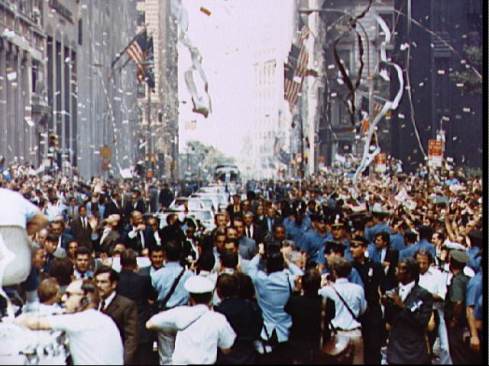
Against the shadow of Sept. 11, 2001, these plaques recall a carefree, exuberant, giddy spirit that may be difficult to conjure again downtown, even if the Yankees do their part.
Carefree? How about the parade in May 1962 when President Félix Houphouët-Boigny of the Ivory Coast was cheered as “Scott Carpenter” by spectators who mistakenly assumed he was a newly returned astronaut.
Exuberant? How about the 1,900 tons of paper showered on Douglas (Wrong Way) Corrigan in August 1938 after his flight from New York to Ireland “instead of his ‘intended’ destination of California,” as the plaque says, with quotation marks that constitute one of the few instances of editorializing.
Giddy? How about May 1950, when there was a parade every day for three days, beginning with one for Prime Minister Liaquat Ali Khan of Pakistan. He was assassinated a year later, one of many foreign leaders who were hailed in the Canyon of Heroes and then jailed, deposed or murdered back home.
“It was almost like a death sentence to get a ticker-tape parade,” said Kenneth R. Cobb, the director of the municipal archives, who has compiled a parade history.
After several spontaneous outbursts, one of the first organized uses of paper tape from stock-market tickers occurred Nov. 18, 1919, in a parade for the Prince of Wales, later the Duke of Windsor.
Grover A. Whalen, the city’s official greeter, recalled in his 1955 autobiography, “Mr. New York,” that he arranged a word-of-mouth campaign among downtown businesses to give the prince a spectacular reception with streams of ticker tape. It wound up including torn-up phone books. (Hmmm. A city official, proud of his Irish descent, contriving to welcome the Prince of Wales by inundating him with waste paper thrown out of windows in tall buildings.)
Watching the paper fall on the Yankees in 1996, Carl Weisbrod, the president of the Downtown Alliance, and Suzanne O’Keefe, the vice president for design, agreed that something should be done to commemorate the parades.
As part of the $20 million streetscape project, under the direction of Cooper, Robertson & Partners, the design studio Pentagram came up with the idea of simple granite sidewalk strips – not unlike the ticker-tape ribbons that remain after a parade, said Michael Bierut, a Pentagram partner – with the date and a few words of description.
(An illustrated brochure and map with information about all 200 parades can be picked up at kiosks outside City Hall and the World Trade Center PATH station or through the alliance, at downtownny.com or 212-835-2789.)
The plaques were made by Dale Travis Associates, the firm responsible for the silver-leaf lettering in the Freedom Tower cornerstone. The granite blocks, 8 inches wide and 3 inches deep, were cut with a water jet, Dale L. Travis said. Then the two-inch stainless-steel letters were inserted, held by pins and thermoplastic grout.
Last week, Jorge Condez and Paul Corrales of A.F.C. Enterprises set some of the last plaques, including “October 28, 1986 * New York Mets, World Series Champions,” into place near Vesey Street.
THREE years and 11 months have passed since the last parade, the longest interval since the 1978 Yankees broke a nine-year dry spell in the Canyon of Heroes.
The next parade will not be easy. The image of a paper blizzard suspended in midair among the downtown skyscrapers, once a visual metaphor for civic celebration, was transformed on Sept. 11, 2001, into a metaphor for cataclysm.
Is it still? Mr. Bierut hopes not. “Part of the resiliency of the city is retaining its own meaning for those metaphors and not surrendering them,” he said. “The post-terror condition has acclimated people to view any disruption of routine as a cause for alarm. There will come a time when the disruption of the routine of city life is seen as something wonderful.”
“Ticker-tape parades were the very essence of that,” Mr. Bierut said.
Just in case, Ms. O’Keefe said, there are 33 blank spots available on Broadway and Park Row to mark future parades. At the current pace, she figured, that ought to last a century and a half.
Bill Maher | February 1 2008
9/11, Bin Laden, Blogs, Broadcatching, Film and Video, Hillary Clinton, Hollywood, Iraq, Los Angeles, McCain, Obama, Oil, Producers, Religion, Tullycast, Video, WritersThis week Bill welcomes columnist Clarence Page, Congressman Darrell Issa, N.O.W. President Kim Gandy and Real Time reporter Matt Taibbi
TULLYCAST
:: :: :: :: :: :: :: :: :: ::
Britney Spears Hospitalized Again Early Thursday Morning
StoriesSpears hospitalized for ‘mental health’

In the second time in a month, the pop star has been physically removed from her home by police.
By Andrew Blankstein
Los Angeles Times Staff Writer
1:53 AM PST, January 31, 2008
Los Angeles Police officers physically removed pop star Britney Spears from her home early today, placing the troubled celebrity on a “mental health evaluation hold,” authorites said.
More than a dozen motorcycle officers and a Los Angeles Fire Department ambulance swept through the front gates of Spears hilltop Studio City residence shortly before 1 a.m., as a police helicopter hovered overheard. At 1:08 a.m., officers inside the home radioed to commanders that “the package is on the way out.”
Spears was rushed from a side entrance of her home into an ambulance. As she was driven down Coldwater Canyon Boulevard, her vehicle was escorted by more than a dozen motorcycle officers, two cruisers and two police helicopters. Her final destination was the UCLA Medical Center, authorities said.
This is the second time in a month that Spears has been placed on a 72-hour welfare hold. The first occurred on Jan. 3, when Spears declined to give up custody of her children to ex-husband Kevin Federline.
The Summit, the winding street on which Spears lives in Studio City, was jammed with the vehicles of journalists and photographers for several hours prior to the police operation.
Authorities said the welfare hold was prompted by a telephone call they received from Spear’s psychiatrist. It was unclear exactly when they had received the call, but it was apparent that the operation had been carefully planned over a period of time. Unlike the first welfare hold — in which Spears’ ambulance was closely pursued by a throng of photographers — vehicles today were blocked from following the same route. The motorcade that whisked Spears to the hospital also showed a large investment in resources. The line of emergency vehicles stretched longer than a football field.
:: :: :: :: :: :: :: :: :: ::
The New York Football Giants Land In The Valley Of The Sun
StoriesCHANDLER, Ariz. — Giants defensive end Michael Strahan arrived at the first of many Super Bowl news conferences dressed in all black. Five teammates and his coach appropriately followed suit.
Linebacker Antonio Pierce said none other than Coach Tom Coughlin put him in charge of the team attire for the Giants’ first public appearance after arriving in Arizona on Monday. Pierce told all participants to wear black suits as a sign of unity.
The fact that Coughlin allowed Pierce to make that decision fit perfectly with the Super Bowl theme of the kinder, gentler Giants coach. That sure-to-be-told story line, along with a few others, kicked off Monday, as the Giants met the national news media here for the first time at their team hotel.
“He opened up to everybody,” Pierce said of Coughlin this season. “He’s showing us his teeth. He’s letting us know he has cheekbones and everything.”
The kinder Coughlin emerged as a favorite topic Monday. Pierce and his teammates described bowling nights and casino nights introduced this season by Coughlin. They spoke of the leadership council he formed.
Pierce said players who rarely dealt with Coughlin did not know who their coach really was. That changed this season, according to the Giants.
The new Coughlin stood at the podium Monday, wearing the requisite dark suit and a red tie, hair parted just so underneath two bright lights pointing toward his head. The new Coughlin turned his opening news conference into a stand-up comedy routine, cracking a couple jokes.
Of the crowd of reporters gathered around him, along with dozens of TV cameras lining the back wall, Coughlin quipped, “This is like a normal day in New York, media-wise.”
Of the Giants’ 10 victories on the road this season, Coughlin joked, “We have a lot of secrets we can’t share with you.”
The Monday session was basically a preview of what this week will be like for the Giants. Surrounded by a small army of reporters, cameramen and radio hosts, they answered the same questions dozens of times, even in this first setting. There was no trash talk, at least not Monday.
The Patriots arrived in Arizona on Sunday night, but the Giants elected to land Monday afternoon. Most players described a subdued flight. Several Giants even slept. Others watched the movie “Michael Clayton.” The buzz picked up as the plane neared landing, with Coughlin describing the feeling of “anticipation and excitement.”
The Giants went straight to the team hotel, the Sheraton Wild Horse Pass. If they were looking for seclusion, the hotel provided it. Located outside of Phoenix, the hotel sits in the Sonoran Desert, surrounded by mountains and cactuses, instead of fans and bars. The hotel complex includes two 18-hole golf courses and a spa that measures 17,500 square feet.
The six Giants selected to participate in the news conference talked of savoring the experience of the week. Strahan and receiver Amani Toomer recalled what it felt like to lose a Super Bowl, the fireworks exploding for the team that beat them, the newspaper the next morning announcing their loss.
“If you lose,” Strahan said. “What is there to remember?”
As if playing the undefeated Patriots did not serve as enough of a challenge, the Giants also came down with a flu bug this week. Coughlin said the bug surfaced in the past day or two, and that three players missed practices with high temperatures. Coughlin said he hoped the sickness “will not be an issue.”
And with that, attention turned back to the story lines sure to dominate the week. Coughlin said the Giants were familiar with the underdog role. He repeated that he never considered not playing his full roster when the Giants faced the Patriots in the regular-season finale.
Across the ballroom, punter Jeff Feagles talked of remembering the experience. A 20-year veteran, Feagles has never been in a Super Bowl before, same as Coughlin, his kinder, gentler head coach. Feagles talked of how fast the plane ride went by, of how giddy his teammates were.
At the airport, he pulled out a camera and started taking pictures. And with that, Super Bowl week was under way for the Giants.
“This is special,” Feagles said. “I’ve been to that airport I can’t tell you how many times. But this felt different. This felt good.”
Bill Maher | January 25 2008
StoriesPart One
Part TwoPart ThreePart FourPart FivePart Six
:: :: :: :: :: :: :: :: :: ::
Howie Kurtz Slobbers All Over John McCain
Stories
Accessibility Opens Doors For McCain
By Howard Kurtz
Washington Post Staff Writer
Monday, January 21, 2008; C01
SPARTANBURG, S.C. — As the JetBlue charter from Michigan touched down in South Carolina, I strolled up to John McCain‘s front-row seat — none of his aides batted an eye — and asked if he would continue to chat with reporters around the clock if he won the Republican nomination.
Most candidates, after all, grow more cautious around the media mob as the stakes get higher.
McCain said he couldn’t stop, because “that destroys credibility.” And besides, he said, “I enjoy it a lot. It keeps me intellectually stimulated, it keeps me thinking about issues, and it keeps me associated with a lower level of human being than I otherwise would be.”
There he goes again.
McCain’s ability to charm the press wasn’t responsible for his big win in Saturday’s South Carolina primary, but it didn’t hurt. After the slimy, rumor-filled campaign run against him in that state in 2000, media outlets yesterday embraced the notion that his triumph was “poetic justice” (Chicago Tribune), “exorcising the ghosts” of South Carolina (New York Times) and a “spiritual victory” (Slate).
Every presidential campaign is constantly calculating whether journalists are potential allies or incorrigible foes. The media are a great — and dirt-cheap — vehicle for carrying a candidate’s message, but submitting to questioning also carries the risk of being thrown on the defensive, as Mitt Romney learned in a tense exchange with Associated Press veteran Glen Johnson last week over the role of lobbyists in his campaign.
Thoughts On John McCain
Stories
….his surge talk is just pure nonsense though; NONE of the bench marks have even been given a sniff.
2006 was the bloodiest year of them all and these numbers appear to me to be about comparisons, only in Baghdad and environs, of the casualty rates to 2007.
Again,-no political process at all and Shiite death squads cleaning up with our resources.
McCain: “Folks, this surge is working-don’t let those pesky facts get in the way of this shiny new groupthink meme”
That said, he is indeed the least unpalatable….by far
Bill Maher | Real Time | January 18 2008
Broadcatching, Economy, Fund, Hillary Clinton, Media Matters, Politics, Religion, Rupert Murdoch, Tullycast, Wall Street, WSJ, ZakariaGuests this week: D.L. Hughley, Dan Savage, John Fund, Fareed Zakaria and Trace Adkins
Pt 1
Pt.2
Pt.3
Pt.4
Pt. 5
Pt. 6
O V E R T I M E
:: :: :: :: :: :: :: :: :: ::
BILL MAHER | January 18, 2008 | Mashup Pt. 2
StoriesBILL MAHER | January 18, 2008 | Mashup Pt. 2
 The New York Herald Sun