Tullycast
9/12: FROM CHAOS TO COMMUNITY
StoriesLooks beautifully sweet…
Experts Doubt Missing Millionaire Steve Fossett Still Alive
Stories| GUARDIAN Wednesday September 12, 2007 By MARTIN GRIFFITH Associated Press Writer RENO, Nev. (AP) – Steve Fossett survived a nearly 30,000-foot plunge in a crippled balloon, a dangerous swim through the frigid English Channel and hours stranded in shark-infested seas. But 10 days after he took off on a routine flight and never returned, doubts were growing Wednesday as to whether he was still alive. Fossett was scouting sites to attempt to break a land-speed record when his small plane disappeared.
“It’s frustrating, but not tiring,” said George Mixon, a crew member with the Colorado Civil Air Patrol who has been part of the search since Sunday. Survival experts say a trained outdoorsman such as Fossett should have been able to signal rescuers with the emergency beacon from the plane or with his specially equipped wristwatch. Even if those didn’t work, he could have built a fire or an X made of rocks or sticks, they said. “He’s either so injured he can’t signal or he’s perished,” said David McMullen of Berkeley, Calif., a leader of the hiking group Desert Survivors, whose members frequently venture into some of the country’s harshest terrain. Fossett took off on Sept. 3 in a single-engine plane from a private airstrip about 80 miles southeast of Reno. He didn’t leave a flight plan. Maj. Cynthia Ryan of the Nevada Civil Air Patrol said Tuesday she’s still betting on Fossett’s “sheer grit and determination” to keep him alive. “We still find people against all odds,” she said. “Maybe he’s got a couple of broken arms and can’t signal.” Such injuries would worsen Fossett’s chances of finding water in the 17,000-square-mile search area – about twice the size of New Jersey. Authorities believe he was carrying only one bottle of water. “No food, that’s not a problem. No water, that’s a problem. That’s a harsh desert out there,” said Lee Bergthold, director of the Palmdale, Calif.-based Center for Wilderness Studies and a former Marine Corps survival instructor. People can go only two or three days without water in the summer, experts say, and Fossett would be hard-pressed to find water in unfamiliar country, even if he was in good health. Nevada, the driest state in the nation with less than 10 inches of precipitation a year, had an unusually dry winter, and stream flows usually diminish by the late summer even in wet years. “At this point, you’d be lucky to find him alive,” Bergthold said. Temperatures in the search area have been in the 80s and 90s, with lows in the 50s and 60s. Shelter from the sun would be just as important as water, McMullen said. McMullen knows what he’s talking about. Six years ago, he found himself stranded with a severely sprained ankle for three nights in Death Valley National Park. He stayed in the shade of a tree until he was rescued by a military helicopter, with the help of a detailed itinerary he had left his wife. “You’ll lose water faster than you can absorb it in heat, and that’s why a shelter is so important,” he said. McMullen and other survival experts faulted Fossett for not filing a flight plan, which might have allowed searchers to focus on a smaller area. “The itinerary I filed for my 2001 hike saved my life,” McMullen said. — Associated Press writers Sandra Chereb in Minden and Scott Sonner in Reno contributed to this story. — |
PATRIOTS HEAD COACH BELICHICK COPS TO FILMING NEW YORK JETS
Stories
Sept. 12 (Bloomberg) — New England Patriots coach Bill Belichick apologized today for videotaping New York Jets coaches during a National Football League game.
Belichick, whose team has won three of the last six Super Bowl title games, said in a statement issued by the Patriots that he spoke with NFL Commissioner Roger Goodell this week and explained that the case stemmed from his own interpretation of the league rules.
NFL security removed a Patriots employee suspected of attempting to steal the Jets’ signals and seized his video camera and tape during the Sept. 9 season-opening game in East Rutherford, New Jersey, won by New England 38-14. Belichick said the Patriots hadn’t been notified of any league ruling.
“I want to apologize to everyone who has been affected, most of all ownership, staff and players,” the coach said. He declined to elaborate in a televised news conference held just after the statement was released.
NFL spokesman Greg Aiello and Jets spokesman Bruce Speight didn’t immediately return messages at their offices seeking comment.
ESPN reported on its Web site yesterday that Goodell has determined the Patriots broke league rules and is considering sanctions, including docking them “multiple draft picks.”
Green Bay Packers President Bob Harlan told ESPN that his team’s security guards identified the cameraman as the same one who was removed from the sidelines of a game against the Patriots at Lambeau Field on Nov. 19, 2006.
League Warning
Former Jets quarterback Boomer Esiason said the NFL circulated a memo last September warning of severe penalties for videotaping other teams’ signals. He also said the Patriots’ success made them targets for critics around the league.
The Patriots have won almost 70 percent of their games since Belichick became coach in January 2000. He is the only NFL coach to win three Super Bowls in four years and his 13-3 playoff record is the second-best in league history, behind Vince Lombardi, for whom the Super Bowl trophy is named.
“Everyone’s piling on right now, there’s no question about it,” Esiason, now an NFL analyst for CBS, said in an interview. “There’s 31 other teams that would love to knock the Patriots off their perch.”
The episode is the latest in a rivalry between the Jets and Patriots that Bill Parcells, who coached both teams, termed a “Border War.”
Teams Rivalry
Parcells left the Patriots in 1997 following a Super Bowl appearance and took over the Jets a month later. In 2000, Belichick took the job coaching the Jets, quit after one day, and then accepted a job coaching New England 3 1/2 weeks later.
Last year, the Jets hired Patriots assistant Eric Mangini as coach and Belichick refused to shake his hand after their first meeting of the season. New England also filed tampering charges with the NFL after the Jets held contract talks with former Patriots wide receiver Deion Branch, who wound up being traded to Seattle by New England.
$3,000 Bill for Hardly Using an iPhone
StoriesTag, You’re It
Fun, Tours and a $3,000 Bill for Hardly Using an iPhone

SAN FRANCISCO, Sept. 9 — When Neil Dingman recently went on a European vacation, he took his iPhone with him with no intention of using it much. In fact, for the 14 days he was there, he used it only a handful of times and had expected to see just a small increase in his next bill for roaming charges.
Instead, he was charged $852.31.
As it turned out, the cellphone carried by Mr. Dingman, a mortgage consultant in Minneapolis, made calls on a European data network several times each hour to check for e-mail messages. Because he didn’t deactivate the feature that automatically checks for new e-mail messages, during Mr. Dingman’s trip through Italy, Croatia and Malta, the phone went to retrieve e-mail more than 500 times.
Other iPhone users have felt the sting of high roaming charges with their iPhone, too. Some, like Mr. Dingman, are unaware that they need to disable the e-mail feature; others are billed erroneously; still others misunderstand the explanation of charges they are given by AT&T customer service representatives. Many of them are complaining to the company or on blogs.
The iPhone is no different from any other phone, said Todd Smith, an AT&T spokesman, with the exception of the BlackBerry, whose users can opt for a flat monthly rate when traveling. Any AT&T customer planning to travel outside the United States should contact AT&T to inquire about roaming plans, he said.
Dave Stolte did that before taking his iPhone with him on a two-week trip to Ireland and England in July. He signed up for a roaming plan, but he said the customer service representative’s explanation of the charges was unclear. His bill was $3,000.
When he was offered a $100 credit, Mr. Stolte said he felt insulted, and he sent letters to the chief executives of AT&T and Apple. The story of his bill quickly spread around the Internet. Before long, he was given a full credit.
“I can’t imagine AT&T would expect all their customers to be technicians and say, ‘O.K., if I go to use Google maps, how many kilobytes am I transferring?’ ” asked Mr. Stolte, a Web designer who lives in Temecula, Calif.
In July, Aaron Oxley took his iPhone with him to London, Dubai and Bangkok. Mr. Oxley said in an e-mail message that he was aware that there would be international roaming data charges, so he always made sure he was in an area with free Wi-Fi when he used his iPhone to access the Internet. But when Mr. Oxley’s AT&T bill arrived, the data charges totaled $300.
When Mr. Oxley called AT&T, he was told that even though he was using Wi-Fi, there was still a data transfer charge.
Indeed, according to Mr. Smith, the AT&T representative, iPhone owners are not charged for Wi-Fi connections. Mr. Oxley eventually received a full refund for the $300 roaming data charge.
Mr. Dingman said it didn’t occur to him to disable the e-mail feature. AT&T eventually reversed the charges, but only after Mr. Dingman signed up for a $24.99-a-month global data plan.
AT&T is not automatically crediting customers for such charges. Mr. Smith said that each complaint is being evaluated case by case.
#88 DALE EARNHARDT JUNIOR SPORTING THE ADIDAS AND DRINKING MELLO YELLO
Stories
Dale Earnhardt Jr.: “Drinking Up” As Coke, Pepsi Trade Places?
This week, Pepsi is expected to give way to Coke as the official beverage of most of NASCAR’s tracks and speculation is that Pepsi will be putting some of the money they would have used for the tracks, to getting its Mountain Dew brand on Dale Earnhardt Jr’s, racing car hood next year.
If that trade-off really happens, it’s a cinch for Pepsi and a dumb move for Coke. The bottom line is people aren’t fans of tracks or fans of the organization itself (NASCAR). They watch races to see their favorite drivers and they are much more likely to support the brand of their favorite drivers than what they are required to drink at the track.
There is a little issue I have though if the Mountain Dew deal goes through. Since Mountain Dew, like Budweiser , is already such a big brand (it’s the nation’s fourth best selling soda behind Coke Classic, Pepsi and Diet Coke) if the deal is consummated it’s going to be nearly impossible to figure out if Earnhardt will have any effect on sales.
Part of me hoped that if a soft drink brand were going to sign Earnhardt, it would have been Coke. And that Coke would unveil a blast from the past that hasn’t been on shelves. That way you could really tell if “Little E” was making a difference.
Like how about Mello Yello? The drink was introduced as a competitor to Mountain Dew 28 years ago and had a great racing tradition. Its motto was “The World’s Fastest Soft Drink” and used a race car driver in its ads. Kyle Petty of course was sponsored by the brand in the early 90s, as was Tom Cruise’s character Cole Trickle in “Days of Thunder” had it on his No. 51 car.
On a related note, I’m pretty sure that Earnhardt is going to set the record next year for the most merchandise ever sold by a single athlete in the history of sport. His popularity combined with a potential sponsor and number change will be part of it (and trust me, Mello Yello would sell more than Mountain Dew). The other part is that–for the first time ever–a mainstream shoe and apparel brand (adidas) is going to make a driver’s outfit and sell it at retail. Reebok looked into getting into the sport in the late 90s, but passed. Puma sponsors Kasey Kahne, but aside from ads doesn’t have much of a retail presence and Nike has a deal to make shoes with Joe Gibbs drivers for its low cost Tailwind brand.
It’s easy to see why all the big brands were scared off with NASCAR. Unlike the traditional sports, the shoes aren’t really shown since they’re in the car with the driver. With no opportunity to display anything, they shied away.
What Adidas will do that no one has done in the past is give NASCAR fans what they really deserve: An authentic firesuit. For too long, fans have had to buy replicas, but I expect adidas to give fans the real thing (it might be $200, but so are authentics from other sports). The alliance will also benefit Earnhardt Jr. plenty because a NASCAR driver has never really had the marketing force of a big apparel brand behind him. He’ll now have a greater distribution channel than ever before.
I expect a new wave to come from this as Adidas will prove this to be the next frontier. Unlike the hundreds of millions it has cost adidas and Reebok to have the rights to make the apparel of all the teams in the NBA and NFL, respectively, a shoe and apparel company will can outfit a race team for a fraction of the cost. By 2009, I expect to see more Adidas, Nike and Under Armour logos on firesuits and also expect that, with these deals, NASCAR merchandising will leap into the stores that carry the licensed apparel from traditional sports.

While we’re on the subject of what could sell more–Mello Yello over Mountain Dew, for example–I truly believe that Earnhardt Jr. would be best served by starting over with a new number next year. He has had No. 8 long enough so that a move wouldn’t alienate fans and a change of number–like Kobe Bryant when he changed from No. 8 to No. 24–would serve to prove just how big he is in the sport.
JOE GIBBS RACING GIVES INSTANT CREDIBILITY TO TOYOTA RACING DEVELOPMENT'S NASCAR PROGRAM
StoriesThe great David Poole on a winning combo…
JGR turns Toyota into Cup contender
Charlotte Observer
DAVID POOLE
Things just got interesting.
Everybody colored inside the lines at Wednesday’s announcement that Joe Gibbs Racing will switch to Toyotas next year. It was all nice and polite, which is curious since Tony Stewart was there.
Make no mistake, however, this was the true beginning of the manufacturer’s foray into NASCAR’s top series. Toyota participated in Nextel Cup in 2007. In 2008, it starts competing.
There’s no kind way to say this, but if the teams using Toyotas this year were building Fords, Chevrolets or Dodges, they’d struggle, too. Michael Waltrip Racing and Team Red Bull started from scratch, and Bill Davis Racing had been wandering in a NASCAR purgatory until it got to start racing Camrys in 2007.
This year, Toyota executives wore out shoe leather worrying about whether they’d get any cars in the Daytona 500. In 2008, they’ll worry about how to win it.
In 2007, only 60.7 percent of the Toyotas trying to make Cup races have made the field. In 2008, it will be shocking to see fewer than two Toyota teams in the Chase for the Nextel Cup.
Sure, it might take some time for the people at Joe Gibbs Racing to switch over all of its cars and learn how to make the Toyota engine power those cars to Victory Lane.
Then again, it might not.
“If we thought we were going to come out of the box slow next year, we wouldn’t have done it,” team President J.D. Gibbs said.
When you’ve accomplished as much as Joe Gibbs Racing has — three Cup championships and 58 victories since 1992 — you don’t accept limitations.
“The only way that you constantly stay ahead of the game is by putting yourselves in positions to be leaders, not followers,” Stewart said. “That’s why I signed up with Joe Gibbs Racing in the first place.”
Leadership is a word that kept coming up.
“There are certain things we think we’d like to have a leadership role in,” said Gibbs, the son of owner Joe Gibbs. ” … With GM, you’ve got four really strong teams, so I think it is probably a little more difficult to say who has a leadership role there. Which direction are we going to go? I think for us it is just the right decision and the right time.”
In other words, J.D. Gibbs wants his team to be the best. That’s the only reason to be in the racing business. And guess what? Toyota feels the same way.
“Our plan has always been that … we would grow,” said Toyota Racing Development President Jim Aust. “You don’t know when that’s going to come available to you.”
JGR became available because all four of the top-tier Chevrolet teams had their deals with GM come up for renewals. Hendrick Motorsports, Richard Childress Racing and Dale Earnhardt Inc. all want to be the best team in the sport, just as JGR does. The chance to be the lead dog at Toyota was too hard for Gibbs to turn down.
Stewart, Denny Hamlin and Kyle Busch will drive for JGR next year. Jeff Gordon, Jimmie Johnson, Dale Earnhardt Jr. and Casey Mears will drive for Hendrick. Those teams are going to be rivals, but if they were all driving Chevrolets that rivalry couldn’t be what it will be with the Gibbs gang in Toyotas.
“From inside the car, they all look the same,” Stewart said, dismissing that premise. It’s no big deal to us.”
But then he added the magic words.
“What it boils down to,” Stewart said, “is we want to win races.”
Correct.
And so does Toyota.
TOM FRIEDMAN RUNS AWAY TO CHINA
StoriesIraq Through China’s Lens
THOMAS FRIEDMAN
Dalian, China
It’s nice to be in a country where Iraq is never mentioned. It’s just a little unnerving when that country is America’s biggest geopolitical and economic rival these days: China.
I heard China’s prime minister, Wen Jiabao, address an international conference here in Dalian, and what impressed me most was how boring it was — a straightforward recitation of the staggering economic progress China has made in the last two decades and the towering economic, political and environmental challenges it still faces.
How nice it must be, I thought, to be a great power and be almost entirely focused on addressing your own domestic problems?
No, I have not gone isolationist. America has real enemies that China does not, and therefore we have to balance a global security role in places like the Middle East with domestic demands.
But something is out of balance with America today. Looking at the world from here, it is hard not to feel that China has spent the last six years training for the Olympics while we’ve spent ourselves into debt on iPods and Al Qaeda.
After 9/11, we tried to effect change in the heart of the Arab-Muslim world by trying to build a progressive government in Baghdad. There was, I believed, a strategic and moral logic for that. But the strategy failed, for a million different reasons, and now it is time to recognize that and focus on how we insulate ourselves from the instability of that world — by having a real energy policy, for starters — how we protect our security interests there in more sustainable ways and how we get back to developing our own house.
By now it should be clear that Iraq is going to be what it is going to be. We’ve never had sufficient troops there to shape Iraq in our own image. We simply can’t go on betting so many American soldiers and resources that Iraqis will one day learn to live together on their own — without either having to be bludgeoned by Saddam or baby-sat by us.
So either we get help or get out. That is, if President Bush believes staying in Iraq can still make a difference, then he needs to muster some allies because the American people are not going to sustain alone — nor should they — a long-shot bet that something decent can still be built in Baghdad.
If the president can’t get help, then he has to initiate a phased withdrawal: now. Because the opportunity cost this war is exacting on our country and its ability to focus on anything else is out of all proportion to what might still be achieved in Iraq by our staying, with too few troops and too few friends.
Iraqis can add. The surge has brought more calm to Iraq largely because the mainstream Iraqi Sunnis finally calculated that they have lost and that both the pro-Al Qaeda Iraqi Sunnis and the radical Shiites are more of a threat to them than the Americans they had been shooting at.
The minute we start withdrawing, all Iraqis will carefully calculate their interests. They may decide that they want more blood baths, but there is just as much likelihood that they will eventually find equilibrium.
I have not been to Dalian in three years. It is not just a nice city for China. It is a beautiful city of wide avenues, skyscrapers, green spaces, software parks and universities.
The president of Dalian University of Technology, Jinping Ou, told me his new focus now is on energy research and that he has 100 doctoral students dealing with different energy problems — where five years ago he barely had any — and that the Chinese government has just decided to open its national energy innovation research center here.
Listening to him, my mind drifted back to Iraq, where I was two weeks ago and where I heard a U.S. officer in Baghdad tell this story:
His unit was on a patrol in a Sunni neighborhood when it got hit by an I.E.D. Fortunately, the bomb exploded too soon and no one was hurt. His men jumped out and followed the detonation wire, which led 1,500 feet into the neighborhood. A U.S. Black Hawk helicopter was in the area and alerted the U.S. soldiers that a man was fleeing the scene on a bicycle. The soldiers asked the Black Hawk for help, and it swooped down and used its rotor blades to blow the insurgent off his bicycle, with a giant “whoosh,” and the U.S. soldiers captured him.
That image of a $6 million high-tech U.S. helicopter with a highly trained pilot blowing an insurgent off his bicycle captures the absurdity of our situation in Iraq. The great Lebanese historian Kamal Salibi said it best: “Great powers should never get involved in the politics of small tribes.”
That is where we are in Iraq. We’re wasting our brains. We’re wasting our people. We’re wasting our future. China is not.
MAUREEN DOWD PLAYS CUTESY WITH PATRAEUS WHILE WASHINGTON GAGS OVER NEWSPAPER AD
StoriesJoe Biden didn’t talk that much yesterday for Joe Biden.
And he told Gen. David Petraeus and Ambassador Ryan Crocker that they shouldn’t talk too much, either, so that members of the Senate Foreign Relations Committee would have time to get in their questions. Even though the senators often didn’t ask questions but simply gave little partisan lectures or told stories about themselves, or in the case of Barbara Boxer, had an aide hold up a blow-up picture of herself with General Petraeus in Iraq.
Nevertheless, Mr. Biden, the committee’s chairman, took time at the end of yesterday’s first hearing with the Surge Twins to make the points, a bit repetitively, that there is no plan to get out of Iraq and that the Bush administration is not leveling with Americans.
John McCain was standing behind Mr. Biden, waiting to sit down for the next hearing — the Armed Services Committee — with the witnesses.
First, the Republican presidential candidate smiled archly at having to cool his heels as the Democratic presidential candidate yakked — sniffing at the Surge that Mr. McCain supports. Then Mr. McCain turned to his G.O.P. colleague Susan Collins and flapped his fingers in the universal hand sign for yakking.
It pretty much said it all.
For months, everyone here has been waiting with great expectations to hear whether the Surge is working from the top commander and top diplomat in Iraq.
But the whole thing was sort of a fizzle. It’s obvious that the Surge is like those girdles the secretaries wear on the vintage advertising show, “Mad Men.” It just pushes the fat around, giving a momentary illusion of flatness. But once Peaches Petraeus, as he was known growing up in Cornwall-on-Hudson, takes the girdle off, the center will not hold.
And it was clear from their marathon testimony that the Iraqi politicians are useless, that we’re going to have a huge number of troops in Iraq for a long time, that there’s no post-Surge strategy, that they’re just playing for time, hoping that somehow, some way, things will look up in the desert maze of demons that General Petraeus referred to as “home.”
The strategy is no more than a soap bubble of hope, just as W.’s invasion of Iraq was based on a fantasy about W.M.D.’s and an illusory view of Iraq.
Even though it was 9/11, Osama was barely mentioned all day.
Republican Senator John Warner, freer than ever now that he’s announced his retirement, turned the screw on the two witnesses.
Do you feel, he asked the general, that the Surge “is making America safer?”
“Sir, I don’t know actually,” Peaches replied. “I have not sat down and sorted out in my own mind.”
The Surge Twins seemed competent and more realistic than some of their misbegotten predecessors, but just too late to do any good. They’re like two veteran pilots trying to crash land the plane.
Ambassador Crocker has expressed a darker, more rueful vision in background briefings with reporters, and he emanated a bit of Graham Greene yesterday.
He noted that the Iraqis know that “they’re going to be there forever,” while we will not.
Pulling troops out too soon, he fears, could “push the Iraqis in the wrong direction. It would make them, I would fear, more focused on, you know, building the walls, stocking the ammunition and getting ready for a big, nasty street fight without us around.”
Asked by Senator McCain if he was confident that the Maliki government will get the job done, the ambassador said dryly: “My level of confidence is under control.”
The star witnesses gave shell game answers, trying to make the best of a hideous hand.
“It’s a hand that’s unlikely to improve in my view,” Hillary Clinton — one of five senators running for president on the two panels — told the Surge Twins. “I think that the reports that you provide to us really require the willing suspension of disbelief.”
Hillary’s plan is to posture and criticize W.’s war all the way to the White House. But then President Clinton will be stuck with figuring out how to pull out the more than 100,000 troops still there policing a lot of crazy sectarian street fighting.
The Republicans seemed happy that the witnesses’ calm presentation bolstered the president’s case for continued war funding. In his speech on Thursday night, W. will be able to accept the recommendations of the Surge Twins, who are only recommending what he wants to hear.
Republicans seemed oblivious to the fact that they may have scored points short term while laying the groundwork for disaster long term. W. won’t care because he’s not running, but it will be political suicide for Republicans entering the campaign with 130,000 troops still in Iraq.
As Lindsey Graham joked to the witnesses about Congress, referring to the talk of the dysfunctional Iraqi government, “You could say we’re dysfunctional and you wouldn’t be wrong.”
THE WOOLWORTH BUILDING: Dark Spots Mar an Aging, Yet Exquisite, Face
StoriesStreetscapes | Woolworth Building
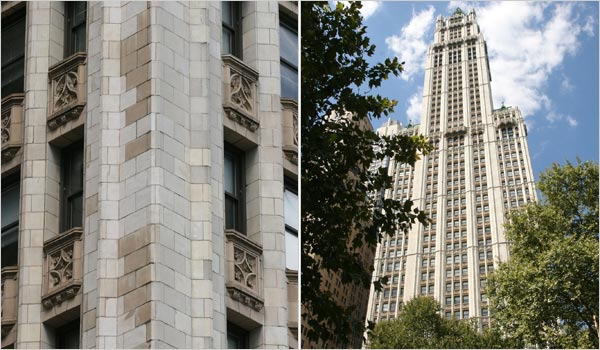
IT’S like a fungus that runs up and down the tower of the Woolworth Building, at Broadway and Park Place. From every angle the cream-colored surface has dirty, discolored patches, the unanticipated consequences of a major restoration project three decades ago.
Frank Woolworth began accumulating his 5-and-10-cent store fortune in 1879, and by 1886 he opened a headquarters in New York City. He was a multimillionaire by 1900, when he built a lacy Gothic-style limestone house at Fifth Avenue and 80th Street, a building demolished in the 1920s.
It was designed by Charles P. H. Gilbert, a mansion specialist who worked up and down the avenue. He also designed the main building of the Jewish Museum, at 92nd Street.
In 1911, Woolworth announced plans for the tallest building in the world, to be constructed on Broadway between Park Place and Barclay Street. Like his house, Woolworth’s new building was to be neo-Gothic and designed by a Gilbert — in this case, Cass Gilbert, who was not related to Charles but was instead an aggressive out-of-towner who had elbowed his way into New York City architecture.
In 1905, Gilbert had designed the boxy Gothic-style West Street Building, at West and Cedar Streets, one of many structures to use the new technology of glazed terra cotta to clad a tall building, and the architect used it as a model for the Woolworth Building.
For Woolworth, Gilbert doubled the size of the 23-story West Street building and then some, to 55 floors, with a pyramidal roof 792 feet high. That topped the 700-foot Metropolitan Life tower, built at Madison Avenue and 24th Street in 1909.
Paul Starrett was one of the contractors bidding on the Woolworth project, and in his 1938 book, “Changing the Skyline,” he recalled trying to persuade Woolworth to use more traditional materials.
“In stone it would be magnificent,” he said, but in terra cotta, “it would look like a 5-and-10-cent store proposition.”
He did not get the job.
The utility of terra cotta was irrefutable: each block of fired clay, usually hollowed out, was a fraction of the weight of brick or stone. The blocks were easily modeled in intricate forms and were protected by a glaze that shed dirt.
A 1912 ad by the Atlantic Terra Cotta Company in The Real Estate Record and Guide boasted, “Cream color in another material would be dark and dirty after a few years’ exposure.”
Unlike many prior skyscrapers, the Woolworth Building was well received by the architectural intelligentsia. It had no raw blank side walls, and the Gothic-style detailing seemed an honest reflection of the new steel-frame technology.
Writing in The Architectural Record in 1913, Montgomery Schuyler particularly admired the way Gilbert adjusted the scale of the ornament. The finials, shields, crockets and other details were not simply giant-sized to look good from a distance but also held up to close view from neighboring buildings.
Compared with European models, “this brand-new American Gothic loses nothing,” Mr. Schuyler said.
But Mr. Starrett’s misgivings were well founded. In his 1938 book he recalled, apparently from years earlier, “the spectacle of the upper part of the Woolworth Building, wired up with metal mesh to catch the falling terra cotta.”
By 1962, The New York Times reported that riggers were repairing broken pieces all year round.
These problems only grew worse, and in the 1970s the Woolworth company retained Ezra D. Ehrenkrantz & Associates (now Ehrenkrantz Eckstut & Kuhn) to examine every one of the 400,000 terra-cotta blocks. The architecture firm found that 25,000 of them needed complete replacement and selected precast concrete instead.
The concrete had a surface coating, meant to be renewed every five years, to shed soil and moisture, like the glaze on the terra-cotta blocks.
Timothy Allanbrook, now a senior consultant at Wiss, Janney, Elstner Associates, an architecture and engineering firm in Northbrook, Ill., worked for Ehrenkrantz at the time and was on and off the scaffolds at the Woolworth Building for three years.
He says the prescription for periodic resealing has not been followed, so the porous concrete has been absorbing water and dirt for years. He suspects that the concrete has absorbed so much dirt that it cannot be cleaned sufficiently so that it matches the original terra cotta, which may leave another replacement as the only option.
Mr. Allanbrook said that 30 years ago, the terra-cotta industry was in decline, making concrete “the optimal choice in a narrow field of imperfect choices.”
Now, terra cotta has seen a resurgence, so the original material could be a reasonable replacement, Mr. Allanbrook said; so could newer materials like concrete reinforced with glass fiber.
Roy Suskin, a vice president of the Witkoff Group, the building’s owner, declined to discuss the problem and any plans for remedying it.
 The New York Herald Sun
