Tullycast
CHRIS MATTHEWS HAS SOMETHING WRONG WITH HIS BRAIN
StoriesREMEMBER SCOOTER LIBBY
Stories
SENATOR JAMES WEBB MAKES SENATOR GRAHAM LOOK LIKE A FLACK
Stories
The two senators square off on Meet The Press
July 15
(PART 2) SEN. JIM WEBB MAKES SEN. GRAHAM LOOK LIKE A FLACK
Stories
PART TWO
The Discussion is about Senator Webb’s bill in the Senate that mandates troop readiness through judicial non-combat periods.
Bush knew Saddam had no weapons of mass destruction
StoriesTwo former CIA officers say the president squelched top-secret intelligence, and a briefing by George Tenet, months before invading Iraq.
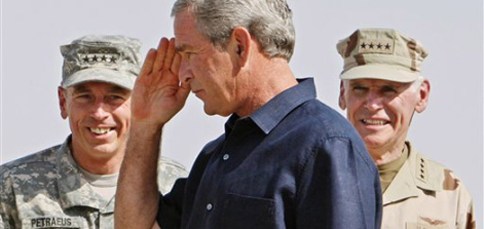
Sep. 06, 2007 | On Sept. 18, 2002, CIA director George Tenet briefed President Bush in the Oval Office on top-secret intelligence that Saddam Hussein did not have weapons of mass destruction, according to two former senior CIA officers. Bush dismissed as worthless this information from the Iraqi foreign minister, a member of Saddam’s inner circle, although it turned out to be accurate in every detail. Tenet never brought it up again.
Nor was the intelligence included in the National Intelligence Estimate of October 2002, which stated categorically that Iraq possessed WMD. No one in Congress was aware of the secret intelligence that Saddam had no WMD as the House of Representatives and the Senate voted, a week after the submission of the NIE, on the Authorization for Use of Military Force in Iraq. The information, moreover, was not circulated within the CIA among those agents involved in operations to prove whether Saddam had WMD.
On April 23, 2006, CBS’s “60 Minutes” interviewed Tyler Drumheller, the former CIA chief of clandestine operations for Europe, who disclosed that the agency had received documentary intelligence from Naji Sabri, Saddam’s foreign minister, that Saddam did not have WMD. “We continued to validate him the whole way through,” said Drumheller. “The policy was set. The war in Iraq was coming, and they were looking for intelligence to fit into the policy, to justify the policy.”
Now two former senior CIA officers have confirmed Drumheller’s account to me and provided the background to the story of how the information that might have stopped the invasion of Iraq was twisted in order to justify it. They described what Tenet said to Bush about the lack of WMD, and how Bush responded, and noted that Tenet never shared Sabri’s intelligence with then Secretary of State Colin Powell. According to the former officers, the intelligence was also never shared with the senior military planning the invasion, which required U.S. soldiers to receive medical shots against the ill effects of WMD and to wear protective uniforms in the desert.
Instead, said the former officials, the information was distorted in a report written to fit the preconception that Saddam did have WMD programs. That false and restructured report was passed to Richard Dearlove, chief of the British Secret Intelligence Service (MI6), who briefed Prime Minister Tony Blair on it as validation of the cause for war.
Secretary of State Powell, in preparation for his presentation of evidence of Saddam’s WMD to the United Nations Security Council on Feb. 5, 2003, spent days at CIA headquarters in Langley, Va., and had Tenet sit directly behind him as a sign of credibility. But Tenet, according to the sources, never told Powell about existing intelligence that there were no WMD, and Powell’s speech was later revealed to be a series of falsehoods.
Both the French intelligence service and the CIA paid Sabri hundreds of thousands of dollars (at least $200,000 in the case of the CIA) to give them documents on Saddam’s WMD programs. “The information detailed that Saddam may have wished to have a program, that his engineers had told him they could build a nuclear weapon within two years if they had fissile material, which they didn’t, and that they had no chemical or biological weapons,” one of the former CIA officers told me.
On the eve of Sabri’s appearance at the United Nations in September 2002 to present Saddam’s case, the officer in charge of this operation met in New York with a “cutout” who had debriefed Sabri for the CIA. Then the officer flew to Washington, where he met with CIA deputy director John McLaughlin, who was “excited” about the report. Nonetheless, McLaughlin expressed his reservations. He said that Sabri’s information was at odds with “our best source.” That source was code-named “Curveball,” later exposed as a fabricator, con man and former Iraqi taxi driver posing as a chemical engineer.
The next day, Sept. 18, Tenet briefed Bush on Sabri. “Tenet told me he briefed the president personally,” said one of the former CIA officers. According to Tenet, Bush’s response was to call the information “the same old thing.” Bush insisted it was simply what Saddam wanted him to think. “The president had no interest in the intelligence,” said the CIA officer. The other officer said, “Bush didn’t give a fuck about the intelligence. He had his mind made up.”
But the CIA officers working on the Sabri case kept collecting information. “We checked on everything he told us.” French intelligence eavesdropped on his telephone conversations and shared them with the CIA. These taps “validated” Sabri’s claims, according to one of the CIA officers. The officers brought this material to the attention of the newly formed Iraqi Operations Group within the CIA. But those in charge of the IOG were on a mission to prove that Saddam did have WMD and would not give credit to anything that came from the French. “They kept saying the French were trying to undermine the war,” said one of the CIA officers.
The officers continued to insist on the significance of Sabri’s information, but one of Tenet’s deputies told them, “You haven’t figured this out yet. This isn’t about intelligence. It’s about regime change.”
The CIA officers on the case awaited the report they had submitted on Sabri to be circulated back to them, but they never received it. They learned later that a new report had been written. “It was written by someone in the agency, but unclear who or where, it was so tightly controlled. They knew what would please the White House. They knew what the king wanted,” one of the officers told me.
That report contained a false preamble stating that Saddam was “aggressively and covertly developing” nuclear weapons and that he already possessed chemical and biological weapons. “Totally out of whack,” said one of the CIA officers. “The first [para]graph of an intelligence report is the most important and most read and colors the rest of the report.” He pointed out that the case officer who wrote the initial report had not written the preamble and the new memo. “That’s not what the original memo said.”
The report with the misleading introduction was given to Dearlove of MI6, who briefed the prime minister. “They were given a scaled-down version of the report,” said one of the CIA officers. “It was a summary given for liaison, with the sourcing taken out. They showed the British the statement Saddam was pursuing an aggressive program, and rewrote the report to attempt to support that statement. It was insidious. Blair bought it.” “Blair was duped,” said the other CIA officer. “He was shown the altered report.”
The information provided by Sabri was considered so sensitive that it was never shown to those who assembled the NIE on Iraqi WMD. Later revealed to be utterly wrong, the NIE read: “We judge that Iraq has continued its weapons of mass destruction (WMD) programs in defiance of UN resolutions and restrictions. Baghdad has chemical and biological weapons as well as missiles with ranges in excess of UN restrictions; if left unchecked, it probably will have a nuclear weapon during this decade.”
In the congressional debate over the Authorization for the Use of Military Force, even those voting against it gave credence to the notion that Saddam possessed WMD. Even a leading opponent such as Sen. Bob Graham, then the Democratic chairman of the Senate Intelligence Committee, who had instigated the production of the NIE, declared in his floor speech on Oct. 12, 2002, “Saddam Hussein’s regime has chemical and biological weapons and is trying to get nuclear capacity.” Not a single senator contested otherwise. None of them had an inkling of the Sabri intelligence.
The CIA officers assigned to Sabri still argued within the agency that his information must be taken seriously, but instead the administration preferred to rely on Curveball. Drumheller learned from the German intelligence service that held Curveball that it considered him and his claims about WMD to be highly unreliable. But the CIA’s Weapons Intelligence, Nonproliferation, and Arms Control Center (WINPAC) insisted that Curveball was credible because what he said was supposedly congruent with available public information.
For two months, Drumheller fought against the use of Curveball, raising the red flag that he was likely a fraud, as he turned out to be. “Oh, my! I hope that’s not true,” said Deputy Director McLaughlin, according to Drumheller’s book “On the Brink,” published in 2006. When Curveball’s information was put into Bush’s Jan. 28, 2003, State of the Union address, McLaughlin and Tenet allowed it to pass into the speech. “From three Iraqi defectors,” Bush declared, “we know that Iraq, in the late 1990s, had several mobile biological weapons labs … Saddam Hussein has not disclosed these facilities. He’s given no evidence that he has destroyed them.” In fact, there was only one Iraqi source — Curveball — and there were no labs.
When the mobile weapons labs were inserted into the draft of Powell’s United Nations speech, Drumheller strongly objected again and believed that the error had been removed. He was shocked watching Powell’s speech. “We have firsthand descriptions of biological weapons factories on wheels and on rails,” Powell announced. Without the reference to the mobile weapons labs, there was no image of a threat.
Col. Lawrence Wilkerson, Powell’s chief of staff, and Powell himself later lamented that they had not been warned about Curveball. And McLaughlin told the Washington Post in 2006, “If someone had made these doubts clear to me, I would not have permitted the reporting to be used in Secretary Powell’s speech.” But, in fact, Drumheller’s caution was ignored.
As war appeared imminent, the CIA officers on the Sabri case tried to arrange his defection in order to demonstrate that he stood by his information. But he would not leave without bringing out his entire family. “He dithered,” said one former CIA officer. And the war came before his escape could be handled.
Tellingly, Sabri’s picture was never put on the deck of playing cards of former Saddam officials to be hunted down, a tacit acknowledgment of his covert relationship with the CIA. Today, Sabri lives in Qatar.
In 2005, the Silberman-Robb commission investigating intelligence in the Iraq war failed to interview the case officer directly involved with Sabri; instead its report blamed the entire WMD fiasco on “groupthink” at the CIA. “They didn’t want to trace this back to the White House,” said the officer.
On Feb. 5, 2004, Tenet delivered a speech at Georgetown University that alluded to Sabri and defended his position on the existence of WMD, which, even then, he contended would still be found. “Several sensitive reports crossed my desk from two sources characterized by our foreign partners as established and reliable,” he said. “The first from a source who had direct access to Saddam and his inner circle” — Naji Sabri — “said Iraq was not in the possession of a nuclear weapon. However, Iraq was aggressively and covertly developing such a weapon.”
Then Tenet claimed with assurance, “The same source said that Iraq was stockpiling chemical weapons.” He explained that this intelligence had been central to his belief in the reason for war. “As this information and other sensitive information came across my desk, it solidified and reinforced the judgments that we had reached in my own view of the danger posed by Saddam Hussein and I conveyed this view to our nation’s leaders.” (Tenet doesn’t mention Sabri in his recently published memoir, “At the Center of the Storm.”)
But where were the WMD? “Now, I’m sure you’re all asking, ‘Why haven’t we found the weapons?’ I’ve told you the search must continue and it will be difficult.”
On Sept. 8, 2006, three Republican senators on the Senate Select Committee on Intelligence — Orrin Hatch, Saxby Chambliss and Pat Roberts — signed a letter attempting to counter Drumheller’s revelation about Sabri on “60 Minutes”: “All of the information about this case so far indicates that the information from this source was that Iraq did have WMD programs.” The Republicans also quoted Tenet, who had testified before the committee in July 2006 that Drumheller had “mischaracterized” the intelligence. Still, Drumheller stuck to his guns, telling Reuters, “We have differing interpretations, and I think mine’s right.”
One of the former senior CIA officers told me that despite the certitude of the three Republican senators, the Senate committee never had the original memo on Sabri. “The committee never got that report,” he said. “The material was hidden or lost, and because it was a restricted case, a lot of it was done in hard copy. The whole thing was fogged up, like Curveball.”
While one Iraqi source told the CIA that there were no WMD, information that was true but distorted to prove the opposite, another Iraqi source was a fabricator whose lies were eagerly embraced. “The real tragedy is that they had a good source that they misused,” said one of the former CIA officers. “The fact is there was nothing there, no threat. But Bush wanted to hear what he wanted to hear.”
— By Sidney Blumenthal

CBS' new reality series, “Kid Nation,” will be broadcast starting Sept. 19
Stories
By Stone Martindale Sep 4, 2007
There is no such thing as bad publicity in show business. Case in point, the controversial CBS series that chronicles kids left to their own devices out in the New Mexican desert.
CBS’ new reality series, “Kid Nation,” will be broadcast starting Sept. 19, in spite of lawsuits and negative articles alleging child abuse and labor law infractions.
Network executives and the program’s producer continued to exude confidence that the reality show would go on as scheduled.
“Everybody’s questions about the show will be answered when it airs,” the show’s executive producer, Tom Forman, said to the New York Times.
According to the Times, CBS has started a series of screenings of the first episode for advertising executives, with some taking place last week and more scheduled for this week.
The show premise is that 40 children, ages 8 to 15, are placed in a “ghost town” in New Mexico to see if they can build a working society without the help of adults.
But soon after the production ended in May, the parent of a child in the production complained about her child being injured and about sub-standard working conditions on the set.
Now, CBS has allegedly made some plans to produce a second edition of the series. It has already held some casting sessions for new children, claims the Times.
Forman told the Times the producers need to be ready to start shooting again if the network likes the early ratings, and orders a second series.
But the problems with the labor law infractions that the state of New Mexico cited for the “Kid Nation” production will have an effect on what state will house the future location of any kid based reality series.
The Times reports that the “attorney general’s office in New Mexico had dropped an investigation into the show, but reopened it two weeks ago after the complaints began to surface.”
Most states have tougher laws than New Mexico’s regarding children and labor.
The negative attention that has popped up over “Kid Nation” has made it too hot a potato for any state to permit future filming, one unnamed CBS executive said to the Times.
Asked if the show could be relocated to Mexico or elsewhere, Mr. Forman said to the Times, “Nothing is off the table.”
Depending on the ratings and the public reception once the series is aired, will determine any future expansion of the “Kid Nation” franchise.
The Times explains that “advertisers buy network programs in packages, rather than on a show by show basis, but they always reserve the right to withdraw from any show whose content they believe may alienate customers.”
source
NY taxi strike over 'spy in cab'
Stories 
New Yorkers are facing the second day of a 48-hour strike by taxi drivers protesting over the introduction of new technology in their cabs.
Authorities want new credit card systems and satellite tracking, which they say will help with lost luggage.
Some drivers say the devices could be used to track their movements.
Organisers said the first day was a “resounding success” but Mayor Michael Bloomberg said 75% of the fleet cabs were working.
The strike comes during New York Fashion Week and the US Open tennis championship.
Flat rates
The city has about 44,000 licensed drivers and 13,000 registered yellow cabs.
At inspections from 1 October, the cabs are required to have GPS satellite tracking systems and video screens to allow passengers to see their location, plus credit card payment facilities.
| They’re charging a flat rate of $10 to anywhere in Manhattan, but if you find a cab, you’re happy to pay it Mark Yaffe, businessman |
The City Taxi & Limousine Commission said the credit card system could create bigger fares and the GPS would help with lost luggage.
Strike organisers, the New York Taxi Workers Alliance, fear the GPS will spy on drivers, whom it says will also have to pay credit card transaction fees.
The alliance’s leader, Bhairavi Desai, told AFP news agency: “Taxi drivers sometimes use the cars in their private time. Why should they tell the [commission] where they are going on a Sunday with their family? This is an invasion of privacy.”
Takings ‘up’
The impact of the strike on Wednesday was disputed.
Mr Desai said only 10% of the 13,000 registered cabs were working.
But city officials put the number of taxis working at 75-80%.
Mayor Bloomberg said: “The city has not come to a stop and people are getting where they need to go.”
The city allowed drivers who were working to offer group rides to separate passengers and let them pay flat rates rather than metered fares.
British businessman Mark Yaffe, who arrived in New York on Wednesday, told the BBC News website: “People are spending a lot longer trying to hail what few cabs there are.
“If one stops for you, it’s likely to already have two or three people in it. They’re charging a flat rate of $10 (£4.95) to anywhere in Manhattan, but if you find a cab, you’re happy to pay it.”
Some reports said there were more cabs about on Thursday.
Michael Woloz, of the Metropolitan Taxicab Board of Trade, which represents 3,200 taxis, told the New York Post: “The drivers were hearing how much everyone was making out there and decided to go to work.”
The paper said some drivers had quadrupled their takings.
Driver Taj Dass told the Post: “I did not work yesterday, but how can I afford to stay out a second day?”
Story from BBC NEWS:
http://news.bbc.co.uk/go/pr/fr/-/2/hi/americas/6982278.stm
JUDE LAW ARRESTED
StoriesDag….
Actor Jude Law was arrested by police over an alleged attack on a photographer ahead of Tuesday night’s GQ Awards.
Law was accused of trying to grab the photographer’s camera in the incident in west London.
The actor, 34, was bailed to return to a London police station in October.
Law was in London to present his Sleuth co-star Sir Michael Caine with the GQ lifetime achievement award in Covent Garden on Tuesday night.
“A 34-year-old man from Maida Vale was arrested yesterday on suspicion of actual bodily harm after voluntarily attending a London police station,” a police statement said.
“The arrest followed an allegation of assault yesterday at a residential address in Maida Vale. The 34-year-old man was released on bail to a date in October pending further inquiries.”
STUPIDEST DO-IT-YOURSELF IDEA EVER
StoriesTurn a Tripod into a Floor Lamp

Turning an unused tripod into an attractive floor lamp is a one-step process, and as weblog Curbly reports, directions aren’t even necessary. All you need to do is purchase a lamp kit and shade and screw it in to the top of the tripod. Who doesn’t love cheap and decorative furniture? Looking for more tripod hacks? We’ve got you covered.
 The New York Herald Sun