Even the brave folks at McClatchy fall into the Beltway Brain Drain

Stories

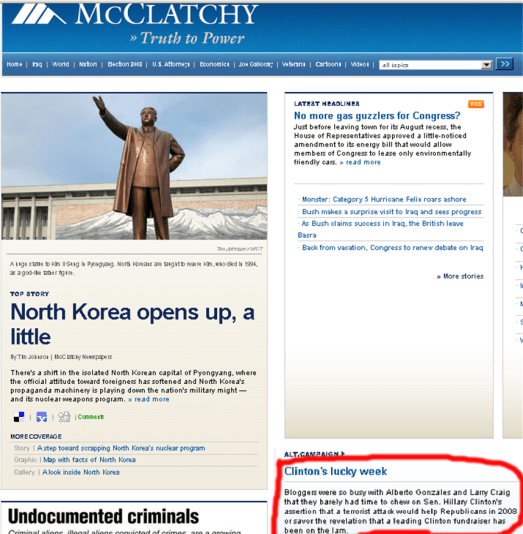
Even the brave folks at McClatchy fell into the Beltway Brain Drain:

“bloggers too busy with Craig and Gonzales that they ignored HSU”

(see below)

Man, Hillary can’t catch a break from ANYBODY!

Summary: In recent days, NBC, CNN, and Fox News have all aired reports or discussed the case of Norman Hsu, who The Wall Street Journal suggested may have funneled illegal campaign contributions to Sen. Hillary Clinton. However, when Mitt Romney’s national finance committee co-chairman Alan Fabian was charged with mail fraud, money laundering, bankruptcy fraud, perjury and obstruction of justice, the three networks did not report or discuss it during programs available in the Nexis database.

hill.png

LARRY CRAIG STORY BEATS ROVE/GONZALES/KATRINA STORIES IN GOTCHA MAINSTREAM PRESS

Stories

bush.jpg

Senator to Quit Over Sex Sting, Officials Say

WASHINGTON, Aug. 31 — Senator Larry E. Craig, Republican of Idaho, under intense pressure from party leaders to step down in the aftermath of an undercover sex sting, plans to resign his seat on Saturday, Republican Party officials said Friday.

Through intermediaries and unusually harsh public statements and actions, party officials made it clear they wanted Mr. Craig to quit before Congress returned from its summer recess next week, hoping quickly to conclude an embarrassing episode that threatened to complicate an already difficult election cycle for Senate Republicans.

Republican Party officials said Friday evening that they had been notified of Mr. Craig’s intention to give up his seat as of Sept. 30 and that Gov. C. L. Otter, a Republican, would name a replacement.

The disclosure of Mr. Craig’s guilty plea to a misdemeanor charge resulting from his arrest in the Minneapolis-St. Paul International Airport in early June was not the only political setback for Republicans this week. On Friday, Senator John W. Warner of Virginia, the former Navy secretary and an influential party voice on military policy, announced in Charlottesville that he would not seek a sixth term in 2008, giving Democrats a better chance at that seat.

Late Friday, Mr. Craig’s office scheduled a public announcement for Saturday morning in Boise, but aides would not publicly disclose his plans. National Republican officials, in what appeared to be a coordinated message, left no doubt what their preference was.

For four days, Republican officials engaged in an almost unheard of campaign to persuade Mr. Craig to step down. Speaking to reporters in his home state of Kentucky, Senator Mitch McConnell, the Republican leader, on Thursday called Mr. Craig’s conduct “unforgivable.” Senator John Ensign of Nevada, chairman of the National Republican Senatorial Committee, raised the prospect of public ethics hearings should Mr. Craig remain in office. Senators also discussed the idea of withholding support for Mr. Craig should he try to run for re-election, according to aides.

Officials at the Republican National Committee readied a news release calling for Mr. Craig to resign but withheld it after learning that there were independent efforts under way to persuade Mr. Craig to quit.

Those actions came after the Republican leadership called for an ethics inquiry and stripped Mr. Craig of his leadership posts on three committees after his guilty plea at the beginning of August to what an undercover officer described as a sexual advance in a men’s restroom in the airport terminal.

Despite such unusual steps against a Senate colleague, Republicans took no punitive action against Senator David Vitter, Republican of Louisiana, after his acknowledgment this summer of involvement with an escort service that the police described as a prostitution front.

Party officials said Mr. Vitter’s case was different in that he faced no criminal charges and was not in the Senate but was serving in the House at the time. In the case of Mr. Craig, they said experience from a recent string of misconduct cases, including the House page scandal that hurt Republicans last year, had shown there was no time to waste if the political fallout was to be minimized.

“We have learned we have to move quickly,” said a senior Senate official who did not want to be identified discussing the political ramifications of Mr. Craig’s case.

The White House added to the pressure on Mr. Craig, expressing disappointment with the senator’s conduct. But the administration has stopped short of calling for Mr. Craig’s direct ouster, instead encouraging the Senate to take action on its own. On Friday, Tony Snow, the White House press secretary, said, “It ought to be handled by the Senate.” He added, “We would expect them to do the requisite policing of their members and to uphold their own high standards.”

Speaking later, a White House official said that the administration was stepping gingerly in a situation over which it had no control, and that it could come out only the worse for trying to insert itself. Some Republicans still hold it against Mr. Bush and Karl Rove, his former adviser, for interceding too directly in removing Senator Trent Lott of Mississippi from his leadership post in 2002 after what some saw as a racially charged comment.

“There’s no way to win or react to the question,” this official said. “It’s a problem that Senator Craig and his colleagues need to deal with.”

Though major Idaho newspapers joined with national party officials in calling for Mr. Craig to resign, prominent Republicans in Idaho were largely silent, except for measured statements of personal support and gratitude for his service in Congress.

“He’s a friend and colleague, and he’s helped a lot of them on their election campaigns,” said Bryan Fischer, director of the Idaho Values Alliance, a conservative group that has been one of the few prominent voices in the state to call for resignation. “This is a small state. It’s just really hard to do anything that makes it look like you’re turning on your friends.”

John Keenan, who served as legislative director for Mr. Craig when he was a congressman in the 1980s and is now an assistant attorney general in Idaho, said: “How do you ask him to execute his political life? I don’t think anyone in good judgment can do that.”

Unless Mr. Craig were to seek re-election, Republicans were confident they could hold the seat in the conservative state. But analysts said national political damage could stem from the continued impression of Congressional Republicans skirting the law after two House members were jailed on corruption charges and other Republicans in the House and Senate remain under federal investigation along with Representative William J. Jefferson, Democrat of Louisiana.

“It feeds an existing problem that Republicans have, which is one of ethics and scandal that has been building for a couple of years,” said Stuart Rothenberg, a nonpartisan political analyst. “The Republican brand has been damaged, and these kinds of headlines don’t do anything to resurrect the brand.”

Strategists for both parties said the disclosure that former Representative Mark Foley, Republican of Florida, had sent sexually explicit messages to under-age pages cost Republicans last year, particularly because it came just weeks before the voting.

Republicans were already at a disadvantage in next year’s Senate contest, having to defend 22 seats against 12 for the Democrats. A handful of those seats are in states that have been trending against Republicans, including Colorado, Minnesota, New Hampshire and now Virginia.

Republican strategists acknowledge the challenge but say they are up to it. They note that Democrats have candidates running in Republican-leaning states like Louisiana and Arkansas.

“We have strong candidates in vulnerable states,” said Rebecca Fisher, a spokeswoman for the National Republican Senatorial Committee. “We don’t have vulnerable candidates.”

Gregory S. Casey, Mr. Craig’s former chief of staff and one of his oldest friends, said Friday night after meeting in Boise with Mr. Craig that he was holding up well despite the weeklong “villification” in the news media.

“I have never in 35 years seen him or heard him do anything inappropriate to anyone, ever,” said Mr. Casey, president of the Business Industry Political Action Committee in Washington. He said that Mr. Craig believed that “the guilty plea was a mistake,” blaming poor judgment while under pressure from an Idaho newspaper investigation about his sexuality.

Mr. Craig plans to try to clear his name, Mr. Casey said. “This is not over,” Mr. Casey said. “He is going to work on this to clear it up, so stay tuned.”

Jim Rutenberg, William Yardley and Duff Wilson contributed reporting.
My first "You should be ashamed sir"

Stories

I’m getting a little teary :

My first “You should be ashamed sir”


  • Mike McNulty // Aug 31st 2007 at 7:53 (edit)

    The only people who should be prosecuted are people like you who undermine the war and the effort of our troops. By all accounts these men did what they had to do…Maybe you should prosecute all B-17 bombardiers who by accident killed innocent germans. We would all be speaking German now if people like yourself ran the country back then…You should be ashamed sir………Michael J. McNulty Syracuse NY

I’m gonna Shake It Off

F1 PRIMETIME

Stories

Copyright 2007 @ Formula One Art & Genius Thanks Glenn!

It was in 1987, the sole Williams exception to the string of seven straight McLaren drivers championships from 1984-91 (and the season that witnessed Piquet’s 3rd World Championship when Mansell broke his back in a qualifying crash at Suzuka), that the seeds for the fifth major technical revolution in Formula One were laid. Although their struggle to remain competitive would be doomed, in the ’87 season Team Lotus unveiled the first F1 car with a computer-controlled “active suspension” system. Active suspension — later joined by the semi-automatic gearbox, traction control, “black box” controlled starting programs and anti-lock brakes — would produce fabulously complex and fast cars, but would also give lie to Niki Lauda’s prediction, after ground effects were banned in 1983, that the new rules “create a purer sense of racing for the driver.”

At the start of the post-turbo era, McLaren remained supremely dominant, but it’s two stars — Ayrton Senna and Alain Prost — would begin a personal battle that never came to an end. Given their cars’ technical superiority, both drivers agreed in 1988 that it made little sense (particularly since they usually qualified 1-2) to fight over the first corner of a race. Senna & Prost 89Yet that gentlemen’s agreement was broken at the 1989 San Marino GP, where Senna overtook Prost during the restart (after a flaming accident at Tamburello when Gerhard Berger hit the wall, a shunt that would have killed the driver a decade before) by taking the racing line from behind. Prost was furious, finding Senna’s adversarial approach to racing impossible to deal with, commenting that “I no longer wish to have any business with him. I appreciate honesty and he is not honest.” (Senna, for his part, complained that fighting for the racing line before the braking zone was legitimate.)

With the 1989 title on the line at Suzuka, the feud came to a head. Prost led by 1.7 seconds at the start, but Senna slowly reeled him in, moving alongside at the chicane, putting two wheels on the grass to go for the inside line. As Prost turned in, he held firm — he had given way previously, but not now. Both cars collided and went off. Prost got out of the cockpit in disgust, but Senna insisted on a push start from the track marshals, stopped for a new nose in the pits, and passed Alessandro Nannini to cross the line first. Yet FISA declared Nannini the winner, disqualified Senna (revoking his superlicense as well) and effectively awarded the championship to Prost. Senna remarked, “What we see today is the true manipulation of the World Championship.”

The two would do the same thing again in 1990 — different corner, same result — except that Prost by now had moved on to Ferrari, no longer content to take a back seat to Senna, and complaining that McLaren was giving preferential treatment in car set-up to the Brazilian. But in 1990, Senna was leading the World Championship when the shunt occurred, and many observers feel, to this day, that Senna deliberately drove Prost off the road as a measure of revenge for the prior year. (Senna admitted as much in 1991, without remorse.)

Green Line

QuoteSome will say, perhaps, that the 1991 World Championship was settled by the events at Montréal or Spa or Estoril, where apparently certain victories gave Nigel Mansell the slip. It was not. In reality, the World Championship was won — and lost — in the first four races, all won by Ayrton Sennna. Won, moreover, by a car which should not have been winning.Quote

Autosport Grand Prix Review ’91 – Nigel Roebuck

Green Line

It was in 1991 that the active era in Formula One truly began, as Team Williams introduced the FW14, designed by Patrick Head. As the first F1 car combining a semi-automatic gearbox (originally debuted Australia 91by Ferrari in 1989) with traction control, the FW14 was revolutionary, but broke the old dictum that “To finish first, first you have to finish.” Thus Senna, driving a plainly inferior McLaren-Honda MP4/6, after four races had recorded four pole positions and four wins. No one had ever started a Formula One World Championship campaign with four straight victories, and for the rest it was more than demoralizing. With an increase in the points for a win from 9 to 10 (and all races counting for the championship for the first time in F1) Senna had 40 points, his nearest challenger 11, and Nigel Mansell of Williams just six.

The Williams began to improve at Monaco, where Mansell took second to Senna, and at the Canadian GP on 2 June it looked like Williams were finally ready to make their move. Mansell qualified second, took the lead in the first corner, and ended the penultimate lap with a commanding lead of more than a minute. Waving to the crowd, Mansell turned into the final hairpin, and the engine cut dead, the car coasting to a slow stop, a victim of electronic gremlins. Nelson Piquet pushed forward to take the checkered flag for Benetton — for what would be his last F1 win. The balance of the 1991 season would see a fruitless quest by Mansell and Williams to catch Senna, including a disqualification while leading at Estoril after a wheel fell off in the middle of pit road. Canada 91Mansell won three in a row in France, England and Germany, and came into Suzuka needing two more victories (and no more than a 4th from Senna) to take the title. But Mansell went off into the sand chasing the Brazilian on lap 10, and Aryton Senna had clinched his 3rd Formula One championship in four years.

But Williams got the bugs worked out of their gearbox and, adding traction control and a host of other computer-controlled wonders, ran off a tremendous streak over the 1992-93 seasons. In 1992, Nigel Mansell finally rode the Williams wave to the World Championship, winning the first five races and a total of nine overall — breaking Senna’s 1988 record — to cruise to the F1 crown. Mansell retired from Williams after

Green Line

QuoteMansell enjoyed enormously the best car and had reached the point in his career when he had could exploit it enormously. He seized the 1992 season and held it tight. In the end, the simplicity was all beguiling. After 13 years, after the nightmare of Adelaide in 1986, the pain of Suzuka in 1987 and 1991, Mansell would achieve the World Championship with five races to spare. That simple.Quote

Grand Prix Showdown – Christopher Hilton

Green Line

team owner Frank Williams announced that he had hired Alain Prost (who took the ’92 season off) for 1993, but headed “over the pond” to IndyCar, where he won the 1993 PPG Cup championship, teaming with Mario Andretti (and Silverstone 93ironically with victories mainly on the ovals). The prodigal Prost returned to claim his seat — promoting test driver Damon Hill, son of Graham and driving number “0,” to the second spot at Williams — and in 1993 in turn won his 4th and last World Championship, putting him 2nd on the all-tome Formula One list only to Juan Manuel Fangio.

Yet in some respects, 1993 was the end of another era — in fact, of two eras — in Formula One. Again fretting over the perceived absence of driver skill as a delimiter of success, and concerned about the impact a long series of “runaway” seasons on worldwide viewership and sponsor money, FIA declared an end to “driver’s aids,” banning active suspension, traction control and other automatic car adjustment mechanisms. While the reaction was typical (recall 1981 and 1983), it was slightly overdone, as Aryton Senna had put on a spectacular show, once again in an outmatched McLaren MP 4/8, Prost 93to win five GPs. The most impressive of these, and perhaps the finest victory of his career, was at the European GP at Donnington Park, where Senna won after picking up five places in the rain on the first lap, cementing his place in history as the rainmeister. (1993 was also the season in which American Michael Andretti tried to master a difficult McLaren without testing and while commuting on the Concorde, crashed in his first four outings, and was sent limping home after a single podium finish.) And so, with a final victory at Adelaide in the last race of the 1993 season, Ayrton Senna prepared to move on to Team Williams, at long last striking a $20 million per-year deal with the team, and owner, who had given him his first test ride in an F1 car more than a decade before.
Green Line

ROBIN MILLER ON MICHIGAN INTERNATIONAL SPEEDWAY

Stories

 167791_sar.jpg

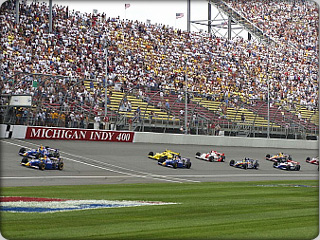
If you’ve harbored any passion for open wheel racing during the past 40 years, then you likely own some fond memories of Michigan International Speedway. A 2-mile, high-banked oval planted in the middle of the Irish Hills, it started life in 1968 as the first purpose-built superspeedway for Indy cars.

For all the great racing, which also included Can-Am, Trans Am and Formula 5000 on the road course plus USAC stocks and NASCAR on the oval, the crowds peaked in the mid-’90s for CART and have fallen off drastically in the past seven years.

Evidently unable to come to an agreement over a new date with the Indy Racing League for 2008 (it didn’t want to be a few weeks away from Detroit), MIS likely is hosting its final IndyCar race on Sunday.

Considering the ovals at Phoenix, Atlanta, Loudon, Fontana, Nazareth, Pike Peak, Orlando, Gateway and Las Vegas have all vanished from the IRL schedule during the past decade, there’s no reason to believe MIS will ever resurface.

But, for me, that drive up I-69 to Highway 12 across to MIS produced some indelible moments, great stories, miles of road rage and a few speeding tickets.

Here they are:

THE LEGAL EAGLE: Mistakenly disqualified from the ’68 Indy 500 and then re-instated after USAC learned its scales were way off, road racer Ronnie Bucknum and his Weinberger Homes Eagle scored the inaugural win at MIS in 1968.

ADIOS ARMCO: In his Indy-car debut in 1972, Merle Bettenhausen crashed on the backstretch. His car caught fire, his shield had flipped up and, instinctively, the middle son of Melvin Tony Bettenhausen tried to raise up out of the cockpit. But the car veered back into the armco guardrail on the backstretch and it severed his right arm. Badly burned on his face, Merle made a victorious comeback in USAC midgets in 1973 driving with a prosthetic arm and a hook. That armco guardrail was replaced by concrete walls and, eventually, armco would disappear altogether from oval racing.

A GOOD IDEA: John Hubbard was a gritty sprint car driver making his Indy-car debut at Michigan in the early ’70s and I was his pitboard man. A.J. Foyt had blown up in qualifying so he was starting last – a couple rows behind us. Before the driver introductions, John asked me if he should go introduce himself to Super Tex and let him know he intended to move over at the start. But, before he could, Foyt walked up and said: “Boy, keep your eye on those mirrors because I’ll be going by on the rightside and I don’t need you slowin’ me down.” Nice to meet you too, Mr. Foyt.

VUKY’S VICTORY: Despite being a tough racer and having a good career, Bill Vukovich Jr. only captured one USAC Indy-car race and it wasn’t easy. In 1973, in the opening heat of the twin 125-milers, Vuky was victimized. He won the race but they gave the checkered flag to Gary Bettenhausen and Johnny Rutherford pulled into victory lane. The ensuing chaos saw Vuky run from his car, jump on the pace car’s hood and start screaming at pace car driver Shim Malone, who had waved Vuky around during a yellow. USAC scoring had totally screwed up and, two weeks after the race, Vuky was awarded the win – by phone in front of nobody and with no celebration.

DICKED AGAIN: While working as the vent man on Johnny Parsons’ car in 1973, chief mechanic Bill Finley warned me not to go behind the car and help push until I made sure Dick Simon (pitted behind us) had come to a complete stop. Sure enough, on the first stops Simon smoked into the pits (no speed limits then) and slid all the way under JP’s rear wing. Finley kicked Simon’s front wing and threatened to smack him with a wheel hammer if it happened again.

Mansell added some unnecessary drama to his ’93 MIS win… (LAT Photo) MORE PHOTOS

ACADEMY AWARD: Following his dominating victory in 1993, Nigel Mansell all but collapsed while getting out of the car, holding his neck and writhing in agony until he looked a few feet away to see teammate Mario Andretti, who had finished second, barely sweating. Nige quickly regrouped and walked to the victory podium. The guy was a helluva racer and put CART on the international map, but what a lame actor…

RELAX RUBE: In 1974, working full-time as a stooge, vent man and beer chaser for Lloyd Ruby’s team, I was not allowed near the toolbox because of my mechanical ineptitude. But, the night before the race, our ace mechanic Danny Jones went on a bender and it was left to Jim Bob Luebbert and myself to assemble the rear suspension. Rube wandered in just before midnight and, to his horror, saw me with a wrench at the back of his car. “Hey, he’s not supposed to do that,” Rube shouted to Luebbert. We assured him I was only watching. Lloyd finished third the next day.

ONGAIS RULES: In 1977, Danny Ongais scored his initial Indy-car win at MIS driving the black Parnelli chassis of Roman Slobodyinski. Afterwards, in the press conference, I asked The Flyin’ Hawaiian to talk about being a tire buster at Indy-car races in the ’60s, not passing his first Indy-car test and now the accomplishment of being a race winner. He frowned and said: “I don’t talk about the past.” Thus began his great relationship with the media.

ARMAGEDDON: In 1981, the first 500-miler was staged at MIS and it was nearly the last. A major pit fire broke out during a pit stop by Herm Johnson and as tires exploded from the heat and pit equipment melted, it looked like Armageddon from the press box. Amazingly, there were no serious injuries in the inferno but A.J. Foyt nearly lost his arm in a grisly accident. On top of that, it rained and the race didn’t end until it was almost dark. Pancho Carter was declared the winner, although many felt it might have been Tony Bettenhausen Jr. because of a mixup during the red flag.

FEAR OF FOYT: In 1982, that “god damn Cooogan” (Kevin Cogan) and I were sitting in a garage when A.J. Foyt spotted us and started walking our way. Foyt had smacked me in 1981 at Indy because he didn’t like something I’d written and Cogan had swerved into A.J. at the start of Indy in ’82 triggering a big crash. “What do you think he wants?,” said Cogan. “Blood,” I replied. But we all had a nice little chat and A.J. walked away chuckling because he knew we were both terrified.

1 2 Next > Last >>

Gibbs Believes in His Team. Do You Believe Him?

Stories

By Thomas Boswell
Friday, August 31, 2007; E01

JACKSONVILLE, Fla. Take your stand now. Don’t wait a month until the Redskins are on their bye week and say, “I knew they’d beat the Dolphins, Eagles and Giants and be 3-0.”

Or,
of course, that could be 0-3, since teams that finish 5-11 one season
seldom tear up the league the next year. Go ahead, take the measure of
the team you’ve glimpsed this August and extrapolate its results. But
make no mistake, there is one question and one question only underneath
your analysis: Do you still believe in Joe Gibbs?

The
team that lost to the Jaguars, 31-14, on Thursday night in sweltering
Jacksonville Municipal Stadium has Gibbs’s complete public stamp of
approval. This week at their annual Welcome Home Luncheon, Gibbs
reiterated once again that he and his staff — the most expensive
teachers in NFL
history — have been given everything they need to win. The coach who
won three Super Bowls claims that he has exactly the men he needs, the
precise players with the talents and temperaments he wants. He praised
their heart in the final seven games last year, after he took the team
back to its smash-mouth roots.

“It’s all on me,” Gibbs says.

Does
he say it because, in the fourth year of his return, he has no
realistic choice? Or does he see something — perhaps many things —
that others simply don’t? Who judges talent and people better than
Gibbs?

On nights like this, we’re reminded that wise fans might
want to give Gibbs the benefit of the doubt one more time. Not out of
gratitude for past Super Bowl victories, though that is merited, but
because coaches as special as Gibbs are so rare. Just a glimpse of the
rich promise that Gibbs thinks he sees is all that the Redskins showed
against the Jags. But it was an eyeful. With one sweet, eight-play,
70-yard touchdown drive on their first possession, the Redskins planted
the seed of hope. It doesn’t take much, does it?

Showing no hint of a limp from his bruised knee, Jason Campbell threw five passes and completed them all for 54 yards and a 23-yard touchdown to Antwaan Randle El. He was merely perfect. Rock Cartwright
blasted for 21 yards on three carries. Then, as quickly as they’d
appeared for one brief first-quarter drive and that 7-0 lead, every
first-string Redskin was finished for the night. Rookies, scrubs and
backup quarterbacks fought for jobs the rest of the evening. Yet, with
that one immaculately executed drive, the Redskins made you wonder:
Could Gibbs be right?

The Jaguars will tell you that Campbell’s
soft touch pass up the left sideline to Randle El was completed against
their third-string cornerback, Dee Webb, a fellow who’s more likely to
be driving a FedEx truck than playing at FedEx Field.
They’ll say that another of their humble third-stringers — defensive
tackle Walter Curry — knocked Campbell head-over-bruised-knee on a
sack that sent the hearts of Redskins followers into their throats.

The
Redskins don’t want to hear it. Their whole preseason has been one
continual offensive frustration. After a poor performance in Tennessee with no points in six possessions, Campbell was injured early in the Steelers game, then missed what would have been a useful test against the mighty Ravens
defense in the first half last week in a game cut in half by lightning.
So he and Gibbs were willing to take the risk of giving him just one
series last night to change the tone of his exhibition season.

“It was a confidence boost. It gave us momentum for the Miami
game,” said Campbell, referring to the season opener in Landover on
Sept. 9. “I was kind of nervous about taking the first hit to my knee.”

Yet he survived exactly the kind of big hit that the Redskins hoped to avoid as he checked down for a 12-yard gain to Mike Sellers. Actually, Campbell took “two licks but it was good to get ’em out of the way.”

If
we step back and view this exhibition season as a whole, the Redskins’
preseason may actually have revealed more than many thought. By playing
on even terms against four teams that all finished at .500 or better
last season, the Redskins established that they are probably a solid,
competitive team that is already considerably better than last season’s
dismal mess.

The Titans,
Steelers, Ravens and Jags may not get to the Super Bowl this season.
But they are tough, physical teams with strong defenses. Playing them
to a standstill in August, especially with minimal time from Campbell,
is not insignificant. Even more important, the Redskins’ biggest
weakness — the 31st-ranked defense in the NFL — showed enormous
improvement. In the first halves of the first three games, the Redskins
allowed only 19 points. None of Jacksonville‘s points came against starters.

“The first half of all those [first] three games we played up to our standards,” defensive end Renaldo Wynn
said. “That’s a big difference from last year. We’ve come a long way.”
This year, there was no confidence-shredding debacle like last August’s
41-0 loss to New England.

“We’ve
got to start off fast in the regular season, not like last year,” added
Wynn. “I don’t care who you are, going 0-4 in preseason, then losing
the first two games leaves a bad taste in your mouth.”

Getting
off to that fast start may be more feasible this season — although the
opener against Miami bears a resemblance to last season’s opener
against the Vikings, when the Redskins were favored but lost by three
points. A large part of any NFL team’s success is the luck of its
scheduling draw. There, the Redskins could hardly ask for more.

Almost
every foe they play at home, where they were 3-5 last year, has a new
head coach, a new untested quarterback or a losing record. The Dolphins
(6-10) will arrive with rookie coach Cam Cameron, a former Redskins
quarterback coach. The digestible Lions (3-13) and Cardinals (5-11)
also arrive at FedEx in the first six weeks of the season. Those three
wins alone should avoid a panic like last year’s 2-5 start.

In the second half, the Redskins host the Bills (7-9) and visit the Vikings (6-10) and Bucs
(4-12). Also, if the Redskins can’t win two of three from their
division rivals at FedEx, they aren’t a serious postseason contender
anyway. Even last year, in what may have been the nadir for a franchise
with enormous resources, the Redskins were only outscored by five
points in three home games against the Eagles, Giants and Cowboys.

“This
game is a mystery,” said Gibbs late last night. “That’s why it’s such
an attraction. The fans don’t know what’s going to happen and we don’t
either. But now it’s going to be played out. It’s a long haul. We’ll
see.”

When the Cowboys come to FedEx on Dec. 30 for the final
game of the season, the Redskins — if they bear any resemblance at all
to the team Gibbs thinks he has — will probably have a winning record,
perhaps 8-7. If that’s the case, a playoff spot may well be at stake as
the year ends.

If that’s how this season works out, with all the attendant Joe’s-back hoopla, don’t say Gibbs didn’t tell you.

Powered by ScribeFire.

New York Offers Incentives to Homebuyers, Builders to Go Green

Stories

New York Offers Incentives to Homebuyers, Builders to Go Green

Published: August 31, 2007

spitzer

By Kelly Sheehan, Online News Editor

New York—Two initiatives to promote the construction of green
homes in New York were recently announced by First Lady Silda Wall
Spitzer and David D. Brown, executive director of the Dormitory
Authority of the state.

In an effort to encourage homeowners to incorporate simple energy
reduction features into their homes, new legislation will offer
incentives to homeowners to integrate environmentally friendly
practices when building or renovating homes. The amount of the
incentive will be based on the size of the home, with a cap of $10,000
per home. This money will help offset the additional costs associated
with green building.

Earlier this year, Governor Eliot Spitzer unveiled his “15 x
15” plan to reduce energy use by 15 percent from forecasted
levels by the year 2015, through new energy efficiency programs.

“Buildings are part of the problem of climate change, but
they can also be part of the solution if they meet a higher standard
for environmental sustainability,” says Spitzer. “This
legislation offers an economic incentive to everyday New Yorkers who
would like to make their homes energy efficient, but are concerned
about higher construction costs. The incentive will help defray these
upfront costs, which will yield significant energy and cost savings for
the homeowner in the long-term. By working together and making smart
building decisions, New York State and New Yorkers can achieve reduced
energy consumption, decrease our carbon imprint, and save consumers
money.”

Powered by ScribeFire.

Glenn Greenwald on the Democrats' responsibility in the wake of Gonzales' resignation

Stories

(Updated belowUpdate IIUpdate III)

Glenn Greenwald drawing
One of the most blatantly dishonest political hacks ever to occupy the position of U.S. Attorney General, Alberto Gonzales, has now resigned.
This is a real moment of truth for the Democratic Congress. Democrats,
who have offered up little other than one failure after the next since
taking power in January, can take a big step toward redeeming
themselves here. No matter what, they must ensure that Gonzales’
replacement is a genuinely trustworthy and independent figure.

That means that Democrats must not confirm anyone, such as Michael
Chertoff, who has been ensconced in the Bush circle. Instead, the DOJ
and the country desperately need a completely outside figure who will
ensure that the prosecutorial machinery operates independently, even if
— especially if — that means finally investigating the litany of
Executive branch abuses and lawbreaking which have gone almost entirely
uninvestigated, as well uncovering those which remain concealed.

The standard excuse invoked by Democrats to justify their capitulations
— namely, that they cannot attract a filibuster-proof or veto-proof
majority to defy the President — will be unavailing here. They
themselves can filibuster the confirmation of any proposed nominee to
replace Gonzales. They do not need Blue Dogs or Bush Dogs or any of the
other hideous cowards in their caucus who remain loyal to the most
unpopular President in modern American history. The allegedly “Good
Democrats” can accomplish this vital step all on their own. They only
need 40 Senate votes to achieve it.

It is difficult to overstate how vital this is. The unexpected
resignation of Gonzales provides a truly critical opportunity to
restore real oversight to our government, to provide advocates of the
rule of law with a quite potent weapon to compel adherence to the law
and, more importantly, to expose and bring accountability for prior
lawbreaking. All of the investigations and scandals, currently stalled
hopelessly, can be dramatically and rapidly advanced with an
independent Attorney General at the helm of the DOJ.

That is not going to happen if the Democrats allow the confirmation
of one of the ostensibly less corrupt and “establishment-respected”
members of the Bush circle — Michael Chertoff or Fred Fielding or Paul Clement
or some Bush appointee along those lines. The new Attorney General must
be someone who is not part of that rotted circle at all — even if they
are supposedly part of the less rotted branches — since it is that
circle which ought to be the subject of multiple DOJ investigations.

As Democrats supposedly just learned (yet again), even the Bush
appointees whom they claim (foolishly) to believe they can trust to act
independently, such as DNI Mike McConnell, have their ultimate
allegiance to George Bush and Dick Cheney. The President is certainly
entitled to choose someone who is generally compatible with him
ideologically, but the only acceptable replacement for Alberto Gonzales
is someone who is truly independent of the Bush machine and whom
Democrats are supremely confident will act independently, which means
pursuing criminal investigations where warranted of the highest levels
of this administration, including the departing Attorney General
himself.

Congressional Democrats, insulting the intelligence of their own
supporters, have repeatedly claimed to have trusted the Bush
administration and its appointees only to be “betrayed” time and again
— they were “betrayed” by allowing the confirmation of Alito and
Roberts to the Supreme Court based on false assurances that they would
respect precedent; they were “betrayed” again by the agreement on the
Military Commissions Act between the White House and
Graham/Warner/McCain only to then have the agreement modified severely
by last-minute changes; they were “betrayed” again by trusting Mike
McConnell on the FISA deal; and they even claim to have been “betrayed”
by supporting the confirmation of Gonzales himself based upon
assurances at his confirmation hearing that he understood and would
honor his independent role as Attorney General.

That excuse is not going to work again. Relying on assurances from
some current Bush appointee that they will act independently is
woefully and self-evidently insufficient. Only a truly outside figure,
one who is entirely independent of the Bush circle, should be
acceptable.

Pressuring Senate Democrats right away on this is vital. There is no
more important domestic political goal then ensuring that the DOJ
investigative and prosecutorial machinery operates independently.
Senate Democrats will have none of their usual excuses if they fail to
compel the nomination of someone truly independent and/or if they sit
by meekly and allow the appointment of someone whose independence is
even questionable.

Whatever it takes — repeated blocking of nominees, filibustering,
protracted hearings — it is critical that it be done in order to
restore integrity to the DOJ. A less-than-independent replacement as
Attorney General will be entirely the fault of Democrats if they allow
it to happen. Conversely, by ensuring the confirmation of someone
independent, Senate Democrats can take a major step in revitalizing the
rule of law, revitalizing their political base, showing the country
they stand for something, and making the case that the 2006 midterm
election change of control actually meant something.

UPDATE: Commenters have suggested that Bush could bypass the confirmation process with a recess appointment, but Bush and Harry Reid have an agreement in place that there will be no recess appointments during Congress’ adjournment:

There’ll
be no recess appointments this time around, Roll Call reports (sub.
req.), meaning the White House won’t be taking advantage of Congress’
vacation to install any contested nominees. That’s due to a deal
between Bush and Senate Majority Leader Harry Reid (D-NV). . . .

Last recess, the White House made a number of controversial recess
appointments, including Swift Boat backer Sam Fox as ambassador to
Belgium. In order to prevent that sort of thing from happening again,
Reid had plotted to keep the Senate in “pro forma” session during the
recess — whereby the Senate floor personnel show up every three days
to make it an official session. But now Reid and Bush have made a deal,
according to Roll Call. Bush won’t make any recess appointments and
Reid has promised to move some of his nominees when Senate gets back in
session.

Obviously,
there is nothing truly binding about the agreement, and Bush could
violate it. But in the Beltway world, that is a Draconian step that
seems unlikely (though not impossible) for many reasons. Far more
likely, it seems, is Bush’s (reasonable) belief that Senate Democrats
will be as accommodating as usual and confirm a replacement who is
acceptable to the administration.

UPDATE II:
Oddly, the Drudge Report, for a period of no more than several minutes,
apparently “reported” that the Bush administration would replace
Gonzales via recess appointment, but has now taken that down.
Identically, the publication most closely associated with Drudge, The Politico,
briefly had a caption on its front page indicating the same thing,
though nothing in its Gonzales article mentioned that. When I just went
to the Politico site to screen capture the recess appointment reference, it, too, had been removed.

The Politico does have an article by the always-plugged-into-the-Bush-administration Mike Allen which signals the potential administration strategy here:

The acting attorney general with be Solicitor General Paul Clement. He
“can stay in that position for quite a while,” a senior administration
official said.

That would avoid a bruising confirmation fight. Some Democratic senators have vowed not to confirm a Gonzales successor. . . .

An administration official explained: An individual may serve in an
acting capacity for 210 days. However, if there is a pending nominee,
the 210 day “clock” starts again when a nominee is announced. The 210
day “clock” would restart again if the nominee is voted down. The clock
stops when there’s a nominee, and restarts with a new 210 days if the
nomination is withdrawn or fails.

Engaging
in that tactic would be tantamount to a recess appointment — allowing
Bush to have an Attorney General in place more or less indefinitely
without Senate confirmation. One would hope, though not necessarily
expect, that Harry Reid and company would treat that as the serious
violation of their agreement that it would be and respond with full
retaliation.

[Immediately after posting this update, the reference to a “recess appointment” has returned to the Politico front page:


And it is now gone again.]

UPDATE III: Gonzales’ resignation is not effective until September 17,
by which time Congress will be back in session, thus precluding an
overt recess appointment. The two most likely strategies for the
administration are: (a) try to find a candidate acceptable to it that
the Senate would be unlikely to block (such as some type of Bush
loyalist and Gonzales-defending Senator like Orrin Hatch — pompous
Senatorial courtesy trumps everything, including the rule of law) or,
alternatively, (b) leave Clement in place indefinitely in an interim
position, thus violating (in effect) the agreement barring recess
appointments. Either way, for countless reasons, this is a fight Senate
Democrats have to engage (which is not, of course, the same thing as
predicting they will, though all efforts should be devoted to
pressuring them to do so).

Powered by ScribeFire.