GREAT QUOTES STOLEN FROM A RIGHT-WING DOUCHEBAG

Stories

“I think it would be a profound mistake for us to use nuclear
weapons in any circumstance… involving civilians. Let me scratch
that. There’s been no discussion of nuclear weapons. That’s not on the
table.”

BARACK OBAMA

“What Giuliani is, is George Bush on steroids. Giuliani, Romney and
the rest of the Republicans running for the nomination are going to
give the country four more years of crony capitalism, which is exactly
what we have now. We have insurance companies and drug companies and
oil companies running this government. They need to be stopped. And
Giuliani just wants to empower them.”

JOHN EDWARDS

“I’m a democrat and I can’t stand this president…. I’m here to
represent people. The people I represent don’t want to impeach
this clown.”

EARL POMEROY

“We should reverse the presumption of confirmation. The Supreme
Court is dangerously out of balance. We cannot afford to see Justice
Stevens replaced by another Roberts, or Justice Ginsburg by another
Alito.”

CHUCK SCHUMER

“While President Bush and Vice President Cheney continue to operate
as if they are leaders of a monarchy, Congress should censure them and
make it clear to this and future generations that their actions are
entirely unacceptable.

“If Congress does not act to formally admonish this White House then
the future of our democracy will be placed on a slippery slope in which
other presidents may point to the actions of this administration as
justification for further abuses of the Constitution. Congress cannot
allow such abuses of power and law, which is why Senator Feingold and I
will soon introduce these censure resolutions.”

MAURICE HINCHEY

“I will be shortly introducing a censure resolution of the president
and the administration. One, on their getting us into the war of
Iraq—in Iraq and their failure to adequately prepare our military
and the misleading statements that have continued throughout the war in
Iraq. And the second, on this administration’s outrageous attack
on the rule of law, all the way from the illegal terrorist surveillance
program to their attitude about torture…. [T]his administration has
done the greatest assault on our Constitution perhaps in American
history.”

RUSS FEINGOLD

“I think we’re in great danger of [a terror attack staged by the U.S. government].”

RON PAUL

“I live in North Carolina. I’ll probably never eat a tangerine again.”

ELIZABETH EDWARDS

And to the analysis of Shields and Brooks…

Stories
David Brooks and Mark Shields
 
audioRealAudioDownload  

JIM LEHRER: And to the analysis of Shields and Brooks, syndicated columnist Mark Shields, New York Times columnist David Brooks.

David, do you see something new and awful about this heat that erupted in the House of Representatives?

DAVID
BROOKS, Columnist, New York Times: It’s not new, but awful. It’s like a
Eugene O’Neill play. They’ve got all these submerged hatreds, and it
only takes a little fissure to open them all up. And that’s what
happened yesterday.

What was striking about what happened with
the ag bill was that, first of all, the parties couldn’t agree what was
in the bill, and then they couldn’t agree on how the vote went about
the bill. And then when they had this whatever happened, the bit of
chaos, and the versions you get depend entirely on what party you’re
talking to, immediately the hatred erupted.

And it’s the same
hatred that erupted when Tom DeLay and others held the vote open a
couple of years ago, and that hatred is still there. And I don’t think
the procedures of the House have changed that much. The majority party
has changed, but a lot of the strong-arm tactics are sort of the same.

JIM LEHRER: Hatred is a strong word to use. Do you agree with David, who uses that word?

MARK
SHIELDS, Syndicated Columnist: No, I disagree with David. I think there
was a crankiness, there is a crankiness in the House right now, this
tension.

JIM LEHRER: Crankiness, not hatred?

MARK SHIELDS:
Crankiness. No, it was cranky. They’re tired. They’ve worked long
hours, and I think they’re ready to get out of there. And I think the
profound difference between what happened last night and what happened
with Tom DeLay, keeping the Medicare bill open for three hours, the
vote on the floor for three hours in total violation of the House
rules, and twisting arms and making threats on the House floor, was
that both Steny Hoyer, the majority leader — I thought who handled it
very well — and Mike McNulty, who was in the chair, said, “I was
wrong. I made a mistake.” I mean, I didn’t hear that in the DeLay era.
That was entirely different. Now…

JIM LEHRER: But David’s point
is that, whether or not it was an honest mistake or not, that
underlying the surface here is tension, and much more than tension.

MARK
SHIELDS: Well, I don’t know — I mean, I thought John Boehner was quite
measured and quite restrained. Roy Blunt, the Republican whip, was
different. And I think there’s no question that, within the Republican
caucus, there are people who are unreconstructed, just as there are
people on the Democratic side who are unreconstructed in any dealing
with the other side.

And I think Roy Blunt was speaking to and
for them, whereas John Boehner, who’s a fierce partisan and a very
loyal Republican, you know, was trying to think how he could make the
house work.

DAVID BROOKS: Well, they both have Machiavellian
reasons to want to make the House appear less angry because the
approval ratings of the Congress as a whole, and the House in
particular, are sub-Cheney, and they’re pretty terrible. So they both
have an incentive to make it seem like they’re both doing their job.

And
the big thing that has changed — this has been a long, gradual change
— is that members of each party are much less likely to care what
people in the other party think of them personally than used to be. And
so they’re perfectly happy to shout, “Shame,” or to behave in shameful
ways toward people in the other party.


Mark Shields


Mark Shields
Syndicated Columnist
Let’s
be very blunt: The House reflects the country, and the country is riven
over the issue of Iraq. There’s a consensus that we want to get out,
and there’s no consensus on how.


Civility in Congress

JIM LEHRER: Does it matter?

MARK SHIELDS: Why, sure, it does matter.

JIM LEHRER: I mean, other than just…

MARK
SHIELDS: It matters because, you know, for one thing, I mean, we saw
the retirement announced this week of Ray LaHood. Ray LaHood is a
Republican from Peoria, Illinois, who served as Bob Michel’s chief of
staff, who was Republican leader, was an enormously civilized, genteel
man, who has friends on the other side of the aisle, and for whatever
reason is leaving.

And the quotient and quota of civility in that
institution has depleted seriously by people like David Skaggs, from
Colorado, who left, and Ray LaHood, both of whom organized a weekend
for families to overcome what David has described, that would get
along. They went away for one weekend, maybe even two, but then he
tried to rejuvenate it, and couldn’t get people to want to do it.

DAVID
BROOKS: I actually went to one of those weekends as a facilitator of
conversation. And there was — I tell the story — there was a woman in
the hallway weeping because, in one of the breakout sessions, she’d
been insulted so badly that she left the room weeping.

JIM LEHRER: A member of the House of Representatives?

DAVID
BROOKS: A spouse. And this was at the civility conference. And so
that’s a little of the atmosphere that was even carrying over.

JIM
LEHRER: Going to substance here now, Speaker Pelosi said in an
interview on the program last night that she was proud of the record of
the House of Representatives during this session. Does she have a right
to be proud? Should she be proud?

DAVID BROOKS: I don’t think in
particular. I think she’s done things to exercise her control over her
party, which looked unlikely when this started. I think she’s been an
effective speaker at organizing the Democrats, and this was a party
that seemed riven with Steny Hoyer on one side and her on the other. I
think she’s been effective in that.

In terms of passing
legislation, changing the way the House does business, reducing the
number of earmarks, that’s certainly not been a success. The number of
earmarks has shot upwards. And so I think substantively, it’s not been
a successful Congress, but politically she’s done well, and that’s what
she’s oriented to, 2008.

MARK SHIELDS: I agree with David. I
think she’s been a far more leader of the — effective leader of the
party than many people thought she was capable of being. I mean, she’s
cracked heads, and she’s kept the Democrats quite united.

Let’s
be very blunt: The House reflects the country, and the country is riven
over the issue of Iraq. There’s a consensus that we want to get out,
and there’s no consensus on how. And that’s exactly where the House is.
And they’ve had six separate votes on it. That drives the House; that
drives the entire ethos of the House, the entire atmosphere of the
House.

I think that — if you’re giving a grade, I’d say it’s an
incomplete, because, I mean, there are things like children’s health,
and the student loan reform, as well as the ethics reform I think that
are significant, and the energy bill — it will be tomorrow — that it
will be September, it will be October, but they will — I think they
will be done.


David Brooks


David Brooks
The New York Times
I
was out on the campaign trail with Republicans in New Hampshire, every
other question was about health insurance. This really is an issue in
even Republican circles.


Debate over children’s health bill

JIM
LEHRER: What do you think on — what is your view on the children’s
health bill, the SCHIP thing, David, which got a lot of heat? We’ve had
debates here on the NewsHour about it.

DAVID BROOKS: I confess
I don’t have an intelligent view on the substance. From first glance,
it looks like something is building on a successful program that would
extend health benefits to children. If you look at the members of the
Senate, the Republicans say who would be unlikely to vote for a
Democratic piece of legislation, I think 18 Republicans voted for it.
So you have to think the thing has some merit.

What strikes me,
interestingly, is the politics of it. Because on the one hand, I was
out on the campaign trail with Republicans in New Hampshire, every
other question was about health insurance. This really is an issue in
even Republican circles.

JIM LEHRER: You mean about no having it and worrying about not having…

DAVID
BROOKS: Exactly, one thing or another, whether it’s veterans or
something, it’s a big issue, let alone on the Democratic side. And so
that’s a big issue. On the other hand, spending restraint is also a
huge issue out there. And Democrats have been notably slow to pick
fights on spending versus not spending, for that reason.

JIM LEHRER: And the SCHIP issue has got both. It’s got health insurance. Also it’s got spending issue politically, right?

MARK SHIELDS: Hey, Jim…

JIM LEHRER: Oh, Mark.

MARK
SHIELDS: … there is no political defense from the White House’s
position on this. This is a Republican program passed in 1997. I mean,
Trent Lott, God bless him, the Republican whip in the Senate, talks
about this is socialized government-run medicine. This is what they’re
trying to push.

The last time I checked, every member of Congress
and their children is covered by a government-sponsored-and-paid-for
health program. I trust in a better conscience they’ll all renounce
this during the recess and go to private plans.

I mean, what are
we talking about? We’re talking about the children of the working poor.
I mean, somehow there’s a charge that the six deadbeats who are 5 years
old, these 6-year-olds want to get on and rip off the taxpayer? I mean,
I just can’t believe it.

They’re going to tax? Yes, they’re going
to tax cigarettes. I mean, unfortunately, cigarettes and the poor
people who smoke them have become a punching bag and a fiscal reservoir
for the country and for programs. But I don’t think the Republicans and
the White House — I mean, the Republicans talk openly about how they
can’t understand the White House’s political point on this.

DAVID
BROOKS: I think most Republicans would not accuse 6-year-olds of being
deadbeats. I don’t think quite that’s their argument. This is the
open-air argument of what’s going to be the biggest domestic argument
of the ’08 campaign, and the Republican position would be, not that
these people shouldn’t be covered, it’s going to be that we shouldn’t
do it in a nationalized way, a Britain-Canada style, and we shouldn’t
ramp up spending that we can’t pay for. And they’d say the cigarette
tax only pays for a tiny portion. There are other things that aren’t
paid for, so you’ve got to pay for it.

And so that’s going to be the argument. I’m not sure the argument is going to be over deadbeat 6-year-olds.


Mark Shields


Mark Shields
Syndicated Columnist
[W]hat
this does is it…ends the whole entertainment industry in Washington,
no tickets, no gifts, no entertainment, no dinners for lobbyists.


New ethics rules

JIM
LEHRER: OK, Mark, you mentioned the ethics legislation. Are things
really going to change that much because of what happened?

MARK SHIELDS: Sure, they are.

MARK
SHIELDS: First of all, Jim, according to the Heritage foundation, the
Republican think-tank, very respected, since 1996, Republicans members
of Congress have left the House, one out of two has become a registered
lobbyist. I mean, the explosion in K Street is just…

JIM LEHRER: K Street is a street in Washington where the lobbyists work and live.

MARK
SHIELDS: Lobbyists work, it’s just remarkable, OK? And the nexus
between lobbyists and money to campaigns — if David’s running, I’m a
lobbyist. What I do is I then collect money from my clients, from my
associates, and I then bundle that money and bring it to David, and
say, “Look, you know, I can only give you $2,300, but here’s $45,000.”

JIM LEHRER: And, by the way, I represent the…

MARK
SHIELDS: Exactly, and I want to have a continuing relationship with you
and your wonderful staff. And what this does is it exposes that, it
ends the whole entertainment industry in Washington, no tickets, no
gifts, no entertainment, no dinners for lobbyists. But the money thing
— for members and staff — extends to two years the time before a
member who leaves can now go out and lobby. And I just think — I
really think it makes an enormous difference. It’s going to be
disinfectant of sunlight. We’re going to know who’s bundling…

JIM LEHRER: They can still bundle, but they have explain it.

MARK SHIELDS: That’s right. That’s right.

JIM LEHRER: What do you think?

DAVID
BROOKS: I think it makes a difference for the reasons Mark talked to.
It’s going to be lonely for us at Nationals games, no lobbyists and
members of Congress floating around, a lot of beer and hot dogs for us.

MARK SHIELDS: You’ll get better seats.

DAVID
BROOKS: But the thing a lot of people wish had gone further — and this
is controversial — is, again, going back to the earmarks and the
transparency of the earmarks. A lot of people, like John McCain, think
that they should have gone further so that the earmarks, that you
couldn’t slip it in.

The Democrats claim they did go to some
extent. But I really think the earmarks are corrosive. And that’s what
the lobbyists really care about is, is getting those special provisions
slipped in. And until you cut away that, which is the root of all
evil…


David Brooks


David Brooks
The New York Times
[I]n
’94, there were 4,000 earmarks in the budget. Ten years later, there
were 14,000. And I think the Washington Post reported there were now
34,000. People love earmarks.

Impact on earmarks

JIM
LEHRER: And the new bill does not in any way ban earmarks. All it does
is say, “You’ve got to say who got the earmarks and why,” right?

MARK SHIELDS: And you have to certify that nobody connected with you is benefiting from it financially.

DAVID
BROOKS: Right, but there are loopholes about where it gets certified
and things like that that a lot of people are complaining about.

JIM LEHRER: So do you think it’s going to end earmarks, it’s going to…

DAVID
BROOKS: Oh, well, it certainly won’t end earmarks. Everybody loves
earmarks. I mean, I think, if I remember this correctly, when Gingrich
came to power in ’94, there were 4,000 earmarks in the budget. Ten
years later, there were 14,000. And I think the Washington Post
reported there were now 34,000. People love earmarks.

JIM LEHRER: Does the raid on Senator Stevens’ Alaska home, does that affect the ethics climate and passable legislation…

MARK
SHIELDS: It guaranteed Senate passage. I mean, if you’re a Republican,
you can’t say, “Oh, boy, this is political.” Here they are, the FBI,
going in and invading and examining the home of the senior Republican
senator. It absolutely guaranteed it.

And I think what we’re
seeing is that Alaska is, from top to bottom — the political
environment there is being examined and will be scrutinized.

JIM LEHRER: A climate change as a result of this?

DAVID
BROOKS: Yes. But, again, the Ted Stevens, what he did, whether he did
it or not, that’s not what the cause of all this lobby reform
legislation. It wasn’t the stuff that people were trying to hide that
caused this legislation. It was the stuff that was happening in the
open day on restaurants on K Street.

And so, you know, what he
did, may have done, may be illegal, but the stuff that was going on
every day is what we needed to address. And that’s what the legislation
was about.

JIM LEHRER: But I’m just thinking about whether or not
it’s tied directly to this. Does it have an indirect influence on the
way people…

DAVID BROOKS: Well, I think when you’ve got money
in freezers, houses being rebuilt, it all feeds in. Duke Cunningham,
we’ve had many cases of this.

JIM LEHRER: OK, David, Mark, thank you both very much.

Online NewsHour: Analysis | Republicans Walk Out on House | August 3, 2007 | PBS

Powered by ScribeFire.

Harry Reid is craaaaaaaaazy!

Stories

Daily Kos

Tue Jul 24, 2007 at 02:31:18 PM PDT

So
your president is at 25% approval rating. Your attorney general is a
laughing stock who doesn’t even bother concealing his perjury and
contempt for Congress (including members of your party). Iraq continues
to spiral out of control. On just about every issue, your political
foes have the upper hand. And on that one advantage you could always
count on — cash — you’re getting blown out.

So what do you do?

Seeing that Republicans can’t function without an enemy, and seeing
that efforts to demonize scaaary Nancy Pelosi have failed disastrously,
they’re moving on to Plan B — Harry Reid.

Senate Republicans are preparing to take aim at Majority Leader
Harry Reid over the August recess for being “all talk but no
action” and helping drag the Democrat-led Congress’
approval rating to a historic low, according to a document distributed
to caucus members.

Sen. Jon Kyl of Arizona, chairman of the Senate Republican
Conference, is meeting with members yesterday and today to disseminate
a message critical of Democrats for endlessly debating the Iraq war,
stalling judicial nominations and squandering time on at least 300
investigations of the Bush administration.

“We really ought to be asking why this Democrat leadership
won’t allow Congress to move forward on serious policy
debates,” Mr. Kyl said, when asked about the talking-points
memorandum he is circulating.

The Carpetbagger Report notes:

I suppose it’s possible that I’ve heard more
breathtaking hypocrisy, but nothing comes to mind. Reid isn’t
allowing Congress to move forward? Republicans are on pace to be the
most obstructionist minority in the history of Congress, and the GOP
wants to blame Reid for blocking progress?

I suppose we should have seen this coming. Fred Hiatt went after
Reid over the weekend, at the same time as David Brooks, Bob Novak, and
a handful of other conservative media voices, suggesting some kind of
coordinated effort to blast the Majority Leader.

And now the RNC is making it official.

The lemmings are in action, their hypocrisy be damned! But isn’t it
always this way? What’s hilarious is the “ammo” Republicans are
wielding in this laughable effort, as Joe at AmericaBlog notes:

The Chair of Republican National Committee, Robert M. “Mike” Duncan,
just launched a full-scale attack on Senate Majority Leader Harry Reid.
The funny thing is that the first line of the e-mail could be a
fundraiser for Democrats:

On Sunday, Senate Majority Leader Harry Reid (D-NV) called President Bush “a liar” and a “part of the culture of corruption.”

Both true.

Duncan’s e-mail devolves into a rant from there. But you have to
love the fact that the RNC is attacking Reid for doing something most
Republican will never, ever do: Tell the truth.

Despite gains in recent years, the GOP still has a vastly superior
media machine to get their message out. So I’m ecstatic that they’ve
decided to give us a helping hand by reminding people that 1) Democrats
oppose Bush, his lies, and his corruption, and 2) Democrats want to get
out of Iraq.

The dumbasses think this is going to help them, so who are we to dissuade them from that notion?

Powered by ScribeFire.

Democratic Accomplishments in the 110th Congress: Leading America in a New Direction

Stories

Democratic Accomplishments in the 110th Congress: Leading America
in a New Direction

Less than six
months into the 110th Congress, Senate Democrats have made significant
strides in passing important, common-sense legislation that reflect the
priorities of the American people.  After nearly a decade of
Republican control, Democrats have worked to restore fiscal
responsibility in Washington and pass key legislation on Iraq policy,
homeland security, troop readiness, veterans’ health care,
economic competitiveness, ethics reform, the minimum wage, health care,
education, energy independence, stem cell research, and Gulf Coast
revitalization.  Democrats are committed to proving that elections
do matter, and we will continue to pursue the international and
domestic priorities that matter most to the American people. 
Together, we will take the country in a new direction. 

Under Democratic leadership, the Senate has passed the following measures:

  • A fiscally responsible budget: a budget that restores fiscal discipline and
    will lead to a surplus, while cutting middle-class taxes and funding
    foreign anddomestic priorities, including education, childrens health care, veterans, and our troops;
  • 9/11 Commission recommendations: a
    bill to make America more secure by giving our first responders the
    tools they need to keep us safe; making it more difficult for potential
    terrorists to travel into our country; advancing efforts to secure our
    rail, air, and mass transit systems; and improving intelligence and
    information sharing between state, local, and federal law enforcement
    agencies;
  • Homeland security funding: legislation
    that provides $1.05 billion in funding necessary to address dangerous
    border and transit vulnerabilities left open by the Bush Administration
    since 9/11;
  • Support for our troops: legislation
    funding the President’s requests for Operation Iraqi Freedom and
    Operation Enduring Freedom, including $1.2 billion in additional
    funding for a total of $3 billion to provide our troops in Iraq with
    mine-resistant, ambush-protected vehicles;
  • Health care for wounded soldiers and veterans: legislation
    that provides $3 billion in supplemental funds for military health care
    and $1.8 billion in supplemental funds to the Department of
    Veterans’ Affairs to accommodate the increasing number of new
    veterans returning home from Iraq and Afghanistan;
  • Benchmarks for Iraq: legislation
    that conditions U.S. economic support for the Iraqi government on its
    progress toward achieving key political benchmarks;
  • National Guard readiness: legislation
    to provide an additional $1 billion to President Bush’s request
    for National Guard equipment needs to remedy equipment shortfalls that
    are compromising the quality of force training and limiting the
    Guard’s ability to quickly respond to natural and potential
    man-made disasters at home;
  • Continuing Resolution: legislation
    providing funding for the nine remaining appropriations bills that were
    not completed by Republicans in the 109th Congress.  In passing
    this legislation, Democrats stayed within budget limits, eliminated
    earmarks, and increased funding for national priorities, including
    veterans’ medical care, Pell grants, elementary and secondary
    education, the National Institutes of Health, state and local law
    enforcement, and global AIDS prevention and treatment;
  • Energy Bill:
    landmark legislation to increase our energy independence, strengthen
    the economy, reduce global warming emissions, and protect American
    consumers.
  • American competitiveness: bipartisan
    legislation to increase the nation’s investment in basic and
    innovative research; strengthen educational opportunities in science,
    technology, engineering, and mathematics from elementary through
    graduate school; and develop the infrastructure needed to enhance
    innovation and competitiveness in the United States;
  • Ethics and lobbying reform: a
    bill to slow the “revolving door” for former Senators and
    staff, strengthen limits on gifts and travel, expand lobbying
    disclosure requirements, establish a study commission on ethics and
    lobbying, prohibit pensions for Members of Congress convicted of
    certain crimes, and implement reform procedures relating to earmarks
    and conference reports;
  • Minimum wage: legislation to increase the federal minimum wage to $7.25/hour;
  • Middle-class tax cuts: the 2008 Budget Resolution
    provides for permanent extensions of the Marriage Penalty tax relief,
    the $1,000 refundable Child Tax Credit; the 10 percent income tax
    bracket; the adoption tax credit; the dependent care tax credit; U.S.
    soldiers combat pay for the earned income tax credit;
    and reform of the estate tax to protect small businesses and family
    farms;
  • AMT patch: the 2008 Budget Resolution
    ensures that the number of taxpayers subject to the alternative minimum
    tax will not increase in 2007, giving Congress and the Administration
    time to come up with a permanent solution; 
  • Head Start: a bill to expand eligibility for the Head Start program;
  • Stem cell research: legislation to expand the number of human embryonic stem cells eligible for federally-funded research; 
  • Children’s health coverage: the 2008 Budget Resolution and the 2007 Emergency Supplemental provide needed funds for the Children’s Health Insurance Program;
  • FDA reauthorization: a bill to greatly improve the Food and Drug Administration’s oversight of drug safety;
  • Rebuilding the Gulf Coast: legislation
    providing a total of $6.4 billion for victims of Hurricanes Katrina and
    Rita, including $1.3 billion to complete levee and drainage repairs,
    $50 million to reduce violent crime in Gulf Coast states, and $110
    million to repair the seafood and fisheries industries, which is vital
    to the region’s economic recovery; 
  • Army Corps reform: legislation to ensure that the Army Corps of Engineers does its job more effectively and soundly;
  • Disaster assistance for small businesses: legislation
    providing recovery assistance for small businesses impacted by the 2005
    hurricanes in an effort to revitalize the Gulf Coast economy;
  • U.S. Attorney appointments: legislation
    ending the indefinite appointment of interim U.S. Attorneys and
    restoring the role of the Senate in the selection of U.S. Attorneys;
  • Tax relief for small businesses: legislation providing a range of deficit-neutral tax incentives designed to help small businesses grow;
  • Education and training: the 2008 Budget Resolution provides for the largest increase since 2002 in funding for elementary and secondary programs; and
  • Energy and environment programs: legislation
    increasing funding for basic science research at the Department of
    Energy and for energy efficiency and renewable energy programs.


Powered by ScribeFire.

'Company': Not what it seems

Stories

thecompanyx.jpg

Sometimes it’s not just the company you keep; it’s how long you keep it.


Credit
TNT with ambition, if not a good grasp of its reach, for trying to
shoehorn the history of the CIA and the Cold War into a six-hour
miniseries. Unfortunately, the project is too short to do its subject
matter justice and too long and clumsy to keep us involved — a
problem compounded by Chris O’Donnell’s boyishly bland performance as TheCompany’s central agent.

CLIP: See what lurks inside ‘The Company’

MORE: Get clued in to TV’s spy legends

Based on Robert Littell’s novel, The Company uses
O’Donnell’s Jack McAuliffe as a witness to CIA history, starting him
off in the agency in the mid-’50s and carrying him through to the fall
of the Soviet Union. He chases spies in Berlin, fights tanks in the
Hungarian Revolution, battles planes at the Bay of Pigs and hunts for
moles in Washington, D.C., yet he never seems to change, mature or even
age.

The performance is so callow, it makes you wonder if it’s meant as some kind of comment on American foreign policy.

O’Donnell
has high-profile support from Alfred Molina as Jack’s mentor and
Michael Keaton as James Angleton, the CIA’s real-life head of
counter-intelligence. Chances are you’ll cling to Molina, who gives the
miniseries its few sparks of life as an amusingly bitter but
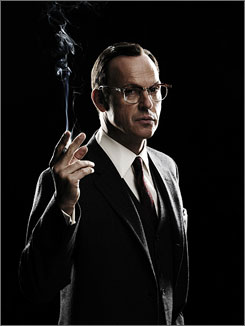
clearheaded cynic. As for Keaton, you’ll either find his oddly
mannered, tightly contained performance intriguing or, well, odd.

To fit all its history in, The Company splits
itself into three semi-separate movies: the first a spy-vs.-spy
thriller, the second an action/adventure story, the third a paranoid
conspiracy tale. But the attempts to connect the whole ultimately
destroy the parts as the continuing plot threads tying the main
characters together take away from the more interesting historic events
going on around them.

Perhaps because the
miniseries strains to cover so many time periods, none feels lived in
or organic as they do in AMC’s gorgeous paean to Madison Avenue in the
’60s, Mad Men. Here it’s more like kids playing dress-up, with scenes in Russia coming across as a bad spoof of Chekhov.

For those who follow CIA history or who have already seen The Good Shepherd,
the writers take on faith the idea that there was a mole in the CIA to
be discovered and that Angleton’s search, however obsessive, was
justified. The other theory, that there was no mole and he tore the
agency apart out of sheer paranoia, will have to wait for another
miniseries.

There is some amusement to be had from The Company‘s
initial embrace of old-tech spying: the primitive listening devices,
the secret codes hidden in walnuts. But by the time they finally reveal
the KGB’s diabolical plan to destroy the Western world, you may just
think the film has gone from walnuts to plain nuts.

Assuming you’re still around, of course. My advice? Spy out some better company.

USATODAY.com

Powered by ScribeFire.

Federated Media is an independent family owned company

Stories
 

 VEDDY INTERSESTING…

Federated
Media is an independent family owned company that offers top quality
products to our customers. Whether they listen to one of our 15
radio stations in the Midwest or read The Truth our newspaper located
in Elkhart, Indiana, we keep Northern Indiana, Southern Michigan, and
Northwest Ohio informed and entertained!

Through our
radio stations Federated Media can provide the combined power to reach
over 986,000 people each week! Our newspaper “The
Truth” reaches 571,000 people each week making Federated Media an
excellent advertising choice! That’s a total reach of over one
and a half million people each week!

We believe
it’s our employees that help discover and define our
successes. Federated Media is made up of over 368 professionals
that continue to strive to make our company “the best independent
multi-media company in the world!”

We invest literally
hundreds of thousands of dollars in training our employees to help
provide our advertisers with excellent customer service, our listeners
with the best local programming available, our readers with accurate
and dependable information, and our employees with the tools they need
to help them further their careers in media.

Thank you for
visiting our web site. If you’d like more information about
our company that has not been provided on our web site, feel free to
contact Dave Ogle regarding newspaper at
dogle@etruth.com or Tony Richards regarding radio broadcasting at trichards@federatedmedia.com .

Thanks again, and welcome to Federated Media!

Welcome to Federated Media

Powered by ScribeFire.

JOSH CATONE LOOKS INTO BLOGGER ETHICS

Stories

Written by Josh Catone / August 3, 2007 / 7 comments

Is there a new blogger scandal brewing? Allen Stern over at CenterNetworks seems to think so. Allen takes issue with the new video blog Webb Alert (which mentioned Read/WriteWeb today), saying that the blog doesn’t disclose its connection with advertising network Federated Media
(which hosts it and sells advertising for it) and suspects that the
whole thing may be an elaborate scheme to push traffic to FM clients
(and notes that FM clients have been gushing over the show in return
for the disproportionate links they get).

I honestly don’t think there’s any conspiracy here, but Allen’s post
sheds light on a larger subject: the journalistic practice of
disclosure. Blogging is still in its relative infancy and bloggers are
still struggling to figure out when and how they should disclose
potential conflicts of interest in an ongoing effort to gain legitimacy
and garner respect from readers and other media producers.

The Ins and Outs of Disclosure

Disclosure is a tricky business and as a practice is still
ill-defined even in the realm of traditional journalism. The general
idea is that anything that might be seen as a potential conflict of
interest between a writer and the subject of his story should be
disclosed to the reader. If I invested in a startup I am writing about,
for example, or if the CEO is my best friend, I should disclose that
fact. But it’s not always so cut and dry.

Journalistic disclosure is something that the ombudsman at National Public Radio writes about a lot. In November of 2005, he published an interesting piece
on the subject asking, “Do journalists have an obligation to disclose a
personal, as well as a professional, connection to a source?” This is
an instance when knowing when to disclose is not so clear. The NPR
ombudsman talks about an episode when a disc jockey on the radio
network mentions in passing a columnist from Slate magazine as a source, but fails to disclose that the columnist is also her husband.

Should she have disclosed that fact? The ombudsman concludes that
the she should have, writing, “In this case, more disclosure would have
been better than less. By finding another person to quote, the program
would have avoided giving an impression of familial favoritism.” But
what if the columnist in question had not been a family member, but a
former co-worker? Or someone whom the radio DJ had interviewed in the
past? Is disclosure still necessary? Or, what if the columnist and DJ
had been romantically involved in the past but aren’t any longer? Does
she need to discuss her sex life on air in the interest of journalistic
integrity? You can see that it becomes quickly confusing, and at times
overtly personal.

Sometimes I think bloggers take disclosures too far. Specifically,
bloggers nearly universally seem to think that they must disclose
advertising relationships when writing about companies that they run
ads for (but then many paradoxically make specific posts thanking and
praising those advertisers). We disclose advertiser relationships here
at Read/WriteWeb, though you’ll notice that I didn’t disclose — until
now — that Federated Media handles some of our advertising. This is
something that I personally think borders on the absurd. Sure some
people might be conflicted about biting the hand that feeds them, so to
speak, and writing negatively about an advertiser. But journalism
(which, let’s face it, is what many bloggers strive for) has long been
an advertising supported medium, and the relationship between writers
and advertisers is obvious to readers.

You’ll never see, for example, Brian Williams on the NBC Nightly
News conclude a story about Ford Motor company by saying that Ford
advertises on the NBC family of networks (which includes USA, Bravo,
CNBC, MSNBC, etc.). The New York Times doesn’t stop to disclose
that the movie they’re reviewing has a display ad in their Arts
section. In fact, the screenshot below depicts the Times’ Arts web page
today. Notice the review of the “Bourne Ultimatum” right next to an
advert for the very same movie. The review was favorable, and didn’t
include any disclosures, but I don’t think anyone thinks that the paper
was shilling for ad dollars.

Further, as my NBC example may have illustrated, full disclosure can
get even trickier for journalists in today’s landscape of media
conglomerates. In a piece from three weeks ago in Slate about Rupert Murdoch’s then-impending purchase of Dow Jones, Jack Shafer wrote about what the full Wall Street Journal
disclosure will look like when News Corp. assumes control of the
newspaper. As Shafer said, it’s “almost as long as the Manhattan
telephone book.”

“Presently, the Wall Street Journal doesn’t run a
disclosure every time it cites a CNBC show or makes a passing mention
of a publication or business that competes with Dow Jones. So there’s
no obvious reason why a News Corp.-owned Journal would have to disclose
its parent company’s holdings if it mentioned Facebook, a movie from
Paramount Pictures, a book from Random House, a show on NBC, the New
York Daily News, LexisNexis, ESPN, Comcast, the Dish Network, or any of
the thousands of companies that directly compete with News Corp.

But common sense would dictate the inclusion of some sort of
rider in full-fledged news stories about News Corp. competitors. My
rough estimate indicates that upwards of a dozen News Corp. competitors
make Journal-worthy news each day.”

When to Disclose

Disclosure is necessary, however, and at times I think that maybe it
is the overzealous trend toward complete and utter transparency offered
by bloggers that makes blogs so attractive to readers. So when should you disclose?

  • Financial association — I don’t mean advertising, which is
    obvious, but less clear affiliations such as investments, ownership, or
    partial-ownership. For example, WIRED should mention they own Reddit
    when they write about the company. (Of course, you might not always even know when you’re investing in a company.)
  • Employment — If you are paid by a company you are writing about as an employee, contractor, or consultant, you should disclose that.
  • Competition — If you are writing specifically about
    a direct competitor to a company you are involved with in an
    aforementioned manner, especially if you’re writing in a negative
    way, it is probably best to disclose it. For example, WIRED should
    disclose that they own Reddit whenever they write about Digg.
  • Personal involvement – This is by far the trickiest. As I
    illustrated before, personal or emotional involvement with stories can
    get complicated and, well, personal. I don’t think it always needs to
    be disclosed. For example, I don’t feel the need to disclose my
    political views whenever I write about politics. However, if I’m
    reviewing a company run by a close friend, I would disclose that fact
    or pass the story to a writer with less emotional involvement.

You’ll notice that I don’t include a rule about disclosing when you
were paid to write about a specific topic or company. The reason is
that any blogger who wants to be taken seriously as a journalist cannot
and will not accept money or gifts from a source (or vice versa). That
said, it should also be noted that there is a big difference between
accepting gifts in exchange for writing a story and accepting review
copies of goods for free. Last year a total non-scandal erupted when Microsoft handed out laptops loaded with Vista
to select tech bloggers. These were not bribes or gifts or payments, as
some people later called them — they were review copies of Vista that
Microsoft (smartly) tried to make sure were loaded in an optimal
machine before being reviewed. I used to work as an editor for an
online computer game magazine and we never paid for the things we
reviewed, and very often were sent pricey pieces of software or
hardware that companies didn’t ask us to return. But we never disclosed
that fact, or let the fact that we didn’t pay for our review copies
influence our reviews.

In 2004 Nick Denton, owner of blog network Gawker Media, called for a code of ethics for bloggers to cover, among other ethical quagmires, the tricky and complicated maze that is disclosure.

“The guidelines would cover questions such as photo
copyright, freebies, pay-to-post deals, editorial tie-ins, paid text
links. They would be voluntary. But sites that adhered to them would be
able to indicate that they met certain blog ethics standards.”

To my knowledge, nothing has ever been accomplished in this area. Earlier this year Tim O’Reilly began to draft a Blogger’s Code of Conduct, but curiously absent are ethical concerns like disclosure policy. Perhaps it is time to revive Denton’s idea?

Conclusion

As I said, blogging is still a very new medium and its evolution is
just beginning. Bloggers are still figuring out by trial and error how
to deal with things like disclosure. I’ll close by borrowing from Vaughn Ververs, writing last year for the CBS blog “Public Eye” about the topic of disclosure:

“The world can be pretty complicated, do simple
disclosures on the part of journalists really do anything to clarify
it? Who is to judge what type of disclosure is germane to a story? If
it’s an example of, you-know-it-when-you-see-it, isn’t it
just one more judgment call that is open to everyone’s individual
interpretation?”

What sort of disclosures do you think are necessary for bloggers? Do
bloggers go overboard? Or do they not disclose enough? Leave your
thoughts in the comments below.

(Full disclosure: I was talking to Allen Stern on instant messenger when I first starting writing this piece. ;))

Blogging Ethics: When And What Should Bloggers Disclose?

Blogging Ethics: When And What Should Bloggers Disclose?
Written by Josh Catone / August 3, 2007 / 7 commentsIs there a new blogger scandal brewing? Allen Stern over at CenterNetworks seems to think so. Allen takes issue with the new video blog Webb Alert (which mentioned Read/WriteWeb today), saying that the blog doesn’t disclose its connection with advertising network Federated Media (which hosts it and sells advertising for it) and suspects that the whole thing may be an elaborate scheme to push traffic to FM clients (and notes that FM clients have been gushing over the show in return for the disproportionate links they get).

I honestly don’t think there’s any conspiracy here, but Allen’s post sheds light on a larger subject: the journalistic practice of disclosure. Blogging is still in its relative infancy and bloggers are still struggling to figure out when and how they should disclose potential conflicts of interest in an ongoing effort to gain legitimacy and garner respect from readers and other media producers.
The Ins and Outs of Disclosure

Disclosure is a tricky business and as a practice is still ill-defined even in the realm of traditional journalism. The general idea is that anything that might be seen as a potential conflict of interest between a writer and the subject of his story should be disclosed to the reader. If I invested in a startup I am writing about, for example, or if the CEO is my best friend, I should disclose that fact. But it’s not always so cut and dry.

Journalistic disclosure is something that the ombudsman at National Public Radio writes about a lot. In November of 2005, he published an interesting piece on the subject asking, “Do journalists have an obligation to disclose a personal, as well as a professional, connection to a source?” This is an instance when knowing when to disclose is not so clear. The NPR ombudsman talks about an episode when a disc jockey on the radio network mentions in passing a columnist from Slate magazine as a source, but fails to disclose that the columnist is also her husband.

Should she have disclosed that fact? The ombudsman concludes that the she should have, writing, “In this case, more disclosure would have been better than less. By finding another person to quote, the program would have avoided giving an impression of familial favoritism.” But what if the columnist in question had not been a family member, but a former co-worker? Or someone whom the radio DJ had interviewed in the past? Is disclosure still necessary? Or, what if the columnist and DJ had been romantically involved in the past but aren’t any longer? Does she need to discuss her sex life on air in the interest of journalistic integrity? You can see that it becomes quickly confusing, and at times overtly personal.

Sometimes I think bloggers take disclosures too far. Specifically, bloggers nearly universally seem to think that they must disclose advertising relationships when writing about companies that they run ads for (but then many paradoxically make specific posts thanking and praising those advertisers). We disclose advertiser relationships here at Read/WriteWeb, though you’ll notice that I didn’t disclose — until now — that Federated Media handles some of our advertising. This is something that I personally think borders on the absurd. Sure some people might be conflicted about biting the hand that feeds them, so to speak, and writing negatively about an advertiser. But journalism (which, let’s face it, is what many bloggers strive for) has long been an advertising supported medium, and the relationship between writers and advertisers is obvious to readers.

You’ll never see, for example, Brian Williams on the NBC Nightly News conclude a story about Ford Motor company by saying that Ford advertises on the NBC family of networks (which includes USA, Bravo, CNBC, MSNBC, etc.). The New York Times doesn’t stop to disclose that the movie they’re reviewing has a display ad in their Arts section. In fact, the screenshot below depicts the Times’ Arts web page today. Notice the review of the “Bourne Ultimatum” right next to an advert for the very same movie. The review was favorable, and didn’t include any disclosures, but I don’t think anyone thinks that the paper was shilling for ad dollars.

Further, as my NBC example may have illustrated, full disclosure can get even trickier for journalists in today’s landscape of media conglomerates. In a piece from three weeks ago in Slate about Rupert Murdoch’s then-impending purchase of Dow Jones, Jack Shafer wrote about what the full Wall Street Journal disclosure will look like when News Corp. assumes control of the newspaper. As Shafer said, it’s “almost as long as the Manhattan telephone book.”

“Presently, the Wall Street Journal doesn’t run a disclosure every time it cites a CNBC show or makes a passing mention of a publication or business that competes with Dow Jones. So there’s no obvious reason why a News Corp.-owned Journal would have to disclose its parent company’s holdings if it mentioned Facebook, a movie from Paramount Pictures, a book from Random House, a show on NBC, the New York Daily News, LexisNexis, ESPN, Comcast, the Dish Network, or any of the thousands of companies that directly compete with News Corp.

But common sense would dictate the inclusion of some sort of rider in full-fledged news stories about News Corp. competitors. My rough estimate indicates that upwards of a dozen News Corp. competitors make Journal-worthy news each day.”

When to Disclose

Disclosure is necessary, however, and at times I think that maybe it is the overzealous trend toward complete and utter transparency offered by bloggers that makes blogs so attractive to readers. So when should you disclose?

* Financial association — I don’t mean advertising, which is obvious, but less clear affiliations such as investments, ownership, or partial-ownership. For example, WIRED should mention they own Reddit when they write about the company. (Of course, you might not always even know when you’re investing in a company.)
* Employment — If you are paid by a company you are writing about as an employee, contractor, or consultant, you should disclose that.
* Competition — If you are writing specifically about a direct competitor to a company you are involved with in an aforementioned manner, especially if you’re writing in a negative way, it is probably best to disclose it. For example, WIRED should disclose that they own Reddit whenever they write about Digg.
* Personal involvement – This is by far the trickiest. As I illustrated before, personal or emotional involvement with stories can get complicated and, well, personal. I don’t think it always needs to be disclosed. For example, I don’t feel the need to disclose my political views whenever I write about politics. However, if I’m reviewing a company run by a close friend, I would disclose that fact or pass the story to a writer with less emotional involvement.

You’ll notice that I don’t include a rule about disclosing when you were paid to write about a specific topic or company. The reason is that any blogger who wants to be taken seriously as a journalist cannot and will not accept money or gifts from a source (or vice versa). That said, it should also be noted that there is a big difference between accepting gifts in exchange for writing a story and accepting review copies of goods for free. Last year a total non-scandal erupted when Microsoft handed out laptops loaded with Vista to select tech bloggers. These were not bribes or gifts or payments, as some people later called them — they were review copies of Vista that Microsoft (smartly) tried to make sure were loaded in an optimal machine before being reviewed. I used to work as an editor for an online computer game magazine and we never paid for the things we reviewed, and very often were sent pricey pieces of software or hardware that companies didn’t ask us to return. But we never disclosed that fact, or let the fact that we didn’t pay for our review copies influence our reviews.

In 2004 Nick Denton, owner of blog network Gawker Media, called for a code of ethics for bloggers to cover, among other ethical quagmires, the tricky and complicated maze that is disclosure.

“The guidelines would cover questions such as photo copyright, freebies, pay-to-post deals, editorial tie-ins, paid text links. They would be voluntary. But sites that adhered to them would be able to indicate that they met certain blog ethics standards.”

To my knowledge, nothing has ever been accomplished in this area. Earlier this year Tim O’Reilly began to draft a Blogger’s Code of Conduct, but curiously absent are ethical concerns like disclosure policy. Perhaps it is time to revive Denton’s idea?
Conclusion

As I said, blogging is still a very new medium and its evolution is just beginning. Bloggers are still figuring out by trial and error how to deal with things like disclosure. I’ll close by borrowing from Vaughn Ververs, writing last year for the CBS blog “Public Eye” about the topic of disclosure:

“The world can be pretty complicated, do simple disclosures on the part of journalists really do anything to clarify it? Who is to judge what type of disclosure is germane to a story? If it’s an example of, you-know-it-when-you-see-it, isn’t it just one more judgment call that is open to everyone’s individual interpretation?”

What sort of disclosures do you think are necessary for bloggers? Do bloggers go overboard? Or do they not disclose enough? Leave your thoughts in the comments below.

(Full disclosure: I was talking to Allen Stern on instant messenger when I first starting writing this piece. ;))

Powered by ScribeFire.

Central Park West Loses Decades-Old Market

Stories

Central Park West Loses Decades-Old Market

Gristede'sThe
empty facade of the Gristedes supermarket on Central Park West that
closed last weekend. (Photo: David W. Dunlap/The New York Times)

It is not easy to find a grocery store on Central Park West. In
fact, it is not easy to find a store of any kind. But for 42 years
— until last weekend — Gristedes operated a 3,200-square-foot supermarket at the West 62nd Street corner of the Century apartment building.

Once a year, on marathon day, the store appeared to be as jammed as Fairway
(if Fairway shoppers wore aluminum foil capes). At other times, it was
simply a modest neighborhood convenience. In late evenings this week,
doormen at the Century were still intercepting eastbound pedestrians
hurrying along 62nd Street, trying to get to Gristedes before 9 p.m. In
more senses than one, the shoppers were too late. It had closed for
good.

flyerA Fresh Direct advertisement bidding farewell to the Central Park West Gristedes.

John A. Catsimatidis, the chairman, president and chief executive of
the Red Apple Group, which owns Gristedes, was quoted this week on The Real Deal
as blaming a steep rent increase. (He was also quoted as saying the
store had “been there for 50 years at least,” but Gristede
Brothers actually signed the lease in 1965.) His office did not return
phone calls this afternoon.

FreshDirect lost no time in reminding neighbors of the changed foodscape.

“Goodbye, Gristedes,” said postcards that arrived on Thursday. “Hello, FreshDirect!” Meanwhile, the Lansco Corporation
is marketing the retail space by noting its location “amid New
York’s most renowned new condominium residences.”

That doesn’t seem to describe the kind of place where you can pick up a quart of milk or a roll of toilet paper.

 City Room .

Powered by ScribeFire.

VING RHAMES' DOGS KILL 40 YR. OLD MAN

Stories

The Daily Breeze

12:30 p.m.:
Caretaker found dead at Ving Rhames’ Brentwood home appeared to have
“injuries as a result of the mauling,” police said. Two of four dogs
taken into custody weigh about 200 pounds.

A man working as a caretaker at a Brentwood
residence owned by actor Ving Rhames was found dead on the property
today after being mauled by two dogs, authorities said.

The man died
at the scene of the attack, which was reported about 7:15 a.m. in the
12900 block of San Vicente Boulevard, said Los Angeles police Officer
Sandra Gonzalez. His name was withheld pending notification of
relatives.

Los Angeles police Lt. Ray Lombardo told ABC7 that the man, in his 40s, had been a caretaker at the residence about two years.

He “appears to have suffered a number of injuries as a result of the dog mauling,” Lombardo said.

“There
were dogs loose on the property. Those dogs have been captured by
animal regulation (officers),” he said. “We have four dogs
that have been taken into custody for quarantine pending further
investigation …” Police believe two of the four dogs — both
weighing about 200 pounds — were involved in the attack.

“Both
those dogs are mastiffs; they’re rather large,” Lombardo
said. “Normally we understand they are pretty friendly dogs. But,
you know, there are occasions where dogs will turn on their owners or
their caretakers, and this looks like a tragic accident.”

The man had numerous dog bites all over his body, but the exact cause of death was pending a coroner’s ruling.

Authorities
said they could not be sure whether it was the dog mauling that proved
fatal, or if the man suffered some other type of health problem, such
as a heart attack, brought on by the dog attack.

Rhames, who appeared in the “Mission Impossible” films, was not at home when the attack occurred, police said.

Powered by ScribeFire.

More California E-Voting Reports Released; More Bad News

Stories

Yesterday the California Secretary of State released
the reports of three source code study teams that analyzed the source
code of e-voting systems from Diebold, Hart InterCivic, and Sequoia.

All three reports found many serious vulnerabilities. It seems
likely that computer viruses could be constructed that could infect any
of the three systems, spread between voting machines, and steal votes
on the infected machines. All three systems use central tabulators
(machines at election headquarters that accumulate ballots and report
election results) that can be penetrated without great effort.

It’s hard to convey the magnitude of the problems in a short
blog post. You really have read through the reports — the
shortest one is 78 pages — to appreciate the sheer volume and
diversity of severe vulnerabilities.

It is interesting (at least to me as a computer security guy) to see
how often the three companies made similar mistakes. They misuse
cryptography in the same ways: using fixed unchangeable keys, using
ciphers in ECB mode, using a cyclic redundancy code for data integrity,
and so on. Their central tabulators use poorly protected database
software. Their code suffers from buffer overflows, integer overflow
errors, and format string vulnerabilities. They store votes in a way
that compromises the secret ballot.

Some of these are problems that the vendors claimed to have fixed years ago. For example, Diebold claimed (p. 11)
in 2003 that its use of hard-coded passwords was “resolved in
subsequent versions of the software”. Yet the current version
still uses at least two hard-coded passwords — one is
“diebold” (report, p. 46) and another is the eight-byte sequence 1,2,3,4,5,6,7,8 (report, p. 45).

Similarly, Diebold in 2003 ridiculed (p. 6)
the idea that their software could suffer from buffer overflows:
“Unlike a Web server or other Internet enabled applications, the
code is not vulnerable to most ‘buffer overflow attacks’ to
which the authors [Kohno et al.]
refer. This form of attack is almost entirely inapplicable to our
application. In the limited number of cases in which it would apply, we
have taken the steps necessary to ensure correctness.” Yet the
California source code study found several buffer overflow
vulnerabilities in Diebold’s systems (e.g., issues 5.1.6, 5.2.3
(”multiple buffer overflows”), and 5.2.18 in the report).

As far as I can tell, major news outlets haven’t taken much
notice of these reports. That in itself may be the most eloquent
commentary on the state of e-voting: reports of huge security holes in
e-voting systems are barely even newsworthy any more.

Freedom to Tinker

Powered by ScribeFire.

Design a site like this with WordPress.com
Get started