Stories
Play Ball! Fans learn to play concession waiting game
StoriesBTF

JS Online
Heh.
Just got back from Wrigley this weekend.
I THINK Sam Adams was $5.50 at Murphys across the street. And the post-game St Pauli Girl was $5.50 at Sluggers, I believe.
Only got one or two brews inside the Friendly Confines on Fri/Sat, Id have guessed it was $5.50 for 12 ounces of Bud?
But dont hold me to it – its not like you walk away if the price doesnt seem right, lol.
Hmm, I think Shea is $8.25. Maybe thats 16 ounces?
At these prices, not sure anyone becomes enough of a regular to have it memorized.
The Wrigley kosher dog was $4, the regular kind $3.50. I noticed that.
Ashley Alexandra Dupre at center of Spitzer scandal
StoriesMarch 12, 2008
Ashley Alexandra Dupre has been named as the woman named in the Eliot Spitzer scandal.
Click for more pictures >>>
Dupre is a 22-year-old would-be singer from New Jersey, the New York Times reported Wednesday.
The newspaper said that Ashley Youmans – now known as Ashley Alexandra Dupre – was identified in court documents as Kristen, the high-priced prostitute who met with Spitzer at the Mayflower Hotel in Washington on February 13.
Dupre has not been charged with any crime. She made a brief appearance Monday in U.S. Magistrate Court as a witness against four people charged with operating Emperor’s Club VIP, the prostitution ring, the Times said.
Click for more pictures >>> Ashley Alexandra Dupre says she left a broken home at age 17 and came to New York City to work the nightclubs as a rhythm and blues singer. Now, at 22, she is the unwitting, and as yet unseen, star of the seamy drama that is the downfall of Gov. Eliot Spitzer of New York.
From the NY Times:
“Kristen”, described in a federal affidavit as having a Feb. 13 rendezvous with Mr. Spitzer at the Mayflower Hotel in Washington, has spent the last few days in her ninth-floor rental in an upscale apartment building in the Flatiron district. On Monday, she made a brief appearance in federal court as a witness in the case against four people charged with operating the prostitution ring, Emperor’s Club V.I.P. In a series of telephone interviews on Tuesday night, she said she had slept very little over the past week due to the stress from the case.
“I just don’t want to be thought of as a monster,” the woman said as she told the tiniest tidbits of her story. Born Ashley Youmans but now known as Ashley Alexandra Dupre, she spoke softly and with good humor as she added with significant understatement: “This has been a very difficult time. It is complicated.”
She has not been charged. The lawyer appointed to represent her, Don D. Buchwald, told a magistrate judge in court on Monday that she had been subpoenaed to testify in a grand jury investigation. Asked to swear that she had accurately filled out and signed a court financial affidavit, she responded affirmatively.
A person with knowledge of the Emperor’s Club operation confirmed that the woman interviewed by The New York Times was the woman identified as Kristen in the affidavit. Mr. Buchwald confirmed various details of Ms. Dupre’s background but would not discuss the contents of the affidavit.
Ms. Dupre said on the telephone Tuesday night that she was worried about how she would pay her rent since the man she was living with “walked out on me” after she discovered he had fathered two children. She said she was considering working at a friend’s restaurant or, once her apartment lease expires, moving back in with her family in New Jersey “to relax.”
From Ashley Alexandra Dupre’s MySpace page
I am all about my music, and my music is all about me… It flows from what I’ve been through, what I’ve seen and how I feel. I live in New York and am on top of the world. Been here since 2004 and I love this city, I love my life here. But, my path has not been easy. When I was 17, I left home. It was my decision and I’ve never looked back. Left my hometown. Left a broken family. Left abuse. Left an older brother who had already split. Left and learned what it was like to have everything, and lose it, again and again. Learned what it was like to wake up one day and have the people you care about most gone. I have been alone. I have abused drugs. I have been broke and homeless. But, I survived, on my own. I am here, in NY because of my music.© AlaskaReport.com All Rights Reserved.
On The Bowery Whole Foods
StoriesThe always-readable 3 Quarks Daily dishes it out:
Dispatches: On The Bowery Whole Foods
First, a few words on the neighborhood. Inside the door, above
a landscape of crushed-ice, a long wooden board has been affixed to the
wall, the purpose of which quickly becomes clear. Fish, having
been selected from the tank in front, sail wriggling through the air,
hit the board, bounce, skitter along it, hit the far inside wall, and
fall to the ice below to be grabbed, alive, and filleted by the staff
in back. Below the plank that ensures the fishmongers’ accuracy,
the heads of large salmon, recently detached, continue to yawn and gawp
reflexively. In front sit wooden baskets of soft-shell
crabs, porgies, shrimp of all sizes, razor clams with their phallic,
protruding siphons, and numerous flatfish, all whole and waiting for
inspection by customers who wouldn’t think of buying a fish without
checking its gills for redness and pressing its scaly sides for taut
resilience. Squeezed between the wall and the crab and lobster
tanks sits a large black bucket, nearly the size of a garbage can, from
which the topmost of many layers of frogs stare up.
Such is a typical fish stall on Mott Street, in downtown
Manhattan. But many other food shops south of Houston Street and
east of Lafayette Street, of all cuisines and nationalities, share the
stall’s intensity, if not always the sheer directness of the
relationship between people and the animals they eat that obtains
there. In the window of Despana, a newish food boutique on Broome
that specializes in Spanish delicacies such as paprikas, olives,
cheeses, and oils, hangs a salt-cured pig’s hind leg, hoof and all,
unmistakably a severed mammalian limb, waiting to be sliced into
transparencies of Serrano ham. Inside Dom’s, a nearby Italian
grocer, chickens complete with head and feet (the better to be added to
to your stockpot) lie in cases beneath gamy homemade sausages that age
hanging from the ceiling. The Essex Market’s Dominican butchers
sell goat meat and oxtails, while pig stomachs and tripe are available
nearby. Not only the Sullivan Street bakery but the Balthazar
bakery, Ceci-Cela, the Falai bakery and several others turn out
impeccable breads.
Bangkok Grocery, the city’s best purveyor of galangal, shrimp
pastes, lime leaves, fish sauces, and other Thai ingredients, is a few
blocks below Canal on the San Francisco-esque, tilted Mosco
Street. Back up on Mott sits DiPalo’s, the legendary supplier of
the best Parmigiano-Reggiano and other Italian artisanal products in
this country. Catty corner from it one can buy the city’s best
Banh Mi, or Vietnamese sandwich, at Banh Mi Saigon Bakery. (This
opinion professionally corroborated by the always scintillating J. Slab
at The Porkchop Express.)
Vegetable sellers and more fishmongers from China’s Fujian Province
line Grand Street all the way to Hester, where a right turn brings you
to Il Labatorio del Gelato, New York’s most lauded ice cream makers,
and a little beyond that a wide-ranging chocolate shop where you can
find most of the finest single-bean productions of Michel Cluizel,
Valrhona, and other chocolate titans. Next door is Alejandro
Alcocer’s excellent food shop, Orange, and restaurant, Brown.
Over another block on Grand is Doughnut Plant, where Mark Singer makes
his grandfather’s recipes using organic ingredients. And back up
to Houston sits Katz’s, the pastrami champion of New York City.
Back west a few blocks on Houston is the new Bowery Whole
Foods. Is it just me who finds still finds appending the word
“Bowery” to such amenities as pricey supermarkets oxymoronic? Or
has the word Bowery already shed its downmarket connotations, or
rather, already accrued the upmarket status into which downmarket
connotations are now magically transformed? Whichever confusing
permutation it is, the branch itself comically interrupts perhaps the
densest, most diverse, and best collection of individual food shops in
the United States. Whole Foods, the American food economy’s
answer to Crate and Barrel, is no doubt a useful intervention in most
suburban contexts in which there are thirty enormous chain pharmacies
for every good butcher or fish shop. If you live on the exurban
outskirts of Columbus, Ohio, presumably Whole Foods appreciably
increases the diversity of available food.
But on Bowery and Houston, Whole Foods represents a much poorer form
of food diversity than what is already there. And, food shops are
not just food shops: they are a solidified form of the social
relationships that obtain between people in an particular place.
The unofficial little vegetable market that pops up on weekends on
Forsyth Street under the Manhattan Bridge represents a food culture of
inspecting produce and comparing adjacent vendors for the best price:
the entire cacophony of traditional market culture. It is the
product and instantiation of the middle and working-class residents of
Chinatown. But don’t think I am making an argument about
authenticity here. Whole Foods is in no way a less natural
emanation of a different class stratum: the professional and managerial
upper-middle people who flow into downtown in increasing numbers.
These people, and their needs for organic baby food, large amounts of
wildly expensive prepared lunchtime panini and salads, exist in
symbiosis with Whole Foods. As downtown New York tilts towards
this population, and its fauxhemian pretensions, there is a natural
influx of corporate franchises with bland, do-gooder brand identities
that serve the casual American elite from Seattle to Cambridge.
But the Bowery Whole Foods tells us something remarkable about its
shoppers: how ignorant they are of where they are and how alienated
they are from food. Perusing it, the thing that impresses you
most is the pervasive labeling, the enormous amounts of information
appended to everything. Everywhere are little identificatory
notes, signs overhead, brochures on what to do with their sausages (eat
them?), glossy photos of the smiling man who supposedly dredged up your
mussels or baited the hook upon which your (always already headless and
filleted) wild salmon met its end. This is food shopping for
people who have come to trust only that which is mediated by text,
addenda, explanations, certifications. It is a website come to
life, or a piece of life for those who prefer websites: each piece of
signage functions as the hyperlink that clicks through to a capsule
review.
I once served some sliced raw albacore tuna doused in soy to a
friend. I had bought the fish not far from Whole Foods from Alex,
the fisherman who had caught it and brought it the next day to the
Greenmarket. I’m lucky to live in a city where this is a humdrum
and everyday transaction. My friend, a film producer, remarked,
“This is great! But how did it get sterile?”
“Sterile?” I asked.
“Yeah. How does it get safe to eat?”
Food? Sterile? This is the alienation on which Whole
Foods depends. In the age of hysterical warning about the dangers
of food, it comes as a surprise to find that fish can be pulled out of
the water and eaten, raw. No anti-bacterial soap or release form
required.
There is something else alienating about Whole Foods: it posits a
universe in which we are all only consumers. The holism its name
gestures towards is not the holism of a community in which buyers and
sellers know each other. Instead, it’s purely about the foods
themselves: one’s interest in food is projected as only another form of
self-interest. Industrial organic food production has many of the
same faults as the conventional food industry; it doesn’t matter.
That organic food is roughly a third the price at socialist
institutions like the Fourth Street Food Coop, or the superb Park Slope
Food Coop, is also unimportant. These neoliberal shoppers prefer
the impersonal embrace of a corporate parent, disguised as some vague
moral goodness. Yet a principle like seasonality is sacrificed to
the lure of exotic, irradiated produce available year-round. Such
are the characteristics of the so-called “foodies.” Even the term
suggests a cute and infantile hobby. And it does seem infantile
to shop at Whole Foods while all around you sits the very food cultures
about which Whole Foods’ publicity materials fantasize.
Near Orchard Street, four blocks from Bowery and Houston Street,
sits Russ and Daughters, a small shop crammed with smoked salmon, cured
salmon, salmon roe, herring, chubs, sturgeon eggs, bagels, fruits and
candies, mustards, cream cheeses, etc. It is a legacy of a time
when the Lower East Side was the world’s single densest agglomeration
of people, and Jewish and Eastern European foodstuffs were for sale
from pushcarts up and down Orchard Street. The store started on
such a pushcart, but this is no neighborhood of Jewish immigrants
anymore. Instead, Russ and Daughters has survived by becoming the
best source for smoked fish and caviar in New York City, no mean
achievement. In a way, it and shops like it have produced the
very market they now serve: the teeming Lower East Side’s taste for
bagels and lox ended up colonizing the nation.
In a world in which we’ve been socialized to distrust the claims of
brands, we paradoxically require ever greater documentations of
authenticity, ever wordier mediations between ourselves and
things. We don’t trust ourselves to be able to divine with our
own eyes what an edible object is, whether it’s genetically modified,
whether it contains omega-3, whether it’s safe for our children.
But the Lower East Side of New York has lasted against this tendency,
thanks to the richness of its cultural inheritance. It’s also
due, frankly, to intrepidness of the people who have lived here, their
lack of a need for handholding, and their willingness to seek out the
new and the strange. There is something beautiful about the fact
that the greatest smoked salmon purveyor in the country operates on the
very corner from which the taste for the foodstuff emanated. It
is a rare and appropriate historical congruence, and to me it
represents what is fascinating and powerful about the food culture of
this quadrant of New York City. Whole Foods is not.
Police concerned about order to stop weapons screening at Obama rally
StoriesDALLAS
— Security details at Barack Obama’s rally Wednesday stopped screening
people for weapons at the front gates more than an hour before the
Democratic presidential candidate took the stage at Reunion Arena.
— Security details at Barack Obama’s rally Wednesday stopped screening
people for weapons at the front gates more than an hour before the
Democratic presidential candidate took the stage at Reunion Arena.
The
order to put down the metal detectors and stop checking purses and
laptop bags came as a surprise to several Dallas police officers who
said they believed it was a lapse in security.
Dallas Deputy
Police Chief T.W. Lawrence, head of the Police Department’s homeland
security and special operations divisions, said the order — apparently
made by the U.S. Secret Service — was meant to speed up the long lines
outside and fill the arena’s vacant seats before Obama came on.
“Sure,”
said Lawrence, when asked if he was concerned by the great number of
people who had gotten into the building without being checked. But, he
added, the turnout of more than 17,000 people seemed to be a “friendly
crowd.”
The Secret Service did not return a call from the Star-Telegram seeking comment.
Doors
opened to the public at 10 a.m., and for the first hour security
officers scanned each person who came in and checked their belongings
in a process that kept movement of the long lines at a crawl. Then,
about 11 a.m., an order came down to allow the people in without being
checked.
Several Dallas police officers said it worried them that
the arena was packed with people who got in without even a cursory
inspection.
They spoke on condition of anonymity because, they
said, the order was made by federal officials who were in charge of
security at the event.
“How can you not be concerned in this day and age,” said one policeman.
Powered by ScribeFire.
Bamboozling the American Electorate Again
StoriesTHE CITY EDITION | SAN FRANCISCO
Rosemary Regello
Bush-Cheney strategy involves G.O.P. crossover voting to take out Hillary, marketing newcomer Obama, an “independent” ticket, and maybe even martial law…

Evidence of a covert campaign to undermine the presidential primaries is rife, so it’s curious that the Democractic Party and even some within the G.O.P. have decided to ignore the actual elephant in the room this year. That would be Karl Rove. After rigging two previous presidential elections, this master of deceit would have us believe that he’s gone off to sit in a corner and write op-eds.
Not so. According to an article in Time Magazine, Republican party activists have been organized to throw their weight behind Barack Obama, the democratic rival of frontrunner Hillary Clinton. Early in Obama’s campaign, major G.O.P. fundraisers and at least one indicted criminal flushed his coffers with cash – something the deep pockets haven’t done for any candidate in their own party. With receipts topping $100 million in 2007, the first-term senator from Illinois is doing well, considering few Americans had even heard of him before 2006.
The Time magazine article goes on to explain that rank and file Republicans in red states have switched their party registrations, enabling them to vote in Democratic primaries. The G.O.P. didn’t even compete in the Nevada primary, where Obama subsequently picked up many rural counties, and in Nebraska, the mayor of Omaha publicly rallied Republicans to caucus for him on February 9th. Called crossover voting, the tactic is playing a crucial role in the Rove push to deprive Clinton of the Democratic nomination. Even with his usually reliable arsenal of dirty tricks – paperless electronic voting equipment, waitlisting, swiftboating, etc. – Rove would be hard pressed to defeat Clinton in November, since she’s popular nationwide and has promised an immediate troop withdrawal from Iraq. If the contest isn’t close, the vote-rigging won’t matter.
If, on the other hand, Obama wins the nomination (or even the VP spot), Rove’s prospects brighten considerably. Largely unvetted by the media, the first-term senator carries considerable baggage from his stint as a state legislator in Chicago. So far, the mainstream press has avoided the messy details and presented something more akin to a Madison Avenue marketing campaign. Both the soft lens and the soft shoe harken back to the media blitz that persuaded Americans in 2003 of the necessity of a pre-emptive strike on Iraq. For example, The author of the Time magazine article, Jay Newton-Small, offered the following explanation to account for the bizarre love affair G.O.P. voters say they’re having with an African American senator on the other side of the aisle. “It seems a lot of Republicans took to heart Obama’s statement in his rousing speech at the 2004 Democratic National Convention that ‘there is not a liberal America and a conservative America — there is the United States of America.'”
Is he kidding? In 2002, it was the “terrorism analysts” who assured us that Iraq posed an imminent threat to our national security. The many baseless assumptions and bald-faced lies repeated daily on the airwaves and front pages of leading newspapers had the effect of branding misinformation on the human brain as if it were fact. Subsequently, the deception campaign opened the door for a $9 trillion run on the U.S. treasury and a protracted conflict with no end in sight. Now that same Pavlov conditioning is being re-deployed to elect “anybody but Hillary”, as Rove operatives like to whisper to each other off camera. And the ruse seems to be working.
Last year, at the same time Clinton commanded a huge lead in the national polls, political analysts and professional strategists hired by CNN and other broadcast networks began hammering across the notion that “the voters don’t like her”. The adjectives “unlikeable”, “divisive” and “polarizing” have been repeated in the same manner that the phrase “weapons of mass destruction” was hurled every night on the evening news in 2003. The same allegations uttered by conservative ideologues on Fox News throughout 2006 became grist for news programs broadcast from coast to coast. “There is no candidate on record, a front-runner for a party’s nomination, who has entered the primary season with negatives as high as she has,” Rove has prognosticated openly about his nemesis.
Interestingly, Obama has parroted the Rove comment in his press interviews, including a clip broadcast on CNN. Obama’s campaign slogan “I’m a uniter, not a divider” is reminiscent of the Bush 2000 campaign, which Rove managed.
The fact that Rove’s polling about Clinton is based on interviews with conservative voters is rarely mentioned. Like the conclusion drawn in the Time article, the unlikeable/polarizing/divisive claim made no sense and lacked any credible proof. Yet anchors like Jim Lehrer, Anderson Cooper of CNN and virtually everyone on the MSNBC and Fox News teams have let the steady drumbeat of false accusation reverberate across their air waves since December. Like a Good Housekeeping stamp of approval, shows like The Situation Room and the News Hour provide the guise of news analysis for claims that would otherwise be dismissed as rantings from a right-wing fringe group. From NBC to PBS, try to find an expert who doesn’t think Clinton would melt if you threw water on her. You won’t.
Despite the chorus of naysayers, on February 5th, the candidate with the “high negatives” captured sizeable majorities in the population-rich states of California, New York, Massachusetts and New Jersey. While Obama won most of the the red states in play, Clinton managed to overcome the crossover voters in the Tennessee, Oklahoma, Arizona and Arkansas primaries, although she enjoys only a small lead in the delegate count. Obama managed to close even that small gap with wins in the caucus states of Washington and Nebraska, along with the Louisiana primary on February 9th.
In addition to uprooting the Democratic race, Rove may be swindling his own party primaries. From a strategic perspective, dividing the delegates between several candidates lays the groundwork for either an independent ticket or a drafted ticket at a party convention. However, with Romney dropping out of the race, McCain now appears destined to lock up the nomination, even though he’s despised by most conservatives. Rove will now almost certainly field an independent ticket. At least two-thirds of the votes cast in all the primaries and caucuses to date have been for the Democrats. In red-state New Hampshire, for instance, 50,000 more votes were cast for Democrats than Republicans, even though the latter ticket was hotly contested at the time. That’s 10 pecent of the total voter turnout. In Iowa, the lopsided vote in the Democratic primary was even more pronounced. G.O.P. winner Mike Huckabee received only half the number of votes cast for Clinton, who placed third behind Obama and Edwards.
Equally worrisome for the Clinton campaign, both traditional progressives and the younger tech-savvy generation appear to have swallowed the Obama “agent of change” bait hook, line and sinker. Nobody would have predicted a few years ago that left-leaning pundits would join in an unholy alliance with Fox News to help defeat a popular liberal with a good shot at extracting the pro-war oil aristocracy, but here we are. Journalists like Ari Berman, editor of The Nation, are popping up on Fox programs they once labeled as 24/7 campaign commercials for the Republican Party. The fact that Obama has no grassroots base, little rooted history in social justice causes, and has paid lip service to Katrina victims and the Gena 6 doesn’t seem to trouble them in the least. Although he says he supports Roe v. Wade, Obama has also attended campaign events organized for him by anti-abortion activists.
In a blog posted the morning after the Iowa Caucus, Adrianna Huffington lauded the Illniois senator as practically the Second Coming. She didn’t have much to offer in the way of specifics, however, and spent the bulk of her remarks railing at Bill Clinton, who she said had conducted himself in an interview as “arrogant and entitled, dismissive and fear-mongering”. The fact that he was angry that the press corps was doing to his wife what the the Bush Administration had done to Valerie Plame didn’t occur to her.
Huffington, it should be noted, was one of several progressive politicos swindled by the California recall referendum a few years back. Knowing the left would be fielding multiple candidates to replace the embattled Democratic governor, Enron’s Ken Lay succeeded in his bid to slip Terminator Arnold Schwarzenegger into office through the back door. Candidate Huffington dropped out of the race just two days before the election, conceding the entire affair had been a set-up to divide the Democratic vote.
That she and her peers have allowed themselves to be bamboozled a second time is frankly astonishing. With a few clicks of a mouse, they might have easily learned that former Speaker Dennis Haster and the Illinois G.O.P. fielded a bible-thumping nutcase named Alan Keyes to run against Obama for the U.S. senate seat in 2004. Keyes was hand-picked to replace Jack Ryan, the candidate who offically won the G.O.P. primary, but was forced out after being accused of a sex scandal. In typical Rovean fashion, the charges against him only stuck long enough to ruin his senate bid. (A bit of trivia – Ryan’s ex-wife is actress Jeri Ryan, who played the character “Seven of Nine” in the television series Star Trek Voyager.) In the general election, Keyes received a pathetic 30 percent of the vote to Obama’s 70 percent, and this in a year when G.O.P. victories dominated the political landscape.
Here’s a little more history you won’t find at HuffPost or The Nation: At the time of his senate run, Obama was a relatively small-town player, a former law professor and two-term state legislator who lost a congressional race against the African American incumbent in 1999. Obama’s first significant donor in the 1990’s was Antoin “Tony” Rezko, a Chicago power broker and developer who tried to recruit him out of law school. After graduating from Harvard, Obama hired on with a community nonprofit agency, then later joined a prestigious Chicago law firm whose clients included Rezko.
Obama worked on (and later endorsed as a senator) a series of low-income housing development deals with Rezko and his partner, Woodlawn Preservation and Investment, collecting $855,000 in development fees. Later, while Rezko was busy fundraising for Obama’s senate race, tenants were having their heat cut off. Two-thirds of the buildings eventually foreclosed, CNN reported. An F.B.I. investigation led to felony charges that Rezko illegally obtained his income through kickbacks and bribes, with a trial set to begin February 25th.
According to Edward McClelland, writing for Salon.com, “Rezko, after all, built part of his fortune by exploiting the black community that Obama had served in the state Senate, and by milking government programs meant to benefit black-owned businesses.”
While it may be unclear why Obama would continue his relationship with Rezco after the city of Chicago had filed a lawsuit for maintaining slums, it’s indisputable that he did. In 2005, Obama approached Rezko for help in purchasing a $2 million Georgian-revival home in a Chicago suburb. The property deal involved two adjoining lots that the owner wanted to sell together. Rezko’s wife bought for the first, while Obama acquired the parcel that included a mansion for $300,000 less than the asking price.
Although no laws were apparently broken in the transaction, the Rezko trail represents a serious liability for Obama should he reach the November election. In the meantime, many of Obama’s campaign donations have since been tied to sources named in the federal indictment. While the Chicago Sun-Times puts the figure of tainted cash at $168,000, the senator initially agreed to give half that amount to charity, but only as an “abundance of caution”, a senior staffer said. Later, after NBC Nightly News grudgingly broadcast a story about the affair, the campaign announced it would donate the entire amount. (For more on this subject, read the articles in the Sun-Times.)
Incredibly, the Rezko affair went unreported by the national media until the CNN debate in South Carolina on January 17th. In response to cutting remarks by Obama about her stint on the Walmart board of directors, Hillary raised the matter of the Chicago slumlord. CNN duly followed-up, interviewing the Sun-Times reporter who broke the story, confirming Clinton’s allegation.
A few days after the debate, the Today show’s Matt Lauer brandished a photograph showing Rezko posing with President Clinton and Hillary during the 1990s and grilled the former First Lady about her relationship to Rezko. Neither she nor her husband appeared to have any history with the developer, yet NBC deftly managed to cast aspersions on them, not Barack Obama.
NBC may in fact be outFoxing Fox News when it comes to sabotauging Clinton’s presidential hopes. On the night before the New Hampshire primary, Brian Williams followed Obama around on the campaign trail, flashing a Newsweek cover of the senator, and proclaining to viewers that the Obama campaign had now become a “movement”. During the same broadcast, Andrea Mitchell described the Clinton campaign as broke, desperate, and ablaze with in-fighting. Mitchell continued with this theme the following night, even as Hillary led in the vote tally by three percentage points.
Following the South Carolina primary, both Mitchell and Tim Russert claimed on Nightly News and Today that the leadership of the Democratic Party is “mad as hell” at Bill Clinton for “attacking” Obama, and are lining up to back the Illinois senator. No sources were offered to substantiate the accusation. Russert also told Matt Lauer that Ted and Caroline Kennedy’s endorsement of Obama represented a sea change in this election, and insinuated that because Bobby Kennedy was friends with Cesar Chavez, founder of the United Farmworkers, the endorsement should pave the way for Obama to capture the Latino vote.
What NBC’s crack team of reporters neglected to mention was that Bobby Kennedy’s own children, the son of Cesar Chavez and the United Farmworkers union have already endorsed Clinton. In Nevada, Latinos in the 60,000 member Culinary Workers Union defied their white male leadership’s endorsement of Obama and helped Clinton win the caucus there. While the Florida primary was showing Clinton with a 15 percent lead in the polls, CNN fill-in anchor Bob Acosta complimented NBC’s aggressive push by declaring the Obama campaign had become a “runaway train” following its big South Carolina victory.
But if there’s a runaway train in this race, it’s the press. A charter member of the military-industrial complex, General Electric owns NBC, while Tim Russert’s Meet the Press served as a principle dissemination outpost for the weapons of mass destruction campaign in 2003. Andrea Mitchell is married to former Federal Reserve chief Alan Greenspan. However, a host of national broadcast networks and newspaper chains appear to be slanting their coverage of the race. On the day after the Florida primary, in which Clinton beat Obama by 17 points in a record turnout of Democrats, only the cable stations reported her victory. In December, the Washington Post’s Howard Kurtz published an article examining the media bias favoring Obama.
“The Illinois senator’s fundraising receives far less press attention than Clinton’s,” Kurtz wrote. “When the Washington Post reported last month that Obama used a political action committee to hand more than $180,000 to Democratic groups and candidates in the early-voting states of Iowa, New Hampshire and South Carolina, the suggestion that he might be buying support received no attention on the network newscasts.”
Unlike Florida, Clinton’s New Hampshire win was not blacked out on television, but accusations of racism surfaced in the days that followed. On-air pundits and Obama surrogates suggested white voters had defied their publicly declared support of the African American candidate in the secrecy of the polling booth. During the same week, Clinton made a speech in South Carolina tying Martin Luther King’s “I have a dream” speech to President Johnson’s signing of the 1964 Cvil Rights Act, highlighting the role of Johnson. A senior advisor to Obama circulated a 4-page memorandum urging surrogates to slam Clinton for being disrespectful to King.
If you tracked the coverage of the ensuing feud between the two campaigns, you would never know that this it was this memo that sparked the race-card accusations. Before the smoking gun showed up on the internet, Obama claimed in a television interview thea neither he nor anyone on his staff had accused Senator Clinton of insensivity. He added that he was “baffled” by her suggestion that they were involved. When the dust cleared, the media downplayed both the Obama memo and subsequent denial. Former President Clinton, however, continues to be barbecued over several angry comments uttered on the campaign trail in defense of his wife. (He also, incidentally, blasted the media’s role in disseminating the racism talking points of Obama staffers.)
Intelligent and astute, Hillary herself has historically shied away from personal attacks, whether it comes from sexist New York firefighters or Chris Matthews of MSNBC’s Hardball. (Her campaign recently cut off relations with the network when another MSNBC reporter declared that the Clintons had “pimped-out” daughter Chelsea in order to win superdelegates.)
This is not to say she isn’t capable of landing a knock-out punch when provoked. During the ABC New Hampshire debate, Clinton slammed the tag-team antics of John Edwards and Barack Obama when they tried to portray her as the voice of the “status quo”. informing the audience that both men supported the energy bill written by Dick Cheney in 2005. She said she opposed because the legislation was “larded with subsidies” for oil companies. She also called attention to Obama’s several votes to fund the Iraq War, as well as the Patriot Act renewal (he was a co-sponsor), and noted that the chair of Obama’s New Hampshire campaign worked as a lobbyist for the drug companies. Obama has also received more contributions from nuclear energy giant Excelon than any other candidate in the race, she noted.
Nevertheless, the title of Mark Lane’s bestselling book challenging the Warren Commission, “Rush to Judgment”, would aptly characterize the pre-election coverage bias in Obama’s direction for all the Democratic primaries this year. Clinton seems remiss in not calling more attention to it. Regarding Karl Rove and the Bush-Cheney team, all Senator Clinton has mustered to date is her oft-repeated statement, “They’re not going to surrender the White House voluntarily.” Last spring, she suggested that another terrorist attack against the United States would inevitably play into the hands of the G.O.P.
Vague as they sound, those two comments may prove prophetic in the event the Obama strategy fails and Hillary goes on to win the Democratic nomination and general election. The implications of a female president for American foreign and domestic policy are profound, creating jitters not only on Wall Street but for the Pentagon, the CIA, and the State Department. It’s possible that a significant number of officials accused of breaking U.S. laws or violating the Geneva Conventions might be arrested and prosecuted by a Clinton-directed Justice Department.
If that’s not enough to keep Bush appointees and generals lying awake deep into the night, consider their long-running undercover relationships with the ayatollahs in Iran (who paved the way for Reagan’s 1980 election), the Pakistani Inter-Services Intelligence, and the Saudi royal family. The Saudis especially have reason to fret now that they and their counterparts in Kuwait and the U.A.E. have started buying up huge stakes in U.S. banks. Condolleeza Rice and Nancy Pelosi are one thing. A Clinton White House is quite another.
For his part, President Bush may have implemented a back-up plan last April when he signed National Security Presidential Directive/NSPD 51, an executive order allowing him to suspend the constitution without prior congressional approval. NSPD 51 gives the President the discretion to declare a state of emergency (i.e. martial law) in the event of a major terrorist attack or other “decapitating” incident against the United States, even if the attack happens outside the country.
Under this scenario, he can cancel elections, padlock the Capitol dome and send the Supreme Court justices home. Not that he’d want to send the Supreme Court home, since its right-wing majority will likely provide a veil of legitimacy for his unchecked powers. The directive also allows Bush to assign his homeland security assistant ( a low-level position exempt from senate confirmation) to administer what has been dubbed the Enduring Constitutional Government. (Here’s the text of the directive.)
Another variation on the theme might come in the form of deadlocked party conventions next summer. William Randolph Hearst took advantage of this predicament in 1932 to force Franklin Roosevelt to adopt an isolationist foreign policy in return for the delegates of the third-place candidate, Texas Congressman Jack Garner. FDR also had to take Garner as his running mate. What’s interesting here is that after FDR beat Hoover in the general election, a would-be assassin fired at the President-elect in Miami. The shots went astray when a woman in the crowd grabbed the man’s arm. Otherwise, Jack Garner might have become president.
Alternatively, a deadlocked convention can be resolved with delegates drafting a non-candidate to accept the party nomination. Al Gore, the born-again global warming crusader, may be jockeying to enter the race in this manner. This is the same gentleman who received a grade of “F” from the League of Conservation Voters when he ran against Bush in 2000. Realizing that any analysis of his actual record on the environment would expose him as a colossal fraud, Gore skipped the primaries this election cycle and set out on the celebrity circuit instead. In the past three years, the former vice-president has appeared in a documentary film, published two books and appeared on all the major talk shows.
All of which suggests that amnesia is fast becoming a staple of American consciousness. In a 1998 press release, Gore proclaimed, “Signing the [Kyoto] Protocol, while an important step forward, imposes no obligations on the United States. The Protocol becomes binding only with the advice and consent of the U.S. Senate. As we have said before, we will not submit the Protocol for ratification without the meaningful participation of key developing countries in efforts to address climate change.” This is the same excuse President Bush has used to avoid carbon caps for the past seven years.
Gore could also be tapped by the so-called “centrist” politicians who met in Oklahoma in January to lobby for an independent ticket, or the internet-based initiative known as Unity ’08, which pledges to run a Democrat and a Republican on the same ticket. New York mayor and billionnaire Michael Bloomberg is said to be testing the waters for a possible run, but his poll numbers to date look unpromising.
In the aftermath of Super Tuesday, Clinton has opened up a small lead of about 100 delegates over Obama, according to an unofficial tally by the Associated Press. ( MSNBC and Fox News argue that Obama leads Clinton.) Only one-third of the 22 million votes cast on February 5th went to Republicans. The more or less evenly divided allocation of Democratic delegates has brought up the possibilty that neither candidate will reach the necessary 2025 mark to win the nomination. That’s because the Democratic National Committee stripped delegates from the general election battleground states of Michigan and Florida last year, citing a complaint filed by the Iowa and New Hampshire state parties. The complaint alleged that by scheduling their primaries before Super Tuesday, the two states violated DNC rules . The party leadership duly ordered candidates not to campaign in either state. (The Republican Party allocated Michigan and Florida delegates without incident.) That brings into play the superdelegates, 796 elected leaders and party officials awarded delegate status at the national convention, a tradition going back to the 1980s. Since two-thirds of the superdelegates have pledged for Clinton, Obama supporters and members of the media are now crying foul, arguing that a “brokered convention” decided in “smoky back rooms” will destroy the Democratic Party.
Responding to those concerns, DNC Chairman Howard Dean issued a press release recently, reassuring Americans that he will intervene before August if the race still remains deadlocked. The extent of his authority to do so is not exactly clear. Some analysts interpreted the move as a DNC attempt to strong-arm the candidates into joining a President/VP ticket, with the delegate leader taking the top spot. Under this scenario, the superdelegates would not determine the slate. The DNC has also said it’s considering hold caucuses in Michigan and Florida in April or May as a way to allocate their delegates. Both pronouncements bode badly for Clinton, who has generally prevailed in regular primary precinct voting, while Obama has won most caucus states. (Caucuses require traveling long distances and waiting outside a building in long lines, factors which tend to deter the participation of older voters.) The Clinton camp has argued that the Florida delegation should be seated according to the primary results, citing the record turnout and the fact that Obama broke his pledge not to campaign there when his advertising showed up on cable TV. State Senator Bill Nelson, a Clinton supporter, balked at the suggestion that the ballots cast by 1.7 million voters in January should be replaced with caucuses which might at best attract 50,000 participants.
Because of Clinton’s strong lead in superdelegates, if the DNC stays out of the battle, she would likely win the nomination and be able to select her own VP. In the meantime, with Romney’s exit from the race, it’s equally probable that the remaining states, including the Clinton strongholds of Texas, Ohio and Pennsylvania, will see an upsurge in crossover voting by Republicans. That’s sure to keep Obama nipping at her heels. Ironically, such a down-low tactic only underscores the importance of the Democratic Party’s use of superdelegates, since they insure the Democratic nominee will actually be determined by, of all things, Democrats.
 ::
::  ::
::  ::
::  ::
::  ::
::  ::
::  ::
::  ::
::  ::
::  ::
:: 
Heady Days, Immortalized Where the Ticker Tape Fell
Stories
September 30, 2004
BLOCKS By DAVID W. DUNLAP
 N the midst of the longest ticker-tape drought in a quarter century, lower Broadway – the Canyon of Heroes – has been paved instead with 164 granite plaques from Bowling Green to the Woolworth Building.
They commemorate ticker-tape parades from October 1886, when the Statue of Liberty was dedicated, to October 2000, when the Yankees last won the World Series. They were commissioned before 9/11 under a plan by the Alliance for Downtown New York to improve the streetscape with new sidewalks, lampposts, signs and wastebaskets.
Only in recent weeks has the parade chronology been finished from beginning to end. Thirty-six intermediate plaques will be installed as permitted by construction projects along the route.
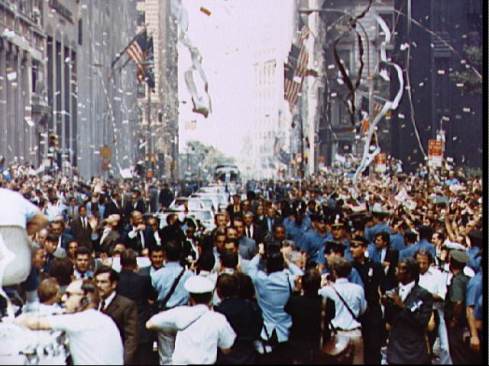
Against the shadow of Sept. 11, 2001, these plaques recall a carefree, exuberant, giddy spirit that may be difficult to conjure again downtown, even if the Yankees do their part.
Carefree? How about the parade in May 1962 when President Félix Houphouët-Boigny of the Ivory Coast was cheered as “Scott Carpenter” by spectators who mistakenly assumed he was a newly returned astronaut.
Exuberant? How about the 1,900 tons of paper showered on Douglas (Wrong Way) Corrigan in August 1938 after his flight from New York to Ireland “instead of his ‘intended’ destination of California,” as the plaque says, with quotation marks that constitute one of the few instances of editorializing.
Giddy? How about May 1950, when there was a parade every day for three days, beginning with one for Prime Minister Liaquat Ali Khan of Pakistan. He was assassinated a year later, one of many foreign leaders who were hailed in the Canyon of Heroes and then jailed, deposed or murdered back home.
“It was almost like a death sentence to get a ticker-tape parade,” said Kenneth R. Cobb, the director of the municipal archives, who has compiled a parade history.
After several spontaneous outbursts, one of the first organized uses of paper tape from stock-market tickers occurred Nov. 18, 1919, in a parade for the Prince of Wales, later the Duke of Windsor.
Grover A. Whalen, the city’s official greeter, recalled in his 1955 autobiography, “Mr. New York,” that he arranged a word-of-mouth campaign among downtown businesses to give the prince a spectacular reception with streams of ticker tape. It wound up including torn-up phone books. (Hmmm. A city official, proud of his Irish descent, contriving to welcome the Prince of Wales by inundating him with waste paper thrown out of windows in tall buildings.)
Watching the paper fall on the Yankees in 1996, Carl Weisbrod, the president of the Downtown Alliance, and Suzanne O’Keefe, the vice president for design, agreed that something should be done to commemorate the parades.
As part of the $20 million streetscape project, under the direction of Cooper, Robertson & Partners, the design studio Pentagram came up with the idea of simple granite sidewalk strips – not unlike the ticker-tape ribbons that remain after a parade, said Michael Bierut, a Pentagram partner – with the date and a few words of description.
(An illustrated brochure and map with information about all 200 parades can be picked up at kiosks outside City Hall and the World Trade Center PATH station or through the alliance, at downtownny.com or 212-835-2789.)
The plaques were made by Dale Travis Associates, the firm responsible for the silver-leaf lettering in the Freedom Tower cornerstone. The granite blocks, 8 inches wide and 3 inches deep, were cut with a water jet, Dale L. Travis said. Then the two-inch stainless-steel letters were inserted, held by pins and thermoplastic grout.
Last week, Jorge Condez and Paul Corrales of A.F.C. Enterprises set some of the last plaques, including “October 28, 1986 * New York Mets, World Series Champions,” into place near Vesey Street.
THREE years and 11 months have passed since the last parade, the longest interval since the 1978 Yankees broke a nine-year dry spell in the Canyon of Heroes.
The next parade will not be easy. The image of a paper blizzard suspended in midair among the downtown skyscrapers, once a visual metaphor for civic celebration, was transformed on Sept. 11, 2001, into a metaphor for cataclysm.
Is it still? Mr. Bierut hopes not. “Part of the resiliency of the city is retaining its own meaning for those metaphors and not surrendering them,” he said. “The post-terror condition has acclimated people to view any disruption of routine as a cause for alarm. There will come a time when the disruption of the routine of city life is seen as something wonderful.”
“Ticker-tape parades were the very essence of that,” Mr. Bierut said.
Just in case, Ms. O’Keefe said, there are 33 blank spots available on Broadway and Park Row to mark future parades. At the current pace, she figured, that ought to last a century and a half.
Britney Spears Hospitalized Again Early Thursday Morning
StoriesSpears hospitalized for ‘mental health’

In the second time in a month, the pop star has been physically removed from her home by police.
By Andrew Blankstein
Los Angeles Times Staff Writer
1:53 AM PST, January 31, 2008
Los Angeles Police officers physically removed pop star Britney Spears from her home early today, placing the troubled celebrity on a “mental health evaluation hold,” authorites said.
More than a dozen motorcycle officers and a Los Angeles Fire Department ambulance swept through the front gates of Spears hilltop Studio City residence shortly before 1 a.m., as a police helicopter hovered overheard. At 1:08 a.m., officers inside the home radioed to commanders that “the package is on the way out.”
Spears was rushed from a side entrance of her home into an ambulance. As she was driven down Coldwater Canyon Boulevard, her vehicle was escorted by more than a dozen motorcycle officers, two cruisers and two police helicopters. Her final destination was the UCLA Medical Center, authorities said.
This is the second time in a month that Spears has been placed on a 72-hour welfare hold. The first occurred on Jan. 3, when Spears declined to give up custody of her children to ex-husband Kevin Federline.
The Summit, the winding street on which Spears lives in Studio City, was jammed with the vehicles of journalists and photographers for several hours prior to the police operation.
Authorities said the welfare hold was prompted by a telephone call they received from Spear’s psychiatrist. It was unclear exactly when they had received the call, but it was apparent that the operation had been carefully planned over a period of time. Unlike the first welfare hold — in which Spears’ ambulance was closely pursued by a throng of photographers — vehicles today were blocked from following the same route. The motorcade that whisked Spears to the hospital also showed a large investment in resources. The line of emergency vehicles stretched longer than a football field.
:: :: :: :: :: :: :: :: :: ::
The New York Football Giants Land In The Valley Of The Sun
StoriesCHANDLER, Ariz. — Giants defensive end Michael Strahan arrived at the first of many Super Bowl news conferences dressed in all black. Five teammates and his coach appropriately followed suit.
Linebacker Antonio Pierce said none other than Coach Tom Coughlin put him in charge of the team attire for the Giants’ first public appearance after arriving in Arizona on Monday. Pierce told all participants to wear black suits as a sign of unity.
The fact that Coughlin allowed Pierce to make that decision fit perfectly with the Super Bowl theme of the kinder, gentler Giants coach. That sure-to-be-told story line, along with a few others, kicked off Monday, as the Giants met the national news media here for the first time at their team hotel.
“He opened up to everybody,” Pierce said of Coughlin this season. “He’s showing us his teeth. He’s letting us know he has cheekbones and everything.”
The kinder Coughlin emerged as a favorite topic Monday. Pierce and his teammates described bowling nights and casino nights introduced this season by Coughlin. They spoke of the leadership council he formed.
Pierce said players who rarely dealt with Coughlin did not know who their coach really was. That changed this season, according to the Giants.
The new Coughlin stood at the podium Monday, wearing the requisite dark suit and a red tie, hair parted just so underneath two bright lights pointing toward his head. The new Coughlin turned his opening news conference into a stand-up comedy routine, cracking a couple jokes.
Of the crowd of reporters gathered around him, along with dozens of TV cameras lining the back wall, Coughlin quipped, “This is like a normal day in New York, media-wise.”
Of the Giants’ 10 victories on the road this season, Coughlin joked, “We have a lot of secrets we can’t share with you.”
The Monday session was basically a preview of what this week will be like for the Giants. Surrounded by a small army of reporters, cameramen and radio hosts, they answered the same questions dozens of times, even in this first setting. There was no trash talk, at least not Monday.
The Patriots arrived in Arizona on Sunday night, but the Giants elected to land Monday afternoon. Most players described a subdued flight. Several Giants even slept. Others watched the movie “Michael Clayton.” The buzz picked up as the plane neared landing, with Coughlin describing the feeling of “anticipation and excitement.”
The Giants went straight to the team hotel, the Sheraton Wild Horse Pass. If they were looking for seclusion, the hotel provided it. Located outside of Phoenix, the hotel sits in the Sonoran Desert, surrounded by mountains and cactuses, instead of fans and bars. The hotel complex includes two 18-hole golf courses and a spa that measures 17,500 square feet.
The six Giants selected to participate in the news conference talked of savoring the experience of the week. Strahan and receiver Amani Toomer recalled what it felt like to lose a Super Bowl, the fireworks exploding for the team that beat them, the newspaper the next morning announcing their loss.
“If you lose,” Strahan said. “What is there to remember?”
As if playing the undefeated Patriots did not serve as enough of a challenge, the Giants also came down with a flu bug this week. Coughlin said the bug surfaced in the past day or two, and that three players missed practices with high temperatures. Coughlin said he hoped the sickness “will not be an issue.”
And with that, attention turned back to the story lines sure to dominate the week. Coughlin said the Giants were familiar with the underdog role. He repeated that he never considered not playing his full roster when the Giants faced the Patriots in the regular-season finale.
Across the ballroom, punter Jeff Feagles talked of remembering the experience. A 20-year veteran, Feagles has never been in a Super Bowl before, same as Coughlin, his kinder, gentler head coach. Feagles talked of how fast the plane ride went by, of how giddy his teammates were.
At the airport, he pulled out a camera and started taking pictures. And with that, Super Bowl week was under way for the Giants.
“This is special,” Feagles said. “I’ve been to that airport I can’t tell you how many times. But this felt different. This felt good.”
Bill Maher | January 25 2008
StoriesPart One
Part TwoPart ThreePart FourPart FivePart Six
:: :: :: :: :: :: :: :: :: ::
 The New York Herald Sun