Arthur Silber | The Honor of Being Human: Why Do You Support?

Stories

The Honor of Being Human: Why Do You Support?

79556252-9bab2a5670-m.jpg

I offer here the first of several essays that will focus on general questions connecting to a number of earlier articles, as well as to certain upcoming pieces. The initial issue that requires further clarification is one I am addressing in considerable detail: the question of obedience.

Obedience is a central theme in my continuing “Final Descent” series. In part because of my own thinking about this issue, and in part because of some unusually perceptive and provocative emails I have received, I offer the following descriptive definition of what I mean by “obedience.” It may seem to certain readers that I offer this informal definition rather late in the game, since I have been analyzing many issues related to obedience for several years. But in this, I follow a common pattern: it is only after we consider a generally understood phenomenon in many different manifestations that we can begin to isolate the critical underlying features. Even now, I am not entirely satisfied with this description, but it will suffice for the moment. I will undoubtedly have occasion to revisit this description and to refine it, as my own understanding increases.

I describe “obedience” in the following manner for a variety of complicated reasons, which reasons alone would require several lengthy essays to explain. Most importantly for my immediate purposes, I wanted this description to encompass at least three fundamentally different kinds of relationships, but to isolate the dynamics of obedience that are common to all of them. Those three relationships are: parent to child; one adult to another adult; and the adult to the state. Here is the description I’ve come up with:

Obedience is the term used to describe the demand by a person in a superior position (superior psychologically, legally and/or in terms of the power he possesses in some other form) that a person in an inferior position conduct himself in a particular manner. The essence of obedience is the demand without more: a reason may be provided, but a reason is unnecessary. Moreover, the reason may be unconvincing or incoherent, and it may contradict other reasons provided for other demands. Most importantly, the reason need not be one that the person in the inferior position agrees with. Informed, voluntary agreement occurs when a person is presented with a reason(s) to act in a certain manner; he understands and is ultimately convinced of the validity of the reason(s), and therefore acts in the manner suggested.Obedience is the opposite of voluntary, uncoerced agreement: the understanding and agreement of the person in the inferior position are not required, and are often not sought at all. The person in the inferior position may profoundly disagree with the reason(s) offered for the demand, if any. When the person in the inferior position obeys, he does so because of his certain knowledge that if he does not, he will be punished in some form: psychologically, legally, socially, or in some other way. Thus, the primary (although not the sole) motivation that ensures obedience is negative in nature: it is not the promise of a reward (even though certain rewards may be offered), but the assurance that he will not suffer consequences that are painful in varying degrees, i.e., that he will not be punished.

I have discussed the centrality of obedience to the way in which almost all children are raised in my numerous essays based on Alice Miller’s work, as well as in the “Final Descent” series, and also in one of my articles about the high school students who protested the Iraq occupation, “When Awareness Is a Crime, and Other Lessons from Morton West.”

It must be appreciated that the child is in a unique position, one that is uniquely defenseless and dependent. As I often note, the child literally depends on his primary caregiver(s) for everything, including life itself. Because of this dependency inherent in the child’s status (especially that of a very young one), the child has no choice but to obey: if he does not, he fears the withdrawal of the caregiver’s affection and protection, which might ultimately mean the loss of the child’s life. Although the child may not understand this in explicit terms, he feels the certainty of this knowledge very deeply. I will soon be examining in more detail the frequently tragic and destructive results of these factors which place the child at grave risk of abuse, which can be psychological and/or physical in nature.

Palast on PBS’ NOW :: "The Fix Is In" for 2008

Stories

Palast on PBS’ NOW
‘The Fix is in’ for 2008

Catch Greg Palast on PBS’ top current affairs program.

WATCH THE REPORT HERE

‘NOW’ furthers the story Palast first busted open for Britain’s BBC Newsnight, the scheme to attack voters of color – the ‘Blue’ ones.

For Bill Moyers’ capable successor, David Brancaccio, Palast lays out the latest evidence never before televised.

Powered by ScribeFire.

Hollywood/New York Writers Strike Hitting Studios In The Pocket

Stories

FROM R E U T E R S  

chips.jpg

By Carl DiOrio

LOS ANGELES (Hollywood Reporter) – Hollywood studios have suggested all along that striking writers will be sadly surprised when they discover the high cost of their six-week-old strike.

Now they’re actually helping them calculate that cost.

A Web site operated by the Alliance of Motion Picture & Television Producers (AMPTP), the bargaining arm of the studios, now boasts a running tally — updated by the second — of income lost by guild members since the Writers Guild of America (WGA) launched its first strike in almost two decades.

By early Wednesday, that tally was running at almost $104 million, according to the site (www.amptp.org)

The Web site flourish was added one day after a spoof of AMPTP.org showed up as AMPTP.com, complete with phony company news releases and executive profiles.

Meanwhile, over on the labor side of the negotiating impasse, picketing continued on both coasts Tuesday.

Sign-bearing strikers walked lines at the usual studio and network locations throughout Los Angeles. And in New York, more than 200 striking writers and others rallied at the West 66th Street site of ABC daytime productions “The View” and “All My Children.”

WGA East reps handed out leaflets to members of the public standing in an audience line for “The View,” whose host Whoopi Goldberg sent out hot chocolate for the striking writers. Among those joining the scribes’ picket line were “Desperate Housewives” actress Dana Delany, and writer-director Nora Ephron.

Reuters/Hollywood Reporter

Busting The Ethanol Myth

Stories

From PERMACULTURE 

wpit.jpg

Myth #1: It Takes More Energy to ­Produce Ethanol than You Get from It!

Most ethanol research over the past 25 years has been on the topic of energy returned on energy invested (EROEI). Public discussion has been dominated by the American Petroleum Institute’s aggressive distribution of the work of Cornell professor David Pimentel and his numerous, deeply flawed studies. Pimentel stands virtually alone in portraying alcohol as having a negative EROEI—producing less energy than is used in its production.

In fact, it’s oil that has a negative EROEI. Because oil is both the raw material and the energy source for production of gasoline, it comes out to about 20% negative. That’s just common sense; some of the oil is itself used up in the process of refining and delivering it (from the Persian Gulf, a distance of 11,000 miles in tanker travel).

The most exhaustive study on ethanol’s EROEI, by Isaias de Carvalho Macedo, shows an alcohol energy return of more than eight units of output for every unit of input—and this study accounts for everything right down to smelting the ore to make the steel for tractors.

But perhaps more important than EROEI is the energy return on fossil fuel input. Using this criterion, the energy returned from alcohol fuel per fossil energy input is much higher. In a system that supplies almost all of its energy from biomass, the ratio of return could be positive by hundreds to one.

Myth #2: There Isn’t Enough Land to Grow Crops for Both Food and Fuel!

According to the U.S. Department of Agriculture, the U.S. has 434,164,946 acres of “cropland”—land that is able to be worked in an industrial fashion (monoculture). This is the prime, level, and generally deep agricultural soil. In addition to cropland, the U.S. has 939,279,056 acres of “farmland.” This land is also good for agriculture, but it’s not as level and the soil not as deep. Additionally, there is a vast amount of acreage—swamps, arid or sloped land, even rivers, oceans, and ponds—that the USDA doesn’t count as cropland or farmland, but which is still suitable for growing specialized energy crops.

Of its nearly half a billion acres of prime cropland, the U.S. uses only 72.1 million acres for corn in an average year. The land used for corn takes up only 16.6% of our prime cropland, and only 7.45% of our total agricultural land.

Even if, for alcohol production, we used only what the USDA considers prime flat cropland, we would still have to produce only 368.5 gallons of alcohol per acre to meet 100% of the demand for transportation fuel at today’s levels. Corn could easily produce this level—and a wide variety of standard crops yield up to triple this. Plus, of course, the potential alcohol production from cellulose could dwarf all other crops.

Myth #3: Ethanol’s an Ecological ­Nightmare!

You’d be hard-pressed to find another route that so elegantly ties the solutions to the problems as does growing our own energy. Far from destroying the land and ecology, a permaculture ethanol solution will vastly improve soil fertility each year.

The real ecological nightmare is industrial agriculture. Switching to organic-style crop rotation will cut energy use on farms by a third or more: no more petroleum-based herbicides, pesticides, or chemical fertilizers. Fertilizer needs can be served either by applying the byproducts left over from the alcohol manufacturing process directly to the soil, or by first running the byproducts through animals as feed.

Myth #4: It’s Food Versus Fuel—We Should Be Growing Crops for Starving Masses, Not Cars!

Humankind has barely begun to work on designing farming as a method of harvesting solar energy for multiple uses. Given the massive potential for polyculture yields, monoculture-study dismissals of ethanol production seem silly when viewed from economic, energetic, or ecological perspectives.

Because the U.S. grows a lot of it, corn has become the primary crop used in making ­ethanol here. This is supposedly ­controversial, since corn is identified as a staple food in poverty-stricken parts of the world. But 87% of the U.S. corn crop is fed to animals. In most years, the U.S. sends close to 20% of its corn to other countries. While it is assumed that these exports could feed most of the hungry in the world, the corn is actually sold to wealthy nations to fatten their livestock. Plus, virtually no impoverished nation will accept our corn, even when it is offered as charity, due to its being genetically modified and therefore unfit for human consumption.

Also, fermenting the corn to alcohol results in more meat than if you fed the corn directly to the cattle. We can actually increase the meat supply by first processing corn into alcohol, which only takes 28% of the starch, leaving all the protein and fat, creating a higher-quality animal feed than the original corn.

Myth #5: Big Corporations Get All Those Ethanol Subsidies, and
Taxpayers Get Nothing in Return!

Between 1968 and 2000, oil companies received subsidies of $149.6 billion, compared to ethanol’s paltry $116.6 million. The subsidies alcohol did receive have worked extremely well in bringing maturity to the industry. Farmer-owned cooperatives now produce the majority of alcohol fuel in the U.S. Farmer-owners pay themselves premium prices for their corn and then pay themselves a dividend on the alcohol profit.

The increased economic activity derived from alcohol fuel production has turned out to be crucial to the survival of noncorporate farmers, and the amounts of money they spend in their communities on goods and services and taxes for schools have been much higher in areas with an ethanol plant. Plus, between $3 and $6 in tax receipts are generated for every dollar of ethanol subsidy. The rate of return can be much higher in rural communities, where re-spending within the community produces a multiplier factor of up to 22 times for each
alcohol fuel subsidy dollar.

Myth #6: Ethanol Doesn’t ­Improve Global Warming! In Fact, It ­Pollutes the Air!

Alcohol fuel has been added to gasoline to reduce virtually every class of air pollution. Adding as little as 5–10% alcohol can reduce carbon monoxide from gasoline exhaust dramatically. When using pure alcohol, the reductions in all three of the major pollutants—carbon monoxide, nitrogen oxides, and ­hydrocarbons—are so great that, in many cases, the remaining emissions are unmeasurably small. Reductions of more than 90% over gasoline emissions in all categories have been routinely documented for straight alcohol fuel.

It is true that when certain chemicals are included in gasoline, addition of alcohol at 2–20% of the blend can cause a reaction that makes these chemicals more volatile and evaporative. But it’s not the ethanol that’s the problem; it’s the gasoline.

Alcohol carries none of the heavy metals and sulfuric acid that gasoline and diesel exhausts do. And straight ethanol’s evaporative emissions are dramatically lower than gasoline’s, no more toxic than what you’d find in the air of your local bar.

As for global warming, the production and use of alcohol neither reduces nor increases the atmosphere’s CO2. In a properly designed system, the amount of CO2 and water emitted during fermentation and from exhaust is precisely the amount of both chemicals that the next year’s crop of fuel plants needs to make the same amount of fuel once again.

Alcohol fuel production actually lets us reduce carbon dioxide emissions, since the growing of plants ties up many times more carbon dioxide than is created in the production and use of the alcohol. Converting from a hydrocarbon to a ­carbohydrate economy could quickly reduce atmospheric carbon dioxide.

More Douchebag Brits (Pt 867)

Stories

From The Beeb’s Blogs

broad.png

Sleepwalking Democrats?

The Democrats’ debate in Las Vegas was interesting. I loved the introduction of a heckler in the early stages – presumably paid for by CNN to give the whole thing a less plastic feel.

On substance: I will leave the discussion of Hillary Clinton’s asbestos pant-suit to other, less salubrious outlets. But it seems to me that the Democrats, all of them, are entering potentially hazardous ground on Iraq. It was striking that they talked, all of them, about ending the war. They used that word: ending. They did not use the word with the same number of syllables but an altogether different feel: winning. Now, a few months ago the E word sounded just fine to most Americans and the W word rather unrealistic, even idiotic and insulting. But now?

Politics is about narrative and the narrative at the moment is of a war that is no longer out of control. It could, of course, go downhill again rapidly but at the moment it is not. For the Democrats, isn’t this is a trap even bigger than driving licences for illegal immigrants? Might they not sleepwalk into calling for a war to end that is actually being won?

And a word to CNN: years ago at my English boarding school we were told not to be boastful. Referring to your talented and thoughtful team of commentators and reporters as “the best political team on television” or whatever the precise phrase is, demeans them and you. After all, this is the “best website in cyberspace” and I am the “best BBC reporter writing this blog” but neither piece of information is interesting or validating unless it comes from others. The willingness of Americans to be proud of their achievements and unashamed to trumpet them is – in my humble view – a hugely attractive trait. But CNN has gone too far…

UPDATE:: What a coinkidink-just found this

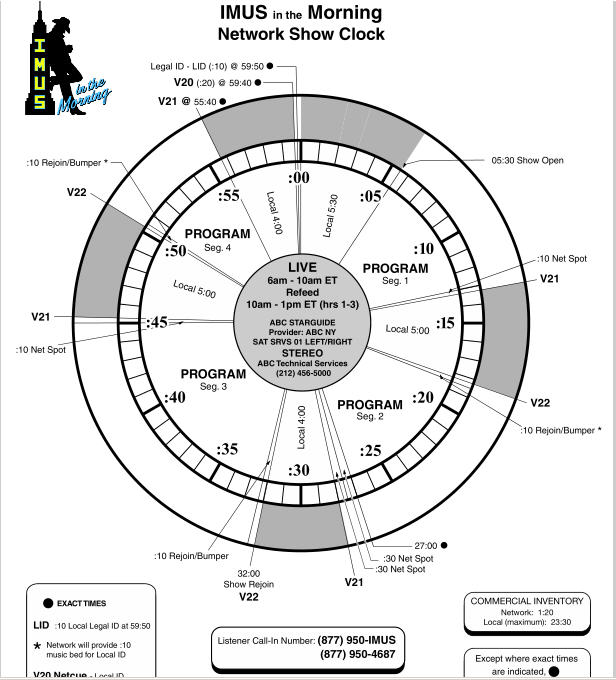
Don Imus’ Simulcast Turns Into Simulcrash

Stories

NY Daily News.
<!–Posted on 05 Dec 2007–>


Just
24 hours after Don Imus put his show back on track, he got blindsided
Tuesday by one of the ugliest technical train wrecks in recent radio
and TV memory.

On their first day in a new studio set up for the RFD-TV simulcast
of his WABC (770 AM) radio show, Imus and his team found much of their
equipment didn’t work properly through the first half of the show.

Clearly furious, Imus refrained from a major outburst even after he
had to postpone and then shorten a phone interview with columnist Tom
Friedman because the phone connection at first didn’t work at all
and then made Friedman sound like he was speaking from a mine shaft.

Similar problems recurred with other guests and cast members. At
times, Imus and his in-house team couldn’t communicate with
engineer Lou Ruffino at WABC across the street.

At one point, Imus had Charles McCord read news headlines, while
Imus tried to contact Ruffino on a cell phone. While McCord read the
news, Imus could be heard in the background trying to resolve the
problem.

“It was certainly embarrassing,” said Tom Taylor, editor
of the trade site Radio-Info.com. “Such displays don’t make
anybody look good – including Imus himself, who has nothing to do with
the technical end.”

“It wasn’t one of our finest moments,” said WABC
program director Phil Boyce. “Complicating it is that because
this was just his second show for us, we had no backup tape to put on
while we worked to fix it.

“Fortunately, I believe we did fix it. We were on it all day and I don’t think it will happen again.”

Some radio people wondered why Imus didn’t do the show from
WABC until the RFD studio was fully tested. But that could have killed
the TV simulcast.

RFD was not available for comment. But Imus vowed to Friedman the
problems would not recur. Imus also joked, “I’ve had eight
months to work on controlling my temper,” suggesting the day was
testing that resolve.

Other news for Imus yesterday was better. While radio does not have
overnight ratings, his return Monday drew a lot of attention and
generally good reviews. A number of major advertisers were also back,
including Hackensack Medical Center, Bigelow Tea, NetJet and Mohegan
Sun.

Taylor said he’s confident this was a one-day disaster.

“Phil and his folks are sharp,” he said. “They’ll figure it out.”

– By David Hinckly

Powered by ScribeFire.

Time magazine refused to publish responses to Klein's false smears

Stories

wpitw.jpg

Joe Klein is Losing it…..

(updated below)The disgraceful behavior of Time Magazine in the Joe Klein scandal has been well-documented. But new facts have emerged that reveal that Time‘s behavior was far worse than previously thought.

First, Sen. Russ Feingold submitted a letter to Time protesting the false statements in Klein’s article. But Time refused to publish it. Sen. Feingold’s spokesman said that the letter “was submitted to TIME very shortly after Klein’s column ran but the letters department was about as responsive as the column was accurate.”

Just to reveal how corrupt that behavior is, The Chicago Tribune — which previously published the factually false excerpts of Klein’s column and then clearly retracted them — yesterday published Feingold’s letter. As Feingold details — but had to go to the Chicago Tribune‘s Letter section to do it — “Klein calls the Democrats’ position on reforming the Foreign Intelligence Surveillance Act ‘well beyond stupid’ but without getting his facts straight.” Feingold also said that “Klein is also flat out wrong” in his false claims that there was some “bipartisan agreement” on a bill to vest “new surveillance powers” that House Democrats ignored.

Second, Rep. Rush Holt — before he published his response in The Huffington Post detailing Klein’s false claims — asked that he be given the opportunity to respond to Klein’s false column directly on Time‘s Swampland, where Klein was in the process of making all sorts of statements compounding his errors. But Time also denied Rep. Holt the opportunity to bring his response to the attention of Time‘s readers.

According to Zach Goldberg, Rep. Holt’s spokesman: “Rep. Holt had an email exchange with Mr. Klein about FISA and his column. During the exchange, Rep. Holt made a request to respond with a Swampland post to clarify what is really in the RESTORE Act. Mr. Klein noted he already issued a public apology and did not accept the request.”

Let’s just ponder for a second how lowly Time‘s behavior here is. It refused the requests of two sitting members of Congress, both of whom are members of the Intelligence Committees and have played a central role in drafting the pending FISA legislation, to correct Klein’s false statements in Time itself. What kind of magazine smears its targets with patently false statements and then blocks them from responding?

Making matters much worse is the fact that, as we now know, Klein’s false statements about the House Democrats’ FISA bill was basically ghost-written by GOP Rep. Pete Hoekstra. Klein never quoted a single Democratic proponent of that bill — either in his original false article, his multiple Swampland posts, nor the three separate “corrections” published by Time.

The whole episode was a GOP-fueled smear on Democrats. Yet Time nonetheless refused to allow Congressional Democrats with the greatest knowledge of this matter to bring to the attention of Time‘s readers how false Klein’s statements were, and how false the subsequent “corrections” were. To describe Time‘s behavior is to illustrate how profoundly unethical it is.

Third, at least 100 individuals wrote letters to Time‘s editors protesting Klein’s article and responding to its claims. I know this because that’s how many people (at least) cc’d me on their letters, forwarded them to me, and/or copied their Letters to the Editor in the Comment section here. Managing Editor Rick Stengel’s voice mail and email box overflowed with responses.

Nonetheless, Time — while publishing 15 separate letters on a whole array of topics in its print edition this week — did not see fit to publish a single letter about the Klein falsehoods. At every step, they sought to hide from their readers — and continue to hide from their readers — just how outrageous and severe were Klein’s false statements by suppressing all responses.

Finally, Howard Kurtz of The Washington Post and CNN — who dives head-first into every right-wing blog controversy — has been completely mute about the Klein/Time scandal, even though it was one of the central focuses of blogs for more than a full week and relates directly to the media criticism issues he is ostensibly assigned to cover. Worse, Kurtz has now been asked about this matter by multiple readers in two consecutive weekly Monday chats he hosts at the Post, but has refused to take a single question about it.

Yesterday, at least 15 people submitted questions to Kurtz on the Time/Klein scandal — again, I know this because that’s how many people emailed me their questions or left them in comments — and not a single one was chosen. Kurtz, however, found time to address multiple questions on such pressing matters as the new Don Imus Show and football.

It’s hardly difficult to understand why Kurtz has joined with the Time editors to steadfastly suppress any effort to expose the behavior of Klein and Time:

Time published blatantly false statements from Klein, refused (and refuses) to retract them, and then bolstered those false claims with a further false claim that Klein had a solid basis for making them. Worse still, they refused to allow even a Senator and a Congressman on the Intelligence Committees — who were the targets of Klein’s smears — to defend themselves and explain in Time why Klein’s accusations were false.

And they (and their corporate minions such as Kurtz) are taking every step possible to ensure that their readers never become aware of what happened. Is it time yet to hear more about how dangerous bloggers are because they operate with no standards?

UPDATE: I just learned that in addition to all of the above, a letter was also sent to Time jointly from House Judiciary Committee Chairman John Conyers and House Intelligence Committee Chairman Silvestre Reyes. Although they communicated with Time in advance and advised them that the letter was coming, Time has not published this letter either.

Prior to posting this, I asked Time to comment on these matters and was told they “will get back to [me] as soon as possible.” I wasn’t interested in waiting longer, so I sent the Time PR person a link to this column and advised her that “unlike Time, I’m happy to post a comment in response to this.” If and when I receive a response from Time, I will post it.

— Glenn Greenwald

An Iraq Contractor Speaks

Stories

October 15, 2004

Tales From the Titan’s Mouth
An Iraq Contractor Speaks
by Christopher Deliso

balkanalysis.com

At first he didn’t want to talk, but after a few beers the Turkish translator and former employee of Titan
– one of the largest American companies providing “human
resources” to the U.S. armed forces in Iraq – loosened up and
started to let me in on his riveting story of life in the field with
American soldiers. The experiences recounted by the young translator,
“Massoud,” proved that low morale and the kind of lurid misconduct that
have plagued the army since last April’s Abu Ghraib scandal were
actually endemic since the war began in March 2003.

Titan’s Travails

Titan,
of course, became infamous partially because of Abu Ghraib. At least
one of its contract workers, Adel Nahkla, was allegedly involved with
chronic torture and abuse of Iraqi prisoners. Other civilian
contractors like the mysterious Stephen Stephanowicz and John Israel of CACI – another “human resources” company with a checkered past and gilded future – were also accused of being involved. These allegations spawned a lawsuit filed in San Diego in June on behalf of the Iraqi victims.

Simultaneously,
Titan’s problems were compounded when aerospace giant Lockheed Martin
dropped plans to buy up the company “because a Justice Dept.
investigation into possible bribery of foreign officials by Titan
subsidiaries or consultants continued past a Lockheed deadline for the
purchase.” The company’s numerous indiscretions led to the hiring of a “vice president for ethics” on Sept. 28.

Most
recently, the San Diego-based firm was hit by the news that one of its
translators, an Iraqi Kurd named Luqman Mohammed Kurdi Hussein, was found beheaded in Iraq
on Oct. 11. The Ansar al-Sunnah Army, which also claimed responsibility
for the beheading of 12 Nepalese workers and three Iraqi Kurds on Aug.
31, took responsibility for the slaying.

Despite its ongoing
problems, NBC reports, the U.S. military on Sept. 17 extended Titan’s
contract to provide 4,500 translators and assistants for Army
operations worldwide “for six months with an option for another six
months, for a potential value of up to $400 million. It is the
contractor’s largest single source of revenue.” Although announced as a
short-term “bridging contract,”
the deal came as sweet relief to a company that has been strung up on
the rack in more ways than one since the Iraq War began in March 2003.

An Opportunity Too Good to Be True?

Massoud,
fortunately, had departed Iraq long before the situation deteriorated,
spending only a few months with the company before deciding to get out.
I spoke with the young man, a Turk of Kurdish origin, in Istanbul. It
took several days to arrange a meeting – partially because he was
considering working again for the U.S. in Iraq, if the situation
someday becomes more stable. However, as he admitted, this looks to be
a long time off.

When we finally met, it was in the bar of one of
this enormous city’s down-and-out hotels, where a clientele of
small-time shuttle traders and other invariably non-English speakers go
to get serviced by prostitutes from Russia and the Ukraine.

By
contrast, Massoud spoke excellent English, a result of both time spent
in the West and his daily dealings with Istanbul’s steady stream of
tourists buying carpets and other goods. Like many other young men in
this line of work, Massoud was impeccably dressed, hair well-oiled and
flashing a gaudy gold watch. Nevertheless, I imagined that he was not
in fact so wealthy as all that – one of the reasons why he was
anxious not to be identified. “Maybe someday I will need to get work
again with the U.S. Army,” he disclosed with a bemused grin.

Massoud
had been hired in the months leading up to war by a Turkish
subcontractor, Ankara-based Core Resources Management (CRM). To
alleviate any doubts about the veracity of his story, he laid out for
me a Pentagon-issued ID card as well as the lengthy original contract
from Titan. He also named several of his then superiors, but asked that
their names not be mentioned.

Why had Massoud considered working
for the U.S. Army in the first place? “Well, I considered that it would
be an easy way to make money fast, and not be so dangerous.” He tried,
unsuccessfully, to convince other Turkish friends to sign up as well.
In the beginning, there hardly seemed reason for worry. Originally,
Massoud and other Kurdish-speaking translators had been slated to work
with the American troops that were to have been operating from remote
bases in the mountainous Kurdish-inhabited region of southern Turkey,
bordering on Iraq. Far away from the fighting, in the vicinity of
friends and family, the job seemed like a maximum gain, minimum
investment situation.

However, when Turkish parliamentarians
astonished the Bush administration by refusing to allow American troops
to use their country as a launching pad for war in late February 2003,
everything changed. The translators would instead be shipped straight
to Iraq – with or without Turkish support.

A Rocky Start

And so on the 2nd or 3rd
of April 2003, Massoud recounts, he and 30 or so other translators were
flown from Ramstein Air Base in Germany (another country that allegedly
refused to go along with U.S. plans, by the way) to northern Iraq,
under cover of darkness. “The flight was terrible,” he recounts.
“Turbulence, and we couldn’t use any lights. When we finally got there,
to a place called Bashut near Kirkuk, they told us that a Major Sanchez
was waiting for us. “‘Where?’ we asked. Nobody knew.”

The Turkish
translators were hastily processed that night, and shown to their
large, 30-man tent – which had apparently been constructed even
more hastily, as it promptly proceeded to collapse once the new
arrivals had gone to bed. “It was a little chaotic,” recounts Massoud.
“Fortunately, we all had done our military service, so we knew how to
handle the situation. Still, it wasn’t a very good introduction to Iraq
… and then we had to wake up at 5:00 or 6:00 in the morning.”

According
to Massoud, Titan’s vice-president had issued an urgent call to get the
translators sent to Iraq immediately, because they “didn’t have anyone
else there.” However, daylight revealed “hundreds of Kurdish, Turkish
and Arabic translators. They had gotten there well before us,” Massoud
explained. According to him, most were over 40 years old and had
allegedly been trained in translation after the first Gulf War –
in faraway Guantanamo Bay, no less. “Since many of these older people
had become American citizens, the soldiers trusted them more than us,”
Massoud attested. “And they were paid much better than us, at $5,000 a
month. However, I don’t think their level of translating was any
better.”

From the beginning, the mission was plagued with problems for both the translators and the U.S. forces.

“The
local Iraqi Kurds were not so nice to us, kind of mistrustful,” said
Massoud. “They didn’t think that we were supportive enough of the PKK
[the militant Kurdistan Worker’s Party, long active in the southeast of
Turkey]. Because of their experiences under Saddam, and the much worse
living conditions in Iraq compared to Turkey, they were fairly
radicalized.”

Despite being Kurdish, Massoud had little sympathy
for the Kurdish militant cause. “Even if my roots are from the south of
Turkey, the reality is I live in Istanbul and I am happy to be
Turkish,” he said.

The Americans, on the other hand, were greeted
with suspicion from ethnic groups of all nationalities. “They [the
soldiers] did not understand the local cultures … and with only
limited chance for communicating, it was easy to understand why they
remained outsiders.”

Despite the apparent mistrust between the
Turkish and Iraqi Kurds, everyone realized that there was business to
be done. “In Istanbul,” Massoud disclosed, “we all know other ways to
make a little money on the side. It was the same in Iraq. For some
reason, all the soldiers had to have souvenirs, like old Iraqi flags.
So I would ask the locals, who of course don’t speak any English, how
much they cost. They’d tell me, say, $5. Then the soldiers I was
translating for would ask, ‘Well, so how much did he say?’ To which I
would answer something like, ‘sir, it’ll be $45.’ And they gladly paid
out the money.”

Loneliness, Poverty and Sex

If
it seemed like money was no object to the Americans at the beginning,
this began to change as the weeks wore on. “After two months in Iraq,”
said Massoud, “the base commanders had still failed to get a proper
bank set up. The first thing on every base has to be a bank. The
soldiers were depressed, trapped on the base, and had by that time
started to run out of money – meaning they couldn’t buy anything
in the PX [army store], and had to eat only the MREs,
meals-read-to-eat, which are pretty terrible, whereas we could use our
local connections to buy whole chickens for $5. So, with this situation
dragging on, the weather starting to warm up and the war continuing in
the south, it started to affect the troop morale.”

Having to cope
with loneliness, malnutrition and basically captive status inside a
heavily-fortified base took its toll. The lack of a bank to dispense
funds, in particular, facilitated some of the most lurid events to have
transpired at the base – illicit sex and prostitution.

“On
the base, there was a big gymnasium,” Massoud explained. “It could fit
about 2,000 people and had many little side rooms on the second level,
like for weight rooms or showers, for example. And a lot of the
soldiers would use these rooms for sex, with each other or sometimes
with translators, of course all against the rules. The shower room was
the most popular.”

In fact, he continued, the soldiers’ steadily
dwindling stock of cash led some female soldiers even to prostitute
themselves. “There was this beautiful, 30-year-old woman soldier who I
was friends with,” Massoud recalled. “And she would sell herself
regularly to the other soldiers – for only $20. I couldn’t
believe it.” When asked if he had ever solicited the woman, the suave,
dark-eyed Turk just laughed and said, “Come on, you think that I had to pay?”

Intrigue and Incompetence

When
asked about other types of scandalous behavior, Massoud alluded to
incidents of procurement fraud, but didn’t provide details. He did not
recall any instances of torture having taken place on base: “Because of
my job position, I was not in a position to know yes or no about that,
anyway.”

Aside from being lonely and slightly depraved, Army life
was dangerous. “We were fired on, on more than one occasion,” Massoud
recalled. “I saw killing and destruction in Iraq … and those
memories will always be with me.”

Located in the ethnically
mixed, oil-rich north of Iraq, the U.S. base and its environs were
“swarming with intelligence officers from all different countries
– Americans, Turkish, Israeli, Syrian, etc.,” attested Massoud.
According to him, the Turkish government’s early concern for the Iraqi
Turkoman minority had led them to send six Turkish army officers along
to Kirkuk with the Americans. “Our site manager told us not to talk to
them or ask them what they were doing there,” said Massoud. “And even
though we thought they were ‘our guys,’ and might protect us if need
be, we never did get beyond a cup of tea, the usual small talk, you
know.”

According to Massoud, it was easy to tell the spooks from
the legitimate workers for Titan or Brown & Root, who were also
there. “The spies were so obvious,” he said. “They’d be the kind of
guys who looked really out of place and would ask too many questions,
things that they didn’t have any reason to ask about – especially
funny since they were asking me, and I was just a translator.”

When
asked what nationality’s agents were most easy to identify, Massoud
chuckled. “You can pick out our guys [Turks] from a mile away. Even if
they were dressed like regular civilians, they were the ones wearing
these standard-issue military boots.”

Local Overtures and Innuendo

Although
he apparently knew nothing more than the soldiers did about potential
external threats, Massoud did have one advantage: his ability to
communicate with the locals.

“We translators were always able to
live much better than the soldiers,” he reminisced. “Whereas they were
stuck with MREs for dinner, we all had fresh and cheap local vegetables
and chicken from the Kurdish people in the area.”

In fact, this
relationship became somewhat more provocative when, aside from the
usual buying and selling, local Iraqi women started showing up outside
the base.

“They were inviting us, saying, ‘come on, come out and
visit us in our homes,'” Massoud said. “But how? We were trapped on the
base like the soldiers. … It was hard to explain this concept to
them.”

Apparently, some of these women were looking for a
husband, and thought they might find one among the ranks of ostensibly
well-off Turkish Kurds working for the U.S. However, since the local
women also were asking for soldiers, there were suspicions that the
even wealthier Americans were being sought out, too. Yet could an
American soldier really be successfully integrated into the tight-knit
and conservative Kurdish tribal culture, even if he wanted to?

“I don’t know if they were interested in marriage,” Massoud reflected. “Maybe just sex.”

I
marveled at how such an act could transpire, given the nature of
Kurdish society and the fact that the Americans weren’t especially
popular, to say the least. “Well, yes, they possibly could have sex
with a soldier,” he nodded, pausing for a final sip of beer.
“Afterwards they might get to kill him too, of course.”

And with
that, apologizing that the hour was late, Massoud shook my hand and
disappeared as quickly as he’d come into the wet, foggy Istanbul night.


Powered by ScribeFire.