
MAUREEN DOWD GIVES GIULIANI A COLUMN OF CUTENESS

Stories

dowd-ts-190.jpg

Maureen Dowd

WASHINGTON

It’s on.

Or, rather, it’s back on.

Rudy versus Hillary, a New York steel-cage match pitting two eye-gouging, hair-pulling, kick-em-till-they’re-dead brawlers.

For months, Hillary’s comely male rivals for the Democratic nomination have tiptoed around her, letting their wives take shots at the front-runner.

Barack Obama looks wary when he’s on stage with Hillary, but Michelle stepped up: “Some women feel it’s a woman’s turn, you know? They just feel like it’s Hillary’s turn. That, I reject, because democracy isn’t supposed to be about whose turn it is.”

That followed Elizabeth Edwards’s takedown of Hillary: “She’s just not as vocal a women’s advocate as I want to see. John is.”

Obama and Edwards probably figured the criticism would sound less Lazio coming from their wives. But it just made them seem as though they were hiding behind their wives’ skirts.

Enter Rudy. He may wear skirts, but he’s not afraid to take down a skirt.

He put up an ad Friday on his campaign Web site slamming her as a hypocrite for running an antiwar campaign after supporting the president on the authorization for war.

Obama has been trying to make this point for quite a while, but so gingerly that every time he sneaks up on it, Hillary surges ahead.

Rudy doesn’t do ginger.

Hillary has been trying to Rudy-up, corralling ground zero and playing the fear card, saying that if there were a terrorist attack before the election, only she could stop Republicans from keeping the White House. But Rudy aims to de-Rudy her. His ad is an instant cult classic, with a solemn trumpet that is reminiscent of “Taps” and a narrator who sounds like the guy who does trailers for “In a World Gone Wrong” disaster flicks.

Just when Hillary was basking in her reinvention of herself, Rudy sprang out of the Republican primary shadows and shoved her back.

He ignores her attempts to be New Hillary, a senator who loves men in uniform, who is not afraid to use military power, and who is tough enough to deal with bin Laden. He recasts her as Old Hillary, a Code Pink pinko first lady and opportunist from a White House that had a reputation for having a flower-child distaste for the military, a left-wing shrew who made a secret socialist health care plan and let gays into the military and certainly can’t be trusted to fight the jihadists.

“In 2002,” the white words flash on a black screen, “Hillary Clinton voted to authorize military action in Iraq because she believed it was the right thing to do.”

Then it goes to a clip of Hillary speaking on the Senate floor during the war authorization debate that Obama has been too refined to highlight.

“If left unchecked, Saddam Hussein will continue to increase his capacity to wage biological and chemical warfare and will keep trying to develop nuclear weapons,” she said, an echo of Condi. “He has also given aid and comfort and sanctuary to terrorists, including Al Qaeda members. So it is with conviction that I support this resolution as being in the best interests of our nation.”

Then the narrator intones, “But now that she’s running for president, Hillary Clinton has changed her position, even joining with the radical group MoveOn .org in attacking American General Petraeus” when she said it would require “a willing suspension of disbelief” to believe him.

“Just when our troops need all our support to finish the job, Hillary Clinton is turning her back on them,” the narrator concludes.

There are harsh images of Hillary, looking brittle in dark glasses, to go with the harsh words.

Rudy has decided that the best way to win his primary is to show he can beat the woman on the way to winning hers.

He can’t campaign on family values or the sanctity of marriage. He can’t whip up any fears on abortion or gays.

He can’t campaign on his plan to get out of Iraq because he doesn’t have one. He can’t campaign as the tough-guy heir to Bush because nobody likes Bush. He can’t campaign on attacking Iran because he’ll sound like crazy Dick Cheney.

He can’t campaign on the economy because he’s W. redux, facing a possible recession because of the mortgage crisis. He can’t campaign on Rudy’s from-the-mountaintop “12 Commitments” because no one knows what they are, and they don’t mention the word “Iraq.”

But he can be the only man in the field tough enough to slap around a woman.

The irony is that if you could loosen up Hillary with a few Jack and gingers, she would probably be closer to her reinvention than to his caricature. She probably secretly supports the surge, knowing that after it sputters, she may reap the whirlwind. And then the Republicans, who have lied, stalled and mismanaged in every way imaginable, will paint her as Ms. Cut and Run, turning her back on the military again.
PAUL KRUGMAN ON BUSH ENABLER AL GREENSPAN

Stories

When President Bush first took office, it seemed unlikely that he would succeed in getting his proposed tax cuts enacted. The questionable nature of his installation in the White House seemed to leave him in a weak political position, while the Senate was evenly balanced between the parties. It was hard to see how a huge, controversial tax cut, which delivered most of its benefits to a wealthy elite, could get through Congress.

greenspan.jpg

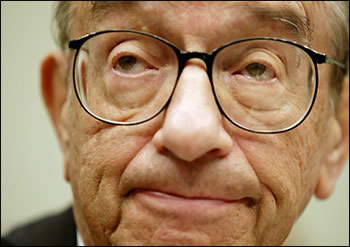
Then Alan Greenspan, the chairman of the Federal Reserve, testified before the Senate Budget Committee.

Until then Mr. Greenspan had presented himself as the voice of fiscal responsibility, warning the Clinton administration not to endanger its hard-won budget surpluses. But now Republicans held the White House, and the Greenspan who appeared before the Budget Committee was a very different man.

Suddenly, his greatest concern — the “emerging key fiscal policy need,” he told Congress — was to avert the threat that the federal government might actually pay off all its debt. To avoid this awful outcome, he advocated tax cuts. And the floodgates were opened.

As it turns out, Mr. Greenspan’s fears that the federal government would quickly pay off its debt were, shall we say, exaggerated. And Mr. Greenspan has just published a book in which he castigates the Bush administration for its fiscal irresponsibility.

Well, I’m sorry, but that criticism comes six years late and a trillion dollars short.

Mr. Greenspan now says that he didn’t mean to give the Bush tax cuts a green light, and that he was surprised at the political reaction to his remarks. There were, indeed, rumors at the time — which Mr. Greenspan now says were true — that the Fed chairman was upset about the response to his initial statement.

But the fact is that if Mr. Greenspan wasn’t intending to lend crucial support to the Bush tax cuts, he had ample opportunity to set the record straight when it could have made a difference.

His first big chance to clarify himself came a few weeks after that initial testimony, when he appeared before the Senate Committee on Banking, Housing and Urban Affairs.

Here’s what I wrote following that appearance: “Mr. Greenspan’s performance yesterday, in his first official testimony since he let the genie out of the bottle, was a profile in cowardice. Again and again he was offered the opportunity to say something that would help rein in runaway tax-cutting; each time he evaded the question, often replying by reading from his own previous testimony. He declared once again that he was speaking only for himself, thus granting himself leeway to pronounce on subjects far afield of his role as Federal Reserve chairman. But when pressed on the crucial question of whether the huge tax cuts that now seem inevitable are too large, he said it was inappropriate for him to comment on particular proposals.

“In short, Mr. Greenspan defined the rules of the game in a way that allows him to intervene as he likes in the political debate, but to retreat behind the veil of his office whenever anyone tries to hold him accountable for the results of those interventions.”

I received an irate phone call from Mr. Greenspan after that article, in which he demanded to know what he had said that was wrong. In his book, he claims that Robert Rubin, the former Treasury secretary, was stumped by that question. That’s hard to believe, because I certainly wasn’t: Mr. Greenspan’s argument for tax cuts was contorted and in places self-contradictory, not to mention based on budget projections that everyone knew, even then, were wildly overoptimistic.

If anyone had doubts about Mr. Greenspan’s determination not to inconvenience the Bush administration, those doubts were resolved two years later, when the administration proposed another round of tax cuts, even though the budget was now deep in deficit. And guess what? The former high priest of fiscal responsibility did not object.

And in 2004 he expressed support for making the Bush tax cuts permanent — remember, these are the tax cuts he now says he didn’t endorse — and argued that the budget should be balanced with cuts in entitlement spending, including Social Security benefits, instead. Of course, back in 2001 he specifically assured Congress that cutting taxes would not threaten Social Security.

In retrospect, Mr. Greenspan’s moral collapse in 2001 was a portent. It foreshadowed the way many people in the foreign policy community would put their critical faculties on hold and support the invasion of Iraq, despite ample evidence that it was a really bad idea.

And like enthusiastic war supporters who have started describing themselves as war critics now that the Iraq venture has gone wrong, Mr. Greenspan has started portraying himself as a critic of administration fiscal irresponsibility now that President Bush has become deeply unpopular and Democrats control Congress.


commentbutton.jpg

BILL MAHER'S REAL TIME WITH CHUCK HAGEL DREW CAREY CARL BERNSTEIN CONGRESSWOMAN JAN SCHAKOWSKY AND AUTHOR DAVID DRAPER

Stories


BILL MAHER’S REAL TIME WITH CHUCK HAGEL DREW CAREY CARL BERNSTEIN CONGRESSWOMAN JAN SCHAKOWSKY AND AUTHOR ROBERT DRAPER

PART ONE

Don't Mess With The New York Jets:: N.F.L. Imposes Record Half-Million Dollar Fine On Patriots Coach Belichick

Stories

NFL Fines Belichick, Limits Patriots’ Draft
By Mark Maske
Washington Post Staff Writer
Friday, September 14, 2007; E01

NFL Commissioner Roger Goodell fined New England Patriots Coach Bill Belichick $500,000 yesterday and stripped the team of at least one draft pick, possibly its first-round selection next spring, for using videotaping equipment to try to steal the New York Jets‘ play signals during a game Sunday.

The Patriots will lose their first-round draft choice in 2008 if they reach the playoffs this season, the league announced last night. If they don’t reach the postseason, they’ll be stripped of their second- and third-round selections. The Patriots were fined $250,000 even though Goodell concluded that franchise owner Robert Kraft was not aware of Belichick’s sign-stealing scheme before the league’s investigation began.

Goodell considered suspending Belichick, according to the league’s announcement, but decided against it because he felt the fine and loss of draft pick or picks were “more significant and long-lasting.”

In a letter to the Patriots, Goodell wrote that “this episode represents a calculated and deliberate attempt to avoid longstanding rules designed to encourage fair play and promote honest competition on the playing field.”

Belichick, who discussed the incident with Goodell earlier in the week, said in a written statement that he accepted “full responsibility” for the incident but blamed it on an “incorrect” interpretation of the league rules.

The three-time Super Bowl-winning coach, who has a salary of more than $4 million this season, apologized “to the Kraft family and every person directly or indirectly associated with the New England Patriots for the embarrassment, distraction and penalty my mistake caused,” but said his team has “never used sideline video to obtain a competitive advantage while the game was in progress.”

Members of the league’s security staff confiscated videotaping equipment from a Patriots employee who was on the field at Giants Stadium during Sunday’s 38-14 triumph over the Jets, who are coached by Belichick’s former defensive coordinator in New England, Eric Mangini. The two have had a combative relationship since Mangini left the Patriots for the Jets prior to last season.

The Patriots had been accused of using such tactics in the past, and Goodell and other league officials determined that the club’s coaches in this instance were using the videotaping equipment to try to steal the play signals being delivered from the Jets’ coaches on their sideline to players on the field.

NFL rules prohibit the use of video recording devices by a team on the field, in the coaches’ booth or in the locker room during a game. According to the league, a memo from Ray Anderson, the NFL’s executive vice president of football operations, was delivered to the general managers and head coaches of every team last September, warning them not to attempt to use videotaping equipment to steal an opponent’s signals.

“Part of my job as head coach is to ensure that our football operations are conducted in compliance of the league rules and all accepted interpretations of them,” Belichick said in the statement. “My interpretation of a rule in the Constitution and Bylaws was incorrect.”

Goodell determined that the Patriots’ tactics did not impact the outcome of Sunday’s game, the league announced. Still, the fine that he imposed on Belichick was the maximum amount allowed under the league’s constitution and bylaws. The league also announced that it would closely “review and monitor” the Patriots’ videotaping practices in the future.

Goodell penalized the Patriots because Belichick “has substantial control over all aspects” of the club’s football operations and “his actions and decisions are properly attributed to the club,” the league announced.

Earlier in the day, sources familiar with the league’s investigation had said that a multiple-game suspension of Belichick was possible but unlikely. Others around the league said they thought a suspension of any Patriots coach or front office official found to have acted improperly was in order, given Goodell’s emphasis in recent months on handing out lengthy suspensions to players for off-field misbehavior.

“He’s kind of set that tone already, that he’s going to be tough on someone who makes a mistake,” Eagles quarterback Donovan McNabb said at his team’s training facility in Philadelphia.

jjg.jpg