Stories
David Brooks Ignores All And Rambles About I.Q.
Stories
INSERT JOKE HERE

A nice phenomenon of the past few years is the diminishing influence of I.Q.
For a time, I.Q. was the most reliable method we had to capture mental aptitude. People had the impression that we are born with these information-processing engines in our heads and that smart people have more horsepower than dumb people.
And in fact, there’s something to that. There is such a thing as general intelligence; people who are good at one mental skill tend to be good at others. This intelligence is partly hereditary. A meta-analysis by Bernie Devlin of the University of Pittsburgh found that genes account for about 48 percent of the differences in I.Q. scores. There’s even evidence that people with bigger brains tend to have higher intelligence.
But there has always been something opaque about I.Q. In the first place, there’s no consensus about what intelligence is. Some people think intelligence is the ability to adapt to an environment, others that capacity to think abstractly, and so on.
Then there are weird patterns. For example, over the past century, average I.Q. scores have risen at a rate of about 3 to 6 points per decade. This phenomenon, known as the Flynn effect, has been measured in many countries and across all age groups. Nobody seems to understand why this happens or why it seems to be petering out in some places, like Scandinavia.
I.Q. can also be powerfully affected by environment. As Eric Turkheimer of the University of Virginia and others have shown, growing up in poverty can affect your intelligence for the worse. Growing up in an emotionally strangled household also affects I.Q.
One of the classic findings of this was made by H.M. Skeels back in the 1930s. He studied mentally retarded orphans who were put in foster homes. After four years, their I.Q.’s diverged an amazing 50 points from orphans who were not moved. And the remarkable thing is the mothers who adopted the orphans were themselves mentally retarded and living in a different institution. It wasn’t tutoring that produced the I.Q. spike; it was love.
Then, finally, there are the various theories of multiple intelligences. We don’t just have one thing called intelligence. We have a lot of distinct mental capacities. These theories thrive, despite resistance from the statisticians, because they explain everyday experience. I’m decent at processing words, but when it comes to calculating the caroms on a pool table, I have the aptitude of a sea slug.
I.Q., in other words, is a black box. It measures something, but it’s not clear what it is or whether it’s good at predicting how people will do in life. Over the past few years, scientists have opened the black box to investigate the brain itself, not a statistical artifact.
Now you can read books about mental capacities in which the subject of I.Q. and intelligence barely comes up. The authors are concerned instead with, say, the parallel processes that compete for attention in the brain, and how they integrate. They’re discovering that far from being a cold engine for processing information, neural connections are shaped by emotion.
Antonio Damasio of the University of Southern California had a patient rendered emotionless by damage to his frontal lobes. When asked what day he could come back for an appointment, he stood there for nearly half an hour describing the pros and cons of different dates, but was incapable of making a decision. This is not the Spock-like brain engine suggested by the I.Q.
Today, the research that dominates public conversation is not about raw brain power but about the strengths and consequences of specific processes. Daniel Schacter of Harvard writes about the vices that flow from the way memory works. Daniel Gilbert, also of Harvard, describes the mistakes people make in perceiving the future. If people at Harvard are moving beyond general intelligence, you know something big is happening.
The cultural consequence is that judging intelligence is less like measuring horsepower in an engine and more like watching ballet. Speed and strength are part of intelligence, and these things can be measured numerically, but the essence of the activity is found in the rhythm and grace and personality — traits that are the products of an idiosyncratic blend of emotions, experiences, motivations and inheritances.
Recent brain research, rather than reducing everything to electrical impulses and quantifiable pulses, actually enhances our appreciation of human complexity and richness. While psychometrics offered the false allure of objective fact, the new science brings us back into contact with literature, history and the humanities, and, ultimately, to the uniqueness of the individual.
PAUL KRUGMAN ON THE SURGE/STAB
Stories
To understand what’s really happening in Iraq, follow the oil money, which already knows that the surge has failed.
Back in January, announcing his plan to send more troops to Iraq, President Bush declared that … “…Iraq will pass legislation to share oil revenues among all Iraqis.”…
Two-thirds of Iraq’s GDP and almost all its government revenue come from the oil sector. Without an agreed system for sharing oil revenues, there is no Iraq, just … armed gangs fighting for control of resources.
Well, the legislation Mr. Bush promised never materialized, and on Wednesday attempts to arrive at a compromise oil law collapsed.
What’s particularly revealing is the cause of the breakdown…, a Kurdish … provincial government … production-sharing deal with the Hunt Oil Company of Dallas … seems to have been the last straw.
Now here’s the thing: Ray L. Hunt, the chief executive and president of Hunt Oil, is a close political ally of Mr. Bush. More than that, Mr. Hunt is a member of the President’s Foreign Intelligence Advisory Board, a key oversight body… By putting his money into a deal with the Kurds.., he’s essentially betting … against the survival of Iraq…
The smart money, then, knows … that the war is lost, and that Iraq is going the way of Yugoslavia. And I suspect that most people in the Bush administration — maybe even Mr. Bush himself — know this, too.
After all, if the administration had any real hope…, officials would be making an all-out effort to get the government … to start delivering on some of those benchmarks, perhaps using the threat that Congress would cut off funds otherwise. Instead, the Bushies are making excuses, minimizing Iraqi failures, moving goal posts and, in general, giving the Maliki government no incentive to do anything differently.
And for that matter, if the administration had any real intention of turning public opinion around, as opposed to merely shoring up the base enough to keep Republican members of Congress on board, it would have sent Gen. David Petraeus … to as many news media outlets as possible — not granted an exclusive appearance to Fox News…
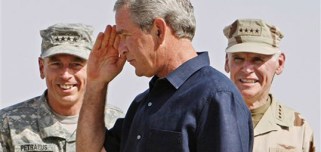
All in all, Mr. Bush’s actions have … been what you’d expect from a man whose plan is to keep up appearances for the next 16 months, never mind the cost in lives and money, then shift the blame for failure onto his successor.
In fact, that’s my interpretation of something that startled many people: Mr. Bush’s decision last month, after spending years denying that the Iraq war had anything in common with Vietnam, to suddenly embrace the parallel.
What all this means is that the next president, even as he or she tries to extricate us from Iraq — and prevent the country’s breakup from turning into a regional war — will have to deal with constant sniping from the people who lied us into an unnecessary war, then lost the war they started, but will never, ever, take responsibility for their failures.
200 SUBSCRIBERS ON YOUTUBE
Stories
WFAN debuts 'first' show without Don Imus
Stories Wednesday, September 5th 2007

Boomer Esiason, at left, and Craig Carton
Boomer Esiason and Craig Carton kicked off their morning show on radio station WFAN yesterday without anything close to a “boom,” which means “mission accomplished” for all concerned.
After the messy and awkward firing of longtime morning host Don Imus in April, WFAN and parent CBS clearly wanted a show more about football anecdotes than Larry Craig jokes.
But morning shows also need edge, and it’s way too early to tell how the new team will create the critical sense that, at any moment, something unexpected and riveting could happen.
Because Carton showed no sign yesterday of the “bad boy” reputation he got at 101.5 in New Jersey, Esiason never had to play the “good cop” many see as part of that dynamic.
Meanwhile, the fact that both guys are broadcast veterans ensured that yesterday’s debut didn’t sound like a “first” show. Carton handles the mechanics – going to breaks, taking calls – and since he has a quick tongue, he gets his full share of airtime. At times, he seemed to hold back to let Esiason finish a story.
Imus’ newsman, Charles McCord, has left the show, and WFAN, so Tracy Burgess did a shortened news break. But the best supporting player was sports guy Chris Carlin, whose good-natured exchange of barbs with Esiason recalled the liveliest parts of the Imus show.
The biggest question yesterday was content. Almost the whole show was devoted to football, which seemed odd on a day when the city had at least two major baseball stories in the return of Pedro Martinez and a possible injury to Roger Clemens.
A fluffy interview with New Orleans Saints quarterback Drew Brees, in that context, seemed marginal, and left the impression that WFAN wanted former football star Esiason to be able to stay in the pocket on his first day.
Presumably there will be plenty of time for him to scramble.
Compromise on Oil Law in Iraq Seems to Be Collapsing
StoriesBAGHDAD, Sept. 12 —
A carefully constructed compromise on a draft law governing Iraq’s
rich oil fields, agreed to in February after months of arduous talks
among Iraqi political groups, appears to have collapsed. The apparent
breakdown comes just as Congress and the White House are struggling to
find evidence that there is progress toward reconciliation and a
functioning government here.Senior Iraqi negotiators met in Baghdad on Wednesday in an attempt
to salvage the original compromise, two participants said. But the
meeting came against the backdrop of a public series of increasingly
strident disagreements over the draft law that had broken out in recent
days between Hussain al-Shahristani, the Iraqi oil minister, and
officials of the provincial government in the Kurdish north, where some
of the nation’s largest fields are located.Mr. Shahristani, a senior member of the Arab Shiite coalition that
controls the federal government, negotiated the compromise with leaders
of the Kurdish and Arab Sunni parties. But since then, the Kurds have
pressed forward with a regional version of the law that Mr. Shahristani
says is illegal. Many of the Sunnis who supported the original deal
have also pulled out in recent months.The oil law — which would govern how oil fields are developed
and managed — is one of several benchmarks that the Bush
administration has been pressing the Iraqis to meet as a sign that they
are making headway toward creating an effective government.Again and again in the past year, agreement on the law has been
fleetingly close before political and sectarian disagreements have
arisen to stall the deal.One of the participants in Wednesday’s meeting, Deputy Prime
Minister Barham Salih, who has worked for much of the past year to push
for the original compromise, said some progress had been made at the
meeting, but that he could not guarantee success.“This has been like a roller coaster,” said Mr. Salih,
who is Kurdish. “There were occasions where we seemed to be
there, where we seemed to have closure, only to fail at that.”“Given the seriousness of the issue, I don’t want to
create false expectations, but I can say there is serious effort to
bring this to closure,” he said.The legislation has already been presented to the Iraqi Parliament,
which has been unable to take virtually any action on it for months.
Contributing to the dispute is the decision by the Kurds to begin
signing contracts with international oil companies before the federal
law is passed. The most recent instance, announced last week on a
Kurdish government Web site, was an oil exploration contract with the
Hunt Oil Company of Dallas.The Sunni Arabs who removed their support for the deal did so, in
part, because of a contract the Kurdish government signed earlier with
a company based in the United Arab Emirates, Dana Gas, to develop gas
reserves.The Kurds say their regional law is consistent with the Iraqi
Constitution, which grants substantial powers to the provinces to
govern their own affairs. But Mr. Shahristani believes that a sort of
Kurdish declaration of independence can be read into the move.
“This to us indicates very serious lack of cooperation that makes
many people wonder if they are really going to be working within the
framework of the federal law,” Mr. Shahristani said in a recent
interview, before the Hunt deal was announced.Kurdish officials dispute that contention, saying that they are
doing their best to work within the Constitution while waiting for the
Iraqi Parliament, which always seems to move at a glacial pace, to
consider the legislation.“We reject what some parties say — that it is a step
towards separation — because we have drafted the Kurdistan oil
law depending on Article 111 of the Iraqi Constitution, which says oil
and natural resources are properties of Iraqi people,” said Jamal
Abdullah, a spokesman for the Kurdistan Regional Government.
“Both Iraqi and Kurdish oil laws depend on that article,”
Mr. Abdullah said.The other crucial players are the Sunnis and Prime Minister Nuri Kamal al-Maliki.
Some members of one of the main Sunni parties, Tawafiq, which insists
on federal control of contracts and exclusive state ownership of the
fields, bolted when it became convinced that the Kurds had no intention
of following those guidelines.But the prime minister’s office believes there is a simpler
reason the Sunnis abandoned or at least held off on the deal: signing
it would have given Mr. Maliki a political success that they did not
want him to have. “I think there is a political reason behind
that delay in order not to see the Iraqi government achieve the real
agreement,” said Sadiq al-Rikabi, a political adviser to Mr.
Maliki. Mr. Rikabi was at Wednesday’s meeting.Ali Baban, who as a senior member of Tawafiq negotiated the
compromise, said that allegation was untrue. “I have a good
relationship” with Mr. Maliki, he said. “This is an issue
of Iraqi unity. This could cause a split in this country.”Mr. Maliki has suggested returning to the original language agreed
to in February and trying once again to push the law through
Parliament. Mr. Salih says there is basic agreement on returning to
that language, but conceded that Sunni participants in
Wednesday’s meeting might insist on a deal that includes changes
to the Iraqi Constitution to safeguard their interests in the
distribution of revenues. A law on how the revenue should be shared is
being developed as a critical companion piece of legislation to the
draft law.The central element of the compromise was agreed to in February
after months of difficult negotiations among Iraq’s political
groups.The main parties in those negotiations were Iraqi Kurds, who were
eager to sign contracts with international oil companies to develop
their northern fields; Arab Shiites, whose population is concentrated
around the country’s southern fields; and Arab Sunnis, with fewer
oil resources where they predominate.Those facts meant that the compromise law had to satisfy both the
Sunni insistence that the central government maintain strong control
over the fields as well as the push by the Kurds and Shiites to give
provincial governments substantial authority to write contracts and
carry out their own development plans.Somehow negotiators managed to strike that balance, but soon after,
the agreement began to crumble. Many of the negotiations centered on a
federal committee that would be set up to review the contracts signed
with oil companies to carry out the development and exploitation of the
fields. The Kurds objected to any requirement that the committee would
have to approve contracts. So in a nuanced bit of language, the
negotiators gave the committee the power only to reject contracts that
did not meet precisely specified criteria.But problems immediately cropped up after the cabinet approved the
draft law and, in what seemed to be a perfunctory step, it went to a
council that was supposed to hone the language to be sure it complied
with Iraqi legal conventions.When the draft emerged from that council, the members of some
parties, particularly the Kurdish ones, thought that the careful
balance struck in the draft had been upset, and they accused Mr.
Shahristani of meddling. Then the law languished in Parliament and,
said Hoshyar Zebari, the Iraqi foreign minister, the Kurds decided to
send a signal that they would not wait indefinitely and signed the
contract with Dana Gas.“It served as a reminder: ‘If you keep stalling, life goes on,’ ” said Mr. Zebari, who is Kurdish.
On Monday the Kurdistan Regional Government, or K.R.G., issued
another rejoinder to the oil minister’s views that the
Kurds’ moves were illegal. “His views are irrelevant to
what the K.R.G. is doing legally and constitutionally in
Kurdistan,” the regional government said.Mr. Shahristani was apparently traveling and did not respond to
e-mail messages sent Wednesday. But Saleem Abdullah al-Juburi, a
Tawafiq member who participated in Wednesday’s meeting, gave his
own assessment of the Kurdish agreements with Hunt and Dana Gas.
“The contracts are not legal,” he said.Reporting was
contributed by Ahmad Fadam, Ali Hamdani and Khalid al-Ansary from
Baghdad, and an Iraqi employee of The New York Times from northern Iraq.
Powered by ScribeFire.
EVEN KEITH OLBERMANN CAN'T "LEAVE BRITNEY ALONE"
Stories
CHRIS CROCKER: GOTCHA AMERICA LOVES TO MAKE FUN OF BRITNEY SPEARS


 The New York Herald Sun