Stories
Republicans Storming the Airwaves to Promote Message of Doom
Stories
Are We Stimulated Yet?
There is a Santa Claus! NPR is in the gifting mode, handing out airtime to yackers from the Grand Old Party (Republicans that is) – and a reader of this blog, “Grumpy Demo” from Dallas, was so kind as to do a bit of analysis of NPR’s big tilt toward Republican talking heads in it’s economic coverage of late. Here’s what Grumpy sent me:
In Reporting On White House Economic Stimulus Package, NPR Interviews Six GOP Congressmen For Every Democrat.
Based on NPR’s own data, NPR demonstrated a preference for Republican members of Congress in its reporting on President Obama’s Economic Stimulus Package. A review of NPR’s “Morning Edition” and “All Things Considered” broadcast records for the month ending February 3, 2008 indicates in the 50 stories on the stimulus, NPR interviewed and quoted 12 GOP Congresspersons, while only quoting 2 Democrats. Numerous polls show that a majority of Americas support the White House’s stimulus package.
When viewed in context – that NPR’s sole Washington news analyst is FOX News’ employee and O’Reilly Factor guest host, Juan Williams, combined with numerous interviews with Heritage Foundation, Cato Institute, American Enterprise Institute, and National Review pundits, with no members of the progressive movement given equal time – NPR demonstrates a clear and unambiguous conservative bias in its reporting. Additionally, during this same period no White House spokesperson was interviewed or quoted by NPR.
Search Data listed below:Month Ending February 3,2008Total Stories: 50Congressmen Interviewed, Quoted: 14GOP Congressmen: 12Democratic Congressmen: 2White House Spokesmen: 0
Morning Edition
- 01/07/09 Oakley D-WI
- 01/19/09 Gingrich D-GAx
- 01/22/09 Roehmer R-TN
- 01/25/09 Cantor R-VA
- 01/20/09 Pence R-I
All Things Considered
- 01/06/09 Hoyer D-MD
- 01/15/09 Cantor R-VA
- 01/20/09 Pence R-IN
- 01/26/09 Grassley R-IW
- 01/27/09 Camp R-MI,Simpson R-ID01/29/09 Gerlach R-PA,Davis RNC,Camp R-MI
Search Links:
- http://www.npr.org/search.php?text=congressman+economic+stimulus&sort=DREDATE%3Anumberdecreasing&aggId=0&prgId=3&topicId=0&how_long_ago=30
- http://www.npr.org/search.php?text=senate+economic+stimulus&sort=DREDATE%3Anumberdecreasing&aggId=0&prgId=3&topicId=0&how_long_ago=30
- http://www.npr.org/search.php?text=congressman+economic+stimulus&sort=DREDATE%3Anumberdecreasing&aggId=0&prgId=2&topicId=0&how_long_ago=30
- http://www.npr.org/search.php?sort=DREDATE:numberdecreasing&start=20&topicId=0&prgId=2&how_long_ago=30&matchany=false&aggId=0&stopwords=false&soundex=false&text=senator economic stimulus


……………………………………………………………………………………………………………………………………………………………..
POLITICO
Rachel Maddow seemed pleasantly surprised when Republican Rep. Donald A. Manzullo turned up on her show last week to talk about his vote against the Democrats’ stimulus plan.
“I can’t tell you how many times a day Republicans say no to invitations to be on this show,” said the liberal MSNBC host. “So we’re very grateful to him for saying yes tonight.” Maddow may have to get used to the experience.
If she had been monitoring MSNBC last week, she would have noticed that more congressional Republicans than Democrats appeared on the network to discuss the stimulus — by a tally of 15-9.
In fact, more congressional Republicans than Democrats appeared on all of the major cable news networks — CNN, Fox News, Fox Business and CNBC — during three days last week surrounding the House vote on the stimulus plan. That’s according to a report by Think Progress, a project of the left-leaning Center for American Progress, which added up congressional TV hits related to the stimulus bill.
The study found that Fox News struck the most balance, with eight Republicans to six Democrats; on CNN, there were two Democrats to seven Republicans.
Now out of power, congressional Republicans are turning to the power of the press, it seems.
“I think this is one of the models that we’re going to use going forward,” said Michael Steel, press secretary for House Minority Leader John A. Boehner (R-Ohio). “Our votes generally don’t matter anymore, but our voices do. Our job is to win the argument, day in and day out.”
And the Republican message offensive didn’t go unnoticed on the other side of the aisle, either.
“What happened with cable last week is that Republican House members were the only show in town,” said a House Democratic leadership aide, who similarly acknowledged that there’s a daily “battle” getting the party’s message to viewers.
Of course, it’s not as if the networks are cutting out the Democrats. But with so much network attention being paid to the Obama administration — including roughly 40 minutes a day devoted to Robert Gibbs’ press briefing — it’s understandable that bookers would seek out House Republicans to provide a counterbalance, even if it means leaving House Democrats out in the process.
CNN political director Sam Feist said simply tallying up appearances of members of Congress only — and specifically when discussing the stimulus — doesn’t offer a complete picture of a network’s coverage, he said.
“As I have looked at what CNN has done the past couple weeks over the stimulus debate, I’ve found the balance is there,” Feist said, adding that it’s never going to be a “perfect balance, minute to minute.”
Doug Thornell, communications director for Democratic Congressional Campaign Committee Chairman Chris Van Hollen, said that while it’s important to make the rounds nationally via cable news, Democratic House members have been reaching out on a local level, too.
“Republicans are hoping to keep the debate in a national partisan box, disseminating their talking points and message through cable or conservative talk radio,” Thornell said.
“Van Hollen has been urging recently elected Democrats to aggressively make the case for the recovery package to their constituents who are hurting as well as to local media,” he said. “I think at the end of the day, it’s easier for Republicans to explain their opposition to an anchor on Fox News than to a worker in their district who just lost their job.”
But it’s not only Fox News, with cable’s most conservative stable of commentators, that Republicans have visited lately. While the rank and file beats the drum over media bias, some elected Republican leaders have hit up the oft-maligned networks among conservatives: MSNBC and CNN.
“You get left out of the story more because you weren’t effectively responding than [because of] any bias,” said Rep. Mike Pence of Indiana, who serves as chairman of the House Republican Conference.
Since becoming conference chairman, Pence — who has a background in television and radio — has beefed up the press shop with additional bookers and is in the process of adding a deputy press secretary to deal specifically with Hispanic media outlets.
Pence said that because the “Republican conference exists to promote Republican members,” he’s been closely watching the morning’s headlines and then having staff reach out to media outlets with those members who can speak authoritatively on specific subjects — subjects that include the stimulus, national security and trade. About 70 members are now in the rapid response groups, which Pence has dubbed “tiger teams.”
Ron Bonjean, a former top Republican spokesman for the House and Senate leadership, drew parallels to the early days of the Clinton administration, when “the Speaker’s Lobby was packed with reporters trying to get Republicans, to get the other side of story.”
Bonjean said that while in the minority, Republicans will have less responsibility in Congress, such as management meetings, thus freeing them up in greater numbers to speak with the press.
“I think that will be a standard template going forward,” Bonjean said, “as long as Obama keeps making news and dominating the media space.”
Chief Iraq War Cheerleader and D.C.'s Favorite Idiot Savant Plays Dress-Up in Afghanistan
Stories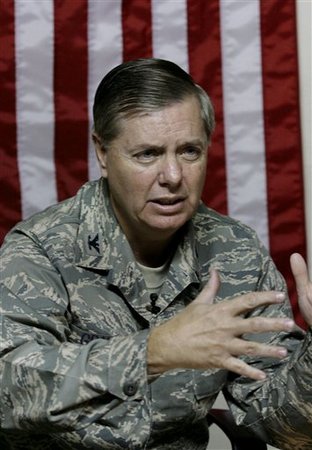
KABUL, Afghanistan (AP) – The men around Lindsey Graham ignored his powerful political title – U.S. senator – and their own douchechills -instead addressing him by rank – colonel.
Graham, a Republican from South Carolina and the only U.S. senator in the military’s Guard or Reserves, donned the Air Force’s camouflaged uniform for five days last week to serve in Kabul.
The senator enrolled in the ROTC in 1973 and has been in the Air Force Guard or Reserves as a military lawyer ever since. In Kabul, he worked with the staff of military lawyers at the U.S. base Camp Eggers. The office is helping to train military judges and defense lawyers, and to write Afghanistan’s uniform code of military justice.
Graham said his experiences in the military taught him how difficult wartime deployments can be on families.
“One thing I learned is that when a soldier, airman or a Marine is away, the more we can take care of the family, the better they’re going to be able to do their job because there’s nothing worse than being deployed and having family problems,” said Graham, a member of the Senate Armed Services Committee.
Graham said that when the military mobilized for the war in Iraq, about 20 percent of Guard and Reserve forces were medically disqualified. He said it wasn’t smart to have “20 percent of your force out of the fight without a shot being fired.” About 25 percent of the Guard and Reserves were uninsured.
In response, Graham worked with Sen. Hillary Clinton in 2005 to allow members of the Guard and Reserve to purchase health insurance for themselves and their families through TRICARE, the military’s health care system.
Seven years after the U.S. invaded Afghanistan to oust the Taliban for hosting al-Qaida chief Osama bin Laden, the United States has a record level of some 32,000 forces in the country, and American commanders have asked for 20,000 more. Violence has soared over the last two years.
Graham, who was in the capital from Sunday through Thursday, called the challenges in Afghanistan “enormous,” and said the U.S. “let some time get by” without enough focus on the country.
“It’s going to get tougher before it gets better. But we have a new strategy in place. Gen. (David) Petreaus understands how to win wars,” Graham said, referring to the chief of U.S. Central Command. “So I want the people of America to know we’re here to make our own national security better.”
The Taliban appears to be making gains in Afghanistan’s provinces, and more U.S. soldiers have died in Afghanistan in 2008 than in any year since the invasion, but Graham said history shows that the momentum in conflicts can turn quickly.
In 1987, Graham said, the Cold War between the Soviet Union and the U.S. was “vigorous.” By 1990, he pointed out, it was over.
“Momentum for evil or good can be powerful. Things can really deteriorate fast, but things can change and I’ve learned that in Iraq,” Graham said of the country, where violence has dropped quickly over the last year. Graham has also served time in Iraq in the Air Force Reserves.
The politician said his service in the military has made him a better senator.
“You don’t need to be in the military to be a good senator or president, but every experience you have helps you,” Graham said.
A Second Mortgage Meltdown
StoriesGood piece.
Vodpod videos no longer available.
more about "A Second Mortgage Meltdown", posted with vodpod
The Hold Steady Kick Some Rock and Roll Arse
StoriesCaptain America And Spiderman Blew Millions In Pro-Troop Propaganda Scam
Stories
EXCLUSIVE FROM W I R E D
By Noah ShachtmanWhile the Pentagon preps for a new administration, a scandal from an earlier era is rearing its head.
A Defense Department project, supposedly designed to support U.S. troops, was used instead to channel millions of dollars to personal friends and allies of its chief. The “America Supports You,” or ASY, program was led in a “questionable and unregulated manner,” according to a Department of Defense Inspector General report, obtained by Danger Room. At least $9.2 million was “inappropriately transferred” by the project’s managers. Much of that money served only to further promote ASY, instead of assisting servicemembers.

In 2004, the office of then-Secretary of Defense Donald Rumsfeld set up ASY as a six-month effort to showcase the U.S. public’s backing for the troops and their families. “If you’re serving overseas, and you watch the mainstream media coverage, sometimes you can’t tell if America knows you’re there,” one official overseeing the program says. America Supports You was seen as a way to counteract that sense.
In time, however, the program grew. Pro-troop rallies were organized. Special wristband and dog tags were made. Special-edition comic books were printed up. Processions were held on the National Mall, on the 9/11 anniversary. Sesame Street characters were enlisted to make DVDs that encouraged families with young children to talk about overseas deployments. America Supports You became a kind of umbrella group for all sorts of charity-related work for service members and military families.
Meanwhile, ASY began to spend millions — not to help the troops, the Inspector General says, but to help itself. “Instead of focusing on its primary mission of showcasing and communicating support to the troops and their families, the ASY program focus [turned to] building or soliciting support from the public,” the Inspector General’s report notes. In 2006 and 2007, for instance, more than $600,000 was spent ginning up support for America Supports You among schoolchildren. Another $165,000 went to a pro-ASY concert aboard the USS Intrepid, docked on Manhattan’s west side. And $15,000 went to actor and musician Gary Sinise’s “Lt. Dan Band” to play a separate show. The report calls all of these “questionable and unregulated actions.”
By mid-2007, allegations began to surface that the Pentagon official in charge of the program, Armed Forces Information Service chief Alison Barber (pictured, left), was improperly redirecting millions of dollars in public funds.
From fiscal years 2004 to 2007, the Inspector General’s report notes, Barber funneled $8.8 million in contracts to the public relations firm Susan Davis International — to set up the myriad events, and to promote the ASY “brand.” The work was incredibly lucrative; Davis’ executives made as much as $312,821 to $662,691 per year. “Paying a public relations contractor annual salaries approaching three-quarters of a million dollars does not appear to be a cost-effective means to support the ASY program and the war fighter,” the report observes.
But what made it even harder to stomach was that Davis was a friend of Barber’s, and a well-known Republican operative, according to former Defense Department lawyer Diane Beaver. Another half-million went to media consultant Mitch Semel, for web work.
Worse still, in the eyes of many, was that Barber used the Stars & Stripes newspaper as a kind of money-laundering service, to pay Davis and Semel. The paper is partially financed by the Pentagon, and was part of Barber’s American Forces Information Service. But Stripes has a decades-long tradition of fierce independence. Editors were galled to discover that Barber’s office was pouring money into the paper’s coffers — and then paying Davis and Semel out of accounts with less congressional oversight and fewer spending restrictions than typical Defense Department funds.
“Readers need to know that the newspaper they trust to provide them independent, accurate, credible news is not in any way operating in a compromised position,” managing editor Doug Clawson said. “If, in fact, Stripes was helping handle public relations work on behalf of a political appointee it doesn’t look good, and could taint the editorial department, and thereby the readers’ perceptions of this newspaper’s mission.”
The Department of Defense’s Inspector General had already launched investigations into financial wrongdoing and organizational mismanagement at America Supports You, the Armed Forces Information Service, and the Defense’ Secretary’s public affairs office. In October 2007, the Inspector General widened its review to include Stars & Stripes.
Barber is no longer at the Pentagon. Two months ago, she abruptly resigned as the heads of both American Supports You and of Defense Media Activity, the new organization that oversees Stars & Stripes. America Supports You has been moved under the Defense Department’s community relations office. “A lot of the big issues have been addressed — how we do contracting, how we use appropriated funds,” one member of that office tells Danger Room. “We’re back in the comfort zone, running a program in the way that the government is used to running it.”
The Man Who Blew The Whistle on Illegal Wiretapping
Stories Issue dated Dec 22, 2008
Thomas M. Tamm was entrusted with some of the government’s most important secrets. He had a Sensitive Compartmented Information security clearance, a level above Top Secret. Government agents had probed Tamm’s background, his friends and associates, and determined him trustworthy.
It’s easy to see why: he comes from a family of high-ranking FBI officials. During his childhood, he played under the desk of J. Edgar Hoover, and as an adult, he enjoyed a long and successful career as a prosecutor. Now gray-haired, 56 and fighting a paunch, Tamm prides himself on his personal rectitude. He has what his 23-year-old son, Terry, calls a “passion for justice.” For that reason, there was one secret he says he felt duty-bound to reveal.
In the spring of 2004, Tamm had just finished a yearlong stint at a Justice Department unit handling wiretaps of suspected terrorists and spies—a unit so sensitive that employees are required to put their hands through a biometric scanner to check their fingerprints upon entering. While there, Tamm stumbled upon the existence of a highly classified National Security Agency program that seemed to be eavesdropping on U.S. citizens. The unit had special rules that appeared to be hiding the NSA activities from a panel of federal judges who are required to approve such surveillance. When Tamm started asking questions, his supervisors told him to drop the subject. He says one volunteered that “the program” (as it was commonly called within the office) was “probably illegal.”
Tamm agonized over what to do. He tried to raise the issue with a former colleague working for the Senate Judiciary Committee. But the friend, wary of discussing what sounded like government secrets, shut down their conversation. For weeks, Tamm couldn’t sleep. The idea of lawlessness at the Justice Department angered him. Finally, one day during his lunch hour, Tamm ducked into a subway station near the U.S. District Courthouse on Pennsylvania Avenue. He headed for a pair of adjoining pay phones partially concealed by large, illuminated Metro maps. Tamm had been eyeing the phone booths on his way to work in the morning. Now, as he slipped through the parade of midday subway riders, his heart was pounding, his body trembling. Tamm felt like a spy. After looking around to make sure nobody was watching, he picked up a phone and called The New York Times.
That one call began a series of events that would engulf Washington—and upend Tamm’s life. Eighteen months after he first disclosed what he knew, the Times reported that President George W. Bush had secretly authorized the NSA to intercept phone calls and e-mails of individuals inside the United States without judicial warrants. The drama followed a quiet, separate rebellion within the highest ranks of the Justice Department concerning the same program. (James Comey, then the deputy attorney general, together with FBI head Robert Mueller and several other senior Justice officials, threatened to resign.) President Bush condemned the leak to the Times as a “shameful act.” Federal agents launched a criminal investigation to determine the identity of the culprit.
The story of Tamm’s phone call is an untold chapter in the history of the secret wars inside the Bush administration. The New York Times won a Pulitzer Prize for its story. The two reporters who worked on it each published books. Congress, after extensive debate, last summer passed a major new law to govern the way such surveillance is conducted. But Tamm—who was not the Times’s only source, but played the key role in tipping off the paper—has not fared so well. The FBI has pursued him relentlessly for the past two and a half years. Agents have raided his house, hauled away personal possessions and grilled his wife, a teenage daughter and a grown son. More recently, they’ve been questioning Tamm’s friends and associates about nearly every aspect of his life. Tamm has resisted pressure to plead to a felony for divulging classified information. But he is living under a pall, never sure if or when federal agents might arrest him.
Exhausted by the uncertainty clouding his life, Tamm now is telling his story publicly for the first time. “I thought this [secret program] was something the other branches of the government—and the public—ought to know about. So they could decide: do they want this massive spying program to be taking place?” Tamm told NEWSWEEK, in one of a series of recent interviews that he granted against the advice of his lawyers. “If somebody were to say, who am I to do that? I would say, ‘I had taken an oath to uphold the Constitution.’ It’s stunning that somebody higher up the chain of command didn’t speak up.”
Let's Stay Out Tonight
StoriesDavid Bowie – Rebel Rebel
Let’s stay out tonight….
The Dead
The Boys Are Back In Town!
Iraq Man Who Threw Shoes at George W. Bush Beaten in Jail
Stories
Shoe thrower ‘beaten in custody’
The brother of the Iraqi journalist who threw his shoes at US President George W Bush has said that the reporter has been beaten in custody.
Muntadar al-Zaidi has suffered a broken hand, broken ribs and internal bleeding, as well as an eye injury, his older brother, Dargham, told the BBC.
Mr Zaidi threw his shoes at Mr Bush at a news conference, calling him “a dog”.
The head of Iraq’s journalists’ union told the BBC that officials told him Mr Zaidi was being treated well.
The union head, Mouyyad al-Lami, said he hoped to visit his colleague later.
An Iraqi official said Mr Zaidi had been handed over to the judicial authorities, according to the AFP news agency.
Earlier, Dargham al-Zaidi told the BBC’s Caroline Wyatt in Baghdad he believed his brother had been taken to a US military hospital in the Iraqi capital.
A second day of rallies in support of Mr Zaidi have been held across Iraq, calling for his release.
Meanwhile, offers to buy the shoes are being made around the Arab world, reports say.
Hero figure
Mr Zaidi told our correspondent that despite offers from many lawyers his brother has not been given access to a legal representative since being arrested by forces under the command of Mowaffaq al-Rubaie, Iraq’s national security adviser.
The Iraqi authorities have said the 28-year-old will be prosecuted under Iraqi law, although it is not yet clear what the charges might be. Iraqi lawyers have speculated that he could face charges of insulting a foreign leader and the Iraqi Prime Minister, Nouri Maliki, who was standing next to President Bush during the incident. The offence carries a maximum penalty of two years in jail.
Our correspondent says that the previously little-known journalist from the private Cairo-based al-Baghdadia TV has become a hero to many, not just in Iraq but across the Arab world, for what many saw as a fitting send-off for a deeply unpopular US president.
As he flung the shoes, Mr Zaidi shouted: “This is a goodbye kiss from the Iraqi people, dog.”
Dargham al-Zaidi told the BBC that his brother deliberately bought Iraqi-made shoes, which were dark brown with laces. They were bought from a shop on al-Khyam street, a well-known shopping street in central Baghdad.
However, not everyone in Iraq has been supportive of the journalist’s action.
Speaking earlier in Baghdad, Mouyyad al-Lami described Mr Zaidi’s action as “strange and unprofessional”, but urged Mr Maliki to show compassion.
“Even if he has made a mistake, the government and the judiciary are broad-minded and we hope they consider his release because he has a family and he is still young,” he told the Associated Press news agency.
“We hope this case ends before going to court.”
Abducted by insurgents
The shoes themselves are said to have attracted bids from around the Arab world.
According to unconfirmed newspaper reports, the former coach of the Iraqi national football team, Adnan Hamad, has offered $100,000 (£65,000) for the shoes, while a Saudi citizen has apparently offered $10m (£6.5m).
The daughter of Libyan leader Muammar Gaddafi, Aicha, said her charity would honour the reporter with a medal of courage, saying his action was a “victory for human rights”. The charity called on the media to support Mr Zaidi and put pressure on the Iraqi government to free him.
Mr Zaidi, who lives in Baghdad, has worked for al-Baghdadia for three years.
Muzhir al-Khafaji, programming director for the channel, described him as a “proud Arab and an open-minded man”.
He said that Mr Zaidi was a graduate of communications from Baghdad University.
“He has no ties with the former regime. His family was arrested under Saddam’s regime,” he said.
Mr Zaidi has previously been abducted by insurgents and held twice for questioning by US forces in Iraq.
In November 2007 he was kidnapped by a gang on his way to work in central Baghdad and released three days later without a ransom.
He said at the time that the kidnappers had beaten him until he lost consciousness, and used his necktie to blindfold him.
Mr Zaidi never learned the identity of his kidnappers, who questioned him about his work before letting him go.
 The New York Herald Sun