The Official Failures of Rebuilding Iraq
Bechtel, Blackwater, CACI, Commission on Wartime Contracting, Congress, Dick Cheney, DOD, Erik Prince, George W. Bush, Halliburton, Irag, Iraqi Infrastructure, KBR, Lobbyists, Pentagon, Senate, Stuart Bowen Jr., WaterSunday, December 14, 2008
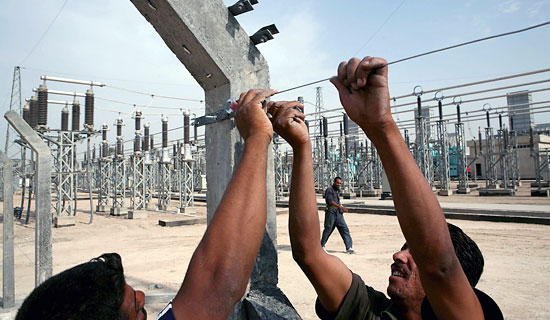
BAGHDAD: An unpublished, 513-page federal history of the U.S.-led reconstruction of Iraq depicts an effort crippled before the invasion by Pentagon planners who were hostile to the idea of rebuilding a foreign country, and then molded into a $100 billion failure by bureaucratic turf wars, spiraling violence and ignorance of the basic elements of Iraqi society and infrastructure.
“Hard Lessons: The Iraq Reconstruction Experience,” the first official account of its kind, is circulating in draft form here and in Washington among a tight circle of technical reviewers, policy experts and senior officials. It also concludes that when the reconstruction began to lag – particularly in the critical area of rebuilding the Iraqi police and army – the Pentagon simply put out inflated measures of progress to cover up the failures.
In one passage, for example, former Secretary of State Colin Powell is quoted as saying that in the months after the 2003 invasion, the Defense Department “kept inventing numbers of Iraqi security forces – the number would jump 20,000 a week! ‘We now have 80,000, we now have 100,000, we now have 120,000.”‘
Powell’s assertion that the Pentagon inflated the number of competent Iraqi security forces is backed up by Lieutenant General Ricardo Sanchez, the former commander of ground troops in Iraq, and L. Paul Bremer 3rd, the top civilian administrator until an Iraqi government took over in June 2004.
Among the overarching conclusions of the history is that five years after embarking on its largest foreign reconstruction project since the Marshall Plan in Europe after World War II, the U.S. government has in place neither the policies and technical capacity nor the organizational structure that would be needed to undertake such a program on anything approaching this scale.
The bitterest message of all for the reconstruction program may be the way the history ends. The hard figures on basic services and industrial production compiled for the report reveal that for all the money spent and promises made, the rebuilding effort never did much more than restore what was destroyed during the invasion and the convulsive looting that followed.
By mid-2008, the history says, $117 billion had been spent on the reconstruction of Iraq, including some $50 billion in U.S. taxpayer money.
The history contains a catalog of new revelations that show the chaotic and often poisonous atmosphere prevailing in the reconstruction effort.
When the Office of Management and Budget balked at the U.S. occupation authority’s abrupt request for about $20 billion in new reconstruction money in August 2003, a veteran Republican lobbyist working for the authority made a bluntly partisan appeal to Joshua Bolten, then the Office of Management and Budget director and now the White House chief of staff. “To delay getting our funds would be a political disaster for the President,” wrote the lobbyist, Tom Korologos. “His election will hang for a large part on show of progress in Iraq and without the funding this year, progress will grind to a halt.” With administration backing, Congress allocated the money later that year.
In an illustration of the hasty and haphazard planning, a civilian official at the U.S. Agency for International Development was at one point given four hours to determine how many miles of Iraqi roads would need to be reopened and repaired. The official searched through the agency’s reference library, and his estimate went directly into a master plan. Whatever the quality of the agency’s plan, it eventually began running what amounted to a parallel reconstruction effort in the provinces that had little relation with the rest of the U.S. effort.
Money for many of the local construction projects still under way is divided up by a spoils system controlled by neighborhood politicians and tribal chiefs. “Our district council chairman has become the Tony Soprano of Rasheed, in terms of controlling resources,” said a U.S. Embassy official working in a dangerous Baghdad neighborhood, referring to the popular TV mob boss. “‘You will use my contractor or the work will not get done.”‘
The United States could soon have reason to consult this cautionary tale of deception, waste and poor planning, as both troop levels and reconstruction efforts in Afghanistan are likely to be stepped up under the new administration.
The incoming Obama administration’s rebuilding experts are expected to focus on smaller-scale projects and emphasize political and economic reform. Still, such programs do not address one of the history’s main contentions: that the reconstruction effort has failed because no single agency in the U.S. government has responsibility for the job.
Five years after the invasion of Iraq, the history concludes, “the government as a whole has never developed a legislatively sanctioned doctrine or framework for planning, preparing and executing contingency operations in which diplomacy, development and military action all figure.”
“Hard Lessons” was compiled by the Office of the Special Inspector General for Iraq Reconstruction, led by Stuart Bowen Jr., a Republican lawyer who regularly travels to Iraq and has a staff of engineers and auditors based here. Copies of several drafts of the history were provided to reporters at The New York Times and ProPublica by two people outside the inspector general’s office who have read the draft but are not authorized to comment publicly.
Bowen’s deputy, Ginger Cruz, declined to comment for publication on the substance of the history. But she said it would be presented Feb. 2 at the first hearing of the Commission on Wartime Contracting, which was created this year as a result of legislation sponsored by Senators Jim Webb of Virginia and Claire McCaskill of Missouri, both Democrats.
The manuscript is based on about 500 new interviews, as well as more than 600 audits, inspections and investigations on which Bowen’s office has reported individually over the years. Laid out for the first time in a connected history, the material forms the basis for broad judgments on the entire rebuilding program.
In the preface, Bowen gives a searing critique of what he calls the “blinkered and disjointed prewar planning for Iraq’s reconstruction” and the botched expansion of the program from a modest initiative to improve Iraqi services to a multibillion-dollar enterprise.
Bowen also swipes at the endless revisions and reversals of the program, which at various times gyrated from a focus on giant construction projects led by large Western contractors to modest community-based initiatives carried out by local Iraqis. While Bowen concedes that deteriorating security had a hand in spoiling the program’s hopes, he suggests, as he has in the past, that the program did not need much outside help to do itself in.
Despite years of studying the program, Bowen writes that he still has not found a good answer to the question of why the program was even pursued as soaring violence made it untenable. “Others will have to provide that answer,” Bowen writes.
“But beyond the security issue stands another compelling and unavoidable answer: The U.S. government was not adequately prepared to carry out the reconstruction mission it took on in mid-2003,” he concludes.
The history cites some projects as successes. The review praises community outreach efforts by the Agency for International Development, the Treasury Department’s plan to stabilize the Iraqi dinar after the invasion and a joint effort by the Departments of State and Defense to create local rebuilding teams.
But the portrait that emerges overall is one of a program’s officials operating by the seat of their pants in the middle of a critical enterprise abroad, where the reconstruction was supposed to convince the Iraqi citizenry of U.S. good will and support the new democracy with lights that turned on and taps that flowed with clean water. Mostly, it is a portrait of a program that seemed to grow exponentially as even those involved from the inception of the effort watched in surprise.
On the eve of the invasion, as it began to dawn on a few U.S. officials that the price for rebuilding Iraq would be vastly greater than they had been told, the degree of miscalculation was illustrated in an encounter between Donald Rumsfeld, then the defense secretary, and Jay Garner, the retired lieutenant general who had hastily been named the chief of what would be a short-lived civilian authority called the Office of Reconstruction and Humanitarian Assistance.
The history records how Garner presented Rumsfeld with several alternative rebuilding plans, including one that would include projects across Iraq.
“What do you think that’ll cost?” Rumsfeld asked of the more expansive plan.
“I think it’s going to cost billions of dollars,” Garner said.
“My friend,” Rumsfeld replied, “if you think we’re going to spend a billion dollars of our money over there, you are sadly mistaken.”
In a way he never anticipated, Rumsfeld turned out to be correct: Before that year was out, the United States had appropriated more than $20 billion for the reconstruction, which would indeed involve projects across the entire country.
Rumsfeld declined comment on the report, but a spokesman, Keith Urbahn, said quotes attributed to him in the document “appear to be accurate.” Powell also declined to comment.
The secondary effects of the invasion and its aftermath were among the most important factors that radically changed the outlook. Tables in the history show that measures of things like the production of electricity and oil; public access to potable water, mobile and landline telephone service; and the presence of Iraqi security forces all plummeted at least 70 percent, and in some cases all the way to zero, in the weeks after the invasion. Subsequent tables in the history give a fast-forward view of what happened as the avalanche of money tumbled into Iraq over the next five years. By the time a sovereign Iraqi government took over from the Americans in June 2004, none of those services – with a single exception, mobile phones – had returned to prewar levels. And by the time of the security improvements in 2007 and 2008, electricity output had, at best, a precarious 10 percent lead on its levels under Saddam Hussein; oil production was still below prewar levels; and access to potable water had increased about 30 percent, although with the nation’s ruined piping system it was unclear how much actually reached people’s homes uncontaminated.
Whether the rebuilding effort could have succeeded in a less violent setting will never be known. In April 2004, thousands of the Iraqi security forces that had been oversold by the Pentagon were overrun, abruptly mutinied or simply abandoned their posts as the insurgency broke out, sending Iraq down a violent path from which it has never completely recovered.
At the end of his narrative, Bowen chooses a line from “Great Expectations” by Charles Dickens as the epitaph of the U.S.-led attempt to rebuild Iraq: “We spent as much money as we could, and got as little for it as people could make up their minds to give us.”
James Glanz reported from Baghdad, and T. Christian Miller, of the nonprofit investigative Web site ProPublica, reported from Washington.
Small Banks Getting Short End of Tarp Bat
Banking, Bernanke, Federal Reserve, Finance, Greenspan, Paulson, TARP, Treasury, Wall StreetSEEKING ALPHA
William Patalon III
Bank of American Corp. (BAC), which is getting $15 billion from the U.S. government as part of the Treasury Department’s $250 billion “recapitalization” effort, is doubling its stake in state-owned China Construction Bank Corp., and will hold a 20% stake worth $24 billion in China’s second-largest lender when that deal is finalized.
PNC Financial Services Group Inc. (PNC), which will get $7.7 billion from Treasury’s Troubled Assets Relief Program (TARP), is using that cash infusion to help finance its $5.2 billion buyout of embattled National City Corp. (NCC).
And U.S. Bancorp (USB), which received a $6.6 billion capital infusion from that same rescue package, has acquired two California lenders – Downey Savings & Loan Association, F.A., a subsidiary of Downey Financial Corp. (DSL), and PFF Bank & Trust, a subsidiary of PFF Bancorp Inc. (OTC: PFFB). U.S. Bank agreed to assume the first $1.6 billion in losses from the two, but says anything beyond that amount is subject to a loss-sharing deal it struck with the Federal Deposit Insurance Corp. (FDIC).

While the Treasury Department’s investment of more than $250 billion in U.S. financial institutions has been billed as a strategy that will bolster the health of the banking system and also jump-start lending, buyout deals such as these three show that the recapitalization plan has actually had a much different result – one that’s left whipsawed U.S. investors and lawmakers alike feeling burned, an ongoing Money Morning investigation continues to show.
Those billions have touched off a banking-sector version of “Let’s Make a Deal,” in which the biggest U.S. banks are using government money to get even bigger. While that’s admittedly removing the smaller, weaker banks from the market – a possible benefit to consumers and taxpayers alike – this trend is also having a detrimental effect: It’s reducing the competition that’s benefited consumers and kept the explosion in banking fees from being far worse than it already is.
This all happens without any of the economic benefits that an actual increase in lending would have had. And it does nothing to address the billions worth of illiquid securities that remain on (or off) banks’ balance sheets – as the recent Citigroup Inc. (C) imbroglio demonstrates.
In fact, Treasury’s TARP program has even managed to create a potentially illegal tax loophole that grants banks a tax-break windfall of as much as $140 billion. Lawmakers are furious – but possibly powerless, afraid that a full-scale assault on the tax change could cause already-done deals to unravel, in turn causing investor confidence to do the same.
One could even argue that since this first bailout (the $700 billion TARP initiative) has fueled takeovers – and not lending – the government had no choice but to roll out the more-recent $800 billion stimulus plan that was aimed at helping consumers and small businesses – a move that may spur lending and spending, but that still adds more debt to the already-sagging federal government balance sheet.
At the end of the day, these buyout deals are bad ones no matter how you evaluate them, says R. Shah Gilani, a retired hedge fund manager and expert on the U.S. credit crisis who is the editor of the Trigger Event Strategist, which identifies trading opportunities emanating from such financial-crisis “aftershocks” as this buyout binge.
“Why in the name of capitalism are taxpayers being fleeced by banks that are being given our money to grow their businesses with the further backstop of more of our money having to be thrown to the FDIC when they fail?” Gilani asked. “Consolidation does not mean that bad loans and illiquid securities are somehow merged out of existence. It means that they are being acquired under the premise that a larger, more consolidated depositor base will better be able to bear the weight of those bad assets. What in heaven’s name prevents depositors from exiting when the merged banks continue to experience massive losses and write-downs? The answer to that question would be … nothing.”
Lining Up for Deal Money
In launching TARP, U.S. Treasury Secretary Henry M. “Hank” Paulson Jr. said the government’s goal was to restore public confidence in the U.S. financial services sector – especially banks – so private investors would be willing to advance money to banks and banks, in turn, would be willing to lend.
“Our purpose is to increase the confidence of our banks, so that they will deploy, not hoard, the capital,” Paulson said.
Whatever Treasury’s actual intent, the reality is that banks are already sniffing out buyout targets, while snuffing out lending – and the TARP money is the reason for both.
Fueled by this taxpayer-supplied capital, the wave of consolidation deals is “absolutely” going to accelerate, says Louis Basenese, a mergers-and-acquisitions expert who is also the editor of The Takeover Trader newsletter. “When it comes to M&A, there’s always a pronounced ‘domino effect.’ Consolidation breeds more consolidation as industry leaders conclude they have to keep acquiring in order to remain competitive.”
Indeed, banking executives have been quite open about their expansionist plans during media interviews, or during conference calls related to quarterly earnings.
Take BB&T Corp. (BBT). During a conference call that dealt with the bank’s third-quarter results, Chief Executive Officer John A. Allison IV said the Winston-Salem, N.C.-based bank “will probably participate” in the government program. Allison didn’t say whether the federal money would induce BB&T to boost its lending. But he did say the bank would likely accept the money in order to finance its expansion plans, The Wall Street Journal said.
“We think that there are going to be some acquisition opportunities – either now or in the near future – and this is a relatively inexpensive way to raise capital [to pay the buyout bill],” Allison said during the conference call.
And BB&T is hardly alone. Zions Bancorporation (ZION), a Salt Lake City-based bank that’s been squeezed by some bad real-estate loans, recently said it would be getting $1.4 billion in federal money. CEO Harris H. Simmons said the infusion would enable Zions to boost “prudent” lending and keep paying its dividend – albeit at a reduced rate.
Sounds good, right? Not so fast. During a conference call about earnings, Zions Chief Financial Officer Doyle L. Arnold said any lending increase wouldn’t be dramatic. Besides, Arnold said, Zions will also use the money “to take advantage of what we would expect will be some acquisition opportunities, including some very low risk FDIC-assisted transactions in the next several quarters.”
Buyouts Already Accelerating
With all the liquidity the world’s governments and central banks have injected into the global financial system, the pace of worldwide deal making is already accelerating. Global deal volume for the year has already passed the $3 trillion level – only the fifth time that’s happened, although it took about three months longer for that to happen this year than it did a year ago.
At a time when the global financial crisis – and the accompanying drop-off in available deal capital (either equity or credit) – has caused about $150 billion in already-announced deals to be yanked off the table since Sept. 1, liquidity from the U.S. and U.K. governments has ignited record levels of financial-sector deal making.
According to Dealogic, government investments in financial institutions has reached $76 billion this year – eight times as much as in all of 2007, which was the previous record year. And that total doesn’t include the $250 billion in TARP money, or other deals that Paulson & Co. are helping engineer – JPMorgan Chase & Co.’s (JPM) buyouts of The Bear Stearns Cos. and Washington Mutual Inc. (WAMUQ), for instance.
If You Can’t Beat ‘em… Buy ‘em?
When it comes to identifying possible buyout targets, M&A experts such as Basenese say there are some very clear frontrunners.
“I’d put regional banks with solid footprints in the Southeast high on the list, and for two reasons,” Basenese said. “First, demographics point to stronger growth [in this region] as retirees migrate to warmer climates – and bring their assets along for the trip. Plus, the Southeast is largely un-penetrated by large national banks. An acquisition of a regional bank like SunTrust Banks Inc. (STI) would provide a distinct competitive advantage.
There’s a very good reason that smaller players may be next: Big banks and small banks have the easiest times – relatively speaking, of course – of raising capital. It’s toughest for the regional players. Big banks can tap into the global financial markets for cash, while the very small – and typically, highly local – banks can raise money from local investors.
The afore-mentioned stealthy shift in the U.S. Tax Code actually gives big U.S. banks a potential windfall of as much as $140 billion, says Gilani, the credit crisis expert and Trigger Event Strategist editor. What does this tax-change do? By acquiring a failed bank whose only real value is the losses on its books, the successful suitor would basically then be able to use the acquired bank’s losses to offset its own gains and thus avoid paying taxes.
 “While everyone was panicking, the Treasury Department slipped through a ruling that allows banks who acquire other banks to fully write-off all the acquired bank’s bad debts,” Gilani says. “For 22 years, the law was such that if you were to buy a company that had losses, say, of $1 billion, you couldn’t just take that loss against your own $1 billion profit and tell Uncle Sam, ‘Gee, now my loss offsets my profit, so I don’t have any profit, and I don’t owe you any tax.’ It was a recipe for tax evasion that demanded an appropriate law that only allows limited write-offs over an extended period of years.”
Given these incentives, who will be doing the buying? Clearly, the biggest U.S.-based banks will be the main hunters. But The Takeover Trader’s Basenese says that even foreign banks will be on the prowl for cheap U.S. banking assets.
Basenese also believes that Goldman Sachs Group Inc. (GS) and Morgan Stanley (MS) will be “big spenders.” Each will use TARP funds to help accelerate its transformation from an investment bank into a bank holding company. The changeover will require each company to build up a big base of deposits. And the best way to do that is to buy other banks, Basenese says.
“One thing [the wave of deals] does is to restore confidence in the sector,” Basenese said. “It will go a long way in convincing CEOs that it’s safe to use excess capital to fund acquisitions, and to grow, instead of using it to defend against a proverbial run on the bank.”
Not everyone agrees with that assessment. Investors who play the merger game correctly will do well. But the game itself won’t necessarily whip the industry into championship form, Gilani says.
“While consolidation, instead of outright collapses, in the banking industry may serve to relieve the FDIC of its burden to make good on failed banks, it in no way guarantees fewer failures,” he said. “In fact, it may only serve to guarantee, in some cases, even larger failures.”
The 17th Floor, Where Wealth Went to Vanish
Bankers, Banking and Finance, Bernie Madoff, Derivitives, Fraud, Hedge Funds, New York, Ponzi Scheme, Proprietary System, Wall Street
The 17th floor, where wealth went to vanish
Monday, December 15, 2008
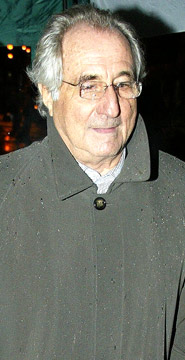
The epicenter of what may be the largest Ponzi scheme in history was the 17th floor of the Lipstick Building, an oval red-granite building rising 34 floors above Third Avenue in Midtown Manhattan.
A busy stock-trading operation occupied the 19th floor, and the computers and paperwork filled the 18th floor of Bernard L. Madoff Investment Securities.
But the 17th floor was Bernie Madoff’s sanctum, occupied by fewer than two dozen staff members and rarely visited by other employees. They called it the “hedge fund” floor, but U.S. prosecutors now say the work Madoff did there was actually a fraud scheme whose losses Madoff himself estimates at $50 billion.
The tally of reported losses climbed through the weekend to nearly $20 billion, with a giant Spanish bank, Banco Santander, reporting on Sunday that clients of one of its Swiss subsidiaries have lost $3 billion. Some of the biggest losers were members of the Palm Beach Country Club, where many of Madoff’s wealthy clients were recruited.
The list of prominent fraud victims grew as well. According to a person familiar with the business of the real estate and publishing magnate Mort Zuckerman, he is also on a list of victims that already included the owners of the New York Mets, a former owner of the Philadelphia Eagles and the chairman of GMAC.
And the 17th floor is now an occupied zone, as investigators and forensic auditors try to piece together what Madoff did with the billions entrusted to him by individuals, banks and hedge funds around the world.
So far, only Madoff, the firm’s 70-year-old founder, has been arrested in the scandal. He is free on a $10 million bond and cannot travel far outside the New York area.
But a question still dominates the investigation: How one person could have pulled off such a far-reaching, long-running fraud, carrying out all the simple practical chores the scheme required, like producing monthly statements, annual tax statements, trade confirmations and bank transfers.
Firms managing money on Madoff’s scale would typically have hundreds of people involved in these administrative tasks. Prosecutors say he claims to have acted entirely alone.
“Our task is to find the records and follow the money,” said Alexander Vasilescu, a lawyer in the New York office of the Securities and Exchange Commission. As of Sunday night, he said, investigators could not shed much light on the fraud or its scale. “We do not dispute his number we just have not calculated how he made it,” he said.
Scrutiny is also falling on the many banks and money managers who helped steer clients to Madoff and now say they are among his victims.
While many investors were friends or met Madoff at country clubs or on charitable boards, even more had entrusted their money to professional advisory firms that, in turn, handed it on to Madoff for a fee.
Investors are now questioning whether these paid advisers were diligent enough in investigating Madoff to ensure that their money was safe. Where those advisers work for big institutions like Banco Santander, investors will most likely look to them, rather than to the remnants of Madoff’s firm, for restitution.
Santander may face $3.1 billion in losses through its Optimal Investment Services, a Geneva-based fund of hedge funds that is owned by the bank. At the end of 2007, Optimal had 6 billion euros, or $8 billion, under management, according to the bank’s annual report which would mean that its Madoff investments were a substantial part of Optimal’s portfolio.
A spokesman for Santander declined to comment on the case.
Other Swiss institutions, including Banque Bénédict Hentsch and Neue Privat Bank, acknowledged being at risk, with Hentsch confirming about $48 million in exposure.
BNP Paribas said it had not invested directly in the Madoff funds but had 350 million euros, or about $500 million, at risk through trades and loans to hedge funds. And the private Swiss bank Reichmuth said it had 385 million Swiss francs, or $327 million, in potential losses. HSBC, one of the world’s largest banks, also said it had made loans to institutions that invested in Madoff but did not disclose the size of its potential losses.
Losses of this scale simply do not seem to fit into the intimate business that Madoff operated in New York.
With just over 200 employees, it was tight-knit and friendly, according to current and former employees. Madoff was gregarious and empathetic, known for visiting sick employees in their hospitals and hosting warmly generous staff parties.
By the elevated standards of Wall Street, the Madoff firm did not pay exceptionally well, but it was loyal to employees even in bad times. Madoff’s family filled the senior positions, but his was not the only family at the firm generations of employees had worked for Madoff.
Even before Madoff collapsed, some employees were mystified by the 17th floor. In recent regulatory filings, Madoff claimed to manage $17 billion for clients a number that would normally occupy a staff of at least 200 employees, far more than the 20 or so who worked on 17.
One Madoff employee said he and other workers assumed that Madoff must have a separate office elsewhere to oversee his client accounts.
Nevertheless, Madoff attracted and held the trust of companies that prided themselves on their diligent investigation of investment managers.
One of them was Walter Noel Jr., who struck up a business relationship with Madoff 20 years ago that helped earn his investment firm, the Fairfield Greenwich Group, millions of dollars in fees.
Indeed, over time, one Fairfield’s strongest selling points for its largest fund was its access to Madoff.
But now, Noel and Fairfield are the biggest known losers in the scandal, facing potential losses of $7.5 billion, more than half its assets.
Jeffrey Tucker, a Fairfield co-founder and former U.S. regulator, said in a statement posted on the firm’s Web site: “We have worked with Madoff for nearly 20 years, investing alongside our clients. We had no indication that we and many other firms and private investors were the victims of such a highly sophisticated, massive fraudulent scheme.”
The huge loss comes at a time when the hedge fund industry has already been wounded by the volatile markets. Several weeks ago, Fairfield had halted investor redemptions at two of its other funds, citing the tough market conditions as dozens of hedge funds have done. The firm reported a drop of $2 billion in assets between September and November.
Fairfield was founded in 1983 by Noel, the former head of international private banking at Chemical Bank, and Tucker, a former Securities and Exchange Commission official. It grew dramatically over the years, attracting investors in Europe, Latin America and Asia.
Noel first met Madoff in the 1980s, and Fairfield’s fortunes grew along with the returns Madoff reported. The two men were very different: Madoff hailed from eastern Queens and was tied closely to the Jewish community, while Noel, a native of Tennessee, moved in the Greenwich social scene with his wife, Monica.
“Walter was always really confident in Bernie and the strategy he employed,” said one hedge fund manager who declined to be named because for fear of jeopardizing his relationship with Noel.
“He was a person of superb ethics, and this has to cut him to the quick,” said George Ball, a former executive at E. F. Hutton and Prudential-Bache Securities who knows Noel.
Fairfield touted its investigative skills. On its Web site, the firm claimed to investigate hedge fund managers for six to 12 months before investing. As part of the process, a team of examiners conducted personal background checks, audited brokerage records and trading reports and interviewed hedge fund executives and compliance officials.
In 2001, Madoff called Fairfield and invited the firm to inspect his books after two news reports questioned the validity of his returns, according to a person close to Fairfield. Outside auditors hired to inspect Madoff’s operations concluded that “everything checked out,” this person said.
“FGG performed comprehensive and conscientious due diligence and risk monitoring,” Marc Kasowitz, a lawyer for Fairfield, said in a statement. “FGG like so many other Madoff clients was a victim of a highly-sophisticated massive fraud that escaped the detection of top institutional and private investors, industry organizations, auditors, examiners, and regulatory authorities.”
Now, Fairfield is seeking to recover what it can from Madoff.
“It is our intention to aggressively pursue the recovery of all assets related to Bernard L. Madoff Investment Securities,” Tucker said in a statement.
Working alongside the U.S. investigators on Madoff’s 17th floor, staffers for Lee Richards 3d, the court-appointed receiver for the firm, are trying to determine what parts of the firm can keep operating to preserve assets for investors.
A hotline number had been posted on the company Web site, madoff.com, but on Sunday night, Richards said that there was little reason to call.
“We don’t have anything to report to investors at this time,” he said. “We are doing everything we can to protect the assets of the Madoff entities that are subject to the receivership, and to learn what we can about the operations of those entities.”
Guess What? That Whole "Limit on Executive Pay" Thingy in Bailout is Bunk
401k, AIG, bailout, Banking, Bankruptcy, Barack Obama, Barney Frank, Bear Stearns, Bernanke, Bernie Madoff, Citi, Congress, Corporate Greed, D.C., Executive Pay, Lehman, Merrill, Morgan Stanley, Mortgage Backed Securities, U.S. Congress, U.S. Senate, U.S. Treasury, Wall StreetExecutive Pay Limits May Prove Toothless
Loophole in Bailout Provision Leaves Enforcement in Doubt
By Amit R. Paley
Washington Post Staff Writer
Monday, December 15, 2008; A01

Congress wanted to guarantee that the $700 billion financial bailout would limit the eye-popping pay of Wall Street executives, so lawmakers included a mechanism for reviewing executive compensation and penalizing firms that break the rules.
But at the last minute, the Bush administration insisted on a one-sentence change to the provision, congressional aides said. The change stipulated that the penalty would apply only to firms that received bailout funds by selling troubled assets to the government in an auction, which was the way the Treasury Department had said it planned to use the money.
Now, however, the small change looks more like a giant loophole, according to lawmakers and legal experts. In a reversal, the Bush administration has not used auctions for any of the $335 billion committed so far from the rescue package, nor does it plan to use them in the future. Lawmakers and legal experts say the change has effectively repealed the only enforcement mechanism in the law dealing with lavish pay for top executives.
“The flimsy executive-compensation restrictions in the original bill are now all but gone,” said Sen. Charles E. Grassley (Iowa), ranking Republican on of the Senate Finance Committee.
The modification reflects how the rapidly shifting nature of the crisis and the government’s response to it have led to unexpected results that are just now beginning to be understood. The Government Accountability Office, the investigative arm of Congress, issued a critical report this month about the financial industry rescue package that said it was unclear how the Treasury would determine whether banks were following the executive-compensation rules.
Michele A. Davis, spokeswoman for the Treasury, said the agency is working to develop a policy for how it will enforce the executive-compensation rules. She would not say when the guidance would be issued or what penalties it might impose. But she said the companies promised to follow the rules in contracts with the department.
The final legislation contained unprecedented restrictions on executive compensation for firms accepting money from the bailout fund. The rules limited incentives that encourage top executives to take excessive risks, provided for the recovery of bonuses based on earnings that never materialize and prohibited “golden parachute” severance pay. But several analysts said that perhaps the most effective provision was the ban on companies deducting more than $500,000 a year from their taxable income for compensation paid to their top five executives.
That tax provision, which amended the Internal Revenue Code, was the only part of the law that contained an explicit enforcement mechanism. The provision means the IRS must review the pay of those executives as part of its normal review of tax filings. If a company does not comply, the IRS can impose a tax penalty. The law did not create an enforcement mechanism for reviewing the other restrictions on executive pay.
If a firm violates the executive-compensation limits, department officials said, the Treasury could seek damages, go to court to force compliance, or even rescind the contracts and recover the bailout money. “We therefore have all the remedies available to us for a breach of contract,” Davis wrote in an e-mail.
Legal experts said those efforts could be complicated if the Treasury outlines the penalties after companies have received bailout money. David M. Lynn, former chief counsel of the Securities and Exchange Commission‘s division of corporation finance, said courts have sometimes placed limits on the government’s ability to impose penalties if there was no fair warning.
“Treasury might find its hands tied down the road,” said Lynn, who is also co-author of “The Executive Compensation Disclosure Treatise and Reporting Guide.”
Congressional leaders are also concerned that the Treasury might simply choose not to enforce the rules or be unwilling to impose financial penalties that could further weaken a firm and send the economy deeper into a tailspin.
The Bush administration at first opposed any restrictions on executive pay, congressional aides said. The original three-page bailout proposal presented to lawmakers in September contained no mention of such limits. “Treasury was pretty clear that they thought doing this exec-comp stuff would limit the effectiveness of the program,” said a Democratic congressional aide involved in the negotiations, who, like others interviewed for this story, spoke on condition of anonymity. “They felt companies might not take part if we put in these rules.”
Congressional leaders disagreed. By the morning of Saturday, Sept. 27, the final day of marathon negotiations on the bill, draft language relating to taxes and containing the enforcement provision applied to all companies participating in the bailout programs, Democratic and Republican congressional aides said. But then Treasury Secretary Henry M. Paulson Jr. and his deputies began pushing for the compensation rules to differentiate between companies whose assets are purchased at auction and those whose assets or equity are purchased directly by the government, the aides said.
Congressional leaders from both parties thought Paulson wanted the distinction for extraordinary cases like American International Group, which the government seized in September. He wanted to be able to push executives out of companies that the government controlled and have the flexibility to bring in strong new executives, said one senior congressional aide.
“The argument that they were making at the time is that the direct investment was going to be used only in circumstances where the company was AIGed, so to speak,” said a senior Democratic congressional aide.
Davis, the Treasury spokeswoman, confirmed that the Treasury pushed to place fewer restrictions on executives at companies receiving capital infusions, but she gave a different explanation. She said many of those firms are more stable and are being encouraged to participate in the bailout to strengthen the overall system. “The provisions for failing institutions should come with more onerous conditions than those for healthy institutions whose participation benefits the entire system,” she said.
Lawmakers agreed to the Treasury’s request that the measure apply only to executives at companies whose assets were bought by the government through auctions. In the executive-compensation tax section, a new sentence saying that eventually was inserted.
Meanwhile, Paulson repeatedly told lawmakers that he did not plan to use bailout funds to inject capital directly into financial institutions. Privately, however, his staff was developing plans to do just that, Paulson acknowledged in an interview.
Although lawmakers hailed the rules as unprecedented new limits on executive pay, several were unhappy that the law was not stricter.
Under pressure from Congress, the Treasury issued regulations in October on executive compensation and applied the tax-deduction limits to all companies receiving bailout funds, although the legislation did not require it for firms that received direct capital injections. But the Treasury failed to issue guidelines requiring the IRS or any other agency to enforce the rules, and it also failed to explain how the restrictions would be enforced.
The Treasury’s regulations also instructed firms to disclose more compensation information to the Securities and Exchange Commission. But officials at the SEC do not think they have the authority to force companies to disclose the kind of pay information required by the bailout law, according to people familiar with the matter, though they hope companies will cooperate. John Nester, an SEC spokesman, declined to comment.
Senators on the Finance Committee have expressed concern to Paulson and are now considering whether they should amend the law to apply the enforcement mechanism to all firms participating in the bailout.
Congressman Ron Paul of Texas Explains Israel's Creation of Hamas to Counter Arafat and the PLO
Arafat, Bin Laden, Blowback, CIA, Hamas, Israel, Muslim, Palestinian, PLO, Soviet Union, United States, US InterventionLet's Stay Out Tonight
StoriesDavid Bowie – Rebel Rebel
Let’s stay out tonight….
Catastrophe Unfolding in Gaza
Gaza, Hamas, Israel, Palestine, White PhosphorousHazem Balousha in Gaza City and Chris McGreal in Jerusalem
It has never been like this before. The assault is coming from the sky, the sea and the ground. The explosion of shells, the gunfire from the tanks and the missiles from planes and helicopters are incessant. The sky is laced with smoke, grey here, black there, as the array of weaponry leaves its distinctive trail.
Most Gazans can only cower in terror in whatever shelter they can find and guess at the cost exacted by each explosion as the toll for those on the receiving end rises remorselessly.
As Israeli forces carved up the Gaza Strip yesterday, dividing the territory in two , the UN warned of a “catastrophe unfolding” for a “trapped, traumatised, terrorised” population.
Among the terrorised was Mahmoud Jaro. He was sheltering with his wife and four young children in his home in Beit Lahiya, on the eastern side of the Gaza Strip, within sight of the Israeli border, when he heard the first tank engines in the early hours of Sunday.
He grabbed his children, the youngest only three, and fled. “I couldn’t see anything. The area was dark,” he said. “They cut off the electricity. We were moving in the pitch dark.
“There were shells, rockets everywhere. I was just trying to protect my children. They were very scared and afraid. My youngest son was crying all the time.” Eventually the family made it across Beit Lahiya to his in-laws’ house in a relatively safer part of the town.
“I don’t know what’s going on. I don’t know what the Israelis want. This time it’s from the air, the sea, the ground at the same time. I’ve never experienced it like this,” he said.
The Israeli army warned others who had stayed in their homes to get out.
It seized control of Palestinian radio frequencies, jamming Hamas and Islamic Jihad stations, and broadcast a warning in Arabic telling people to move towards the centre of Gaza City for their own safety.
Others did not escape the assault. The wounded and dead piled up at Gaza’s Shifa hospital yesterday.
Eric Fosse, a Norwegian doctor there, said Hamas fighters were a small minority of the casualties brought in. “This hospital has been filled up with patients,” he added. This morning they [Israeli forces] bombed the fruit market. There were a large number of casualties.
“We became like a field hospital. There were two patients at a time in the operating rooms and we were operating on other people in the corridors. Some were dying before we could get to them.”
Moawya Hasanian, the head of Shifa’s emergency and ambulance department, said the hospital had taken in 33 dead and 137 wounded by lunchtime on Sunday.
Among those killed was a paramedic after his ambulance was hit by Israeli fire. Three of his colleagues were wounded.
“Only three of the dead are from Hamas, the rest are civilians,” Hasanian said. “There are many children under 18. There are many in critical condition. We are working under pressure. It’s not easy to work with bombs and air strikes everywhere. It’s not easy for ambulances to move.”
Since Israeli ground forces crossed into Gaza on Saturday evening, five people were killed when an Israeli shell hit Gaza city’s main market. Palestinian sources said a single tank shell killed 12 other people in northern Gaza. An air strike killed five people in a mosque as dusk fell.
More than 500 Palestinians have been killed since Israel began its operation nine days ago. Hamas has put up a fight, claiming Israeli casualties. The military said one soldier was killed by a mortar and 32 others wounded as they fought for control of areas around Beit Lahiya, Beit Hanoun and the Jabalya refugee camp in northern Gaza, close to where Hamas launches its rockets on Israel.
The Israeli military said Hamas fighters were not engaging them in close combat but using mortars and roadside bombs.
Occasionally, through the Israeli attack and Palestinian resistance to it, there came the sound of a Hamas rocket launched into Israel – a reminder that the invading army is going to have to move even deeper into Gaza to achieve its declared aim.
By dusk yesterday, Hamas had fired at least 30 rockets.
John Ging, the head of the UN relief agency in Gaza, described the situation there as “inhuman”.
“We have a catastrophe unfolding in Gaza for the civilian population,” he said. “The people of Gaza City and the north now have no water. That comes on top of having no electricity. They’re trapped, they’re traumatised, they’re terrorised by this situation … The inhumanity of this situation, the lack of action to bring this to an end, is bewildering to them.”
The UN has been particularly angered at the contention of the Israeli foreign minister, Tzipi Livni, that there is no humanitarian crisis in Gaza.
Ging also accused Israel of a campaign of destroying public buildings vital to the administration and governance of Gaza. “The whole infrastructure of the future state of Palestine is being destroyed,” he said. “Blowing up the parliament building. That’s the parliament of Palestine. That’s not a Hamas building. The president’s compound is for the president of Palestine.”
While some Israeli forces seized control of areas north and east of Gaza City, tanks and troops also carved their way through the centre of Gaza, taking control of what used to be the Jewish settlement of Netzarim.
Some of the tanks then continued on the short distance to the sea, cutting Gaza in two – a tactic frequently favoured by the Israeli army when it still had military bases in the territory – and making movement between the halves impossible for Palestinians.
Samar Abdel-Rahman lives close to Netzarim and watched the Israelis move back into the settlement. “All night there were bombs, fire, from everywhere,” he said. “All of my family came to my room because its the safest place in the house. We are 13 people living here. Since the Israeli operation started I didn’t leave the house. We’ve had electricity for just a few hours the entire time. We are not even cooking.”
The Israeli military has been accusing Hamas officials of cowardice and abandoning the population by going in to hiding on the seized radio frequencies.
The leadership, including the prime minister, Ismail Haniyeh, and the Hamas chief, Mahmoud Zahar, have not been seen in public in days following the targeted assassinations of other senior officials by the Israelis.
But Abu Ubaida, a spokesman for the armed wing of Hamas, denied they were hiding and said the morale of the organisation’s fighters remained high.
………………………………………………………………………………………………………………………………………………
Pictures coming out of Gaza by AFP news service show white phosphorous rounds exploding over and setting fires in urban civilian areas. Meanwhile Haaretz has confirmed that cluster munitions are also being used by the IDF but says they’re being used over “open areas”. Gaza is a lot smaller than Rhode Island and cluster bombs have a pattern as big as a football field so your definition of “open areas” may vary from the IDF’s.
The BBC has a slideshow. here’s the third photo.

Kool Kid Sanjay Gupta Annoyed by That Guy Michael Moore and His Annoying Facts
Cabinet, Douchebaggery, Gupta, Moore, Obama, Sicko, Surgeon GeneralLive From The District of Columbia! It's The Nancy and Rahm Show
Barack Obama, Harry Reid, Nancy Pelosi, Rahm Emmanuel, U.S. Congress, U.S. Senate
In a recent conversation with House Speaker Nancy Pelosi, Rahm Emanuel offered some advice on a Democratic House leadership race. Pelosi’s response, according to several Democratic sources: It is “an internal House Democratic Caucus matter, and we’ll handle it.”
Democratic insiders say there’s no animosity between Pelosi and Emanuel, who’s leaving his post as chairman of the House Democratic Caucus to become the next White House chief of staff.
But the speaker is laying down the law nonetheless.
In talks with Emanuel and others, sources say, Pelosi has “set parameters” for what she wants from Barack Obama and his White House staff — no surprises, and no backdoor efforts to go around her and other Democratic leaders by cutting deals with moderate New Democrats or conservative Blue Dogs.
Specifically, Pelosi has told Emanuel that she wants to know when representatives of the incoming administration have any contact with her rank-and-file Democrats — and why, sources say.
During the Bush years, the White House set policy, and Republicans on Capitol Hill were expected to follow it. Former Speaker Dennis Hastert (R-Ill.) occasionally lashed out at former White House chief of staff Andy Card or other senior administration aides when he felt they had gone too far. But in general, Republican lawmakers followed Bush’s lead on every major legislative battle, from Iraq to tax and spending bills to anti-terror policies. With the exception of immigration reform, the House fight over the $700 billion Wall Street bailout package and last week’s meltdown over a bailout for the Big Three automakers, Bush got what he wanted from Congress, especially within his own party.
Pelosi and Senate Majority Leader Harry Reid (D-Nev.) are signaling that they won’t tolerate a repeat with a Democrat in the White House and Democratic majorities in the House and the Senate.

Pelosi “is not going to allow Obama to triangulate her,” said a Democratic source close to the leadership. “It’s not going to happen to her.”
Pelosi’s mantra, in a way, is “no surprises.” The speaker wants to be told when Reid is communicating with the Blue Dogs or other factions with her caucus, and she expects the same from Obama when he arrives in the Oval Office, said Democratic sources.
“We certainly are in frequent communication with the [Obama] transition team,” said Brendan Daly, Pelosi’s communications director. Daly noted that Pelosi and Emanuel have long-standing ties — she appointed him to head up the Democratic Congressional Campaign Committee at the start of 2005 — and added that Emanuel often speaks directly with John Lawrence, Pelosi’s chief of staff.
Daly said Pelosi will work closely with Obama and Reid to craft an economic stimulus package early next year, as well as other economic recovery legislation.
“She and President-elect Obama have the same goals,” Daly added. “It’s a matter of working together to get things done.”
Pelosi herself said the same about Obama in an interview with Bloomberg’s Al Hunt last week, stating that “our priorities are the same about creating good-paying jobs.”
But it won’t always be that easy. Capitol Hill veterans predict that, no matter how much goodwill there is at the start of a new administration, there are always battles over policy and legislative priorities between the White House and Congress.
“There is tension. There is going to be tension,” said a Democratic veteran of Capitol Hill. “This is not Hastert. She wants to know what they are up to.”
The Emanuel-Pelosi relationship is a complex one that defies easy explanation. Emanuel was a rising star inside the Democratic Caucus — with many members convinced he would be speaker one day — until Obama tapped him for the West Wing job. In large part, Emanuel owed his rise to Pelosi, who put him in charge of the DCCC, where he helped lead the Democrats back to the House majority after 12 years out of power.
From the DCCC, Emanuel moved up to the chairmanship of the caucus. But both he and Pelosi had stocked the DCCC with their own loyalists after the 2006 election, and they both tried to influence campaign strategy as subtly as possible through these surrogates. At the same time, Emanuel was often jockeying with other members on major legislation, including immigration reform and the Wall Street bailout, but rarely without the speaker’s blessing.
Pelosi sometimes resisted Emanuel’s desire to always be on the attack, but she did respect his insight and his willingness to work hard to achieve legislative and political goals. She refused to back Emanuel when he made noises about running for majority whip, the post now held by Rep. Jim Clyburn (D-S.C.). But when Obama approached him about the chief of staff job, Emanuel consulted Pelosi first.
Yet the two will find themselves on different ends of Pennsylvania Avenue next year, and that will change the nature of their current relationship profoundly.
“Look, they have different goals now,” said an aide to one top Democrat. “Her job is to protect her members; his job is protect Obama. Those can’t always be the same thing.”
This source added: “I think they will do what they can to work together, but these are two strong-willed people who are used to getting their way. There’s bound to be some areas of disagreement. We’ll just have to see how they handle it.”
 The New York Herald Sun