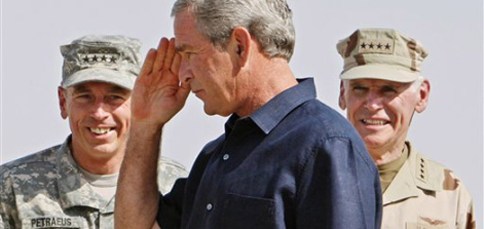
The two senators square off on Meet The Press
July 15
The two senators square off on Meet The Press
July 15
PART TWO
The Discussion is about Senator Webb’s bill in the Senate that mandates troop readiness through judicial non-combat periods.
Two former CIA officers say the president squelched top-secret intelligence, and a briefing by George Tenet, months before invading Iraq.
Sep. 06, 2007 | On Sept. 18, 2002, CIA director George Tenet briefed President Bush in the Oval Office on top-secret intelligence that Saddam Hussein did not have weapons of mass destruction, according to two former senior CIA officers. Bush dismissed as worthless this information from the Iraqi foreign minister, a member of Saddam’s inner circle, although it turned out to be accurate in every detail. Tenet never brought it up again.
Nor was the intelligence included in the National Intelligence Estimate of October 2002, which stated categorically that Iraq possessed WMD. No one in Congress was aware of the secret intelligence that Saddam had no WMD as the House of Representatives and the Senate voted, a week after the submission of the NIE, on the Authorization for Use of Military Force in Iraq. The information, moreover, was not circulated within the CIA among those agents involved in operations to prove whether Saddam had WMD.
On April 23, 2006, CBS’s “60 Minutes” interviewed Tyler Drumheller, the former CIA chief of clandestine operations for Europe, who disclosed that the agency had received documentary intelligence from Naji Sabri, Saddam’s foreign minister, that Saddam did not have WMD. “We continued to validate him the whole way through,” said Drumheller. “The policy was set. The war in Iraq was coming, and they were looking for intelligence to fit into the policy, to justify the policy.”
Now two former senior CIA officers have confirmed Drumheller’s account to me and provided the background to the story of how the information that might have stopped the invasion of Iraq was twisted in order to justify it. They described what Tenet said to Bush about the lack of WMD, and how Bush responded, and noted that Tenet never shared Sabri’s intelligence with then Secretary of State Colin Powell. According to the former officers, the intelligence was also never shared with the senior military planning the invasion, which required U.S. soldiers to receive medical shots against the ill effects of WMD and to wear protective uniforms in the desert.
Instead, said the former officials, the information was distorted in a report written to fit the preconception that Saddam did have WMD programs. That false and restructured report was passed to Richard Dearlove, chief of the British Secret Intelligence Service (MI6), who briefed Prime Minister Tony Blair on it as validation of the cause for war.
Secretary of State Powell, in preparation for his presentation of evidence of Saddam’s WMD to the United Nations Security Council on Feb. 5, 2003, spent days at CIA headquarters in Langley, Va., and had Tenet sit directly behind him as a sign of credibility. But Tenet, according to the sources, never told Powell about existing intelligence that there were no WMD, and Powell’s speech was later revealed to be a series of falsehoods.
Both the French intelligence service and the CIA paid Sabri hundreds of thousands of dollars (at least $200,000 in the case of the CIA) to give them documents on Saddam’s WMD programs. “The information detailed that Saddam may have wished to have a program, that his engineers had told him they could build a nuclear weapon within two years if they had fissile material, which they didn’t, and that they had no chemical or biological weapons,” one of the former CIA officers told me.
On the eve of Sabri’s appearance at the United Nations in September 2002 to present Saddam’s case, the officer in charge of this operation met in New York with a “cutout” who had debriefed Sabri for the CIA. Then the officer flew to Washington, where he met with CIA deputy director John McLaughlin, who was “excited” about the report. Nonetheless, McLaughlin expressed his reservations. He said that Sabri’s information was at odds with “our best source.” That source was code-named “Curveball,” later exposed as a fabricator, con man and former Iraqi taxi driver posing as a chemical engineer.
The next day, Sept. 18, Tenet briefed Bush on Sabri. “Tenet told me he briefed the president personally,” said one of the former CIA officers. According to Tenet, Bush’s response was to call the information “the same old thing.” Bush insisted it was simply what Saddam wanted him to think. “The president had no interest in the intelligence,” said the CIA officer. The other officer said, “Bush didn’t give a fuck about the intelligence. He had his mind made up.”
But the CIA officers working on the Sabri case kept collecting information. “We checked on everything he told us.” French intelligence eavesdropped on his telephone conversations and shared them with the CIA. These taps “validated” Sabri’s claims, according to one of the CIA officers. The officers brought this material to the attention of the newly formed Iraqi Operations Group within the CIA. But those in charge of the IOG were on a mission to prove that Saddam did have WMD and would not give credit to anything that came from the French. “They kept saying the French were trying to undermine the war,” said one of the CIA officers.
The officers continued to insist on the significance of Sabri’s information, but one of Tenet’s deputies told them, “You haven’t figured this out yet. This isn’t about intelligence. It’s about regime change.”
The CIA officers on the case awaited the report they had submitted on Sabri to be circulated back to them, but they never received it. They learned later that a new report had been written. “It was written by someone in the agency, but unclear who or where, it was so tightly controlled. They knew what would please the White House. They knew what the king wanted,” one of the officers told me.
That report contained a false preamble stating that Saddam was “aggressively and covertly developing” nuclear weapons and that he already possessed chemical and biological weapons. “Totally out of whack,” said one of the CIA officers. “The first [para]graph of an intelligence report is the most important and most read and colors the rest of the report.” He pointed out that the case officer who wrote the initial report had not written the preamble and the new memo. “That’s not what the original memo said.”
The report with the misleading introduction was given to Dearlove of MI6, who briefed the prime minister. “They were given a scaled-down version of the report,” said one of the CIA officers. “It was a summary given for liaison, with the sourcing taken out. They showed the British the statement Saddam was pursuing an aggressive program, and rewrote the report to attempt to support that statement. It was insidious. Blair bought it.” “Blair was duped,” said the other CIA officer. “He was shown the altered report.”
The information provided by Sabri was considered so sensitive that it was never shown to those who assembled the NIE on Iraqi WMD. Later revealed to be utterly wrong, the NIE read: “We judge that Iraq has continued its weapons of mass destruction (WMD) programs in defiance of UN resolutions and restrictions. Baghdad has chemical and biological weapons as well as missiles with ranges in excess of UN restrictions; if left unchecked, it probably will have a nuclear weapon during this decade.”
In the congressional debate over the Authorization for the Use of Military Force, even those voting against it gave credence to the notion that Saddam possessed WMD. Even a leading opponent such as Sen. Bob Graham, then the Democratic chairman of the Senate Intelligence Committee, who had instigated the production of the NIE, declared in his floor speech on Oct. 12, 2002, “Saddam Hussein’s regime has chemical and biological weapons and is trying to get nuclear capacity.” Not a single senator contested otherwise. None of them had an inkling of the Sabri intelligence.
The CIA officers assigned to Sabri still argued within the agency that his information must be taken seriously, but instead the administration preferred to rely on Curveball. Drumheller learned from the German intelligence service that held Curveball that it considered him and his claims about WMD to be highly unreliable. But the CIA’s Weapons Intelligence, Nonproliferation, and Arms Control Center (WINPAC) insisted that Curveball was credible because what he said was supposedly congruent with available public information.
For two months, Drumheller fought against the use of Curveball, raising the red flag that he was likely a fraud, as he turned out to be. “Oh, my! I hope that’s not true,” said Deputy Director McLaughlin, according to Drumheller’s book “On the Brink,” published in 2006. When Curveball’s information was put into Bush’s Jan. 28, 2003, State of the Union address, McLaughlin and Tenet allowed it to pass into the speech. “From three Iraqi defectors,” Bush declared, “we know that Iraq, in the late 1990s, had several mobile biological weapons labs … Saddam Hussein has not disclosed these facilities. He’s given no evidence that he has destroyed them.” In fact, there was only one Iraqi source — Curveball — and there were no labs.
When the mobile weapons labs were inserted into the draft of Powell’s United Nations speech, Drumheller strongly objected again and believed that the error had been removed. He was shocked watching Powell’s speech. “We have firsthand descriptions of biological weapons factories on wheels and on rails,” Powell announced. Without the reference to the mobile weapons labs, there was no image of a threat.
Col. Lawrence Wilkerson, Powell’s chief of staff, and Powell himself later lamented that they had not been warned about Curveball. And McLaughlin told the Washington Post in 2006, “If someone had made these doubts clear to me, I would not have permitted the reporting to be used in Secretary Powell’s speech.” But, in fact, Drumheller’s caution was ignored.
As war appeared imminent, the CIA officers on the Sabri case tried to arrange his defection in order to demonstrate that he stood by his information. But he would not leave without bringing out his entire family. “He dithered,” said one former CIA officer. And the war came before his escape could be handled.
Tellingly, Sabri’s picture was never put on the deck of playing cards of former Saddam officials to be hunted down, a tacit acknowledgment of his covert relationship with the CIA. Today, Sabri lives in Qatar.
In 2005, the Silberman-Robb commission investigating intelligence in the Iraq war failed to interview the case officer directly involved with Sabri; instead its report blamed the entire WMD fiasco on “groupthink” at the CIA. “They didn’t want to trace this back to the White House,” said the officer.
On Feb. 5, 2004, Tenet delivered a speech at Georgetown University that alluded to Sabri and defended his position on the existence of WMD, which, even then, he contended would still be found. “Several sensitive reports crossed my desk from two sources characterized by our foreign partners as established and reliable,” he said. “The first from a source who had direct access to Saddam and his inner circle” — Naji Sabri — “said Iraq was not in the possession of a nuclear weapon. However, Iraq was aggressively and covertly developing such a weapon.”
Then Tenet claimed with assurance, “The same source said that Iraq was stockpiling chemical weapons.” He explained that this intelligence had been central to his belief in the reason for war. “As this information and other sensitive information came across my desk, it solidified and reinforced the judgments that we had reached in my own view of the danger posed by Saddam Hussein and I conveyed this view to our nation’s leaders.” (Tenet doesn’t mention Sabri in his recently published memoir, “At the Center of the Storm.”)
But where were the WMD? “Now, I’m sure you’re all asking, ‘Why haven’t we found the weapons?’ I’ve told you the search must continue and it will be difficult.”
On Sept. 8, 2006, three Republican senators on the Senate Select Committee on Intelligence — Orrin Hatch, Saxby Chambliss and Pat Roberts — signed a letter attempting to counter Drumheller’s revelation about Sabri on “60 Minutes”: “All of the information about this case so far indicates that the information from this source was that Iraq did have WMD programs.” The Republicans also quoted Tenet, who had testified before the committee in July 2006 that Drumheller had “mischaracterized” the intelligence. Still, Drumheller stuck to his guns, telling Reuters, “We have differing interpretations, and I think mine’s right.”
One of the former senior CIA officers told me that despite the certitude of the three Republican senators, the Senate committee never had the original memo on Sabri. “The committee never got that report,” he said. “The material was hidden or lost, and because it was a restricted case, a lot of it was done in hard copy. The whole thing was fogged up, like Curveball.”
While one Iraqi source told the CIA that there were no WMD, information that was true but distorted to prove the opposite, another Iraqi source was a fabricator whose lies were eagerly embraced. “The real tragedy is that they had a good source that they misused,” said one of the former CIA officers. “The fact is there was nothing there, no threat. But Bush wanted to hear what he wanted to hear.”
— By Sidney Blumenthal

By Stone Martindale Sep 4, 2007
There is no such thing as bad publicity in show business. Case in point, the controversial CBS series that chronicles kids left to their own devices out in the New Mexican desert.
CBS’ new reality series, “Kid Nation,” will be broadcast starting Sept. 19, in spite of lawsuits and negative articles alleging child abuse and labor law infractions.
Network executives and the program’s producer continued to exude confidence that the reality show would go on as scheduled.
“Everybody’s questions about the show will be answered when it airs,” the show’s executive producer, Tom Forman, said to the New York Times.
According to the Times, CBS has started a series of screenings of the first episode for advertising executives, with some taking place last week and more scheduled for this week.
The show premise is that 40 children, ages 8 to 15, are placed in a “ghost town” in New Mexico to see if they can build a working society without the help of adults.
But soon after the production ended in May, the parent of a child in the production complained about her child being injured and about sub-standard working conditions on the set.
Now, CBS has allegedly made some plans to produce a second edition of the series. It has already held some casting sessions for new children, claims the Times.
Forman told the Times the producers need to be ready to start shooting again if the network likes the early ratings, and orders a second series.
But the problems with the labor law infractions that the state of New Mexico cited for the “Kid Nation” production will have an effect on what state will house the future location of any kid based reality series.
The Times reports that the “attorney general’s office in New Mexico had dropped an investigation into the show, but reopened it two weeks ago after the complaints began to surface.”
Most states have tougher laws than New Mexico’s regarding children and labor.
The negative attention that has popped up over “Kid Nation” has made it too hot a potato for any state to permit future filming, one unnamed CBS executive said to the Times.
Asked if the show could be relocated to Mexico or elsewhere, Mr. Forman said to the Times, “Nothing is off the table.”
Depending on the ratings and the public reception once the series is aired, will determine any future expansion of the “Kid Nation” franchise.
The Times explains that “advertisers buy network programs in packages, rather than on a show by show basis, but they always reserve the right to withdraw from any show whose content they believe may alienate customers.”
source

New Yorkers are facing the second day of a 48-hour strike by taxi drivers protesting over the introduction of new technology in their cabs.
Authorities want new credit card systems and satellite tracking, which they say will help with lost luggage.
Some drivers say the devices could be used to track their movements.
Organisers said the first day was a “resounding success” but Mayor Michael Bloomberg said 75% of the fleet cabs were working.
The strike comes during New York Fashion Week and the US Open tennis championship.
Flat rates
The city has about 44,000 licensed drivers and 13,000 registered yellow cabs.
At inspections from 1 October, the cabs are required to have GPS satellite tracking systems and video screens to allow passengers to see their location, plus credit card payment facilities.
| They’re charging a flat rate of $10 to anywhere in Manhattan, but if you find a cab, you’re happy to pay it Mark Yaffe, businessman |
The City Taxi & Limousine Commission said the credit card system could create bigger fares and the GPS would help with lost luggage.
Strike organisers, the New York Taxi Workers Alliance, fear the GPS will spy on drivers, whom it says will also have to pay credit card transaction fees.
The alliance’s leader, Bhairavi Desai, told AFP news agency: “Taxi drivers sometimes use the cars in their private time. Why should they tell the [commission] where they are going on a Sunday with their family? This is an invasion of privacy.”
Takings ‘up’
The impact of the strike on Wednesday was disputed.
Mr Desai said only 10% of the 13,000 registered cabs were working.
But city officials put the number of taxis working at 75-80%.
Mayor Bloomberg said: “The city has not come to a stop and people are getting where they need to go.”
The city allowed drivers who were working to offer group rides to separate passengers and let them pay flat rates rather than metered fares.
British businessman Mark Yaffe, who arrived in New York on Wednesday, told the BBC News website: “People are spending a lot longer trying to hail what few cabs there are.
“If one stops for you, it’s likely to already have two or three people in it. They’re charging a flat rate of $10 (£4.95) to anywhere in Manhattan, but if you find a cab, you’re happy to pay it.”
Some reports said there were more cabs about on Thursday.
Michael Woloz, of the Metropolitan Taxicab Board of Trade, which represents 3,200 taxis, told the New York Post: “The drivers were hearing how much everyone was making out there and decided to go to work.”
The paper said some drivers had quadrupled their takings.
Driver Taj Dass told the Post: “I did not work yesterday, but how can I afford to stay out a second day?”
Story from BBC NEWS:
http://news.bbc.co.uk/go/pr/fr/-/2/hi/americas/6982278.stm
Dag….
Actor Jude Law was arrested by police over an alleged attack on a photographer ahead of Tuesday night’s GQ Awards.
Law was accused of trying to grab the photographer’s camera in the incident in west London.
The actor, 34, was bailed to return to a London police station in October.
Law was in London to present his Sleuth co-star Sir Michael Caine with the GQ lifetime achievement award in Covent Garden on Tuesday night.
“A 34-year-old man from Maida Vale was arrested yesterday on suspicion of actual bodily harm after voluntarily attending a London police station,” a police statement said.
“The arrest followed an allegation of assault yesterday at a residential address in Maida Vale. The 34-year-old man was released on bail to a date in October pending further inquiries.”

Turning an unused tripod into an attractive floor lamp is a one-step process, and as weblog Curbly reports, directions aren’t even necessary. All you need to do is purchase a lamp kit and shade and screw it in to the top of the tripod. Who doesn’t love cheap and decorative furniture? Looking for more tripod hacks? We’ve got you covered.
Bhairavi Desai Is an Unlikely Voice, Gender for Cabbies
By LARRY McSHANE
Associated Press Writer

NEW YORK (AP) — She is the unlikely embodiment of New York City’s striking cabbies: A college graduate, a woman, barely 5 feet tall, soft-spoken.
But as the city’s two-day taxi job action headed toward its finish, Bhairavi Desai reaffirmed her prominent role in the city’s labor movement and her willingness to make bold moves on behalf of her membership in the New York Taxi Workers Alliance.
“She doesn’t rattle easy,” said Ed Ott, head of the New York City Central Labor Council. “That’s the thing that’s very interesting to me — she does not rattle easy. Under extraordinary pressure, she keeps an even keel.
“She never raises her voice. She never swears. She’s steady as a rock.”
Desai, 34, is a slight woman — 5-foot-1, 110 pounds — who co-founded the alliance in 1998, the same year the city’s cabbies refused to drive in a historic one-day walkout over working conditions.
This time around, she organized a 48-hour work stoppage over the city’s insistence that all cabs are fitted with new technology — including global positioning systems and video screens that will allow customers to pay by credit card.
The cabbies are complaining that the GPS technology will allow Big Brother into their cabs, and that the credit card option will cut into profits by costing them a 5 percent fee on every transaction. The technology must be in place as the cabs come up for inspection starting Oct. 1.
The city has 13,000 yellow cabs and 44,000 licensed drivers. The alliance — an advocacy group, not a union — claims to represent about one-fifth of those cabbies.
The success of the strike that began Wednesday morning remained in dispute well into day two. City officials said 82 percent of the taxi fleet was on the road Thursday, while the ever-passionate Desai was proclaiming triumph.
“You know, the numbers can be spun as much as the opposition wants, but the reality is, the waiting lines speak for themselves,” Desai said Thursday.
It’s that attitude that made her one of 17 people recognized by the Ford Foundation in its 2005 Leadership for a Changing World awards, where she was among those cited for bringing “not only concrete gains to their communities but a determination to stand for justice.”
One year earlier, she was honored by another group as one of the “Top 5 Under 35” South Asians in the metropolitan area. And in 2003, the Asian American Legal Defense and Education Fund presented her with a “Justice in Action” award.
Desai was born in India, where her grandmother — as related in stories to her grandchildren — was arrested in the fight for her homeland’s independence. Her father was an attorney who “fought for the rights of the underprivileged,” Desai once said.
When she was six, the family immigrated to the United States and settled in Harrison, N.J., a gritty blue-collar town near Newark. Her father wound up buying a small grocery store, while her mother worked in a factory.
Desai recalled her mother, side by side with one of her two brothers, filling out applications at an assortment of businesses before landing her job.
She graduated from Rutgers University in 1994 with a degree in women’s studies, but instead found her niche in a business where 99 percent of the drivers are male. After winning the Ford award two years ago, Desai said she was inspired by her membership.
“Through taxi drivers, I have learned the true meanings of honesty and humor, forgiveness and fairness, the maturity to handle difficulties with grace, and, at all times, the importance of dignity,” Desai said.
MSNBC: Luciano Pavarotti, whose vibrant high C’s and ebullient showmanship made him one of the world’s most beloved tenors, has died, his manager told The Associated Press. He was 71.
His manager, Terri Robson, told the AP in an e-mail statement that Pavarotti died at his home in Modena, Italy, at 5 a.m. local time. Pavarotti had been diagnosed with pancreatic cancer last year and underwent further treatment in August.
“The Maestro fought a long, tough battle against the pancreatic cancer, which eventually took his life. In fitting with the approach that characterized his life and work, he remained positive until finally succumbing to the last stages of his illness,” the statement said.

If, as Lewis Mumford wrote, cities were created as “a means of bringing heaven down to earth” and “a symbol of the possible,” New York is the epitome of those dreams. No other city’s skyline thrusts so aggressively toward the heavens, pulling down the clouds like a monarch shrugging into a cloak. No other city’s history so embodies the idea of innovation and achievement in such a dazzling range of human endeavors. “There is no place like it, no place with an atom of its glory, pride and exultancy,” novelist Thomas Wolfe rhapsodized in 1935. “It lays its hand upon a man’s bowels; he grows drunk with ecstasy; he grows young and full of glory, he feels that he can never die.”
That is why New York was for more than two centuries — and still is — a beacon for the best, brightest and bravest people from all over the U.S. and all around the world. They come to test themselves against the toughest competition, to make a buck, to reinvent lives that seem stale in any other setting. As the song that has become the city’s unofficial anthem puts it, “If I can make it there, I’d make it anywhere.”
In virtually every category, New York has the best, the biggest, the most — except for civility, of which it has the least. With a flood of new arrivals from Europe, the Soviet Union and the Third World, New York’s population has rebounded from its 1980 low of 7 million to an estimated 8 million, more than twice as many as runner-up Los Angeles. Washington may be the home of Congress and the President, but New York is the financial capital of the world. Even with the rise of Japan and Germany, the New York Stock Exchange remains the world’s most prestigious financial market, on which stocks worth trillions of dollars are traded.
In culture too, New York remains a pacesetter. Other cities would be proud to have one world-class performing troupe. New York has dozens, including the Metropolitan Opera, the New York Philharmonic, the American Ballet Theater, the Alvin Ailey American Dance Theater, and the Manhattan Theater Club. As a showcase for theater, Broadway has few rivals — unless they are the city’s own off-Broadway and off-off-Broadway productions. Its collection of museums is a gallery in itself.
But just as the sheer size of New York’s population makes possible a dazzling smorgasbord of urban delights, it also magnifies a myriad of social ills. Only about 1 of every 100 New Yorkers is homeless, but that adds up to 90,000 people huddling in shelters or eking out a life of not-so-quiet desperation on the street. A mere 1 in 300 New Yorkers may be a victim of AIDS, but that totals 27,000 people, a staggering 19% of all confirmed cases in the U.S. Says Paul Grogan, president of the Local Initiatives Support Corp., a nonprofit housing-development organization: “New York is the same as every place — only more so.”
Until recently, the negative aspects of New York living were more than compensated by the exhilaration of simply being there. As architecture critic Ada Louise Huxtable says, “When it is good, New York is very, very good. Which is why New Yorkers put up with so much that is bad.” Over the decades, Gothamites have evolved a hard-boiled, calculating approach to life that enables them to enjoy the city’s manifold pleasures while minimizing its most egregious hassles. Says Brigette Moore, 19, a college student from Brooklyn’s Sheepshead Bay section: “I wouldn’t have wanted to grow up in any other city. I think people in other parts of the country are more limited. In New York you have the privilege to be anything you want.”
But that balance has now begun to shift. Reason: a surge of drugs and violent crime that government officials seem utterly unable to combat. Eight other major cities have higher homicide rates, but New York’s carnage dwarfs theirs in absolute terms. Last year 1,905 people were murdered in New York, more than twice as many as in Los Angeles. In the first five months of this year, 888 homicides were committed, setting a pace that will result in a new record if it goes unchecked.
The victims have been of all races, all classes, all ages. This summer, in one eight-day period, four children were killed by stray gunshots as they played on the sidewalks, toddled in their grandmother’s kitchens or slept soundly in their own beds. Six others have been wounded since late June. So many have died that a new slang term has been coined to describe them: “mushrooms,” as vulnerable as tiny plants that spring up underfoot.
The city was still absorbing those horrors two weeks ago when Sean Healy, a prosecutor in the Bronx district attorney’s office, was cut down by a hail of gunfire as he selected a package of doughnuts from the shelf of a neighborhood grocery. That same day Vander Beatty, a former political power in Brooklyn attempting a comeback by running for district leader, was shot to death in his campaign headquarters. The prime suspect, according to police, was a longtime friend who was allegedly angry over the manner in which a lawyer who had been recommended by Beatty had handled his alimony case.
Then last week came the murder of 22-year-old Brian Watkins, an avid tennis buff from Provo, Utah, on a subway platform in midtown Manhattan. Over the years, his family frequently made a pilgrimage to watch the U.S. Open tennis tournament in Queens. En route to dinner at Tavern on the Green, a popular tourist attraction, the family was attacked by a group of eight black and Hispanic youths. After one of the gang cut open his father’s pocket to get at his money and punched his mother in the face, Brian jumped to his parents’ defense. He was stabbed with a four-inch butterfly knife and died 40 minutes later at St. Vincent’s Hospital.
The shock of Watkins’ death was intensified by the venality of its alleged motive. According to police, the suspects are members of F.T.S. (an abbreviated obscenity), a Queens youth gang that requires its members to commit a mugging as an initiation rite. They were reportedly trying to raise cash to finance an evening of frolicking at Roseland, a nearby dance hall, where six suspects were arrested. Two others were rounded up later.
Like the brutal rape of the Central Park jogger and the murder of Yusuf Hawkins in the Bensonhurst section of Brooklyn last year, Watkins’ death quickly assumed a larger symbolic meaning. Outside the city it confirmed what most Americans already believed: New York is an exciting but dangerous place. Among New Yorkers it reinforced the spreading conviction that the city has spun out of control. A growing sense of vulnerability has been deepened by the belief that deadly violence, once mostly confined to crime-ridden ghetto neighborhoods that the police wrote off as free-fire zones, is now lashing out randomly at anyone, anytime, even in areas once considered relatively safe.
New Yorkers were quick to notice that the Watkins family were attacked even though they were traveling in a group of five, including three men. But such a precaution did not prevent them — or thousands of city residents — from being victimized. “Crime is tearing at the vitals of this city and has completely altered ordinary life,” says Thomas Reppetto, president of the Citizens Crime Commission, a private watchdog group. “Worst of all, it is destroying the morale of our citizens.”
The looming question in many minds was what, if anything, people could do to protect themselves when children were no longer safe in their beds. “New Yorkers can put up with dirty streets, poor schools and broken subways,” warns Mitchell Moss, director of the urban research center at New York University. “But New Yorkers cannot take uncertainty — risks, yes, but not uncertainty.”
At times the city has seemed so consumed with crime that it was incapable of thinking about anything else. Nursery-school teachers in some of the city’s tougher neighborhoods train children barely old enough to talk to hit the floor at the sound of gunshots. They call them “firecrackers” and reward the swift with a lollipop.
What has most dismayed many New Yorkers is the tepid response of the city’s leaders to the surge of mayhem. Like everyone else in New York, Mayor David Dinkins and his handpicked police commissioner, Lee Brown, seem at a loss for remedies to the worst crime wave to hit the city in a decade. “New York is in desperate need of leadership,” says Moss, “and it simply isn’t there.” A TIME/CNN poll of New Yorkers taken during this summer’s rash of killings showed that only 47% approved of Dinkins’ performance, and an equal number believed he is no different or worse than his abrasive predecessor, Edward I. Koch.
New York’s plunge into chaos cannot be blamed on Dinkins, who has been in office for only nine months. In fact, he has inherited the whirlwind sown by decades of benign neglect, misplaced priorities and outright incompetence at every level of government. If during the city’s close brush with bankruptcy during the 1970s Gerald Ford was willing to let New York drop dead, the Reagan Administration seemed eager to bury it. Since 1980, cutbacks in federal aid have cost New York billions, with funds for subsidized housing alone dropping $16 billion. Despite a series of state and local levies that now place New Yorkers among the most heavily taxed citizens in the nation, the city has never recovered from those setbacks.
Most brutally hit have been basic social services. Even with the addition of 1,058 new police officers in October, the force will still be 14% smaller than its 1975 level of 31,683. Meanwhile crime, fueled by the drug epidemic, has jumped 25%. Since 1987, the number of street sweepers has been slashed from 1,400 to 300, trash collections in midtown Manhattan have been reduced by a third, and what used to be daily rounds in the outer boroughs have been reduced to twice a week. Epidemics of AIDS, tuberculosis and syphilis have pushed the health-care system to the breaking point. As many New Yorkers are waiting for public housing as there are existing units, leading occupants to double or triple up in a frantic bid for shelter. “The chickens have come home to roost,” says Madeline Lee, executive director of the New York Foundation, which supports community projects for the disadvantaged, “and New York doesn’t let anyone escape from the reality of that.”
That reality includes an infrastructure so dilapidated that the very streets seem to be rising up in rebellion. A year ago, a series of exploding steam pipes spewed carcinogenic asbestos into apartment houses in Manhattan. When some residents moved back into their homes after a protracted cleanup, objects of value had been stolen.
During the roaring 1980s, it appeared that New York might slip by. High finance and a booming real estate market transported New York to a paroxysm of unbridled capitalism, with all its attendant glitz and excess. At the height of the bull market, 60,000 new jobs were being created annually, luring droves of hyperambitious baby boomers to the canyons of Wall Street and midtown Manhattan. Nicknamed “the Erector set,” a stable of real estate developers transformed the cityscape, throwing up 50 million sq. ft. of glistening office monoliths within Manhattan alone. New fortunes upended the city’s social lineage, shoving Rockefeller and Astor aside for Trump, Steinberg and Kravis. The new barons redefined wealth beyond Jay Gatsby’s wildest dreams, ensconcing themselves in palatial aeries groaning with old masters and nouveau exorbitance.
But behind the blinding glitter of the new multimillionaires, the city was failing the bulk of its citizens. Even the basic rudiments of civil behavior seemed to evaporate along with the glitter of the boom times. Every day 155,000 subway riders jump the turnstiles, denying the cash-strapped mass transit system at least $65 million annually. The streets have become public rest rooms for both people and animals, even though failure to clean up after a pet dog carries fines of up to $100. What was once the bustle of a hyperkinetic city has become a demented frenzy.
Skyrocketing real estate prices (a one-room apartment that rents for $800 a month is considered a bargain) have driven middle-class families out of Manhattan and are threatening the creative enterprises that make the island a cultural oasis. Twenty years ago, about 50 or 60 new productions opened on Broadway each year. Today soaring costs have driven the price of an orchestra seat to $60, and a healthy season yields no more than 35 new shows, only 12 of which are deemed successes. In dance alone, New York lost 55 world-class studios in the past four years. Others, including Martha Graham Dance, are considering following the example of the Joffrey Ballet by establishing second and third homes in other cities. That means a shorter season in New York. “This is the most expensive, difficult and competitive city for arts organizations,” says David Resnicow, president of the Arts and Communications Counselors, which arranges sponsorships for corporations and cultural institutions. “You don’t have to be in New York to make it. ”
The daily litany of problems seems all the starker now because of the feverish boosterism that characterized Koch’s three terms as mayor. The 65- year-old Democrat lived and breathed New York, taking the pulse of the city through his own. “How’m I doin’?” was his constant question as he flitted from fire to shooting to gala to press conference. For much of his 12-year tenure, the answer was “O.K.” But rampant corruption within his administration and the widening economic and racial fissures in the city ultimately soured New Yorkers on their tireless but tiresome mayor.
Last November New Yorkers turned to Dinkins in the hope that the cautious and gentle veteran clubhouse politician would heal the rifts among them and offer a modicum of racial peace. “A Gorgeous Mosaic” became the 63-year-old grandfather’s metaphor for his divided city, and he pulled together an ethnically diverse electorate to become New York’s first black mayor by a narrow margin. Dinkins has named more minorities to top-level staff positions than any mayor before him and has drawn on a national pool of talent to fill posts in his administration. With little fanfare, the silver-haired insider fashioned a slash-and-tax $28 billion budget that met with grudging approval from unions and business leaders alike.
But the battle for survival is being fought on the sidewalks of New York, not in the ledger books. And so far, Dinkins’ lackluster performance has strengthened the unsettling sense that he is simply not up to his job. In the war against crime, Dinkins’ initiatives have been piecemeal and halting, ranging from a stillborn gun-amnesty program (only 35 illegal firearms have been turned in) to the hiring of less than a fourth of the additional 5,000 officers that police commissioner Brown contends are needed to win back the streets.
Part of the mayor’s problem is style. Unlike the prickly Koch, Dinkins rarely raises his voice and disdains the finger-in-your-chest aggressiveness that has characterized New York politicians since the days of Tammany Hall. He is far more comfortable in quiet back-room negotiations than in public confrontations with unhappy constituents. His finest hour may have been the lavish hero’s welcome the city provided in June for South African leader Nelson Mandela, for whom New York’s warring ethnic groups seemed to put aside their differences during a three-day celebration of racial harmony.
A more serious drawback is Dinkins’ reluctance to attack problems in a direct and forceful way. Since January, for example, the Flatbush section of Brooklyn has been roiled by a black boycott of two Korean grocery stores that began after a Haitian woman accused the Koreans of assaulting her in an argument over a dollar’s worth of fruit. The shopowners obtained a civil court injunction ordering the protesters to remain at least 50 ft. away from the shops’ entrances, but Dinkins has not ordered the police to enforce it. Instead, he appointed a commission to review his handling of the affair. Not surprisingly, the report it issued two weeks ago praised the mayor’s conduct and lambasted Brooklyn district attorney Charles Hynes for not vigorously pushing the investigation and prosecution of the Haitian woman’s original complaint.
Despite the mounting unease about his leadership, Dinkins remains unfazed. His response last week to demands that he publicly condemn the Watkins murder was characteristically orotund. Quoth the mayor: “I say that if two nations are in dispute and one diplomat says to the representative of another government, ‘Her Majesty’s government is exceedingly distressed,’ everybody knows that means we’re mad as hell. Now, however, I’m prepared to say I’m mad as hell, not simply ‘We’re exceedingly distressed.’ ”
Even so, Dinkins’ remark was a significant shift from his earlier pronouncements. At times the mayor has attempted to downplay the crime wave as a public relations problem: “This administration is doing all it can to win back our streets. Some of it has been to address the image of the city. People need to feel secure, and ((a bad image)) adversely impacts business and tourism.” He has also portrayed the outbreak as a local manifestation of a national crisis beyond his control: “If the problems of drugs and crime were only in New York, then you could ask, What is it that you folks are doing wrong? But all of our urban centers are afflicted similarly. The fact that it’s happening somewhere else doesn’t mean that I don’t have a problem to address. But the fact that the problem is regional or nationwide does say that the Federal Government should assist in addressing it.” Says Dinkins: “You have to have credibility. People have to have faith in you.”
These days faith is in short supply. So is money. Megadeveloper Lew Rudin, who heads a corporate cheerleading organization, Association for a Better New York, estimates it would take $5 trillion to bring his city back up to par. Although its annual budget is larger than that of all but two states, New York City is in a financial straitjacket, and the nation’s economic downturn, more harshly reflected in the Northeast than elsewhere, offers little hope for future relief. Says financier Felix Rohatyn, who devised the plan that saved New York from bankruptcy 15 years ago: “I just don’t see the light at the end of the tunnel. However, we cannot turn our back on the city now.” Facing a $1.8 billion shortfall, the Dinkins administration has been forced to raise taxes $800 million and cut city services more than $200 million.
Such cutbacks mean that for average New Yorkers the struggle to attain what other Americans take for granted will become even more grueling. The challenge is especially tough for families with children. New York public schools are burdened with educating 940,000 students, representing 150 countries and speaking more than 100 languages. Less than half read at or above grade level, 1 out of 3 drop out before their senior year, and those who do stay in school often take five to seven years to graduate from high school. The system itself is rife with troubles. Almost a third of the city’s 32 local school boards are under investigation for corruption, building maintenance has chalked up a $500 million backlog, and a basic in-school service like nursing care has been slashed 86%. An impossible caseload of 1,000 high school students for every guidance counselor makes a mockery of the profession.
Other New Yorkers are waging private wars for safe and affordable housing. Willie Olmo, an electronics technician who supports his wife Mabel and five daughters on a salary of $30,000, had nowhere to go last year when the landlord abandoned the apartment building in which the family lived. When police declined to drive away crack users who had set up a drug den in the building’s basement, Olmo picked up a baseball bat and chased them out himself. He then bought walkie-talkies with his own money and started a tenants’ patrol, which has since expanded into a neighborhood watch committee. Next he persuaded his neighbors to lease the building from the city and manage it themselves. “We’ve tried to improve the neighborhood so we could live here,” says Mabel. “Rents everywhere else are too high.”
For those who can afford it, the increasingly attractive choice is to leave New York behind. According to the Household Goods Carriers’ Bureau, which tracks the business of the city’s six largest moving companies, 12,000 more customers moved out over the past two years than moved in. For the first time in this century, fear of crime is the main catalyst for this burgeoning exodus. “People may want to be here,” says Richard Anderson, head of New York’s Regional Plan Association, “but the things that drive them away are bubbling to the surface.” Says Laura Ziman, a native New Yorker who recently fled to upstate New York with her husband and their two toddlers: “I love the city, but it’s just becoming unlivable.”
So far the exodus from New York is no more than a trickle. But it could become a flood if the fear of crime begins to overshadow the city’s unique combination of pizazz and opportunity. Unchecked violence has already dulled the luster of the Big Apple. The daunting task before its leaders is to prevent it from rotting to the core.
CREDIT: From a telephone poll of 1,009 New York City residents for TIME/CNN on Aug. 2 to 5 by Yankelovich Clancy Shulman. Sampling is plus or minus 3%.