GIGAOM
Mathew Ingram
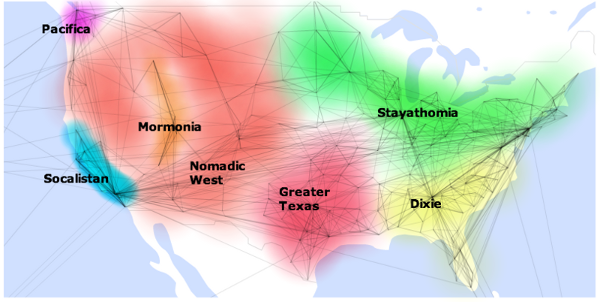
Peter Warden, a former Apple engineer, likes to analyze data — so much so that he started scraping public profiles and photos from hundreds of millions of Facebook accounts about a year ago, and now has data collected from more than 200 million around the world. He wrote a fascinating post recently on his personal blog about what that data shows about how interconnected (or disconnected) users in the various American states.
In a nutshell, Warden’s data analysis showed that Facebook users in the U.S. can be roughly segmented into seven regions, which he named facetiously:
- Stayathomia: This belt’s defining feature is how near most people are to their friends, implying they don’t move far.
- Dixie: Like Stayathomia, Dixie towns tend to have links mostly to other nearby cities rather than spanning the country.
- Greater Texas: Unlike Stayathomia, there’s a definite central city to this cluster, otherwise most towns just connect to their immediate neighbors.
- Mormonia: The only region that’s completely surrounded by another cluster, Mormonia mostly consists of Utah towns that are highly connected to each other, with an offshoot in Eastern Idaho.
- Nomadic West: The defining feature of this area is how likely even small towns are to be strongly connected to distant cities; it looks like the inhabitants have done a lot of moving around the county.
- Socalistan: LA is definitely the center of gravity for this cluster. Almost everywhere in California and Nevada has links to both LA and SF, but LA is usually first.
- Pacifica: Tightly connected to each other, it doesn’t look like Washingtonians are big travelers compared to the rest of the West, even though a lot of them claim to need a vacation.
Of course, Warden’s data — which he collected in the course of analyzing Facebook profiles and fan pages worldwidebecoming more cosmopolitan, according to the most recent demographic survey of Facebook users. Marshall Kirkpatrick has more detail on what Warden is up to in this post. for various corporate customers — only reflects what users of Facebook choose to reveal about themselves, and many don’t include all their friends or other information in their public profiles. As large as it is, Facebook also still represents only a small slice of the American population, and likely a fairly homogeneous slice at that, although the social network is




 The New York Herald Sun