Afghanistan
Gore Vidal With Bill Maher | April 10, 2009
Afghanistan, Gore Vidal, IraqPart Two
Part Three
Bill Maher With Madeline Albright | March 20, 2009
Afghanistan, Al Qaeda, Bin Laden, George Bush, Madeline Albright, Pakistan, Politics, Tullycast4Bill Maher | Opening Monologue
Afghanistan, AIG. Bonus, Al Qaeda, Albright, Bin Laden, Bush, Cheney, Geuthner, Greenspan, Pakistan, Politics, Saddam, TullycastBill Maher | Opening Monologue
TULLYCAST Abides…
Bill Maher | Panel Discussion | February 27, 2009
Politics, Real TimeThomas Ricks Plays Propaganda Point-Man on Pentagon Plan for Permanent U.S. Bases in Iraq
Admiral Fallon, AEI, Bechtel. Halliburton, Blackwater, Carlyle Group, Colin Powell, Condi Rice, Dick Cheney, Don Rumsfeld, Douglas Feith, Erik Prince, General Keane, General Odierno, General Patraeus, George W. Bush, Iraq, KBR, Military Industrial Complex, Neocons, Oil, Paul Wolfowitz, PNAC, Propaganda, Raytheon, Richard Perle, Steven Hadley, Think-TanksThe Crimes of George W. Bush [Video]
9/11, Ari Fleisher, Barack Obama, Bechtel, Bin Laden, Blackwater USA, Broadcatching, Carlyle, CPA, Dan Senor, David addinton, Elliot Abrams, Erik Prince, Extraordinary Rendition. Illegal, FISA, Frodo, Gonzalez, Guantanamo, Halliburton, Iraq, John Ashcroft, John Yoo, Karl Rove, KBR, Kristol, Military Commisions, Paul Bremer, Perle, PNAC, Politics, Rice, Rumsfeld, Scooter Libby, Torture, Truth Commision, Tullycast, U.S. Attorney Scandal, Valerie Plame, Vengeance Cnard, Wall Street, Waterboarding, Wiretapping, WolfowitzChief Iraq War Cheerleader and D.C.'s Favorite Idiot Savant Plays Dress-Up in Afghanistan
Stories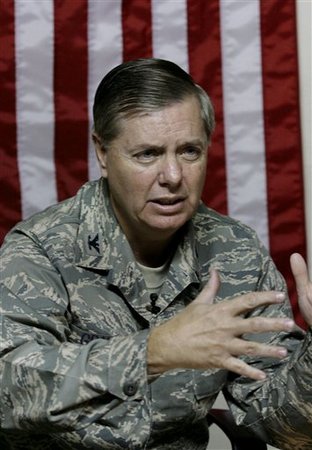
KABUL, Afghanistan (AP) – The men around Lindsey Graham ignored his powerful political title – U.S. senator – and their own douchechills -instead addressing him by rank – colonel.
Graham, a Republican from South Carolina and the only U.S. senator in the military’s Guard or Reserves, donned the Air Force’s camouflaged uniform for five days last week to serve in Kabul.
The senator enrolled in the ROTC in 1973 and has been in the Air Force Guard or Reserves as a military lawyer ever since. In Kabul, he worked with the staff of military lawyers at the U.S. base Camp Eggers. The office is helping to train military judges and defense lawyers, and to write Afghanistan’s uniform code of military justice.
Graham said his experiences in the military taught him how difficult wartime deployments can be on families.
“One thing I learned is that when a soldier, airman or a Marine is away, the more we can take care of the family, the better they’re going to be able to do their job because there’s nothing worse than being deployed and having family problems,” said Graham, a member of the Senate Armed Services Committee.
Graham said that when the military mobilized for the war in Iraq, about 20 percent of Guard and Reserve forces were medically disqualified. He said it wasn’t smart to have “20 percent of your force out of the fight without a shot being fired.” About 25 percent of the Guard and Reserves were uninsured.
In response, Graham worked with Sen. Hillary Clinton in 2005 to allow members of the Guard and Reserve to purchase health insurance for themselves and their families through TRICARE, the military’s health care system.
Seven years after the U.S. invaded Afghanistan to oust the Taliban for hosting al-Qaida chief Osama bin Laden, the United States has a record level of some 32,000 forces in the country, and American commanders have asked for 20,000 more. Violence has soared over the last two years.
Graham, who was in the capital from Sunday through Thursday, called the challenges in Afghanistan “enormous,” and said the U.S. “let some time get by” without enough focus on the country.
“It’s going to get tougher before it gets better. But we have a new strategy in place. Gen. (David) Petreaus understands how to win wars,” Graham said, referring to the chief of U.S. Central Command. “So I want the people of America to know we’re here to make our own national security better.”
The Taliban appears to be making gains in Afghanistan’s provinces, and more U.S. soldiers have died in Afghanistan in 2008 than in any year since the invasion, but Graham said history shows that the momentum in conflicts can turn quickly.
In 1987, Graham said, the Cold War between the Soviet Union and the U.S. was “vigorous.” By 1990, he pointed out, it was over.
“Momentum for evil or good can be powerful. Things can really deteriorate fast, but things can change and I’ve learned that in Iraq,” Graham said of the country, where violence has dropped quickly over the last year. Graham has also served time in Iraq in the Air Force Reserves.
The politician said his service in the military has made him a better senator.
“You don’t need to be in the military to be a good senator or president, but every experience you have helps you,” Graham said.
Dick Cheney is Fairly Pleased With His Eight Bloody Years
Afghanistan, Dick Cheney, George W. Bush, Iraq, War Criminal
- guardian.co.uk, Wednesday 17 December 2008 01.19 GMT
The outgoing US vice-president, Dick Cheney, last night gave an unapologetic assessment of his eight years in office, defending the invasion of Iraq, the US prison camp at Guantánamo Bay, secret wiretapping and the extreme interrogation method known as waterboarding.
In his first television interview since the presidential election in November, Cheney displayed no regrets and gave no ground to his many critics within America and around the world. He summed up his record by saying: “I think, given the circumstances we’ve had to deal with, we’ve done pretty well.”

He told ABC News he stood by the most controversial policies of the Bush administration, and urged president-elect Barack Obama to think hard before undoing them. Asked about the use of torture on terror suspects, he replied: “We don’t do torture. We never have. It’s not something this administration subscribes to.”
Later in the same interview, Cheney was asked whether the use of waterboarding in the interrogation of the alleged mastermind of the September 11 attacks, Khaled Sheikh Mohammed, had been appropriate. He replied: “I do.”
Waterboarding is a technique that induces the sensation of drowning, and is widely regarded as a form of torture. It was used on three high-level al-Qaida suspects, including Mohammed, but has since been banned by the US.
Cheney was chosen in 2000 by George Bush to be his vice-president; he did not put his own name forward for the job. He has since turned into one of the most divisive and reviled vice-presidents in US history, amassing to his office enormous powers and devising a stream of controversial policies.
Despite the vitriol he has attracted, and Bush’s historically low approval rating of just 29%, Cheney was still able to joke about his term in the White House.
He referred to a comment from Hillary Clinton likening him to the Star Wars character Darth Vader. “I asked my wife about that, if that didn’t bother her. She said, no, it humanises you.”
But his lack of any introspection over the decisions made under his watch – in contrast to Bush who recently said he had been sorry about the false intelligence over Iraq – will renew Cheney’s reputation as a combatant and uncompromising vice-president.
Though no weapons of mass destruction were ever found, he insisted that Saddam Hussein had had the capability to produce them.
“He had the technology, he had the people. This was a bad actor and the country’s better off, the world’s better off with Saddam gone. We made the right decision,” he said.
On Guantánamo, he challenged the incoming Obama administration to think hard about what he claimed were the “hardcore” detainees still being held at the Cuban base.
“What are you going to do with those prisoners?” he said, adding: “I don’t know any other nation in the world that would do what we’ve done in terms of taking care of people who are avowed enemies.”
He also defended the use of secret wiretapping of suspects that was carried out without court warrant.
“It’s worked. It’s been successful. It was legal from the very beginning.”
Given the role of hate-figure that Cheney has acquired over the years among the American left, many US liberals will be dismayed to hear him say that he largely approves of the cabinet put together by the president-elect.
He praised the decision to keep Robert Gates as defence secretary as “excellent” and predicted that General Jim Jones would be “very, very effective” as national security adviser.
He even complimented his old adversary, Hillary Clinton, Obama’s choice as secretary of state, saying “she’s tough, she’s smart, she works very hard and she may turn out to be just what President Obama needs.”
Cheney has 34 days left in office. This will be his fourth transition out of government and back to private life. He said he was not ready to retire yet, but did want to spend more time with his family. “Got some rivers I want to face. Maybe write a book. I haven’t decided yet.”
Judge Rules White House Aides Can Be Subpoenaed
Afghanistan, AIPAC, Alberto Gonzales, Ari Fleisher, Bay Buchanan, Bill Kristol, Brit Hume, Brooke Hogan, Charles Krauthammer, David Addigton, David Iglesias, Dick Cheney, Elliot Abrams, Exxon, Frodo, George Bush, Harriet Miers, Hulk Hogan, Iraq, Irving Kristol, Jesse Ventura, Joseph Wilson, Judith Miller, Justice Department, Karen Hughes, Karl Rove, Luther Campbell, Matt Cooper, Michael Mukasey, Mobil, Monica Goodling, Pam Anderson, PNAC, Robert Luskin, Robert Novak, Roger Ailes, Rupert Murdoch, Scooter Libby, Tim Russert, Tom Friedman, Valerie Plame, Viveca Novak
WASHINGTON — President Bush’s top advisers must honor subpoenas issued by Congress, a federal judge ruled on Thursday in a case that involves the firings of several United States attorneys but has much wider constitutional implications for all three branches of government.
“The executive’s current claim of absolute immunity from compelled Congressional process for senior presidential aides is without any support in the case law,” Judge John D. Bates ruled in United States District Court here.
Unless overturned on appeal, a former White House counsel, Harriet E. Miers, and the current White House chief of staff, Joshua B. Bolten, would be required to cooperate with the House Judiciary Committee, which has been investigating the controversial dismissal of the federal prosecutors in 2006.
While the ruling is the first in which a court has agreed to enforce a Congressional subpoena against the White House, Judge Bates called his 93-page decision “very limited” and emphasized that he could see the possibility of the dispute being resolved through political negotiations. The White House is almost certain to appeal the ruling.
It was the latest setback for the Bush administration, which maintains that current and former White House aides are immune from congressional subpoena. On Wednesday, the House Judiciary Committee voted along party lines to recommend that Karl Rove, a former top political adviser to President Bush, be cited for contempt for ignoring a subpoena and not appearing at a hearing on political interference by the White House at the Justice Department.
Although Judge Bates did not specifically say so, his ruling, if sustained on appeal, might apply as well to Mr. Rove and his refusal to testify.
The House has already voted to hold Ms. Miers and Mr. Bolten in contempt for refusing to testify or to provide documents about the dismissals of the United States attorneys, which critics of the administration have suggested were driven by an improper mix of politics and decisions about who should, or should not, be prosecuted.
Judge Bates, who was appointed to the bench by President Bush in 2001, said Ms. Miers cannot simply ignore a subpoena to appear but must state her refusal in person. Moreover, he ruled, both she and Mr. Bolten must provide all non-privileged documents related to the dismissals.
Ms. Miers and Mr. Bolten, citing legal advice from the White House, have refused for months to comply with Congressional subpoenas. The White House has repeatedly invoked executive privilege, the doctrine that allows the advice that a president gets from his close advisers to remain confidential.
In essence, Judges Bates held that whatever immunity from Congressional subpoenas that executive branch officials might enjoy, it is not “absolute.” And in any event, he said, it is up to the courts, not the executive branch, to determine the scope of its immunity in particular cases.
“We are reviewing the decision,” Emily Lawrimore, a White House spokeswoman, said. Before the decision was handed down, several lawyers said it would almost surely be appealed, no matter which way it turned, because of its importance.
Democrats in Congress issued statements in which they were quick to claim victory in the struggle with the administration over the dismissals of the federal prosecutors and other occurences in the Justice Department, and that they looked forward to hearing from the appropriate White House officials.
“I have long pointed out that this administration’s claims of executive privilege and immunity, which White House officials have used to justify refusing to even show up when served with congressional subpoenas, are wrong,” said Senator Patrick J. Leahy, Democrat of Vermont who is chairman of the Senate Judiciary Committee.
Mr. Leahy’s House counterpart in the House had a similar reaction.
“Today’s landmark ruling is a ringing reaffirmation of the fundamental principle of checks and balances and the basic American idea that no person is above the law,” said Representative John D. Conyers, the Michigan Democrat who is chairman of the House Judiciary Committee.
 The New York Herald Sun