Wall Street Bonuses Are Same As 2004

AIG, Banking, Bear Stearns, CDS, Citi, Executive Pay, Finance, Merrill, Wall Street, Wall Street bailout
January 29, 2009

What Red Ink? Wall Street Paid Hefty Bonuses

Wall Street ArrestBy almost any measure, 2008 was a complete disaster for Wall Street — except, that is, when the bonuses arrived.

Despite crippling losses, multibillion-dollar bailouts and the passing of some of the most prominent names in the business, employees at financial companies in New York, the now-diminished world capital of capital, collected an estimated $18.4 billion in bonuses for the year.

That was the sixth-largest haul on record, according to a report released Wednesday by the New York State comptroller.

While the payouts paled next to the riches of recent years, Wall Street workers still took home about as much as they did in 2004, when the Dow Jones industrial average was flying above 10,000, on its way to a record high.

Some bankers took home millions last year even as their employers lost billions.

The comptroller’s estimate, a closely watched guidepost of the annual December-January bonus season, is based largely on personal income tax collections. It excludes stock option awards that could push the figures even higher.

The state comptroller, Thomas P. DiNapoli, said it was unclear if banks had used taxpayer money for the bonuses, a possibility that strikes corporate governance experts, and indeed many ordinary Americans, as outrageous. He urged the Obama administration to examine the issue closely.

“The issue of transparency is a significant one, and there needs to be an accounting about whether there was any taxpayer money used to pay bonuses or to pay for corporate jets or dividends or anything else,” Mr. DiNapoli said in an interview.

Granted, New York’s bankers and brokers are far poorer than they were in 2006, when record deals, and the record profits they generated, ushered in an era of Wall Street hyperwealth. All told, bonuses fell 44 percent last year, from $32.9 billion in 2007, the largest decline in dollar terms on record.

But the size of that downturn partly reflected the lofty heights to which bonuses had soared during the bull market. At many banks, those payouts were based on profits that turned out to be ephemeral. Throughout the financial industry, years of earnings have vanished in the flames of the credit crisis.

According to Mr. DiNapoli, the brokerage units of New York financial companies lost more than $35 billion in 2008, triple their losses in 2007. The pain is unlikely to end there, and Wall Street is betting that the Obama administration will move swiftly to buy some of banks’ troubled assets to encourage reluctant banks to make loans.

Many corporate governance experts, investors and lawmakers question why financial companies that have accepted taxpayer money paid any bonuses at all. Financial industry executives argue that they need to pay their best workers well in order to keep them, but with many banks cutting jobs, job options are dwindling, even for stars.

Lucian A. Bebchuk, a professor at Harvard Law School and expert on executive compensation, called the 2008 bonus figure “disconcerting.” Bonuses, he said, are meant to reward good performance and retain employees. But Wall Street disbursed billions despite staggering losses and a shrinking job market.

“This was neither the sixth-best year in terms of aggregate profits, nor was it the sixth-most-difficult year in terms of retaining employees,” Professor Bebchuk said.

Echoing Mr. DiNapoli, Professor Bebchuk said he was concerned that banks might be using taxpayer money to subsidize bonuses or dividends to stockholders. “What the government has been trying to do is shore up capital, and any diversion of capital out of banks, whether in the form of dividends or large payments to employees, really undermines what we are trying to do,” he said.

Jesse M. Brill, a lawyer and expert on executive compensation, said government bailout programs like the Troubled Asset Relief Program, or TARP, should be made more transparent.

“We are all flying in the dark,” Mr. Brill said. “Companies can simply say they are trying to do their best to comply with compensation limits without providing any of the details that the public is entitled to.”

Bonuses paid by one troubled Wall Street firm, Merrill Lynch, have come under particular scrutiny during the last week.

Andrew M. Cuomo, the New York attorney general, has issued subpoenas to John A. Thain, Merrill’s former chief executive, and to an executive at Bank of America, which recently acquired Merrill, asking for information about Merrill’s decision to pay $4 billion to $5 billion in bonuses despite new, gaping losses that forced Bank of America to seek a second financial lifeline from Washington.

A Treasury Department official said that in the coming weeks, the department would take action to further ensure taxpayer money is not used to pay bonuses.

Even though Wall Street spent billions on bonuses, New York firms squeezed rank-and-file executives harder than many companies in other fields. Outside the financial industry, many corporate executives received fatter bonuses in 2008, even as the economy lost 2.6 million jobs. According to data from Equilar, a compensation research firm, the average performance-based bonuses for top executives, other than the chief executive, at 132 companies with revenues of more than $1 billion increased by 14 percent, to $265,594, in the 2008 fiscal year.

For New York State and New York City, however, the leaner times on Wall Street will hurt, Mr. DiNapoli said.

Mr. DiNapoli said the average Wall Street bonus declined 36.7 percent, to $112,000. That is smaller than the overall 44 percent decline because the money was spread among a smaller pool following thousands of job losses.

The comptroller said the reduction in bonuses would cost New York State nearly $1 billion in income tax revenue and cost New York City $275 million.

On Wall Street, where money is the ultimate measure, some employees apparently feel slighted by their diminished bonuses. A poll of 900 financial industry employees released on Wednesday by eFinancialCareers.com, a job search Web site, found that while nearly eight out of 10 got bonuses, 46 percent thought they deserved more.

Paul J. Sullivan contributed reporting.

Thousands Line Up For Free Food In San Francisco

George W. Bush, Homelessness, San Francisco, The Economy

Wednesday, December 17, 2008

sf-food

(12-16) 13:47 PST SAN FRANCISCO — Never have so many people waited so long in San Francisco for a chicken.

Not only a chicken, but cans of pears, corn, carrots and tomatoes, plus a sack of pinto beans.

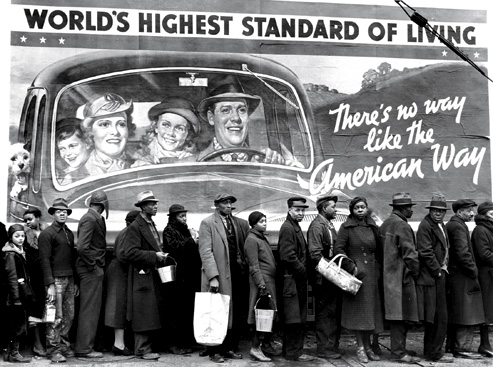
The line Tuesday for the annual grocery giveaway at Glide Memorial United Methodist Church was longer than anyone could remember. It stretched beyond the liquor store on the corner, past a half dozen residence hotels, up and down the aisles of a parking lot and along the far side of the massage parlor. It coiled back on itself like a cobra.

“We may run out of food,” said the Rev. Cecil Williams, who this year appeared to mean it. “The line is all the way around the block, twice over. We’re trying to rush things along so the line doesn’t come back on itself three times.”

Six thousand sacks of groceries were handed out. The first thousand came with a turkey. The rest came with a chicken. A lot of people were willing to show up before dawn in rainy 40-degree weather, to make sure they got the turkey instead of the less weighty, if not lesser, bird.

Four hundred volunteers in red T-shirts began passing out the food at 7 a.m., about a half hour earlier than scheduled. By 8 a.m., the turkeys were gone and it was chickens only.

Williams stood on the sidewalk in front of his fabled Tenderloin church, directing traffic. In the race for the turkeys, a woman in a motorized wheelchair nearly plowed over a woman in a walker, along with Williams.

“Just a minute here,” said Williams. “Take it easy. Please.”

Inside the church, volunteers were loading up the sacks in an assembly line that would do credit to whatever’s left of the ones in Detroit. Sarah Anderson, who was perched on two cases of canned corn while she loaded cans from a third case into the sacks, marveled at the versatility of canned corn.

“You can sit on it and then you can eat it,” she said.

Aaron Harris, who was lifting 48 cans of tomato sauce at a time, said it’s important to do something good when times are bad.

“People are hurting right now,” he said. “It’s good to give back.”

Outside, the line was so long that dozens of volunteers were required to make sure it stayed orderly. There was also a line for the three outhouses that had been set up in the middle of Ellis Street.

At the end of the food line, John Sorensen and a pal, Danny Holliday, were waiting for their sacks.

“Times are tougher than ever,” said Sorensen, an unemployed construction worker. “I used to be able to find some kind of work. Not now.”

Holliday, an out-of-work waiter, said standing in line for free groceries “is kind of a new thing to me.”

“I’m broke all the time right now,” he said. “So this really helps.”

Across Ellis Street in front of Boeddeker Park, recipients conducted the usual swapping. Homeless people without access to kitchens were less than excited about a sack of uncooked pinto beans and more than willing to trade for a can of cooked vegetables. Deals went down by the dozens.

“OK, gimme the beans and the rice,” said one man in a denim coat to another man in a knit cap. “You get the peas, corn and carrots.”

E-mail Steve Rubenstein at srubenstein@sfchronicle.com.

Not Just Super Rich Getting Destroyed By "The Madoff"

Banking, Berrie Madoff, Charities, Investment Firms, Money Manager, NASDAQ, The Madoff, Wall Street

ASSOCIATED PRESS

Dec 14, 6:16 PM (ET)

By JOE BEL BRUNOWall Street Arrest

NEW YORK (AP) – From a Jewish youth charity in Boston to major banks as far afield as Zurich, the list of investors who say they were duped in one of Wall Street’s biggest Ponzi schemes are streaming forward.

Around the world, investors who sunk cash into veteran Wall Street money manager Bernard Madoff’s investment pool spent the weekend calculating how much exposure they might have. The 70-year-old Madoff, well respected in the investment community after serving as chairman of the Nasdaq Stock Market, was arrested Thursday in what prosecutors say was a $50 billion scheme to defraud investors.

One thing was clear in the fallout from his arrest: The alleged victims span from the super rich, to pensioners and powerful financial institutions, to local charities. Some investors claim they’ve been wiped out, while others are still likely to come forward.

“There were a lot of very sophisticated people who were duped, and that happens a great deal when you’ve had somebody decide to be unscrupulous,” said Harvey Pitt, a former chairman of the Securities and Exchange Commission, a regulator in charge of monitoring investment funds like the one Madoff operated.

(AP) The apartment building where Bernard L. Madoff’s lives on New York’s Upper East Side is seen…
Full Image

“It isn’t just the big investors,” he said. “There’s a lot of charitable and foundation money involved in this, which is the real tragedy.”

Charities across the country are expected to be directly affected by the collapse of Madoff’s investment fund. The assets of Bernard L. Madoff Investment Securities LLC were frozen Friday in a deal with federal regulators and a receiver was appointed to manage the firm’s financial affairs.

One of the largest financial scams to hit Wall Street has investors wondering if they’ll ever get their money back.

In Boston, the Robert I. Lappin Charitable Foundation, a charity that financed trips for Jewish youth to Israel, said on its Web site Sunday that the money for its operations was invested with Madoff.

“The money needed to fund the programs of the Lappin Foundation is gone,” it said. “The foundation staff has been terminated today.”

(AP) The Manhattan apartment building where Bernard L. Madoff lives on New York City’s Upper East Side…
Full Image

New Jersey Sen. Frank Lautenberg, one of the wealthiest members of the Senate, entrusted his family’s charitable foundation to Madoff. Lautenberg’s attorney, Michael Griffinger, said they weren’t yet sure the extent of the foundation’s losses, but that the bulk of its investments had been handled by Madoff.

Lautenberg’s foundation handed out more than $765,000 to at least 100 recipients in 2006, according to the most recent listing on Guidestar, which tracks charitable organization filings.

The foundation helps support a variety of religious, educational, civic and arts organizations in New Jersey and elsewhere, and its contributions range from a gift of than $300,000 to the United Jewish Communities of MetroWest New Jersey to a $2,000 donation to a children’s program at the Hackensack Medical Center.

Reports from Florida to Minnesota included profiles of ordinary investors who gave Madoff their money. Some had been friends with him for decades, others were able to invest because they were a friend of a friend. They told stories of losing everything from $40,000 to an entire nest egg worth well over $1 million.

They join a list of more powerful investors that have come forward, all worried about the extent of their losses. The roster of names include Philadelphia Eagles owner Norman Braman, New York Mets owner Fred Wilpon and J. Ezra Merkin, the chairman of GMAC Financial Services, among others.

Beyond U.S. hedge funds, more corporate names disclosed exposure to Madoff. Late Sunday, some of Europe’s biggest banks acknowledged they, too, were exposed to Madoff’s investment fund.

Switzerland’s Reichmuth & Co. said the private bank has $327 million at risk. It told investors that they “sincerely regret” being affected.

Other banks such as Spain’s Grupo Santander SA, Europe’s second-largest banking consortium, and France’s BNP Paribas are also left with billions of dollars in exposure, according to media reports. Both banks could not immediately be reached for comment.

__

Associated Press Writer Samantha Henry in Trenton, N.J. contributed to this report.

New Rules From Bill Maher For October 17, 2008

Barack Obama, Broadcatching, Comedy, Credit Default Swaps, Financial Crisis, Hedge Funds, John McCain, Politics, Sarah Palin, Tullycast, Video, Wall Street

Sarah Palin Pals Around With Secessionists | Maher 10/17/08

Barack Obama, Broadcatching, Comedy, Credit Default Swaps, Financial Crisis, Hedge Funds, John McCain, Politics, Sarah Palin, Tullycast, Video, Wall Street

Frank Luntz Tries The P.O.W. Card One More Time-Maher-Oct 17

Barack Obama, Broadcatching, Comedy, Credit Default Swaps, Financial Crisis, Hedge Funds, John McCain, Politics, Sarah Palin, Tullycast, Video, Wall Street

"When The Credit Runs Out- The Game Stops" | Maher 10/17/08

Barack Obama, Broadcatching, Comedy, Credit Default Swaps, Financial Crisis, Hedge Funds, John McCain, Politics, Sarah Palin, Tullycast, Video, Wall Street

"I'm Snaking a Septic Tank-Pinch Me" Bill Maher 10/17/08

Stories

http://www.youtube.com/watch?v=oEmKKExsANI

Bush Stole American Optimism | Tom Friedman with Bill Maher

Barack Obama, Broadcatching, Comedy, Credit Default Swaps, Financial Crisis, Hedge Funds, John McCain, Politics, Sarah Palin, Tullycast, Video, Wall Street

Stiglitz on The Great American Economy [must read]

Stories

VANITY FAIR

Reversal of Fortune

Describing how ideology, special-interest pressure, populist politics, and sheer incompetence have left the U.S. economy on life support, the author puts forth a clear, commonsense plan to reverse the Bush-era follies and regain America’s economic sanity.

by Joseph E. Stiglitz November 2008

When the American economy enters a downturn, you often hear the experts debating whether it is likely to be V-shaped (short and sharp) or U-shaped (longer but milder). Today, the American economy may be entering a downturn that is best described as L-shaped. It is in a very low place indeed, and likely to remain there for some time to come.

Virtually all the indicators look grim. Inflation is running at an annual rate of nearly 6 percent, its highest level in 17 years. Unemployment stands at 6 percent; there has been no net job growth in the private sector for almost a year. Housing prices have fallen faster than at any time in memory—in Florida and California, by 30 percent or more. Banks are reporting record losses, only months after their executives walked off with record bonuses as their reward. President Bush inherited a $128 billion budget surplus from Bill Clinton; this year the federal government announced the second-largest budget deficit ever reported. During the eight years of the Bush administration, the national debt has increased by more than 65 percent, to nearly $10 trillion (to which the debts of Freddie Mac and Fannie Mae should now be added, according to the Congressional Budget Office). Meanwhile, we are saddled with the cost of two wars. The price tag for the one in Iraq alone will, by my estimate, ultimately exceed $3 trillion.