


Real Time With Bill Maher ~ March 19 2010 ~ Dennis Kucinich
Broadcatching, Health Care Reform, The Veal Pen

The FDL health care team has been covering the health care debate in congress since it began last year. They have put together a fact sheet to help readers sort through the myths and facts of the health care bill:
Myth |
Truth |
| 1. This is a universal health care bill. |
The bill is neither universal health care nor universal health insurance.
Per the CBO:
|
| 2. Insurance companies hate this bill |
This bill is almost identical to the plan written by AHIP, the insurance company trade association, in 2009. The original Senate Finance Committee bill was authored by a former Wellpoint VP. Since Congress released the first of its health care bills on October 30, 2009, health care stocks have risen 28.35%. |
| 3. The bill will significantly bring down insurance premiums for most Americans. |
The bill will not bring down premiums significantly, and certainly not the $2,500/year that the President promised.
Annual premiums in 2016, status quo / with bill: Small group market, single: $7,800 / $7,800 Small group market, family: $19,3oo / $19,200 Large Group market, single: $7,400 / $7,300 Large group market, family: $21,100 / $21,300 Individual market, single: $5,500 / $5,800* Individual market, family: $13,100 / $15,200* |
| 4. The bill will make health care affordable for middle class Americans. |
The bill will impose a financial hardship on middle class Americans who will be forced to buy a product that they can’t afford to use.A family of four making $66,370 will be forced to pay $8,628 per year for insurance. After basic necessities, this leaves them with $8,307 in discretionary income — out of which they would have to cover clothing, credit card and other debt, child care and education costs, in addition to $5,882 in annual out-of-pocket medical expenses for which families will be responsible. |
| 5. This plan is similar to the Massachusetts plan, which makes health care affordable. | Many Massachusetts residents forgo health care because they can’t afford it.A 2009 study by the state of Massachusetts found that:
|
| 6. This bill provide health care to 31 million people who are currently uninsured. |
This bill will mandate that millions of people who are currently uninsured must purchase insurance from private companies, or the IRS will collect up to 2% of their annual income in penalties. Some will be assisted with government subsidies. |
| 7. You can keep the insurance you have if you like it. |
The excise tax will result in employers switching to plans with higher co-pays and fewer covered services.
Older, less healthy employees with employer-based health care will be forced to pay much more in out-of-pocket expenses than they do now. |
| 8. The “excise tax” will encourage employers to reduce the scope of health care benefits, and they will pass the savings on to employees in the form of higher wages. | There is insufficient evidence that employers pass savings from reduced benefits on to employees. |
| 9. This bill employs nearly every cost control idea available to bring down costs. |
This bill does not bring down costs and leaves out nearly every key cost control measure, including:
|
| 10. The bill will require big companies like WalMart to provide insurance for their employees | The bill was written so that most WalMart employees will qualify for subsidies, and taxpayers will pick up a large portion of the cost of their coverage. |
| 11. The bill “bends the cost curve” on health care. |
The bill ignored proven ways to cut health care costs and still leaves 24 million people uninsured, all while slightly raising total annual costs by $234 million in 2019. “Bends the cost curve” is a misleading and trivial claim, as the US would still spend far more for care than other advanced countries.
In 2009, health care costs were 17.3% of GDP. Annual cost of health care in 2019, status quo: $4,670.6 billion (20.8% of GDP) Annual cost of health care in 2019, Senate bill: $4,693.5 billion (20.9% of GDP) |
| 12. The bill will provide immediate access to insurance for Americans who are uninsured because of a pre-existing condition. | Access to the “high risk pool” is limited and the pool is underfunded. It will cover few people, and will run out of money in 2011 or 2012Only those who have been uninsured for more than six months will qualify for the high risk pool. Only 0.7% of those without insurance now will get coverage, and the CMS report estimates it will run out of funding by 2011 or 2012. |
| 13. The bill prohibits dropping people in individual plans from coverage when they get sick. | The bill does not empower a regulatory body to keep people from being dropped when they’re sick.There are already many states that have laws on the books prohibiting people from being dropped when they’re sick, but without an enforcement mechanism, there is little to hold the insurance companies in check. |
| 14. The bill ensures consumers have access to an effective internal and external appeals process to challenge new insurance plan decisions. | The “internal appeals process” is in the hands of the insurance companies themselves, and the “external” one is up to each state. Ensuring that consumers have access to “internal appeals” simply means the insurance companies have to review their own decisions. And it is the responsibility of each state to provide an “external appeals process,” as there is neither funding nor a regulatory mechanism for enforcement at the federal level. |
| 15. This bill will stop insurance companies from hiking rates 30%-40% per year. |
This bill does not limit insurance company rate hikes. Private insurers continue to be exempt from anti-trust laws, and are free to raise rates without fear of competition in many areas of the country. |
| 16. When the bill passes, people will begin receiving benefits under this bill immediately |
Most provisions in this bill, such as an end to the ban on pre-existing conditions for adults, do not take effect until 2014. Six months from the date of passage, children could not be excluded from coverage due to pre-existing conditions, though insurance companies could charge more to cover them. Children would also be allowed to stay on their parents’ plans until age 26. There will be an elimination of lifetime coverage limits, a high risk pool for those who have been uninsured for more than 6 months, and community health centers will start receiving money. |
| 17. The bill creates a pathway for single payer. |
Bernie Sanders’ provision in the Senate bill does not start until 2017, and does not cover the Department of Labor, so no, it doesn’t create a pathway for single payer. Obama told Dennis Kucinich that the Ohio Representative’s amendment is similar to Bernie Sanders’ provision in the Senate bill, and creates a pathway to single payer. Since the waiver does not start until 2017, and does not cover the Department of Labor, it is nearly impossible to see how it gets around the ERISA laws that stand in the way of any practical state single payer system. |
| 18 The bill will end medical bankruptcy and provide all Americans with peace of mind. |
Most people with medical bankruptcies already have insurance, and out-of-pocket expenses will continue to be a burden on the middle class.
|
*Cost of premiums goes up somewhat due to subsidies and mandates of better coverage. CBO assumes that cost of individual policies goes down 7-10%, and that people will buy more generous policies.
Documentation:


Part Two
February 11, 2009
By Moira Herbst
At his first prime-time press conference, President Obama was asked a central question about the $800 billion-plus economic stimulus package: How will Americans know if it’s working? “My initial measure of success is creating or saving 4 million jobs,” Obama answered.
That was on Feb. 9, a day before the Senate passed an $838 billion version of the bill by a vote of 61-37, following the Jan. 28 passage of an $819 billion version in the House. The House and Senate have begun negotiations to reconcile the measures, which Obama would like to sign into law by Feb. 16, the federal Presidents’ Day holiday. When people have a job, Obama explained, they purchase and invest, allowing companies to do the same and, in turn, to hire more workers as business expands.
Yet while job creation is arguably the most important goal of the stimulus package, other parts of the bill will have a much more immediate and visible impact. Food stamp increases and extensions of unemployment benefits will be among the first noticeable effects of the package. Tax credit payments for individuals and families would follow, along with other tax breaks and incentives. Rising consumer confidence and lower unemployment will be far more gradual, and aren’t likely to surface until late 2009 at the earliest.
There’s an understanding among many economists that the sooner a government intervenes in an economic crisis, the more effective it tends to be in getting the economy back on track. That doesn’t mean that precise measurement of success is easy, however. “The problem is, we don’t know what trajectory the economy would take without the stimulus package,” says J. Bradford DeLong, an economics professor at the University of California-Berkeley. “We can’t enter a Star Trek-like divided universe in which we compare what’s happening with the stimulus versus without it. It’s hard to precisely judge its impact.”
DeLong says that looking at interest rates will provide a clearer idea of whether the stimulus plan is working. “If interest rates stay extremely low, the plan is definitely working,” he says. “If Treasury interest rates do start to rise by more than normal levels, then we worry that [the spending] is crowding out private economic activity and discouraging investment.” Specifically, he says that if medium- to long-term Treasury bond interest rates climb two or three percentage points higher in the next year and inflation sets in, the stimulus package is not having its intended effect.
Of course, how one benefits from the stimulus package depends on several factors, including income, professional skills, and where you live. “What you’ll see [in benefit] and when you see it depends on who you are,” says Steve Ellis, vice-president at Taxpayers for Common Sense, a taxpayer advocacy group. “If you are living hand-to-mouth, you should have greater access to food stamps and other assistance right away. If you’re employed and not doing as well but hanging on, you won’t see much change unless a [federally funded] construction project starts up nearby. For them, the government hand will be less visible and less direct.”
Direct assistance for the poor and unemployed, considered as among the most effective stimulus measures, will be the first to take effect. Both the House and Senate bills offer an additional $20.2 billion to extend emergency unemployment benefits for more than 3 million people whose state benefits are set to run out after March. They also offer an extra $25 a week in jobless benefits to millions of workers through the end of the year; the current average weekly benefit is $293.
The packages also would give $7 billion to states that adopt reforms that make it easier for part-time workers, low-wage earners, and women to qualify for benefits. The proposals vary in the amounts by which they would increase food stamp benefits and additional medical assistance for low-income, unemployed workers under Medicaid, but both include spending for these items. An additional $17 billion in the stimulus bills would boost the maximum Pell Grant for higher education by $400 per applicant and provide other financial aid. Along with extended benefits, the unemployed may start to see shorter lines at the unemployment office. Both stimulus bills give states $500 million to help process unemployment applications, which have been overwhelming state systems across the country.
Working and middle-income Americans will benefit from the $82.1 billion in tax credit payments the plans offer. The House plan would give individuals earning up to $75,000 a year a tax credit of $500 and couples earning up to $150,000 a year a tax credit of $1,000. (The Senate bill lowers the income cap to $70,000 for individuals and $140,000 for couples, which critics say would reduce the stimulus effect.) Taxpayers can receive this credit either by claiming a credit on their 2009 and 2010 tax returns or by reducing their withholding from their paychecks. Other tax incentives to encourage auto and home purchases, included in the Senate bill, would be experienced by consumers at the time of purchase.
Later this year, the effects of other spending will become more visible. The bills offer states tens of billions in “state stabilization” money, to fund grants for education and to patch holes that have emerged in many state budgets. (The House bill sets aside $79 billion in state stabilization funds, the Senate bill cuts that to $39 billion.) Another $3 billion is earmarked for state and local law enforcement.
In the meantime, the stimulus plans are expected to create or save jobs in various sectors of the economy. The nonpartisan Congressional Budget Office estimated that the House version of the bill would create between 1.3 million and 3.9 million jobs by the end of 2010. While police officers and teachers might feel the effect immediately, other workers would find jobs later this year on such projects as modernizing electrical grids, building highways, and weatherizing federal buildings.
Mark Zandi, chief economist at Moodys.com (MCO), says that if the package works according to Washington’s plan, unemployment insurance claims should start to drop in the summer and continue through the fall. He warns, however, that the unemployment rate will be slower to fall because layoffs will offset some of the gains. Some economists say that even as the unemployment rate does begin to fall, it will be hard to measure what would have happened without the economic stimulus plan.
The stimulus is likely to provoke heated “Did it work?” debates for years to come among politicians, economists, and the public. “We are throwing a rock into our nation’s economic pond, and the ripple effects will spread throughout the economy,” says Ellis of the taxpayer group. Still, he says the impact might be more muted than many would hope: the annual U.S. gross domestic product is $13 trillion, while the stimulus package is about $900 billion over several years. Says Ellis: “It’s a big rock, but it’s a very big pond.”
Herbst is a reporter for BusinessWeek in New York.
Such a Boehner
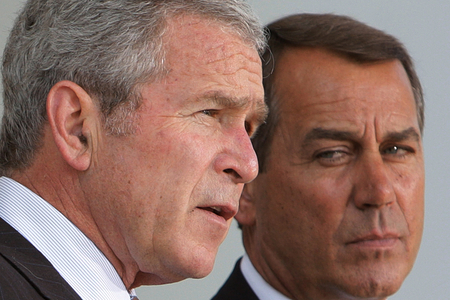
Of course it doesn’t matter that the report simply didn’t say what George Stephanopoulos, David Brooks and the rest of the Villagers Said it did.
The figure they cited wasn’t just out of context and just plain old misleading- it was wrong.
In fact, as the initial AP report noted, the CBO analysis did not take into account all aspects of the recovery plan — while it found that “only $26 billion out of $274 billion in infrastructure spending would be delivered into the economy by the Sept. 30 end of the budget year,” it did not “cover tax cuts or efforts by Democrats to provide relief to cash-strapped state governments to help with their Medicaid bills,” among other provisions. Nonetheless, in echoing aspects of the AP’s original report about the CBO analysis, numerous media figures and outlets left out the fact, reported by the AP, that CBO analyzed only part of the bill.
As the Huffington Post’s Ryan Grim reported in a January 23 article: “[T]he nonpartisan CBO ran a small portion of an earlier version of the stimulus plan through a computer program that uses a standard formula to determine a score — how quickly money will be spent. The score only dealt with the part of the stimulus headed for the Appropriations Committee and left out the parts bound for the Ways and Means or Energy and Commerce Committee.” The article continued: “Because it dealt with just a part of the stimulus, it estimated the spending rate for only about $300 billion of the $825 billion plan. Significant changes have been made to the part of the bill the CBO looked at.”
And it looks like Good Ol’ Ed Henry has taken one for the team in his first Official Reacharound for The Village:
Media Matters:
On the January 23 edition of CNN’s Lou Dobbs Tonight, White House correspondent Ed Henry referred to a “study” from the Congressional Budget Office that Henry claimed “showed” that Obama’s economic stimulus package “may not really stimulate the economy.” Henry later asserted that the study “was suggesting that a lot of the spending proposals in the original plan would not really take effect for a couple of years, so it wouldn’t clearly help create jobs in the first two years of the president’s administration.”
David Brock and the writers and researchers at Media Matters For America have all the details
Sept. 29 (Bloomberg) — The Federal Reserve will pump an additional $630 billion into the global financial system, flooding banks with cash to alleviate the worst banking crisis since the Great Depression.

The Fed increased its existing currency swaps with foreign central banks by $330 billion to $620 billion to make more dollars available worldwide. The Term Auction Facility, the Fed’s emergency loan program, will expand by $300 billion to $450 billion. The European Central Bank, the Bank of England and the Bank of Japan are among the participating authorities.
The Fed’s expansion of liquidity, the biggest since credit markets seized up last year, came hours before the U.S. House of Representatives rejected a $700 billion bailout for the financial industry. The crisis is reverberating through the global economy, causing stocks to plunge and forcing European governments to rescue four banks over the past two days alone.
“Today’s blast of term liquidity will settle the funding markets down, and allow trust to slowly be restored between borrowers and lenders,” said Chris Rupkey, chief financial economist at Bank of Tokyo-Mitsubishi UFJ Ltd. in New York. On the other hand, “the Fed’s balance sheet is about to explode.”
The MSCI World Index of stocks in 23 developed markets sank 6 percent, the most since its creation in 1970. Credit markets deteriorated further as authorities tried to save more financial institutions from collapse.
European Rescue
European governments have rescued four banks in two days and the Federal Deposit Insurance Corp. said today it helped Citigroup Inc. buy the banking operations of Wachovia Corp. after its shares collapsed. The Standard & Poor’s 500 Index fell 3.8 percent and the cost of borrowing dollars for three months rose to the highest since January. The rate for euros hit a record.
“If people think the authorities may give in to fears, they are wrong,” Financial Stability Forum Chairman Mario Draghi said today in Amsterdam, where the international group of regulators and finance officials is meeting. “There is willingness and determination on winning the battle to restore confidence and stability.”
Banks and brokers have slowed lending as they struggle to restore their capital after $586 billion in credit losses and writedowns since the mortgage crisis began a year ago. The bankruptcy of Lehman Brothers Holdings Inc. also sparked fears among banks they wouldn’t be repaid by counterparties, driving up the cost of short-term loans between banks.
Funding Risk
“By committing to provide a very large quantity of term funding, the Federal Reserve actions should reassure financial market participants that financing will be available against good collateral, lessening concerns about funding and rollover risk,” the central bank said.
The Bank of England and the ECB will each double the size of their dollar swap facilities with the Fed to as much as $80 billion and $240 billion, respectively. The Swiss National Bank and the Bank of Japan will also double their dollar swap lines, while the central banks in Australia, Norway, Sweden, Denmark and Canada tripled theirs.
All the banks extended their facilities until the end of April 2009.
The Fed is also increasing the size of its three 84-day TAF sales to $75 billion apiece, from $25 billion. That means the Fed will make a total of $225 billion available in 84-day loans. The central bank will keep the sales of 28-day credit at $75 billion.
Special Sales
In addition, the Fed will hold two special TAF sales in November totaling $150 billion so banks can have funding available for one or two weeks over year-end. The exact timing and terms will be determined later, the Fed said. The TAF program began in December, totaling $40 billion.
The bank-rescue plan being debated by Congress today would give the Fed more power over short-term interest rates by providing authority as of Oct. 1 to pay interest on reserves held at the central bank by financial institutions. That would make it easier for the Fed to pump funds into the banking system.
Paying interest on reserves puts a “floor” under the traded overnight rate, which would allow a central bank “to provide liquidity during times of stress” without affecting the rate, New York Fed economists said in a paper last month.
To contact the reporter on this story: Scott Lanman in Washington at slanman@bloomberg.netCraig Torres in Washington at ctorres3@bloomberg.net.
 The New York Herald Sun