MAUREEN DOWD PLAYS CUTESY WITH PATRAEUS WHILE WASHINGTON GAGS OVER NEWSPAPER AD

Stories

PEACHES TIGHTENS THE GIRDLE

Maureen Dowd

Joe Biden didn’t talk that much yesterday for Joe Biden.

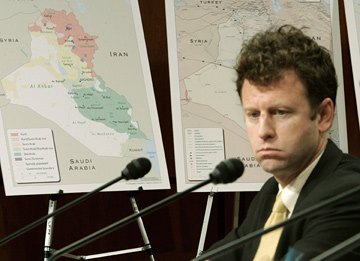
And he told Gen. David Petraeus and Ambassador Ryan Crocker that they shouldn’t talk too much, either, so that members of the Senate Foreign Relations Committee would have time to get in their questions. Even though the senators often didn’t ask questions but simply gave little partisan lectures or told stories about themselves, or in the case of Barbara Boxer, had an aide hold up a blow-up picture of herself with General Petraeus in Iraq.

Nevertheless, Mr. Biden, the committee’s chairman, took time at the end of yesterday’s first hearing with the Surge Twins to make the points, a bit repetitively, that there is no plan to get out of Iraq and that the Bush administration is not leveling with Americans.

John McCain was standing behind Mr. Biden, waiting to sit down for the next hearing — the Armed Services Committee — with the witnesses.

First, the Republican presidential candidate smiled archly at having to cool his heels as the Democratic presidential candidate yakked — sniffing at the Surge that Mr. McCain supports. Then Mr. McCain turned to his G.O.P. colleague Susan Collins and flapped his fingers in the universal hand sign for yakking.

It pretty much said it all.

For months, everyone here has been waiting with great expectations to hear whether the Surge is working from the top commander and top diplomat in Iraq.

But the whole thing was sort of a fizzle. It’s obvious that the Surge is like those girdles the secretaries wear on the vintage advertising show, “Mad Men.” It just pushes the fat around, giving a momentary illusion of flatness. But once Peaches Petraeus, as he was known growing up in Cornwall-on-Hudson, takes the girdle off, the center will not hold.

And it was clear from their marathon testimony that the Iraqi politicians are useless, that we’re going to have a huge number of troops in Iraq for a long time, that there’s no post-Surge strategy, that they’re just playing for time, hoping that somehow, some way, things will look up in the desert maze of demons that General Petraeus referred to as “home.”

The strategy is no more than a soap bubble of hope, just as W.’s invasion of Iraq was based on a fantasy about W.M.D.’s and an illusory view of Iraq.

Even though it was 9/11, Osama was barely mentioned all day.

Republican Senator John Warner, freer than ever now that he’s announced his retirement, turned the screw on the two witnesses.

Do you feel, he asked the general, that the Surge “is making America safer?”

“Sir, I don’t know actually,” Peaches replied. “I have not sat down and sorted out in my own mind.”

The Surge Twins seemed competent and more realistic than some of their misbegotten predecessors, but just too late to do any good. They’re like two veteran pilots trying to crash land the plane.

Ambassador Crocker has expressed a darker, more rueful vision in background briefings with reporters, and he emanated a bit of Graham Greene yesterday.

He noted that the Iraqis know that “they’re going to be there forever,” while we will not.

Pulling troops out too soon, he fears, could “push the Iraqis in the wrong direction. It would make them, I would fear, more focused on, you know, building the walls, stocking the ammunition and getting ready for a big, nasty street fight without us around.”

Asked by Senator McCain if he was confident that the Maliki government will get the job done, the ambassador said dryly: “My level of confidence is under control.”

The star witnesses gave shell game answers, trying to make the best of a hideous hand.

“It’s a hand that’s unlikely to improve in my view,” Hillary Clinton — one of five senators running for president on the two panels — told the Surge Twins. “I think that the reports that you provide to us really require the willing suspension of disbelief.”

Hillary’s plan is to posture and criticize W.’s war all the way to the White House. But then President Clinton will be stuck with figuring out how to pull out the more than 100,000 troops still there policing a lot of crazy sectarian street fighting.

The Republicans seemed happy that the witnesses’ calm presentation bolstered the president’s case for continued war funding. In his speech on Thursday night, W. will be able to accept the recommendations of the Surge Twins, who are only recommending what he wants to hear.

Republicans seemed oblivious to the fact that they may have scored points short term while laying the groundwork for disaster long term. W. won’t care because he’s not running, but it will be political suicide for Republicans entering the campaign with 130,000 troops still in Iraq.

As Lindsey Graham joked to the witnesses about Congress, referring to the talk of the dysfunctional Iraqi government, “You could say we’re dysfunctional and you wouldn’t be wrong.”

New York Times

commentbutton.jpg

BILL MAHER:: THE COMPLETE SHOW 09/07/2007

9/11, Bin Laden, Giuliani


Part One


Part Two


Part Three


Part Four


Part Five


Part Six


Part Seven


NEW RULES


commentbutton.jpg


THE WOOLWORTH BUILDING: Dark Spots Mar an Aging, Yet Exquisite, Face

Stories

THE NEW YORK TIMES

September 9, 2007

Streetscapes | Woolworth Building

09scapexlarge1.jpg

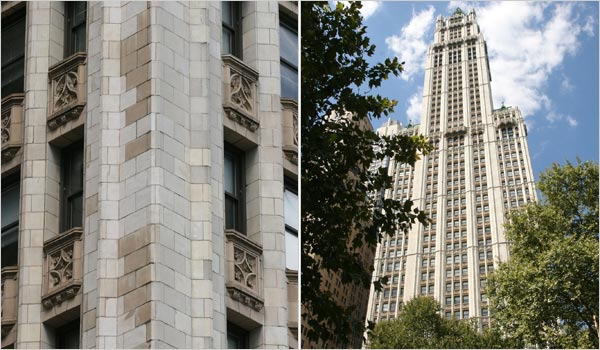
IT’S like a fungus that runs up and down the tower of the Woolworth Building, at Broadway and Park Place. From every angle the cream-colored surface has dirty, discolored patches, the unanticipated consequences of a major restoration project three decades ago.

Frank Woolworth began accumulating his 5-and-10-cent store fortune in 1879, and by 1886 he opened a headquarters in New York City. He was a multimillionaire by 1900, when he built a lacy Gothic-style limestone house at Fifth Avenue and 80th Street, a building demolished in the 1920s.

It was designed by Charles P. H. Gilbert, a mansion specialist who worked up and down the avenue. He also designed the main building of the Jewish Museum, at 92nd Street.

In 1911, Woolworth announced plans for the tallest building in the world, to be constructed on Broadway between Park Place and Barclay Street. Like his house, Woolworth’s new building was to be neo-Gothic and designed by a Gilbert — in this case, Cass Gilbert, who was not related to Charles but was instead an aggressive out-of-towner who had elbowed his way into New York City architecture.

In 1905, Gilbert had designed the boxy Gothic-style West Street Building, at West and Cedar Streets, one of many structures to use the new technology of glazed terra cotta to clad a tall building, and the architect used it as a model for the Woolworth Building.

For Woolworth, Gilbert doubled the size of the 23-story West Street building and then some, to 55 floors, with a pyramidal roof 792 feet high. That topped the 700-foot Metropolitan Life tower, built at Madison Avenue and 24th Street in 1909.

Paul Starrett was one of the contractors bidding on the Woolworth project, and in his 1938 book, “Changing the Skyline,” he recalled trying to persuade Woolworth to use more traditional materials.

“In stone it would be magnificent,” he said, but in terra cotta, “it would look like a 5-and-10-cent store proposition.”

He did not get the job.

The utility of terra cotta was irrefutable: each block of fired clay, usually hollowed out, was a fraction of the weight of brick or stone. The blocks were easily modeled in intricate forms and were protected by a glaze that shed dirt.

A 1912 ad by the Atlantic Terra Cotta Company in The Real Estate Record and Guide boasted, “Cream color in another material would be dark and dirty after a few years’ exposure.”

Unlike many prior skyscrapers, the Woolworth Building was well received by the architectural intelligentsia. It had no raw blank side walls, and the Gothic-style detailing seemed an honest reflection of the new steel-frame technology.

Writing in The Architectural Record in 1913, Montgomery Schuyler particularly admired the way Gilbert adjusted the scale of the ornament. The finials, shields, crockets and other details were not simply giant-sized to look good from a distance but also held up to close view from neighboring buildings.

Compared with European models, “this brand-new American Gothic loses nothing,” Mr. Schuyler said.

But Mr. Starrett’s misgivings were well founded. In his 1938 book he recalled, apparently from years earlier, “the spectacle of the upper part of the Woolworth Building, wired up with metal mesh to catch the falling terra cotta.”

By 1962, The New York Times reported that riggers were repairing broken pieces all year round.

These problems only grew worse, and in the 1970s the Woolworth company retained Ezra D. Ehrenkrantz & Associates (now Ehrenkrantz Eckstut & Kuhn) to examine every one of the 400,000 terra-cotta blocks. The architecture firm found that 25,000 of them needed complete replacement and selected precast concrete instead.

The concrete had a surface coating, meant to be renewed every five years, to shed soil and moisture, like the glaze on the terra-cotta blocks.

Timothy Allanbrook, now a senior consultant at Wiss, Janney, Elstner Associates, an architecture and engineering firm in Northbrook, Ill., worked for Ehrenkrantz at the time and was on and off the scaffolds at the Woolworth Building for three years.

He says the prescription for periodic resealing has not been followed, so the porous concrete has been absorbing water and dirt for years. He suspects that the concrete has absorbed so much dirt that it cannot be cleaned sufficiently so that it matches the original terra cotta, which may leave another replacement as the only option.

Mr. Allanbrook said that 30 years ago, the terra-cotta industry was in decline, making concrete “the optimal choice in a narrow field of imperfect choices.”

Now, terra cotta has seen a resurgence, so the original material could be a reasonable replacement, Mr. Allanbrook said; so could newer materials like concrete reinforced with glass fiber.

Roy Suskin, a vice president of the Witkoff Group, the building’s owner, declined to discuss the problem and any plans for remedying it.

THE CONTINUED MADNESS OF TOM FRIEDMAN

Stories

ANOTHER SIX MONTHS FRIEDMAN AT IT AGAIN

One of the most troubling lessons of the Iraq invasion is just how empty the Arab dictatorships are. Once you break the palace, by ousting the dictator, the elevator goes straight to the mosque. There is nothing in between — no civil society, no real labor unions, no real human rights groups, no real parliaments or press. So it is not surprising to see the sort of clerical leadership that has emerged in both the Sunni and Shiite areas of Iraq.

But this is not true in northern Iraq, in Kurdistan. Though not a full-fledged democracy, Kurdistan is developing the key elements of a civil society. I met in Erbil with 20 such Kurdish groups — unions, human rights and political watchdogs, editors and women’s associations. It is worth studying what went right in Kurdistan to understand what we still can and can’t do to promote democratization in the rest of Iraq and the Arab world.

The United States played a critical role in Kurdistan. In 1998, we helped to resolve the Kurdish civil war — the power struggle between two rival clans — which created the possibility of a stable, power-sharing election in 2005. And by removing Saddam, we triggered a flood of foreign investment here.

But that is all we did. Today, there are almost no U.S. soldiers or diplomats in Kurdistan. Yet politics here is flourishing, as is the economy, because the Kurds want it that way. Down south, we’ve spent billions trying to democratize the Sunni and Shiite zones and have little to show for it.

Three lessons: 1) Until the power struggle between Sunnis and Shiites is resolved, you can’t establish any stable politics in southern Iraq. 2) When people want to move down a progressive path, there is no stopping them. When they don’t, there is no helping them. 3) Culture matters. The Kurdish Islam is a moderate, tolerant strain, explained Salam Bawari, head of Kurdistan’s Democracy and Human Rights Research Center. “We have a culture of pluralism,” he said. “We have 2,000 years of living together with people living around us.” Actually, there are still plenty of Arab-Kurdish disputes, but there is an ethos of tolerance here you don’t find elsewhere in Iraq.

While visiting Kurdistan, I read a timely new book, “Democracy’s Good Name: The Rise and Risks of the World’s Most Popular Form of Government,” by my friend Michael Mandelbaum, a foreign affairs expert at Johns Hopkins University. It is highly relevant to America’s democracy project in Iraq and beyond.

Mr. Mandelbaum argues that democracy is made up of two elements: liberty and popular sovereignty. “Liberty involves what governments do” — the rule of law, the protection of people from abuses of state power and the regulations by which government institutions operate, he explains. Popular sovereignty involves how the people determine who governs them — through free elections.

What Baghdad exemplifies, Mr. Mandelbaum says, is what happens when you have elections without liberty. You end up with a tyranny of the majority, or what Fareed Zakaria has labeled “illiberal democracy.” Kurdistan, by contrast, has a chance to build a balanced democracy, because it is nurturing the institutions of liberty, not just holding elections.

What the Kurdistan-Baghdad contrast also illustrates, notes Mr. Mandelbaum, is that “we can help create the conditions for democracy to take root, but people have to develop the skills and values that make it work themselves.”

In the southern part of Iraq “you have people who are undemocratic who have a democratic government,” said Hemin Malazada, who heads a Kurdish journalists’ association. “In Kurdistan, you have a democratic government for a democratic people.”

One way a country develops the software of liberty, Mr. Mandelbaum says, is by nurturing a free market. Kurdistan has one. The economy in the rest of Iraq remains a mess. “A market economy,” he argues, “gives people a stake in peace, as well as a constructive way of dealing with people who are strangers. Free markets teach the basic democratic practices of compromise and trust.”

Democracy can fail because of religious intolerance, the curse of oil, a legacy of colonialism and military dictatorship, or an aversion to Western values — the wellspring of democracy. The Middle East, notes Mr. Mandelbaum, is the one region afflicted by all of these maladies. That doesn’t mean democratization is impossible here, as the Kurds demonstrate. But it does mean it’s really hard. Above all, Iraq teaches us that democracy is possible only when people want both pillars of it — liberty and self-government — and build both themselves. We’re miles away from that in Baghdad.

The DC Establishment versus American public opinion-GLENN GREENWALD

Stories

cover1.jpg

  WEIRDO NEOCON DREAMER MICHAEL O’HANLON

By large majorities, Americans distrust Gen. Petreaus’ report and, in general, claims about Progress in Iraq.

GLENN GREENWALD-SALON

Sep. 09, 2007 | (updated below)

The Washington Establishment has spent the last several months glorifying Gen. David Petraeus, imposing the consensus that The Surge is Succeeding, and most importantly of all, ensuring that President Bush will not be compelled to withdraw troops from Iraq for the remainder of his presidency. The P.R. campaign to persuade the country that the Surge is Succeeding has been as intense and potent as any P.R. campaign since the one that justified the invasion itself. While this campaign has worked wonders with our gullible media stars and Democratic Congressional leadership, it has failed completely with the American people.

Ever since the Surge was announced (and allowed) back in January, Conventional Beltway Media Wisdom continuously insisted that September was going to be the Dramatic Month of Reckoning, when droves of fair-minded and election-fearing Republicans finally abandoned the President and compelled an end to the war. But the opposite has occurred.

Democratic Congressional leaders — due either to illusory fears of political repercussions and/or a desire that the war continue — seem more supportive than ever of the ongoing occupation (or at least more unwilling than ever to stop it). They are going to do nothing to mandate meaningful troop withdrawal. Most Republicans are hiding behind the shiny badges of Gen. Petraeus and his typically sunny claims about Progress in Iraq, and they, too, are as unified as ever that we cannot end our occupation.

None of that is notable or surprising to anyone other than our nation’s media stars. It has been depressingly predictable (and predicted) for months that Petreaus would descend on Washington in September, hail the Great Progress we are making, and the entire D.C. Establishment — and more than enough members of both parties — would meekly fall into line and support whatever scheme prevailed at the time for ensuring that we stayed in Iraq through the end of the Bush presidency. The notion of the “Moderate Congressional Republican” who will stand up to the President has long been an absurd Beltway myth, as was the expectation that Democrats in Congress would ever force the President to end the war.

But what is notable about all of this, if not surprising as well, is that the overwhelming majority of the American people now harbor such intense distrust towards our political and media elite that they are virtually immune to any of these tactics. Several polls over the past month have revealed that most Americans do not trust Gen. Petraeus to give an accurate report about Iraq. And a newly released, comprehensive Washington Post-ABC News poll today starkly illustrates just how wide the gap is between American public opinion and the behavior of our political establishment.

The majority of Americans have emphatically rejected the Beltway P.R. campaign of the last several months, and are as opposed more than ever before to the war. Perhaps most remarkably, in light of the bipartisan canonization rituals to which we have been subjected, a strong majority (53-39%) believes that Gen. Petreaus’ report “will try to make things look better than they really are” (rather than “honestly reflect the situation in Iraq”).

Moreover, huge majorities continue to believe that the war was not worth fighting (62-36%) and that the U.S. “is not making significant progress toward restoring civil order in Iraq” (60-36%). Only a small minority (28%) believe the Surge has made the situation in Iraq better, while vast majorities believe it has made no difference (58%) or has made the situation worse (12%). And a sizable plurality continues to believe the U.S. is losing the war (48-34%).

More significantly still, overwhelming numbers of Americans understand what the D.C. Establishment refuses to accept: namely, that even if there are marginal and isolated security improvements, there is still no point in continuing to stay in Iraq. Large majorities want the number of U.S. troops in Iraq decreased (58-39%); believe overwhelmingly that a decrease should begin “right away,” rather than by the end of the year or next year (62-33%); and favor legislation now to compel troop withdrawal by the spring (55-41%).

Yet the “debate” taking place in the Beltway regarding Iraq could not be any further removed from the views most Americans hold, and the war-continuing actions of our political class over the next several weeks will be — yet again — in complete defiance of the pervasive belief in this country that it is long past time to end the war. Just as they do with regard to the realities in Iraq, our political class just pretends that these facts about American public opinion are not true. As but one particularly egregious (though representative) example, this is what Fred Thompson advisor Mary Matalin said last week on the Meet the Press:

MS. MATALIN: Yes, because what we’re seeing for the first time last week, is a majority of people now support and believe that the war can be won.

Matalin’s claim that a majority “believe that the war can be won” is extremely dubious (the Post-ABC Poll found the opposite: that a plurality believes the U.S. will lose the war; only a minority (39%) believes we will win). But Matalin’s claim that “a majority of people now support” the war is just an outright lie.One poll after the next for at least two years has found that Americans overwhelmingly oppose the war and want it to end. But Matalin, a Serious Member in Good Standing of our Beltway Establishment, can go on Meet the Press, sitting there with Tim Russert and her husband and others, and spout lies like this about what Americans think about the war because the D.C. Establishment wants to believe that they are trusted and respected. Matalin also said this about what “Americans believe”:

It does not comport with the critics of the president who say progress is being made, including front-runners Hillary Rodham Clinton and, and Barack Obama. So people are very nuanced about this. They understand not only that it can be won, but that it must be won. They understand the consequences of defeat. Further, two thirds of them trust — and nobody more than the generals — when Petraeus and Crocker come and give their report, that will be the positive time.

These are total falsehoods. Yet The D.C. Establishment, including Democratic Congressional leaders, are wedded to the premise that Gen. Petreaus must not be challenged, that we are making Progress due to the Surge, and that — whatever else is true — compelled withdrawal (i.e., withdrawal before George W. Bush wants to withdraw) is irresponsible and dangerous.In his Washington Post Editorial this morning, Fred Hiatt came as close as he ever has today to admitting that there is no point in continuing to remain in Iraq, rhetorically asking: “If Iraqis are not moving toward political reconciliation, what justifies a continuing commitment of U.S. troops, with the painful sacrifices in lives that entails?” That question answers itself: nothing justifies our ongoing occupation. Yet Hiatt can’t bring himself to follow that premise to its logical conclusion: namely, that withdrawal is the only rational option.

The Establishment is so invested in ensuring that the war they created can be painted as a Success, and even more so in the notion that forced withdrawal is something only the Unserious People advocate, that they will never follow their premise (we are doing nothing good in Iraq) to its logical conclusion (therefore we should force Bush to withdraw whether he wants to or not). And the entire leadership strata of our political class, including Congressional Democrats, either shares those premises and/or are far too weak and afraid to defy them. The war thus continues, and the gap between our political class and American public opinion continues to grow.

In one sense, it is quite unhealthy in a democracy for such a large majority of Americans to so distrust the political and media establishment that they even believe in advance that war reports from our leading General will be nothing more than self-serving and misleading propaganda. But in another, more important sense, when a democracy’s political establishment becomes as rotted and deceitful and corrupt as ours has become — enabling the most unpopular President in modern American history to continue what is so blatantly a senseless war for years and years, in complete defiance of what Americans want — the one encouraging sign is that a majority realizes how corrupt our establishment is and has stopped believing anything they say.

One of the very few governmental institutions that inspired respect among Americans has been the military, and that is still the case. But anyone who becomes a part of our political class, such as Gen. Petraeus, is inherently distrusted. This war has completely eroded the relationship between our Beltway ruling class and the rest of the country. That would normally be something to lament, but in this case, it is something to celebrate. The Beltway ruling class — political and media figures alike — deserves nothing but scorn and distrust. As they spend the next several weeks enabling George Bush to continue this war for as long as he wants, they will earn a lot more of both.

UPDATE: One of the most depressing aspects of this entire Establishment spectacle is how mind-numbingly predictable it all is. Here is what I wrote back in May about what would happen in September. I excerpt this not because I was the only one saying it — to the contrary, virtually every blogger I read was saying the same thing — but only to illustrate how dishonest the DC Establishment is in everything they say and do:

The single greatest and most transparent delusion in our public discourse right now — and that is a distinction for which there is always an intense competition — is that Something Weighty and Significant is Going to Happen In September with regard to the Iraq War.September, you see, is the real turning point, the real Day of Reckoning. Finally, our political elites are going to face the cold, hard truth in an unvarnished and hard-nosed way about The Facts on the Ground. That is the read deadline for George W. Bush. No more leniency for him come September. Republicans, Democrats and their pundit and opinion-making comrades alike have all banded together — strength in numbers — and boldly decreed: “No More.” Either we have Real Progress in September, or that is the end of the line.

That’s what one hears over and over from all of our Serious and Sober Beltway denizens — the ones who advocated the war in the first place and assured us it was going well for the last four years (and therefore have great credibility on such matters). As but just one example, the very serious, sober, smart expert Michael O’Hanlon, bearing the title of Senior Fellow of Foreign Policy Studies at the Brookings Institution, was on Fox News yesterday explaining how “smart” the Democrats were for funding the war with no limits because their real opportunity is September, when — if things are not going well — everyone will support them in imposing real limits.

But all that is going to happen In September is that we are going to await with bated breath for General David Petraeus — he of infallible wisdom, judgment and honesty, and unquestionable objectivity — to descend upon Washington and reveal whether there is Real Progress being made (by him) in Iraq. We are all going to leave partisanship and politics to the side and turn to the source who resides above all of that, the one who can be counted on to speak the Real Truth — General David Petraeus.

And, needless to say, General Petraeus will, cautiously though emphatically, declare that progress is being made, though there is much work that remains to be done. And therefore we must redouble our resolve and stay until The Job is Done. . . .

And with General Petraeus heralded as the Objective Source of Honor to be Trusted, the White House and Congressional Republicans and Fred Hiatt will immediately proclaim that it would be irresponsible and reckless (and terribly unserious) not to continue with our Great Progress, that we should leave such judgments to the Generals on the Ground, not Politicians in Washington. Joe Lieberman and Bill Kristol will warn that anyone who speaks out in dissent at this Important Time of Opportunity is Emboldening Al Qaeda, and General Petraeus will agree.

And in September, when the great (though incomplete) progress is unveiled by General Petraeus, our pundit class will continue their canonization of The General, and thus, that there is Progress in Iraq will be the conventional wisdom which all serious and responsible people recognize (“Finally, after four years of frustration, General David Petraeus, in dramatic testimony before Congress, highlighted the great improvement the U.S. is seeing in its war against Al Qaeda in Iraq”). And a sufficient number of Democrats will either be persuaded by this ritual or will be sufficiently afraid of it to do anything other than let the entire spectacle continue.

The central unyielding truth in our political landscape is that — no matter what — the War in Iraq is not going to end before the end of the Bush presidency. That has been obvious for a very long time, and that is why it is so bizarre to watch the Beltway establishment continue to pretend that there is some Big Decision Day coming in September — the day when Republicans take a stand and our political elite put their foot down.

Nothing has changed. Republicans and media-war-proponents are far too invested in the war to do anything other than claim it is finally going well. And there are more than enough Democrats who either (a) believe we should stay in Iraq indefinitely, (b) perceive political benefits from staying, and/or (c) fear forcing withdrawal.

Kevin Drum recently claimed that Gen. Petraeus “outplayed” bloggers and war opponents by secretly launching a brilliant P.R. campaign — unbeknownst to naive bloggers — to persuade the D.C. establishment that the Surge was Succeeding (“I’ve been thinking about is how badly the liberal blogosphere and the liberal establishment have been outplayed here. . . . We’re only seeing the results of Petraeus’s PR blitzkrieg now. . . . The general has profoundly outplayed the amateurs on their home turf. . . . Bravo, general. Well played”). That is completely wrong.

While our media stars and Democratic politicians may not have been aware of it, most bloggers realized exactly what Gen. Petreaus was doing, and apparently, so, too, did most Americans. It’s the same game that the D.C. Establishment has been playing for four years with regard to the war and it’s anything but difficult to recognize.

— Glenn Greenwald
TIME WARNER TO INTRODUCE 24 NEW ONLINE VIDEO PRODUCTIONS

Stories

THIS IS INTERESTING…..

September 10, 2007

LOS ANGELES, Sept. 9 — In the race to become a major supplier of original video programming to the Web, Warner Brothers has decided to reverse its direction.

The studio, part of Time Warner, plans today to introduce 24 Web productions in a range of formats including minimovies, games and episodic television shows.

But for this latest online push, Warner Brothers has discarded its initial strategy of insisting that advertisers shoulder production costs from the start. Instead, it has decided to finance most projects itself and worry about lining up advertisers to recoup costs later.

“In trying to get the business off the ground,” said Craig Hunegs, executive vice president for business development, “we ended up in a bit of a dance with advertisers about what various projects would look like.”

The shift underlines a growing realization among the big Hollywood studios: Web entertainment is evolving so quickly that they must take on more financial risk to keep up.

So far, Warner and most other traditional studios have tried to lock down a comfortable, low-risk business model before venturing too far online. That approach has slowed them down, delivering a competitive edge to scrappier, upstart production companies.

In the year since Warner moved into original production for the Web, it has delivered just one project: Hardly News, a satirical pop-culture quiz show that had its premiere on Anheuser-Busch’s entertainment Web site, Bud.TV, in April. It failed to gain an audience, although the studio is not giving up on the concept and is weighing new distribution options.

“We may have initially had a narrow view,” said Bruce Rosenblum, president of the Warner Brothers Television Group, which houses the studio’s digital production unit. He is now operating on the idea that as long as the studio churns out quality digital entertainment, advertising dollars will follow.

The slate of short-form Web productions that Warner plans to announce today are already deep in the production pipeline and range across genres including science fiction and animation.

“The Jeannie Tate Show,” created by Liz Cackowski, is a 10-episode series about a neurotic soccer mom who presents a television talk show from her minivan. A puppet comedy for adults from the Jim Henson Company, unofficially titled the Simian Undercover Detective Squad, follows a group of ape investigators.

The comedy projects can hit close to home. A mockumentary titled “Viral,” from Joey Manderino and David Young, looks at the dysfunction that overtakes a digital studio as it tries to come up with the next big online hit.

The studio says that a half-dozen more video projects are in development, including an animated offshoot of “The Wizard of Oz” and an online dating game produced by Lauren Graham of “Gilmore Girls.” Joseph McGinty Nichol, a director of the “Charlie’s Angels” movies who is known as McG, also has a project in the works.

Although Warner is spending more cash up front, executives point out that the combined budget for the 24 projects is less than $3 million, or the approximate cost of one episode of a high-end television drama.

And Mr. Rosenblum has distribution plans for most of its new digital entertainment. RealNetworks has agreed to distribute the Jim Henson project. With other projects, Mr. Hunegs said, programming will appear on Joost and other video portals. Warner plans to sell its digital projects to advertisers through its own media sales unit.

The studio is trying to gain traction in an increasingly crowded field. More than a dozen new production companies are angling for a share of the exploding online video business. Among the upstarts achieving early success are Generate, co-founded by a former Warner executive, and Vuguru, a new media company backed by Walt Disney’s former chief, Michael D. Eisner.

Brent Weinstein, chief executive of 60Frames Entertainment, a digital studio co-founded by the United Talent Agency, said, “We can get things to market a lot quicker than traditional media companies because we aren’t hamstrung by all their legal and rights issues.”

The agency, like most of its rivals, is building an internal unit devoted to scouting up-and-coming creators of Internet content and to securing new media deals for existing clients with the likes of Warner.

Jason U. Nadler, director of UTA Online, said, “Artists know the Web is a great place to both showcase their talent and incubate new ideas without the pressure of delivering a full-blown movie or television hit out of the gate.”

Although Warner’s digital venture, dubbed Studio 2.0, has gotten off to a slow start, the company has emerged as a leader in other areas of Web entertainment.

Mr. Rosenblum announced a deal in May 2006 to allow local television stations that buy reruns of the Warner-produced comedy “Two and a Half Men” to stream the episodes on their Web sites. The studio’s TMZ.com, a Web celebrity tabloid, has grown so popular since its debut in December that Warner will introduce a television spin-off this week.

And Warner’s chief executive, Barry M. Meyer, announced plans last week for a virtual online world populated by animated characters from the company’s library. A spring debut is planned for the site, called T-Works. It will also stream episodes of Hanna-Barbera and Looney Tunes cartoons.

“Some of the announcements you will see from us over the next several months will show how dedicated we are to this business,” Mr. Rosenblum said.

MAUREEN DOWD ON FRED THOMPSON AND THE FATHER FIGURE PHENOMENON

Stories

OLD SCHOOL INANITY
BY MAUREEN DOWD

Dying for a daddy, the Republicans turn their hungry eyes to Fred

Fred Thompson acts tough on screen. And like Ronald Reagan, he has a distinctively masculine timbre and an extremely involved wife.

In his announcement video, Mr. Thompson stood in front of a desk in what looked like, duh, a law office, rumbling reassuringly that in this “dangerous time” he would deal with “the safety and security of the American people.”

As Michelle Cottle wrote in The New Republic, far more than puffy-coiffed Mitt and even more than tough guys Rudy and McCain, the burly, 6-foot-5, 65-year-old Mr. Thompson exudes “old-school masculinity.”

“In Thompson’s presence (live or on-screen),” she wrote, “one is viscerally, intimately reassured that he can handle any crisis that arises, be it a renegade Russian sub or a botched rape case.” But she wondered, was he really “enough of a man for this fight,” or just someone who meandered through life, creating the illusion of a masculine mystique?

Newsweek reported that some close to the Tennessean “question whether moving into the White House is truly Thompson’s life ambition — or more the dream of his second wife, Jeri, a former G.O.P. operative who is his unofficial campaign manager and top adviser.”

It took only two days of campaigning to answer the masculine mystique question. Fred gave an interview to CNN’s John King as his bus rolled through Iowa.

“To what degree should the American people hold the president of the United States responsible for the fact that bin Laden is still at large six years later?” Mr. King asked.

“I think bin Laden is more of a symbolism than he is anything else,” Mr. Thompson drawled. “Bin Laden being in the mountains of Afghanistan or — or Pakistan is not as important as the fact that there’s probably Al Qaeda operatives inside the United States of America.”

Usually, you can only get that kind of exquisitely inane logic from the president. Who does Fred think is sending operatives or inspiring them to come?

Fred is not Ronnie; he’s warmed-over W. President Reagan always knew who the foe was.

Fred followed W.’s nutty lead of marginalizing Osama on a day when TV showed another creepy, fruitcake manifesto by the terrorist, who was wearing what seemed to be a fake beard left over from Woody Allen’s “Bananas” and bloviating on everything from the subprime mortgage crisis to the “woes” of global warming to a Kennedy assassination conspiracy theory to the wisdom of Noam Chomsky to the unwisdom of Richard Perle to the heartwarming news that Muslims have lived with Jews and not “incinerated them” to the need to “continue to escalate the killing and fighting” against American kids in Iraq.

Can we please get someone in charge who will stop whining that Osama is hiding in “harsh terrain,” hunt him down and blast him forward to the Stone Age?

Fred must have missed the news of the administration’s intelligence estimate in July deeming Al Qaeda rejuvenated and “a persistent and evolving terrorist threat” to Americans.

Pressed by Mr. King on the fact that the Bush hawks went after Saddam instead of Osama, Fred continued to sputter: “You — you’re — you’re not served up these issues one at a time. They — they come when they come, and you have to — you have to deal with them.”

Democrats pounced. John Edwards issued a statement saying, “That bin Laden is still at large is Bush’s starkest failure.” John McCain and Rudy Giuliani also stressed the need to take out Osama.

Fred quickly caved on the matter of men in caves. At a rally later in the day he manned up. “Apparently Osama bin Laden has crawled out of his cave long enough to send another video and he is getting a lot of attention,” he said, “and ought to be caught and killed.”

He continued to insist that killing bin Laden would not end the terrorist threat, without realizing that this is true now because, by not catching bin Laden, W. allowed him to explode into an inspirational force for jihadists.

Republicans are especially eager for a papa after their disappointing experiences with Junior. After going through so many shattering disasters, W. seems more the inexperienced kid than ever.

In Australia, the president called Australian soldiers in Iraq “Austrian troops,” and got into a weird to-and-fro on TV with the South Korean president.

W. cooperated with Ropert Draper, the author of a new biography of him, yet the portrait was not flattering. Like a frat president sitting around with the brothers trying to figure out whether to party with Tri-Delts or Thetas, W. asked his advisers for a show of hands last year to see if Rummy should stay on. And W. is obsessed with getting the Secret Service to arrange his biking trails.

“What kind of male,” one of his advisers wondered aloud, “obsesses over his bike riding time, other than Lance Armstrong or a 12-year-old boy?”

-NEW YORK TIMES-

mdowd.jpg

commentbutton.jpg

'Soprano' Michael Imperioli 'baffled' by bomb outside building

Stories

BY TANANGACHI MFUNI, DENIS HAMILL and TINA MOORE


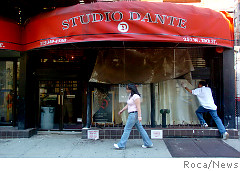
amd_studiodante.jpgImperioli’s theater, Studio Dante.

Bada bing – bada boom!

A Manhattan building owned by “Sopranos” star Michael Imperioli was shaken by an explosion early yesterday when a pipe bomb detonated outside.

Imperioli, who played Tony Soprano’s nephew on the hit HBO series, told the Daily News he was “baffled” by the blast, which did not hurt anyone but terrified several residents.

“I don’t know anything about this bomb in front of my theater,” Imperioli said. “I’m completely baffled.”

Police officials said they were unsure if the 1 a.m. blast had any connection to Imperioli or his performance space, Studio Dante, on the first floor of the building on 29th St. between Seventh and Eighth Aves.

Investigators said Imperioli had been locked in a dispute with a former tenant, but later said the disagreement wasn’t related to the blast. Imperioli said he wasn’t aware of any conflicts with tenants or neighbors.

“I don’t think that’s true,” he said. “You’ll get 10 different stories by the time this is finished.”

Whoever detonated the 2-by-4-inch bomb either planted it or threw it after lighting a fuse, police sources said. The explosion smashed a window of a nearby minivan, sent a large cloud of smoke into the sky and reverberated throughout the midtown neighborhood. The blast drew a large response of firefighters and cops, including officers from the FBI-NYPD Joint Terrorism Task Force. Tenants were evacuated from Imperioli’s four-story building.

“I heard some big explosion and I heard the car alarms in the neighborhood,” said Joe Brockett, 46, an advertising executive who lives in the building. “It was deep; it was not like a little firecracker.”

Mayor Bloomberg declared the blast wasn’t terrorism-related. Several neighborhood streets were closed temporarily as cops searched for other explosive devices.

First-grade teacher Jennifer Russo, 32, who lives two doors down from Imperioli’s building, said she was terrified by the blast. “My heart was pounding,” said Russo, who regretfully missed the first day at Public School 96 in the Bronx because she couldn’t get back into her home.

Flavio Souza, the 51-year-old local resident who owns the red Chevrolet minivan damaged in the blast, slept through the explosion. “It’s very bad these things happen,” said Souza, a bridge painter from Brazil.

Several residents of Imperioli’s building drank at the Molly Wee Pub at 30th St. and Eighth Ave. to pass the time after being forced from their homes.

“It shook the house; it knocked some oyster plates off the wall,” said Ken Holiday, 29, a student at the nearby Fashion Institute of Technology.

Imperioli said there are “drunks and druggies in the area late at night.” He said he had not been stalked or threatened and doesn’t believe he was the target.

Imperioli showed up at his building hours after the blast and did something his mob character would never do: He talked to the cops. “I told them all I know, which is basically nothing,” he said.

“It’s terrible,” he added. “This whole day felt like an hallucination. It’s surreal. … We have the greatest police force in the world. I’m confident they will come up with something.”

tmoore@nydailynews.com

With Peter Kadushin and Erin Einhorn