Broadcatch
B-52 Carrying 5 Nuclear Warheads Mistakenly Flew Across United States
StoriesBREAKING:FROM CROOKS AND LIARS
By: Logan Murphy
 From Americablog:
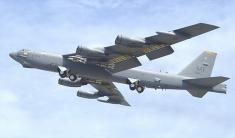
CNN’s Barbara Starr has been breathlessly reporting the news that a B-52, loaded with nuclear warheads, flew across the country last week — without anyone’s knowledge. It has caused quite a stir in the military. Starr reports that Bush had to be informed about the mistake. Here’s an NBC report:
An Air Force squadron commander has been relieved of his command after five nuclear weapons were mistakenly loaded aboard a B-52 and flown cross-country from North Dakota to Louisiana last week, NBC News reported.
Five 150-kiloton warheads were attached to cruise missiles that were flown from Minot Air Force Base in North Dakota to Barksdale Air Force Base in Louisiana to be dismantled, but they should have been removed, according to officials.
Military officials insist the warheads remained “under control” at all times and did not pose a danger.
That’s comforting.
More information as it becomes available.
NEW YORK MAGAZINE::GETTING IT DONE
Stories
THE MAUREEN DOWD "BARACK OBAMA HIT PIECE" IS FINALLY HERE!
StoriesMAUREEN DOWD: The 46-Year-Old Virgin
WASHINGTON
Barack Hussein Obama squinted into the New Hampshire sun to read a new speech on his teleprompter Monday and turned into William Jennings Bryan.
It isn’t a good fit. Obama is many things, but the Great Commoner ain’t one of them. Bryan gave a Cross-of-Gold speech, and Obama gave a Cross-of-Media speech.
The urbane young senator who rules over Chicago society with his wife, Michelle, the glamour boy who has graced more fashionable magazine covers than Heidi Klum, the debonair pol who has wowed crowds at white-tie and black-tie press dinners in D.C., suddenly started ranting about Washington pundits and other jades on the Potomac who don’t appreciate the thrilling loftiness of his message and purifying minimalism of his résumé.
Suddenly, the candidate who had so consciously modeled himself and his wife on J.F.K. and Jackie was a simple rube, fighting the system.
“There are a lot of people who have been in Washington longer than me, who have better connections and go to the right dinner parties and know how to talk the Washington talk,” he told an audience in Manchester.
The smooth jazz senator claiming no facility with “Washington talk” struck a false note. In the traditional Labor Day kickoff to a campaign that has already left us weary of the inauthentic, the shopworn and the hyper-prepped, Obama told voters: “Now, when the folks in Washington hear me speak, this is usually when they start rolling their eyes, ‘Oh, there he goes talking about hope again. He’s so naïve. He’s a hope-peddler. He’s a hope-monger.’ Well, I stand guilty as charged. I am hopeful about America. Apparently, the pundits consider this a chronic condition, a symptom of a lack of experience.”
Actually, the only thing we regard as a symptom of a lack of experience is a lack of experience. This pundit, for one, needs hope as much as any American these days. But the only time I roll my eyes is when my hope is dashed that Obama will boldly take on Hillary, making his campaign more than cameras and mirrors and magazine covers.
The Obama promise was a fresh approach to politics, and now he pulls out the oldest trick in the playbook — the insider-who-pretends-to-be-an-outsider bit, the tactical populist, the sophisticate desperately shedding his sophistication.
I expected more of him than the same outsider routine I’ve heard from other beltway familiars, like Pat Buchanan and Bush senior.
Poppy took off his striped, preppie watchband and talked about his alleged love of pork rinds. (He really liked martinis and popcorn.)
When he ran for president in 1992, Mr. Buchanan claimed to be an outsider, even though he was a Washington native, an aide to three presidents and a D.C. pundit who lived so close to C.I.A. headquarters that his cat kept setting off the security sensors buried in the woods.
Obama doesn’t understand that his new approach — obliquely attacking Hillary by dismissing “those who tout their experience working the system in Washington” — cedes ground to her by admitting she has more experience working the system.
He allows Hillary to present herself as having the experience to be president just because she was married to one. He should be making the opposite case, that Hillary — go ahead, use her name, she won’t bite you, or even if she does, you’ll get over it — knew from nothing about the system.
In the White House, she botched health care and bungled dealing with special prosecutors — remember that talent she had for losing critical files? And in the Senate, she played it safe and became a Democratic Senator Pothole while helping W. launch his disaster in Iraq.
Obama relentlessly recited his credentials to voters in New Hampshire, talking about being a community organizer the way corporate lawyers remind you they were in the Peace Corps.
It’s not his experience that excites people, but his brainy élan. We don’t know about his judgment: good on Iraq, bad on Rezko.
The joke on Obama is that the only experience that has served Hillary well has been the experience of raw, retail politics — the kind he turns up his nose at — which has allowed her to seem authoritative and professional and singularly unwhiny in speeches and debates.
She first tripped up Obama by making him think that every time he fought back he was falling off his pedestal. As one of the Washington pundits Obama has scorned put it, with a grin: “That’s why you have two hands, one to graciously greet your opponents and one to stick the shiv in.”
By conjuring a scenario where Hillary is the deft insider and he’s the dewy outsider, Obama only plays into her playbook again.
To borrow Oscar Levant’s old joke about Doris Day: We knew Obama before he was a virgin.
President Bush thinks he can make “ridiculous” money out on the lecture circuit
StoriesDays before the 2006 election, Robert Draper reports in his fascinating new book, as things were looking bleaker and bleaker for House Republicans, and even the party’s chairman was predicting a G.O.P. defeat, George W. Bush brushed aside such forecasts, telling one of his worried aides that they were all being pessimists. When she protested that she was simply being realistic, he said: “Realist — I like that,” but added, “There’s a fine line between realism and pessimism.”
In “Dead Certain” Mr. Draper — a national correspondent for GQ magazine and a former Texas Monthly editor who wrote a lengthy profile of Mr. Bush, then governor of Texas, in 1998 — draws a detailed portrait, based on six hourlong interviews with the notoriously press-wary president and interviews with some 200 other sources, including Laura Bush, Vice President Dick Cheney, Secretary of State Condoleezza Rice, former Secretary of Defense Donald H. Rumsfeld and the senior adviser Karl Rove.
It is a portrait of the commander in chief as a willful optimist, proud of his self-confidence and convinced that any expressions of doubt would make him less of a leader: a man addicted to “Big Ideas and small comforts” (like riding his bike), a stubborn, even obstinate politician loath to change course or second-guess himself, and given to valuing loyalty above almost everything else.
This overall picture is hardly new, of course, and Mr. Draper’s depiction of the president as an avatar of certainty owes a lot to Ron Suskind’s 2004 portrait of Mr. Bush (which appeared in The New York Times Magazine) and to the portrait Bob Woodward drew in his 2006 book, “State of Denial.” While there are many aspects of the Bush presidency that Mr. Draper completely neglects — there is almost nothing here about executive power, interrogation policy or the treatment of detainees — what “Dead Certain” does do and does very nimbly is give the reader an intimate sense of the president’s personality and how it informs his decision making.
At the same time, it ratifies what many other reporters and former insiders have said about this administration’s ad hoc, often haphazard policy-making process, while suggesting that the West Wing has grown increasingly dysfunctional over the years, with the aides Karl Rove and Dan Bartlett “constantly at war” with each other, and other staff members not on speaking terms.
Already, “Dead Certain” has caused controversy, showing that the blame game in an increasingly embattled administration is already in full play. In the book President Bush is quoted, saying of the much-criticized decision to disband the Iraqi army (a decision many experts say fatally fueled the insurgency): “Well, the policy was to keep the army intact,” adding that it just “didn’t happen.”
In response, his former top envoy to Iraq, L. Paul Bremer III, who issued that fateful order in 2003, has released letters showing that the president was told in advance by Mr. Bremer of a plan to “dissolve Saddam’s military and intelligence structures.”
“Dead Certain” also asserts, almost in passing, that it was John Roberts who suggested Harriet Miers to Mr. Bush as a possible Supreme Court nominee, leading to her disastrous nomination. Chief Justice Roberts denied that report through a court spokeswoman, who said “the account is not true.”
Although the President Bush described in this volume will be familiar to most readers, Mr. Draper colors in the outlines with lots of tiny details. Apparently Mr. Bush loves doing imitations of Dr. Evil from the “Austin Powers” movies. He keeps meticulous count of all the books he’s read. (At one point he tells Mr. Draper he’s up to 87 for the year.) And he’s wildly competitive about his bike riding, eager to show his younger Secret Service companions “who’s The Man” and insistent on burning at least 1,000 calories during each workout.
This is a president who says he cries easily and often about dead and wounded soldiers, a president who Mr. Draper says doesn’t defer, as widely believed, to Vice President Cheney and Mr. Rove (who apparently recommended that Mr. Cheney not be put on the 2000 ticket, arguing, in Mr. Draper’s words, that picking “Daddy’s top foreign-policy guy ran counter to message.”)
Mr. Draper tells us that the president repeated his conviction that Saddam Hussein possessed weapons of mass destruction to his chief of staff, Andrew H. Card Jr., “all the way up until Card’s departure in April 2006, almost exactly three years after the Coalition had begun its fruitless search for WMD’s.”
And he describes Mr. Bush asking for a show of hands at an April 2006 dinner about whether to keep Mr. Rumsfeld on as defense secretary in the face of a downward-spiraling war: Mr. Bush, Mr. Rove, Mr. Bartlett and Stephen J. Hadley, the national security adviser, voted to keep Mr. Rumsfeld on board; Mr. Card, the outgoing chief of staff; Joshua B. Bolten, the incoming chief of staff; and Ms. Rice, among others, voted for Mr. Rumsfeld’s ouster.
The president, who, Mr. Draper repeatedly observes, prizes routine and familiarity, hoped his favorite staff members would be “eight-year men”: “The notion that change was not only good but essential — that once-vital personnel would outlive their usefulness and require culling — ran counter to his impulses.”
It is also clear from Mr. Draper’s book that President Bush dislikes criticism and bad news, and that staffers found it very hard “to stick one’s arm into the fiercely whirring gears of Team Bush’s institutionalized optimism and say, ‘Let’s … slow… down. And rethink this.’ ” For that matter, this volume is studded with examples — on matters ranging from the Iraq war to Hurricane Katrina — of aides failing to deliver distressing information to the president or failing to persuade him to grapple quickly with unfortunate developments.
In her much-criticized role as national security adviser, Ms. Rice, for instance, is described as deciding to be the president’s information broker and sounding board rather than the person, as Mr. Draper puts it, who would ruffle “his feathers with opinions that he did not share.” She is quoted as telling a close friend: “It’s not my exercising influence over him. I’m internalizing his world.”
As other reporters and former administration insiders have frequently observed, dissenting views, be they on Iraq or domestic policy, are rarely solicited by this White House, and Mr. Draper writes that one of Mr. Bush’s most pronounced traits is “an almost petulant heedlessness to the outside world.” Members of the Iraq Study Group told Mr. Draper that they found the president “far more upbeat than the realities in Iraq seemed to warrant,” and that it occurred to one of them that President Bush did not so much want to hear their views as “convince us that we should be writing a report that would reflect his views.”
What’s more, when dissenting views did reach the president, the results could be an obstinate digging in of heels. For example, calls for Mr. Rumsfeld’s resignation from several retired generals in the spring of 2006 elicited this response from Mr. Bush: “No military guy is gonna tell a civilian how to react.” As one aide glumly put it: “The moment someone would say ‘Fire Donald Rumsfeld,’ Donald Rumsfeld would get a new lease on life.”
The best approach to selling the ever-competitive president on an idea, aides told Mr. Draper, was to tell him, “This is going to be a really tough decision.” Mr. Rumsfeld (whose own Big Idea was to “transform” the military and go into Iraq with a lighter, faster force) gave similar advice, telling his lieutenants that if they wanted the president’s support for an initiative, it was always best to frame it as a “Big New Thing.”
Mr. Draper writes that Mr. Bush was “at root a man who craved purpose — a sense of movement, of consequence” and that he was irresistibly drawn to Big Ideas like bringing democracy to the Middle East, Big Ideas that stood in sharp contrast to the prudent small ball played by his father, who was often accused of lacking the “vision thing.”
So what does the current President Bush plan to do after leaving office? At the end of this revealing book, Mr. Draper quotes him saying that he plans to build a “Freedom Institute,” a sort of think tank where young leaders from abroad can learn about democracy. Mr. Bush, who has a net worth estimated at $8 million to $21 million, also said he would like to make some money — “replenish the ol’ coffers,” as he put it.
He said he could : “I don’t know what my dad gets. But it’s more than fifty, seventy-five” thousand dollars a speech.
NUNS WANT BUSH CHENEY IMPEACHED
StoriesA progressive group of U.S. nuns has called on Congress to impeach President Bush and Vice President Cheney because of their roles in the war in Iraq.
“The National Coalition of American Nuns is impelled by conscience to call you to act promptly to impeach President George W. Bush and Vice President Dick Cheney for … high crimes and misdemeanors,” the group wrote in a letter written on behalf of its board members.
The letter says that impeachment is warranted for their “deceiving the public under the false pretense that Iraq possessed weapons of mass destruction” and “destroying” the reputation of the United States and the good will of other nations.
“The time for impeachment is now — before the example of George W. Bush’s regime is set in stone,” they wrote. “Future generations will thank you for preserving the freedom of our nation and its relation to the entire human community.”
The coalition was founded in 1969 for individual nuns dedicated to issues of social justice and human rights.
The letter was approved during a mid-August meeting of the board, held in Chicago. During that same meeting, the board unanimously adopted statements opposing all war and affirming peacemaking efforts. “Rather than continuing support of a just-war theory, a more compassionate church would oppose all war and teach peacemaking skills for all levels of government and interpersonal conflict resolution,” the statement reads.
The board also adopted statements pledging to work to “moderate the impact we make on planet Earth,” and supporting nuclear disarmament and relief efforts for the poor in Africa.
NASCAR RENAMES SERIES TO "SPRINT CUP"
StoriesSources: NASCAR to rename series Sprint Cup
By Marty Smith
ESPN.com

Beginning with the 2008 season, Sprint will replace Nextel as title sponsor of NASCAR’s premiere racing series, multiple high-ranking industry sources told ESPN.com on condition of anonymity. The series will be known as the NASCAR Sprint Cup Series, sources said. NASCAR declined comment. Dean Kessel, Sprint’s NASCAR marketing director, denied the claims, and said Sprint/Nextel is still sorting the proposition out with NASCAR. Kessel also said that multiple outstanding details must be finalized internally before a decision can be made either way. This would mark the third name since 2003 for NASCAR’s Cup Series. From 1972-2003, the Cup Series was sponsored by R.J. Reynolds tobacco through its Winston cigarette brand. Then, starting in 2004, Nextel assumed the naming rights to the most popular racing series in the United States.
Sprint and Nextel agreed to a $36 billion merger in December 2004.
J.J. YELEY TO DRIVE THE #96 CAR FOR HALL OF FAME RACING
StoriesCHARLOTTE, N.C. — Hall of Fame Racing has signed J.J. Yeley to drive for the No. 96 team in the Sprint Cup Series beginning in 2008.
Yeley’s debut in the No. 96 car will come in February’s Budweiser Shootout at Daytona International Speedway. His entry into the prestigious event came via his first career pole at Michigan International Speedway this past June.
“In 23 years of being involved in professional sports, I have worked with many great athletes,” said Jeff Moorad, owner of Hall of Fame Racing. “J.J Yeley’s determination to succeed reminds me of many of the championship athletes that I have been around in my career. He is hungry and determined to win races and championships and to do it with class. We look forward to J.J. being an integral part of Hall of Fame Racing and to winning with him going forward.”
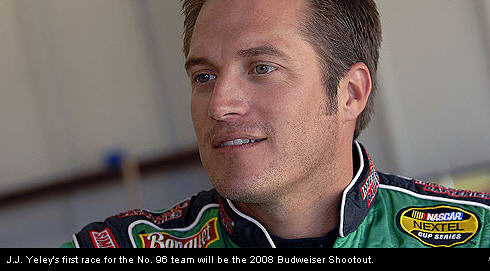
Yeley comes to Hall of Fame Racing from Joe Gibbs Racing, the team for which he drove full time in the Nextel Cup Series beginning in 2006. Yeley will take over for Tony Raines, current driver of the No. 96 Chevrolet, following the conclusion of the 2007 season.
“After meeting with Jeff Moorad and Tom Garfinkel it was easy to see why both of them have been so successful with the Arizona Diamondbacks and their other past ventures,” said Yeley, whose contract with Hall of Fame Racing runs through the 2010 season. “Both of them are very determined to be successful. They know you can’t just come in and throw money at the team and expect to win races. The benefit of this team is that there’s already a great history and foundation in place with equipment from Joe Gibbs Racing, which is equal to the best equipment in the sport. All those things added up to make me feel that Hall of Fame Racing and DLP will be the best fit for me.”
Yeley brings a strong motorsports pedigree to Hall of Fame Racing. The son of seven-time Arizona Midget Racing Association and two-time World of Outlaws midget champion “Cactus” Jack Yeley, J.J. came to stock cars by way of open-wheel midget and sprint cars in the U.S. Auto Club (USAC), and it was his outstanding 2003 season that put him top-of-mind among Nextel Cup car owners.
The second-generation driver from Phoenix reeled off an amazing 24 USAC wins in 2003, breaking the single-season record set by racing legend A.J. Foyt, who won 19 races during the 1961 season. In addition, Yeley became only the second driver in USAC history to win the Triple Crown by capturing the Midget, Sprint and Silver Crown championships in a single season, joining his current Joe Gibbs Racing teammate Tony Stewart as the only other driver to accomplish that feat (1995).
Yeley has two other USAC championships along with an Indianapolis 500 start in 1998. But it’s NASCAR that Yeley now calls home, as his 68 career Nextel Cup starts and 110 Busch Series starts attest.
“When you leave an organization like Joe Gibbs Racing, one of the top teams in NASCAR, you want to try to make the right step to be more successful,” said Yeley, who finished a career-best second in May at the Coca-Cola 600 at Lowe’s Motor Speedway. “I’ve never had to make a decision this difficult in my life, but I’m confident that Hall of Fame Racing will be competitive week-in and week out and build the future team around me as their driver. The affiliation with the Arizona Diamondbacks and the great people in Phoenix was just an added bonus that makes it the perfect fit for me.”
“We are very much looking forward to J.J. representing DLP and our retail partners,” said Dave Duncan, sponsorship marketing manager for DLP Products and Texas Instruments. “We’ve had a relationship with J.J. the past two seasons as an associate sponsor on the No. 18 car and look forward to working with him in the future.”
“It’s been great to see DLP come into the sport,” Yeley said. “I have a TV in my bonus room that’s a 61-inch DLP HDTV that is a favorite of my family. They’re just a great sponsor that I’ve had an affiliation with in the past and I’m looking forward to being a part of this team. I’m really looking forward to the opportunity to take them to Victory Lane.”
Raines has driven for Hall of Fame Racing the past two seasons and will drive the final 11 races in 2007.
“I very much enjoyed working with everyone at Hall of Fame Racing and DLP,” Raines said. “I can’t thank them enough for everything they did for me and both companies are class organizations. We had some success, especially in the Car of Tomorrow races and I look forward to running the final 11 races, including the five COT races. We’re going to do our best to finish out strong before we go our separate ways. I wish them the best of luck in 2008 and beyond.”
Millionaire Missing On Short Flight
StoriesMillionaire Aviator Missing on Short Flight

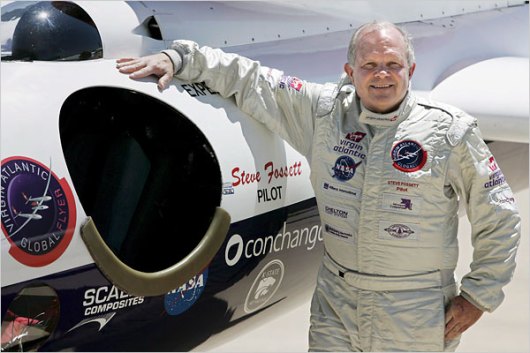
LAS VEGAS, Sept. 5 — A search was under way in the mountainous terrain of western Nevada on Tuesday for Steve Fossett, the millionaire aviator, who disappeared on Monday after taking off from a ranch for a brief recreational flight in a single-engine plane.
Mr. Fossett, 63, took off from a ranch owned by the hotel magnate William Barron Hilton at about 9 a.m. but was expected back by noon to leave the ranch with his wife on a private jet, said Major Cynthia S. Ryan, public information officer of the Civil Air Patrol Nevada Wing.
Mr. Fossett is a veteran aviator known for his quests to set world records. In 2002, on his sixth try, he became the first person to fly around the world uninterrupted in a hot-air balloon. He has an application pending with the federal Bureau of Land Management to allow him to try to break the land-speed record in a jet-powered race car in the northern Nevada desert sometime next year.
Nine aircraft have been searching several hundred square miles for signs of Mr. Fossett or the blue-and-white single-engine Citabria Super Decathlon he was last seen in, Major Ryan said. Mr. Fossett took off heading south from the Flying M Ranch, which is about 90 miles southeast of Reno.
A spokeswoman for the Federal Aviation Administration, Alison Duquette, said that Mr. Fossett’s family had called when he did not return, and that her agency had issued a notice on Tuesday morning to all pilots in the area to look for wreckage.
Among the aircraft used in the search were six Civil Air Patrol Cessna 182 planes, each with three-person crews and helicopters from the Nevada National Guard, the California Highway Patrol and the Naval Air Station Fallon in Fallon, Nev.
“We’re committing federal resources to this mission,” Major Ryan said. “We’d do this for anyone.”
At a news conference Tuesday afternoon, Major Ryan said the plane has a tracking device that can be detected by satellite, but she didn’t know if searchers had gotten any information from it.
Major Ryan said that the weather was clear and wind was light on Monday when Mr. Fossett took off, and that the plane he was in was used the day before by other guests of the ranch. She said technicians at the ranch said it was in “excellent technical condition.”
Major Ryan also noted that Mr. Fossett did not take along a satellite phone or other radio equipment “he would normally take because he only intended to be gone a short while.”
The plane is owned by the Flying M Hunting Club, Inc. It is a fairly simple private plane, with two seats and fixed landing gear. F.A.A. records indicate it was built in 1980 or earlier.
The Flying M Ranch is an exclusive, invitation-only resort popular among wealthy aviators, both amateur and professional.
Even the brave folks at McClatchy fall into the Beltway Brain Drain
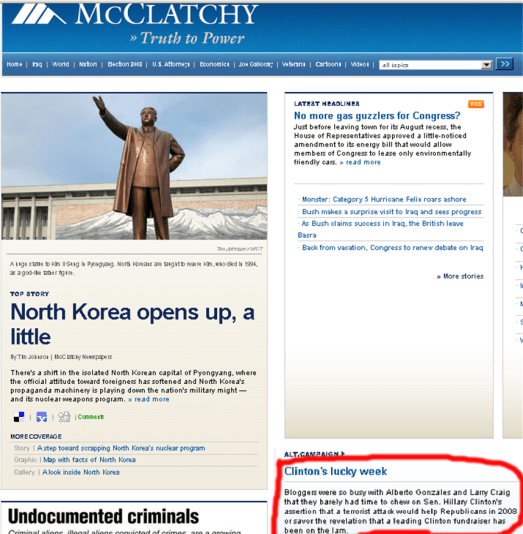
StoriesEven the brave folks at McClatchy fell into the Beltway Brain Drain:
“bloggers too busy with Craig and Gonzales that they ignored HSU”
(see below)
Man, Hillary can’t catch a break from ANYBODY!
Summary: In recent days, NBC, CNN, and Fox News have all aired reports or discussed the case of Norman Hsu, who The Wall Street Journal suggested may have funneled illegal campaign contributions to Sen. Hillary Clinton. However, when Mitt Romney’s national finance committee co-chairman Alan Fabian was charged with mail fraud, money laundering, bankruptcy fraud, perjury and obstruction of justice, the three networks did not report or discuss it during programs available in the Nexis database.

 The New York Herald Sun