
Broadcatch
DALE EARNHARDT JUNIOR TO DRIVE FOR HENDRICK MOTORSPORTS
Stories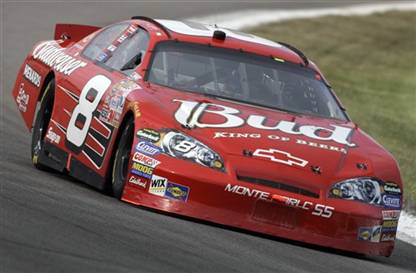
BILL O'REILLY ACCUSES MSNBC OF PLOT AGAINST GEORGE BUSH
9/11, Bin Laden, MSNBC, Rove
IT'S SUBPOENA TIME
Stories

|
Editorial
It’s Subpoena Time
For months, senators have
listened to a parade of well-coached Justice Department witnesses
claiming to know nothing about how nine prosecutors were chosen for
firing. This week, it was the turn of Bradley Schlozman, a former
federal attorney in Missouri, to be uninformative and not credible. It
is time for Senator Patrick Leahy, the chairman of the Judiciary
Committee, to deliver subpoenas that have been approved for Karl Rove,
former White House counsel Harriet Miers and their top aides, and to
make them testify in public and under oath.
Mr. Schlozman was appointed United States attorney in Missouri while
the state was in the midst of a hard-fought Senate race. In his brief
stint, he pushed a lawsuit, which was thrown out by a federal judge,
that could have led to thousands of Democratic-leaning voters being
wrongly purged from the rolls. Just days before the election, he
indicted voter registration workers from the liberal group Acorn on
fraud charges. Republicans quickly made the indictments an issue in the
Senate race.
Mr. Schlozman said it did not occur to him that the indictments
could affect the campaign. That is hard to believe since the Justice
Department’s guidelines tell prosecutors not to bring vote fraud
investigations right before an election, so as not to affect the
outcome. He also claimed, laughably, that he did not know that Acorn
was a liberal-leaning group.
Mr. Schlozman fits neatly into the larger picture. Prosecutors who
refused to use their offices to help Republicans win elections, like
John McKay in Washington State, and David Iglesias in New Mexico, were
fired. Prosecutors who used their offices to help Republicans did well.
Congress has now heard from everyone in the Justice Department who
appears to have played a significant role in the firings of the
prosecutors. They have all insisted that the actual decisions about
whom to fire came from somewhere else. It is increasingly clear that
the somewhere else was the White House. If Congress is going to get to
the bottom of the scandal, it has to get the testimony of Mr. Rove, his
aides Scott Jennings and Sara Taylor, Ms. Miers and her deputy, William
Kelley.
The White House has offered to make them available only if they do
not take an oath and there is no transcript. Those conditions are a
formula for condoning perjury, and they are unacceptable. As for
documents, the White House has released piles of useless e-mail
messages. But it has reported that key e-mails to and from Mr. Rove
were inexplicably destroyed. At the same time, it has argued that
e-mails of Mr. Rove’s that were kept on a Republican Party
computer system, which may contain critical information, should not be
released.
This noncooperation has gone on long enough. Mr. Leahy should
deliver the subpoenas for the five White House officials and make clear
that if the administration resists, Congress will use all available
means to get the information it needs.
Powered by ScribeFire.
VALERIE PLAME TESTIFIES UNDER OATH BEFORE CONGRESS
StoriesI was living in Mendicino when my girlfriend called and said he died and I flipped
Stories
Who’s Got My Extra: Bill Kreutzmann

Bill Kreutzmann, Fort Point, San Francisco, November 1965. Photo by Herbie Greene
For today’s edition of Jerry Garcia
extras, we have an extended jam from Grateful Dead drummer Bill
Kreutzmann, featuring unpublished stories of the first time Kreutz laid
eyes on Garcia, house cleaning on acid and scuba diving. Check your
regulator and get wet.
When I was 15 or 16, my father bought a five string banjo. He
didn’t get into it, so he put in an advertisement to sell the
thing and this guy comes to the door to buy it and it’s Garcia.
That was the first time we ever met. He was hanging out in Palo Alto
with the beatniks. He grew up in San Francisco where his mother owned a
bar. That world tends to make you grow up a lot faster than a
protective home life in Palo Alto. I left home when I was 16, I
couldn’t stand my parents fighting and all that. I wanted to play
music, so I left.
Later [Garcia] was playing in Palo Alto at a club called the Tangent on
University Avenue. I would go there by myself to see what was going on.
He had the jug band—Mother McCree’s Uptown Jug
Champions—and he was playing banjo in that. Bob Weir was playing
guitar and Pigpen was playing washtub bass and I think [Robert] Hunter
was playing something too, probably guitar. I sat there in the audience
and I said, Man, I would follow this guy anywhere. And then not very
long after that I got a phone call and it was him or Bobby and they
said, “Do you want to play drums? We’re switching to
electric.” I was a drummer in Palo Alto. I was always into rock
music, but it was a switch for those guys. It was after Dylan changed
and went electric. I just played with every band that I could get my
hands on, when you first start you say yes to everything.
Early on, before it became impossible, [Garcia] would help people that
were ODing on psychedelics. He would sit down and take the time to talk
to them. Then it became, Holy shit there is not enough hours in the day
to do that. That is probably where that reputation got started, him
being a guru or father figure or whatever. He was a really gentle neat
guy. He had the most loving eyes. He would look at you and you would
feel nothing but love.
When he and I would get high on acid way back in Palo Alto we would
usually end up cleaning house, just me and him. It was the end of the
trip and you’ve come way down, so you want to put it all back
together.
Me and Jerry got certified [for scuba diving] in ’87 together at
Jack’s Dive Locker [in Hawaii]. Before our tests or anything
we’re just diving and having fun, and another dive instructor
comes up to our group and asks Garcia for an autograph under the water.
The reason I moved over here [to Hawaii] is that him and I had a pact
that when the band stopped playing, when there was no more Grateful
Dead, we would both buy places over here. I just kept the promise. The
bands after he left, like the Other Ones, just weren’t the same.
Great players, but they never did the songs quite like he did them.
I was living in Mendicino when my girlfriend called and said he died
and I flipped. I went into shock. I knew he was trying to go clean at
the Betty Ford Center, and he came back and something happened. When
you do stuff like that to your body, all your organs get weak. His body
was ready to go, doggonit. He had kicked a few other times. and one
time he had kicked and we were playing a show at the Shoreline
Ampitheatre near Palo Alto, and he was really wired and it was like
razorblades on your backbone or something. He played so great. He
leaned over and said, “Billy, I’m so nervous.” And I
was like, “You are playing your fucking ass off, shut up.”
I was hoping he would stay like that, but unfortunately that drug pulls
too strong.
I think if he had gotten himself clean again, which it looked like he
was trying to do, he probably would have stopped playing in the
Grateful Dead because I don’t think he really liked the Grateful
Dead at the end there. That’s my honest feeling. I think he was
doing it for money, I didn’t feel he was doing it for the fun
anymore, I don’t think any of us were. I think the last five
years in that band were kind of wasted. You can’t capture the
magic in a box, even if there wasn’t drug problems with any of
the band members and everybody was perfect. The art kind of leaves. The
muse kind of pulls its energy out. My feeling was that he was always
going to play with another band.
Posted in Music | 06/06/2007
Powered by ScribeFire.
Lewis Scooter Libby was sentenced to jail today in Washington D.C.
9/11, RoveLewis Scooter Libby was sentenced to jail today in Washington D.C. for his role in covering up the illegal leaking of a C.I.A. undercover agents’ identity and lying to and misleading federal investigators from the F.B.I. and Justice Department about this activity.
ON WILLIAM SAFIRE'S ASSNESS
9/11, Bin LadenI’m going to remain calm.
But I get physically ill at the thought of this weasel;
cute language columns vs. 625,000 Iraqis dead…
I know I know,,,but we have to start calling the Joe “turning a corner!”Liebermans and William (uh) Safires and Thomas (next 6 months!) Friedmans and David “Mealy Mouthed” Brooks’ on their complete and utter full-of-shitness/wrongness/assness… They were wrong about everything and are still wrong….wrong!
But they’ve just numbed us out with all their antics and just last week the President used the Iraq-Al-Qaeda connection yet AGAIN!
I mean WTF!?
1441!!!!!!!!!!!
P.S.
PLAME WAS UNDERCOVER YOU FUCKING MOTHERFUCKERS!
thanks
JT

The disc of terror : LETTERS TO THE EDITOR
Friday, February 13, 2004
I must take issue with William Safire’s contention that an intercepted document, allegedly written by Abu Musab al-Zarqawi, establishes a clear link between Saddam Hussein and Al Qaeda. (“Saddam’s links to terror, on disc,” Views, Feb. 12) This highly suspect message refers to ongoing and future operations to maintain a destabilized Iraq. It suggests, if anything, that the U.S. invasion and occupation has encouraged terrorist networks to team with Iraqi nationalists in order to focus on a common enemy.
To claim that because Al Qaeda may now be operating in Iraq confirms that the terror network was there under Saddam’s regime is yet another poor attempt to justify President George W. Bush’s pre-emptive war.
Buck Rutledge, Knoxville, Tennessee
Follow our plans : LETTERS TO THE EDITOR
Thursday, January 22, 2004
Thomas Friedman tells the Europeans to let Turkey join the European Union, or else (“Turkey, the EU and history,” Views, Jan. 12). William Safire solves the Kurdish question by telling the Kurds this and the Turks that. (“How to answer the Kurdish question,” Views, Jan. 15).
.There seems to be agreement between the two columnists: The world needs to be told what to do, or else.
Fons van Mourik, Tannay, Switzerland
William Safire, minister of disinformation
The New York Times runs corrections when reporters get a middle initial wrong. So why does its conservative columnist get away with glaring errors that shape world affairs?
By Barry Lando
Pages 1 2
February 21, 2004 | With daily revelations of how the White House made use of faulty intelligence to bolster its political agenda, the media is also beginning to examine its own role in the affair. There’s plenty to examine: Take, for instance, William Safire and the New York Times, frequently cited as a conduit for official disinformation.
A recent example was his trumpeting of the sensational charges published last November in the Weekly Standard, a conservative magazine. The article proved, according to Safire, “that Saddam Hussein’s spy agency and top al-Qaida operatives certainly were in frequent contact for a decade, and that there is renewed reason to suspect an Iraqi spymaster in Prague may have helped finance the 9/11 attacks.” Those charges were based on the leak of a secret memorandum from Douglas Feith, a senior Pentagon official, to the U.S. Senate Intelligence Committee.
Safire had been pounding on the Prague connection since November 2001, two months after the 9/11 terror attacks. Fired anew by the Weekly Standard’s story, he fired off two imperious columns of his own, demanding action from FBI Director Robert Mueller and the Senate Intelligence Committee. “I’d also assign new agents to follow up leads in Prague,” he advised.
“Intrepid journalists,” Safire assured his readers, “will ultimately bring the full story of the Saddam-bin Laden connection to light. In the meantime, the F.B.I. should stop treating 9/11 as a cold case.”
Sounds pretty sensational indeed, except for the fact that the Pentagon immediately issued an unusual statement declaring that reports claiming that the new information proved there had been contacts between al-Qaida and Iraq “are inaccurate.”
Further, the Pentagon continued, the leak “was deplorable and may be illegal.”
The memo consists mainly of 50 excerpts drawn from raw intelligence reports from four U.S. agencies from 1990 to 2003. They are vague, mostly unsourced and far from conclusive. Indeed, according to several retired intelligence officers, the memo represents the same kind of ideological cherry-picking of intelligence that led to the U.S. invasion of Iraq in the first place.
In short, the original headline-making conclusions are now seen by most to be threadbare. But not to Safire, who has made no mention of the Pentagon denials and remains incredulous that anyone might doubt the charges.
That, of course, is vintage Safire. Which might be fine if he were writing for a small town paper in Northern Maine. But the fact is that, whether Times editors like it or not, for most readers, Safire’s charges also carry the weighty validation of the planet’s most important newspaper of record. It’s a problem the Times has yet to face.
I speak from the experience of looking into three Safire columns attacking France.
Countries cannot sue for libel. Otherwise, France would have quite a case against Safire and the Times. Safire’s wild charges in a three-column barrage last year helped to deepen the war-related alienation between the U.S. and France. And though erroneous, they have entered the realm of historical verity — and remain there to this day, thanks to the Times.
What is particularly outrageous is that Safire and his sources were allowed to continue their campaign using the Times and the International Herald Tribune as their podium — even though the editors of both papers had been advised that the charges didn’t hold water.
Further, according to Times policy, neither Safire nor his editors are under any obligation whatsoever to correct those errors.
Safire’s main accusation was that French companies, with the knowledge of French intelligence services, helped supply vital rocket fuel components to Saddam.
As a former producer for 30 years with CBS’ “60 Minutes,” I looked into Safire’s claim. I concluded that his story was based more on Francophobia than fact, built on flimsy evidence and biased reporting.
Safire’s case has two parts. The first is that a French trader, CIS Paris, was the key intermediary enabling a Chinese company, Qilo Chemicals, to ship a product known as HTPB to Iraq. HTPB is used as a “binder” for solid rocket propellants. His charge is based on quotes from an exchange of e-mails, leaked to Safire from “an Arab source.” The most damning message was sent Sept. 4, 2002. In that e-mail, James Crown of Qilo Chemicals wrote, “Thank you for your order to our HTPB-III! We just have sent a 40′ container to Tartous (Syria) last month.”
According to Safire, the chemical was received there by a trading company that was an intermediary for the Iraqi missile industry, the end user. The HTPB was then trucked across Syria to Iraq. According to Safire, it was the French connection — CIS Paris — that made the whole deal possible.
CIS Paris president Jean-Pierre Pertriaux makes no secret of his long-term relationship with Iraq, including brokering materials destined for military ends, like HTPB. He also admits having contacted the Chinese company, Qilo Chemicals. Like many such brokers, he skirts the law. By acting only as a go-between, strictly speaking, he would not be breaking any French or European export regulations, if the HTPB were not exported from France.
But the key point is that, according to Pertriaux, he was never able to consummate the deal for HTPB. When contacted by phone, James Crown of Qilo also claimed he’d never completed the sale.
What about the e-mails cited by Safire?
Read in their entirety, they make no sense, one sentence contradicting the next. Indeed, carefully analyzed, the whole convoluted exchange of e-mails quoted by Safire doesn’t hold together, which may be why Safire quotes sparingly from them.
Safire also noted that Pertriaux claimed the deal with Qilo Chemicals was never consummated, but there was no way that denial would blunt his attack.
His target wasn’t a single French trader but the government of France. CIS Paris, he charged, would never have been able to pursue its trade without the knowledge of French intelligence. “French intelligence has long been aware of it,” he wrote.
Safire was right on that point, but totally wrong on his conclusions. In July 2002, both the U.S. State Department and the Defense Intelligence Agency warned France of CIS Paris’ attempts to purchase various products for Iraq’s arms industry. The French immediately investigated CIS’s activities but found nothing illegal. They requested more information from the United States — information that might permit France to intercept any eventual delivery.
The U.S. authorities never replied.
“We’re still waiting,” says a French source close to the investigation.
TWO

So why did the deal between Qilo Chemical and CIS Paris never go through? Because, despite the lack of response from the U.S., the French continued to monitor CIS Paris’ activities and, in August 2002, when it looked as if CIS Paris was about to make a firm order, the authorities warned CIS Paris to back off. “There are many different ways to exert pressure,” says the French source.
It wasn’t just one private French broker involved with Saddam’s rocket program, Safire continued, but firms controlled by the French government itself.
“I’m also told,” he wrote, again with no attribution, “that a contract was signed last April in Paris for five tons of 99 percent unsymmetric dimethylhydrazine, another advanced missile fuel, which is produced by France’s Societe Nationale des Poudre [sic] et Explosifs (SNPE). In addition, Iraqi attempts to buy an oxidizer for solid propellant missiles, ammonium perchlorate, were successful, at least on paper.”
The Times’ columnist concluded his vitriolic attack: “Perhaps a few intrepid members of the Chirac Adoration Society, formerly known as the French media, will ask France’s lax export-control authorities about these shipments.”
The French government immediately investigated Safire’s charge. The conclusion: SNPE exported neither product to Iraq, nor to any Middle Eastern country — other than the state of Israel.
I submitted an Op-Ed piece to the Times ticking off the many serious flaws in Safire’s column. Within hours, editor David Shipley replied that under Times policy, the Op-Ed page did not run pieces that quarrelled with its own columnists. He didn’t question the points I made in my article. He suggested I write a brief letter to the editor.
Fine, I thought, can’t argue with New York Times policy, but at least they’d been advised of the errors in Safire’s report. I also e-mailed Safire saying I’d found problems with his column and would like to talk with him. There was no reply.
Just a few hours later, though, the Times published another vitriolic Safire salvo, “French Connection II,” continuing the same erroneous blather about the French and Saddam’s rocket fuel, this time targeting President Chirac.
Now the Times, like most newspapers, maintains that pieces on its Op-Ed page represent the personal views of their columnists. Their relationship is with the publisher, Op-Ed editor David Shipley told me, not with the editors. They are not subject to the same meticulous checking as more mortal Times reporters.
That lack of editorial oversight may make for provocative columns, but most readers don’t recognize such fine distinctions, which is understandable. Particularly when, as in the case of those Safire columns, we were not presented with opinion but opinion disguised as investigative reporting — in reality a pretense, a caricature of investigative reporting. One would expect such explosive charges to be subject to the Times’ famous editorial checks and balances.
But one would be wrong.
With the imprimatur of his august paper, Safire’s charges were picked up by newspapers and Internet sites around the globe, and consecrated as fact “reported in the New York Times.” They fueled the firestorm against the French — and they continue to do so.
I wrote a rebuttal that was published in Le Monde and by Tompaine.com. The Times bureau in Paris immediately asked for a translation of the Le Monde article and I thought that ended the matter. I had demonstrated that Safire’s charges were seriously flawed, if not completely false. At the very least, I had given the Times editors the specific facts behind my charge that they were giving Safire’s wild fiction a totally undeserved platform. No one from the Times contacted me or questioned my article.
Incredibly — at least as I saw it — a few days later, the Times published yet another column by Safire, continuing his same fabricated charge; this time, he challenged the CIA to reveal what it knew about France’s role in shipping rocket fuel to Iraq. (Why won’t the CIA tell all? Aha, another government coverup!)
The next day, Safire’s column ran in the International Herald Tribune, as had the first two Safire attacks against France. The editors there also knew Safire’s charges had gaping holes, but they had no choice in the matter. Since the paper is owned by the Times, its editors are required to republish the Times’ star columnists without question.
As Walter Wells, the managing editor of the IHT wrote me: “It’s apparent that Safire — like Krugman or Friedman — has free rein in his columns, even when he’s dead wrong.”
This is not the first time William Safire has been accused of mistaking fiction for fact, floating charges based on information leaked by unnamed high-level sources. After the World Trade Center attack, it was Safire who claimed as “undisputed fact” that, just five months prior to 9/11, Mohamed Atta had met secretly in Prague with a top-ranking Iraqi intelligence officer. In the supercharged months following 9/11, that accusation was the journalistic equivalent of tossing a lighted match into a powder keg, bolstering the case of those pushing for the U.S. to topple Saddam.
Over the following months, however, other more serious reporters found that Safire’s reporting was, once again, flimsy at best. It was based on erroneous information from Czech intelligence, and was finally denied by Czech President Vaclav Havel himself. But the best evidence of Safire’s ongoing error was that Colin Powell, desperate to demonstrate even the shakiest link between al-Qaida and Saddam, made no mention of that supposed Prague meeting to build the U.S. case before the United Nations
Safire, typically, has never backed down, inventing one conspiracy after another to explain away the Czech denials. The truth about Atta, Safire promised — and the French rocket fuel companies — would be uncovered once U.S. forces had taken Baghdad and had access to all those secret files and Iraqi officials. Well, the U.S. forces have been there now for months, and we’re still waiting. Now, he announces, he’s found proof of the Atta-Iraq connection in the memo leaked to the Weekly Standard. The memo, you’ll recall, that the Pentagon called inaccurate.
And this is the New York Times, mind you, a paper that regularly runs a “Corrections Box” to fess up to the most picayune of inaccuracies, from an incorrect middle initial to the misspelling of a company name — but not to innuendo and error on its Op-Ed page.
Recently, editor David Shipley wrote a piece attempting to explain the makeup of the Times Op-Ed page. I thought that was an ideal opening to submit another article. Using the Safire anti-French diatribes as case in point, I suggested it was a bit too much to expect the average reader to comprehend that while the Times stands behind the facts on its news pages, it can set a much lower standard for the “facts” presented by its columnists.
Shipley suggested I send the piece instead to Times ombudsman, Dan Okrent. Okrent, in reply, said I raised some interesting points which, one day, he might deal with.
On Feb. 15, in an astonishing admission, Okrent wrote that one issue that has attracted his attention is “whether columnists should be free, as they are now, to decide whether and when to publish corrections of their own mistakes.”
Is all of this old history? Not really. Just Google “Safire” and “France.” You’ll find scores of sites around the world that still carry Safire’s venomous opinions as indisputable fact, backed by the credibility of the New York Times.
Police Drummer Stewart Copeland Calls Reunion Show “Unbelievably Lame”
StoriesWe are the mighty Police and we are totally at sea.”

“It usually takes about four or five shows in a tour before you get to the disaster gig,” Police drummer Stewart Copeland writes on his blog
(yes, he has a blog). “But we’re The Police so we are a
little ahead of schedule.” Thus reads the self-eviscerating post
in which the drummer describes exactly how bad the band’s
much-heralded reunion shows have been sounding to him. He explicitly
details his take on the band’s second major reunion show in
Vancouver with a blow-by-blow of his onstage musings (read Charles
Cross’ review of the first show here). Oh, and he calls Sting a “petulant pansy.” Here are our favorite snippets from Copeland’s post:
- “I collect myself in the dark and
start to warm up the gong with a few gentle taps. But I’m
overdoing it. It’s resonating and reaching it’s crescendo
before the stage has fully reached its position. Sort of like a
premature ejaculation. There’s nothing for it so I take a big
swing for the big hit. Problem is, I’m just fractionally too far
away and the beater misses the sweet spot and the big pompous opening
to the show is a damp squib. Never mind.”
- “I stride manfully to my drums. Andy
has started the opening guitar riff to MESSAGE IN A BOTTLE and the
crowd is going nuts. Problem is, I missed hearing him start. Is he on
the first time around or the second? I look over at Sting
and he’s not much help, his cue is me – and I’m lost.
Never mind. “Crack!” on the snare and I’m in, so
Sting starts singing. Problem is, he heard my crack as two in the bar,
but it was actually four – so we are half a bar out of sync with
each other. Andy is in Idaho.” - “There is just something wrong. We
just can’t get on the good foot. We shamble through the song
[”Synchronicity”] and hit
the big ending. Last night Sting did a big leap for the cut-off hit,
and he makes the same move tonight, but he gets the footwork just a
little bit wrong and doesn’t quite achieve lift-off. The mighty
Sting momentarily looks like a petulant pansy instead of the god of
rock.” - “We get to the end of the first verse
and I snap into the chorus groove — and Sting doesn’t.
He’s still in the verse. We’ll have to listen to the tapes
tomorrow to see who screwed up, but we are so off kilter that Sting
counts us in to begin the song again. This is ubeLIEVably lame. We are
the mighty Police and we are totally at sea.” - “In rehearsal this afternoon we
changed the keys of EVERY LITTLE THING and DON’T STAND SO CLOSE
so needless to say Andy and Sting are now on-stage in front of twenty
thousand fans playing avant-garde twelve-tone hodgepodges of both
tunes. Lost, lost, lost. I also changed my part for DON’T STAND
and it’s actually working quite well but there is a dissonant
noise coming from my two colleagues.” - “When we meet up back-stage for the
first time after the set and before the encores, we fall into each
other’s arms laughing hysterically. Above our heads, the crowd is
making so much noise that we can’t talk. We just shake our heads
ruefully and head back up the stairs to the stage. Funny thing is, we
are enjoying ourselves anyway. Screw it, it’s only music. What
are you gonna do? But maybe it’s time to get out of
Vancouver…”
Powered by ScribeFire.
Denny Doherty, a founding member of the 1960s folk-pop band the Mamas and the Papas, dead at 66
StoriesDenny Doherty, a founding member of the 1960s folk-pop
band the Mamas and the Papas, died yesterday at his home in
Mississauga, Ontario. He was 66.The cause was not immediately known, his daughter Emberly said. But
she said her father had recently suffered kidney failure after surgery
for a stomach aneurysm.With chiming guitars and rich, meticulous harmonies that could be
tinged with darkness, the Mamas and the Papas became one of the most
popular and influential American bands of the era between the Beatles’
arrival and Woodstock. Their enduring hits, like “California Dreamin’,”
“Monday, Monday” and “Dedicated to the One I Love,” mixed the gentle
jangle of folk with a rock backbeat and sweet, layered pop vocals.
NYTimes:
Powered by ScribeFire.
 The New York Herald Sun