Brian De Palma interrupted at NY Film Festival Press Conference
This is a “fair use” issue.
Broadcatch
If a powerful op-ed falls in a forest…
StoriesIf a powerful op-ed falls in a forest…
By: Steve Benen August 21st CROOKS AND LIARS DOT COM
After the Michael O’Hanlon/Ken Pollack op-ed appeared in the NYT a few weeks ago, the political response was overwhelming. It was read, repeatedly, on the floor of Congress; it was cited frequently by administration officials and its ideological allies; and O’Hanlon and Pollack became fixtures on the talking-head shows. The piece, and the story behind, was practically ubiquitous.
Flash forward a few weeks. A couple of days ago, the NYT also published an op-ed from seven infantrymen and noncommissioned officers with the 82nd Airborne Division, who will soon be returning home frustrated and jaded. The piece, “The War as We Saw It,” was a sweeping condemnation of everything we’ve heard of late from the Kristol-McCain-Lieberman-O’Hanlon-Pollack crowd.
Surely, given the vast coverage of the O’Hanlon/Pollack piece, the powerful perspective of these heroes would be immediately picked up everywhere, right? Wrong. Greg Sargent explained, that the op-ed “has been met with near-total silence.”
Bill Maher :: September 28 2007:: Tullycast
StoriesEfforts to crack down on lead paint thwarted by China, Bush Administration
StoriesPOSTED::Tue, Aug. 21, 2007::
Kevin G. Hall | McClatchy Newspapers
WASHINGTON — The Bush administration and China have both undermined efforts to tighten rules designed to ensure that lead paint isn’t used in toys, bibs, jewelry and other children’s products.
Both have fought efforts to better police imported toys from China.

UNRELATED DOUCHEBAG JOE SCARBOROUGH
Now both are under increased scrutiny following last week’s massive toy recall by Mattel Inc., the world’s largest toymaker. The recalls of Chinese-made toys follow several other lead-paint-related scares since June that have affected products featuring Sesame Street characters, Thomas the Train and Dora the Explorer.
Lead paint is toxic when ingested by children and can cause brain damage or death. It’s been mostly banned in the United States since the late 1970s, but is permitted in the coating of toys, providing it amounts to less than six hundred parts per million.
The Bush administration has hindered regulation on two fronts, consumer advocates say. It stalled efforts to press for greater inspections of imported children’s products, and it altered the focus of the Consumer Product Safety Commission (CPSC), moving it from aggressive protection of consumers to a more manufacturer-friendly approach.
“The overall philosophy is regulations are bad and they are too large a cost for industry, and the market will take care of it,” said Rick Melberth, director of regulatory policy at OMBWatch, a government watchdog group formed in 1983. “That’s been the philosophy of the Bush administration.”
Today, more than 80 percent of all U.S. toys are now made in China and few of them get inspected.
“We’ve been complaining about this issue, warning it is going to happen, and it is disappointing that it has happened,” said Tom Neltner, a co-chairman of the Sierra Club’s national toxics committee.
The recent toy recalls — along with the presence of lead in vinyl baby bibs and children’s jewelry — are prompting the Bush administration to take a deeper look at the safety of toys and other imported products.
President Bush has asked the Department of Health and Human Services to report in September on ways to better ensure safe imports. He’s also asked the Centers for Disease Control and Prevention to consider responses to lead paint threats to children.
But as recently as last December, the Sierra Club sued the Bush administration after the Environmental Protection Agency rebuffed a petition to require health and safety studies for companies that use lead in children’s products. The EPA and Sierra Club settled out of court in April, with the administration agreeing to write a letter to the CPSC that expressed concern about insufficient quality control on products containing lead.
The Sierra Club’s interest in lead paint in children’s products grew out of the largest-ever CPSC-conducted recall. That action on July 8, 2004, targeted 150 million pieces of Chinese-made children’s jewelry sold in vending machines across the United States. Since 2003, the commission has conducted about 40 recalls of children’s jewelry because of high levels of lead.
In March 2006, a 4-year-old Minnesota boy died of lead poisoning after swallowing a metal charm that came with Reebok shoes. The charm was found to contain more than 90 percent lead.
From 1994 until 2001, Ann Brown headed the CPSC under Presidents Clinton and Bush. She didn’t push for an outright ban on lead in all children’s products, partly because China’s rise to export prowess hadn’t yet unfolded.
“Today, I would say there should be an outright ban in any lead in any toy product,” she said in a telephone interview. “If I were at CPSC now, I’d say that trying to recall (tainted products) is like picking sand out of the beach — it’s just not possible.”
Before leaving her post, Brown unsuccessfully pushed for pre-market testing of children’s products. The idea largely died when the Bush administration took over, said Brown, who’s working with Sen. Hillary Clinton’s presidential campaign. The CPSC has only 100 field inspectors to police problems with all products sold to more than 301 million Americans. None of the inspectors are stationed in China or anywhere else abroad.
China remains very much under the microscope. It’s fighting a CPSC proposal to bring the lead restrictions in children’s jewelry to the same levels as those imposed on toys and furniture — six hundred parts per million, which effectively amounts to a ban.
“We have done recall after recall since 2003. We would like to move towards a ban and make the marketplace safe,” said Scott Wolfson, a commission spokesman.
But in a March 12 filing, China was the only one of 48 interested parties to tell the panel that it opposed new restrictions on lead paint in children’s jewelry. Guo LiSheng, the deputy director of a Chinese global trade agency, warned against “unnecessary obstacles to trade” and advocated international rules that allow some lead content. He added that good product labeling was sufficient.
“We agree with the viewpoint of USA of protecting the children’s healthy and safety. And we consider that the method of stick warning mark on the children’s metal jewelry … may be more efficient than setting the limit of lead content,” LiSheng wrote from Beijing.
Of the 400 or so product recalls this year, about 60 percent involve products made in China, according to commission statistics.
In response to the toy recalls and tainted products, China announced last Friday the creation of a government panel on product safety. The government appointed Wu Yi, the vice premier and China’s top problem-solver, to head the panel.
Outside a Toys-R-Us store in Maryland’s capital city of Annapolis, Bruce Waskmunski suggested it was a no-brainer that lead should be completely banned from children’s products. He’s angry about the June recall of a Chinese-made Thomas the Train wooden toy that he bought his son.
“The only thing lead paint is in now (in the United States) is 40- or 50-year-old buildings,” he grumbled. “We’ve known about lead paint for years, but we’re giving away the penny to China.”
To read Sierra Club’s initial request for the Bush administration to monitor lead, click here: Sierra Club request.
To read the EPA’s settlement with Sierra Club, click here: EPA settlement.
2007 McClatchy Newspapers
A$*HOLES OF REPORTING: BASHING BLOGGERS BECOMING BIG
Stories08.19.07 — 8:16PM
For
a variety of reasons I try to stay out of the debates over blogs as
such, what they’re good or bad at and the rest. But this morning I was
alerted to an opinion column in the Los Angeles Times by Michael Skube,
a journalism professor at Elon University. The sum of the piece is that
the blogosphere is as rife with disputation as it is thin on
information, or more specifically, reporting, writing that demands “time, thorough fact-checking and verification and, most of all, perseverance.”
Now, fair enough. There’s certainly no end of blog pontificating
fueled by puffed-up self-assertion rather than facts. But Skube’s piece
reads with a vagueness that suggests he has less than a passing
familiarity with the topic at issue. And I will confess to you that
what really caught my attention was that in a column bewailing how
blogs don’t do any real reporting one of the four bloggers he mentioned
was me.
Now, whether we do any quality reporting at TPM is a matter of
opinion. And everyone is entitled to theirs. So against my better
judgment, I sent Skube an email telling him that I found it hard to
believe he was very familiar with TPM if he was including us as
examples in a column about the dearth of original reporting in the
blogosphere.
Now, I get criticized plenty. And that’s fair since I do plenty of
criticizing. And I wouldn’t raise any of this here if it weren’t for
what came up in Skube’s response.
Not long after I wrote I got a reply: “I didn’t put your name into
the piece and haven’t spent any time on your site. So to that extent
I’m happy to give you benefit of the doubt …”
This seemed more than a little odd since, as I said, he certainly
does use me as an example — along with Sullivan, Matt Yglesias and
Kos. So I followed up noting my surprise that he didn’t seem to
remember what he’d written in his own opinion column on the very day it
appeared and that in any case it cut against his credibility somewhat
that he wrote about sites he admits he’d never read.
To which I got this response: “I said I did not refer to you in the
original. Your name was inserted late by an editor who perhaps thought
I needed to cite more examples … “
And this is from someone who teaches journalism?
Perhaps I’m naive. But it surprises me a great deal that a professor
of journalism freely admits that he allows to appear under his own name
claims about a publication he concedes he’s never read.
Actually, if you look at what he says, it seems Skube’s editor at the Times
oped page didn’t think he had enough specific examples in his article
decrying our culture of free-wheeling assertion bereft of factual
backing. Or perhaps any examples. So the editor came up with a few
blogs to mention and Skube signed off. And Skube was happy to sign off
on the addition even though he didn’t know anything about them.
I grant you that the blogosphere needs better bloggers. But, as usual, the need for better critics seems even more acute.
Talking Points Memo | Annals of Reporting
Powered by ScribeFire.
"I hate all Iranians" declares American Official
StoriesBritsh MPs visiting the Pentagon to discuss America’s stance on Iran and Iraq were shocked to be told by one of President Bush’s senior women officials: “I hate all Iranians.”
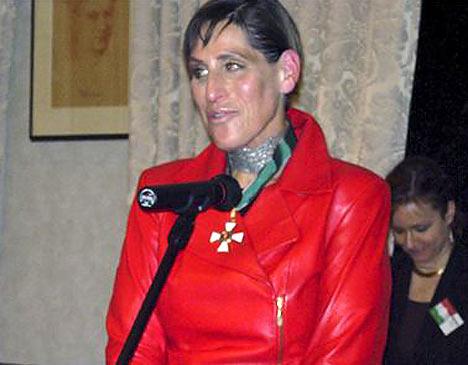
And she also accused Britain of “dismantling” the Anglo-US-led coalition in Iraq by pulling troops out of Basra too soon.
The all-party group of MPs say Debra Cagan, Deputy Assistant Secretary for Coalition Affairs to Defence Secretary Robert Gates, made the comments this monthThe six MPs were taken aback by the hardline approach of the Pentagon and in particular Ms Cagan, one of Mr Bush’s foreign policy advisers.
She made it clear that although the US had no plans to attack Iran, it did not rule out doing so if the Iranians ignored warnings not to develop a nuclear bomb.
It was her tone when they met her on September 11 that shocked them most.
The MPs say that at one point she said: “In any case, I hate all Iranians.”
Although it was an aside, it was not out of keeping with her general demeanour.
“She seemed more keen on saying she didn’t like Iranians than that the US had no plans to attack Iran,” said one MP. “She did say there were no plans for an attack but the tone did not fit the words.”
Another MP said: “I formed the impression that some in America are looking for an excuse to attack Iran. It was very alarming.”
Tory Stuart Graham, who was on the ten-day trip, would not discuss Ms Cagan but said: “It was very sobering to hear from the horse’s mouth how the US sees the situation.”
Ms Cagan, whose job involves keeping the coalition in Iraq together, also criticised Britain for pulling out troops.
“She said if we leave the south of Iraq, the Iranians will take it over,” said one MP.
Another said: “She is very forceful and some of my colleagues were intimidated by her muscular style.”
The MPs also saw Henry Worcester, Deputy Director of the Office of Iranian Affairs, who said he favoured talks with Iran.
The Pentagon denied Ms Cagan said she “hated” Iranians.
“She doesn’t speak that way,” said an official.
But when The Mail on Sunday spoke to four of the six MPs, three confirmed privately that she made the remark and one declined to comment. The other two could not be contacted.
I Will Never Take This Water bottle Camping
Stories
Scorsese to direct George Harrison documentary
Stories
 VIA YAHOO
Thu Sep 27,
Filmmaker Martin Scorsese plans to
direct an authorized documentary about George Harrison, the
former Beatle who died of lung cancer in 2001, Daily Variety
reported on Thursday.
Interviews and early production will begin this year, and
the film will take several years to complete, the trade paper
said.
“It would have given George great joy to know that Martin
Scorsese has agreed to tell his story,” the paper quoted
Harrison’s widow, Olivia, as saying.
She will serve as a producer of the untitled project, and
will supply archival materials. Daily Variety added that
surviving Beatle members Paul McCartney and Ringo Starr would
participate, as would the Beatles’ Apple Records label.
Scorsese, who won an Oscar this year for directing the
crime saga “The Departed,” is preparing for the April 2008
release of a concert documentary about the Rolling Stones,
called “Shine A Light.” He turned his attention to Bob Dylan in
the 2005 documentary “No Direction Home,” and depicted the
Band’s farewell concert in 1976’s “The Last Waltz.”
The Harrison movie will cover his time in the Fab Four,
when he composed such memorable tunes as “Something” and “Here
Comes the Sun,” his inconsistent solo career, his foray into
movie production with such projects as “Monty Python’s Life of
Brian,” and his enthusiastic embrace of Eastern mysticism,
Daily Variety said.
“George Harrison’s music and his search for spiritual
meaning is a story that still resonates today and I’m looking
forward to delving deeper,” Scorsese was quoted as saying.
Tullycast
Powered by ScribeFire.
Dissing D.C.
StoriesStill no vibrant urban core. Height restrictions and the inevitable
scarity of affordable Class A commercial office space have encouraged
businesses that might otherwise be inclined to locate in the city out
to the suburbs, and even beyond into ex-urban hells like Loudoun and
Charles counties. Long workdays bracketed by exhausting commutes back
and forth to these outer suburbs. Rise of faux town centers in
otherwise indistinguishable places like Reston, Ballston, Rockville,
Bethesda, and Silver Spring serve to pull people out of the city at
night and encourage them to stay out on the weekends. Disproportionate
representation of current and ex-military in the metropolitan area who
still hear Taps playing in their heads every night at 9:30 pm. Downtown
business base of government, accounting/auditing, lobbying, trade
association, and national and international law firms not known for
attracting the, shall we say, bohemian demographic that demands your
“urban perks”. Lingering perceptions that the District still annually
vies with Detroit for the title of Murder Capital of the United States.
Georgetown, an area that might otherwise attract your “wealthy, single,
young people”, is limited by the absence of Metro service, the
surrounding neighborhood’s well-known and powerfully expressed aversion
to noise, fun and other signs of life, and the sense that the whole
place stopped being cool about 40 years ago. That ridiculous “Capital
of the Free World” ethos that demands long hours at the
department/agency/bureau/institute/office in the service of freedom
just isn’t conducive to lots of down time.
I am sure there are others
Powered by ScribeFire.
HILLARY IS A POLITICIAN! AMERICA SHOCKED….SHOCKED I TELL YOU
Stories
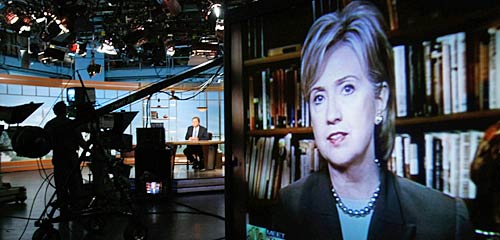
In a rare feat, the Democratic front-runner appears on all five major Sunday programs, discussing Iraq and her health plan.
By Jim Puzzanghera
Los Angeles Times Staff Writer
September 24, 2007
WASHINGTON —
Sen. Hillary Rodham Clinton reinforced her position as the
Democratic presidential front-runner Sunday as she executed the rare
feat of appearing on all five major TV talk shows in one morning,
defending her new healthcare proposal and vowing to oppose any Iraq war
funding unless it is tied to starting a U.S. troop withdrawal.
“I will not vote for any funding that does not move us toward beginning
to withdraw our troops, that does not have pressure on the Iraqi
government to make the tough political decisions that they have, that
does not recognize that there is a diplomatic endeavor that has to be
undertaken,” the New York Democrat said on “Fox News Sunday.”
President Bush plans to ask Congress this week for nearly $200 billion to fund the war through the end of next year.
Clinton — who holds a 22-point lead over her closest rival, Sen.
Barack Obama of Illinois, in the latest national Gallup Poll on the
Democratic presidential field — did not criticize her opponents for
the party nomination. Instead she focused on her general-election
prospects, highlighting her success in winning Republican and
independent votes in her two Senate races.
“Anyone who gets the Democratic nomination is going to be subjected to
the withering attacks that come from the other side,” Clinton said on NBC’s “Meet the Press.” “I think I’ve proven that I not only can survive them but surpass them.”
Appearing on “Fox News Sunday” for the first time
in more than three years — and almost exactly a year after former
President Bill Clinton had an angry confrontation on the show with host
Chris Wallace over attempts in the 1990s to capture Osama bin Laden —
the senator laughed loudly when asked why she and her husband “have
such a hyper-partisan view of politics.”
“Well, Chris, if you had walked even a day in our shoes over the last
15 years, I’m sure you’d understand,” she said. “But you know, the real
goal for our country right now is to get beyond partisanship, and I’m
sure trying to do my part, because we’ve got a lot of serious problems
that we’re trying to deal with.”
Clinton took to the airwaves Sunday after unveiling her long-awaited
healthcare proposal, the American Health Choices Plan, last week. It
would require everyone to have medical insurance and would offer tax
credits to those who can’t afford it. Half of the program’s
$110-billion-a-year price tag would come from savings she says she can
squeeze from the current healthcare system, which she calls bloated and
inefficient. The rest would come largely from repealing tax cuts for
those earning more than $250,000 a year.
“It is not only a moral imperative that we try to cover everyone, it is
now an economic necessity,” she said on “Meet the Press.”
Clinton dismissed criticism from Republican presidential candidate
Rudolph W. Giuliani that her healthcare plan amounted to “socialized
medicine.” She said it created no new federal bureaucracy and addressed
a crucial problem.
“I’m waiting for any Republican candidate to come out with a plan
that can be really scrutinized, that we can ask hard questions about,”
she said on ABC’s “This Week.” “It seems as though they’re in the ‘just say no’ category, and I don’t think that’s good for the country.”
But Iraq was the focus of much of the interviews. Clinton again
defended her 2002 vote authorizing the use of military force against
Iraq. Many antiwar activists have called for her to apologize for that
vote.
“I cast a sincere vote based on my assessment at the time, and I take
responsibility for that vote,” she said on “Meet the Press.”
She continued: “It’s fair to say that the president misused the
authority that he was given, and if I had the opportunity to act now
based on what I know now, I never would’ve voted that way.”
Clinton also would not directly criticize the liberal group MoveOn.org
for its recent full-page ad in the New York Times referring to Army
Gen. David H. Petraeus, the U.S. commander in Iraq, as “General Betray
Us.” Republicans condemned the ad, and Bush said Democrats were afraid
to criticize the group because of its liberal clout.
“I don’t condone attacks by anyone on the patriotism and service of our military,” Clinton said on CNN’s “Late Edition.”
“But let’s be clear here. This debate should not be about an ad. This
debate should be about the president’s failed policies.”
Asked on CBS’ “Face the Nation” whether her husband would have a policy role if she is elected president, Clinton responded, “No. No.”
“Among the many lessons that I have learned, we want to be sure that
the president, my husband, does whatever he can, just as I tried to do
whatever I could, and I think he has a very special and important role
in reaching out to the rest of the world,” she said.
Appearing on all five major Sunday talk shows — the political
equivalent of hitting for the cycle in baseball — is known among TV
producers and political operatives as a “full Ginsburg,” after the
first person to pull it off, Southern California attorney William H.
Ginsburg. He made the circuit on Feb. 1, 1998, in defense of his client
Monica S. Lewinsky, the onetime White House intern at the center of a
Bill Clinton sex scandal.
Ginsburg had to scurry from studio to studio that day; Clinton taped her appearances from her home in Chappaqua, N.Y.
Only high-profile guests in the midst of major news events have the
cachet for the five-show circuit. Those who have done it include
then-vice presidential nominee Dick Cheney during the 2000 Republican
convention; Sen. Joe Lieberman of Connecticut, then the Democratic vice
presidential candidate, during the 2000 Florida recount; and
then-Secretary of State Colin L. Powell during a nuclear weapons
showdown with North Korea in 2002. Giuliani and then-Rep. Rick Lazio
(R-N.Y.) also did it in 2000 in their race against Clinton for the
Senate.
Powered by ScribeFire.
 The New York Herald Sun