"Britney is fat!" "GOTCHA!": On Chuck Hagel, Jim Lehrer And The Iraq War

Stories

pm.png

JT

I remember that dreary fall of 2002 when Jim Lehrer would have Chuck Hagel and Richard Lugar and Joe Biden on about once a week to repeat again and again and again how the initial “defeat” of Iraq’s “forces” could be and probably would be accomplished quite easily.

The problem, they practically shouted (I recall the very mellow Dick Lugar just bristle with disdain at some assbite’s analysis from one of the neocon think-tanks) was Securing The Peace after our precision bombs had taken out the “valuable targets” they had.

It seems to me that the same “Americans” who are just so gosh darned fed up with this war while at the same time don’t seem to know and/or care about what exactly it is that we’ve wrought over there, ought to think about all their bluster and bullshit and preoccupation with some missing little girl in Utah (Elizabeth Smart-remember her?) or Michael Jackson holding his kid over a balcony or how smooth and powerful that handsome Donald Rumsfeld looked yesterday at one of his wonderful press conferences….

“Gotcha” America was and is constantly preoccupied with the latest scandal and you can always count on Larry King to do a roundtable discussion about what exactly went wrong with Lindsey Anna Nicole Paris Hasselhoff; televise the bickering of parents Alec Balwin and Kim Bassinger or spend a week with wall-to-wall coverage of a bathroom misdemeanor setup…

GOTCHA! Britney is fat! GOTCHA!

I remember that there were many voices at that time, literally screaming about the dangers and pure folly of invading Iraq,  including Mohammed El Baradi, Hans Blix and Scott Ritter among others.
Chuck Hagel has always stuck in my mind because of his unwavering statements about the disaster this folly could produce.

But I can’t get the image out of my mind of Congressman John Conyers trying to hold hearings on the “Downing Street Memos” back in June of 2005, when the Republicans were still stifling all dissent, and being relegated to the basement of the Capitol. (Longworth?)

For the last six years, Democrats tried to hold this Bush Administration accountable for a myriad of transgressions only to be obstructed at every turn.

Now the fickle American public, oblivious to the fact that we’ve probably killed a million Iraqis, just want to “get out of there” and scream at the Democrats to stop the war immediately. Those darned Democrats, that’s the problem; or the classic: “It’s both parties really” (Note: “No, it’s the Republicans who created and cheer lead this beastly effort- you don’t get to now, finally, start including the Dems in this mess)

Did you see the hissyfit that the Beltway mob threw about the Move On advertisement? Enough said.

Sheesh….

Chuck Hagel On Real Time With Bill Maher :: September 14, 2007 ::

Joe Scarbourough still can’t shake his past

Stories

Why has Lori Klausutis’ Death Been Swept Under the Rug?


This article is the first in a series on TRUTHOUT which will present the known facts and raise some questions about this strange and tragic case.

Part I: Congressional Aide Found Dead in Congressman’s Office

By Jennifer Van Bergen

t r u t h o u t | January 4, 2001 – Remember the news back in July that Lori Klausutis, an aide to U.S. Representative Joe Scarborough (R-FL), was found dead in the congressman’s District Office in Fort Walton Beach, Florida?

If you don’t, that’s because the news came and went in the blink of an eye.

130px-joe_congress.jpg

Wait. Did you get that? A congressman’s aide. Dead. In the congressman’s office. No witnesses.

And the media were all but silent.

While the Condit/Levy story ran rampant in the national press for weeks on end, the Scarborough/Klausutis story got barely nine lines in the Associated Press and only one line in The Washington Post.

Does it make you wonder?

Wait until you hear the rest of the story. It has all the elements of a good murder mystery.

* The congressman (an ardent and vocal supporter of G.W., by the way) resigns only six months after re-election, just prior to his aide’s death. The reason: amid rumors of marital infidelity, the recently-divorced husband wants to spend more time with his sons.

* A medical examiner who had his license revoked in another state. Why? He lost it falsifying autopsies.

* The medical examiner’s supervisor had contributed thousands of dollars to the congressman’s election campaign.

* Contradictory reports about whether there is a visible head injury or not.

* A medical conclusion that contains several inconsistencies. First, that Mrs. Klausutis, who was a marathon runner, died of a cardiac arryhthmia. Second, that although she had suffered a fractured skull and a “contracoup” bruise on the opposite side of the brain, the injury could not possibly have been caused by a physical assault.

* Then there’s the question of whether the office was locked and the lights were on. One report says the door was locked and the lights were off; another report says the door was unlocked and the lights were on.

* And if all this weren’t enough, there’s the scientist husband who does high level weapon design work for the Air Force.

These are only the more obvious elements of the case. And this is not newsworthy enough for the press?

To be fair, the local press, the Northwest Florida Daily News, thought it was newsworthy for a few weeks. They published several short but good pieces and made a public records request for the police and medical reports. However, after the paper published the autopsy findings — which concluded that Lori Klausutis fainted, fell and hit her head on the desk — which effectively closed the police investigation, the paper had little more to go on. Furthermore, some local citizens accused the paper of “sensationalizing” the story. So, the story died.

In fact, however, the news stayed alive on various message boards on the internet and two intrepid journalists did do some excellent research which was published online, but amazingly, no major paper or television network even mentioned the story. Why?

That question is perhaps unaswerable. But it should be raised, along with all the many other questions that arise in this case. This series intends to review the facts and raise these questions.

“Absolutely no evidence of foul play”

Mrs. Klausutis was found dead in Rep. Joe Scarborough’s Fort Walton Beach office at about 8:10 a.m. on July 20 by Juanita and Andreas Bergmann, who claim they had an appointment that morning with Rep. Scarborough to facilitate Mr. Bergmann’s application for a green card. Mr. Scarborough, however, was still in Washington, D.C. and flew home only later that day.

The day after Mrs. Klausutis was found, the police said there was no evidence of “foul play or trauma to her body.” The following day, having performed his autopsy and while waiting for the results of blood tests, Dr. Michael Berkland, the medical examiner, told the press that there was “absolutely no evidence” that Lori was “a victim of ‘foul play.’” By July 26, although Berkland had still not received the toxicology results, which he noted would likely play a key role in determining whether Ms. Klausutis had died of natural causes or accidentally, Berkland stated that he had “ruled out homicide.” While he said he didn’t think that suicide was a likely scenario either, he stated that he was also investigating it as a possibility.

Finally, on August 6, Berkland released the autopsy. Oddly, although the police had originally stated that there were no signs of trauma, Berkland acknowledged that Klausutis had sustained a “scratch and bruise” on her head which had been noted in the original death investigation. His explanation for having lied to the press was to “prevent undue speculation” about the cause of death.

Berkland determined that Lori, an avid runner who ran fivemiles a day, had a prolapsed mitral valve which caused a sudden cardiac arrhythmia — an irregular heartbeat — which in turn caused Lori to faint “in midstride,” and hit her head on the desk. How Berkland came up with this theory is unknown since the medical report contains no description of the death scene, no diagram of the location of the body, or its posture or appearance as Berkland first observed it on the morning of July 20th..

Early on in the investigation, there were rumors that Ms. Klausutis had suffered from previous health problems, but her family issued a statement contradicting this.

Thus, in the very first chapter of this story, several questions arise. How could a healthy, physically fit, 28-year-old woman suddenly “faint” of a previously undetected heart problem? How could the police, with no witnesses, and knowing from the outset that Ms. Klausustis had sustained a bruise to the head, determine that there was no evidence of an attack? If Rep. Scarborough had an appointment with the Bergmann’s, why was he still in Washington, D.C.? Or was he? Why did the police and medical examiner lie to the public about the existence of visible signs of head trauma? They lied to the public so easily. Could they have lied about other things, as well? Given their later reluctance to pursue the case or release any information whatsoever about it, this lie may indicate a less-than-honest handling of the case.

FRANK RICH GETS ON BOARD THE DEMOCRAT BASHING MEME : "CAN'T BLAME PUBLIC FOR CHANGING CHANNEL"

Stories

 Will the Democrats Betray Us?
By Frank Rich
The New York Times
    Sunday 16 September 2007

    “Sir, I don’t know, actually”: The fact that America’s surrogate commander in chief, David Petraeus, could not say whether the war in Iraq is making America safer was all you needed to take away from last week’s festivities in Washington. Everything else was a verbal quagmire, as administration spin and senatorial preening fought to a numbing standoff.

    Not that many Americans were watching. The country knew going in that the White House would win its latest campaign to stay its course of indefinitely shoveling our troops and treasure into the bottomless pit of Iraq. The only troops coming home alive or with their limbs intact in President Bush’s troop “reduction” are those who were scheduled to be withdrawn by April anyway. Otherwise the president would have had to extend combat tours yet again, mobilize more reserves or bring back the draft.

    On the sixth anniversary of the day that did not change everything, General Petraeus couldn’t say we are safer because he knows we are not. Last Sunday, Michael Scheuer, the former chief of the C.I.A.’s Osama bin Laden unit, explained why. He wrote in The Daily News that Al Qaeda, under the de facto protection of Pervez Musharraf, is “on balance” more threatening today that it was on 9/11. And as goes Pakistan, so goes Afghanistan. On Tuesday, just as the Senate hearings began, Lisa Myers of NBC News reported on a Taliban camp near Kabul in an area nominally controlled by the Afghan government we installed. It is training bomb makers to attack America.

    Little of this registered in or beyond the Beltway. New bin Laden tapes and the latest 9/11 memorial rites notwithstanding, we’re back in a 9/10 mind-set. Bin Laden, said Frances Townsend, the top White House homeland security official, “is virtually impotent.” Karen Hughes, the Bush crony in charge of America’s P.R. in the jihadists’ world, recently held a press conference anointing Cal Ripken Jr. our international “special sports envoy.” We are once more sleepwalking through history, fiddling while the Qaeda not in Iraq prepares to burn.

    This is why the parallels between Vietnam and Iraq, including those more accurate than Mr. Bush’s recent false analogies, can take us only so far. Our situation is graver than it was during Vietnam.

    Certainly there were some eerie symmetries between General Petraeus’s sales pitch last week and its often-noted historical antecedent: Gen. William Westmoreland’s similar mission for L.B.J. before Congress on April 28, 1967. Westmoreland, too, refused to acknowledge that our troops were caught in a civil war. He spoke as well of the “repeated successes” of the American-trained South Vietnamese military and ticked off its growing number of combat-ready battalions. “The strategy we’re following at this time is the proper one,” the general assured America, and “is producing results.”

    Those fabulous results delayed our final departure from Vietnam for another eight years – just short of the nine to 10 years General Petraeus has said may be needed for a counterinsurgency in Iraq. But there’s a crucial difference between the Westmoreland show of 1967 and the 2007 revival by General Petraeus and Ambassador Ryan Crocker. Westmoreland played to a full and largely enthusiastic house. Most Americans still supported the war in Vietnam and trusted him; so did all but a few members of Congress, regardless of party. All three networks pre-empted their midday programming for Westmoreland’s Congressional appearance.

    Our Iraq commander, by contrast, appeared before a divided and stalemated Congress just as an ABC News-Washington Post poll found that most Americans believed he would overhype progress in Iraq. No network interrupted a soap opera for his testimony. On cable the hearings fought for coverage with Britney Spears’s latest self-immolation and the fate of Madeleine McCann, our latest JonBenet Ramsey stand-in.

    General Petraeus and Ambassador Crocker could grab an hour of prime television time only by slinking into the safe foxhole of Fox News, where Brit Hume chaperoned them on a gloomy, bunkerlike set before an audience of merely 1.5 million true believers. Their “Briefing for America,” as Fox titled it, was all too fittingly interrupted early on for a commercial promising pharmaceutical relief from erectile dysfunction.

    Even if military “victory” were achievable in Iraq, America could not win a war abandoned by its own citizens. The evaporation of that support was ratified by voters last November. For that, they were rewarded with the “surge.” Now their mood has turned darker. Americans have not merely abandoned the war; they don’t want to hear anything that might remind them of it, or of war in general. Katie Couric’s much-promoted weeklong visit to the front produced ratings matching the CBS newscast’s all-time low. Angelina Jolie’s movie about Daniel Pearl sank without a trace. Even Clint Eastwood’s wildly acclaimed movies about World War II went begging. Over its latest season, “24” lost a third of its viewers, just as Mr. Bush did between January’s prime-time address and last week’s.

    12policy-600.jpgYou can’t blame the public for changing the channel. People realize that the president’s real “plan for victory” is to let his successor clean up the mess. They don’t want to see American troops dying for that cause, but what can be done? Americans voted the G.O.P. out of power in Congress; a clear majority consistently tell pollsters they want out of Iraq. And still every day is Groundhog Day. Our America, unlike Vietnam-era America, is more often resigned than angry. Though the latest New York Times-CBS News poll finds that only 5 percent trust the president to wrap up the war, the figure for the (barely) Democratic-controlled Congress, 21 percent, is an almost-as-resounding vote of no confidence.

    Last week Democrats often earned that rating, especially those running for president. It is true that they do not have the votes to overcome a Bush veto of any war legislation. But that doesn’t mean the Democrats have to go on holiday. Few used their time to cross-examine General Petraeus and Ambassador Crocker on their disingenuous talking points, choosing instead to regurgitate stump sentiments or ask uncoordinated, redundant questions. It’s telling that the one question that drew blood – are we safer? – was asked by a Republican, John Warner, who is retiring from the Senate.

    Americans are looking for leadership, somewhere, anywhere. At least one of the Democratic presidential contenders might have shown the guts to soundly slap the “General Betray-Us” headline on the ad placed by MoveOn.org in The Times, if only to deflate a counterproductive distraction. This left-wing brand of juvenile name-calling is as witless as the “Defeatocrats” and “cut and run” McCarthyism from the right; it at once undermined the serious charges against the data in the Petraeus progress report (including those charges in the same MoveOn ad) and allowed the war’s cheerleaders to hyperventilate about a sideshow. “General Betray-Us” gave Republicans a furlough to avoid ownership of an Iraq policy that now has us supporting both sides of the Shiite-vs.-Sunni blood bath while simultaneously shutting America’s doors on the millions of Iraqi refugees the blood bath has so far created.

    It’s also past time for the Democratic presidential candidates to stop getting bogged down in bickering about who has the faster timeline for withdrawal or the more enforceable deadline. Every one of these plans is academic anyway as long as Mr. Bush has a veto pen. The security of America is more important – dare one say it? – than trying to outpander one another in Iowa and New Hampshire.

    The Democratic presidential candidates in the Senate need all the unity and focus they can muster to move this story forward, and that starts with the two marquee draws, Hillary Clinton and Barack Obama. It’s essential to turn up the heat full time in Washington for any and every legislative roadblock to administration policy that they and their peers can induce principled or frightened Republicans to endorse.

    They should summon the new chief of central command (and General Petraeus’s boss), Adm. William Fallon, for tough questioning; he is reportedly concerned about our lapsed military readiness should trouble strike beyond Iraq. And why not grill the Joint Chiefs and those half-dozen or so generals who turned down the White House post of “war czar” last fall? The war should be front and center in Congress every day.

    Mr. Bush, confident that he got away with repackaging the same bankrupt policies with a nonsensical new slogan (“Return on Success”) Thursday night, is counting on the public’s continued apathy as he kicks the can down the road and bides his time until Jan. 20, 2009; he, after all, has nothing more to lose. The job for real leaders is to wake up America to the urgent reality. We can’t afford to punt until Inauguration Day in a war that each day drains America of resources and will. Our national security can’t be held hostage indefinitely to a president’s narcissistic need to compound his errors rather than admit them.

    The enemy votes, too. Cataclysmic events on the ground in Iraq, including Thursday’s murder of the Sunni tribal leader Mr. Bush embraced two weeks ago as a symbol of hope, have never arrived according to this administration’s optimistic timetable. Nor have major Qaeda attacks in the West. It’s national suicide to entertain the daydream that they will start doing so now.

TOM FRIEDMAN'S INNER DEMONS ARE GETTING TO HIM

Stories

vw.jpg

TOM FRIEDMAN’S INNER DEMONS ARE GETTING TO HIM 

SOMEBODY ELSE’S MESS

By THOMAS L. FRIEDMAN

Published: September 16, 2007

George W. Bush delivered his farewell address on Thursday evening — handing the baton, and probably the next election, to the Democrats.

Why do I say that? Because in his speech to the nation the president basically said that on the most important, indeed only, legacy issue left in his presidency, Iraq, there would be no change in policy — that a substantial number of U.S. troops would remain in Iraq “beyond my presidency.” Therefore, it will be up to his successor to end the war he started.

“In one fell swoop George Bush abdicated to Petraeus, Maliki and the Democrats,” said David Rothkopf, visiting scholar at the Carnegie Endowment, referring to Gen. David Petraeus and the Iraqi prime minister, Nuri al-Maliki. “Bush left it to Petraeus to handle the war, Maliki to handle our timetable and therefore our checkbook, and the Democrats to ultimately figure out how to end this.”

The sad thing for the American people is that we have no commander in chief anymore, framing our real situation and options. The president’s description on Thursday of the stakes in Iraq was delusional. An Iraqi ally fighting for “freedom” against “extremists”? There are extremists in the Iraqi government, army and police. There is a civil war on top of tribal, neighborhood and jihadist wars, fueled not by a single Iraqi quest for freedom, but by differing quests for “justice,” revenge and, yes, democracy. The only possible self-sustaining outcome in the near term is some form of radical federalism.

We also do not have a commander in chief weighing the costs of staying in Iraq indefinitely against America’s other interests at home and abroad. When General Petraeus honestly averred that he could not say whether pursuing the surge in Iraq would make America safer, he underscored how much the war there has become disconnected from every conceivable worthy goal — democratization of Iraq or spreading progressive governance in the Arab-Muslim world — and is now just about itself and abstractions of “winning” or “not failing.”

“We must begin by considering the overall security of this nation. It’s our responsibility here in Congress under the Constitution to ensure that the United States military can deter and if needed prevail anywhere our interests are threatened. Iraq is an important piece of the overall equation, but it is only a piece. There are very real trade-offs when you send 160,000 of our men and women in uniform to Iraq. Those troops in Iraq are not available for other missions.”

While Mr. Bush’s tacit resignation last week greatly increases the odds of a Democratic victory in 2008, there are several wild cards that could change things: a miraculous turnaround in Iraq (unlikely, but you can always hope), a terrorist attack in America, a coup in Pakistan that puts loose nukes in the hands of Islamist radicals, or a recession induced by the meltdown in the U.S. mortgage market, which forces a stark choice between bailing out Baghdad or Chicago.

The first three, for sure, could propel the right Republican candidate right back into the thick of things — especially if the Democrats have not positioned themselves with a credible approach to Iraq and the wider national security issues facing the country.

There is an opportunity now for Democrats, and Americans will be listening — but they need to articulate a concrete endgame policy, and it would have to include at least three components:

First, a detailed blueprint with a fixed withdrawal date tied to a negotiation with Iraqi factions on a federal solution tied to a military redeployment plan to contain the inevitable spillover from Iraq.

Second, a commitment by the next president to impose a stiff tariff on all imported crude oil, to make sure we become less dependent on what is sure to be a more unstable Middle East as we leave Iraq. And third, a plan to deal with the broader terrorist challenge. Set a date. Set a price. That will get people’s attention.

Democratic candidates have been talking about health care and other important issues, but the overriding foreign policy message that still comes across from them to many Americans, argues Mr. Rothkopf, is that Democrats are simply “anti-Bush, antiwar and antitrade.” Be careful: despite the mess Mr. Bush has made in the world, or maybe because of it, Americans will not hand the keys to a Democrat who does not convey a “gut” credibility on national security.

MAUREEN DOWD GIVES GIULIANI A COLUMN OF CUTENESS

Stories

dowd-ts-190.jpg

Maureen Dowd

WASHINGTON

It’s on.

Or, rather, it’s back on.

Rudy versus Hillary, a New York steel-cage match pitting two eye-gouging, hair-pulling, kick-em-till-they’re-dead brawlers.

For months, Hillary’s comely male rivals for the Democratic nomination have tiptoed around her, letting their wives take shots at the front-runner.

Barack Obama looks wary when he’s on stage with Hillary, but Michelle stepped up: “Some women feel it’s a woman’s turn, you know? They just feel like it’s Hillary’s turn. That, I reject, because democracy isn’t supposed to be about whose turn it is.”

That followed Elizabeth Edwards’s takedown of Hillary: “She’s just not as vocal a women’s advocate as I want to see. John is.”

Obama and Edwards probably figured the criticism would sound less Lazio coming from their wives. But it just made them seem as though they were hiding behind their wives’ skirts.

Enter Rudy. He may wear skirts, but he’s not afraid to take down a skirt.

He put up an ad Friday on his campaign Web site slamming her as a hypocrite for running an antiwar campaign after supporting the president on the authorization for war.

Obama has been trying to make this point for quite a while, but so gingerly that every time he sneaks up on it, Hillary surges ahead.

Rudy doesn’t do ginger.

Hillary has been trying to Rudy-up, corralling ground zero and playing the fear card, saying that if there were a terrorist attack before the election, only she could stop Republicans from keeping the White House. But Rudy aims to de-Rudy her. His ad is an instant cult classic, with a solemn trumpet that is reminiscent of “Taps” and a narrator who sounds like the guy who does trailers for “In a World Gone Wrong” disaster flicks.

Just when Hillary was basking in her reinvention of herself, Rudy sprang out of the Republican primary shadows and shoved her back.

He ignores her attempts to be New Hillary, a senator who loves men in uniform, who is not afraid to use military power, and who is tough enough to deal with bin Laden. He recasts her as Old Hillary, a Code Pink pinko first lady and opportunist from a White House that had a reputation for having a flower-child distaste for the military, a left-wing shrew who made a secret socialist health care plan and let gays into the military and certainly can’t be trusted to fight the jihadists.

“In 2002,” the white words flash on a black screen, “Hillary Clinton voted to authorize military action in Iraq because she believed it was the right thing to do.”

Then it goes to a clip of Hillary speaking on the Senate floor during the war authorization debate that Obama has been too refined to highlight.

“If left unchecked, Saddam Hussein will continue to increase his capacity to wage biological and chemical warfare and will keep trying to develop nuclear weapons,” she said, an echo of Condi. “He has also given aid and comfort and sanctuary to terrorists, including Al Qaeda members. So it is with conviction that I support this resolution as being in the best interests of our nation.”

Then the narrator intones, “But now that she’s running for president, Hillary Clinton has changed her position, even joining with the radical group MoveOn .org in attacking American General Petraeus” when she said it would require “a willing suspension of disbelief” to believe him.

“Just when our troops need all our support to finish the job, Hillary Clinton is turning her back on them,” the narrator concludes.

There are harsh images of Hillary, looking brittle in dark glasses, to go with the harsh words.

Rudy has decided that the best way to win his primary is to show he can beat the woman on the way to winning hers.

He can’t campaign on family values or the sanctity of marriage. He can’t whip up any fears on abortion or gays.

He can’t campaign on his plan to get out of Iraq because he doesn’t have one. He can’t campaign as the tough-guy heir to Bush because nobody likes Bush. He can’t campaign on attacking Iran because he’ll sound like crazy Dick Cheney.

He can’t campaign on the economy because he’s W. redux, facing a possible recession because of the mortgage crisis. He can’t campaign on Rudy’s from-the-mountaintop “12 Commitments” because no one knows what they are, and they don’t mention the word “Iraq.”

But he can be the only man in the field tough enough to slap around a woman.

The irony is that if you could loosen up Hillary with a few Jack and gingers, she would probably be closer to her reinvention than to his caricature. She probably secretly supports the surge, knowing that after it sputters, she may reap the whirlwind. And then the Republicans, who have lied, stalled and mismanaged in every way imaginable, will paint her as Ms. Cut and Run, turning her back on the military again.

PAUL KRUGMAN ON BUSH ENABLER AL GREENSPAN

Stories

When President Bush first took office, it seemed unlikely that he would succeed in getting his proposed tax cuts enacted. The questionable nature of his installation in the White House seemed to leave him in a weak political position, while the Senate was evenly balanced between the parties. It was hard to see how a huge, controversial tax cut, which delivered most of its benefits to a wealthy elite, could get through Congress.

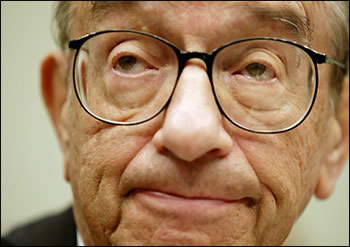
greenspan.jpg

Then Alan Greenspan, the chairman of the Federal Reserve, testified before the Senate Budget Committee.

Until then Mr. Greenspan had presented himself as the voice of fiscal responsibility, warning the Clinton administration not to endanger its hard-won budget surpluses. But now Republicans held the White House, and the Greenspan who appeared before the Budget Committee was a very different man.

Suddenly, his greatest concern — the “emerging key fiscal policy need,” he told Congress — was to avert the threat that the federal government might actually pay off all its debt. To avoid this awful outcome, he advocated tax cuts. And the floodgates were opened.

As it turns out, Mr. Greenspan’s fears that the federal government would quickly pay off its debt were, shall we say, exaggerated. And Mr. Greenspan has just published a book in which he castigates the Bush administration for its fiscal irresponsibility.

Well, I’m sorry, but that criticism comes six years late and a trillion dollars short.

Mr. Greenspan now says that he didn’t mean to give the Bush tax cuts a green light, and that he was surprised at the political reaction to his remarks. There were, indeed, rumors at the time — which Mr. Greenspan now says were true — that the Fed chairman was upset about the response to his initial statement.

But the fact is that if Mr. Greenspan wasn’t intending to lend crucial support to the Bush tax cuts, he had ample opportunity to set the record straight when it could have made a difference.

His first big chance to clarify himself came a few weeks after that initial testimony, when he appeared before the Senate Committee on Banking, Housing and Urban Affairs.

Here’s what I wrote following that appearance: “Mr. Greenspan’s performance yesterday, in his first official testimony since he let the genie out of the bottle, was a profile in cowardice. Again and again he was offered the opportunity to say something that would help rein in runaway tax-cutting; each time he evaded the question, often replying by reading from his own previous testimony. He declared once again that he was speaking only for himself, thus granting himself leeway to pronounce on subjects far afield of his role as Federal Reserve chairman. But when pressed on the crucial question of whether the huge tax cuts that now seem inevitable are too large, he said it was inappropriate for him to comment on particular proposals.

“In short, Mr. Greenspan defined the rules of the game in a way that allows him to intervene as he likes in the political debate, but to retreat behind the veil of his office whenever anyone tries to hold him accountable for the results of those interventions.”

I received an irate phone call from Mr. Greenspan after that article, in which he demanded to know what he had said that was wrong. In his book, he claims that Robert Rubin, the former Treasury secretary, was stumped by that question. That’s hard to believe, because I certainly wasn’t: Mr. Greenspan’s argument for tax cuts was contorted and in places self-contradictory, not to mention based on budget projections that everyone knew, even then, were wildly overoptimistic.

If anyone had doubts about Mr. Greenspan’s determination not to inconvenience the Bush administration, those doubts were resolved two years later, when the administration proposed another round of tax cuts, even though the budget was now deep in deficit. And guess what? The former high priest of fiscal responsibility did not object.

And in 2004 he expressed support for making the Bush tax cuts permanent — remember, these are the tax cuts he now says he didn’t endorse — and argued that the budget should be balanced with cuts in entitlement spending, including Social Security benefits, instead. Of course, back in 2001 he specifically assured Congress that cutting taxes would not threaten Social Security.

In retrospect, Mr. Greenspan’s moral collapse in 2001 was a portent. It foreshadowed the way many people in the foreign policy community would put their critical faculties on hold and support the invasion of Iraq, despite ample evidence that it was a really bad idea.

And like enthusiastic war supporters who have started describing themselves as war critics now that the Iraq venture has gone wrong, Mr. Greenspan has started portraying himself as a critic of administration fiscal irresponsibility now that President Bush has become deeply unpopular and Democrats control Congress.


commentbutton.jpg