Karl Rove Discusses His Second Subpoena From House Judiciary Committee
Vodpod videos no longer available.
Cheney
Colin Powell's Chief of Staff Lawrence Wilkerson Reveals the Truth About Gitmo and Graib
Abu Graib, AEI, Al Qaeda, Colin Powell, Condoleeza Rice, David Addington, David Wurmser, Dick Cheney, Donald Rumsfeld, Douglas Feith, Elliot Abrams, Guantanamo, Iran, Iraq, John Negroponte, Lawrence Wilkerson, Military Industrial Complex, Neocons, Paul Wolfowitz, Richard Perle, Think-TanksDick Cheney is a man of principles. Disastrous principles
Alan Greenspan, Ben Bernanke, Bin Laden, Cheney Energy Task Force, Condoleezza Rice, Dick Cheney, Donald Rumsfeld, George W. Bush, Gerald Ford, Iraq, John Snow, Karl Rove, Larry Lindsey, Molly Tully, National Economic Council, Office of Homeland Security, Paul O'Neill, Saddam Hussein, Scooter Libby, Torture, U.N., WyomingVICE GRIP
THE WASHINGTON MONTHLY :: FEB/MARCH 2003
JOSHUA MICAH MARSHALL
Early last December, Vice President Dick Cheney was dispatched to inform his old friend, Treasury Secretary Paul O’Neill, that he was being let go. O’Neill, the president’s advisers felt, had made too many missteps, given too much bad advice, uttered too many gaffes. He had become a liability to the administration. As Cheney himself once said in a different context, it was time for him to go. It couldn’t have been a fun conversation–especially since it was Cheney who had picked O’Neill two years earlier.
O’Neill stormed off to Pittsburgh and within days the White House had announced his replacement. Yet the new treasury secretary nominee turned out not to be much of an improvement. Like O’Neill, John Snow was a veteran of the Ford administration who ran an old-economy titan (the railroad firm CSX) and seemed to lack the global market financial experience demanded of modern day treasury secretaries. Like other Bush appointees, Snow came from a business that traded heavily on the Washington influence game. And–again typical of the president and his men–the size of Snow’s compensation package seemed inversely proportional to the returns he made for his shareholders. Of the three new members of the president’s economic team nominated in early December, Snow was the only one to get almost universally poor reviews. He was also Dick Cheney’s pick.
Week after week, one need only read the front page of The Washington Post to find similar Cheney lapses. Indeed, just a few days after Cheney hand-picked Snow, Newsweek magazine featured a glowing profile of National Security Adviser Condoleezza Rice that began with an anecdote detailing her deft efforts to clean up another Cheney mess. In a July speech, the vice president had argued that weapons inspections in Iraq were useless and shouldn’t even be tried. That speech nearly upended the administration’s careful late-summer repositioning in favor of a new United Nations-backed inspections program. As the article explained, Rice–the relatively junior member of the president’s inner circle of foreign policy advisers–had to take the vice president aside and walk him through how to repair the damage he’d done, with a new statement implicitly retracting his earlier gaffe. Such mistakes–on energy policy, homeland security, corporate reform–abound. Indeed, on almost any issue, it’s usually a sure bet that if Cheney has lined up on one side, the opposite course will turn out to be the wiser.
Yet somehow, in Washington’s collective mind, Cheney’s numerous stumbles and missteps have not displaced the reputation he enjoys as a sober, reliable, skilled inside player. Even the Newsweek article, so eager to convey Rice’s competence, seemed never to explicitly note the obvious subtext: Cheney’s evident incompetence. If there were any justice or logic in this administration as to who should or shouldn’t keep their job, there’d be another high-ranking official in line for one of those awkward conversations: Dick Cheney.
Overruling Dick
Consider the evidence. Last year, Cheney’s White House energy task force produced an all-drilling-and-no-conservation plan that failed not just on policy grounds but as a political matter as well, saddling the administration with a year-long public relations headache after Cheney insisted on running his outfit with a near-Nixonian level of secrecy. (To this day, Cheney and his aides have refused to provide the names of most of those industry executives who “advised” him on the task force’s recommendations, though a federal judge has now rejected the Government Accounting Office’s effort to make them do so.) During the spring of 2001, rather than back congressional efforts to implement the findings of the Hart-Rudman commission that called for forceful action to combat terrorism (including the creation of a department of homeland security), Cheney opted to spearhead his own group–not because he disagreed with the commission’s proposals, but to put the administration’s stamp on whatever anti-terrorism reforms did get adopted. Cheney’s security task force did nothing for four months, lurching into action only after terrorists actually attacked America on September 11. In the months that followed, Cheney was one of several key advisers arguing that the White House should keep Tom Ridge’s Office of Homeland Security within the White House rather than upgrade it to a cabinet department and thus open it to congressional scrutiny. Cheney’s obstinacy ensured that the administration’s efforts were stuck in neutral for nearly eight months.
Cheney has not fared much better in the diplomatic arena. Last March, he went on a tour of Middle Eastern capitals to line up America’s allies for our war against Saddam. He returned a week later with the Arabs lining up behind Saddam and against us–a major embarrassment for the White House. Much of the success of the administration’s Iraq policy came only after it abandoned the strategy of unilateral action against Saddam, the strategy Cheney championed, to one of supporting a U.N. inspections regime–a necessary and successful course correction that Cheney resisted and almost halted. Indeed, broadly speaking, the evolution of White House Iraq policy might be described fairly as a slow process of overruling Dick Cheney.
And there’s more. Remember those corporate scandals that came close to crippling Bush? Last summer, White House advisers were pondering whether to back the sort of tough corporate accountability measures that Democrats and the press were demanding. The president was scheduled to deliver a big speech on Wall Street in early July. His advisers were divided. Some argued that strong reforms were at the least a political necessity. But Cheney, along with National Economic Council chair Larry Lindsey, opposed the idea, arguing that new restrictions on corporations would further weaken the economy. The president took Cheney’s advice, and gave a speech on Wall Street that recommended only mild and unspecific reforms. “He mentioned a lot of things in the speech that the Securities and Exchange Commission already does,” one non-plussed Wall Streeter told The Washington Post with a yawn. The day after the president’s speech, the Dow shed 282 points, the biggest single-day drop since the post-terrorist tailspin of Sept. 20. Within days the president was backpedaling and supporting what Cheney had said he shouldn’t. Lindsey got the boot later in the year. Cheney is still in the West Wing shaping economic policy.
Cartel Capitalists
Much of the reason Cheney so often calls things wrong–even on those business issues that would seem his area of expertise–can be traced to the culture in which he’s spent most of his professional life. Despite his CEO credentials and government experience, Dick Cheney has been surprisingly insulated from the political and financial marketplace. He began his career as a Nixon-administration functionary under Donald Rumsfeld. Later, he joined the Ford administration as a deputy assistant to the president before becoming White House chief of staff. From there he moved into elective office, but to the ultra-safe House seat from Wyoming, a post only slightly less shielded from the tides of American politics than were his posts in the Ford administration.
Cheney resigned his House seat in 1989 and moved back to the executive branch where he belonged, serving–with distinction–as defense secretary under the first President Bush. From there he moved to the corporate suite at Halliburton, where he eventually earned tens of millions of dollars. But Halliburton is a peculiar kind of enterprise. It doesn’t market shoes or design software. Rather, its business–providing various products and services to the oil industry and the military–is based on securing lucrative contracts and concessions from a handful of big customers, primarily energy companies and the U.S. and foreign governments. Success in that business comes not by understanding and meeting the demands of millions of finicky customers, but by cementing relationships with and winning the support of a handful of powerful decision-makers.
Indeed, that’s why Halliburton came to Cheney in the first place. His ties with the Bush family, his post-Gulf War friendships with Arab emirs, and the Rolodex he’d compiled from a quarter century in Washington made him a perfect rainmaker. And though he did rather poorly on the management side–he shepherded Halliburton’s disastrous merger with Dresser Industries, which saddled the new company with massive asbestos liabilities–he handled the schmoozing part of the enterprise well.
Cheney is conservative, of course, but beneath his conservatism is something more important: a mindset rooted in his peculiar corporate-Washington-insider class. It is a world of men–very few women–who have been at the apex of both business and government, and who feel that they are unique in their mastery of both. Consequently, they have an extreme assurance in their own judgment about what is best for the country and how to achieve it. They see themselves as men of action. But their style of action is shaped by the government bureaucracies and cartel-like industries in which they have operated. In these institutions, a handful of top officials make the plans, and then the plans are carried out. Ba-da-bing. Ba-da-boom.
In such a framework all information is controlled tightly by the principals, who have “maximum flexibility” to carry out the plan. Because success is measured by securing the deal rather than by, say, pleasing millions of customers, there’s no need to open up the decision-making process. To do so, in fact, is seen as governing by committee. If there are other groups (shareholders, voters, congressional committees) who agree with you, fine, you use them. But anyone who doesn’t agree gets ignored or, if need be, crushed. Muscle it through and when the results are in, people will realize we were right is the underlying attitude.
The danger of this mindset is obvious. No single group of people has a monopoly on the truth. Whether it be plumbers, homemakers, or lobbyist bureaucrats, any group will inevitably see the world through its own narrow, mostly self-interested, prism. But few groups are so accustomed to self-dealing and self-aggrandizement as the cartel-capitalist class. And few are more used to equating their own self-interest with the interests of the country as a whole.
Not since the Whiz Kids of the Kennedy-Johnson years has Washington been led by men of such insular self-assurance. Their hierarchical, old economy style of management couldn’t be more different from the loose, non-hierarchical style of, say, high-tech corpor-ations or the Clinton White House, with all their open debate, concern with the interests of “stake-holders,” manic focus on pleasing customers (or voters), and constant reassessment of plans and principles. The latter style, while often sloppy and seemingly juvenile, tends to produce pretty smart policy. The former style, while appearing so adult and competent, often produces stupid policy.
Over time, people in the White House have certainly had to deal with enough examples of Cheney’s poor judgment. It’s fallen to the White House’s political arm, led by the poll-conscious Karl Rove, to rein in or overrule him. Yet the vice president has apparently lost little stature within the White House. That may be because his get-it-done-and-ignore-the-nay-sayers attitude is one that others in the administration share. Cheney stands up for the cartel-capitalist principles they admire. He is right, in a sense, even when he’s wrong.
Why, though, has the press failed to grasp Cheney’s ineptitude? The answer seems to lie in the power of political assumptions. The historian of science Thomas Kuhn famously observed that scientific theories or “paradigms”–Newtonian physics, for instance–could accommodate vast amounts of contradictory evidence while still maintaining a grip on intelligent people’s minds. Such theories tend to give way not incrementally, as new and conflicting data slowly accumulates, but in sudden crashes, when a better theory comes along that explains the anomalous facts. Washington conventional wisdom works in a similar way. It doesn’t take long for a given politician to get pegged with his or her own brief story line. And those facts and stories that get attention tend to be those that conform to the established narrative. In much the same way, Cheney’s reputation as the steady hand at the helm of the Bush administration–the CEO to Bush’s chairman–is so potent as to blind Beltway commentators to the examples of vice presidential incompetence accumulating, literally, under their noses. Though far less egregious, Cheney’s bad judgment is akin to Trent Lott’s ugly history on race: Everyone sort of knew it was there, only no one ever really took notice until it was pointed out in a way that was difficult to ignore. Cheney is lucky; as vice president, he can’t be fired. But his terrible judgment will, at some point, become impossible even for the Beltway crowd not to see.
Joshua Micah Marshall, author of the Talking Points Memo, is a Washington Monthly contributing writer.
The White Van: Were Israelis Detained on Sept. 11 Spies?
9/11, 9/11 Crime Investigation, Bin Laden, Dick Cheney, George W. Bush, Israel, Manhattan, Mossad, New York City, Saudi Arabia, Twin Towers, WTC, wtc7
Were Israelis Detained on Sept. 11 Spies?
June 21 —2002
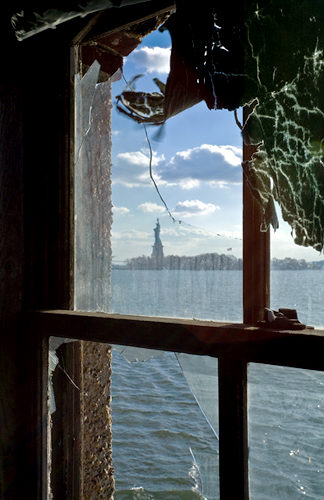
Millions saw the horrific images of the World Trade Center attacks, and those who saw them won’t forget them. But a New Jersey homemaker saw something that morning that prompted an investigation into five young Israelis and their possible connection to Israeli intelligence.
Maria, who asked us not to use her last name, had a view of the World Trade Center from her New Jersey apartment building. She remembers a neighbor calling her shortly after the first plane hit the towers.
She grabbed her binoculars and watched the destruction unfolding in lower Manhattan. But as she watched the disaster, something else caught her eye.
Maria says she saw three young men kneeling on the roof of a white van in the parking lot of her apartment building. “They seemed to be taking a movie,” Maria said.
The men were taking video or photos of themselves with the World Trade Center burning in the background, she said. What struck Maria were the expressions on the men’s faces. “They were like happy, you know … They didn’t look shocked to me. I thought it was very strange,” she said.
She found the behavior so suspicious that she wrote down the license plate number of the van and called the police. Before long, the FBI was also on the scene, and a statewide bulletin was issued on the van.
The plate number was traced to a van owned by a company called Urban Moving. Around 4 p.m. on Sept. 11, the van was spotted on a service road off Route 3, near New Jersey’s Giants Stadium. A police officer pulled the van over, finding five men, between 22 and 27 years old, in the vehicle. The men were taken out of the van at gunpoint and handcuffed by police.
The arresting officers said they saw a lot that aroused their suspicion about the men. One of the passengers had $4,700 in cash hidden in his sock. Another was carrying two foreign passports. A box cutter was found in the van. But perhaps the biggest surprise for the officers came when the five men identified themselves as Israeli citizens.
‘We Are Not Your Problem’
According to the police report, one of the passengers told the officers they had been on the West Side Highway in Manhattan “during the incident” — referring to the World Trade Center attack. The driver of the van, Sivan Kurzberg, told the officers, “We are Israeli. We are not your problem. Your problems are our problems. The Palestinians are the problem.” The other passengers were his brother Paul Kurzberg, Yaron Shmuel, Oded Ellner and Omer Marmari.
When the men were transferred to jail, the case was transferred out of the FBI’s Criminal Division, and into the bureau’s Foreign Counterintelligence Section, which is responsible for espionage cases, ABCNEWS has learned.
One reason for the shift, sources told ABCNEWS, was that the FBI believed Urban Moving may have been providing cover for an Israeli intelligence operation.
After the five men were arrested, the FBI got a warrant and searched Urban Moving’s Weehawken, N.J., offices.
The FBI searched Urban Moving’s offices for several hours, removing boxes of documents and a dozen computer hard drives. The FBI also questioned Urban Moving’s owner. His attorney insists that his client answered all of the FBI’s questions. But when FBI agents tried to interview him again a few days later, he was gone.
Three months later 2020’s cameras photographed the inside of Urban Moving, and it looked as if the business had been shut down in a big hurry. Cell phones were lying around; office phones were still connected; and the property of dozens of clients remained in the warehouse.
The owner had also cleared out of his New Jersey home, put it up for sale and returned with his family to Israel.
‘A Scary Situation’
Steven Gordon, the attorney for the five Israeli detainees, acknowledged that his clients’ actions on Sept. 11 would easily have aroused suspicions. “You got a group of guys that are taking pictures, on top of a roof, of the World Trade Center. They’re speaking in a foreign language. They got two passports on ’em. One’s got a wad of cash on him, and they got box cutters. Now that’s a scary situation.”
But Gordon insisted that his clients were just five young men who had come to America for a vacation, ended up working for a moving company, and were taking pictures of the event.
The five Israelis were held at the Metropolitan Detention Center in Brooklyn, ostensibly for overstaying their tourist visas and working in the United States illegally. Two weeks after their arrest, an immigration judge ordered them to be deported. But sources told ABCNEWS that FBI and CIA officials in Washington put a hold on the case.
The five men were held in detention for more than two months. Some of them were placed in solitary confinement for 40 days, and some of them were given as many as seven lie-detector tests.
Plenty of Speculation
Since their arrest, plenty of speculation has swirled about the case, and what the five men were doing that morning. Eventually, The Forward, a respected Jewish newspaper in New York, reported the FBI concluded that two of the men were Israeli intelligence operatives.
Vince Cannistraro, a former chief of operations for counterterrorism with the CIA who is now a consultant for ABCNEWS, said federal authorities’ interest in the case was heightened when some of the men’s names were found in a search of a national intelligence database.
Israeli Intelligence Connection?
According to Cannistraro, many people in the U.S. intelligence community believed that some of the men arrested were working for Israeli intelligence. Cannistraro said there was speculation as to whether Urban Moving had been “set up or exploited for the purpose of launching an intelligence operation against radical Islamists in the area, particularly in the New Jersey-New York area.”
Under this scenario, the alleged spying operation was not aimed against the United States, but at penetrating or monitoring radical fund-raising and support networks in Muslim communities like Paterson, N.J., which was one of the places where several of the hijackers lived in the months prior to Sept. 11.
For the FBI, deciphering the truth from the five Israelis proved to be difficult. One of them, Paul Kurzberg, refused to take a lie-detector test for 10 weeks — then failed it, according to his lawyer. Another of his lawyers told us Kurzberg had been reluctant to take the test because he had once worked for Israeli intelligence in another country.
Sources say the Israelis were targeting these fund-raising networks because they were thought to be channeling money to Hamas and Islamic Jihad, groups that are responsible for most of the suicide bombings in Israel. “[The] Israeli government has been very concerned about the activity of radical Islamic groups in the United States that could be a support apparatus to Hamas and Islamic Jihad,” Cannistraro said.
The men denied that they had been working for Israeli intelligence out of the New Jersey moving company, and Ram Horvitz, their Israeli attorney, dismissed the allegations as “stupid and ridiculous.”
Mark Regev, the spokesman for the Israeli Embassy in Washington, goes even further, asserting the issue was never even discussed with U.S. officials.
“These five men were not involved in any intelligence operation in the United States, and the American intelligence authorities have never raised this issue with us,” Regev said. “The story is simply false.”
No ‘Pre-Knowledge’
Despite the denials, sources tell ABCNEWS there is still debate within the FBI over whether or not the young men were spies. Many U.S. government officials still believe that some of them were on a mission for Israeli intelligence. But the FBI told ABCNEWS, “To date, this investigation has not identified anybody who in this country had pre-knowledge of the events of 9/11.”
Sources also said that even if the men were spies, there is no evidence to conclude they had advance knowledge of the terrorist attacks on Sept. 11. The investigation, at the end of the day, after all the polygraphs, all of the field work, all the cross-checking, the intelligence work, concluded that they probably did not have advance knowledge of 9/11,” Cannistraro noted.
As to what they were doing on the van, they say they read about the attack on the Internet, couldn’t see it from their offices and went to the parking lot for a better view. But no one has been able to find a good explanation for why they may have been smiling with the towers of the World Trade Center burning in the background. Both the lawyers for the young men and the Israeli Embassy chalk it up to immature conduct.
According to ABCNEWS sources, Israeli and U.S. government officials worked out a deal — and after 71 days, the five Israelis were taken out of jail, put on a plane, and deported back home.
While the former detainees refused to answer ABCNEWS’ questions about their detention and what they were doing on Sept. 11, several of the detainees discussed their experience in America on an Israeli talk show after their return home.
Said one of the men, denying that they were laughing or happy on the morning of Sept. 11, “The fact of the matter is we are coming from a country that experiences terror daily. Our purpose was to document the event.” 
ABCNEWS’ Chris Isham, John Miller, Glenn Silber and Chris Vlasto contributed to this report.
Karl Rove Discusses His Second Subpoena From House Judiciary Committee
CIA, David Iglesias, Don Siegelman, Guantanamo, Iraq, Joe Wilson, Justice Department, Karl Rove, Torture, U.S. Attorney Firings, Valerie Plame, Wiretapping, WMDThomas Ricks Plays Propaganda Point-Man on Pentagon Plan for Permanent U.S. Bases in Iraq
Admiral Fallon, AEI, Bechtel. Halliburton, Blackwater, Carlyle Group, Colin Powell, Condi Rice, Dick Cheney, Don Rumsfeld, Douglas Feith, Erik Prince, General Keane, General Odierno, General Patraeus, George W. Bush, Iraq, KBR, Military Industrial Complex, Neocons, Oil, Paul Wolfowitz, PNAC, Propaganda, Raytheon, Richard Perle, Steven Hadley, Think-TanksDick Cheney is Fairly Pleased With His Eight Bloody Years
Afghanistan, Dick Cheney, George W. Bush, Iraq, War Criminal
- guardian.co.uk, Wednesday 17 December 2008 01.19 GMT
The outgoing US vice-president, Dick Cheney, last night gave an unapologetic assessment of his eight years in office, defending the invasion of Iraq, the US prison camp at Guantánamo Bay, secret wiretapping and the extreme interrogation method known as waterboarding.
In his first television interview since the presidential election in November, Cheney displayed no regrets and gave no ground to his many critics within America and around the world. He summed up his record by saying: “I think, given the circumstances we’ve had to deal with, we’ve done pretty well.”

He told ABC News he stood by the most controversial policies of the Bush administration, and urged president-elect Barack Obama to think hard before undoing them. Asked about the use of torture on terror suspects, he replied: “We don’t do torture. We never have. It’s not something this administration subscribes to.”
Later in the same interview, Cheney was asked whether the use of waterboarding in the interrogation of the alleged mastermind of the September 11 attacks, Khaled Sheikh Mohammed, had been appropriate. He replied: “I do.”
Waterboarding is a technique that induces the sensation of drowning, and is widely regarded as a form of torture. It was used on three high-level al-Qaida suspects, including Mohammed, but has since been banned by the US.
Cheney was chosen in 2000 by George Bush to be his vice-president; he did not put his own name forward for the job. He has since turned into one of the most divisive and reviled vice-presidents in US history, amassing to his office enormous powers and devising a stream of controversial policies.
Despite the vitriol he has attracted, and Bush’s historically low approval rating of just 29%, Cheney was still able to joke about his term in the White House.
He referred to a comment from Hillary Clinton likening him to the Star Wars character Darth Vader. “I asked my wife about that, if that didn’t bother her. She said, no, it humanises you.”
But his lack of any introspection over the decisions made under his watch – in contrast to Bush who recently said he had been sorry about the false intelligence over Iraq – will renew Cheney’s reputation as a combatant and uncompromising vice-president.
Though no weapons of mass destruction were ever found, he insisted that Saddam Hussein had had the capability to produce them.
“He had the technology, he had the people. This was a bad actor and the country’s better off, the world’s better off with Saddam gone. We made the right decision,” he said.
On Guantánamo, he challenged the incoming Obama administration to think hard about what he claimed were the “hardcore” detainees still being held at the Cuban base.
“What are you going to do with those prisoners?” he said, adding: “I don’t know any other nation in the world that would do what we’ve done in terms of taking care of people who are avowed enemies.”
He also defended the use of secret wiretapping of suspects that was carried out without court warrant.
“It’s worked. It’s been successful. It was legal from the very beginning.”
Given the role of hate-figure that Cheney has acquired over the years among the American left, many US liberals will be dismayed to hear him say that he largely approves of the cabinet put together by the president-elect.
He praised the decision to keep Robert Gates as defence secretary as “excellent” and predicted that General Jim Jones would be “very, very effective” as national security adviser.
He even complimented his old adversary, Hillary Clinton, Obama’s choice as secretary of state, saying “she’s tough, she’s smart, she works very hard and she may turn out to be just what President Obama needs.”
Cheney has 34 days left in office. This will be his fourth transition out of government and back to private life. He said he was not ready to retire yet, but did want to spend more time with his family. “Got some rivers I want to face. Maybe write a book. I haven’t decided yet.”
Terror Suspect's Case Drags on 5 years After Arrest in Minneapolis
Civil Liberties, Guantanamo, War on Terror“Some harm to civil liberties seems to be endemic to war situations and you know, at the end of the day, if we win this war against terrorism, we and the whole world will be more free and our rights will be more secure, but along the way, there may be some situations and some individuals who will have the opposite,” said Joshua Muravchik, a resident scholar at American Enterprise Institute, a Washington think tank.

On a cold December morning five years ago, FBI agents knocked on the door of a basement apartment in northeast Minneapolis, and Mohamed Abdullah Warsame answered.
He let the agents in to talk, and later they took him to another location to talk more. He hasn’t been home since.
For five years, Warsame, now 35, has been awaiting trial on charges that he provided material support to Al-Qaida. A Canadian citizen of Somali descent, he has done most of the waiting alone in a jail cell, under special restrictions that limit his contact with the outside world.
His pretrial detention is one of the longest for a terrorism- related case since Sept. 11, with the delays stemming from a variety of sources.
Authorities have needed extra time for security clearances. Attorneys have argued over Warsame’s detention conditions and debated access to facts and witnesses. Some information is classified by the federal government, and defense attorneys have no legal access to it. An appeals court is also considering whether some of Warsame’s statements to authorities, thrown out by the district judge, should be allowed to be used against him.
Warsame was one of 46 still awaiting trial as of mid-2007, among the 108 charged since Sept. 11 with providing material support to a terrorist organization, according to one analyst who tracks such cases.
The length of Warsame’s case raises questions about how the courts handle terrorism cases.
The federal courts are “being used the same way that the prosecutions in Guantanamo are being used … based on the accusation of terrorism, the normal rules don’t seem to apply,” said Peter Erlinder, a professor at the William Mitchell College of Law in St. Paul and who has been involved in Warsame’s defense and at least one other terrorism-related case. Some Guantanamo detainees are being released in less time than Warsame has been held, Erlinder said.
Others point out that Warsame and other defendants in terrorism cases present unusual circumstances.
“Some harm to civil liberties seems to be endemic to war situations and you know, at the end of the day, if we win this war against terrorism, we and the whole world will be more free and our rights will be more secure, but along the way, there may be some situations and some individuals who will have the opposite,” said Joshua Muravchik, a resident scholar at American Enterprise Institute, a Washington think tank. “And it’s a shame, but nonetheless, if there’s a strong reason to believe that this man was involved with terrorists, I wouldn’t want him out on the streets.”
Warsame’s case may be cited as the debate rages about what to do with detainees if Guantanamo closes, said Robert Chesney, a Wake Forest University professor who compiled the data on 108 defendants. Warsame’s is the longest pretrial detention of the post-9/11 terrorism prosecutions that Chesney has found.
Some question whether federal courts are equipped to handle such cases or special courts should be set up.
Those against setting up special courts argue that defendants would be deprived of due process and a fair trial.
John Radsan, a former CIA attorney who is now a professor at William Mitchell, said the public will see more drawn-out court procedures if terrorism cases continue in federal courts. Rules have long been in place to handle classified information in federal court, he said, but few cases needed them.
Though Radsan said he favors prosecuting high-level terrorism cases in a separate arena, Warsame doesn’t necessarily fall into that category, he said.
Nevertheless, Warsame’s case highlights the difficulty of using regular courts. “If we’re having this much trouble on Warsame, imagine what’s in store if we try to handle higher-level terrorists in the regular courts,” he said.
A dragged-out case
Warsame, who was a student at Minneapolis Community and Technical College at the time of his arrest, is charged with lying to federal agents about traveling to Afghanistan in 2000 and later sending $2,000 to an associate he met at a training camp there. Authorities contend Warsame once dined next to Osama bin Laden and fought on the front lines with the Taliban.
The U.S. attorney’s office, which is prosecuting the case, declined to comment.
A defense attorney said early in the case that Warsame was searching for a Muslim utopia and went to training camps because he was out of money and needed shelter. The attorney said someone had lent Warsame money to get back to North America and the money he sent was repayment.
The latest delay in the case comes as the 8th Circuit U.S. Court of Appeals considers a district judge’s ruling that statements Warsame made to authorities on his second day of interviews with FBI agents in 2003 cannot be used against him. U.S. District Judge John Tunheim found that Warsame was in custody that day when agents spoke to him without a Miranda warning at Camp Ripley, a National Guard base near Little Falls.
Prosecutors appealed that decision to the higher court.
Defense attorney David Thomas said he’s been frustrated by the lack of access to information. “Most of the evidence is classified, so I can’t see that,” Thomas said. “I sit there and I watch. The government will make a submission to Judge Tunheim and then Tunheim will lob something back to the government and, you know, I don’t see any of it. It’s like sitting at a tennis match, watching the ball go back and forth.”
‘Give Warsame a chance’
Thomas said his client is “full of vim and vigor” and wants to keep fighting the charges.
Warsame’s family in the Twin Cities declined to comment.
Talk of the case has been fading in the local Somali community recently, said Sharmarke Jama, a member of the United Somali Movement. Nevertheless, the length of the case helped feed skepticism, fear and mistrust of the justice system, he added.
The Somali Justice Advocacy Center’s Omar Jamal said he plans to write a letter and “plead to the court to give [Warsame] a chance for his day in court and get over with this. He’s been there suffering, not knowing his fate.”
Pam Louwagie • 612-673-7102
© 2009 Star Tribune. All rights reserved.
ABC News Exclusive: Dick Cheney Still Batshit Crazy
Abu Graib, Guantanamo, terrorismABC NEWS
Exclusive: Cheney Holds Hard-Line Stance

In an Exclusive Interview with ABC News, Vice President Dick Cheney Opens Up About His Hard-Line Tactics
By JONATHAN KARL
Dec. 15, 2008 —
In an exclusive interview Monday with ABC News, Vice President Dick Cheney issued an unapologetic defense of the Bush administration’s anti-terror policies, including the use of waterboarding, and said the prison at Guantanamo Bay should remain open as long as there’s a war on terror.
In his first exit interview and first television interview since the November election, Cheney held fast to his views on coercing information out of alleged terrorists, saying waterboarding was an appropriate means of getting information from Khalid Sheikh Mohammed, the alleged mastermind behind the Sept. 11 terrorist attacks.
Cheney resisted those who say the Bush administration has overstepped its bounds on torture, saying national intelligence is an art, not a science.
“On the question of so-called torture, we don’t do torture,” Cheney told ABC News. “We never have. It’s not something that this administration subscribes to.
“I think those who allege that we’ve been involved in torture, or that somehow we violated the Constitution or laws with the terrorist surveillance program, simply don’t know what they’re talking about.”
Cheney was also asked whether he authorized the tactics used against Khalid Sheikh Mohammed.
“I was aware of the program, certainly, and involved in helping get the process cleared, as the agency in effect came in and wanted to know what they could and couldn’t do,” Cheney said. “And they talked to me, as well as others, to explain what they wanted to do. And I supported it.”
“There was a period of time there, three or four years ago, when about half of everything we knew about al Qaeda came from that one source,” he added. “So, it’s been a remarkably successful effort. I think the results speak for themselves.”
Cheney also said the Sept. 11 terrorist attacks most certainly became “a prime motivation” in shaping his time in office.
“Have I changed?” Cheney asked. “Well, not in the sense that I’ve gone through some fundamental psychological transition here but I have been since that day focused very much on what we needed to do to defend the nation and I think the policies we’ve recommended, the programs that we’ve undertaken have been good program. I think those have been sound decisions and if that’s what they mean by saying I’ve changed, I’m guilty.”
Cheney Disputes Rove
The outgoing vice president also disputed former Bush adviser Karl Rove’s recent comments about the decision to go to war in Iraq.
While discussing Bush’s legacy earlier this month, Rove said he did not believe the administration would have gone to war had intelligence revealed Saddam Hussein did not possess weapons of mass destruction.
“I disagree with that,” Cheney said Monday. “As I look at the intelligence with respect to Iraq, what they got wrong was that there weren’t any stockpiles.”
“What they found was that Saddam Hussein still had the capability to produce weapons of mass destruction. He had the technology, he had the people, he had the basic feed stock.”
Cheney added that, given Saddam Hussein’s capabilities, reputation and track record of brutality, “this was a bad actor and the country’s better off, the world’s better off with Saddam gone, and I think we made the right decision in spite of the fact that the original NIE was off in some of its major judgments.”
Cheney Says Guantanamo Should Remain Open
Cheney said the prison at Guantanamo Bay could be responsibly shut down only when the war on terror has ended. Asked when that might be, he added, “Well, nobody knows. Nobody can specify that.”
“A lot of people, including the president, expressed the view that they’d like to close Guantanamo,” he said. “I think everybody can say we wished there were no necessity for Guantanamo, but you have to be able to answer these other questions before you can do that responsibly.”
Cheney warned that prisoners released from Guantanamo could prove dangerous to the United States, adding that the problem of what to do with released prisoners had not yet been solved.
“If you release people that shouldn’t have been released — and that’s happened in some cases already — you end up with them back on the battlefield,” he said.
Cheney said the Guantanamo detainees have been “well treated.”
“I don’t know any other nation in the world that would do what we’ve done in terms of taking care of people who are avowed enemies, and many of whom still swear up and down that their only objective is to kill more Americans,” he said.
Read excerpts from Monday’s interview here.
ABC News’ Kate Barrett contributed to this report.
The Official Failures of Rebuilding Iraq
Bechtel, Blackwater, CACI, Commission on Wartime Contracting, Congress, Dick Cheney, DOD, Erik Prince, George W. Bush, Halliburton, Irag, Iraqi Infrastructure, KBR, Lobbyists, Pentagon, Senate, Stuart Bowen Jr., WaterSunday, December 14, 2008
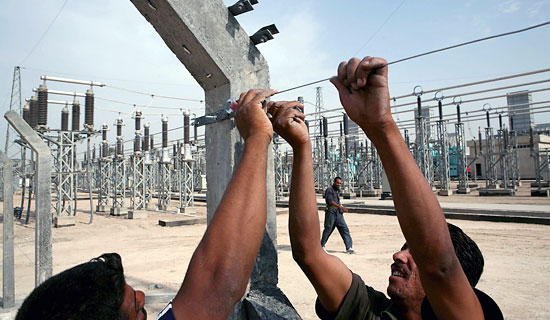
BAGHDAD: An unpublished, 513-page federal history of the U.S.-led reconstruction of Iraq depicts an effort crippled before the invasion by Pentagon planners who were hostile to the idea of rebuilding a foreign country, and then molded into a $100 billion failure by bureaucratic turf wars, spiraling violence and ignorance of the basic elements of Iraqi society and infrastructure.
“Hard Lessons: The Iraq Reconstruction Experience,” the first official account of its kind, is circulating in draft form here and in Washington among a tight circle of technical reviewers, policy experts and senior officials. It also concludes that when the reconstruction began to lag – particularly in the critical area of rebuilding the Iraqi police and army – the Pentagon simply put out inflated measures of progress to cover up the failures.
In one passage, for example, former Secretary of State Colin Powell is quoted as saying that in the months after the 2003 invasion, the Defense Department “kept inventing numbers of Iraqi security forces – the number would jump 20,000 a week! ‘We now have 80,000, we now have 100,000, we now have 120,000.”‘
Powell’s assertion that the Pentagon inflated the number of competent Iraqi security forces is backed up by Lieutenant General Ricardo Sanchez, the former commander of ground troops in Iraq, and L. Paul Bremer 3rd, the top civilian administrator until an Iraqi government took over in June 2004.
Among the overarching conclusions of the history is that five years after embarking on its largest foreign reconstruction project since the Marshall Plan in Europe after World War II, the U.S. government has in place neither the policies and technical capacity nor the organizational structure that would be needed to undertake such a program on anything approaching this scale.
The bitterest message of all for the reconstruction program may be the way the history ends. The hard figures on basic services and industrial production compiled for the report reveal that for all the money spent and promises made, the rebuilding effort never did much more than restore what was destroyed during the invasion and the convulsive looting that followed.
By mid-2008, the history says, $117 billion had been spent on the reconstruction of Iraq, including some $50 billion in U.S. taxpayer money.
The history contains a catalog of new revelations that show the chaotic and often poisonous atmosphere prevailing in the reconstruction effort.
When the Office of Management and Budget balked at the U.S. occupation authority’s abrupt request for about $20 billion in new reconstruction money in August 2003, a veteran Republican lobbyist working for the authority made a bluntly partisan appeal to Joshua Bolten, then the Office of Management and Budget director and now the White House chief of staff. “To delay getting our funds would be a political disaster for the President,” wrote the lobbyist, Tom Korologos. “His election will hang for a large part on show of progress in Iraq and without the funding this year, progress will grind to a halt.” With administration backing, Congress allocated the money later that year.
In an illustration of the hasty and haphazard planning, a civilian official at the U.S. Agency for International Development was at one point given four hours to determine how many miles of Iraqi roads would need to be reopened and repaired. The official searched through the agency’s reference library, and his estimate went directly into a master plan. Whatever the quality of the agency’s plan, it eventually began running what amounted to a parallel reconstruction effort in the provinces that had little relation with the rest of the U.S. effort.
Money for many of the local construction projects still under way is divided up by a spoils system controlled by neighborhood politicians and tribal chiefs. “Our district council chairman has become the Tony Soprano of Rasheed, in terms of controlling resources,” said a U.S. Embassy official working in a dangerous Baghdad neighborhood, referring to the popular TV mob boss. “‘You will use my contractor or the work will not get done.”‘
The United States could soon have reason to consult this cautionary tale of deception, waste and poor planning, as both troop levels and reconstruction efforts in Afghanistan are likely to be stepped up under the new administration.
The incoming Obama administration’s rebuilding experts are expected to focus on smaller-scale projects and emphasize political and economic reform. Still, such programs do not address one of the history’s main contentions: that the reconstruction effort has failed because no single agency in the U.S. government has responsibility for the job.
Five years after the invasion of Iraq, the history concludes, “the government as a whole has never developed a legislatively sanctioned doctrine or framework for planning, preparing and executing contingency operations in which diplomacy, development and military action all figure.”
“Hard Lessons” was compiled by the Office of the Special Inspector General for Iraq Reconstruction, led by Stuart Bowen Jr., a Republican lawyer who regularly travels to Iraq and has a staff of engineers and auditors based here. Copies of several drafts of the history were provided to reporters at The New York Times and ProPublica by two people outside the inspector general’s office who have read the draft but are not authorized to comment publicly.
Bowen’s deputy, Ginger Cruz, declined to comment for publication on the substance of the history. But she said it would be presented Feb. 2 at the first hearing of the Commission on Wartime Contracting, which was created this year as a result of legislation sponsored by Senators Jim Webb of Virginia and Claire McCaskill of Missouri, both Democrats.
The manuscript is based on about 500 new interviews, as well as more than 600 audits, inspections and investigations on which Bowen’s office has reported individually over the years. Laid out for the first time in a connected history, the material forms the basis for broad judgments on the entire rebuilding program.
In the preface, Bowen gives a searing critique of what he calls the “blinkered and disjointed prewar planning for Iraq’s reconstruction” and the botched expansion of the program from a modest initiative to improve Iraqi services to a multibillion-dollar enterprise.
Bowen also swipes at the endless revisions and reversals of the program, which at various times gyrated from a focus on giant construction projects led by large Western contractors to modest community-based initiatives carried out by local Iraqis. While Bowen concedes that deteriorating security had a hand in spoiling the program’s hopes, he suggests, as he has in the past, that the program did not need much outside help to do itself in.
Despite years of studying the program, Bowen writes that he still has not found a good answer to the question of why the program was even pursued as soaring violence made it untenable. “Others will have to provide that answer,” Bowen writes.
“But beyond the security issue stands another compelling and unavoidable answer: The U.S. government was not adequately prepared to carry out the reconstruction mission it took on in mid-2003,” he concludes.
The history cites some projects as successes. The review praises community outreach efforts by the Agency for International Development, the Treasury Department’s plan to stabilize the Iraqi dinar after the invasion and a joint effort by the Departments of State and Defense to create local rebuilding teams.
But the portrait that emerges overall is one of a program’s officials operating by the seat of their pants in the middle of a critical enterprise abroad, where the reconstruction was supposed to convince the Iraqi citizenry of U.S. good will and support the new democracy with lights that turned on and taps that flowed with clean water. Mostly, it is a portrait of a program that seemed to grow exponentially as even those involved from the inception of the effort watched in surprise.
On the eve of the invasion, as it began to dawn on a few U.S. officials that the price for rebuilding Iraq would be vastly greater than they had been told, the degree of miscalculation was illustrated in an encounter between Donald Rumsfeld, then the defense secretary, and Jay Garner, the retired lieutenant general who had hastily been named the chief of what would be a short-lived civilian authority called the Office of Reconstruction and Humanitarian Assistance.
The history records how Garner presented Rumsfeld with several alternative rebuilding plans, including one that would include projects across Iraq.
“What do you think that’ll cost?” Rumsfeld asked of the more expansive plan.
“I think it’s going to cost billions of dollars,” Garner said.
“My friend,” Rumsfeld replied, “if you think we’re going to spend a billion dollars of our money over there, you are sadly mistaken.”
In a way he never anticipated, Rumsfeld turned out to be correct: Before that year was out, the United States had appropriated more than $20 billion for the reconstruction, which would indeed involve projects across the entire country.
Rumsfeld declined comment on the report, but a spokesman, Keith Urbahn, said quotes attributed to him in the document “appear to be accurate.” Powell also declined to comment.
The secondary effects of the invasion and its aftermath were among the most important factors that radically changed the outlook. Tables in the history show that measures of things like the production of electricity and oil; public access to potable water, mobile and landline telephone service; and the presence of Iraqi security forces all plummeted at least 70 percent, and in some cases all the way to zero, in the weeks after the invasion. Subsequent tables in the history give a fast-forward view of what happened as the avalanche of money tumbled into Iraq over the next five years. By the time a sovereign Iraqi government took over from the Americans in June 2004, none of those services – with a single exception, mobile phones – had returned to prewar levels. And by the time of the security improvements in 2007 and 2008, electricity output had, at best, a precarious 10 percent lead on its levels under Saddam Hussein; oil production was still below prewar levels; and access to potable water had increased about 30 percent, although with the nation’s ruined piping system it was unclear how much actually reached people’s homes uncontaminated.
Whether the rebuilding effort could have succeeded in a less violent setting will never be known. In April 2004, thousands of the Iraqi security forces that had been oversold by the Pentagon were overrun, abruptly mutinied or simply abandoned their posts as the insurgency broke out, sending Iraq down a violent path from which it has never completely recovered.
At the end of his narrative, Bowen chooses a line from “Great Expectations” by Charles Dickens as the epitaph of the U.S.-led attempt to rebuild Iraq: “We spent as much money as we could, and got as little for it as people could make up their minds to give us.”
James Glanz reported from Baghdad, and T. Christian Miller, of the nonprofit investigative Web site ProPublica, reported from Washington.
 The New York Herald Sun