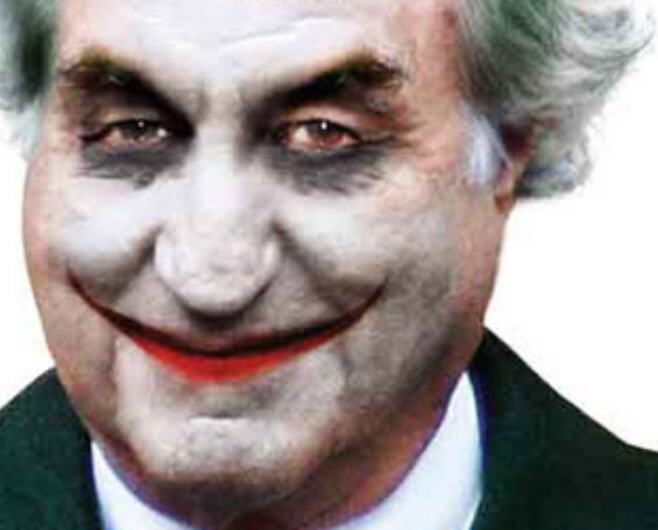
Senior executives at JPMorgan Chase expressed serious doubts about the legitimacy of Bernard L. Madoff’s investment business more than 18 months before his Ponzi schemecollapsed but continued to do business with him, according to internal bank documents made public in a lawsuit that was unsealed on Thursday.
On June 15, 2007, an obviously high-level risk management officer for Chase’s investment bank sent a lunchtime e-mail to colleagues to report that another bank executive “just told me that there is a well-known cloud over the head of Madoff and that his returns are speculated to be part of a ponzi scheme.”
Even before that, a top private banking executive had been consistently steering clients away from investments linked to Mr. Madoff because his “Oz-like signals” were “too difficult to ignore.” And the first Chase risk analyst to look at a Madoff feeder fund, in February 2006, reported to his superiors that its returns did not make sense because it did far better than the securities that were supposedly in its portfolio.
Despite those suspicions and many more, the bank allowed Mr. Madoff to move billions of dollars of investors’ cash in and out of his Chase bank accounts right up until the day of his arrest in December 2008 — although by then, the bank had withdrawn all but $35 million of the $276 million it had invested in Madoff-linked hedge funds , according to the litigation.


 In 2006 a CJR editor (a seasoned journalist formerly with Time magazine in Asia, The Wall Street Journal Europe, and The Far Eastern Economic Review) called me to discuss suspicions he was forming about the US financial media. I gave him leads but warned, “Chasing this will take you down a rabbit hole with no bottom.” For months he pursued his story against pressure and threats he once described as, “something out of a Hollywood B movie, but unlike the movies, the evil corporations fighting the journalist are not thugs burying toxic waste, they are Wall Street and the financial media itself.”
 The New York Herald Sun