Banks Got Cheatsheet For Their "Stress Tests"

Bank of america, Citicorp, Federal Reserve, Fifth Third, Morgan Stanley, PNC, Sun Trust, WELLS FARGO

Banks Won Concessions on Tests

Fed Cut Billions Off Some Initial Capital-Shortfall Estimates;

Tempers Flare at Wells
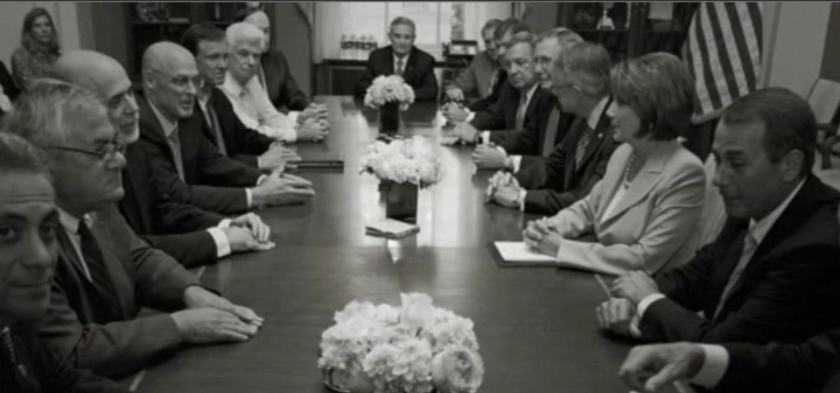
bailout

The Federal Reserve significantly scaled back the size of the capital hole facing some of the nation’s biggest banks shortly before concluding its stress tests, following two weeks of intense bargaining.

In addition, according to bank and government officials, the Fed used a different measurement of bank-capital levels than analysts and investors had been expecting, resulting in much smaller capital deficits.

The overall reaction to the stress tests, announced Thursday, has been generally positive. But the haggling between the government and the banks shows the sometimes-tense nature of the negotiations that occurred before the final results were made public.

Government officials defended their handling of the stress tests, saying they were responsive to industry feedback while maintaining the tests’ rigor.

Interactives: Compare Banks Tested

Bank by Bank Findings

When the Fed last month informed banks of its preliminary stress-test findings, executives at corporations including Bank of America Corp., Citigroup Inc. and Wells Fargo & Co. were furious with what they viewed as the Fed’s exaggerated capital holes. A senior executive at one bank fumed that the Fed’s initial estimate was “mind-numbingly” large. Bank of America was “shocked” when it saw its initial figure, which was more than $50 billion, according to a person familiar with the negotiations.

At least half of the banks pushed back, according to people with direct knowledge of the process. Some argued the Fed was underestimating the banks’ ability to cover anticipated losses with revenue growth and aggressive cost-cutting. Others urged regulators to give them more credit for pending transactions that would thicken their capital cushions.

At times, frustrations boiled over. Negotiations with Wells Fargo, where Chairman Richard Kovacevich had publicly derided the stress tests as “asinine,” were particularly heated, according to people familiar with the matter. Government officials worried San Francisco-based Wells might file a lawsuit contesting the Fed’s findings.

The Fed ultimately accepted some of the banks’ pleas, but rejected others. Shortly before the test results were unveiled Thursday, the capital shortfalls at some banks shrank, in some cases dramatically, according to people familiar with the matter.

[fed changed estimates]

Bank of America’s final gap was $33.9 billion, down from an earlier estimate of more than $50 billion, according to a person familiar with the negotiations.

A Bank of America spokesman wouldn’t comment on how much the previous gap was reduced, though he said it resulted from an adjustment for first-quarter results and errors made by regulators in their analysis. “It wasn’t lobbying,” he said.

Wells Fargo’s capital hole shrank to $13.7 billion, according to people familiar with the matter. Before adjusting for first-quarter results and other factors, the figure was $17.3 billion, according to a federal document.

“In the end we agreed with the number. We didn’t necessarily like the number,” said Wells Fargo Chief Financial Officer Howard Atkins. He said the company was particularly unhappy with the Fed’s assumptions about Wells Fargo’s revenue outlook.

At Fifth Third Bancorp, the Fed was preparing to tell the Cincinnati-based bank to find $2.6 billion in capital, but the final tally dropped to $1.1 billion. Fifth Third said the decline stemmed in part from regulators giving it credit for selling a part of a business line.

Citigroup’s capital shortfall was initially pegged at roughly $35 billion, according to people familiar with the matter. The ultimate number was $5.5 billion. Executives persuaded the Fed to include the future capital-boosting impacts of pending transactions.

SunTrust Banks Inc. also persuaded the Fed to significantly reduce the size of its estimated capital gap to $2.2 billion, after identifying mathematical errors in the Fed’s earlier calculations, according to a person familiar with the matter.

PNC Financial Services Group Inc., saw a capital hole materialize at the last minute. As recently as Wednesday, PNC executives were under the impression they wouldn’t need to find any new capital, according to people familiar with the matter. Thursday morning, the Fed informed PNC that it had a $600 million shortfall.

Regulators said other banks also were told they needed more capital than initially projected.

The Fed’s findings were less severe than some experts had been bracing for. A weeklong rally in bank stocks continued Friday, with the KBW Bank Stocks index surging 10%. Investors were especially relieved by the relatively small capital holes at regional banks. Shares of Fifth Third soared 59%, while Regions Financial Corp.’s $2.5 billion deficit led to a 25% leap in its stock.

With the stress tests, government officials were walking a fine line. If the regulators were too tough on banks, they risked angering their constituents and spooking markets. But if they were too soft, the tests could have lost credibility, defeating their basic confidence-building purpose.

[Chart]

All the back-and-forth is typical of the way regulators traditionally wrap up their examinations of banks: Regulators often present preliminary findings to lenders and then give them time to respond. The process can result in changes to the regulators’ initial conclusions. Some of the stress-test revisions, for instance, were made to account for the beneficial impact of the industry’s strong first-quarter profits.

On Friday, some analysts questioned the yardstick, known as Tier 1 common capital, that regulators chose to assess capital levels. Many experts had assumed the Fed would use a better-known metric called tangible common equity.

According to Gerard Cassidy, an analyst with RBC Capital Markets, the 19 banks’ cumulative shortfall would have been more than $68 billion deeper if the government had used the latter metric, which accounts for unrealized losses.

Federal officials said their projections reflected the most comprehensive analysis ever conducted of the industry.

The test results showed that the 19 banks faced a total of $599 billion in losses over the next two years under the government’s worst-case, Depression-like scenario. The Fed directed 10 banks to add a total of nearly $75 billion to their capital buffers to insulate themselves from potential losses.

Banks pressed ahead on Friday with plans to fill their capital holes by tapping public markets. Wells Fargo raised $7.5 billion in stock through a public offering. The bank originally planned to raise $6 billion, but expanded the offering, which was valued at $22 a share, due to robust demand. Shares of Wells Fargo rallied $3.42, or 14% to $28.18.

Morgan Stanley, which is facing a $1.8 billion capital hole, raised $4 billion by selling stock. Shares of Morgan rose $1.06, or 4%, to $28.20.

—Robin Sidel and Maurice Tamman contributed to this article.
Bank of America: When $45 Billion is Really $199.2 billion

Stories

crashing

Michael Whitney

FIREDOGLAKE/ OXDOWN GAZETE

Friday April 24, 2009

If you’ve been following the news, you know by now that Bank of America is in debt to the American taxpayer in the amount of $45 billion – the amount of TARP funds (aka “bailout money”) that they received since last year.

But it turns out that a figure that you likely haven’t heard – $199.2 billion – paints a bit more of an accurate number on how much Bank of America will most likely “borrow” from the American people.

How do we figure?

$12 Billion in TARP Funds for AIG
In addition to the $45 billion in direct TARP funds mentioned above, Bank of America has received a total of $12 billion from AIG after its own bailout, all of which is directly attributable to financing from the Federal Reserve (AIG.com)

$98.2 Billion in Asset Guarantees Against Losses
Bank of America has received a taxpayer guarantee on $118 billion worth of toxic assets. Taxpayers are on the hook for up to $98.2 billion in losses – $7.5 billion from the Treasury, $2.5 billion from the FDIC, and $88.2 billion from the Federal Reserve. (New York Times, 1/16/09)

$44 Billion in Asset Guarantees Through the FDIC’s TLGP
That’s a lot of initials, but essentially, the $44 billion is backed by new bond issuances under the Debt Guarantee Program. This is more than any other financial institution. (Barrons 4/20/09)

Sick of This?
So where does that leave Bank of America? Essentially, it leaves them in our debt. It’s time that Bank of America’s CEO, Ken Lewis, answers to the decisions that he’s made during his tenure as Chief Executive Officer. It’s just one of the many reasons why we’re calling for him to be fired next week during Bank of America’s annual shareholder meeting.

If you’ve yet to sign your name to our list of now-tens of thousands of fellow taxpayers who have called for CEO Ken Lewis to go, go to TakeBackTheEconomy.org.

Bill Black With Bill Moyers

Banking Crisis, Bill Black, FDIC, Goldman Sachs, SEC, Tim Geithner, Wall Street

Part Two

Part Three

[http://www.youtube.com/watch?v=jJ38T-VgmSY]

Greenwald: The Individuals Obama Chose to be His Top Economic Officials Embody Exactly the Corruption He Repeatedly Vowed to End

AIG, Alan Greenspan, Bear Stearns, Citibank, Goldman Sachs, Henry Paulson, Larry Summers, Robert Rubin, Tim Geithner

Larry Summers, Tim Geithner and Wall Street’s ownership of government

Glenn Greenwald- SALON

Apr. 04, 2009 |

White House officials yesterday released their personal financial disclosure forms, and included in the millions of dollars which top Obama economics adviser Larry Summers made from Wall Street in 2008 is this detail:bailout

Lawrence H. Summers, one of President Obama’s top economic advisers, collected roughly $5.2 million in compensation from hedge fund D.E. Shaw over the past year and was paid more than $2.7 million in speaking fees by several troubled Wall Street firms and other organizations. . . .

Financial institutions including JP Morgan Chase, Citigroup, Goldman Sachs, Lehman Brothers and Merrill Lynch paid Summers for speaking appearances in 2008. Fees ranged from $45,000 for a Nov. 12 Merrill Lynch appearance to $135,000 for an April 16 visit to Goldman Sachs, according to his disclosure form.

That’s $135,000 paid by Goldman Sachs to Summers — for a one-day visit.  And the payment was made at a time — in April, 2008 — when everyone assumed that the next President would either be Barack Obama or Hillary Clinton and that Larry Summers would therefore become exactly what he now is:  the most influential financial official in the U.S. Government (and the $45,000 Merrill Lynch payment came 8 days after Obama’s election). Goldman would not be able to make a one-day $135,000 payment to Summers now that he is Obama’s top economics adviser, but doing so a few months beforehand was obviously something about which neither parties felt any compunction.  It’s basically an advanced bribe.  And it’s paying off in spades.  And none of it seemed to bother Obama in the slightest when he first strongly considered naming Summers as Treasury Secretary and then named him his top economics adviser instead (thereby avoiding the need for Senate confirmation), knowing that Summers would exert great influence in determining who benefited from the government’s response to the financial crisis.

Last night, former Reagan-era S&L regulator and current University of Missouri Professor Bill Black was on Bill Moyers’ Journal and detailed the magnitude of what he called the on-going massive fraud, the role Tim Geithner played in it before being promoted to Treasury Secretary (where he continues to abet it), and — most amazingly of all — the crusade led by Alan Greenspan, former Goldman CEO Robert Rubin (Geithner’s mentor) and Larry Summers in the late 1990s to block the efforts of top regulators (especially Brooksley Born, head of the Commodities Futures Trading Commission) to regulate the exact financial derivatives market that became the principal cause of the global financial crisis.  To get a sense for how deep and massive is the on-going fraud and the key role played in it by key Obama officials, I highly recommend watching that Black interview (it can be seen here and the transcript is here).

This article from Stanford Magazine — an absolutely amazing read — details how Summers, Rubin and Greenspan led the way in blocking any regulatory efforts of the derivatives market whatsoever on the ground that the financial industry and its lobbyists were objecting:

As chairperson of the CFTC, Born advocated reining in the huge and growing market for financial derivatives. . . . One type of derivative—known as a credit-default swap—has been a key contributor to the economy’s recent unraveling. . .

Back in the 1990s, however, Born’s proposal stirred an almost visceral response from other regulators in the Clinton administration, as well as members of Congress and lobbyists. . . . But even the modest proposal got a vituperative response. The dozen or so large banks that wrote most of the OTC derivative contracts saw the move as a threat to a major profit center. Greenspan and his deregulation-minded brain trust saw no need to upset the status quo. The sheer act of contemplating regulation, they maintained, would cause widespread chaos in markets around the world.

Born recalls taking a phone call from Lawrence Summers, then Rubin’s top deputy at the Treasury Department, complaining about the proposal, and mentioning that he was taking heat from industry lobbyists. . . . The debate came to a head April 21, 1998. In a Treasury Department meeting of a presidential working group that included Born and the other top regulators, Greenspan and Rubin took turns attempting to change her mind. Rubin took the lead, she recalls.

“I was told by the secretary of the treasury that the CFTC had no jurisdiction, and for that reason and that reason alone, we should not go forward,” Born says. . . . “It seemed totally inexplicable to me,” Born says of the seeming disinterest her counterparts showed in how the markets were operating. “It was as though the other financial regulators were saying, ‘We don’t want to know.’”

She formally launched the proposal on May 7, and within hours, Greenspan, Rubin and Levitt issued a joint statement condemning Born and the CFTC, expressing “grave concern about this action and its possible consequences.” They announced a plan to ask for legislation to stop the CFTC in its tracks.

Rubin, Summers and Greenspan succeeded in inducing Congress — funded, of course, by these same financial firms — to enact legislation blocking the CFTC from regulating these derivative markets.  More amazingly still, the CFTC, headed back then by Born, is now headed by Obama appointee Gary Gensler, a former Goldman Sachs executive (naturally) who was as instrumental as anyone in blocking any regulations of those derivative markets (and then enriched himself by feeding on those unregulated markets).

Just think about how this works.  People like Rubin, Summers and Gensler shuffle back and forth from the public to the private sector and back again, repeatedly switching places with their GOP counterparts in this endless public/private sector looting.  When in government, they ensure that the laws and regulations are written to redound directly to the benefit of a handful of Wall St. firms, literally abolishing all safeguards and allowing them to pillage and steal.  Then, when out of government, they return to those very firms and collect millions upon millions of dollars, profits made possible by the laws and regulations they implemented when in government.  Then, when their party returns to power, they return back to government, where they continue to use their influence to ensure that the oligarchical circle that rewards them so massively is protected and advanced.  This corruption is so tawdry and transparent — and it has fueled and continues to fuel a fraud so enormous and destructive as to be unprecedented in both size and audacity — that it is mystifying that it is not provoking more mass public rage.

All of that leads to things like this, from today’s Washington Post:

The Obama administration is engineering its new bailout initiatives in a way that it believes will allow firms benefiting from the programs to avoid restrictions imposed by Congress, including limits on lavish executive pay, according to government officials. . . .

The administration believes it can sidestep the rules because, in many cases, it has decided not to provide federal aid directly to financial companies, the sources said. Instead, the government has set up special entities that act as middlemen, channeling the bailout funds to the firms and, via this two-step process, stripping away the requirement that the restrictions be imposed, according to officials. . . .

In one program, designed to restart small-business lending, President Obama’s officials are planning to set up a middleman called a special-purpose vehicle — a term made notorious during the Enron scandal — or another type of entity to evade the congressional mandates, sources familiar with the matter said.

If that isn’t illegal, it is as close to it as one can get.  And it is a blatant attempt by the White House to brush aside — circumvent and violate — the spirit if not the letter of Congressional restrictions on executive pay for TARP-receiving firms.  It was Obama, in the wake of various scandals over profligate spending by TARP firms, who pretended to ride the wave of populist anger and to lead the way in demanding limits on compensation.  And ever since his flamboyant announcement, Obama — adopting the same approach that seems to drive him in most other areas — has taken one step after the next to gut and render irrelevant the very compensation limits he publicly pretended to champion (thereafter dishonestly blaming Chris Dodd for doing so and virtually destroying Dodd’s political career).   And the winners — as always — are the same Wall St. firms that caused the crisis in the first place while enriching and otherwise co-opting the very individuals Obama chose to be his top financial officials.

Worse still, what is happening here is an exact analog to what is happening in the realm of Bush war crimes — the Obama administration’s first priority is to protect the wrongdoers and criminals by ensuring that the criminality remains secret.  Here is how Black explained it last night:

Black:  Geithner is charging, is covering up. Just like Paulson did before him. Geithner is publicly saying that it’s going to take $2 trillion — a trillion is a thousand billion — $2 trillion taxpayer dollars to deal with this problem. But they’re allowing all the banks to report that they’re not only solvent, but fully capitalized. Both statements can’t be true. It can’t be that they need $2 trillion, because they have masses losses, and that they’re fine.

These are all people who have failed. Paulson failed, Geithner failed. They were all promoted because they failed, not because…

Moyers:  What do you mean?

Black: Well, Geithner has, was one of our nation’s top regulators, during the entire subprime scandal, that I just described. He took absolutely no effective action. He gave no warning. He did nothing in response to the FBI warning that there was an epidemic of fraud. All this pig in the poke stuff happened under him. So, in his phrase about legacy assets. Well he’s a failed legacy regulator. . . .

The Great Depression, we said, “Hey, we have to learn the facts. What caused this disaster, so that we can take steps, like pass the Glass-Steagall law, that will prevent future disasters?” Where’s our investigation?

What would happen if after a plane crashes, we said, “Oh, we don’t want to look in the past. We want to be forward looking. Many people might have been, you know, we don’t want to pass blame. No. We have a nonpartisan, skilled inquiry. We spend lots of money on, get really bright people. And we find out, to the best of our ability, what caused every single major plane crash in America. And because of that, aviation has an extraordinarily good safety record. We ought to follow the same policies in the financial sphere. We have to find out what caused the disasters, or we will keep reliving them. . . .

Moyers: Yeah. Are you saying that Timothy Geithner, the Secretary of the Treasury, and others in the administration, with the banks, are engaged in a cover up to keep us from knowing what went wrong?

Black: Absolutely.

Moyers: You are.

Black: Absolutely, because they are scared to death. . . . What we’re doing with — no, Treasury and both administrations. The Bush administration and now the Obama administration kept secret from us what was being done with AIG. AIG was being used secretly to bail out favored banks like UBS and like Goldman Sachs. Secretary Paulson’s firm, that he had come from being CEO. It got the largest amount of money. $12.9 billion. And they didn’t want us to know that. And it was only Congressional pressure, and not Congressional pressure, by the way, on Geithner, but Congressional pressure on AIG.

Where Congress said, “We will not give you a single penny more unless we know who received the money.” And, you know, when he was Treasury Secretary, Paulson created a recommendation group to tell Treasury what they ought to do with AIG. And he put Goldman Sachs on it.

Moyers: Even though Goldman Sachs had a big vested stake.

Black: Massive stake. And even though he had just been CEO of Goldman Sachs before becoming Treasury Secretary. Now, in most stages in American history, that would be a scandal of such proportions that he wouldn’t be allowed in civilized society.

This is exactly what former IMF Chief Economist Simon Johnson warned about in his vital Atlantic article:  “that the finance industry has effectively captured our government — a state of affairs that more typically describes emerging markets, and is at the center of many emerging-market crises.”   This is the key passage where Johnson described the hallmark of how corrupt oligarchies that cause financial crises then attempt to deal with the fallout:

Squeezing the oligarchs, though, is seldom the strategy of choice among emerging-market governments. Quite the contrary: at the outset of the crisis, the oligarchs are usually among the first to get extra help from the government, such as preferential access to foreign currency, or maybe a nice tax break, or—here’s a classic Kremlin bailout technique — the assumption of private debt obligations by the government. Under duress, generosity toward old friends takes many innovative forms. Meanwhile, needing to squeeze someone, most emerging-market governments look first to ordinary working folk—at least until the riots grow too large. . . .

As much as he campaigned against anything, Obama railed against precisely this sort of incestuous, profoundly corrupt control by narrow private interests of the Government, yet he has chosen to empower the very individuals who most embody that corruption.  And the results are exactly what one would expect them to be.

* * * * *

I was on the Moyers program last night after the Black interview — along with Amy Goodman — discussing the media’s role in this establishment corruption (that segment can be viewed here), and yesterday morning I was on C-SPAN’s Washington Journal with the primary topic being this blatant, sleazy oligarchical control of both the Executive and legislative branches (which can be seen here).

UPDATE:  Just to get a sense for how propagandistic, sycophantic and fact-free are the most extreme Obama worshippers in our “journalist” class, consider this recent article from The New Republic‘s Noam Scheiber in which he urged the White House to “free its economic oracle” — Summers — and defended and praised Summers on the ground that “his exposure to Wall Street over the years has been limited.”  As Jonathan Schwarz asks, citing the massive compensation on which Summers engorged himself by feeding at the Wall Street trough last year:  “I wonder what would have constituted ‘significant’ exposure to Wall Street? Maybe if he’d worked for D.E. Shaw full time? (Amazingly, Summers was paid $5.2 million for a part-time position.)”

— Glenn Greenwald

Mos Def, Salman Rushdie and Chris Hitchens on RealTime with Bill Maher

Alcohol, Barack Obama, Chris Hitchens, Iran, Marijuana, Mos Def, Nuclear, Osama Bin Laden, Politics, Salman Rushdie, Tullycast

TULLYCAST

Government Bailout Hits $8.5 trillion

Adjustable Rate Mortgages, AIG, Alan Greenspan, bailout, Banking Regulation, Banks, Ben Bernanke, Bernie Madoff, BofA, Citi, Credit, Credit Default Swaps, Fannie Mae, Federal Reserve, Finance, Freddy Mac, Henry Paulson, Lehman, Merrill, Mrs. Andrea Mitchell, Treasury, Wachovia, Wall Street, World Savings

chia-obama-animated-21

Kathleen Pender

The San Francisco Chronicle

November 26, 2008

The federal government committed an additional $800 billion to two new loan programs on Tuesday, bringing its cumulative commitment to financial rescue initiatives to a staggering $8.5 trillion, according to Bloomberg News.

That sum represents almost 60 percent of the nation’s estimated gross domestic product.

Given the unprecedented size and complexity of these programs and the fact that many have never been tried before, it’s impossible to predict how much they will cost taxpayers. The final cost won’t be known for many years.

The money has been committed to a wide array of programs, including loans and loan guarantees, asset purchases, equity investments in financial companies, tax breaks for banks, help for struggling homeowners and a currency stabilization fund.

Most of the money, about $5.5 trillion, comes from the Federal Reserve, which as an independent entity does not need congressional approval to lend money to banks or, in “unusual and exigent circumstances,” to other financial institutions.

To stimulate lending, the Fed said on Tuesday it will purchase up to $600 billion in mortgage debt issued or backed by Fannie Mae, Freddie Mac and government housing agencies. It also will lend up to $200 billion to holders of securities backed by consumer and small-business loans. All but $20 billion of that $800 billion represents new commitments, a Fed spokeswoman said.

About $1.1 trillion of the $8.5 trillion is coming from the Treasury Department, including $700 billion approved by Congress in dramatic fashion under the Troubled Asset Relief Program.

The rest of the commitments are coming from the Federal Deposit Insurance Corp. and the Federal Housing Administration.

Only about $3.2 trillion of the $8.5 trillion has been tapped so far, according to Bloomberg. Some of it might never be.

Relatively little of the money represents direct outlays of cash with no strings attached, such as the $168 billion in stimulus checks mailed last spring.

Where it’s going

Most of the money is going into loans or loan guarantees, asset purchases or stock investments on which the government could see some return.

“If the economy were to miraculously recover, the taxpayer could make money. That’s not my best guess or even a likely scenario,” but it’s not inconceivable, says Anil Kashyap, a professor at the University of Chicago’s Booth School of Business.

The risk/reward ratio for taxpayers varies greatly from program to program.

For example, the first deal the government made when it bailed out insurance giant AIG had little risk and a lot of potential upside for taxpayers, Kashyap said. “Then it turned out the situation (at AIG) was worse than realized, and the terms were so brutal (to AIG) that we had to renegotiate. Now we have given them a lot more credit on more generous terms.”

Kashyap says the worst deal for taxpayers could be the Citigroup deal announced late Sunday. The government agreed to buy an additional $20 billion in preferred stock and absorb up to $249 billion in losses on troubled assets owned by Citi.

Given that Citigroup’s entire market value on Friday was $20.5 billion, “instead of taking that $20 billion in preferred shares we could have bought the company,” he says.

It’s hard to say how much the overall rescue attempt will add to the annual deficit or the national debt because the government accounts for each program differently.

If the Treasury borrows money to finance a program, that money adds to the federal debt and must eventually be paid off, with interest, says Diane Lim Rogers, chief economist with the Concord Coalition, a nonpartisan group that aims to eliminate federal deficits.

The federal debt held by the public has risen to $6.4 trillion from $5.5 trillion at the end of August. (Total debt, including that owed to Social Security and other government agencies, stands at more than $10 trillion.)

However, a $1 billion increase in the federal debt does not necessarily increase the annual budget deficit by $1 billion because it is expected to be repaid over time, Rogers said.

Annual deficit

A deficit arises when the government’s expenditures exceed its revenues in a particular year. Some estimate that the federal deficit will exceed $1 trillion this fiscal year as a result of the economic slowdown and efforts to revive it.

The Fed’s activities to shore up the financial system do not show up directly on the federal budget, although they can have an impact. The Fed lends money from its own balance sheet or by essentially creating new money. It has been doing both this year.

The problem is, “if you print money all the time, the money becomes worth less,” Rogers says. This usually leads to higher inflation and higher interest rates. The value of the dollar also falls because foreign investors become less willing to invest in the United States.

Today, interest rates are relatively low and the dollar has been mostly strengthening this year because U.S. Treasury securities “are still for the moment a very safe thing to be investing in because the financial market is so unstable,” Rogers said. “Once we stabilize the stock market, people will not be so enamored of clutching onto Treasurys.”

At that point, interest rates and inflation will rise. Increased borrowing by the Treasury will also put upward pressure on interest rates.

Deflation a big concern

Today, however, the Fed is more worried about deflation than inflation and is willing to flood the market with money if necessary to prevent an economic collapse.

Federal Reserve Chairman Ben Bernanke “has ordered the helicopters to get ready,” said Axel Merk, president of Merk Investments. “The helicopters are hovering and the first cash is making it through the seams. Soon, a door may be opened.”

Rogers says her biggest fear is not hyperinflation and the social unrest it could unleash. “I’m more worried about a lot of federal dollars being committed and not having much to show for it. My worst fear is we are leaving our children with a huge debt burden and not much left to pay it back.”

Economic rescue

Key dates in the federal government’s campaign to alleviate the economic crisis.

March 11: The Federal Reserve announces a rescue package to provide up to $200 billion in loans to banks and investment houses and let them put up risky mortgage-backed securities as collateral.

March 16: The Fed provides a $29 billion loan to JPMorgan Chase & Co. as part of its purchase of investment bank Bear Stearns.

July 30: President Bush signs a housing bill including $300 billion in new loan authority for the government to back cheaper mortgages for troubled homeowners.

Sept. 7: The Treasury takes over mortgage giants Fannie Mae and Freddie Mac, putting them into a conservatorship and pledging up to $200 billion to back their assets.

Sept. 16: The Fed injects $85 billion into the failing American International Group, one of the world’s largest insurance companies.

Sept. 16: The Fed pumps $70 billion more into the nation’s financial system to help ease credit stresses.

Sept. 19: The Treasury temporarily guarantees money market funds against losses up to $50 billion.

Oct. 3: President Bush signs the $700 billion economic bailout package. Treasury Secretary Henry Paulson says the money will be used to buy distressed mortgage-related securities from banks.

Oct. 6: The Fed increases a short-term loan program, saying it is boosting short-term lending to banks to $150 billion.

Oct. 7: The Fed says it will start buying unsecured short-term debt from companies, and says that up to $1.3 trillion of the debt may qualify for the program.

Oct. 8: The Fed agrees to lend AIG $37.8 billion more, bringing total to about $123 billion.

Oct. 14: The Treasury says it will use $250 billion of the $700 billion bailout to inject capital into the banks, with $125 billion provided to nine of the largest.

Oct. 14: The FDIC says it will temporarily guarantee up to a total of $1.4 trillion in loans between banks.

Oct. 21: The Fed says it will provide up to $540 billion in financing to provide liquidity for money market mutual funds.

Nov. 10: The Treasury and Fed replace the two loans provided to AIG with a $150 billion aid package that includes an infusion of $40 billion from the government’s bailout fund.

Nov. 12: Paulson says the government will not buy distressed mortgage-related assets, but instead will concentrate on injecting capital into banks.

Nov. 17: Treasury says it has provided $33.6 billion in capital to another 21 banks. So far, the government has invested $158.6 billion in 30 banks.

Sunday: The Treasury says it will invest $20 billion in Citigroup Inc., on top of $25 billion provided Oct. 14. The Treasury, Fed and FDIC also pledge to backstop large losses Citigroup might absorb on $306 billion in real estate-related assets.

Tuesday: The Fed says it will purchase up to $600 billion more in mortgage-related assets and will lend up to $200 billion to the holders of securities backed by various types of consumer loans.

Source: Associated Press

Net Worth runs Tuesdays, Thursdays and Sundays. E-mail Kathleen Pender at kpender@sfchronicle.com.


Paul Krugman: "On the Edge"

Barack Obama, D.C., Economy, Federal Reserve, Finance, GOP, Larry Summers, Media, Paul Krugman, Politics, Republicans, Stimulus Bill, Tim Geithner
February 6, 2009
Op-Ed Columnist
On the Edge

A not-so-funny thing happened on the way to economic recovery. Over the last two weeks, what should have been a deadly serious debate about how to save an economy in desperate straits turned, instead, into hackneyed political theater, with Republicans spouting all the old clichés about wasteful government spending and the wonders of tax cuts.

It’s as if the dismal economic failure of the last eight years never happened — yet Democrats have, incredibly, been on the defensive. Even if a major stimulus bill does pass the Senate, there’s a real risk that important parts of the original plan, especially aid to state and local governments, will have been emasculated.

Somehow, Washington has lost any sense of what’s at stake — of the reality that we may well be falling into an economic abyss, and that if we do, it will be very hard to get out again.

It’s hard to exaggerate how much economic trouble we’re in. The crisis began with housing, but the implosion of the Bush-era housing bubble has set economic dominoes falling not just in the United States, but around the world.

Consumers, their wealth decimated and their optimism shattered by collapsing home prices and a sliding stock market, have cut back their spending and sharply increased their saving — a good thing in the long run, but a huge blow to the economy right now. Developers of commercial real estate, watching rents fall and financing costs soar, are slashing their investment plans. Businesses are canceling plans to expand capacity, since they aren’t selling enough to use the capacity they have. And exports, which were one of the U.S. economy’s few areas of strength over the past couple of years, are now plunging as the financial crisis hits our trading partners.

Meanwhile, our main line of defense against recessions — the Federal Reserve’s usual ability to support the economy by cutting interest rates — has already been overrun. The Fed has cut the rates it controls basically to zero, yet the economy is still in free fall.

It’s no wonder, then, that most economic forecasts warn that in the absence of government action we’re headed for a deep, prolonged slump. Some private analysts predict double-digit unemployment. The Congressional Budget Office is slightly more sanguine, but its director, nonetheless, recently warned that “absent a change in fiscal policy … the shortfall in the nation’s output relative to potential levels will be the largest — in duration and depth — since the Depression of the 1930s.”

Worst of all is the possibility that the economy will, as it did in the ’30s, end up stuck in a prolonged deflationary trap.

We’re already closer to outright deflation than at any point since the Great Depression. In particular, the private sector is experiencing widespread wage cuts for the first time since the 1930s, and there will be much more of that if the economy continues to weaken.

As the great American economist Irving Fisher pointed out almost 80 years ago, deflation, once started, tends to feed on itself. As dollar incomes fall in the face of a depressed economy, the burden of debt becomes harder to bear, while the expectation of further price declines discourages investment spending. These effects of deflation depress the economy further, which leads to more deflation, and so on.

And deflationary traps can go on for a long time. Japan experienced a “lost decade” of deflation and stagnation in the 1990s — and the only thing that let Japan escape from its trap was a global boom that boosted the nation’s exports. Who will rescue America from a similar trap now that the whole world is slumping at the same time?

Would the Obama economic plan, if enacted, ensure that America won’t have its own lost decade? Not necessarily: a number of economists, myself included, think the plan falls short and should be substantially bigger. But the Obama plan would certainly improve our odds. And that’s why the efforts of Republicans to make the plan smaller and less effective — to turn it into little more than another round of Bush-style tax cuts — are so destructive.

So what should Mr. Obama do? Count me among those who think that the president made a big mistake in his initial approach, that his attempts to transcend partisanship ended up empowering politicians who take their marching orders from Rush Limbaugh. What matters now, however, is what he does next.

It’s time for Mr. Obama to go on the offensive. Above all, he must not shy away from pointing out that those who stand in the way of his plan, in the name of a discredited economic philosophy, are putting the nation’s future at risk. The American economy is on the edge of catastrophe, and much of the Republican Party is trying to push it over that edge.

It's an Eminence Front, Dress Yourself to Kill

Stories

People Forget….

Design a site like this with WordPress.com
Get started