America The Tarnished | Paul Krugman

Tullycast
March 30, 2009
Op-Ed Columnist
6a0

America the Tarnished

Ten years ago the cover of Time magazine featured Robert Rubin, then Treasury secretary, Alan Greenspan, then chairman of the Federal Reserve, and Lawrence Summers, then deputy Treasury secretary. Time dubbed the three “the committee to save the world,” crediting them with leading the global financial system through a crisis that seemed terrifying at the time, although it was a small blip compared with what we’re going through now.

All the men on that cover were Americans, but nobody considered that odd. After all, in 1999 the United States was the unquestioned leader of the global crisis response. That leadership role was only partly based on American wealth; it also, to an important degree, reflected America’s stature as a role model. The United States, everyone thought, was the country that knew how to do finance right.

How times have changed.

Never mind the fact that two members of the committee have since succumbed to the magazine cover curse, the plunge in reputation that so often follows lionization in the media. (Mr. Summers, now the head of the National Economic Council, is still going strong.) Far more important is the extent to which our claims of financial soundness — claims often invoked as we lectured other countries on the need to change their ways — have proved hollow.

Indeed, these days America is looking like the Bernie Madoff of economies: for many years it was held in respect, even awe, but it turns out to have been a fraud all along.

It’s painful now to read a lecture that Mr. Summers gave in early 2000, as the economic crisis of the 1990s was winding down. Discussing the causes of that crisis, Mr. Summers pointed to things that the crisis countries lacked — and that, by implication, the United States had. These things included “well-capitalized and supervised banks” and reliable, transparent corporate accounting. Oh well.

One of the analysts Mr. Summers cited in that lecture, by the way, was the economist Simon Johnson. In an article in the current issue of The Atlantic, Mr. Johnson, who served as the chief economist at the I.M.F. and is now a professor at M.I.T., declares that America’s current difficulties are “shockingly reminiscent” of crises in places like Russia and Argentina — including the key role played by crony capitalists.

In America as in the third world, he writes, “elite business interests — financiers, in the case of the U.S. — played a central role in creating the crisis, making ever-larger gambles, with the implicit backing of the government, until the inevitable collapse. More alarming, they are now using their influence to prevent precisely the sorts of reforms that are needed, and fast, to pull the economy out of its nosedive.”

It’s no wonder, then, that an article in yesterday’s Times about the response President Obama will receive in Europe was titled “English-Speaking Capitalism on Trial.”

Now, in fairness we have to say that the United States was far from being the only nation in which banks ran wild. Many European leaders are still in denial about the continent’s economic and financial troubles, which arguably run as deep as our own — although their nations’ much stronger social safety nets mean that we’re likely to experience far more human suffering. Still, it’s a fact that the crisis has cost America much of its credibility, and with it much of its ability to lead.

And that’s a very bad thing.

Like many other economists, I’ve been revisiting the Great Depression, looking for lessons that might help us avoid a repeat performance. And one thing that stands out from the history of the early 1930s is the extent to which the world’s response to crisis was crippled by the inability of the world’s major economies to cooperate.

The details of our current crisis are very different, but the need for cooperation is no less. President Obama got it exactly right last week when he declared: “All of us are going to have to take steps in order to lift the economy. We don’t want a situation in which some countries are making extraordinary efforts and other countries aren’t.”

Yet that is exactly the situation we’re in. I don’t believe that even America’s economic efforts are adequate, but they’re far more than most other wealthy countries have been willing to undertake. And by rights this week’s G-20 summit ought to be an occasion for Mr. Obama to chide and chivy European leaders, in particular, into pulling their weight.

But these days foreign leaders are in no mood to be lectured by American officials, even when — as in this case — the Americans are right.

The financial crisis has had many costs. And one of those costs is the damage to America’s reputation, an asset we’ve lost just when we, and the world, need it most.

Bill Maher With Madeline Albright | March 20, 2009

Afghanistan, Al Qaeda, Bin Laden, George Bush, Madeline Albright, Pakistan, Politics, Tullycast4

C'Mon, C'Mon Listen To The Money Talk

11 Trillion, Barack Obama. Tim Geithner, Ben Bernanke, China, GDP, National Dept, Treasury Department

National Dept Hits 11 Trillion; Sucker

11 Trillion, Barack Obama. Tim Geithner, Ben Bernanke, China, GDP, National Dept, Treasury Department

CBS NEWS

45088178The Federal Government’s flood of red ink hit another high-water mark as the Treasury Department quietly reported today that the National Debt hit $11-trillion for the first time ever.
To be exact, the Debt now stands at $11,033,157,578,669.78. Divide it by the U.S. population and it comes up to over $36,000 in debt for every man, woman and child among us.

And the government is running up mountains of debt with increasing speed. It took just over 5 ½ months for Uncle Sam to go another trillion dollars deeper in debt since hitting $10-trillion last September 30th. It’s the fastest jump in U.S. history.

The hundreds of billions of dollars being spent as part of the federal bailout of the financial markets is a leading factor in the rapid increase. Over $400-billion in debt has been accrued in the 57 days since President Obama took office.

And the federal budget he unveiled last month projects even faster increases in the National Debt. It’ll hit $12.7-trillion by the end of the fiscal year on September 30th. The Administration’s four year estimate shows that by the end of September 2012, the Debt will have soared to $16.2-trillion – which amounts to nearly 100% of the projected Gross Domestic Product that year.

The U.S. is running up so much debt so quickly, some investors are worried. Over the weekend, Chinese Premier Wen Jiabao, who says his country has about a trillion dollars invested in U.S. Treasury notes, said he wanted a guarantee.

President Obama said Wen’s got nothing to worry about.

“Not just the Chinese government, but every investor, can have absolute confidence in the soundness of investments in the United States,” he said on Saturday.

That’s because the U.S. government’s power to tax stands behind all of its debt. If Uncle Sam ever needs a bailout, then as now, taxpayers get nailed.

It took the U.S. government 191 years – from 1791 until 1982 – to run up its first trillion dollars in debt. The second and third trillions got on the scoreboard much more quickly – each in just four years.

By the time George W. Bush was inaugurated in 2001, the National Debt stood at $5.7-trillion. He ran up more debt faster than nearly all of his predecessors combined: just under $4.9-trillion.

The National Debt stood at $10.6-trillon on the day Barack Obama took office. But if his budget projections are accurate, he’ll run up nearly as much government debt in four years as President Bush did in eight.

Inside the Mind of the G.O.P. | J.D. Hayworth Blames Soros and Schumer For Financial Meltdown

Chuck Schumer, Financial Crisis, George Soros, GOP, J.D. Hayworth, MSNBC, Rush Limbaugh

Inside the Mind of the G.O.P. | J.D. Hayworth Blames Soros and Schumer For Financial Meltdown

Vodpod videos no longer available.

Former AIG Head Hank Greenberg on CNBC With Maria Bartiromo

AIG, Bear Stearns, Ben Bernanke, Citibank, CNBC, Cramer+Stewart, Credit Default Swaps, Deep Capture, Derivatives, Dick Fuld, Gradient Analytics, Hedge Funds, Henry Paulson, Jim Cramer, Jon Stewart, Lehman Brothers, Maria Bartiromo, Mortgage Crisis, Overstock, Patrick Byrne

Former AIG Head Hank Greenberg on CNBC With Maria Bartiromo

Vodpod videos no longer available.

Bill Maher With Ron Paul | Real Time | February 20, 2009

Banking, Bullshit, Credit Default Swaps, Deficit Hawks Activate, FDR, GOP, Keynesian, Libertarian Assholes, Politics, Real Time, Ron Paul, Texas, Wall Street

Jim Rogers Says Geithner Caused Crisis; Must Let Banks Fail

Banking, Finance, Jim Rodgers, Stimulus Package, Tim Geithner, Wall Street. Peter Schiff

Paul Krugman: "On the Edge"

Barack Obama, D.C., Economy, Federal Reserve, Finance, GOP, Larry Summers, Media, Paul Krugman, Politics, Republicans, Stimulus Bill, Tim Geithner
February 6, 2009
Op-Ed Columnist
On the Edge

A not-so-funny thing happened on the way to economic recovery. Over the last two weeks, what should have been a deadly serious debate about how to save an economy in desperate straits turned, instead, into hackneyed political theater, with Republicans spouting all the old clichés about wasteful government spending and the wonders of tax cuts.

It’s as if the dismal economic failure of the last eight years never happened — yet Democrats have, incredibly, been on the defensive. Even if a major stimulus bill does pass the Senate, there’s a real risk that important parts of the original plan, especially aid to state and local governments, will have been emasculated.

Somehow, Washington has lost any sense of what’s at stake — of the reality that we may well be falling into an economic abyss, and that if we do, it will be very hard to get out again.

It’s hard to exaggerate how much economic trouble we’re in. The crisis began with housing, but the implosion of the Bush-era housing bubble has set economic dominoes falling not just in the United States, but around the world.

Consumers, their wealth decimated and their optimism shattered by collapsing home prices and a sliding stock market, have cut back their spending and sharply increased their saving — a good thing in the long run, but a huge blow to the economy right now. Developers of commercial real estate, watching rents fall and financing costs soar, are slashing their investment plans. Businesses are canceling plans to expand capacity, since they aren’t selling enough to use the capacity they have. And exports, which were one of the U.S. economy’s few areas of strength over the past couple of years, are now plunging as the financial crisis hits our trading partners.

Meanwhile, our main line of defense against recessions — the Federal Reserve’s usual ability to support the economy by cutting interest rates — has already been overrun. The Fed has cut the rates it controls basically to zero, yet the economy is still in free fall.

It’s no wonder, then, that most economic forecasts warn that in the absence of government action we’re headed for a deep, prolonged slump. Some private analysts predict double-digit unemployment. The Congressional Budget Office is slightly more sanguine, but its director, nonetheless, recently warned that “absent a change in fiscal policy … the shortfall in the nation’s output relative to potential levels will be the largest — in duration and depth — since the Depression of the 1930s.”

Worst of all is the possibility that the economy will, as it did in the ’30s, end up stuck in a prolonged deflationary trap.

We’re already closer to outright deflation than at any point since the Great Depression. In particular, the private sector is experiencing widespread wage cuts for the first time since the 1930s, and there will be much more of that if the economy continues to weaken.

As the great American economist Irving Fisher pointed out almost 80 years ago, deflation, once started, tends to feed on itself. As dollar incomes fall in the face of a depressed economy, the burden of debt becomes harder to bear, while the expectation of further price declines discourages investment spending. These effects of deflation depress the economy further, which leads to more deflation, and so on.

And deflationary traps can go on for a long time. Japan experienced a “lost decade” of deflation and stagnation in the 1990s — and the only thing that let Japan escape from its trap was a global boom that boosted the nation’s exports. Who will rescue America from a similar trap now that the whole world is slumping at the same time?

Would the Obama economic plan, if enacted, ensure that America won’t have its own lost decade? Not necessarily: a number of economists, myself included, think the plan falls short and should be substantially bigger. But the Obama plan would certainly improve our odds. And that’s why the efforts of Republicans to make the plan smaller and less effective — to turn it into little more than another round of Bush-style tax cuts — are so destructive.

So what should Mr. Obama do? Count me among those who think that the president made a big mistake in his initial approach, that his attempts to transcend partisanship ended up empowering politicians who take their marching orders from Rush Limbaugh. What matters now, however, is what he does next.

It’s time for Mr. Obama to go on the offensive. Above all, he must not shy away from pointing out that those who stand in the way of his plan, in the name of a discredited economic philosophy, are putting the nation’s future at risk. The American economy is on the edge of catastrophe, and much of the Republican Party is trying to push it over that edge.

Stiglitz Calls Bad Bank Idea "Cash For Trash"

Bad Bank, Barack Obama, Columbia University, Davos, George Soros, Good Bank, Jamie Dimon, Joseph Stiglitz, JPMorgan Chase & Co, National Debt, Stimulus Package, Tim Geithner

BLOOMBERG

stiglitz_73457812

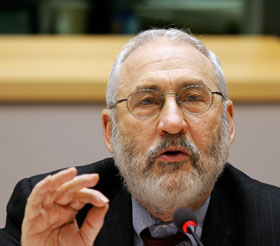
Feb. 1 (Bloomberg) — Nobel laureate Joseph Stiglitz said any decision by President Barack Obama to establish a so-called bad bank to rid financial companies of toxic assets risks swelling the national debt.

Obama’s administration is moving closer to buying the illiquid assets currently clogging bank’s balance sheets and preventing them from boosting lending, people familiar with the matter said this week.

That amounts to swapping taxpayers’ “cash for trash,” Stiglitz said yesterday in a panel discussion at the World Economic Forum in Davos, Switzerland. “You shouldn’t chase good money after bad. We’re talking about a national debt that’s very hard to manage.”

Stiglitz, a professor at Columbia University in New York and a former adviser to President Bill Clinton, says the plan would leave taxpayers paying for years of excess lending by banks. It would also deprive the government of money that would have been better spent shoring up Social Security, he said.

Whether a bad bank would accelerate an end to the financial crisis split delegates attending the Davos talks. JPMorgan Chase & Co. Chief Executive Officer Jamie Dimon said such an operation would help if “executed well.” Billionaire investor George Soros said in an interview that “it’s not the measure that would turn the situation around and enable banks to lend.”

Obama Plan

Obama said yesterday he’s readying a plan to unlock credit markets and lower mortgage rates. Under the initiative, the government would buy some tainted securities and insure the banks against losses on the rest.

“Soon my Treasury secretary, Timothy Geithner, will announce a new strategy for reviving our financial system that gets credit flowing to businesses and families,” Obama said in his weekly radio address.

Stiglitz drew criticism from panel participant Angel Gurria, head of the Organization for Economic Cooperation and Development, who says a bad bank is necessary for lending to resume.

“I agree about the moral, ethical fallout, but you’ve got to face the music and someone has to take the loss,” said Gurria, Mexico’s former finance minister. “It’s the only way to jumpstart the economy.”

Bank losses worldwide from toxic U.S.-originated assets may double to $2.2 trillion, the International Monetary Fund said in a report released Jan. 28.

John Monks, general secretary of the European Trade Union Confederation, told the same audience that governments are getting “close to straining the patience of the public and voters” by repeatedly extending lifelines to banks.

Philippines President Gloria Arroyo urged Obama to make a quick decision on his plan.

“We want Americans to do something,” she said at the session, which was called “Rebooting the Global Economy.” “We can discuss what to do but the worst thing is to do nothing.”