The Quiet Coup :: Simon Johnson

AIG, Banking Crisis, CDS, Goldman Sachs, Hank Paulson, SEC, Simon Johnsin

The Quiet Coup

bo2

The crash has laid bare many unpleasant truths about the United States. One of the most alarming, says a former chief economist of the International Monetary Fund, is that the finance industry has effectively captured our government—a state of affairs that more typically describes emerging markets, and is at the center of many emerging-market crises. If the IMF’s staff could speak freely about the U.S., it would tell us what it tells all countries in this situation: recovery will fail unless we break the financial oligarchy that is blocking essential reform. And if we are to prevent a true depression, we’re running out of time.

SIMON JOHNSON

ATLANTIC MAGAZINE

One thing you learn rather quickly when working at the International Monetary Fund is that no one is ever very happy to see you. Typically, your “clients” come in only after private capital has abandoned them, after regional trading-bloc partners have been unable to throw a strong enough lifeline, after last-ditch attempts to borrow from powerful friends like China or the European Union have fallen through. You’re never at the top of anyone’s dance card.

The reason, of course, is that the IMF specializes in telling its clients what they don’t want to hear. I should know; I pressed painful changes on many foreign officials during my time there as chief economist in 2007 and 2008. And I felt the effects of IMF pressure, at least indirectly, when I worked with governments in Eastern Europe as they struggled after 1989, and with the private sector in Asia and Latin America during the crises of the late 1990s and early 2000s. Over that time, from every vantage point, I saw firsthand the steady flow of officials—from Ukraine, Russia, Thailand, Indonesia, South Korea, and elsewhere—trudging to the fund when circumstances were dire and all else had failed.

Every crisis is different, of course. Ukraine faced hyperinflation in 1994; Russia desperately needed help when its short-term-debt rollover scheme exploded in the summer of 1998; the Indonesian rupiah plunged in 1997, nearly leveling the corporate economy; that same year, South Korea’s 30-year economic miracle ground to a halt when foreign banks suddenly refused to extend new credit.

But I must tell you, to IMF officials, all of these crises looked depressingly similar. Each country, of course, needed a loan, but more than that, each needed to make big changes so that the loan could really work. Almost always, countries in crisis need to learn to live within their means after a period of excess—exports must be increased, and imports cut—and the goal is to do this without the most horrible of recessions. Naturally, the fund’s economists spend time figuring out the policies—budget, money supply, and the like—that make sense in this context. Yet the economic solution is seldom very hard to work out.

No, the real concern of the fund’s senior staff, and the biggest obstacle to recovery, is almost invariably the politics of countries in crisis.

Typically, these countries are in a desperate economic situation for one simple reason—the powerful elites within them overreached in good times and took too many risks. Emerging-market governments and their private-sector allies commonly form a tight-knit—and, most of the time, genteel—oligarchy, running the country rather like a profit-seeking company in which they are the controlling shareholders. When a country like Indonesia or South Korea or Russia grows, so do the ambitions of its captains of industry. As masters of their mini-universe, these people make some investments that clearly benefit the broader economy, but they also start making bigger and riskier bets. They reckon—correctly, in most cases—that their political connections will allow them to push onto the government any substantial problems that arise.

In Russia, for instance, the private sector is now in serious trouble because, over the past five years or so, it borrowed at least $490 billion from global banks and investors on the assumption that the country’s energy sector could support a permanent increase in consumption throughout the economy. As Russia’s oligarchs spent this capital, acquiring other companies and embarking on ambitious investment plans that generated jobs, their importance to the political elite increased. Growing political support meant better access to lucrative contracts, tax breaks, and subsidies. And foreign investors could not have been more pleased; all other things being equal, they prefer to lend money to people who have the implicit backing of their national governments, even if that backing gives off the faint whiff of corruption.
The World is Pissed

Barack Obama. Global Financial Crisis, E.U., Emerging Markets, France, G-20, IMF, Iran, NATO, Prague, Robert Gibbs, Russia, Strasbourg, UK
March 29, 2009

Obama Will Face a Defiant World on Foreign Visit

WASHINGTON — President Obama is facing challenges to American power on multiple fronts as he prepares for his first trip overseas since taking office, with the nation’s economic woes emboldening allies and adversaries alike.

Despite his immense popularity around the world, Mr. Obama will confront resentment over American-style capitalism and resistance to his economic prescriptions when he lands in London on Tuesday for the Group of 20 summit meeting of industrial and emerging market nations plus the European Union.

The president will not even try to overcome NATO’s unwillingness to provide more troops in Afghanistan when he goes on later in the week to meet with the military alliance.

He seems unlikely to return home with any more to show for his attempts to open a dialogue with Iran’s leaders, who have, so far, responded with tough words, albeit not tough enough to persuade Russia to support the United States in tougher sanctions against Tehran. And he will be tested in face-to-face meetings by the leaders of China and Russia, who have been pondering the degree to which the power of the United States to dominate global affairs may be ebbing.

Mr. Obama is unlikely to push for specific commitments from other countries on stimulus spending to bolster their own economies, White House officials acknowledged Saturday in a teleconference call, despite the fact that administration officials would like to see European countries, in particular, increase their spending to try to prompt a global economic recovery.

“Nobody is asking any country to come to London to commit to do more right now,” said Michael Froman, deputy national security adviser for international economic affairs. Instead, world leaders at the meeting will try to “do whatever is necessary to restore global growth,” Mr. Froman said.

The challenges stem in part from lingering unhappiness around the world at the way the Bush administration used American power. But they have been made more intense by the sense in many capitals that the United States is no longer in any position to dictate to other nations what types of economic policies to pursue — or to impose its will more generally as it intensifies the war in Afghanistan and extracts itself from Iraq.

“There is a direct challenge under way to the paradigms that America has been trying to sell to the rest of the world,” said Eswar S. Prasad, a former China division chief at the International Monetary Fund. The American banking collapse, which precipitated the global meltdown, has led to a fundamental rethinking of the American way as a model for the rest of the world. Yet even as his presence stirs opposition to particular American policies, Mr. Obama is being welcomed by many Europeans as an embodiment of American ideals.

In Prague, where Mr. Obama will stop later in the week, local officials are installing a hot line for residents to find out about street closings. In Strasbourg, France, site of a NATO meeting, protesters are planning an “international resistance camp” with antiwar actions designed to press Mr. Obama to get American troops out of Afghanistan. In Istanbul, his last stop, workers are polishing up the Hagia Sophia basilica-cum-mosque-cum-museum for the expected visit.

“The rest of the world is yearning for him,” said Kenneth Rogoff, a Harvard economist. “On the one hand, they’ll all be criticizing him, and criticizing the American model. But they all want to hear that he does have a miracle to deliver.”

The quandary has left senior advisers to Mr. Obama scrambling to come up with a way for him to project both American power and the new cooperative international model that his aides have been promising.

Mr. Obama will try to show confidence that his stimulus and economic program will work, administration officials said, while conceding that it may take time. He will say that he has put all the pieces in place to fix the American economy, while acknowledging that in a global system nations cannot put up walls to protect their individual economies.

Robert D. Hormats, vice chairman of Goldman Sachs International, said the president “must demonstrate to the world that he understands that it’s not just about saving ourselves.”

And Mr. Obama must try to do all of that in the middle of a global recession for which most of the world blames the United States. “The U.S. brand name has clearly suffered from this crisis, and the rest of the world is no longer willing to sit quietly and be lectured by the United States on how they should conduct economic policy,” Mr. Rogoff said.

A senior Obama administration official acknowledged that it would be harder for Mr. Obama to exhort other countries to adopt the American model. But Robert Gibbs, the White House spokesman, said Saturday in the conference call that Mr. Obama “is going to listen in London, as well as to lead.”

“Many of the things we’ve done in the past week demonstrate that America is leading by example,” he said.

In the past, American officials traveled to India, Brazil, China and South Africa and lectured government officials on the need for open markets, free trade and deregulation. But now some of those very policies — particularly deregulation — are viewed as the culprits for the recent economic collapse.

“Emerging markets now think they can do what they want without hectoring from the United States,” said Mr. merging Markets, Prasad, the former monetary fund official.

Compounding the problem for Mr. Obama is that the route that he has chosen to lead the United States out of the mess — heavy government spending — is not available to many other countries. European governments, for instance, are far more lukewarm about enormous stimulus programs because they already have strong social safety nets, and more fears of inflation, than does the United States.

So when Mr. Obama meets with other world leaders in London, he will be confronting a philosophical divide, with the United States on the defensive not just on economic issues like trade and financial regulation but also on a variety of national security and diplomatic matters.

After he leaves London, Mr. Obama will go to the French-German border for a NATO meeting at a time when European governments, under pressure from their populations, are looking for the exit doors in Afghanistan even as the United States sends more troops and money.

Administration officials had initially said they hoped to get more troop contributions at the NATO meeting; now they do not even talk about securing more troops from the Europeans, in a tacit acknowledgment that the forces will not be coming.

“I hope that Afghanistan will not be Obama’s war, because it should be owned by all of us,” said NATO’s secretary general, Jaap de Hoop Scheffer.

But there are already twice as many American troops as NATO troops in Afghanistan, and “Europe will never be able to match the numbers of the Americans in Afghanistan,” Mr. de Hoop Scheffer said. The NATO summit meeting, he said, “will not be about troop contributions.”

In Prague, Mr. Obama will confront an Eastern Europe nervous about Russian attempts to reassert itself in an area that Moscow views as its backyard. Mr. Obama has taken pains to reassure Russia that his administration will tread carefully regarding Bush administration plans to locate a missile defense system in Poland and the Czech Republic.

Yet in placating Russia, Mr. Obama has raised hackles in Poland, where officials seek closer ties to the United States.

George Soros Calls G20: "Make or Break"

AIG, Barack Obama, Ben Bernanke, CDS, Europe, Fed, G20, George Soros, IMF, Larry Summers, Special Drawing Rights, Tim Geithner, Treasury, UK, World Financial Crisis
By Joe Lynam

071113_p00_soros

Billionaire investor Gorge Soros has said the G20 summit will be a “make or break” event for the world’s economy.

In a BBC interview, Mr Soros said the international financial system had collapsed because it was flawed and it had to be restructured.

Mr Soros say it may be the last chance to prevent a full-scale depression.

He said the G20 meeting had to come up with concrete solutions to help the developing world in particular, which had been been worst hit.

‘Depression’

Mr Soros warned that any attempt to pull economies out of recession had to be done co-operatively.

He said: “The G20 meeting is make or break because unless they do something for developing world there will be serious collapse in that part of the world.

“I’m using phrase depression because unless we take the right measures we’re liable to end up there.

If countries start doing it [engineering a new financial world order] bilaterally instead of multilaterally, the system will fall apart and we’ll end up in depression.”

He also said the rebuilding meant the previous economic system had to be scrapped.

The International financial system has collapsed and cannot be restored in its current form ”
George Soros

“I don’t think we’ll ever be back to where we came from. It should be recognised that the last 25 years were an aberration and we cannot go back there. We have to reconstruct the financial system from its foundations up.”

Mr Soros said regulators and the financial sector shared the blame for the meltdown, as they “participated in this crazy boom built on false premises on the belief that markets are self-regulating and should be left alone”.

Mr Soros also warned the UK economy was in a deep recession “which is going to be a lasting one”.

He added: “The International financial system has collapsed and cannot be restored in its current form. It will have to be restructured because it was flawed and collapsed under its own weight.”

In May last year, Mr Soros was interviewed by the BBC’s business editor Robert Peston and said he was worried about the US and UK’s ability to deal with the downturn because of their reliance on credit.

Mr Soros urged wealthy nations to give their allocations of the IMF’s internal currency, called Special Drawing Rights, to poorer ones because developing countries were not in a position to bail out their own failing banks.

George Soros famously made his name – and $1bn – when he bet that sterling would have to withdraw from the European Exchange Rate Mechanism in 1992. He’s also said to have accurately predicted and profited from the Asian financial crisis in 1997.

The 78-year-old Hungarian is one of the largest aid donors in Africa, having donated around $6bn to his favourite causes.

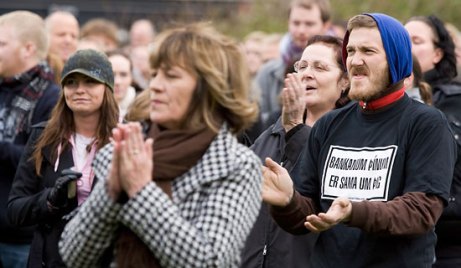
Iceland Economy Melts Away Like an Owsley Gooniebird

Central Bank of Iceland, euro, Financial Crisis, Iceland, IMF, Kaupthing Bank

Iceland is all but officially bankrupt
INTERNATIONAL HERALD TRIBUNE

International Herald Tribune

Iceland is all but officially bankrupt

By Eric Pfanner
Thursday, October 9, 2008

REYKJAVIK: People go bankrupt all the time. Companies do, too. But countries?

Iceland was on the verge of doing exactly that on Thursday as the government shut down the stock market and seized control of its last major independent bank. That brought trading in the country’s currency to a halt, with foreign banks no longer willing to take Icelandic krona, even at fire-sale rates.

As the meltdown in the Icelandic financial system quickened, with the government seemingly powerless to do anything about it, analysts said there was probably only one realistic option left: for Iceland to be bailed out by the International Monetary Fund.


“Iceland is bankrupt,” said Arsaell Valfells, a professor at the University of Iceland. “The Icelandic krona is history. The IMF has to come and rescue us.”


Prime Minister Geir Haarde, who had warned this week of the threat of “national bankruptcy,” said Thursday that Iceland’s finance minister, Arni Mathiesen, would be in Washington this weekend for the autumn IMF/World Bank meetings. He declined to say whether Iceland was seeking a rescue package from the international lender.


“We will certainly keep this option open, but we have not yet made a decision,” Haarde said Thursday at a news conference.

The IMF managing director, Dominique Strauss-Kahn, said in Washington that he had activated an emergency funding system, last used during the Asian financial crisis of the late 1990’s, to help countries in crisis. Though not mentioning Iceland by name, he said: “We are ready to answer any demand by countries facing problems.”

Iceland has approached Russia about a loan of €4 billion, or $5.5 billion, to help see it through the crisis, but Haarde said no agreement had been reached.

An IMF intervention in Iceland, which would necessarily involve accepting a series of harsh measures to restore fiscal and monetary stability, would underline the extraordinary reversal in the country’s fortunes after a decade-long, debt-fueled binge by the country’s banks, businesses and some private citizens. The banks, while avoiding the toxic mortgage securities that have humbled Wall Street, expanded aggressively at home and abroad. When credit tightened and the krona fell this year, they were unable to finance their debts.

In these circumstances, going to the IMF “is probably the only thing Iceland can do,” said Richard Portes, an economist at the London Business School.

Events have moved so fast that the full import of national bankruptcy has yet to sink in here. It’s happened before, of course, but in places like Argentina and Thailand, not a country that likes to think of itself as close to Europe.

And on an island raked by icy North Atlantic winds and dotted with volcanoes and geysers, where people live with the threat of earthquakes and maritime disasters, few residents seem to be losing their cool over the financial crisis – yet. But some have suffered deep losses, and others are simply bewildered at how things could have gone so wrong so quickly.

“There is a lot of fear in society and there are people who are losing everything,” Bubbi Morthens, an Icelandic rock favorite, said Wednesday after singing at an impromptu midday concert in central Reykjavik intended to lift people’s spirits.

Like many of his compatriots, Morthens did well when Iceland was riding high, accumulating considerable wealth. But when the government seized control of Iceland’s third-largest bank, Glitnir, last month, Morthens said he lost his life savings, which he had invested in the bank’s stock.

On Thursday, the government seized Kaupthing Bank, the country’s largest lender, effectively completing the nationalization of the banking system after the previous takeover of Glitnir and the No.2 lender, Landsbanki.

Meanwhile trading in the currency froze up Thursday, according to Bloomberg News, citing dealers at Nordea, a big Scandinavian bank. The last trade was made at 340 krona to the euro, Nordea said – less than half what the Icelandic currency was worth at the start of the week.

Haarde said the Central Bank of Iceland had set up a special system to handle currency transactions, so that Icelandic companies could conduct international business.

“We are gradually moving through this crisis,” he said, sounding surprisingly unworried for the leader of a country facing economic and financial disaster. “There are still a few issues to resolve but that is the nature of these kinds of things.”

Problems with the krona have been at the core of the government’s inability to control the crisis. Without a viable currency, there is no way to support the banks, which have done the bulk of their business in foreign markets. There is also no way to bring down inflation or interest rates, both already in double digits before the crisis intensified in recent days.

Valfells and Portes said that once the situation is stabilized, the best way forward would be for Iceland is to give up on the krona and adopt the euro instead.

How could Iceland, which is not even a member of the European Union, adopt the currency?

One option would be to simply “peg” its currency to the euro. In that case, Iceland would also hand over control of monetary policy, including the setting of interest rates, to the European Central Bank in Frankfurt.

But fixing the currency to the euro could be difficult for Iceland, given that its central bank probably lacks the necessary reserve to defend such a level if the currency were to come under renewed attack, Portes said.

That leaves another option: applying to join the European Union and adding Iceland to the euro zone. Because Iceland is already part of the European Economic Area, a looser trading bloc, it already abides by many EU rules.

Still, such a move would be politically challenging. The conservative Independence Party, headed by the prime minister, has been dead set against it. Another member of that party, which is governing in a coalition with the pro-EU Social Democrats, is the central bank chairman, David Oddsson, a former prime minister.

They are supported by the powerful fishing industry, which mostly wants to stay out of the euro and to keep Europe at a comfortable distance. Fishing has been the focus of many clashes between Iceland and its European neighbors – most heatedly with Britain, in what became known as the Cod Wars of the 1950s to the 70s. The two countries clashed repeatedly over Iceland’s move to extend exclusive fishing rights into waters that had long been trawled by British vessels, too.

Tension with Britain has flared anew during the current crisis. It centers on accounts, worth an estimated 8 billion pounds, that Britons hold in the Icelandic banks; while the British government has guaranteed private savers’ accounts, charities and local government organizations fear that they will lose their money. The government of Prime Minister Gordon Brown of Britain has used powers granted under anti-terrorism laws to freeze British assets of Landsbanki until the standoff is resolved.

“We do not consider this to be a particularly friendly act,” Haarde said, adding that he had tried to defuse the situation in a telephone call with Brown on Thursday.

For all the worries, this capital city of 120,000 people still displays the fruits of the decade-long economic boom that followed the deregulation of Iceland’s financial sector in the 1990s – hip cafés, lobster restaurants and stylish shops selling outdoor gear.

But the days when the economy seemed capable of gravity-defying feats are gone. So are the days when investors went on an international buying spree, adding some of the biggest names of the British and American retailing industries to their portfolios. Gone too, are the days when ordinary citizens effortlessly joined in the fun, taking out second mortgages to finance their own trips abroad or at least to the Laugavegur, the main shopping strip in Reykjavik.

“It’s difficult; the landscape is very difficult,” said Franch Michelsen, a watch dealer in central Reykjavik, as he took a break Wednesday from cleaning his shop window.

Some ordinary Icelanders face a similar problem to the one that brought down the banks. In recent months, many mortgages were taken out in foreign currencies – marketed by the banks as a way to benefit from lower interest rates abroad, as rates in Iceland rose into the double digits.

Now, with the Icelandic krona plunging, homeowners suddenly have to pay back far more expensive euro or dollar values of their mortgages. At the same time, house prices are falling.

The Reverend Karl Sigurbjornsson, the bishop of Iceland, who leads the state-sponsored Lutheran church, says he worries about how the prospect of financial suffering will affect a society that “was led to believe that it was unlimited growth forever.”

“What will happen when the dust settles?” he asked. “A lot of people will be very angry. It will be a challenge for our society.”
Correction:
Notes:
International Herald Tribune Copyright © 2008 The International Herald Tribune | http://www.iht.com

Technorati Tags: , , , , , ,