Breaking The Bank : Behind The Financial Meltdown ~ Frontline [Video]

Bank of america, Frontline, Hank Paulson, IMF, John Thain, Ken Lewis, Lehman Brothers, Merrill Lynch, Michael Kirk, Simon Johnson, Wall Street

bbb

F R O N T L I N E

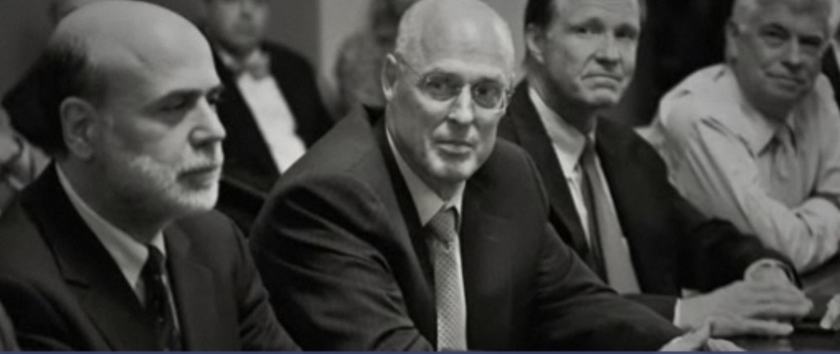
In Breaking the Bank, FRONTLINE producer Michael Kirk (Inside the Meltdown, Bush’s War) draws on a rare combination of high-profile interviews with key players Ken Lewis and former Merrill Lynch CEO John Thain to reveal the story of two banks at the heart of the financial crisis, the rocky merger, and the government’s new role in taking over — some call it “nationalizing” — the American banking system.

It all began on that fateful weekend in September 2008 when the American economy was on the verge of melting down. Then-Secretary of the Treasury Henry Paulson, his former protégé John Thain, and Ken Lewis, one of the most powerful bankers in the country, secretly cut a deal to merge Bank of America and Merrill Lynch.

The merger of the nation’s largest bank and Merrill Lynch was supposed to help save the American financial system by preventing the imminent Lehman Brothers bankruptcy from setting off a destructive chain reaction. But it became immediately clear that it had not worked. Within days, the entire global financial system was collapsing.

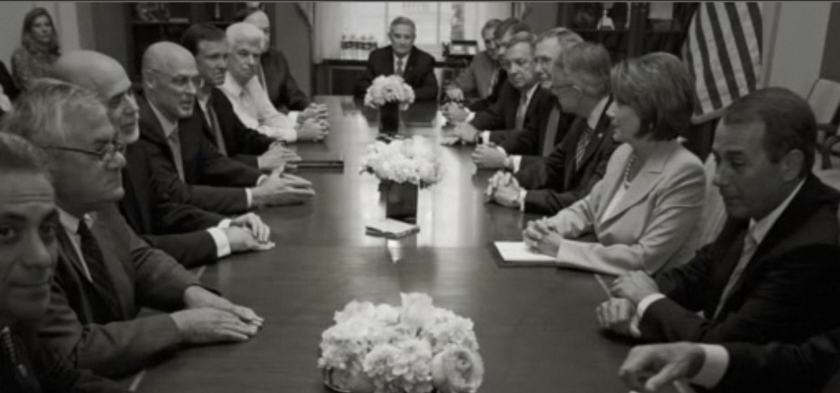
In Washington, Secretary Paulson was determined to spend billions of government dollars to prevent the American banking system from dragging the country into a depression. That October, Lewis, Thain and other top bank CEOs found themselves at an emergency meeting at the Treasury Department. Paulson told the group they had no choice but to accept $125 billion of capital from American taxpayers in order to save the financial system. Initially, Bank of America’s CEO Lewis was supportive of the plan. “We are so intertwined with the U.S. that it’s hard to separate what’s good for the United States and what’s good for Bank of America,” Lewis tells FRONTLINE.

But some observers now say that Paulson’s injection of public capital was the beginning of unprecedented government involvement in the nation’s banking system, with consequences few understood.

“I think we nationalized the banks in the U.S. on that day,” former International Monetary Fund chief economist Simon Johnson says. “The government got a lot of say in how they are run, a lot of constraints, a lot of responsibility. A lot of downside risk was taken on that day.”

By December, Lewis was discovering what it meant to have the government as a partial owner. When fourth-quarter losses at Merrill grew to $15 billion, Lewis began to look for a way to get out of the deal. But in tense negotiations with government officials, Lewis was told he had no choice. If he did not go through with the merger, regulators threatened to change the bank’s management.

“Ken Lewis blinked, the full force of the government is being brought upon him. The rules of the game have changed,” Wall Street Journal reporter Dan Fitzpatrick says. “Ken Lewis is on top of the financial services world, but he’s not in charge. The government holds all the cards at the end of the day.”

FRONTLINE’s Breaking the Bank tells the story of Lewis’ struggle to survive in this new financial order, where public outrage and government edicts are now as important to banking as shareholders and deposits. With his bank on the brink, Lewis now finds himself the subject of a shareholder revolt, congressional indignation, presidential pressure and the increasingly conflicting demands of private investors and government officials.

“This is more than a story about just one man or one bank,” says producer Michael Kirk. “This is the story of the most important change in the relationship between government and private business in a generation.”

Senate Turns Aside New Attempt to Scrutinize Fed

Ben Bernanke, Federal Reserve, Goldman Sachs, Hank Paulson, Politics

bailoutREUTERS

Mon Jul 6, 2009 5:59pm EDT

WASHINGTON (Reuters) – The U.S. Federal Reserve, facing growing pressure as it tries to heal the ailing economy, dodged a bullet on Monday when the U.S. Senate cast aside a new effort to increase scrutiny of the central bank.

On procedural grounds, the Senate blocked a bid to permit the U.S. comptroller general, who heads the investigative arm of Congress known as the Government Accountability Office, to audit the Federal Reserve system and issue a report.

Republican Senator Jim DeMint, who has been pushing for greater transparency at the Fed, failed to get the provision attached to the must-pass annual spending bill that includes funding for the GAO for the upcoming 2010 fiscal year.

The audit would have included details about the Fed’s discount window operations, funding facilities, open market operations and agreements with foreign central banks and governments, DeMint said on the Senate floor.

“The Federal Reserve will create and disburse trillions of dollars in response to our current financial crisis,” DeMint said. “Americans across the nation, regardless of their opinion on the bailout, want to know where the money has gone.

“Allowing the Fed to operate our nation’s monetary system in almost complete secrecy leads to abuse, inflation and a lower quality of life,” he said.

Democrats who control the Senate blocked the South Carolina Republican’s amendment on the grounds that it violated rules prohibiting legislation attached to spending bills.

Fed officials were not immediately available to comment.

The move comes as some lawmakers have increasingly become wary of the Fed’s actions, particularly for its handling of the real estate market and the meltdown of major financial institutions like investment bank Bear Stearns and insurance giant American International Group.

A non-binding provision in the fiscal 2010 budget blueprint Congress approved in April called on the Fed to provide more information about collateral posted against Bear Stearns and AIG loans.

That measure also sought a study evaluating the appropriate number and costs of the regional Fed banks.

The U.S. central bank has a seven-member board in Washington whose members are nominated by the president and confirmed by the Senate. It also has 12 regional banks whose presidents are appointed by banks and other businesses in their local districts, with the consent of the Washington board.

(Reporting by Jeremy Pelofsky and Alister Bull, editing by Dan Grebler)

It's Goldman Sachs' Party And They'll Profit If They Want To

AIG, Bank of america, Citibank, Goldman Sachs, Henry Paulson, John Thain, Joshua Bolten, Matt Taibbi, Merrill Lynch, Robert Rubin, Robert Steel, Tim Geithner

THE GREAT AMERICAN BUBBLE MACHINE

ROLLING STONE

MATT TAIBBI

crashing

From tech stocks to high gas prices, Goldman Sachs has engineered every major market manipulation since the Great Depression – and they’re about to do it again


The first thing you need to know about Goldman Sachs is that it’s everywhere. The world’s most powerful investment bank is a great vampire squid wrapped around the face of humanity, relentlessly jamming its blood funnel into anything that smells like money. In fact, the history of the recent financial crisis, which doubles as a history of the rapid decline and fall of the suddenly swindled-dry American empire, reads like a Who’s Who of Goldman Sachs graduates.

By now, most of us know the major players. As George Bush’s last Treasury secretary, former Goldman CEO Henry Paulson was the architect of the bailout, a suspiciously self-serving plan to funnel trillions of Your Dollars to a handful of his old friends on Wall Street. Robert Rubin, Bill Clinton’s former Treasury secretary, spent 26 years at Goldman before becoming chairman of Citigroup – which in turn got a $300 billion taxpayer bailout from Paulson. There’s John Thain, the rear end in a top hat chief of Merrill Lynch who bought an $87,000 area rug for his office as his company was imploding; a former Goldman banker, Thain enjoyed a multibillion-dollar handout from Paulson, who used billions in taxpayer funds to help Bank of America rescue Thain’s sorry company. And Robert Steel, the former Goldmanite head of Wachovia, scored himself and his fellow executives $225 million in golden parachute payments as his bank was self-destructing. There’s Joshua Bolten, Bush’s chief of staff during the bailout, and Mark Patterson, the current Treasury chief of staff, who was a Goldman lobbyist just a year ago, and Ed Liddy, the former Goldman director whom Paulson put in charge of bailed-out insurance giant AIG, which forked over $13 billion to Goldman after Liddy came on board. The heads of the Canadian and Italian national banks are Goldman alums, as is the head of the World Bank, the head of the New York Stock Exchange, the last two heads of the Federal Reserve Bank of New York – which, incidentally, is now in charge of overseeing Goldman – not to mention …

But then, any attempt to construct a narrative around all the former Goldmanites in influential positions quickly becomes an absurd and pointless exercise, like trying to make a list of everything. What you need to know is the big picture: If America is circling the drain, Goldman Sachs has found a way to be that drain – an extremely unfortunate loophole in the system of Western democratic capitalism, which never foresaw that in a society governed passively by free markets and free elections, organized greed always defeats disorganized democracy.

The bank’s unprecedented reach and power have enabled it to turn all of America into a giant pump-and-dump scam, manipulating whole economic sectors for years at a time, moving the dice game as this or that market collapses, and all the time gorging itself on the unseen costs that are breaking families everywhere – high gas prices, rising consumer-credit rates, half-eaten pension funds, mass layoffs, future taxes to pay off bailouts. All that money that you’re losing, it’s going somewhere, and in both a literal and a figurative sense, Goldman Sachs is where it’s going: The bank is a huge, highly sophisticated engine for converting the useful, deployed wealth of society into the least useful, most wasteful and insoluble substance on Earth – pure profit for rich individuals.

They achieve this using the same playbook over and over again. The formula is relatively simple: Goldman positions itself in the middle of a speculative bubble, selling investments they know are crap. Then they hoover up vast sums from the middle and lower floors of society with the aid of a crippled and corrupt state that allows it to rewrite the rules in exchange for the relative pennies the bank throws at political patronage. Finally, when it all goes bust, leaving millions of ordinary citizens broke and starving, they begin the entire process over again, riding in to rescue us all by lending us back our own money at interest, selling themselves as men above greed, just a bunch of really smart guys keeping the wheels greased. They’ve been pulling this same stunt over and over since the 1920s – and now they’re preparing to do it again, creating what may be the biggest and most audacious bubble yet.

If you want to understand how we got into this financial crisis, you have to first understand where all the money went – and in order to understand that, you need to understand what Goldman has already gotten away with. It is a history exactly five bubbles long – including last year’s strange and seemingly inexplicable spike in the price of oil. There were a lot of losers in each of those bubbles, and in the bailout that followed. But Goldman wasn’t one of them.

IF AMERICA IS NOW CIRCLING THE DRAIN, GOLDMAN SACHS HAS FOUND A WAY TO BE THAT DRAIN.

BUBBLE #1 – THE GREAT DEPRESSION

Goldman wasn’t always a too-big-to-fail Wall Street behemoth, the ruthless face of kill-or-be-killed capitalism on steroids – just almost always. The bank was actually founded in 1869 by a German immigrant named Marcus Goldman, who built it up with his son-in-law Samuel Sachs. They were pioneers in the use of commercial paper, which is just a fancy way of saying they made money lending out short-term IOUs to small-time vendors in downtown Manhattan.

You can probably guess the basic plotline of Goldman’s first 100 years in business: plucky, immigrant-led investment bank beats the odds, pulls itself up by its bootstraps, makes shitloads of money. In that ancient history there’s really only one episode that bears scrutiny now, in light of more recent events: Goldman’s disastrous foray into the speculative mania of pre-crash Wall Street in the late 1920s.

This great Hindenburg of financial history has a few features that might sound familiar. Back then, the main financial tool used to bilk investors was called an “investment trust.” Similar to modern mutual funds, the trusts took the cash of investors large and small and (theoretically, at least) invested it in a smorgasbord of Wall Street securities, though the securities and amounts were often kept hidden from the public. So a regular guy could invest $10 or $100 in a trust and feel like he was a big player. Much as in the 1990s, when new vehicles like day trading and e-trading attracted reams of new suckers from the sticks who wanted to feel like big shots, investment trusts roped a new generation of regular-guy investors into the speculation game.

Beginning a pattern that would repeat itself over and over again, Goldman got into the investment-trust game late, then jumped in with both feet and went hog-wild. The first effort was the Goldman Sachs Trading Corporation; the bank issued a million shares at $100 apiece, bought all those shares with its own money and then sold 90 percent of them to the hungry public at $104. The trading corporation then relentlessly bought shares in itself, bidding the price up further and further. Eventually it dumped part of its holdings and sponsored a new trust, the Shenandoah Corporation, issuing millions more in shares in that fund – which in turn sponsored yet another trust called the Blue Ridge Corporation. In this way, each investment trust served as a front for an endless investment pyramid: Goldman hiding behind Goldman hiding behind Goldman. Of the 7,250,000 initial shares of Blue Ridge, 6,250,000 were actually owned by Shenandoah – which, of course, was in large part owned by Goldman Trading.

The end result (ask yourself if this sounds familiar) was a daisy chain of borrowed money, one exquisitely vulnerable to a decline in performance anywhere along the line; The basic idea isn’t hard to follow. You take a dollar and borrow nine against it; then you take that $10 fund and borrow $90; then you take your $100 fund and, so long as the public is still lending, borrow and invest $900. If the last fund in the line starts to lose value, you no longer have the money to pay back your investors, and everyone gets massacred.

In a chapter from The Great Crash, 1929 titled “In Goldman Sachs We Trust,” the famed economist John Kenneth Galbraith held up the Blue Ridge and Shenandoah trusts as classic examples of the insanity of leverage-based investment. The trusts, he wrote, were a major cause of the market’s historic crash; in today’s dollars, the losses the bank suffered totaled $475 billion. “It is difficult not to marvel at the imagination which was implicit in this gargantuan insanity,” Galbraith observed, sounding like Keith Olbermann in an ascot. “If there must be madness, something may be said for having it on a heroic scale.”

BUBBLE #2 – TECH STOCKS

Fast-Forward about 65 years. Goldman not only survived the crash that wiped out so many of the investors it duped, it went on to become the chief underwriter to the country’s wealthiest and most powerful corporations. Thanks to Sidney Weinberg, who rose from the rank of janitor’s assistant to head the firm, Goldman became the pioneer of the initial public offering, one of the principal and most lucrative means by which companies raise money. During the 1970s and 1980s, Goldman may not have been the planet-eating Death Star of political influence it is today, but it was a top-drawer firm that had a reputation for attracting the very smartest talent on the Street.

It also, oddly enough, had a reputation for relatively solid ethics and a patient approach to investment that shunned the fast buck; its executives were trained to adopt the firm’s mantra, “long-term greedy.” One former Goldman banker who left the firm in the early Nineties recalls seeing his superiors give up a very profitable deal on the grounds that it was a long-term loser. “We gave back money to ‘grownup’ corporate clients who had made bad deals with us,” he says. “Everything we did was legal and fair – but ‘long-term greedy’ said we didn’t want to make such a profit at the clients’ collective expense that we spoiled the marketplace.”

But then, something happened. It’s hard to say what it was exactly; it might have been the fact that Goldman’s co-chairman in the early Nineties, Robert Rubin, followed Bill Clinton to the White House, where he directed the National Economic Council and eventually became Treasury secretary. While the American media fell in love with the story line of a pair of baby-boomer, Sixties-child, Fleetwood Mac yuppies nesting in the White House, it also nursed an undisguised crush on Rubin, who was hyped as without a doubt the smartest person ever to walk the face of the Earth, with Newton, Einstein, Mozart and Kant running far behind.

Rubin was the prototypical Goldman banker. He was probably born in a $4,000 suit, he had a face that seemed permanently frozen just short of an apology for being so much smarter than you, and he exuded a Spock-like, emotion-neutral exterior; the only human feeling you could imagine him experiencing was a nightmare about being forced to fly coach. It became almost a national cliche that whatever Rubin thought was best for the economy – a phenomenon that reached its apex in 1999, when Rubin appeared on the cover of Time with his Treasury deputy, Larry Summers, and Fed chief Alan Greenspan under the headline THE COMMITTEE TO SAVE THE WORLD. And “what Rubin thought,” mostly, was that the American economy, and in particular the financial markets, were over-regulated and needed to be set free. During his tenure at Treasury, the Clinton White House made a series of moves that would have drastic consequences for the global economy – beginning with Rubin’s complete and total failure to regulate his old firm during its first mad dash for obscene short-term profits.

The basic scam in the Internet Age is pretty easy even for the financially illiterate to grasp. Companies that weren’t much more than pot-fueled ideas scrawled on napkins by up-too-late bong-smokers were taken public via IPOs, hyped in the media and sold to the public for megamillions. It was as if banks like Goldman were wrapping ribbons around watermelons, tossing them out 50-story windows and opening the phones for bids. In this game you were a winner only if you took your money out before the melon hit the pavement.

It sounds obvious now, but what the average investor didn’t know at the time was that the banks had changed the rules of the game, making the deals look better than they actually were. They did this by setting up what was, in reality, a two-tiered investment system – one for the insiders who knew the real numbers, and another for the lay investor who was invited to chase soaring prices the banks themselves knew were irrational. While Goldman’s later pattern would be to capitalize on changes in the regulatory environment, its key innovation in the Internet years was to abandon its own industry’s standards of quality control.

“Since the Depression, there were strict underwriting guidelines that Wall Street adhered to when taking a company public,” says one prominent hedge-fund manager. “The company had to be in business for a minimum of five years, and it had to show profitability for three consecutive years. But Wall Street took these guidelines and threw them in the trash.” Goldman completed the snow job by pumping up the sham stocks: “Their analysts were out there saying Bullshit.com is worth $100 a share.”

The problem was, nobody told investors that the rules had changed. “Everyone on the inside knew,” the manager says. “Bob Rubin sure as hell knew what the underwriting standards were. They’d been intact since the 1930s.”

Jay Ritter, a professor of finance at the University of Florida who specializes in IPOs, says banks like Goldman knew full well that many of the public offerings they were touting would never make a dime. “In the early Eighties, the major underwriters insisted on three years of profitability. Then it was one year, then it was a quarter. By the time of the Internet bubble, they were not even requiring profitability in the foreseeable future.”

Goldman has denied that it changed its underwriting standards during the Internet years, but its own statistics belie the claim. Just as it did with the investment trust in the 1920s, Goldman started slow and finished crazy in the Internet years. After it took a little-known company with weak financials called Yahoo! public in 1996, once the tech boom had already begun, Goldman quickly became the IPO king of the Internet era. Of the 24 companies it took public in 1997, a third were losing money at the time of the IPO. In 1999, at the height of the boom, it took 47 companies public, including stillborns like Webvan and eToys, investment offerings that were in many ways the modern equivalents of Blue Ridge and Shenandoah. The following year, it underwrote 18 companies in the first four months, 14 of which were money losers at the time. As a leading underwriter of Internet stocks during the boom, Goldman provided profits far more volatile than those of its competitors: In 1999, the average Goldman IPO leapt 281 percent above its offering price, compared to the Wall Street average of 181 percent.

How did Goldman achieve such extraordinary results? One answer is that they used a practice called “laddering,” which is just a fancy way of saying they manipulated the share price of new offerings. Here’s how it works: Say you’re Goldman Sachs, and Bullshit.com comes to you and asks you to take their company public. You agree on the usual terms: You’ll price the stock, determine how many shares should be released and take the Bullshit.com CEO on a “road show” to schmooze investors, all in exchange for a substantial fee (typically six to seven percent of

the amount raised). You then promise your best clients the right to buy big chunks of the IPO at the low offering price – let’s say Bullshit.com’s starting share price is $15 – in exchange for a promise that they will buy more shares later on the open market. That seemingly simple demand gives you inside knowledge of the IPO’s future, knowledge that wasn’t disclosed to the day-trader schmucks who only had the prospectus to go by: You know that certain of your clients who bought X amount of shares at $15 are also going to buy Y more shares at $20 or $25, virtually guaranteeing that the price is going to go to $25 and beyond. In this way, Goldman could artificially jack up the new company’s price, which of course was to the bank’s benefit – a six percent fee of a $500 million IPO is serious money.

Goldman was repeatedly sued by shareholders for engaging in laddering in a variety of Internet IPOs, including Webvan and NetZero. The deceptive practices also caught the attention of Nichol as Maier, the syndicate manager of Cramer & Co., the hedge fund run at the time by the now-famous chattering television rear end in a top hat Jim Cramer, himself a Goldman alum. Maier told the SEC that while working for Cramer between 1996 and 1998, he was repeatedly forced to engage in laddering practices during IPO deals with Goldman.

“Goldman, from what I witnessed, they were the worst perpetrator,” Maier said. “They totally fueled the bubble. And it’s specifically that kind of behavior that has caused the market crash. They built these stocks upon an illegal foundation – manipulated up – and ultimately, it really was the small person who ended up buying in.” In 2005, Goldman agreed to pay $40 million for its laddering violations – a puny penalty relative to the enormous profits it made. (Goldman, which has denied wrongdoing in all of the cases it has settled, refused to respond to questions for this story.)

Another practice Goldman engaged in during the Internet boom was “spinning,” better known as bribery. Here the investment bank would offer the executives of the newly public company shares at extra-low prices, in exchange for future underwriting business. Banks that engaged in spinning would then undervalue the initial offering price – ensuring that those “hot” opening price shares it had handed out to insiders would be more likely to rise quickly, supplying bigger first-day rewards for the chosen few. So instead of Bullshit.com opening at $20, the bank would approach the Bullshit.com CEO and offer him a million shares of his own company at $18 in exchange for future business – effectively robbing all of Bullshit’s new shareholders by diverting cash that should have gone to the company’s bottom line into the private bank account of the company’s CEO.

In one case, Goldman allegedly gave a multimillion-dollar special offering to eBay CEO Meg Whitman, who later joined Goldman’s board, in exchange for future i-banking business. According to a report by the House Financial Services Committee in 2002, Goldman gave special stock offerings to executives in 21 companies that it took public, including Yahoo! co-founder Jerry Yang and two of the great slithering villains of the financial-scandal age – Tyco’s Dennis Kozlowski and Enron’s Ken Lay. Goldman angrily denounced the report as “an egregious distortion of the facts” – shortly before paying $110 million to settle an investigation into spinning and other manipulations launched by New York state regulators. “The spinning of hot IPO shares was not a harmless corporate perk,” then-attorney general Eliot Spitzer said at the time. “Instead, it was an integral part of a fraudulent scheme to win new investment-banking business.”

Such practices conspired to turn the Internet bubble into one of the greatest financial disasters in world history: Some $5 trillion of wealth was wiped out on the NASDAQ alone. But the real problem wasn’t the money that was lost by shareholders, it was the money gained by investment bankers, who received hefty bonuses for tampering with the market. Instead of teaching Wall Street a lesson that bubbles always deflate, the Internet years demonstrated to bankers that in the age of freely flowing capital and publicly owned financial companies, bubbles are incredibly easy to inflate, and individual bonuses are actually bigger when the mania and the irrationality are greater.

GOLDMAN SCAMMED HOUSING INVESTORS BY BETTING AGAINST ITS OWN CRAPPY MORTGAGES.

Nowhere was this truer than at Goldman. Between 1999 and 2002, the firm paid out $28.5 billion in compensation and benefits – an average of roughly $350,000 a year per employee. Those numbers are important because the key legacy of the Internet boom is that the economy is now driven in large part by the pursuit of the enormous salaries and bonuses that such bubbles make possible. Goldman’s mantra of “long-term greedy” vanished into thin air as the game became about getting your check before the melon hit the pavement.

The market was no longer a rationally managed place to grow real, profitable businesses: It was a huge ocean of Someone Else’s Money where bankers hauled in vast sums through whatever means necessary and tried to convert that money into bonuses and payouts as quickly as possible. If you laddered and spun 50 Internet IPOs that went bust within a year, so what? By the time the Securities and Exchange Commission got around to fining your firm $110 million, the yacht you bought with your IPO bonuses was already six years old. Besides, you were probably out of Goldman by then, running the U.S. Treasury or maybe the state of New Jersey. (One of the truly comic moments in the history of America’s recent financial collapse came when Gov. Jon Corzine of New Jersey, who ran Goldman from 1994 to 1999 and left with $320 million in IPO-fattened stock, insisted in 2002 that “I’ve never even heard the term ‘laddering’ before.”)

For a bank that paid out $7 billion a year in salaries, $110 million fines issued half a decade late were something far less than a deterrent – they were a joke. Once the Internet bubble burst, Goldman had no incentive to reassess its new, profit-driven strategy; it just searched around for another bubble to inflate. As it turns out, it had one ready, thanks in large part to Rubin.

BUBBLE #3 – THE HOUSING CRAZE

Goldman’s role in the sweeping disaster that was the housing bubble is not hard to trace. Here again, the basic trick was a decline in underwriting standards, although in this case the standards weren’t in IPOs but in mortgages. By now almost everyone knows that for decades mortgage dealers insisted that home buyers be able to produce a down payment of 10 percent or more, show a steady income and good credit rating, and possess a real first and last name. Then, at the dawn of the new millennium, they suddenly threw all that poo poo out the window and started writing mortgages on the backs of napkins to cocktail waitresses and ex-cons carrying five bucks and a Snickers bar.

None of that would have been possible without investment bankers like Goldman, who created vehicles to package those lovely mortgages and sell them en masse to unsuspecting insurance companies and pension funds. This created a mass market for toxic debt that would never have existed before; in the old days, no bank would have wanted to keep some addict ex-con’s mortgage on its books, knowing how likely it was to fail. You can’t write these mortgages, in other words, unless you can sell them to someone who doesn’t know what they are.

Goldman used two methods to hide the mess they were selling. First, they bundled hundreds of different mortgages into instruments called Collateralized Debt Obligations. Then they sold investors on the idea that, because a bunch of those mortgages would turn out to be OK, there was no reason to worry so much about the lovely ones: The CDO, as a whole, was sound. Thus, junk-rated mortgages were turned into AAA-rated investments. Second, to hedge its own bets, Goldman got companies like AIG to provide insurance – known as credit-default swaps – on the CDOs. The swaps were essentially a racetrack bet between AIG and Goldman: Goldman is betting the ex-cons will default, AIG is betting they won’t.

There was only one problem with the deals: All of the wheeling and dealing represented exactly the kind of dangerous speculation that federal regulators are supposed to rein in. Derivatives like CDOs and credit swaps had already caused a series of serious financial calamities: Procter & Gamble and Gibson Greetings both lost fortunes, and Orange County, California, was forced to default in 1994. A report that year by the Government Accountability Office recommended that such financial instruments be tightly regulated – and in 1998, the head of the Commodity Futures Trading Commission, a woman named Brooksley Born, agreed. That May, she circulated a letter to business leaders and the Clinton administration suggesting that banks be required to provide greater disclosure in derivatives trades, and maintain reserves to cushion against losses.

More regulation wasn’t exactly what Goldman had in mind. “The banks go crazy – they want it stopped,” says Michael Greenberger, who worked for Born as director of trading and markets at the CFTC and is now a law professor at the University of Maryland. “Greenspan, Summers, Rubin and [SEC chief Arthur] Levitt want it stopped.”

Clinton’s reigning economic foursome – “especially Rubin,” according to Greenberger – called Born in for a meeting and pleaded their case. She refused to back down, however, and continued to push for more regulation of the derivatives. Then, in June 1998, Rubin went public to denounce her move, eventually recommending that Congress strip the CFTC of its regulatory authority. In 2000, on its last day in session, Congress passed the now-notorious Commodity Futures Modernization Act, which had been inserted into an 1l,000-page spending bill at the last minute, with almost no debate on the floor of the Senate. Banks were now free to trade default swaps with impunity.

But the story didn’t end there. AIG, a major purveyor of default swaps, approached the New York State Insurance Department in 2000 and asked whether default swaps would be regulated as insurance. At the time, the office was run by one Neil Levin, a former Goldman vice president, who decided against regulating the swaps. Now freed to underwrite as many housing-based securities and buy as much credit-default protection as it wanted, Goldman went berserk with lending lust. By the peak of the housing boom in 2006, Goldman was underwriting $76.5 billion worth of mortgage-backed securities – a third of which were subprime – much of it to institutional investors like pensions and insurance companies. And in these massive issues of real estate were vast swamps of crap.

Take one $494 million issue that year, GSAMP Trust 2006-S3. Many of the mortgages belonged to second-mortgage borrowers, and the average equity they had in their homes was 0.71 percent. Moreover, 58 percent of the loans included little or no documentation – no names of the borrowers, no addresses of the homes, just zip codes. Yet both of the major ratings agencies, Moody’s and Standard & Poor’s, rated 93 percent of the issue as investment grade. Moody’s projected that less than 10 percent of the loans would default. In reality, 18 percent of the mortgages were in default within 18 months.

Not that Goldman was personally at any risk. The bank might be taking all these hideous, completely irresponsible mortgages from beneath-gangster-status firms like Countrywide and selling them off to municipalities and pensioners – old people, for God’s sake – pretending the whole time that it wasn’t grade-D horseshit. But even as it was doing so, it was taking short positions in the same market, in essence betting against the same crap it was selling. Even worse, Goldman bragged about it in public. “The mortgage sector continues to be challenged,” David Viniar, the bank’s chief financial officer, boasted in 2007. “As a result, we took significant markdowns on our long inventory positions …. However, our risk bias in that market was to be short, and that net short position was profitable.” In other words, the mortgages it was selling were for chumps. The real money was in betting against those same mortgages.

“That’s how audacious these assholes are,” says one hedge-fund manager. “At least with other banks, you could say that they were just dumb – they believed what they were selling, and it blew them up. Goldman knew what it was doing.” I ask the manager how it could be that selling something to customers that you’re actually betting against – particularly when you know more about the weaknesses of those products than the customer – doesn’t amount to securities fraud.

“It’s exactly securities fraud,” he says. “It’s the heart of securities fraud.”

Eventually, lots of aggrieved investors agreed. In a virtual repeat of the Internet IPO craze, Goldman was hit with a wave of lawsuits after the collapse of the housing bubble, many of which accused the bank of withholding pertinent information about the quality of the mortgages it issued. New York state regulators are suing Goldman and 25 other underwriters for selling bundles of crappy Countrywide mortgages to city and state pension funds, which lost as much as $100 million in the investments. Massachusetts also investigated Goldman for similar misdeeds, acting on behalf of 714 mortgage holders who got stuck ho1ding predatory loans. But once again, Goldman got off virtually scot-free, staving off prosecution by agreeing to pay a paltry $60 million – about what the bank’s CDO division made in a day and a half during the real estate boom.

The effects of the housing bubble are well known – it led more or less directly to the collapse of Bear Stearns, Lehman Brothers and AIG, whose toxic portfolio of credit swaps was in significant part composed of the insurance that banks like Goldman bought against their own housing portfolios. In fact, at least $13 billion of the taxpayer money given to AIG in the bailout ultimately went to Goldman, meaning that the bank made out on the housing bubble twice: It hosed the investors who bought their horseshit CDOs by betting against its own crappy product, then it turned around and hosed the taxpayer by making him payoff those same bets.

And once again, while the world was crashing down all around the bank, Goldman made sure it was doing just fine in the compensation department. In 2006, the firm’s payroll jumped to $16.5 billion – an average of $622,000 per employee. As a Goldman spokesman explained, “We work very hard here.”

But the best was yet to come. While the collapse of the housing bubble sent most of the financial world fleeing for the exits, or to jail, Goldman boldly doubled down – and almost single-handedly created yet another bubble, one the world still barely knows the firm had anything to do with.

BUBBLE #4 – $4 A GALLON

By the beginning of 2008, the financial world was in turmoil. Wall Street had spent the past two and a half decades producing one scandal after another, which didn’t leave much to sell that wasn’t tainted. The terms junk bond, IPO, subprime mortgage and other once-hot financial fare were now firmly associated in the public’s mind with scams; the terms credit swaps and CDOs were about to join them. The credit markets were in crisis, and the mantra that had sustained the fantasy economy throughout the Bush years – the notion that housing prices never go down – was now a fully exploded myth, leaving the Street clamoring for a new bullshit paradigm to sling.

Where to go? With the public reluctant to put money in anything that felt like a paper investment, the Street quietly moved the casino to the physical-commodities market – stuff you could touch: corn, coffee, cocoa, wheat and, above all, energy commodities, especially oil. In conjunction with a decline in the dollar, the credit crunch and the housing crash caused a “flight to commodities.” Oil futures in particular skyrocketed, as the price of a single barrel went from around $60 in the middle of 2007 to a high of $147 in the summer of 2008.

That summer, as the presidential campaign heated up, the accepted explanation for why gasoline had hit $4.11 a gallon was that there was a problem with the world oil supply. In a classic example of how Republicans and Democrats respond to crises by engaging in fierce exchanges of moronic irrelevancies, John McCain insisted that ending the moratorium on offshore drilling would be “very helpful in the short term,” while Barack Obama in typical liberal-arts yuppie style argued that federal investment in hybrid cars was the way out.

GOLDMAN TURNED A SLEEPY OIL MARKET INTO A GIANT BETTING PARLOR – SPIKING PRICES AT THE PUMP.

But it was all a lie. While the global supply of oil will eventually dry up, the short-term flow has actually been increasing. In the six months before prices spiked, according to the U.S. Energy Information Administration, the world oil supply rose from 85.24 million barrels a day to 85.72 million. Over the same period, world oil demand dropped from 86.82 million barrels a day to 86.07 million. Not only was the short-term supply of oil rising, the demand for it was falling – which, in classic economic terms, should have brought prices at the pump down.

So what caused the huge spike in oil prices? Take a wild guess. Obviously Goldman had help – there were other players in the physical-commodities market – but the root cause had almost everything to do with the behavior of a few powerful actors determined to turn the once-solid market into a speculative casino. Goldman did it by persuading pension funds and other large institutional investors to invest in oil futures – agreeing to buy oil at a certain price on a fixed date. The push transformed oil from a physical commodity, rigidly subject to supply and demand, into something to bet on, like a stock. Between 2003 and 2008, the amount of speculative money in commodities grew from $13 billion to $317 billion, an increase of 2,300 percent. By 2008, a barrel of oil was traded 27 times, on average, before it was actually delivered and consumed.

As is so often the case, there had been a Depression-era law in place designed specifically to prevent this sort of thing. The commodities market was designed in large part to help farmers: A grower concerned about future price drops could enter into a contract to sell his corn at a certain price for delivery later on, which made him worry less about building up stores of his crop. When no one was buying corn, the farmer could sell to a middleman known as a “traditional speculator,” who would store the grain and sell it later, when demand returned. That way, someone was always there to buy from the farmer, even when the market temporarily had no need for his crops.

In 1936, however, Congress recognized that there should never be more speculators in the market than real producers and consumers. If that happened, prices would be affected by something other than supply and demand, and price manipulations would ensue. A new law empowered the Commodity Futures Trading Commission – the very same body that would later try and fail to regulate credit swaps – to place limits on speculative trades in commodities. As a result of the CFTC’s oversight, peace and harmony reigned in the commodities markets for more than 50 years.

All that changed in 1991 when, unbeknownst to almost everyone in the world, a Goldman-owned commodities-trading subsidiary called J. Aron wrote to the CFTC and made an unusual argument. Farmers with big stores of corn, Goldman argued, weren’t the only ones who needed to hedge their risk against future price drops – Wall Street dealers who made big bets on oil prices also needed to hedge their risk, because, well, they stood to lose a lot too.

This was complete and utter crap – the 1936 law, remember, was specifically designed to maintain distinctions between people who were buying and selling real tangible stuff and people who were trading in paper alone. But the CFTC, amazingly, bought Goldman’s argument. It issued the bank a free pass, called the “Bona Fide Hedging” exemption, allowing Goldman’s subsidiary to call itself a physical hedger and escape virtually all limits placed on speculators. In the years that followed, the commission would quietly issue 14 similar exemptions to other companies.

Now Goldman and other banks were free to drive more investors into the commodities markets, enabling speculators to place increasingly big bets. That 1991 letter from Goldman more or less directly led to the oil bubble in 2008, when the number of speculators in the market – driven there by fear of the falling dollar and the housing crash – finally overwhelmed the real physical suppliers and consumers. By 2008, at least three quarters of the activity on the commodity exchanges was speculative, according to a congressional staffer who studied the numbers – and that’s likely a conservative estimate. By the middle of last summer, despite rising supply and a drop in demand, we were paying $4 a gallon every time we pulled up to the pump.

What is even more amazing is that the letter to Goldman, along with most of the other trading exemptions, was handed out more or less in secret. “I was the head of the division of trading and markets, and Brooksley Born was the chair of the CFTC,” says Greenberger, “and neither of us knew this letter was out there.” In fact, the letters only came to light by accident. Last year, a staffer for the House Energy and Commerce Committee just happened to be at a briefing when officials from the CFTC made an offhand reference to the exemptions.

“1 had been invited to a briefing the commission was holding on energy,” the staffer recounts. “And suddenly in the middle of it, they start saying, ‘Yeah, we’ve been issuing these letters for years now.’ I raised my hand and said, ‘Really? You issued a letter? Can I see it?’ And they were like, ‘Duh, duh.’ So we went back and forth, and finally they said, ‘We have to clear it with Goldman Sachs.’ I’m like, ‘What do you mean, you

have to clear it with Goldman Sachs?'”

The CFTC cited a rule that prohibited it from releasing any information about a company’s current position in the market. But the staffer’s request was about a letter that had been issued 17 years earlier. It no longer had anything to do with Goldman’s current position. What’s more, Section 7 of the 1936 commodities law gives Congress the right to any information it wants from the commission. Still, in a classic example of how complete Goldman’s capture of government is, the CFTC waited until it got clearance from the bank before it turned the letter over.

Armed with the semi-secret government exemption, Goldman had become the chief designer of a giant commodities betting parlor. Its Goldman Sachs Commodities Index – which tracks the prices of 24 major commodities but is overwhelmingly weighted toward oil – became the place where pension funds and insurance companies and other institutional investors could make massive long-term bets on commodity prices. Which was all well and good, except for a couple of things. One was that index speculators are mostly “long only” bettors, who seldom if ever take short positions – meaning they only bet on prices to rise. While this kind of behavior is good for a stock market, it’s terrible for commodities, because it continually forces prices upward. “If index speculators took short positions as well as long ones, you’d see them pushing prices both up and down,” says Michael Masters, a hedge-fund manager who has helped expose the role of investment banks in the manipulation of oil prices. “But they only push prices in one direction: up.”

Complicating matters even further was the fact that Goldman itself was cheerleading with all its might for an increase in oil prices. In the beginning of 2008, Arjun Murti, a Goldman analyst, hailed as an “oracle of oil” by The New York Times, predicted a “super spike” in oil prices, forecasting a rise to $200 a barrel. At the time Goldman was heavily invested in oil through its commodities-trading subsidiary, J. Aron; it also owned a stake in a major oil refinery in Kansas, where it warehoused the crude it bought and sold. Even though the supply of oil was keeping pace with demand, Murti continually warned of disruptions to the world oil supply, going so far as to broadcast the fact that he owned two hybrid cars. High prices, the bank insisted, were somehow the fault of the piggish American consumer; in 2005, Goldman analysts insisted that we wouldn’t know when oil prices would fall until we knew “when American consumers will stop buying gas-guzzling sport utility vehicles and instead seek fuel-efficient alternatives.”

But it wasn’t the consumption of real oil that was driving up prices – it was the trade in paper oil. By the summer of2008, in fact, commodities speculators had bought and stockpiled enough oil futures to fill 1.1 billion barrels of crude, which meant that speculators owned more future oil on paper than there was real, physical oil stored in all of the country’s commercial storage tanks and the Strategic Petroleum Reserve combined. It was a repeat of both the Internet craze and the housing bubble, when Wall Street jacked up present-day profits by selling suckers shares of a fictional fantasy future of endlessly rising prices.

In what was by now a painfully familiar pattern, the oil-commodities melon hit the pavement hard in the summer of 2008, causing a massive loss of wealth; crude prices plunged from $147 to $33. Once again the big losers were ordinary people. The pensioners whose funds invested in this crap got massacred: CalPERS, the California Public Employees’ Retirement System, had $1.1 billion in commodities when the crash came. And the damage didn’t just come from oil. Soaring food prices driven by the commodities bubble led to catastrophes across the planet, forcing an estimated 100 million people into hunger and sparking food riots throughout the Third World.

Now oil prices are rising again: They shot up 20 percent in the month of May and have nearly doubled so far this year. Once again, the problem is not supply or demand. “The highest supply of oil in the last 20 years is now,” says Rep. Bart Stupak, a Democrat from Michigan who serves on the House energy committee. “Demand is at a 10-year low. And yet prices are up.”

Asked why politicians continue to harp on things like drilling or hybrid cars, when supply and demand have nothing to do with the high prices, Stupak shakes his head. “I think they just don’t understand the problem very well,” he says. “You can’t explain it in 30 seconds, so politicians ignore it.”
Add to: Facebook | Digg | Del.icio.us | Stumbleupon | Reddit | Blinklist | Twitter | Technorati | Furl | Newsvine

U.S. Lawmakers Smell Something Fishy in Bank of America / Merrill Deal

bailout, Banking Crisis, BankOf America, Ben Bernanke, Goldman Sachs, Henry Paulson, Merrill Lynch, TARP, Tim Geithner

bo21U.S. lawmakers seek BofA-Merrill probe

R E U T E R S

Fri Apr 24, 2009
By Kim Dixon and Rachelle Younglai

WASHINGTON (Reuters) – Momentum is building among U.S. lawmakers to investigate Bank of America’s (BAC.N: Quote, Profile, Research, Stock Buzz) purchase of Merrill Lynch, amid allegations that federal officials gave the bank’s chief executive an ultimatum to complete the deal with the troubled investment house.

A senior Republican Senator joined House Democrats on Friday in seeking more details after New York’s attorney general said CEO Kenneth Lewis had testified he was pressured by former Treasury Secretary Henry Paulson and Fed Chairman Ben Bernanke to do the merger, or lose his job.

“That was very disturbing,” Senator Richard Shelby, the ranking Republican on the Banking Committee, told the Reuters Global Financial Regulation Summit in Washington on Friday.

“I don’t know if there is securities fraud in there or what,” said Shelby, from Alabama.

Meanwhile, lawmakers in the House of Representatives expanded their probe by demanding all internal communications from the Federal Reserve and the U.S. Treasury Department touching on the deal.

New York Attorney General Andrew Cuomo said on Thursday that Lewis testified that Paulson and Bernanke also pressured him to keep quiet about losses at the troubled Merrill Lynch, which rose to $12 billion from $9 billion in a matter of days.

This account has been disputed by representatives for Bernanke and Paulson but raises questions about whether federal officials encouraged Lewis to keep important information from investors.

Bank of America ultimately got additional federal bailout money to absorb Merrill.

Shelby said he wants the Senate Banking Committee to hold a hearing on the merger.

A spokeswoman for Senate Banking Committee Chairman Christopher Dodd said he was deeply concerned about the allegations and had talked on Friday with Cuomo. “He will decide on next steps soon,” she said.

Representative Ed Towns, chairman of the House Oversight and Government Reform Committee, and domestic policy subcommittee chairman Dennis Kucinich, sent letters dated April 23 to the Fed and Treasury demanding the internal documents, with a request for responses by May 4.

“The implications of Mr. Lewis’ testimony, if accurate, are extremely serious,” said Towns and Kucinich.

The Securities and Exchange Commission has already said it is reviewing the disclosures surrounding the merger.

Publicly-traded companies are supposed to widely publicize so-called material information — information an investor needs to decide whether to buy or sell a stock.

“Bank of America and Ken Lewis are, in my mind, in deep trouble,” said James Cox, a securities professor at Duke Law School. “Both under state law and federal law disclosure standards there was clear duty to correct earlier statements regarding the viability and wisdom of the acquisition of Merrill Lynch.”

The potential liability of Paulson and Bernanke is a more murky area, according to former SEC chairman Harvey Pitt, who served under former President George W. Bush.

Securities law absolves government officials from liability in acts performed as part of official duties, he said.

“If Paulson and Bernanke coerced B of A to violate the securities laws out of concern for the economy, they can’t be liable and I think it would be hard to hold B of A liable,” Pitt said in an email.

“Nevertheless, you can’t violate the duties you owe shareholders merely because someone in the government asks you to do so,” said Pitt.

(For summit blog: blogs.reuters.com/summits/)

(Reporting by Kim Dixon and Rachelle Younglai; Editing by Tim Dobbyn)

Bank of America: When $45 Billion is Really $199.2 billion

Stories

crashing

Michael Whitney

FIREDOGLAKE/ OXDOWN GAZETE

Friday April 24, 2009

If you’ve been following the news, you know by now that Bank of America is in debt to the American taxpayer in the amount of $45 billion – the amount of TARP funds (aka “bailout money”) that they received since last year.

But it turns out that a figure that you likely haven’t heard – $199.2 billion – paints a bit more of an accurate number on how much Bank of America will most likely “borrow” from the American people.

How do we figure?

$12 Billion in TARP Funds for AIG
In addition to the $45 billion in direct TARP funds mentioned above, Bank of America has received a total of $12 billion from AIG after its own bailout, all of which is directly attributable to financing from the Federal Reserve (AIG.com)

$98.2 Billion in Asset Guarantees Against Losses
Bank of America has received a taxpayer guarantee on $118 billion worth of toxic assets. Taxpayers are on the hook for up to $98.2 billion in losses – $7.5 billion from the Treasury, $2.5 billion from the FDIC, and $88.2 billion from the Federal Reserve. (New York Times, 1/16/09)

$44 Billion in Asset Guarantees Through the FDIC’s TLGP
That’s a lot of initials, but essentially, the $44 billion is backed by new bond issuances under the Debt Guarantee Program. This is more than any other financial institution. (Barrons 4/20/09)

Sick of This?
So where does that leave Bank of America? Essentially, it leaves them in our debt. It’s time that Bank of America’s CEO, Ken Lewis, answers to the decisions that he’s made during his tenure as Chief Executive Officer. It’s just one of the many reasons why we’re calling for him to be fired next week during Bank of America’s annual shareholder meeting.

If you’ve yet to sign your name to our list of now-tens of thousands of fellow taxpayers who have called for CEO Ken Lewis to go, go to TakeBackTheEconomy.org.

Bill Black With Bill Moyers

Banking Crisis, Bill Black, FDIC, Goldman Sachs, SEC, Tim Geithner, Wall Street

Part Two

Part Three

[http://www.youtube.com/watch?v=jJ38T-VgmSY]

The Quiet Coup :: Simon Johnson

AIG, Banking Crisis, CDS, Goldman Sachs, Hank Paulson, SEC, Simon Johnsin

The Quiet Coup

bo2

The crash has laid bare many unpleasant truths about the United States. One of the most alarming, says a former chief economist of the International Monetary Fund, is that the finance industry has effectively captured our government—a state of affairs that more typically describes emerging markets, and is at the center of many emerging-market crises. If the IMF’s staff could speak freely about the U.S., it would tell us what it tells all countries in this situation: recovery will fail unless we break the financial oligarchy that is blocking essential reform. And if we are to prevent a true depression, we’re running out of time.

SIMON JOHNSON

ATLANTIC MAGAZINE

One thing you learn rather quickly when working at the International Monetary Fund is that no one is ever very happy to see you. Typically, your “clients” come in only after private capital has abandoned them, after regional trading-bloc partners have been unable to throw a strong enough lifeline, after last-ditch attempts to borrow from powerful friends like China or the European Union have fallen through. You’re never at the top of anyone’s dance card.

The reason, of course, is that the IMF specializes in telling its clients what they don’t want to hear. I should know; I pressed painful changes on many foreign officials during my time there as chief economist in 2007 and 2008. And I felt the effects of IMF pressure, at least indirectly, when I worked with governments in Eastern Europe as they struggled after 1989, and with the private sector in Asia and Latin America during the crises of the late 1990s and early 2000s. Over that time, from every vantage point, I saw firsthand the steady flow of officials—from Ukraine, Russia, Thailand, Indonesia, South Korea, and elsewhere—trudging to the fund when circumstances were dire and all else had failed.

Every crisis is different, of course. Ukraine faced hyperinflation in 1994; Russia desperately needed help when its short-term-debt rollover scheme exploded in the summer of 1998; the Indonesian rupiah plunged in 1997, nearly leveling the corporate economy; that same year, South Korea’s 30-year economic miracle ground to a halt when foreign banks suddenly refused to extend new credit.

But I must tell you, to IMF officials, all of these crises looked depressingly similar. Each country, of course, needed a loan, but more than that, each needed to make big changes so that the loan could really work. Almost always, countries in crisis need to learn to live within their means after a period of excess—exports must be increased, and imports cut—and the goal is to do this without the most horrible of recessions. Naturally, the fund’s economists spend time figuring out the policies—budget, money supply, and the like—that make sense in this context. Yet the economic solution is seldom very hard to work out.

No, the real concern of the fund’s senior staff, and the biggest obstacle to recovery, is almost invariably the politics of countries in crisis.

Typically, these countries are in a desperate economic situation for one simple reason—the powerful elites within them overreached in good times and took too many risks. Emerging-market governments and their private-sector allies commonly form a tight-knit—and, most of the time, genteel—oligarchy, running the country rather like a profit-seeking company in which they are the controlling shareholders. When a country like Indonesia or South Korea or Russia grows, so do the ambitions of its captains of industry. As masters of their mini-universe, these people make some investments that clearly benefit the broader economy, but they also start making bigger and riskier bets. They reckon—correctly, in most cases—that their political connections will allow them to push onto the government any substantial problems that arise.

In Russia, for instance, the private sector is now in serious trouble because, over the past five years or so, it borrowed at least $490 billion from global banks and investors on the assumption that the country’s energy sector could support a permanent increase in consumption throughout the economy. As Russia’s oligarchs spent this capital, acquiring other companies and embarking on ambitious investment plans that generated jobs, their importance to the political elite increased. Growing political support meant better access to lucrative contracts, tax breaks, and subsidies. And foreign investors could not have been more pleased; all other things being equal, they prefer to lend money to people who have the implicit backing of their national governments, even if that backing gives off the faint whiff of corruption.

Greenwald: The Individuals Obama Chose to be His Top Economic Officials Embody Exactly the Corruption He Repeatedly Vowed to End

AIG, Alan Greenspan, Bear Stearns, Citibank, Goldman Sachs, Henry Paulson, Larry Summers, Robert Rubin, Tim Geithner

Larry Summers, Tim Geithner and Wall Street’s ownership of government

Glenn Greenwald- SALON

Apr. 04, 2009 |

White House officials yesterday released their personal financial disclosure forms, and included in the millions of dollars which top Obama economics adviser Larry Summers made from Wall Street in 2008 is this detail:bailout

Lawrence H. Summers, one of President Obama’s top economic advisers, collected roughly $5.2 million in compensation from hedge fund D.E. Shaw over the past year and was paid more than $2.7 million in speaking fees by several troubled Wall Street firms and other organizations. . . .

Financial institutions including JP Morgan Chase, Citigroup, Goldman Sachs, Lehman Brothers and Merrill Lynch paid Summers for speaking appearances in 2008. Fees ranged from $45,000 for a Nov. 12 Merrill Lynch appearance to $135,000 for an April 16 visit to Goldman Sachs, according to his disclosure form.

That’s $135,000 paid by Goldman Sachs to Summers — for a one-day visit.  And the payment was made at a time — in April, 2008 — when everyone assumed that the next President would either be Barack Obama or Hillary Clinton and that Larry Summers would therefore become exactly what he now is:  the most influential financial official in the U.S. Government (and the $45,000 Merrill Lynch payment came 8 days after Obama’s election). Goldman would not be able to make a one-day $135,000 payment to Summers now that he is Obama’s top economics adviser, but doing so a few months beforehand was obviously something about which neither parties felt any compunction.  It’s basically an advanced bribe.  And it’s paying off in spades.  And none of it seemed to bother Obama in the slightest when he first strongly considered naming Summers as Treasury Secretary and then named him his top economics adviser instead (thereby avoiding the need for Senate confirmation), knowing that Summers would exert great influence in determining who benefited from the government’s response to the financial crisis.

Last night, former Reagan-era S&L regulator and current University of Missouri Professor Bill Black was on Bill Moyers’ Journal and detailed the magnitude of what he called the on-going massive fraud, the role Tim Geithner played in it before being promoted to Treasury Secretary (where he continues to abet it), and — most amazingly of all — the crusade led by Alan Greenspan, former Goldman CEO Robert Rubin (Geithner’s mentor) and Larry Summers in the late 1990s to block the efforts of top regulators (especially Brooksley Born, head of the Commodities Futures Trading Commission) to regulate the exact financial derivatives market that became the principal cause of the global financial crisis.  To get a sense for how deep and massive is the on-going fraud and the key role played in it by key Obama officials, I highly recommend watching that Black interview (it can be seen here and the transcript is here).

This article from Stanford Magazine — an absolutely amazing read — details how Summers, Rubin and Greenspan led the way in blocking any regulatory efforts of the derivatives market whatsoever on the ground that the financial industry and its lobbyists were objecting:

As chairperson of the CFTC, Born advocated reining in the huge and growing market for financial derivatives. . . . One type of derivative—known as a credit-default swap—has been a key contributor to the economy’s recent unraveling. . .

Back in the 1990s, however, Born’s proposal stirred an almost visceral response from other regulators in the Clinton administration, as well as members of Congress and lobbyists. . . . But even the modest proposal got a vituperative response. The dozen or so large banks that wrote most of the OTC derivative contracts saw the move as a threat to a major profit center. Greenspan and his deregulation-minded brain trust saw no need to upset the status quo. The sheer act of contemplating regulation, they maintained, would cause widespread chaos in markets around the world.

Born recalls taking a phone call from Lawrence Summers, then Rubin’s top deputy at the Treasury Department, complaining about the proposal, and mentioning that he was taking heat from industry lobbyists. . . . The debate came to a head April 21, 1998. In a Treasury Department meeting of a presidential working group that included Born and the other top regulators, Greenspan and Rubin took turns attempting to change her mind. Rubin took the lead, she recalls.

“I was told by the secretary of the treasury that the CFTC had no jurisdiction, and for that reason and that reason alone, we should not go forward,” Born says. . . . “It seemed totally inexplicable to me,” Born says of the seeming disinterest her counterparts showed in how the markets were operating. “It was as though the other financial regulators were saying, ‘We don’t want to know.’”

She formally launched the proposal on May 7, and within hours, Greenspan, Rubin and Levitt issued a joint statement condemning Born and the CFTC, expressing “grave concern about this action and its possible consequences.” They announced a plan to ask for legislation to stop the CFTC in its tracks.

Rubin, Summers and Greenspan succeeded in inducing Congress — funded, of course, by these same financial firms — to enact legislation blocking the CFTC from regulating these derivative markets.  More amazingly still, the CFTC, headed back then by Born, is now headed by Obama appointee Gary Gensler, a former Goldman Sachs executive (naturally) who was as instrumental as anyone in blocking any regulations of those derivative markets (and then enriched himself by feeding on those unregulated markets).

Just think about how this works.  People like Rubin, Summers and Gensler shuffle back and forth from the public to the private sector and back again, repeatedly switching places with their GOP counterparts in this endless public/private sector looting.  When in government, they ensure that the laws and regulations are written to redound directly to the benefit of a handful of Wall St. firms, literally abolishing all safeguards and allowing them to pillage and steal.  Then, when out of government, they return to those very firms and collect millions upon millions of dollars, profits made possible by the laws and regulations they implemented when in government.  Then, when their party returns to power, they return back to government, where they continue to use their influence to ensure that the oligarchical circle that rewards them so massively is protected and advanced.  This corruption is so tawdry and transparent — and it has fueled and continues to fuel a fraud so enormous and destructive as to be unprecedented in both size and audacity — that it is mystifying that it is not provoking more mass public rage.

All of that leads to things like this, from today’s Washington Post:

The Obama administration is engineering its new bailout initiatives in a way that it believes will allow firms benefiting from the programs to avoid restrictions imposed by Congress, including limits on lavish executive pay, according to government officials. . . .

The administration believes it can sidestep the rules because, in many cases, it has decided not to provide federal aid directly to financial companies, the sources said. Instead, the government has set up special entities that act as middlemen, channeling the bailout funds to the firms and, via this two-step process, stripping away the requirement that the restrictions be imposed, according to officials. . . .

In one program, designed to restart small-business lending, President Obama’s officials are planning to set up a middleman called a special-purpose vehicle — a term made notorious during the Enron scandal — or another type of entity to evade the congressional mandates, sources familiar with the matter said.

If that isn’t illegal, it is as close to it as one can get.  And it is a blatant attempt by the White House to brush aside — circumvent and violate — the spirit if not the letter of Congressional restrictions on executive pay for TARP-receiving firms.  It was Obama, in the wake of various scandals over profligate spending by TARP firms, who pretended to ride the wave of populist anger and to lead the way in demanding limits on compensation.  And ever since his flamboyant announcement, Obama — adopting the same approach that seems to drive him in most other areas — has taken one step after the next to gut and render irrelevant the very compensation limits he publicly pretended to champion (thereafter dishonestly blaming Chris Dodd for doing so and virtually destroying Dodd’s political career).   And the winners — as always — are the same Wall St. firms that caused the crisis in the first place while enriching and otherwise co-opting the very individuals Obama chose to be his top financial officials.

Worse still, what is happening here is an exact analog to what is happening in the realm of Bush war crimes — the Obama administration’s first priority is to protect the wrongdoers and criminals by ensuring that the criminality remains secret.  Here is how Black explained it last night:

Black:  Geithner is charging, is covering up. Just like Paulson did before him. Geithner is publicly saying that it’s going to take $2 trillion — a trillion is a thousand billion — $2 trillion taxpayer dollars to deal with this problem. But they’re allowing all the banks to report that they’re not only solvent, but fully capitalized. Both statements can’t be true. It can’t be that they need $2 trillion, because they have masses losses, and that they’re fine.

These are all people who have failed. Paulson failed, Geithner failed. They were all promoted because they failed, not because…

Moyers:  What do you mean?

Black: Well, Geithner has, was one of our nation’s top regulators, during the entire subprime scandal, that I just described. He took absolutely no effective action. He gave no warning. He did nothing in response to the FBI warning that there was an epidemic of fraud. All this pig in the poke stuff happened under him. So, in his phrase about legacy assets. Well he’s a failed legacy regulator. . . .

The Great Depression, we said, “Hey, we have to learn the facts. What caused this disaster, so that we can take steps, like pass the Glass-Steagall law, that will prevent future disasters?” Where’s our investigation?

What would happen if after a plane crashes, we said, “Oh, we don’t want to look in the past. We want to be forward looking. Many people might have been, you know, we don’t want to pass blame. No. We have a nonpartisan, skilled inquiry. We spend lots of money on, get really bright people. And we find out, to the best of our ability, what caused every single major plane crash in America. And because of that, aviation has an extraordinarily good safety record. We ought to follow the same policies in the financial sphere. We have to find out what caused the disasters, or we will keep reliving them. . . .

Moyers: Yeah. Are you saying that Timothy Geithner, the Secretary of the Treasury, and others in the administration, with the banks, are engaged in a cover up to keep us from knowing what went wrong?

Black: Absolutely.

Moyers: You are.

Black: Absolutely, because they are scared to death. . . . What we’re doing with — no, Treasury and both administrations. The Bush administration and now the Obama administration kept secret from us what was being done with AIG. AIG was being used secretly to bail out favored banks like UBS and like Goldman Sachs. Secretary Paulson’s firm, that he had come from being CEO. It got the largest amount of money. $12.9 billion. And they didn’t want us to know that. And it was only Congressional pressure, and not Congressional pressure, by the way, on Geithner, but Congressional pressure on AIG.

Where Congress said, “We will not give you a single penny more unless we know who received the money.” And, you know, when he was Treasury Secretary, Paulson created a recommendation group to tell Treasury what they ought to do with AIG. And he put Goldman Sachs on it.

Moyers: Even though Goldman Sachs had a big vested stake.

Black: Massive stake. And even though he had just been CEO of Goldman Sachs before becoming Treasury Secretary. Now, in most stages in American history, that would be a scandal of such proportions that he wouldn’t be allowed in civilized society.

This is exactly what former IMF Chief Economist Simon Johnson warned about in his vital Atlantic article:  “that the finance industry has effectively captured our government — a state of affairs that more typically describes emerging markets, and is at the center of many emerging-market crises.”   This is the key passage where Johnson described the hallmark of how corrupt oligarchies that cause financial crises then attempt to deal with the fallout:

Squeezing the oligarchs, though, is seldom the strategy of choice among emerging-market governments. Quite the contrary: at the outset of the crisis, the oligarchs are usually among the first to get extra help from the government, such as preferential access to foreign currency, or maybe a nice tax break, or—here’s a classic Kremlin bailout technique — the assumption of private debt obligations by the government. Under duress, generosity toward old friends takes many innovative forms. Meanwhile, needing to squeeze someone, most emerging-market governments look first to ordinary working folk—at least until the riots grow too large. . . .

As much as he campaigned against anything, Obama railed against precisely this sort of incestuous, profoundly corrupt control by narrow private interests of the Government, yet he has chosen to empower the very individuals who most embody that corruption.  And the results are exactly what one would expect them to be.

* * * * *

I was on the Moyers program last night after the Black interview — along with Amy Goodman — discussing the media’s role in this establishment corruption (that segment can be viewed here), and yesterday morning I was on C-SPAN’s Washington Journal with the primary topic being this blatant, sleazy oligarchical control of both the Executive and legislative branches (which can be seen here).

UPDATE:  Just to get a sense for how propagandistic, sycophantic and fact-free are the most extreme Obama worshippers in our “journalist” class, consider this recent article from The New Republic‘s Noam Scheiber in which he urged the White House to “free its economic oracle” — Summers — and defended and praised Summers on the ground that “his exposure to Wall Street over the years has been limited.”  As Jonathan Schwarz asks, citing the massive compensation on which Summers engorged himself by feeding at the Wall Street trough last year:  “I wonder what would have constituted ‘significant’ exposure to Wall Street? Maybe if he’d worked for D.E. Shaw full time? (Amazingly, Summers was paid $5.2 million for a part-time position.)”

— Glenn Greenwald

Matt Taibbi: The Big Takeover – Rolling Stone Magazine

AIG, Alan Greenspan, Banking, CDS, Citi, Congress, Deep Capture, Federal Regulators, Federal Reserve, Hank Greenberg, Hank Paulson, Jim Cramer, Joe Cassano, Matt Taibbi, Rolling Stone, SEC, Tim Geithner, Treasury Department, Wall Street

The global economic crisis isn’t about money – it’s about power. How Wall Street insiders are using the bailout to stage a revolution

ROLLING STONE | March 19, 2009

The Big Takeover-

Matt Taibbi

05oped_190v

It’s over — we’re officially, royally fucked. No empire can survive being rendered a permanent laughingstock, which is what happened as of a few weeks ago, when the buffoons who have been running things in this country finally went one step too far. It happened when Treasury Secretary Timothy Geithner was forced to admit that he was once again going to have to stuff billions of taxpayer dollars into a dying insurance giant called AIG, itself a profound symbol of our national decline — a corporation that got rich insuring the concrete and steel of American industry in the country’s heyday, only to destroy itself chasing phantom fortunes at the Wall Street card tables, like a dissolute nobleman gambling away the family estate in the waning days of the British Empire.


The latest bailout came as AIG admitted to having just posted the largest quarterly loss in American corporate history — some $61.7 billion. In the final three months of last year, the company lost more than $27 million every hour. That’s $465,000 a minute, a yearly income for a median American household every six seconds, roughly $7,750 a second. And all this happened at the end of eight straight years that America devoted to frantically chasing the shadow of a terrorist threat to no avail, eight years spent stopping every citizen at every airport to search every purse, bag, crotch and briefcase for juice boxes and explosive tubes of toothpaste. Yet in the end, our government had no mechanism for searching the balance sheets of companies that held life-or-death power over our society and was unable to spot holes in the national economy the size of Libya (whose entire GDP last year was smaller than AIG’s 2008 losses).


So it’s time to admit it: We’re fools, protagonists in a kind of gruesome comedy about the marriage of greed and stupidity. And the worst part about it is that we’re still in denial — we still think this is some kind of unfortunate accident, not something that was created by the group of psychopaths on Wall Street whom we allowed to gang-rape the American Dream. When Geithner announced the new $30 billion bailout, the party line was that poor AIG was just a victim of a lot of shitty luck — bad year for business, you know, what with the financial crisis and all. Edward Liddy, the company’s CEO, actually compared it to catching a cold: “The marketplace is a pretty crummy place to be right now,” he said. “When the world catches pneumonia, we get it too.” In a pathetic attempt at name-dropping, he even whined that AIG was being “consumed by the same issues that are driving house prices down and 401K statements down and Warren Buffet’s investment portfolio down.”


Liddy made AIG sound like an orphan begging in a soup line, hungry and sick from being left out in someone else’s financial weather. He conveniently forgot to mention that AIG had spent more than a decade systematically scheming to evade U.S. and international regulators, or that one of the causes of its “pneumonia” was making colossal, world-sinking $500 billion bets with money it didn’t have, in a toxic and completely unregulated derivatives market.


Nor did anyone mention that when AIG finally got up from its seat at the Wall Street casino, broke and busted in the afterdawn light, it owed money all over town — and that a huge chunk of your taxpayer dollars in this particular bailout scam will be going to pay off the other high rollers at its table. Or that this was a casino unique among all casinos, one where middle-class taxpayers cover the bets of billionaires.


People are pissed off about this financial crisis, and about this bailout, but they’re not pissed off enough. The reality is that the worldwide economic meltdown and the bailout that followed were together a kind of revolution, a coup d’état. They cemented and formalized a political trend that has been snowballing for decades: the gradual takeover of the government by a small class of connected insiders, who used money to control elections, buy influence and systematically weaken financial regulations.


The crisis was the coup de grâce: Given virtually free rein over the economy, these same insiders first wrecked the financial world, then cunningly granted themselves nearly unlimited emergency powers to clean up their own mess. And so the gambling-addict leaders of companies like AIG end up not penniless and in jail, but with an Alien-style death grip on the Treasury and the Federal Reserve — “our partners in the government,” as Liddy put it with a shockingly casual matter-of-factness after the most recent bailout.


The mistake most people make in looking at the financial crisis is thinking of it in terms of money, a habit that might lead you to look at the unfolding mess as a huge bonus-killing downer for the Wall Street class. But if you look at it in purely Machiavellian terms, what you see is a colossal power grab that threatens to turn the federal government into a kind of giant Enron — a huge, impenetrable black box filled with self-dealing insiders whose scheme is the securing of individual profits at the expense of an ocean of unwitting involuntary shareholders, previously known as taxpayers.


The best way to understand the financial crisis is to understand the meltdown at AIG. AIG is what happens when short, bald managers of otherwise boring financial bureaucracies start seeing Brad Pitt in the mirror. This is a company that built a giant fortune across more than a century by betting on safety-conscious policyholders — people who wear seat belts and build houses on high ground — and then blew it all in a year or two by turning their entire balance sheet over to a guy who acted like making huge bets with other people’s money would make his dick bigger.


That guy — the Patient Zero of the global economic meltdown — was one Joseph Cassano, the head of a tiny, 400-person unit within the company called AIG Financial Products, or AIGFP. Cassano, a pudgy, balding Brooklyn College grad with beady eyes and way too much forehead, cut his teeth in the Eighties working for Mike Milken, the granddaddy of modern Wall Street debt alchemists. Milken, who pioneered the creative use of junk bonds, relied on messianic genius and a whole array of insider schemes to evade detection while wreaking financial disaster. Cassano, by contrast, was just a greedy little turd with a knack for selective accounting who ran his scam right out in the open, thanks to Washington’s deregulation of the Wall Street casino. “It’s all about the regulatory environment,” says a government source involved with the AIG bailout. “These guys look for holes in the system, for ways they can do trades without government interference. Whatever is unregulated, all the action is going to pile into that.”


The mess Cassano created had its roots in an investment boom fueled in part by a relatively new type of financial instrument called a collateralized-debt obligation. A CDO is like a box full of diced-up assets. They can be anything: mortgages, corporate loans, aircraft loans, credit-card loans, even other CDOs. So as X mortgage holder pays his bill, and Y corporate debtor pays his bill, and Z credit-card debtor pays his bill, money flows into the box.


The key idea behind a CDO is that there will always be at least some money in the box, regardless of how dicey the individual assets inside it are. No matter how you look at a single unemployed ex-con trying to pay the note on a six-bedroom house, he looks like a bad investment. But dump his loan in a box with a smorgasbord of auto loans, credit-card debt, corporate bonds and other crap, and you can be reasonably sure that somebody is going to pay up. Say $100 is supposed to come into the box every month. Even in an apocalypse, when $90 in payments might default, you’ll still get $10. What the inventors of the CDO did is divide up the box into groups of investors and put that $10 into its own level, or “tranche.” They then convinced ratings agencies like Moody’s and S&P to give that top tranche the highest AAA rating — meaning it has close to zero credit risk.


Suddenly, thanks to this financial seal of approval, banks had a way to turn their shittiest mortgages and other financial waste into investment-grade paper and sell them to institutional investors like pensions and insurance companies, which were forced by regulators to keep their portfolios as safe as possible. Because CDOs offered higher rates of return than truly safe products like Treasury bills, it was a win-win: Banks made a fortune selling CDOs, and big investors made much more holding them.


The problem was, none of this was based on reality. “The banks knew they were selling crap,” says a London-based trader from one of the bailed-out companies. To get AAA ratings, the CDOs relied not on their actual underlying assets but on crazy mathematical formulas that the banks cooked up to make the investments look safer than they really were. “They had some back room somewhere where a bunch of Indian guys who’d been doing nothing but math for God knows how many years would come up with some kind of model saying that this or that combination of debtors would only default once every 10,000 years,” says one young trader who sold CDOs for a major investment bank. “It was nuts.”


Now that even the crappiest mortgages could be sold to conservative investors, the CDOs spurred a massive explosion of irresponsible and predatory lending. In fact, there was such a crush to underwrite CDOs that it became hard to find enough subprime mortgages — read: enough unemployed meth dealers willing to buy million-dollar homes for no money down — to fill them all. As banks and investors of all kinds took on more and more in CDOs and similar instruments, they needed some way to hedge their massive bets — some kind of insurance policy, in case the housing bubble burst and all that debt went south at the same time. This was particularly true for investment banks, many of which got stuck holding or “warehousing” CDOs when they wrote more than they could sell. And that’s were Joe Cassano came in.


Known for his boldness and arrogance, Cassano took over as chief of AIGFP in 2001. He was the favorite of Maurice “Hank” Greenberg, the head of AIG, who admired the younger man’s hard-driving ways, even if neither he nor his successors fully understood exactly what it was that Cassano did. According to a source familiar with AIG’s internal operations, Cassano basically told senior management, “You know insurance, I know investments, so you do what you do, and I’ll do what I do — leave me alone.” Given a free hand within the company, Cassano set out from his offices in London to sell a lucrative form of “insurance” to all those investors holding lots of CDOs. His tool of choice was another new financial instrument known as a credit-default swap, or CDS.


The CDS was popularized by J.P. Morgan, in particular by a group of young, creative bankers who would later become known as the “Morgan Mafia,” as many of them would go on to assume influential positions in the finance world. In 1994, in between booze and games of tennis at a resort in Boca Raton, Florida, the Morgan gang plotted a way to help boost the bank’s returns. One of their goals was to find a way to lend more money, while working around regulations that required them to keep a set amount of cash in reserve to back those loans. What they came up with was an early version of the credit-default swap.


In its simplest form, a CDS is just a bet on an outcome. Say Bank A writes a million-dollar mortgage to the Pope for a town house in the West Village. Bank A wants to hedge its mortgage risk in case the Pope can’t make his monthly payments, so it buys CDS protection from Bank B, wherein it agrees to pay Bank B a premium of $1,000 a month for five years. In return, Bank B agrees to pay Bank A the full million-dollar value of the Pope’s mortgage if he defaults. In theory, Bank A is covered if the Pope goes on a meth binge and loses his job.


When Morgan presented their plans for credit swaps to regulators in the late Nineties, they argued that if they bought CDS protection for enough of the investments in their portfolio, they had effectively moved the risk off their books. Therefore, they argued, they should be allowed to lend more, without keeping more cash in reserve. A whole host of regulators — from the Federal Reserve to the Office of the Comptroller of the Currency — accepted the argument, and Morgan was allowed to put more money on the street.


What Cassano did was to transform the credit swaps that Morgan popularized into the world’s largest bet on the housing boom. In theory, at least, there’s nothing wrong with buying a CDS to insure your investments. Investors paid a premium to AIGFP, and in return the company promised to pick up the tab if the mortgage-backed CDOs went bust. But as Cassano went on a selling spree, the deals he made differed from traditional insurance in several significant ways. First, the party selling CDS protection didn’t have to post any money upfront. When a $100 corporate bond is sold, for example, someone has to show 100 actual dollars. But when you sell a $100 CDS guarantee, you don’t have to show a dime. So Cassano could sell investment banks billions in guarantees without having any single asset to back it up.


Secondly, Cassano was selling so-called “naked” CDS deals. In a “naked” CDS, neither party actually holds the underlying loan. In other words, Bank B not only sells CDS protection to Bank A for its mortgage on the Pope — it turns around and sells protection to Bank C for the very same mortgage. This could go on ad nauseam: You could have Banks D through Z also betting on Bank A’s mortgage. Unlike traditional insurance, Cassano was offering investors an opportunity to bet that someone else’s house would burn down, or take out a term life policy on the guy with AIDS down the street. It was no different from gambling, the Wall Street version of a bunch of frat brothers betting on Jay Feely to make a field goal. Cassano was taking book for every bank that bet short on the housing market, but he didn’t have the cash to pay off if the kick went wide.


In a span of only seven years, Cassano sold some $500 billion worth of CDS protection, with at least $64 billion of that tied to the subprime mortgage market. AIG didn’t have even a fraction of that amount of cash on hand to cover its bets, but neither did it expect it would ever need any reserves. So long as defaults on the underlying securities remained a highly unlikely proposition, AIG was essentially collecting huge and steadily climbing premiums by selling insurance for the disaster it thought would never come.


Initially, at least, the revenues were enormous: AIGFP’s returns went from $737 million in 1999 to $3.2 billion in 2005. Over the past seven years, the subsidiary’s 400 employees were paid a total of $3.5 billion; Cassano himself pocketed at least $280 million in compensation. Everyone made their money — and then it all went to shit.


II. THE REGULATORS
Cassano’s outrageous gamble wouldn’t have been possible had he not had the good fortune to take over AIGFP just as Sen. Phil Gramm — a grinning, laissez-faire ideologue from Texas — had finished engineering the most dramatic deregulation of the financial industry since Emperor Hien Tsung invented paper money in 806 A.D. For years, Washington had kept a watchful eye on the nation’s banks. Ever since the Great Depression, commercial banks — those that kept money on deposit for individuals and businesses — had not been allowed to double as investment banks, which raise money by issuing and selling securities. The Glass-Steagall Act, passed during the Depression, also prevented banks of any kind from getting into the insurance business.


But in the late Nineties, a few years before Cassano took over AIGFP, all that changed. The Democrats, tired of getting slaughtered in the fundraising arena by Republicans, decided to throw off their old reliance on unions and interest groups and become more “business-friendly.” Wall Street responded by flooding Washington with money, buying allies in both parties. In the 10-year period beginning in 1998, financial companies spent $1.7 billion on federal campaign contributions and another $3.4 billion on lobbyists. They quickly got what they paid for. In 1999, Gramm co-sponsored a bill that repealed key aspects of the Glass-Steagall Act, smoothing the way for the creation of financial megafirms like Citigroup. The move did away with the built-in protections afforded by smaller banks. In the old days, a local banker knew the people whose loans were on his balance sheet: He wasn’t going to give a million-dollar mortgage to a homeless meth addict, since he would have to keep that loan on his books. But a giant merged bank might write that loan and then sell it off to some fool in China, and who cared?


The very next year, Gramm compounded the problem by writing a sweeping new law called the Commodity Futures Modernization Act that made it impossible to regulate credit swaps as either gambling or securities. Commercial banks — which, thanks to Gramm, were now competing directly with investment banks for customers — were driven to buy credit swaps to loosen capital in search of higher yields. “By ruling that credit-default swaps were not gaming and not a security, the way was cleared for the growth of the market,” said Eric Dinallo, head of the New York State Insurance Department.


The blanket exemption meant that Joe Cassano could now sell as many CDS contracts as he wanted, building up as huge a position as he wanted, without anyone in government saying a word. “You have to remember, investment banks aren’t in the business of making huge directional bets,” says the government source involved in the AIG bailout. When investment banks write CDS deals, they hedge them. But insurance companies don’t have to hedge. And that’s what AIG did. “They just bet massively long on the housing market,” says the source. “Billions and billions.”


In the biggest joke of all, Cassano’s wheeling and dealing was regulated by the Office of Thrift Supervision, an agency that would prove to be defiantly uninterested in keeping watch over his operations. How a behemoth like AIG came to be regulated by the little-known and relatively small OTS is yet another triumph of the deregulatory instinct. Under another law passed in 1999, certain kinds of holding companies could choose the OTS as their regulator, provided they owned one or more thrifts (better known as savings-and-loans). Because the OTS was viewed as more compliant than the Fed or the Securities and Exchange Commission, companies rushed to reclassify themselves as thrifts. In 1999, AIG purchased a thrift in Delaware and managed to get approval for OTS regulation of its entire operation.


Making matters even more hilarious, AIGFP — a London-based subsidiary of an American insurance company — ought to have been regulated by one of Europe’s more stringent regulators, like Britain’s Financial Services Authority. But the OTS managed to convince the Europeans that it had the muscle to regulate these giant companies. By 2007, the EU had conferred legitimacy to OTS supervision of three mammoth firms — GE, AIG and Ameriprise.


That same year, as the subprime crisis was exploding, the Government Accountability Office criticized the OTS, noting a “disparity between the size of the agency and the diverse firms it oversees.” Among other things, the GAO report noted that the entire OTS had only one insurance specialist on staff — and this despite the fact that it was the primary regulator for the world’s largest insurer!


“There’s this notion that the regulators couldn’t do anything to stop AIG,” says a government official who was present during the bailout. “That’s bullshit. What you have to understand is that these regulators have ultimate power. They can send you a letter and say, ‘You don’t exist anymore,’ and that’s basically that. They don’t even really need due process. The OTS could have said, ‘We’re going to pull your charter; we’re going to pull your license; we’re going to sue you.’ And getting sued by your primary regulator is the kiss of death.”


When AIG finally blew up, the OTS regulator ostensibly in charge of overseeing the insurance giant — a guy named C.K. Lee — basically admitted that he had blown it. His mistake, Lee said, was that he believed all those credit swaps in Cassano’s portfolio were “fairly benign products.” Why? Because the company told him so. “The judgment the company was making was that there was no big credit risk,” he explained. (Lee now works as Midwest region director of the OTS; the agency declined to make him available for an interview.)


In early March, after the latest bailout of AIG, Treasury Secretary Timothy Geithner took what seemed to be a thinly veiled shot at the OTS, calling AIG a “huge, complex global insurance company attached to a very complicated investment bank/hedge fund that was allowed to build up without any adult supervision.” But even without that “adult supervision,” AIG might have been OK had it not been for a complete lack of internal controls. For six months before its meltdown, according to insiders, the company had been searching for a full-time chief financial officer and a chief risk-assessment officer, but never got around to hiring either. That meant that the 18th-largest company in the world had no one checking to make sure its balance sheet was safe and no one keeping track of how much cash and assets the firm had on hand. The situation was so bad that when outside consultants were called in a few weeks before the bailout, senior executives were unable to answer even the most basic questions about their company — like, for instance, how much exposure the firm had to the residential-mortgage market.


III. THE CRASH
Ironically, when reality finally caught up to Cassano, it wasn’t because the housing market crapped but because of AIG itself. Before 2005, the company’s debt was rated triple-A, meaning he didn’t need to post much cash to sell CDS protection: The solid creditworthiness of AIG’s name was guarantee enough. But the company’s crummy accounting practices eventually caused its credit rating to be downgraded, triggering clauses in the CDS contracts that forced Cassano to post substantially more collateral to back his deals.


By the fall of 2007, it was evident that AIGFP’s portfolio had turned poisonous, but like every good Wall Street huckster, Cassano schemed to keep his insane, Earth-swallowing gamble hidden from public view. That August, balls bulging, he announced to investors on a conference call that “it is hard for us, without being flippant, to even see a scenario within any kind of realm of reason that would see us losing $1 in any of those transactions.” As he spoke, his CDS portfolio was racking up $352 million in losses. When the growing credit crunch prompted senior AIG executives to re-examine its liabilities, a company accountant named Joseph St. Denis became “gravely concerned” about the CDS deals and their potential for mass destruction. Cassano responded by personally forcing the poor sap out of the firm, telling him he was “deliberately excluded” from the financial review for fear that he might “pollute the process.”


The following February, when AIG posted $11.5 billion in annual losses, it announced the resignation of Cassano as head of AIGFP, saying an auditor had found a “material weakness” in the CDS portfolio. But amazingly, the company not only allowed Cassano to keep $34 million in bonuses, it kept him on as a consultant for $1 million a month. In fact, Cassano remained on the payroll and kept collecting his monthly million through the end of September 2008, even after taxpayers had been forced to hand AIG $85 billion to patch up his fuck-ups. When asked in October why the company still retained Cassano at his $1 million-a-month rate despite his role in the probable downfall of Western civilization, CEO Martin Sullivan told Congress with a straight face that AIG wanted to “retain the 20-year knowledge that Mr. Cassano had.” (Cassano, who is apparently hiding out in his lavish town house near Harrods in London, could not be reached for comment.)


What sank AIG in the end was another credit downgrade. Cassano had written so many CDS deals that when the company was facing another downgrade to its credit rating last September, from AA to A, it needed to post billions in collateral — not only more cash than it had on its balance sheet but more cash than it could raise even if it sold off every single one of its liquid assets. Even so, management dithered for days, not believing the company was in serious trouble. AIG was a dried-up prune, sapped of any real value, and its top executives didn’t even know it.


On the weekend of September 13th, AIG’s senior leaders were summoned to the offices of the New York Federal Reserve. Regulators from Dinallo’s insurance office were there, as was Geithner, then chief of the New York Fed. Treasury Secretary Hank Paulson, who spent most of the weekend preoccupied with the collapse of Lehman Brothers, came in and out. Also present, for reasons that would emerge later, was Lloyd Blankfein, CEO of Goldman Sachs. The only relevant government office that wasn’t represented was the regulator that should have been there all along: the OTS.


“We sat down with Paulson, Geithner and Dinallo,” says a person present at the negotiations. “I didn’t see the OTS even once.”


On September 14th, according to another person present, Treasury officials presented Blankfein and other bankers in attendance with an absurd proposal: “They basically asked them to spend a day and check to see if they could raise the money privately.” The laughably short time span to complete the mammoth task made the answer a foregone conclusion. At the end of the day, the bankers came back and told the government officials, gee, we checked, but we can’t raise that much. And the bailout was on.


A short time later, it came out that AIG was planning to pay some $90 million in deferred compensation to former executives, and to accelerate the payout of $277 million in bonuses to others — a move the company insisted was necessary to “retain key employees.” When Congress balked, AIG canceled the $90 million in payments.


Then, in January 2009, the company did it again. After all those years letting Cassano run wild, and after already getting caught paying out insane bonuses while on the public till, AIG decided to pay out another $450 million in bonuses. And to whom? To the 400 or so employees in Cassano’s old unit, AIGFP, which is due to go out of business shortly! Yes, that’s right, an average of $1.1 million in taxpayer-backed money apiece, to the very people who spent the past decade or so punching a hole in the fabric of the universe!


“We, uh, needed to keep these highly expert people in their seats,” AIG spokeswoman Christina Pretto says to me in early February.


“But didn’t these ‘highly expert people’ basically destroy your company?” I ask.


Pretto protests, says this isn’t fair. The employees at AIGFP have already taken pay cuts, she says. Not retaining them would dilute the value of the company even further, make it harder to wrap up the unit’s operations in an orderly fashion.


The bonuses are a nice comic touch highlighting one of the more outrageous tangents of the bailout age, namely the fact that, even with the planet in flames, some members of the Wall Street class can’t even get used to the tragedy of having to fly coach. “These people need their trips to Baja, their spa treatments, their hand jobs,” says an official involved in the AIG bailout, a serious look on his face, apparently not even half-kidding. “They don’t function well without them.”


IV. THE POWER GRAB
So that’s the first step in wall street’s power grab: making up things like credit-default swaps and collateralized-debt obligations, financial products so complex and inscrutable that ordinary American dumb people — to say nothing of federal regulators and even the CEOs of major corporations like AIG — are too intimidated to even try to understand them. That, combined with wise political investments, enabled the nation’s top bankers to effectively scrap any meaningful oversight of the financial industry. In 1997 and 1998, the years leading up to the passage of Phil Gramm’s fateful act that gutted Glass-Steagall, the banking, brokerage and insurance industries spent $350 million on political contributions and lobbying. Gramm alone — then the chairman of the Senate Banking Committee — collected $2.6 million in only five years.
The law passed 90-8 in the Senate, with the support of 38 Democrats, including some names that might surprise you: Joe Biden, John Kerry, Tom Daschle, Dick Durbin, even John Edwards.
The act helped create the too-big-to-fail financial behemoths like Citigroup, AIG and Bank of America — and in turn helped those companies slowly crush their smaller competitors, leaving the major Wall Street firms with even more money and power to lobby for further deregulatory measures. “We’re moving to an oligopolistic situation,” Kenneth Guenther, a top executive with the Independent Community Bankers of America, lamented after the Gramm measure was passed.


The situation worsened in 2004, in an extraordinary move toward deregulation that never even got to a vote. At the time, the European Union was threatening to more strictly regulate the foreign operations of America’s big investment banks if the U.S. didn’t strengthen its own oversight. So the top five investment banks got together on April 28th of that year and — with the helpful assistance of then-Goldman Sachs chief and future Treasury Secretary Hank Paulson — made a pitch to George Bush’s SEC chief at the time, William Donaldson, himself a former investment banker. The banks generously volunteered to submit to new rules restricting them from engaging in excessively risky activity. In exchange, they asked to be released from any lending restrictions. The discussion about the new rules lasted just 55 minutes, and there was not a single representative of a major media outlet there to record the fateful decision.


Donaldson OK’d the proposal, and the new rules were enough to get the EU to drop its threat to regulate the five firms. The only catch was, neither Donaldson nor his successor, Christopher Cox, actually did any regulating of the banks. They named a commission of seven people to oversee the five companies, whose combined assets came to total more than $4 trillion. But in the last year and a half of Cox’s tenure, the group had no director and did not complete a single inspection. Great deal for the banks, which originally complained about being regulated by both Europe and the SEC, and ended up being regulated by no one.


Once the capital requirements were gone, those top five banks went hog-wild, jumping ass-first into the then-raging housing bubble. One of those was Bear Stearns, which used its freedom to drown itself in bad mortgage loans. In the short period between the 2004 change and Bear’s collapse, the firm’s debt-to-equity ratio soared from 12-1 to an insane 33-1. Another culprit was Goldman Sachs, which also had the good fortune, around then, to see its CEO, a bald-headed Frankensteinian goon named Hank Paulson (who received an estimated $200 million tax deferral by joining the government), ascend to Treasury secretary.


Freed from all capital restraints, sitting pretty with its man running the Treasury, Goldman jumped into the housing craze just like everyone else on Wall Street. Although it famously scored an $11 billion coup in 2007 when one of its trading units smartly shorted the housing market, the move didn’t tell the whole story. In truth, Goldman still had a huge exposure come that fateful summer of 2008 — to none other than Joe Cassano.


Goldman Sachs, it turns out, was Cassano’s biggest customer, with $20 billion of exposure in Cassano’s CDS book. Which might explain why Goldman chief Lloyd Blankfein was in the room with ex-Goldmanite Hank Paulson that weekend of September 13th, when the federal government was supposedly bailing out AIG.


When asked why Blankfein was there, one of the government officials who was in the meeting shrugs. “One might say that it’s because Goldman had so much exposure to AIGFP’s portfolio,” he says. “You’ll never prove that, but one might suppose.”


Market analyst Eric Salzman is more blunt. “If AIG went down,” he says, “there was a good chance Goldman would not be able to collect.” The AIG bailout, in effect, was Goldman bailing out Goldman.


Eventually, Paulson went a step further, elevating another ex-Goldmanite named Edward Liddy to run AIG — a company whose bailout money would be coming, in part, from the newly created TARP program, administered by another Goldman banker named Neel Kashkari.


V. REPO MEN
There are plenty of people who have noticed, in recent years, that when they lost their homes to foreclosure or were forced into bankruptcy because of crippling credit-card debt, no one in the government was there to rescue them. But when Goldman Sachs — a company whose average employee still made more than $350,000 last year, even in the midst of a depression — was suddenly faced with the possibility of losing money on the unregulated insurance deals it bought for its insane housing bets, the government was there in an instant to patch the hole. That’s the essence of the bailout: rich bankers bailing out rich bankers, using the taxpayers’ credit card.


The people who have spent their lives cloistered in this Wall Street community aren’t much for sharing information with the great unwashed. Because all of this shit is complicated, because most of us mortals don’t know what the hell LIBOR is or how a REIT works or how to use the word “zero coupon bond” in a sentence without sounding stupid — well, then, the people who do speak this idiotic language cannot under any circumstances be bothered to explain it to us and instead spend a lot of time rolling their eyes and asking us to trust them.


That roll of the eyes is a key part of the psychology of Paulsonism. The state is now being asked not just to call off its regulators or give tax breaks or funnel a few contracts to connected companies; it is intervening directly in the economy, for the sole purpose of preserving the influence of the megafirms. In essence, Paulson used the bailout to transform the government into a giant bureaucracy of entitled assholedom, one that would socialize “toxic” risks but keep both the profits and the management of the bailed-out firms in private hands. Moreover, this whole process would be done in secret, away from the prying eyes of NASCAR dads, broke-ass liberals who read translations of French novels, subprime mortgage holders and other such financial losers.


Some aspects of the bailout were secretive to the point of absurdity. In fact, if you look closely at just a few lines in the Federal Reserve’s weekly public disclosures, you can literally see the moment where a big chunk of your money disappeared for good. The H4 report (called “Factors Affecting Reserve Balances”) summarizes the activities of the Fed each week. You can find it online, and it’s pretty much the only thing the Fed ever tells the world about what it does. For the week ending February 18th, the number under the heading “Repurchase Agreements” on the table is zero. It’s a significant number.


Why? In the pre-crisis days, the Fed used to manage the money supply by periodically buying and selling securities on the open market through so-called Repurchase Agreements, or Repos. The Fed would typically dump $25 billion or so in cash onto the market every week, buying up Treasury bills, U.S. securities and even mortgage-backed securities from institutions like Goldman Sachs and J.P. Morgan, who would then “repurchase” them in a short period of time, usually one to seven days. This was the Fed’s primary mechanism for controlling interest rates: Buying up securities gives banks more money to lend, which makes interest rates go down. Selling the securities back to the banks reduces the money available for lending, which makes interest rates go up.


If you look at the weekly H4 reports going back to the summer of 2007, you start to notice something alarming. At the start of the credit crunch, around August of that year, you see the Fed buying a few more Repos than usual — $33 billion or so. By November, as private-bank reserves were dwindling to alarmingly low levels, the Fed started injecting even more cash than usual into the economy: $48 billion. By late December, the number was up to $58 billion; by the following March, around the time of the Bear Stearns rescue, the Repo number had jumped to $77 billion. In the week of May 1st, 2008, the number was $115 billion — “out of control now,” according to one congressional aide. For the rest of 2008, the numbers remained similarly in the stratosphere, the Fed pumping as much as $125 billion of these short-term loans into the economy — until suddenly, at the start of this year, the number drops to nothing. Zero.


The reason the number has dropped to nothing is that the Fed had simply stopped using relatively transparent devices like repurchase agreements to pump its money into the hands of private companies. By early 2009, a whole series of new government operations had been invented to inject cash into the economy, most all of them completely secretive and with names you’ve never heard of. There is the Term Auction Facility, the Term Securities Lending Facility, the Primary Dealer Credit Facility, the Commercial Paper Funding Facility and a monster called the Asset-Backed Commercial Paper Money Market Mutual Fund Liquidity Facility (boasting the chat-room horror-show acronym ABCPMMMFLF). For good measure, there’s also something called a Money Market Investor Funding Facility, plus three facilities called Maiden Lane I, II and III to aid bailout recipients like Bear Stearns and AIG.


While the rest of America, and most of Congress, have been bugging out about the $700 billion bailout program called TARP, all of these newly created organisms in the Federal Reserve zoo have quietly been pumping not billions but trillions of dollars into the hands of private companies (at least $3 trillion so far in loans, with as much as $5.7 trillion more in guarantees of private investments). Although this technically isn’t taxpayer money, it still affects taxpayers directly, because the activities of the Fed impact the economy as a whole. And this new, secretive activity by the Fed completely eclipses the TARP program in terms of its influence on the economy.


No one knows who’s getting that money or exactly how much of it is disappearing through these new holes in the hull of America’s credit rating. Moreover, no one can really be sure if these new institutions are even temporary at all — or whether they are being set up as permanent, state-aided crutches to Wall Street, designed to systematically suck bad investments off the ledgers of irresponsible lenders.


“They’re supposed to be temporary,” says Paul-Martin Foss, an aide to Rep. Ron Paul. “But we keep getting notices every six months or so that they’re being renewed. They just sort of quietly announce it.”


None other than disgraced senator Ted Stevens was the poor sap who made the unpleasant discovery that if Congress didn’t like the Fed handing trillions of dollars to banks without any oversight, Congress could apparently go fuck itself — or so said the law. When Stevens asked the GAO about what authority Congress has to monitor the Fed, he got back a letter citing an obscure statute that nobody had ever heard of before: the Accounting and Auditing Act of 1950. The relevant section, 31 USC 714(b), dictated that congressional audits of the Federal Reserve may not include “deliberations, decisions and actions on monetary policy matters.” The exemption, as Foss notes, “basically includes everything.” According to the law, in other words, the Fed simply cannot be audited by Congress. Or by anyone else, for that matter.


VI. WINNERS AND LOSERS
Stevens isn’t the only person in Congress to be given the finger by the Fed. In January, when Rep. Alan Grayson of Florida asked Federal Reserve vice chairman Donald Kohn where all the money went — only $1.2 trillion had vanished by then — Kohn gave Grayson a classic eye roll, saying he would be “very hesitant” to name names because it might discourage banks from taking the money.


“Has that ever happened?” Grayson asked. “Have people ever said, ‘We will not take your $100 billion because people will find out about it?'”


“Well, we said we would not publish the names of the borrowers, so we have no test of that,” Kohn answered, visibly annoyed with Grayson’s meddling.


Grayson pressed on, demanding to know on what terms the Fed was lending the money. Presumably it was buying assets and making loans, but no one knew how it was pricing those assets — in other words, no one knew what kind of deal it was striking on behalf of taxpayers. So when Grayson asked if the purchased assets were “marked to market” — a methodology that assigns a concrete value to assets, based on the market rate on the day they are traded — Kohn answered, mysteriously, “The ones that have market values are marked to market.” The implication was that the Fed was purchasing derivatives like credit swaps or other instruments that were basically impossible to value objectively — paying real money for God knows what.


“Well, how much of them don’t have market values?” asked Grayson. “How much of them are worthless?”


“None are worthless,” Kohn snapped.


“Then why don’t you mark them to market?” Grayson demanded.


“Well,” Kohn sighed, “we are marking the ones to market that have market values.”


In essence, the Fed was telling Congress to lay off and let the experts handle things. “It’s like buying a car in a used-car lot without opening the hood, and saying, ‘I think it’s fine,'” says Dan Fuss, an analyst with the investment firm Loomis Sayles. “The salesman says, ‘Don’t worry about it. Trust me.’ It’ll probably get us out of the lot, but how much farther? None of us knows.”


When one considers the comparatively extensive system of congressional checks and balances that goes into the spending of every dollar in the budget via the normal appropriations process, what’s happening in the Fed amounts to something truly revolutionary — a kind of shadow government with a budget many times the size of the normal federal outlay, administered dictatorially by one man, Fed chairman Ben Bernanke. “We spend hours and hours and hours arguing over $10 million amendments on the floor of the Senate, but there has been no discussion about who has been receiving this $3 trillion,” says Sen. Bernie Sanders. “It is beyond comprehension.”


Count Sanders among those who don’t buy the argument that Wall Street firms shouldn’t have to face being outed as recipients of public funds, that making this information public might cause investors to panic and dump their holdings in these firms. “I guess if we made that public, they’d go on strike or something,” he muses.


And the Fed isn’t the only arm of the bailout that has closed ranks. The Treasury, too, has maintained incredible secrecy surrounding its implementation even of the TARP program, which was mandated by Congress. To this date, no one knows exactly what criteria the Treasury Department used to determine which banks received bailout funds and which didn’t — particularly the first $350 billion given out under Bush appointee Hank Paulson.


The situation with the first TARP payments grew so absurd that when the Congressional Oversight Panel, charged with monitoring the bailout money, sent a query to Paulson asking how he decided whom to give money to, Treasury responded — and this isn’t a joke — by directing the panel to a copy of the TARP application form on its website. Elizabeth Warren, the chair of the Congressional Oversight Panel, was struck nearly speechless by the response.


“Do you believe that?” she says incredulously. “That’s not what we had in mind.”


Another member of Congress, who asked not to be named, offers his own theory about the TARP process. “I think basically if you knew Hank Paulson, you got the money,” he says.


This cozy arrangement created yet another opportunity for big banks to devour market share at the expense of smaller regional lenders. While all the bigwigs at Citi and Goldman and Bank of America who had Paulson on speed-dial got bailed out right away — remember that TARP was originally passed because money had to be lent right now, that day, that minute, to stave off emergency — many small banks are still waiting for help. Five months into the TARP program, some not only haven’t received any funds, they haven’t even gotten a call back about their applications.


“There’s definitely a feeling among community bankers that no one up there cares much if they make it or not,” says Tanya Wheeless, president of the Arizona Bankers Association.


Which, of course, is exactly the opposite of what should be happening, since small, regional banks are far less guilty of the kinds of predatory lending that sank the economy. “They’re not giving out subprime loans or easy credit,” says Wheeless. “At the community level, it’s much more bread-and-butter banking.”


Nonetheless, the lion’s share of the bailout money has gone to the larger, so-called “systemically important” banks. “It’s like Treasury is picking winners and losers,” says one state banking official who asked not to be identified.


This itself is a hugely important political development. In essence, the bailout accelerated the decline of regional community lenders by boosting the political power of their giant national competitors.


Which, when you think about it, is insane: What had brought us to the brink of collapse in the first place was this relentless instinct for building ever-larger megacompanies, passing deregulatory measures to gradually feed all the little fish in the sea to an ever-shrinking pool of Bigger Fish. To fix this problem, the government should have slowly liquidated these monster, too-big-to-fail firms and broken them down to smaller, more manageable companies. Instead, federal regulators closed ranks and used an almost completely secret bailout process to double down on the same faulty, merger-happy thinking that got us here in the first place, creating a constellation of megafirms under government control that are even bigger, more unwieldy and more crammed to the gills with systemic risk.


In essence, Paulson and his cronies turned the federal government into one gigantic, half-opaque holding company, one whose balance sheet includes the world’s most appallingly large and risky hedge fund, a controlling stake in a dying insurance giant, huge investments in a group of teetering megabanks, and shares here and there in various auto-finance companies, student loans, and other failing businesses. Like AIG, this new federal holding company is a firm that has no mechanism for auditing itself and is run by leaders who have very little grasp of the daily operations of its disparate subsidiary operations.


In other words, it’s AIG’s rip-roaringly shitty business model writ almost inconceivably massive — to echo Geithner, a huge, complex global company attached to a very complicated investment bank/hedge fund that’s been allowed to build up without adult supervision. How much of what kinds of crap is actually on our balance sheet, and what did we pay for it? When exactly will the rent come due, when will the money run out? Does anyone know what the hell is going on? And on the linear spectrum of capitalism to socialism, where exactly are we now? Is there a dictionary word that even describes what we are now? It would be funny, if it weren’t such a nightmare.


VII. YOU DON’T GET IT
The real question from here is whether the Obama administration is going to move to bring the financial system back to a place where sanity is restored and the general public can have a say in things or whether the new financial bureaucracy will remain obscure, secretive and hopelessly complex. It might not bode well that Geithner, Obama’s Treasury secretary, is one of the architects of the Paulson bailouts; as chief of the New York Fed, he helped orchestrate the Goldman-friendly AIG bailout and the secretive Maiden Lane facilities used to funnel funds to the dying company. Neither did it look good when Geithner — himself a protégé of notorious Goldman alum John Thain, the Merrill Lynch chief who paid out billions in bonuses after the state spent billions bailing out his firm — picked a former Goldman lobbyist named Mark Patterson to be his top aide.


In fact, most of Geithner’s early moves reek strongly of Paulsonism. He has continually talked about partnering with private investors to create a so-called “bad bank” that would systemically relieve private lenders of bad assets — the kind of massive, opaque, quasi-private bureaucratic nightmare that Paulson specialized in. Geithner even refloated a Paulson proposal to use TALF, one of the Fed’s new facilities, to essentially lend cheap money to hedge funds to invest in troubled banks while practically guaranteeing them enormous profits.


God knows exactly what this does for the taxpayer, but hedge-fund managers sure love the idea. “This is exactly what the financial system needs,” said Andrew Feldstein, CEO of Blue Mountain Capital and one of the Morgan Mafia. Strangely, there aren’t many people who don’t run hedge funds who have expressed anything like that kind of enthusiasm for Geithner’s ideas.


As complex as all the finances are, the politics aren’t hard to follow. By creating an urgent crisis that can only be solved by those fluent in a language too complex for ordinary people to understand, the Wall Street crowd has turned the vast majority of Americans into non-participants in their own political future. There is a reason it used to be a crime in the Confederate states to teach a slave to read: Literacy is power. In the age of the CDS and CDO, most of us are financial illiterates. By making an already too-complex economy even more complex, Wall Street has used the crisis to effect a historic, revolutionary change in our political system — transforming a democracy into a two-tiered state, one with plugged-in financial bureaucrats above and clueless customers below.


The most galling thing about this financial crisis is that so many Wall Street types think they actually deserve not only their huge bonuses and lavish lifestyles but the awesome political power their own mistakes have left them in possession of. When challenged, they talk about how hard they work, the 90-hour weeks, the stress, the failed marriages, the hemorrhoids and gallstones they all get before they hit 40.


“But wait a minute,” you say to them. “No one ever asked you to stay up all night eight days a week trying to get filthy rich shorting what’s left of the American auto industry or selling $600 billion in toxic, irredeemable mortgages to ex-strippers on work release and Taco Bell clerks. Actually, come to think of it, why are we even giving taxpayer money to you people? Why are we not throwing your ass in jail instead?”


But before you even finish saying that, they’re rolling their eyes, because You Don’t Get It. These people were never about anything except turning money into money, in order to get more money; valueswise they’re on par with crack addicts, or obsessive sexual deviants who burgle homes to steal panties. Yet these are the people in whose hands our entire political future now rests.


Good luck with that, America. And enjoy tax season.


Government Report: TARP a Complete Clusterf*ck

Stories

McClatchy Washington Bureau

Wed, Apr. 01, 2009

Watchdogs: Treasury won’t disclose bank bailout details

Chris Adams | McClatchy Newspapersbush_ok_100

WASHINGTON — The massive programs designed to rescue the nation’s financial sector are operating without adequate oversight, with vague goals and limited disclosure of their details to the taxpayers who are paying for them, government watchdogs told a Senate panel Tuesday.

The Troubled Asset Relief Program, or TARP, was launched in the midst of last fall’s collapse of the nation’s banking system and is designed to get loans flowing to businesses and individuals.

But “without a clearer explanation” about parts of the program, “it is not possible to exercise meaningful oversight over Treasury’s actions,” said Elizabeth Warren, a Harvard Law School professor who leads a special congressional oversight panel monitoring the TARP program. Her comments came in a Senate Finance Committee hearing on the bailout program.

Noting that TARP passed Congress six months ago, Warren said that her group has repeatedly called on the Treasury Department to provide a clear strategy for the program — and that “the absence of such a vision hampers effective oversight.”

Although she has asked Treasury to explain its strategy, “Congress and the American public have no clear answer to that question.”

TARP is one of several programs the government has launched in recent months to help ailing institutions and even bolster healthy banks. Warren singled out one program, known as TALF, for appearing to involve “substantial downside risk and high costs for the American taxpayer” while offering big potential rewards for private interests. She said the public information about that program was “contradictory, promoting substantial confusion.”

The Government Accountability Office shared some of the same concerns, saying in a new report that “Treasury continues to struggle with developing an effective overall communication strategy” for the TARP program.

Beyond that, the GAO’s report pointed out the difficulty in even measuring whether TARP is working. As of March 27, the Treasury Department had handed out more than $300 billion of the $700 billion in approved TARP funds, the GAO said.

The majority of that money went to banks large and small around the country. And there are signs that credit is flowing from those banks; the GAO said that several hundred billion dollars in new loans were processed by the largest TARP recipients in December and January.

But crediting TARP for that is difficult, given the range of actions the government has taken since October. “Isolating the effect of TARP’s activities continues to be difficult,” the GAO’s Gene Dodaro said in his prepared testimony.

The Treasury Department, in a statement, said that “transparency and accountability are central to ensuring that taxpayer funds are spent wisely,” and noted that the department is actively working to respond to the recommendations of GAO and other oversight bodies. Among other things, the department has hired more staff and expanded its survey on bank lending activities.

Iowa Sen. Charles Grassley, the panel’s ranking Republican, described himself as “disappointed and frustrated” in the amount of information available about the program. “You can’t measure effectiveness when you don’t know what the goals and objectives of a program are, or how the program is being run,” he said.

Warren’s oversight panel made news earlier this year with its report that Treasury’s bailout programs had overpaid by an estimated $78 billion in its transactions with the nation’s ailing financial institutions. She said that issue is still under investigation.

Design a site like this with WordPress.com
Get started