FROM THE NY TIMES‘
CITY ROOM BLOG
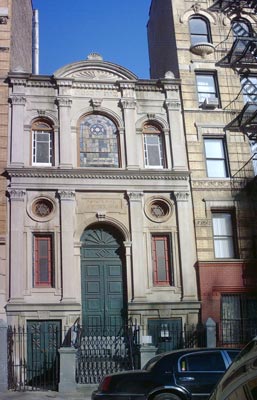
This much can be agreed on: An Orthodox congregation established by Eastern European Jews in 1888 occupies a lovely but crumbling neo-Classical building with a two-story Victorian Gothic interior at 415 East Sixth Street, between First Avenue and Avenue A, on the Lower East Side — a neighborhood where real estate prices have been soaring, placing pressure on owners of old buildings to sell their property to developers for retail and commercial uses.
Everything else — including even the question of how to correctly render the name of the synagogue — is contentious in a bitter dispute that has erupted in recent weeks over the fate of the building.
This afternoon, the Greenwich Village Society for Historic Preservation, the Lower East Side Conservancy and several other nonprofit groups held a news conference outside the synagogue, to draw attention to a plan by the synagogue’s board to enter a partnership with a developer, which would demolish the structure and replace it with a mixed-use building that would contain apartments, as well as a new synagogue. In a letter [pdf] to the city’s Landmarks Preservation Commission, the society has called for the synagogue to be designated a landmark, which would prevent it from being demolished.
The congregation has filed demolition plans with the city’s Department of Buildings, but insists that it wants to preserve the character of the congregation and that the current structure is in desperate disrepair. The demolition plans were reported by The Villager, a weekly newspaper, late last month. The synagogue’s board voted on July 7 to approve a deal with the Kushner Companies, which would build a new six-story building on the site, with a synagogue on the first two floors and 10 apartments on the top four stories.
It is not quite clear when the building at 415 East Sixth Street was constructed, but twoarticles in The Times from November 1903 refer to the building as a “four-story dwelling,” and a January 1911 article said the building had been the home of “wholesale confectioners.”
In any event, the Adas Yisroel Anshe Mezritch, or Congregation Mezritch, which was founded in 1888, drastically renovated the building and began using it as a synagogue in 1910. The society said in a statement:
The handsome neo-Classical building (which has an even more impressive interior) was one of the Lower East Side’s many “tenement synagogues,” so named because they filled narrow lots sandwiched between tenements and served the poor immigrants who populated the surrounding buildings. While a few such tenement synagogue buildings remain in the East Village, including the former Beth Hamedrash Hagadol Anshe Ungarn Synagogue at 242 East Seventh Street, which was recently landmarked by the city, Congregation Mezritch Synagogue appears to be the sole remaining operating tenement synagogue in the East Village, and thus is an important link to what was once perhaps the most significant Jewish community in America.
Andrew Berman, executive director of the historic preservation society, said that “buildings like this — at once humble and grand — really speak to the profound aspirations of the generations of immigrants who came through the Lower East Side, and the impact they had and continue to have upon our city and country.”
In a statement, Shelley Ackerman, whose father, Pesach Ackerman, has been the synagogue’s rabbi for more than 40 years, defended the board’s plans. She said:
Our synagogue is not and never has been for sale. The pending proposal (if in fact it moves forward) would help to preserve Anshe Meseritz and provide a much more comfortable, welcoming, and accessible space for our beloved congregants. We are acting along these lines to guarantee the securing and survival of this synagogue.
Those who instigate these activities are fueled by a romantic notion of preserving an old structure, one in desperate need of renovation. And without that renovation is likely to fall. Some are motivated by ignorance, others by greed.
Dozens of other beautiful similar (landmark-worthy) synagogues in much better or worse shape than this one on the Lower East Side have been sold and/or destroyed in the last 20 years. These sales were motivated by the greed of a few parties who benefited. In almost every case, the synagogue in question did not. This case is completely different. There is no sale pending, only air rights to build apartments that will provide needed income to sustain the synagogue and congregation going forward.
In a phone interview, Ms. Ackerman said the synagogue was in an advanced state of disrepair. The exterior steps are so steep as to be unusable during inclement weather, she said. Parts of the interior are crumbling. There are inadequate bathrooms, poor climate control and no kitchen, she added.
The hubbub has become personal — and divided the 40 or so members of the congregation.
“Anyone who is familiar with Rabbi Ackerman’s role in the synagogue for the last 40 years knows that despite no wages, he has been present seven days a week and has done everything within his power to make sure that the synagogue survives,” his daughter said in the statement. “He is devoted to the preservation of his temple and would never do anything to endanger the future of the synagogue.”
Several former or current members of the congregation have weighed in on the side of the preservationists, including Joel Kaplan, executive director of United Jewish Council of the East Side, and William E. Rapfogel, chief executive of the Metropolitan Council on Jewish Poverty.
Freda Fried, whose father was active in the synagogue for decades and whose mother was on its board, said the board’s vote in July was held on a Monday morning after the July 4 holiday weekend. “It provided little information about the sale in its mailing, so members could do any due diligence or even consider it important to give a proxy to anyone else,” she said. “If there was a real process and search for a development partner, little or no information was provided about any other choices.”
Gerard Wolfe, a retired art historian credited with “rediscovery” of the Eldridge Street Synagogue, called the Mezeritz synagogue “a jewel,” and added, in a statement, “Its demolition would be an irretrievable, unforgivable loss.”
Andrew S. Dolkart, a professor of historic preservation at Columbia who is not involved in the dispute, said the East Sixth Street building was an outstanding example of vernacular architecture and reflected the neo-Classical influence of the 1897 synagogue built by Congregation Shearith Israel, also known as the Spanish and Portuguese Synagogue.
“It wasn’t designed by a sophisticated architect,” Professor Dolkart said. “It wasn’t a pioneering building. It was an architect who was looking at what sophisticated designers were doing and then adapting it in an inexpensive and not so sophisticated manner, to create a kind of folk classicism, almost.”
In a phone interview, Professor Dolkart said he favored preserving the Lower East Side structure, because cities should preserve “architecture that not only reflects the lives and history of the rich, but also the incredibly history of common people in New York.”
 The New York Herald Sun