Dylan Ratigan is Out at CNBC's Fast Money

Cable News, CDS, CNBC, Deep Capture, Dylan Ratigan, Economy, Guy Adami, John Tully, Naked Short-Selling, Patrick Byrne, Phantom Stocks

Tully

March 30, 2009

Guy Adami just said : “Wait, Wait, Let’s Officially welcome Melissa to the center chair…” (unofficial transcript)

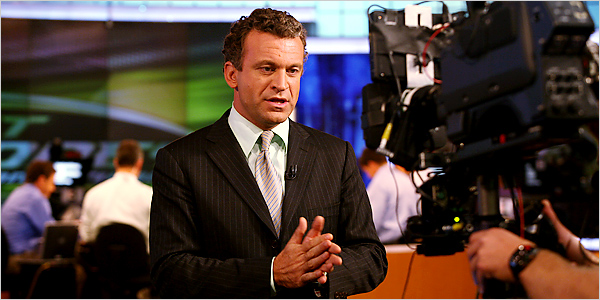
drMedia outlets have been reporting for the past few days that Dylan Ratigan’s March 31 contract would not be renewed.

As Broadcatching mentioned earlier , we met Mr. Ratigan last fall outside NASDAQ HQ and he was a swell chap.

He was cruising for a bruising talking all that truth and ABC is going to give him a fat payday.

Uh oh….


Stiglitz on The Great American Economy [must read]

Stories

VANITY FAIR

Reversal of Fortune

Describing how ideology, special-interest pressure, populist politics, and sheer incompetence have left the U.S. economy on life support, the author puts forth a clear, commonsense plan to reverse the Bush-era follies and regain America’s economic sanity.

by Joseph E. Stiglitz November 2008

When the American economy enters a downturn, you often hear the experts debating whether it is likely to be V-shaped (short and sharp) or U-shaped (longer but milder). Today, the American economy may be entering a downturn that is best described as L-shaped. It is in a very low place indeed, and likely to remain there for some time to come.

Virtually all the indicators look grim. Inflation is running at an annual rate of nearly 6 percent, its highest level in 17 years. Unemployment stands at 6 percent; there has been no net job growth in the private sector for almost a year. Housing prices have fallen faster than at any time in memory—in Florida and California, by 30 percent or more. Banks are reporting record losses, only months after their executives walked off with record bonuses as their reward. President Bush inherited a $128 billion budget surplus from Bill Clinton; this year the federal government announced the second-largest budget deficit ever reported. During the eight years of the Bush administration, the national debt has increased by more than 65 percent, to nearly $10 trillion (to which the debts of Freddie Mac and Fannie Mae should now be added, according to the Congressional Budget Office). Meanwhile, we are saddled with the cost of two wars. The price tag for the one in Iraq alone will, by my estimate, ultimately exceed $3 trillion.

McCain Tries To Blame Financial Crisis On Democratic Takeover Of Congress In 2007

Wall Street


T H I N K P R O G R E S S

In April, Sen. John McCain (R-AZ) claimed that “you could make an argument that there’s been great progress economically” since President Bush took office. He then revised that argument in August, releasing an ad that declared “we’re worse off than we were four years ago.”

Now McCain is revising his timeline again. In an interview with right-wing radio host Michael Medved this past Friday, McCain agreed with Medved’s assertion that “the economy was really progressing pretty well under most of President Bush’s term” before Democrats took control of Congress in January 2007:

MEDVED: Let me ask you one other thing senator, which again, I think is on the minds of lots and lots of our listeners. The economy was really progressing pretty well under most of President Bush’s term. Then the Democrats took over in Congress in 2007 and now we’re in this horrible crisis. Coincidence?

MCCAIN: No, it isn’t.

McCain went on to place the blame for the financial crisis on Fannie Mae and Freddie Mac, claiming that Democrats “were willing co-conspirators with this game of three-card monty that went on and then it collapsed.” Listen to it here:

Medved and McCain’s claim that “the economy was progressing really well” before Democrats took control of Congress is laughable. As Center for American Progress Senior Fellow Christian Weller’s economic snapshot from December 2006 shows, the economy was already in rough shape:

Famly Debt Was Rising: By September 2006, household debt rose to an unprecedented 130.9% of disposable income. From March 2001 to September 2006, personal debt relative to disposable income grew each quarter by 1.6 percentage points—almost five times faster than in the 1990s. In the second quarter of 2006, families had to spend 14.4% of their disposable income to service their debt—the largest share since 1980.

The Housing Market Had Slowed: The supply of homes for sale each month averaged 6.9 months of supply for the six months ending in October 2006—the largest supply since 1991.

Savings Had Plummeted: The personal saving rate of -1.3% in the third quarter of 2006 marked the sixth quarter in a row with a negative personal saving rate.

As for McCain’s claim that Fannie Mae and Freddie Mac are the central cause of the current economic crisis, McClatchy thoroughly debunked it over the weekend, writing that “private sector loans, not Fannie or Freddie, triggered crisis.” McClatchy notes that the “weakening of underwriting standards for U.S. subprime mortgages” began in late 2004 while Republicans controlled both the House and the Senate.

Transcript:

MEDVED: Let me ask you one other thing senator, which again, I think is on the minds of lots and lots of our listeners. The economy was really progressing pretty well under most of President Bush’s term. Then the Democrats took over in Congress in 2007 and now we’re in this horrible crisis. Coincidence?

MCCAIN: No, it isn’t. Although, as you know, and you and I have had this discussion in the past, the Bush administration let these spending bills be signed and him not doing what Ronald Reagan used to do and that is veto them, make them famous, and fight against it. But also, more interestingly, 2006, there was a group of us, as a result of an investigation, and I think it was the Inspector General, that said, look, this Fannie Mae and Freddie Mac are completely out of control, if we don’t do something about it, we’re going to have an incredible financial crisis. And we sent a letter about it. We introduced legislation to rein them in and Senator Obama at the time said that these subprime loans were, quote, “a good idea.” And the Democrats in Congress were specifically talking about, the ones who got all the money, were defending, defending, and saying we can’t re-regulations on Fannie and Freddie and were actually encouraging, as you know, people to borrow money that they couldn’t pay back. A fundamental of economics, so they were willing co-conspirators with this game of three-card monty that went on and then it collapsed, you know.

It's an Eminence Front, Dress Yourself to Kill

Stories

People Forget….

New Rules For October 10, 2008 | Bill Maher

Comedy, Economy, Politics, Tullycast, Video, Wall Street, Youtube

Bill Maher | October 10, 2008 | Nixon Warned of U.S. Becoming Pitiful Helpless Giant

Comedy, Economy, Politics, Tullycast, Video, Wall Street, Youtube

The 56 Trillion Dollar Deficit | Bill Maher Interviews Fmr. Comptroller General David Walker

Comedy, Economy, Politics, Tullycast, Video, Wall Street, Youtube

DAVID WALKER in CNN online:

CNN) — The Emergency Economic Stabilization Act contains plenty to make lawmakers on the left and right shudder. On the right, it’s the apparent abandonment of free-market principles. On the left, it’s the absence of punishment for high-flying Wall Street CEO’s.

Looking down the middle, what I found downright unnerving was how hard Washington struggled to pass a bill that, in reality, represents less than 1 percent of our current federal financial hole.

Don’t get me wrong. Congress and the Bush Administration are to be commended for acting to relieve the credit crunch and trying to minimize any immediate, adverse effect on our economy and by consequence, on American jobs and access to credit.

The ultimate cost of the act should ring up at less than $500 billion, less than the advertised $700 billion because of anticipated proceeds from the government’s sale of the assets it will acquire with the appropriated funds.

The nation’s real tab, on the other hand, amounted to $53 trillion as of the end of the last fiscal year. That was the sum of our public debt; accrued civilian and military retirement benefits; unfunded, promised Social Security and Medicare benefits; and other financial obligations — all according to the government’s most recent financial statement of September 30, 2007.
Don’t Miss * Fed pumps billions more into banks * Dollar plummets against yen * In Depth: Commentaries

The rescue package and other bailout efforts for Fannie Mae, Freddie Mac, AIG and the auto industry, escalating operating deficits, compounding interest and other factors are likely to boost the tab to $56 trillion or more by the end of this calendar year.

With numbers and trends like this, you might ask, “Who will bail out America?” The answer is, no one but us!

Since we’re going to have to save ourselves, recent events could hardly be called encouraging. It took an additional $100 billion in incentives — some would call them “sweeteners;” others might call them bribes — to get lawmakers to pass the rescue package. Regardless of what you call these incentives, ultimately the taxpayers will have to pick up the tab, with interest.

The process that was employed to achieve enactment of this bill was hardly a model of efficiency or effectiveness. The original proposal represented an over-reach and under-communication by the administration.

Neither lawmakers nor ordinary citizens had enough information to properly assess the real risks, the need for action and what an appropriate course of action might be. Furthermore, the key players allowed the legislation to be characterized as a $700 billion bailout of Wall Street, which was neither an accurate nor a fair reflection of the legislation.

Passage of the credit-crunch relief provisions in the act was understandable, not just because of what risks and needed actions the Treasury and the Federal Reserve were aware of, but more importantly, because of what policymakers didn’t know and eventually might have to address.

Let’s face it — the regular order in Washington is broken. We must move beyond crisis management approaches and start to address some of the key fiscal and other challenges facing this country if we want our future to be better than our past.

A good place to start would be for the presidential candidates to acknowledge our $53 trillion (and growing) federal financial hole and commit to begin to address it. Their endorsement of the need for a bipartisan fiscal future commission along the lines of the one sponsored by Rep. Jim Cooper, D-Tennessee, and Rep. Frank Wolf, R-Virginia, also would make sense.

Any such commission should, at a minimum, address the need for statutory budget controls, comprehensive Social Security reform, a first round of tax reform and a first round of comprehensive health care reform. It should hold hearings both inside and beyond the Beltway. And, its recommendations should be guaranteed to receive an up-or-down vote by Congress if a super-majority of the commission’s members can agree on a comprehensive proposal.

Editor’s Note: David M. Walker served as comptroller general of the United States and head of the Government Accountability Office (GAO) from 1998 to 2008. He is now president and CEO of the Peter G. Peterson Foundation.
Our fiscal time bomb is ticking, and the time for action is now!
DAVID WALKER

Now Can We Legalize Pot? | Bill Maher | Oct. 10, 2008

Comedy, Economy, Politics, Tullycast, Video, Wall Street, Youtube

Thank God We're Not Stuck in That Horrible Clinton Economy | Real Time With Bill Maher | October 10, 2008

Barack Obama, Ben Bernanke, Citi, Credit Default Swaps, Credit markets, Dana Bould, David Walker, Deregulation, Dow Jones, Election 2008, Federal Reserve, G.W. Bush, Hedge Funds, Henry Paulson, John McCain, Keating 5, Lehman, LIBOR, Maxine Waters, Mortgage Crisis, Oliver Stone, Politics, Realtime, Short Selling, Steven Moore, Treasury, Tullycast, Video, Wachovia, Wall Street bailout

Dead People Overwhelmingly Support John McCain | Bill Maher | October 3, 2008

Barack Obama, Ben Bernanke, Citi, Credit Default Swaps, Credit markets, Dana Bould, David Walker, Deregulation, Dow Jones, Election 2008, Federal Reserve, G.W. Bush, Hedge Funds, Henry Paulson, John McCain, Keating 5, Lehman, LIBOR, Maxine Waters, Mortgage Crisis, Oliver Stone, Politics, Realtime, Short Selling, Steven Moore, Treasury, Tullycast, Video, Wachovia, Wall Street bailout