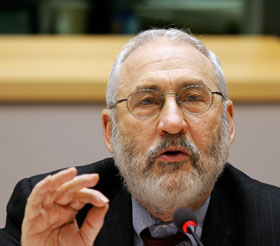
Feb. 1 (Bloomberg) — Nobel laureate Joseph Stiglitz said any decision by President Barack Obama to establish a so-called bad bank to rid financial companies of toxic assets risks swelling the national debt.
Obama’s administration is moving closer to buying the illiquid assets currently clogging bank’s balance sheets and preventing them from boosting lending, people familiar with the matter said this week.
That amounts to swapping taxpayers’ “cash for trash,” Stiglitz said yesterday in a panel discussion at the World Economic Forum in Davos, Switzerland. “You shouldn’t chase good money after bad. We’re talking about a national debt that’s very hard to manage.”
Stiglitz, a professor at Columbia University in New York and a former adviser to President Bill Clinton, says the plan would leave taxpayers paying for years of excess lending by banks. It would also deprive the government of money that would have been better spent shoring up Social Security, he said.
Whether a bad bank would accelerate an end to the financial crisis split delegates attending the Davos talks. JPMorgan Chase & Co. Chief Executive Officer Jamie Dimon said such an operation would help if “executed well.” Billionaire investor George Soros said in an interview that “it’s not the measure that would turn the situation around and enable banks to lend.”
Obama Plan
Obama said yesterday he’s readying a plan to unlock credit markets and lower mortgage rates. Under the initiative, the government would buy some tainted securities and insure the banks against losses on the rest.
“Soon my Treasury secretary, Timothy Geithner, will announce a new strategy for reviving our financial system that gets credit flowing to businesses and families,” Obama said in his weekly radio address.
Stiglitz drew criticism from panel participant Angel Gurria, head of the Organization for Economic Cooperation and Development, who says a bad bank is necessary for lending to resume.
“I agree about the moral, ethical fallout, but you’ve got to face the music and someone has to take the loss,” said Gurria, Mexico’s former finance minister. “It’s the only way to jumpstart the economy.”
Bank losses worldwide from toxic U.S.-originated assets may double to $2.2 trillion, the International Monetary Fund said in a report released Jan. 28.
John Monks, general secretary of the European Trade Union Confederation, told the same audience that governments are getting “close to straining the patience of the public and voters” by repeatedly extending lifelines to banks.
Philippines President Gloria Arroyo urged Obama to make a quick decision on his plan.
“We want Americans to do something,” she said at the session, which was called “Rebooting the Global Economy.” “We can discuss what to do but the worst thing is to do nothing.”
 The New York Herald Sun