Vodpod videos no longer available.
Summers
New Rules From Bill Maher For April 16 2010
Broadcatching


Senate Turns Aside New Attempt to Scrutinize Fed
Ben Bernanke, Federal Reserve, Goldman Sachs, Hank Paulson, Politics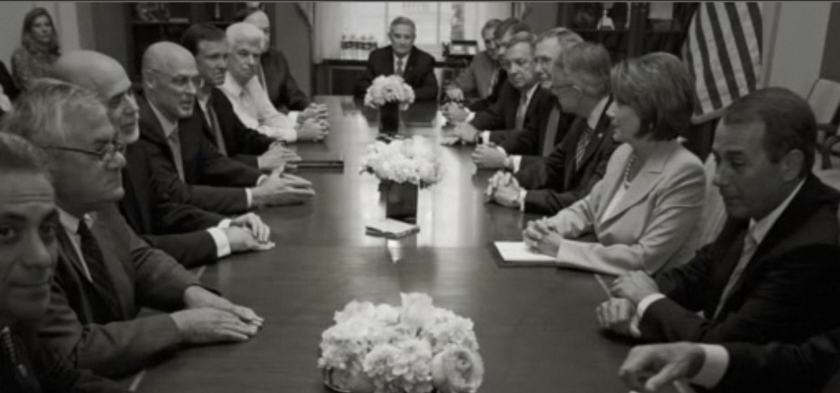 REUTERS
Mon Jul 6, 2009 5:59pm EDT
WASHINGTON (Reuters) – The U.S. Federal Reserve, facing growing pressure as it tries to heal the ailing economy, dodged a bullet on Monday when the U.S. Senate cast aside a new effort to increase scrutiny of the central bank.
On procedural grounds, the Senate blocked a bid to permit the U.S. comptroller general, who heads the investigative arm of Congress known as the Government Accountability Office, to audit the Federal Reserve system and issue a report.
Republican Senator Jim DeMint, who has been pushing for greater transparency at the Fed, failed to get the provision attached to the must-pass annual spending bill that includes funding for the GAO for the upcoming 2010 fiscal year.
The audit would have included details about the Fed’s discount window operations, funding facilities, open market operations and agreements with foreign central banks and governments, DeMint said on the Senate floor.
“The Federal Reserve will create and disburse trillions of dollars in response to our current financial crisis,” DeMint said. “Americans across the nation, regardless of their opinion on the bailout, want to know where the money has gone.
“Allowing the Fed to operate our nation’s monetary system in almost complete secrecy leads to abuse, inflation and a lower quality of life,” he said.
Democrats who control the Senate blocked the South Carolina Republican’s amendment on the grounds that it violated rules prohibiting legislation attached to spending bills.
Fed officials were not immediately available to comment.
The move comes as some lawmakers have increasingly become wary of the Fed’s actions, particularly for its handling of the real estate market and the meltdown of major financial institutions like investment bank Bear Stearns and insurance giant American International Group.
A non-binding provision in the fiscal 2010 budget blueprint Congress approved in April called on the Fed to provide more information about collateral posted against Bear Stearns and AIG loans.
That measure also sought a study evaluating the appropriate number and costs of the regional Fed banks.
The U.S. central bank has a seven-member board in Washington whose members are nominated by the president and confirmed by the Senate. It also has 12 regional banks whose presidents are appointed by banks and other businesses in their local districts, with the consent of the Washington board.
(Reporting by Jeremy Pelofsky and Alister Bull, editing by Dan Grebler)
The Quiet Coup :: Simon Johnson
AIG, Banking Crisis, CDS, Goldman Sachs, Hank Paulson, SEC, Simon JohnsinThe Quiet Coup

The crash has laid bare many unpleasant truths about the United States. One of the most alarming, says a former chief economist of the International Monetary Fund, is that the finance industry has effectively captured our government—a state of affairs that more typically describes emerging markets, and is at the center of many emerging-market crises. If the IMF’s staff could speak freely about the U.S., it would tell us what it tells all countries in this situation: recovery will fail unless we break the financial oligarchy that is blocking essential reform. And if we are to prevent a true depression, we’re running out of time.
One thing you learn rather quickly when working at the International Monetary Fund is that no one is ever very happy to see you. Typically, your “clients” come in only after private capital has abandoned them, after regional trading-bloc partners have been unable to throw a strong enough lifeline, after last-ditch attempts to borrow from powerful friends like China or the European Union have fallen through. You’re never at the top of anyone’s dance card.
The reason, of course, is that the IMF specializes in telling its clients what they don’t want to hear. I should know; I pressed painful changes on many foreign officials during my time there as chief economist in 2007 and 2008. And I felt the effects of IMF pressure, at least indirectly, when I worked with governments in Eastern Europe as they struggled after 1989, and with the private sector in Asia and Latin America during the crises of the late 1990s and early 2000s. Over that time, from every vantage point, I saw firsthand the steady flow of officials—from Ukraine, Russia, Thailand, Indonesia, South Korea, and elsewhere—trudging to the fund when circumstances were dire and all else had failed.
Every crisis is different, of course. Ukraine faced hyperinflation in 1994; Russia desperately needed help when its short-term-debt rollover scheme exploded in the summer of 1998; the Indonesian rupiah plunged in 1997, nearly leveling the corporate economy; that same year, South Korea’s 30-year economic miracle ground to a halt when foreign banks suddenly refused to extend new credit.
But I must tell you, to IMF officials, all of these crises looked depressingly similar. Each country, of course, needed a loan, but more than that, each needed to make big changes so that the loan could really work. Almost always, countries in crisis need to learn to live within their means after a period of excess—exports must be increased, and imports cut—and the goal is to do this without the most horrible of recessions. Naturally, the fund’s economists spend time figuring out the policies—budget, money supply, and the like—that make sense in this context. Yet the economic solution is seldom very hard to work out.
No, the real concern of the fund’s senior staff, and the biggest obstacle to recovery, is almost invariably the politics of countries in crisis.
Typically, these countries are in a desperate economic situation for one simple reason—the powerful elites within them overreached in good times and took too many risks. Emerging-market governments and their private-sector allies commonly form a tight-knit—and, most of the time, genteel—oligarchy, running the country rather like a profit-seeking company in which they are the controlling shareholders. When a country like Indonesia or South Korea or Russia grows, so do the ambitions of its captains of industry. As masters of their mini-universe, these people make some investments that clearly benefit the broader economy, but they also start making bigger and riskier bets. They reckon—correctly, in most cases—that their political connections will allow them to push onto the government any substantial problems that arise.
In Russia, for instance, the private sector is now in serious trouble because, over the past five years or so, it borrowed at least $490 billion from global banks and investors on the assumption that the country’s energy sector could support a permanent increase in consumption throughout the economy. As Russia’s oligarchs spent this capital, acquiring other companies and embarking on ambitious investment plans that generated jobs, their importance to the political elite increased. Growing political support meant better access to lucrative contracts, tax breaks, and subsidies. And foreign investors could not have been more pleased; all other things being equal, they prefer to lend money to people who have the implicit backing of their national governments, even if that backing gives off the faint whiff of corruption.
Greenwald: The Individuals Obama Chose to be His Top Economic Officials Embody Exactly the Corruption He Repeatedly Vowed to End
AIG, Alan Greenspan, Bear Stearns, Citibank, Goldman Sachs, Henry Paulson, Larry Summers, Robert Rubin, Tim GeithnerLarry Summers, Tim Geithner and Wall Street’s ownership of government
Apr. 04, 2009 |
White House officials yesterday released their personal financial disclosure forms, and included in the millions of dollars which top Obama economics adviser Larry Summers made from Wall Street in 2008 is this detail:

Lawrence H. Summers, one of President Obama’s top economic advisers, collected roughly $5.2 million in compensation from hedge fund D.E. Shaw over the past year and was paid more than $2.7 million in speaking fees by several troubled Wall Street firms and other organizations. . . .
Financial institutions including JP Morgan Chase, Citigroup, Goldman Sachs, Lehman Brothers and Merrill Lynch paid Summers for speaking appearances in 2008. Fees ranged from $45,000 for a Nov. 12 Merrill Lynch appearance to $135,000 for an April 16 visit to Goldman Sachs, according to his disclosure form.
That’s $135,000 paid by Goldman Sachs to Summers — for a one-day visit. And the payment was made at a time — in April, 2008 — when everyone assumed that the next President would either be Barack Obama or Hillary Clinton and that Larry Summers would therefore become exactly what he now is: the most influential financial official in the U.S. Government (and the $45,000 Merrill Lynch payment came 8 days after Obama’s election). Goldman would not be able to make a one-day $135,000 payment to Summers now that he is Obama’s top economics adviser, but doing so a few months beforehand was obviously something about which neither parties felt any compunction. It’s basically an advanced bribe. And it’s paying off in spades. And none of it seemed to bother Obama in the slightest when he first strongly considered naming Summers as Treasury Secretary and then named him his top economics adviser instead (thereby avoiding the need for Senate confirmation), knowing that Summers would exert great influence in determining who benefited from the government’s response to the financial crisis.
Last night, former Reagan-era S&L regulator and current University of Missouri Professor Bill Black was on Bill Moyers’ Journal and detailed the magnitude of what he called the on-going massive fraud, the role Tim Geithner played in it before being promoted to Treasury Secretary (where he continues to abet it), and — most amazingly of all — the crusade led by Alan Greenspan, former Goldman CEO Robert Rubin (Geithner’s mentor) and Larry Summers in the late 1990s to block the efforts of top regulators (especially Brooksley Born, head of the Commodities Futures Trading Commission) to regulate the exact financial derivatives market that became the principal cause of the global financial crisis. To get a sense for how deep and massive is the on-going fraud and the key role played in it by key Obama officials, I highly recommend watching that Black interview (it can be seen here and the transcript is here).
This article from Stanford Magazine — an absolutely amazing read — details how Summers, Rubin and Greenspan led the way in blocking any regulatory efforts of the derivatives market whatsoever on the ground that the financial industry and its lobbyists were objecting:
As chairperson of the CFTC, Born advocated reining in the huge and growing market for financial derivatives. . . . One type of derivative—known as a credit-default swap—has been a key contributor to the economy’s recent unraveling. . .
Back in the 1990s, however, Born’s proposal stirred an almost visceral response from other regulators in the Clinton administration, as well as members of Congress and lobbyists. . . . But even the modest proposal got a vituperative response. The dozen or so large banks that wrote most of the OTC derivative contracts saw the move as a threat to a major profit center. Greenspan and his deregulation-minded brain trust saw no need to upset the status quo. The sheer act of contemplating regulation, they maintained, would cause widespread chaos in markets around the world.
Born recalls taking a phone call from Lawrence Summers, then Rubin’s top deputy at the Treasury Department, complaining about the proposal, and mentioning that he was taking heat from industry lobbyists. . . . The debate came to a head April 21, 1998. In a Treasury Department meeting of a presidential working group that included Born and the other top regulators, Greenspan and Rubin took turns attempting to change her mind. Rubin took the lead, she recalls.
“I was told by the secretary of the treasury that the CFTC had no jurisdiction, and for that reason and that reason alone, we should not go forward,” Born says. . . . “It seemed totally inexplicable to me,” Born says of the seeming disinterest her counterparts showed in how the markets were operating. “It was as though the other financial regulators were saying, ‘We don’t want to know.’”
She formally launched the proposal on May 7, and within hours, Greenspan, Rubin and Levitt issued a joint statement condemning Born and the CFTC, expressing “grave concern about this action and its possible consequences.” They announced a plan to ask for legislation to stop the CFTC in its tracks.
Rubin, Summers and Greenspan succeeded in inducing Congress — funded, of course, by these same financial firms — to enact legislation blocking the CFTC from regulating these derivative markets. More amazingly still, the CFTC, headed back then by Born, is now headed by Obama appointee Gary Gensler, a former Goldman Sachs executive (naturally) who was as instrumental as anyone in blocking any regulations of those derivative markets (and then enriched himself by feeding on those unregulated markets).
Just think about how this works. People like Rubin, Summers and Gensler shuffle back and forth from the public to the private sector and back again, repeatedly switching places with their GOP counterparts in this endless public/private sector looting. When in government, they ensure that the laws and regulations are written to redound directly to the benefit of a handful of Wall St. firms, literally abolishing all safeguards and allowing them to pillage and steal. Then, when out of government, they return to those very firms and collect millions upon millions of dollars, profits made possible by the laws and regulations they implemented when in government. Then, when their party returns to power, they return back to government, where they continue to use their influence to ensure that the oligarchical circle that rewards them so massively is protected and advanced. This corruption is so tawdry and transparent — and it has fueled and continues to fuel a fraud so enormous and destructive as to be unprecedented in both size and audacity — that it is mystifying that it is not provoking more mass public rage.
All of that leads to things like this, from today’s Washington Post:
The Obama administration is engineering its new bailout initiatives in a way that it believes will allow firms benefiting from the programs to avoid restrictions imposed by Congress, including limits on lavish executive pay, according to government officials. . . .
The administration believes it can sidestep the rules because, in many cases, it has decided not to provide federal aid directly to financial companies, the sources said. Instead, the government has set up special entities that act as middlemen, channeling the bailout funds to the firms and, via this two-step process, stripping away the requirement that the restrictions be imposed, according to officials. . . .
In one program, designed to restart small-business lending, President Obama’s officials are planning to set up a middleman called a special-purpose vehicle — a term made notorious during the Enron scandal — or another type of entity to evade the congressional mandates, sources familiar with the matter said.
If that isn’t illegal, it is as close to it as one can get. And it is a blatant attempt by the White House to brush aside — circumvent and violate — the spirit if not the letter of Congressional restrictions on executive pay for TARP-receiving firms. It was Obama, in the wake of various scandals over profligate spending by TARP firms, who pretended to ride the wave of populist anger and to lead the way in demanding limits on compensation. And ever since his flamboyant announcement, Obama — adopting the same approach that seems to drive him in most other areas — has taken one step after the next to gut and render irrelevant the very compensation limits he publicly pretended to champion (thereafter dishonestly blaming Chris Dodd for doing so and virtually destroying Dodd’s political career). And the winners — as always — are the same Wall St. firms that caused the crisis in the first place while enriching and otherwise co-opting the very individuals Obama chose to be his top financial officials.
Worse still, what is happening here is an exact analog to what is happening in the realm of Bush war crimes — the Obama administration’s first priority is to protect the wrongdoers and criminals by ensuring that the criminality remains secret. Here is how Black explained it last night:
Black: Geithner is charging, is covering up. Just like Paulson did before him. Geithner is publicly saying that it’s going to take $2 trillion — a trillion is a thousand billion — $2 trillion taxpayer dollars to deal with this problem. But they’re allowing all the banks to report that they’re not only solvent, but fully capitalized. Both statements can’t be true. It can’t be that they need $2 trillion, because they have masses losses, and that they’re fine.
These are all people who have failed. Paulson failed, Geithner failed. They were all promoted because they failed, not because…
Moyers: What do you mean?
Black: Well, Geithner has, was one of our nation’s top regulators, during the entire subprime scandal, that I just described. He took absolutely no effective action. He gave no warning. He did nothing in response to the FBI warning that there was an epidemic of fraud. All this pig in the poke stuff happened under him. So, in his phrase about legacy assets. Well he’s a failed legacy regulator. . . .
The Great Depression, we said, “Hey, we have to learn the facts. What caused this disaster, so that we can take steps, like pass the Glass-Steagall law, that will prevent future disasters?” Where’s our investigation?
What would happen if after a plane crashes, we said, “Oh, we don’t want to look in the past. We want to be forward looking. Many people might have been, you know, we don’t want to pass blame. No. We have a nonpartisan, skilled inquiry. We spend lots of money on, get really bright people. And we find out, to the best of our ability, what caused every single major plane crash in America. And because of that, aviation has an extraordinarily good safety record. We ought to follow the same policies in the financial sphere. We have to find out what caused the disasters, or we will keep reliving them. . . .
Moyers: Yeah. Are you saying that Timothy Geithner, the Secretary of the Treasury, and others in the administration, with the banks, are engaged in a cover up to keep us from knowing what went wrong?
Black: Absolutely.
Moyers: You are.
Black: Absolutely, because they are scared to death. . . . What we’re doing with — no, Treasury and both administrations. The Bush administration and now the Obama administration kept secret from us what was being done with AIG. AIG was being used secretly to bail out favored banks like UBS and like Goldman Sachs. Secretary Paulson’s firm, that he had come from being CEO. It got the largest amount of money. $12.9 billion. And they didn’t want us to know that. And it was only Congressional pressure, and not Congressional pressure, by the way, on Geithner, but Congressional pressure on AIG.
Where Congress said, “We will not give you a single penny more unless we know who received the money.” And, you know, when he was Treasury Secretary, Paulson created a recommendation group to tell Treasury what they ought to do with AIG. And he put Goldman Sachs on it.
Moyers: Even though Goldman Sachs had a big vested stake.
Black: Massive stake. And even though he had just been CEO of Goldman Sachs before becoming Treasury Secretary. Now, in most stages in American history, that would be a scandal of such proportions that he wouldn’t be allowed in civilized society.
This is exactly what former IMF Chief Economist Simon Johnson warned about in his vital Atlantic article: “that the finance industry has effectively captured our government — a state of affairs that more typically describes emerging markets, and is at the center of many emerging-market crises.” This is the key passage where Johnson described the hallmark of how corrupt oligarchies that cause financial crises then attempt to deal with the fallout:
Squeezing the oligarchs, though, is seldom the strategy of choice among emerging-market governments. Quite the contrary: at the outset of the crisis, the oligarchs are usually among the first to get extra help from the government, such as preferential access to foreign currency, or maybe a nice tax break, or—here’s a classic Kremlin bailout technique — the assumption of private debt obligations by the government. Under duress, generosity toward old friends takes many innovative forms. Meanwhile, needing to squeeze someone, most emerging-market governments look first to ordinary working folk—at least until the riots grow too large. . . .
As much as he campaigned against anything, Obama railed against precisely this sort of incestuous, profoundly corrupt control by narrow private interests of the Government, yet he has chosen to empower the very individuals who most embody that corruption. And the results are exactly what one would expect them to be.
* * * * *
I was on the Moyers program last night after the Black interview — along with Amy Goodman — discussing the media’s role in this establishment corruption (that segment can be viewed here), and yesterday morning I was on C-SPAN’s Washington Journal with the primary topic being this blatant, sleazy oligarchical control of both the Executive and legislative branches (which can be seen here).
UPDATE: Just to get a sense for how propagandistic, sycophantic and fact-free are the most extreme Obama worshippers in our “journalist” class, consider this recent article from The New Republic‘s Noam Scheiber in which he urged the White House to “free its economic oracle” — Summers — and defended and praised Summers on the ground that “his exposure to Wall Street over the years has been limited.” As Jonathan Schwarz asks, citing the massive compensation on which Summers engorged himself by feeding at the Wall Street trough last year: “I wonder what would have constituted ‘significant’ exposure to Wall Street? Maybe if he’d worked for D.E. Shaw full time? (Amazingly, Summers was paid $5.2 million for a part-time position.)”
— Glenn Greenwald
George Soros Calls G20: "Make or Break"
AIG, Barack Obama, Ben Bernanke, CDS, Europe, Fed, G20, George Soros, IMF, Larry Summers, Special Drawing Rights, Tim Geithner, Treasury, UK, World Financial Crisis

Billionaire investor Gorge Soros has said the G20 summit will be a “make or break” event for the world’s economy.
In a BBC interview, Mr Soros said the international financial system had collapsed because it was flawed and it had to be restructured.
Mr Soros say it may be the last chance to prevent a full-scale depression.
He said the G20 meeting had to come up with concrete solutions to help the developing world in particular, which had been been worst hit.
‘Depression’
Mr Soros warned that any attempt to pull economies out of recession had to be done co-operatively.
He said: “The G20 meeting is make or break because unless they do something for developing world there will be serious collapse in that part of the world.
“I’m using phrase depression because unless we take the right measures we’re liable to end up there.
If countries start doing it [engineering a new financial world order] bilaterally instead of multilaterally, the system will fall apart and we’ll end up in depression.”
He also said the rebuilding meant the previous economic system had to be scrapped.
“ The International financial system has collapsed and cannot be restored in its current form ”
George Soros
George Soros
“I don’t think we’ll ever be back to where we came from. It should be recognised that the last 25 years were an aberration and we cannot go back there. We have to reconstruct the financial system from its foundations up.”
Mr Soros said regulators and the financial sector shared the blame for the meltdown, as they “participated in this crazy boom built on false premises on the belief that markets are self-regulating and should be left alone”.
Mr Soros also warned the UK economy was in a deep recession “which is going to be a lasting one”.
He added: “The International financial system has collapsed and cannot be restored in its current form. It will have to be restructured because it was flawed and collapsed under its own weight.”
In May last year, Mr Soros was interviewed by the BBC’s business editor Robert Peston and said he was worried about the US and UK’s ability to deal with the downturn because of their reliance on credit.
Mr Soros urged wealthy nations to give their allocations of the IMF’s internal currency, called Special Drawing Rights, to poorer ones because developing countries were not in a position to bail out their own failing banks.
George Soros famously made his name – and $1bn – when he bet that sterling would have to withdraw from the European Exchange Rate Mechanism in 1992. He’s also said to have accurately predicted and profited from the Asian financial crisis in 1997.
The 78-year-old Hungarian is one of the largest aid donors in Africa, having donated around $6bn to his favourite causes.
America The Tarnished | Paul Krugman
TullycastOp-Ed Columnist

America the Tarnished
Ten years ago the cover of Time magazine featured Robert Rubin, then Treasury secretary, Alan Greenspan, then chairman of the Federal Reserve, and Lawrence Summers, then deputy Treasury secretary. Time dubbed the three “the committee to save the world,” crediting them with leading the global financial system through a crisis that seemed terrifying at the time, although it was a small blip compared with what we’re going through now.
All the men on that cover were Americans, but nobody considered that odd. After all, in 1999 the United States was the unquestioned leader of the global crisis response. That leadership role was only partly based on American wealth; it also, to an important degree, reflected America’s stature as a role model. The United States, everyone thought, was the country that knew how to do finance right.
How times have changed.
Never mind the fact that two members of the committee have since succumbed to the magazine cover curse, the plunge in reputation that so often follows lionization in the media. (Mr. Summers, now the head of the National Economic Council, is still going strong.) Far more important is the extent to which our claims of financial soundness — claims often invoked as we lectured other countries on the need to change their ways — have proved hollow.
Indeed, these days America is looking like the Bernie Madoff of economies: for many years it was held in respect, even awe, but it turns out to have been a fraud all along.
It’s painful now to read a lecture that Mr. Summers gave in early 2000, as the economic crisis of the 1990s was winding down. Discussing the causes of that crisis, Mr. Summers pointed to things that the crisis countries lacked — and that, by implication, the United States had. These things included “well-capitalized and supervised banks” and reliable, transparent corporate accounting. Oh well.
One of the analysts Mr. Summers cited in that lecture, by the way, was the economist Simon Johnson. In an article in the current issue of The Atlantic, Mr. Johnson, who served as the chief economist at the I.M.F. and is now a professor at M.I.T., declares that America’s current difficulties are “shockingly reminiscent” of crises in places like Russia and Argentina — including the key role played by crony capitalists.
In America as in the third world, he writes, “elite business interests — financiers, in the case of the U.S. — played a central role in creating the crisis, making ever-larger gambles, with the implicit backing of the government, until the inevitable collapse. More alarming, they are now using their influence to prevent precisely the sorts of reforms that are needed, and fast, to pull the economy out of its nosedive.”
It’s no wonder, then, that an article in yesterday’s Times about the response President Obama will receive in Europe was titled “English-Speaking Capitalism on Trial.”
Now, in fairness we have to say that the United States was far from being the only nation in which banks ran wild. Many European leaders are still in denial about the continent’s economic and financial troubles, which arguably run as deep as our own — although their nations’ much stronger social safety nets mean that we’re likely to experience far more human suffering. Still, it’s a fact that the crisis has cost America much of its credibility, and with it much of its ability to lead.
And that’s a very bad thing.
Like many other economists, I’ve been revisiting the Great Depression, looking for lessons that might help us avoid a repeat performance. And one thing that stands out from the history of the early 1930s is the extent to which the world’s response to crisis was crippled by the inability of the world’s major economies to cooperate.
The details of our current crisis are very different, but the need for cooperation is no less. President Obama got it exactly right last week when he declared: “All of us are going to have to take steps in order to lift the economy. We don’t want a situation in which some countries are making extraordinary efforts and other countries aren’t.”
Yet that is exactly the situation we’re in. I don’t believe that even America’s economic efforts are adequate, but they’re far more than most other wealthy countries have been willing to undertake. And by rights this week’s G-20 summit ought to be an occasion for Mr. Obama to chide and chivy European leaders, in particular, into pulling their weight.
But these days foreign leaders are in no mood to be lectured by American officials, even when — as in this case — the Americans are right.
The financial crisis has had many costs. And one of those costs is the damage to America’s reputation, an asset we’ve lost just when we, and the world, need it most.
White House: Priority Is Legislation That "Doesn't Signal A Change In Our Overall Stance on Trade
AFL-CIO, Barack Obama, Bob Baugh, CAFTA, Free Trade, Larry Summers, NAFTA, Ohio, Pennsylvania, Robert Gibbs, Trade, White House, Wisconsin, WTO
By David Sirota
02/04/2009
Whether or not you are among the tiny minority of Americans who thinks our trade and globalization policies are good for our country, it is undeniable that Barack Obama campaigned on very explicit pledges to radically change those policies [1]. He not only campaigned on an implicit promise to support Buy America laws [2], but with regards to existing trade agreements and their provisions dealing with procurement, he said he does “not support trade efforts that undermine important federal, state and local policies.”
Clearly, his move to water-down the Buy America laws he campaigned on violate the spirit – if not the letter – of his campaign promises, especially because he is justifying the move by citing the trade agreement restrictions he said he opposed. But today, the White House went even further, saying that the administration’s overarching goal is actually no wholesale change of trade policy whatsoever. Check this out [3] from White House press secretary Robert Gibbs’ briefing today:
The lawmakers are reacting to a demand by the White House that the provisions satisfy U.S. obligations under the World Trade Organization. President Barack Obama “wants to ensure that any legislation that passes is consistent with trade agreements and doesn’t signal a change in our overall stance on trade,” White House Press Secretary Robert Gibbs said at a news briefing today.
As the AFL-CIO’s Bob Baugh notes – and as Public Citizen ably details [4] – Buy America laws (ie. laws that let the government target its procurement to American companies) are completely consistent with our international trade agreements. Indeed, both the “protectionist” [5] fearmongering and the “violation of trade pacts” nonsense are canards on the substance.
But that’s less important than the White House’s meta statement here. After winning free-trade-decimated swing states like Ohio, Indiana, Pennsylvania, Wisconsin on very clear promises to change America’s overall stance on trade policy, the White House has made an official declaration that one of the president’s biggest objectives in the debate over the stimulus bill is that the legislation “doesn’t signal a change in our overall stance on trade.” Yes, the administration that came in on a promise of “change” is explicitly saying it doesn’t want to even “signal a change.”
Between this, and Larry Summers’ letter [6] insisting that the Obama administration will avoid any “industrial policy” at all cost, I don’t know how much more clear the Obama administration can really make things. It is going before cameras specifically saying its objective is to prevent change on one of the most important economic issues that Obama campaigned on.
Small Banks Getting Short End of Tarp Bat
Banking, Bernanke, Federal Reserve, Finance, Greenspan, Paulson, TARP, Treasury, Wall StreetSEEKING ALPHA
William Patalon III
Bank of American Corp. (BAC), which is getting $15 billion from the U.S. government as part of the Treasury Department’s $250 billion “recapitalization” effort, is doubling its stake in state-owned China Construction Bank Corp., and will hold a 20% stake worth $24 billion in China’s second-largest lender when that deal is finalized.
PNC Financial Services Group Inc. (PNC), which will get $7.7 billion from Treasury’s Troubled Assets Relief Program (TARP), is using that cash infusion to help finance its $5.2 billion buyout of embattled National City Corp. (NCC).
And U.S. Bancorp (USB), which received a $6.6 billion capital infusion from that same rescue package, has acquired two California lenders – Downey Savings & Loan Association, F.A., a subsidiary of Downey Financial Corp. (DSL), and PFF Bank & Trust, a subsidiary of PFF Bancorp Inc. (OTC: PFFB). U.S. Bank agreed to assume the first $1.6 billion in losses from the two, but says anything beyond that amount is subject to a loss-sharing deal it struck with the Federal Deposit Insurance Corp. (FDIC).
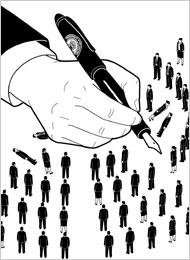
While the Treasury Department’s investment of more than $250 billion in U.S. financial institutions has been billed as a strategy that will bolster the health of the banking system and also jump-start lending, buyout deals such as these three show that the recapitalization plan has actually had a much different result – one that’s left whipsawed U.S. investors and lawmakers alike feeling burned, an ongoing Money Morning investigation continues to show.
Those billions have touched off a banking-sector version of “Let’s Make a Deal,” in which the biggest U.S. banks are using government money to get even bigger. While that’s admittedly removing the smaller, weaker banks from the market – a possible benefit to consumers and taxpayers alike – this trend is also having a detrimental effect: It’s reducing the competition that’s benefited consumers and kept the explosion in banking fees from being far worse than it already is.
This all happens without any of the economic benefits that an actual increase in lending would have had. And it does nothing to address the billions worth of illiquid securities that remain on (or off) banks’ balance sheets – as the recent Citigroup Inc. (C) imbroglio demonstrates.
In fact, Treasury’s TARP program has even managed to create a potentially illegal tax loophole that grants banks a tax-break windfall of as much as $140 billion. Lawmakers are furious – but possibly powerless, afraid that a full-scale assault on the tax change could cause already-done deals to unravel, in turn causing investor confidence to do the same.
One could even argue that since this first bailout (the $700 billion TARP initiative) has fueled takeovers – and not lending – the government had no choice but to roll out the more-recent $800 billion stimulus plan that was aimed at helping consumers and small businesses – a move that may spur lending and spending, but that still adds more debt to the already-sagging federal government balance sheet.
At the end of the day, these buyout deals are bad ones no matter how you evaluate them, says R. Shah Gilani, a retired hedge fund manager and expert on the U.S. credit crisis who is the editor of the Trigger Event Strategist, which identifies trading opportunities emanating from such financial-crisis “aftershocks” as this buyout binge.
“Why in the name of capitalism are taxpayers being fleeced by banks that are being given our money to grow their businesses with the further backstop of more of our money having to be thrown to the FDIC when they fail?” Gilani asked. “Consolidation does not mean that bad loans and illiquid securities are somehow merged out of existence. It means that they are being acquired under the premise that a larger, more consolidated depositor base will better be able to bear the weight of those bad assets. What in heaven’s name prevents depositors from exiting when the merged banks continue to experience massive losses and write-downs? The answer to that question would be … nothing.”
Lining Up for Deal Money
In launching TARP, U.S. Treasury Secretary Henry M. “Hank” Paulson Jr. said the government’s goal was to restore public confidence in the U.S. financial services sector – especially banks – so private investors would be willing to advance money to banks and banks, in turn, would be willing to lend.
“Our purpose is to increase the confidence of our banks, so that they will deploy, not hoard, the capital,” Paulson said.
Whatever Treasury’s actual intent, the reality is that banks are already sniffing out buyout targets, while snuffing out lending – and the TARP money is the reason for both.
Fueled by this taxpayer-supplied capital, the wave of consolidation deals is “absolutely” going to accelerate, says Louis Basenese, a mergers-and-acquisitions expert who is also the editor of The Takeover Trader newsletter. “When it comes to M&A, there’s always a pronounced ‘domino effect.’ Consolidation breeds more consolidation as industry leaders conclude they have to keep acquiring in order to remain competitive.”
Indeed, banking executives have been quite open about their expansionist plans during media interviews, or during conference calls related to quarterly earnings.
Take BB&T Corp. (BBT). During a conference call that dealt with the bank’s third-quarter results, Chief Executive Officer John A. Allison IV said the Winston-Salem, N.C.-based bank “will probably participate” in the government program. Allison didn’t say whether the federal money would induce BB&T to boost its lending. But he did say the bank would likely accept the money in order to finance its expansion plans, The Wall Street Journal said.
“We think that there are going to be some acquisition opportunities – either now or in the near future – and this is a relatively inexpensive way to raise capital [to pay the buyout bill],” Allison said during the conference call.
And BB&T is hardly alone. Zions Bancorporation (ZION), a Salt Lake City-based bank that’s been squeezed by some bad real-estate loans, recently said it would be getting $1.4 billion in federal money. CEO Harris H. Simmons said the infusion would enable Zions to boost “prudent” lending and keep paying its dividend – albeit at a reduced rate.
Sounds good, right? Not so fast. During a conference call about earnings, Zions Chief Financial Officer Doyle L. Arnold said any lending increase wouldn’t be dramatic. Besides, Arnold said, Zions will also use the money “to take advantage of what we would expect will be some acquisition opportunities, including some very low risk FDIC-assisted transactions in the next several quarters.”
Buyouts Already Accelerating
With all the liquidity the world’s governments and central banks have injected into the global financial system, the pace of worldwide deal making is already accelerating. Global deal volume for the year has already passed the $3 trillion level – only the fifth time that’s happened, although it took about three months longer for that to happen this year than it did a year ago.
At a time when the global financial crisis – and the accompanying drop-off in available deal capital (either equity or credit) – has caused about $150 billion in already-announced deals to be yanked off the table since Sept. 1, liquidity from the U.S. and U.K. governments has ignited record levels of financial-sector deal making.
According to Dealogic, government investments in financial institutions has reached $76 billion this year – eight times as much as in all of 2007, which was the previous record year. And that total doesn’t include the $250 billion in TARP money, or other deals that Paulson & Co. are helping engineer – JPMorgan Chase & Co.’s (JPM) buyouts of The Bear Stearns Cos. and Washington Mutual Inc. (WAMUQ), for instance.
If You Can’t Beat ‘em… Buy ‘em?
When it comes to identifying possible buyout targets, M&A experts such as Basenese say there are some very clear frontrunners.
“I’d put regional banks with solid footprints in the Southeast high on the list, and for two reasons,” Basenese said. “First, demographics point to stronger growth [in this region] as retirees migrate to warmer climates – and bring their assets along for the trip. Plus, the Southeast is largely un-penetrated by large national banks. An acquisition of a regional bank like SunTrust Banks Inc. (STI) would provide a distinct competitive advantage.
There’s a very good reason that smaller players may be next: Big banks and small banks have the easiest times – relatively speaking, of course – of raising capital. It’s toughest for the regional players. Big banks can tap into the global financial markets for cash, while the very small – and typically, highly local – banks can raise money from local investors.
The afore-mentioned stealthy shift in the U.S. Tax Code actually gives big U.S. banks a potential windfall of as much as $140 billion, says Gilani, the credit crisis expert and Trigger Event Strategist editor. What does this tax-change do? By acquiring a failed bank whose only real value is the losses on its books, the successful suitor would basically then be able to use the acquired bank’s losses to offset its own gains and thus avoid paying taxes.
 “While everyone was panicking, the Treasury Department slipped through a ruling that allows banks who acquire other banks to fully write-off all the acquired bank’s bad debts,” Gilani says. “For 22 years, the law was such that if you were to buy a company that had losses, say, of $1 billion, you couldn’t just take that loss against your own $1 billion profit and tell Uncle Sam, ‘Gee, now my loss offsets my profit, so I don’t have any profit, and I don’t owe you any tax.’ It was a recipe for tax evasion that demanded an appropriate law that only allows limited write-offs over an extended period of years.”
Given these incentives, who will be doing the buying? Clearly, the biggest U.S.-based banks will be the main hunters. But The Takeover Trader’s Basenese says that even foreign banks will be on the prowl for cheap U.S. banking assets.
Basenese also believes that Goldman Sachs Group Inc. (GS) and Morgan Stanley (MS) will be “big spenders.” Each will use TARP funds to help accelerate its transformation from an investment bank into a bank holding company. The changeover will require each company to build up a big base of deposits. And the best way to do that is to buy other banks, Basenese says.
“One thing [the wave of deals] does is to restore confidence in the sector,” Basenese said. “It will go a long way in convincing CEOs that it’s safe to use excess capital to fund acquisitions, and to grow, instead of using it to defend against a proverbial run on the bank.”
Not everyone agrees with that assessment. Investors who play the merger game correctly will do well. But the game itself won’t necessarily whip the industry into championship form, Gilani says.
“While consolidation, instead of outright collapses, in the banking industry may serve to relieve the FDIC of its burden to make good on failed banks, it in no way guarantees fewer failures,” he said. “In fact, it may only serve to guarantee, in some cases, even larger failures.”
The 17th Floor, Where Wealth Went to Vanish
Bankers, Banking and Finance, Bernie Madoff, Derivitives, Fraud, Hedge Funds, New York, Ponzi Scheme, Proprietary System, Wall Street
The 17th floor, where wealth went to vanish
Monday, December 15, 2008
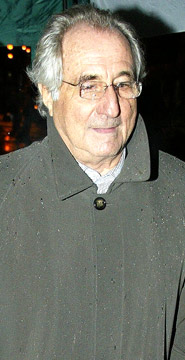
The epicenter of what may be the largest Ponzi scheme in history was the 17th floor of the Lipstick Building, an oval red-granite building rising 34 floors above Third Avenue in Midtown Manhattan.
A busy stock-trading operation occupied the 19th floor, and the computers and paperwork filled the 18th floor of Bernard L. Madoff Investment Securities.
But the 17th floor was Bernie Madoff’s sanctum, occupied by fewer than two dozen staff members and rarely visited by other employees. They called it the “hedge fund” floor, but U.S. prosecutors now say the work Madoff did there was actually a fraud scheme whose losses Madoff himself estimates at $50 billion.
The tally of reported losses climbed through the weekend to nearly $20 billion, with a giant Spanish bank, Banco Santander, reporting on Sunday that clients of one of its Swiss subsidiaries have lost $3 billion. Some of the biggest losers were members of the Palm Beach Country Club, where many of Madoff’s wealthy clients were recruited.
The list of prominent fraud victims grew as well. According to a person familiar with the business of the real estate and publishing magnate Mort Zuckerman, he is also on a list of victims that already included the owners of the New York Mets, a former owner of the Philadelphia Eagles and the chairman of GMAC.
And the 17th floor is now an occupied zone, as investigators and forensic auditors try to piece together what Madoff did with the billions entrusted to him by individuals, banks and hedge funds around the world.
So far, only Madoff, the firm’s 70-year-old founder, has been arrested in the scandal. He is free on a $10 million bond and cannot travel far outside the New York area.
But a question still dominates the investigation: How one person could have pulled off such a far-reaching, long-running fraud, carrying out all the simple practical chores the scheme required, like producing monthly statements, annual tax statements, trade confirmations and bank transfers.
Firms managing money on Madoff’s scale would typically have hundreds of people involved in these administrative tasks. Prosecutors say he claims to have acted entirely alone.
“Our task is to find the records and follow the money,” said Alexander Vasilescu, a lawyer in the New York office of the Securities and Exchange Commission. As of Sunday night, he said, investigators could not shed much light on the fraud or its scale. “We do not dispute his number we just have not calculated how he made it,” he said.
Scrutiny is also falling on the many banks and money managers who helped steer clients to Madoff and now say they are among his victims.
While many investors were friends or met Madoff at country clubs or on charitable boards, even more had entrusted their money to professional advisory firms that, in turn, handed it on to Madoff for a fee.
Investors are now questioning whether these paid advisers were diligent enough in investigating Madoff to ensure that their money was safe. Where those advisers work for big institutions like Banco Santander, investors will most likely look to them, rather than to the remnants of Madoff’s firm, for restitution.
Santander may face $3.1 billion in losses through its Optimal Investment Services, a Geneva-based fund of hedge funds that is owned by the bank. At the end of 2007, Optimal had 6 billion euros, or $8 billion, under management, according to the bank’s annual report which would mean that its Madoff investments were a substantial part of Optimal’s portfolio.
A spokesman for Santander declined to comment on the case.
Other Swiss institutions, including Banque Bénédict Hentsch and Neue Privat Bank, acknowledged being at risk, with Hentsch confirming about $48 million in exposure.
BNP Paribas said it had not invested directly in the Madoff funds but had 350 million euros, or about $500 million, at risk through trades and loans to hedge funds. And the private Swiss bank Reichmuth said it had 385 million Swiss francs, or $327 million, in potential losses. HSBC, one of the world’s largest banks, also said it had made loans to institutions that invested in Madoff but did not disclose the size of its potential losses.
Losses of this scale simply do not seem to fit into the intimate business that Madoff operated in New York.
With just over 200 employees, it was tight-knit and friendly, according to current and former employees. Madoff was gregarious and empathetic, known for visiting sick employees in their hospitals and hosting warmly generous staff parties.
By the elevated standards of Wall Street, the Madoff firm did not pay exceptionally well, but it was loyal to employees even in bad times. Madoff’s family filled the senior positions, but his was not the only family at the firm generations of employees had worked for Madoff.
Even before Madoff collapsed, some employees were mystified by the 17th floor. In recent regulatory filings, Madoff claimed to manage $17 billion for clients a number that would normally occupy a staff of at least 200 employees, far more than the 20 or so who worked on 17.
One Madoff employee said he and other workers assumed that Madoff must have a separate office elsewhere to oversee his client accounts.
Nevertheless, Madoff attracted and held the trust of companies that prided themselves on their diligent investigation of investment managers.
One of them was Walter Noel Jr., who struck up a business relationship with Madoff 20 years ago that helped earn his investment firm, the Fairfield Greenwich Group, millions of dollars in fees.
Indeed, over time, one Fairfield’s strongest selling points for its largest fund was its access to Madoff.
But now, Noel and Fairfield are the biggest known losers in the scandal, facing potential losses of $7.5 billion, more than half its assets.
Jeffrey Tucker, a Fairfield co-founder and former U.S. regulator, said in a statement posted on the firm’s Web site: “We have worked with Madoff for nearly 20 years, investing alongside our clients. We had no indication that we and many other firms and private investors were the victims of such a highly sophisticated, massive fraudulent scheme.”
The huge loss comes at a time when the hedge fund industry has already been wounded by the volatile markets. Several weeks ago, Fairfield had halted investor redemptions at two of its other funds, citing the tough market conditions as dozens of hedge funds have done. The firm reported a drop of $2 billion in assets between September and November.
Fairfield was founded in 1983 by Noel, the former head of international private banking at Chemical Bank, and Tucker, a former Securities and Exchange Commission official. It grew dramatically over the years, attracting investors in Europe, Latin America and Asia.
Noel first met Madoff in the 1980s, and Fairfield’s fortunes grew along with the returns Madoff reported. The two men were very different: Madoff hailed from eastern Queens and was tied closely to the Jewish community, while Noel, a native of Tennessee, moved in the Greenwich social scene with his wife, Monica.
“Walter was always really confident in Bernie and the strategy he employed,” said one hedge fund manager who declined to be named because for fear of jeopardizing his relationship with Noel.
“He was a person of superb ethics, and this has to cut him to the quick,” said George Ball, a former executive at E. F. Hutton and Prudential-Bache Securities who knows Noel.
Fairfield touted its investigative skills. On its Web site, the firm claimed to investigate hedge fund managers for six to 12 months before investing. As part of the process, a team of examiners conducted personal background checks, audited brokerage records and trading reports and interviewed hedge fund executives and compliance officials.
In 2001, Madoff called Fairfield and invited the firm to inspect his books after two news reports questioned the validity of his returns, according to a person close to Fairfield. Outside auditors hired to inspect Madoff’s operations concluded that “everything checked out,” this person said.
“FGG performed comprehensive and conscientious due diligence and risk monitoring,” Marc Kasowitz, a lawyer for Fairfield, said in a statement. “FGG like so many other Madoff clients was a victim of a highly-sophisticated massive fraud that escaped the detection of top institutional and private investors, industry organizations, auditors, examiners, and regulatory authorities.”
Now, Fairfield is seeking to recover what it can from Madoff.
“It is our intention to aggressively pursue the recovery of all assets related to Bernard L. Madoff Investment Securities,” Tucker said in a statement.
Working alongside the U.S. investigators on Madoff’s 17th floor, staffers for Lee Richards 3d, the court-appointed receiver for the firm, are trying to determine what parts of the firm can keep operating to preserve assets for investors.
A hotline number had been posted on the company Web site, madoff.com, but on Sunday night, Richards said that there was little reason to call.
“We don’t have anything to report to investors at this time,” he said. “We are doing everything we can to protect the assets of the Madoff entities that are subject to the receivership, and to learn what we can about the operations of those entities.”
 The New York Herald Sun