
How Hardball Resembles Laurel and Hardy

Beltway Memes, Budget, Chris Matthews, CNBC, Doublespeak, Hardball, Media, Politics, Socialism Canard, Stimulus Package, Teaparty Astroturfing
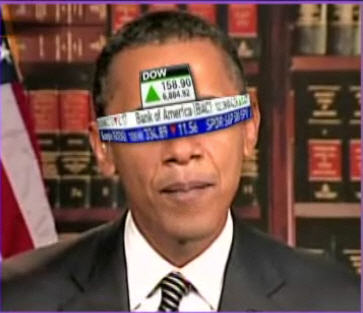
obama-ticker
The loud dumb fellow got it wrong. His pals were too timid to tell him:
THURSDAY, MARCH 5, 2009

How Hardball’s like Laurel and Hardy: On Monday, ABC News had no idea how marginal tax rates actually work (see THE DAILY HOWLER, 3/4/09).

Last night, Chris Matthews loudly ran off the rails concerning those troubling “earmarks.”

The excitable host conducted his chat with pundits Heileman and Cillizza. Before we see what Matthews said, let’s review the basic facts: The federal spending bill in question totals $410 billion. Of that, the “earmarks” total $7.7 billion. The “earmarks” thus comprise less than 1.9 percent of the total package. (Beyond that, we’ve seen no one try to explain why these provisions are “wasteful.”)

The guest pundits did make several attempts to calm Matthews as he thundered about all the “pork” and “crap” in the bill. But as usual, his thunder about Obama’s failure to deal with this “pork-barrel spending” prevailed. By the way: How well did Matthews know his facts? Eventually, it came to this. We use the Nexis transcript:

HEILEMANN (3/4/09): Well, look, but, Chris, this is, this is—this stuff is such small potatoes compared to the stuff that is on the president’s agenda to actually—

(CROSSTALK)

MATTHEWS: More than—

(CROSSTALK)

MATTHEWS: —410 billion dollars!

HEILEMANN: —to actually fix the economy.

MATTHEWS: Four hundred and 10 billion dollars!

HEILEMANN: That’s, that’s—that’s half of the original TARP, as you know, and probably about a third or a quarter of what we’re eventually going to put in—

MATTHEWS: This is actually government spending, by the way. This isn’t loan guarantees.

Trust us. Anyone who watched this segment would have thought that the bill in question involved $410 billion in “earmarks.” And of course, no one clarified what Matthews said. The actual worth of the “earmarks—$7.7 billion—was never mentioned. No one made the slightest attempt to state the basic facts. (To find the full transcript, click here.)

We’ll guess that Heileman and/or Cillizza knew the actual figures involved here. But uh-oh! From watching Matthews through the years, we’ll guess that he probably didn’t. At any rate, one thing is certain: Citizens who watched this program were never exposed to the actual facts. The guest pundits could have corrected or clarified what Matthews said. But darlings! It just isn’t done!

Hardball viewers came away with bogus facts in their noggins again.

But then, Hardball is often like Laurel and Hardy. The loud dumb one is always in charge. The others know that their pal has it wrong—but they’re too timid to tell him.

Laurel and Hardy played this for laughs, comically sketching the human condition. The loud dumb one was always in charge! Today, it’s the shape of your “press corps.”


Where'd The Bailout Money Go? Shhhh, It's a Secret

Stories

warren2WASHINGTON (AP)

Dec 22

By MATT APUZZO– It’s something any bank would demand to know before handing out a loan: Where’s the money going?

But after receiving billions in aid from U.S. taxpayers, the nation’s largest banks say they can’t track exactly how they’re spending the money or they simply refuse to discuss it.

“We’ve lent some of it. We’ve not lent some of it. We’ve not given any accounting of, ‘Here’s how we’re doing it,'” said Thomas Kelly, a spokesman for JPMorgan Chase, which received $25 billion in emergency bailout money. “We have not disclosed that to the public. We’re declining to.”

The Associated Press contacted 21 banks that received at least $1 billion in government money and asked four questions: How much has been spent? What was it spent on? How much is being held in savings, and what’s the plan for the rest?

None of the banks provided specific answers.

“We’re not providing dollar-in, dollar-out tracking,” said Barry Koling, a spokesman for Atlanta, Ga.-based SunTrust Banks Inc., which got $3.5 billion in taxpayer dollars.

Some banks said they simply didn’t know where the money was going.

“We manage our capital in its aggregate,” said Regions Financial Corp. (RF) spokesman Tim Deighton, who said the Birmingham, Ala.-based company is not tracking how it is spending the $3.5 billion it received as part of the financial bailout.

The answers highlight the secrecy surrounding the Troubled Assets Relief Program, which earmarked $700 billion – about the size of the Netherlands’ economy – to help rescue the financial industry. The Treasury Department has been using the money to buy stock in U.S. banks, hoping that the sudden inflow of cash will get banks to start lending money.

There has been no accounting of how banks spend that money. Lawmakers summoned bank executives to Capitol Hill last month and implored them to lend the money – not to hoard it or spend it on corporate bonuses, junkets or to buy other banks. But there is no process in place to make sure that’s happening and there are no consequences for banks who don’t comply.

“It is entirely appropriate for the American people to know how their taxpayer dollars are being spent in private industry,” said Elizabeth Warren, the top congressional watchdog overseeing the financial bailout.

But, at least for now, there’s no way for taxpayers to find that out.

Pressured by the Bush administration to approve the money quickly, Congress attached nearly no strings on the $700 billion bailout in October. And the Treasury Department, which doles out the money, never asked banks how it would be spent.

“Those are legitimate questions that should have been asked on Day One,” said Rep. Scott Garrett, R-N.J., a House Financial Services Committee member who opposed the bailout as it was rushed through Congress. “Where is the money going to go to? How is it going to be spent? When are we going to get a record on it?”

Nearly every bank AP questioned – including Citibank and Bank of America, two of the largest recipients of bailout money – responded with generic public relations statements explaining that the money was being used to strengthen balance sheets and continue making loans to ease the credit crisis.

A few banks described company-specific programs, such as JPMorgan Chase’s plan to lend $5 billion to nonprofit and health care companies next year. Richard Becker, senior vice president of Wisconsin-based Marshall & Ilsley Corp. (MI) (MI), said the $1.75 billion in bailout money allowed the bank to temporarily stop foreclosing on homes.

But no bank provided even the most basic accounting for the federal money.

“We’re choosing not to disclose that,” said Kevin Heine, spokesman for Bank of New York Mellon, which received about $3 billion.

Others said the money couldn’t be tracked. Bob Denham, a spokesman for North Carolina-based BB&T Corp., said the bailout money “doesn’t have its own bucket.” But he said taxpayer money wasn’t used in the bank’s recent purchase of a Florida insurance company. Asked how he could be sure, since the money wasn’t being tracked, Denham said the bank would have made that deal regardless.

Others, such as Morgan Stanley (MS) spokeswoman Carissa Ramirez, offered to discuss the matter with reporters on condition of anonymity. When AP refused, Ramirez sent an e-mail saying: “We are going to decline to comment on your story.”

Most banks wouldn’t say why they were keeping the details secret.

“We’re not sharing any other details. We’re just not at this time,” said Wendy Walker, a spokeswoman for Dallas-based Comerica Inc., which received $2.25 billion from the government.

Heine, the New York Mellon Corp. spokesman who said he wouldn’t share spending specifics, added: “I just would prefer if you wouldn’t say that we’re not going to discuss those details.”

The banks which came closest to answering the questions were those, such as U.S. Bancorp and Huntington Bancshares Inc., that only recently received the money and have yet to spend it. But neither provided anything more than a generic summary of how the money would be spent.

Lawmakers say they want to tighten restrictions on the remaining, yet-to-be-released $350 billion block of bailout money before more cash is handed out. Treasury Secretary Henry Paulson said the department is trying to step up its monitoring of bank spending.

“What we’ve been doing here is moving, I think, with lightning speed to put necessary programs in place, to develop them, implement them, and then we need to monitor them while we’re doing this,” Paulson said at a recent forum in New York. “So we’re building this organization as we’re going.”

Warren, the congressional watchdog appointed by Democrats, said her oversight panel will try to force the banks to say where they’ve spent the money.

“It would take a lot of nerve not to give answers,” she said.

But Warren said she’s surprised she even has to ask.

“If the appropriate restrictions were put on the money to begin with, if the appropriate transparency was in place, then we wouldn’t be in a position where you’re trying to call every recipient and get the basic information that should already be in public documents,” she said.

Garrett, the New Jersey congressman, said the nation might never get a clear answer on where hundreds of billions of dollars went.

“A year or two ago, when we talked about spending $100 million for a bridge to nowhere, that was considered a scandal,” he said.

Associated Press writers Stevenson Jacobs in New York and Christopher S. Rugaber and Daniel Wagner in Washington contributed to this report.
Bill Maher With Ron Paul | Real Time | February 20, 2009

Banking, Bullshit, Credit Default Swaps, Deficit Hawks Activate, FDR, GOP, Keynesian, Libertarian Assholes, Politics, Real Time, Ron Paul, Texas, Wall Street

Banks Keeping Mum on TARP Bailout Funds; Only Morgan Stanley Coming Clean

ABC, AIG, Banking, Finance, Goldman Sachs, Morgan Stanley, TARP, Treasury, Verizon, Wall Street

inaug3

Morgan Stanley Is One Bank That Cites a Loan From TARP Money

Other Financial Banks Including Goldman Sachs and CitiGroup Keep Mum on How They Are Using TARP Cash

By CHARLES HERMAN, DAN ARNALL, LAUREN PEARLE and ZUNAIRA ZAKI

ABC NEWS

Dec. 17, 2008—

Banks that were rescued with billions of dollars in public funds have, in most cases, refused to provide specifics about how they have used or intend to use the money.

ABC News asked 16 of the banks that have received money from the Treasury Department’s $700 billion Trouble Asset Relief Program the same two questions: How has your financial institution used the money, and how much has your financial institution allocated to bonuses and incentives this year?

To read the banks’ responses, click here.

Goldman Sachs reported Tuesday that it paid $10.93 billion in compensation for the year, which includes salaries and bonuses, payroll taxes and benefits. That is down 46 percent from a year ago. Goldman Sachs received $10 billion from the Treasury.

“Bonuses across Goldman Sachs will be down significantly this year,” a bank representative told ABC News. The spokesman refused to disclose the size of the bonus pool or how much of the compensation fund of $10.93 billion was planned for bonuses.

“We do not break down the components of compensation; however, most of that number was not bonuses,” he said. Goldman Sachs added, “TARP money is not being paid to employee compensation. It’s been and will continue to be used to facilitate client activity in the capital markets.”

Goldman Sachs has pointed out that seven of its senior executives were forgoing bonuses this year. The company also reported Tuesday that it lost $2.1 billion in the last quarter.

“It looks like Goldman Sachs is treating this as business as usual,” said compensation expert James Reda. “They are taking our taxpayer money. They should be able to account for that money.

“What’s missing from this report is the exact amount of bonuses that were paid,” said Reda. He later added, “They’re hiding the ball.”

Fred Cannon, chief equity strategist with Keefe Bruyette and & Woods, an investment bank that specializes exclusively in financial services, said, “It is difficult to say what the TARP funds are directly used for. In terms of compensation, while TARP funds may not directly pay for compensation, the funds do provide additional overall cash to the companies.”

When pressed for what the TARP money was being used for, Goldman Sachs replied that it is spent to “facilitate client activity in the capital markets.”

Only One Bank Cited a Loan It Made

Of the 16 banks that were contacted by ABC News and asked how they were spending the hundreds of billions of taxpayer dollars, only one bank pointed to a specific loan that it made with the cash. That was a $17 billion loan that Morgan Stanley made to Verizon Wireless.

Morgan Stanley, which received $10 billion from TARP, released its quarterly finances today. The bank announced a dramatic and larger-than-predicted $2.37 billion quarterly loss but an overall year-end profit of $1.59 billion. That was down 49 percent from last year. The bank’s stock price dropped 72 percent this year.

In response to an ABC News email request, Morgan Stanley public information officer Mark Lake confirmed that bonuses are down “approximately 50 percent.”

Besides the Verizon loan cited by Morgan Stanley, the banks declined to detail how they were using the federal funds.

“Tarp money doesn’t go into bonuses,” Lake said, in an email to ABC News.

Wells Fargo said that of the $25 billion it received, it “cannot provide any foward-looking guidance on lending for this quarter [and] Intend[s] to use the Capital Purchase Program funds to make more loans to credit-worthy customers.”

More typical was the generic response by the Bank of New York Mellon, which said of the fortune it had banked in public moneys: “Using the $3 billion to provide liquidity to the credit markets.”

Congress and fiscal watchdogs have been frustrated and upset that the banks do not have to account for the way they are spending these publicly financed bonanzas.

The U.S. Treasury has spent or committed $335 billion of the $700 billion in the TARP fund in an attempt to get banks back in the lending business and to unfreeze the nation’s credit markets.

Last week Congress was angered to learn that giant insurance company American Insurance Group, which received $150 billion in TARP cash to stay afloat, was paying more than $100 million in “retention bonuses” to 168 employees.

That revelation prompted Rep. Elijah Cummings, D-Md., to complain, “It’s absolutely and incredibly wrong that we don’t have more transparency.”

All the Banks That Got TARP Cash Indicate They Are Paying Bonuses

While several banks said that its top executives would skip bonuses this year or its compensation pool was smaller this year than in past years, all indicated that some end-of-year compensation was in the works.

When asked how much the banks were paying out in bonuses and whether TARP funds would be used to finance them, most of the banks did not make such a declaration.

“Incentive compensation not yet allocated,” was as far as JP Morgan Chase, which received $25 billion from TARP, would go.

Bank of America, which got $15 billion from TARP, said only, “Have reduced the incentive targets by more than half. Final awards have not been determined.”

State Street Bank ruled out using TARP to reward its top officers.

“Will not use any of the proceeds from the TARP Capital Purchase Program to fund our bonus pool or executive compensation,” the bank insisted.

Cannon said the banks are being very conservative with their money.

After reviewing the statements the banks provided to ABC News he said, “The banks are expressing good intention in line with the good intention of the program. However, the answers from the bank belie the current challenge; the economy is deteriorating rapidly and making good loans, with strong underwriting into an economy that is falling apart is very difficult.”

ABC News’ MaryKate Burke contributed to this report.

–>