Bank of America: When $45 Billion is Really $199.2 billion

Stories

crashing

Michael Whitney

FIREDOGLAKE/ OXDOWN GAZETE

Friday April 24, 2009

If you’ve been following the news, you know by now that Bank of America is in debt to the American taxpayer in the amount of $45 billion – the amount of TARP funds (aka “bailout money”) that they received since last year.

But it turns out that a figure that you likely haven’t heard – $199.2 billion – paints a bit more of an accurate number on how much Bank of America will most likely “borrow” from the American people.

How do we figure?

$12 Billion in TARP Funds for AIG
In addition to the $45 billion in direct TARP funds mentioned above, Bank of America has received a total of $12 billion from AIG after its own bailout, all of which is directly attributable to financing from the Federal Reserve (AIG.com)

$98.2 Billion in Asset Guarantees Against Losses
Bank of America has received a taxpayer guarantee on $118 billion worth of toxic assets. Taxpayers are on the hook for up to $98.2 billion in losses – $7.5 billion from the Treasury, $2.5 billion from the FDIC, and $88.2 billion from the Federal Reserve. (New York Times, 1/16/09)

$44 Billion in Asset Guarantees Through the FDIC’s TLGP
That’s a lot of initials, but essentially, the $44 billion is backed by new bond issuances under the Debt Guarantee Program. This is more than any other financial institution. (Barrons 4/20/09)

Sick of This?
So where does that leave Bank of America? Essentially, it leaves them in our debt. It’s time that Bank of America’s CEO, Ken Lewis, answers to the decisions that he’s made during his tenure as Chief Executive Officer. It’s just one of the many reasons why we’re calling for him to be fired next week during Bank of America’s annual shareholder meeting.

If you’ve yet to sign your name to our list of now-tens of thousands of fellow taxpayers who have called for CEO Ken Lewis to go, go to TakeBackTheEconomy.org.

Canadian Banks Avoided Mortgage Meltdown

Banks, Canada, Federal Reserve, Mortgage Backed Securities, Subprime Lending, TD Bank

CBS News

Bankers Eschewed Subprime Loans, Mortgage Securities; The Result — No Bank Failures

1333019404_1e2c6382fb

Two more U.S. banks were taken over by the government overnight. And while a number of this country’s biggest banks reported improving conditions this week, some of their accounting methods have been questioned.

One place where none of this banking drama is taking place is Canada, as CBS Evening News weekend anchor Jeff Glor reports.

Ed Clark is a plainspoken, polite and prudent Canadian bank CEO with a few simple rules: “We should never do things for our customers and clients that we don’t actually understand. If you wouldn’t put your mother-in-law in this, don’t put our clients in it.”

You may never have heard of Clark or Toronto Dominion bank (aka TD Bank), but it’s the sixth-largest bank in North America – and, in the middle of a global banking crisis, a profitable one at that.

“We will make more money in this quarter than any bank in North America,” Clark said. “So for a little Canadian bank sitting up here, yeah that feels pretty good.”

How did that come to pass?

“Basically, because we didn’t do the things that blew other banks up,” Clark said.

And neither did TD Banks’s Canadian brethren. In the last quarter of 2008, all of Canada’s major banks were profitable, collectively making $2.5 billion during a period when U.S. banks lost more than $26 billion.

In fact, since the financial crisis began, American taxpayers have provided more than $300 billion dollars to more than 450 companies. During that same period, from their government, Canadian banks have not received one penny.

One reason: Take those infamous subprime mortgages given to risky homebuyers. They crippled banks in the U.S., where at peak, 25 percent of loans were subprime. In Canada? Three percent.

“Our U.S. subsidiaries did not do any subprime lending. Nothing. Zero,” Clark said. “We just said, ‘Stay away from this stuff. We know where this is going.'”

Another villain in the financial crisis were toxic mortgage-backed securities – risky loans that were chopped up and resold in countless different ways. Many banks gobbled up the now virtually worthless investments. Ed Clark got out 4 years ago saying they were just too complex.

Clark: “As soon as you see that complexity, you say, ‘How can I possibly think I actually can guess whether this will work or not?’ And as soon as I hear that, I say, ‘Get out of it.'”

Sherry Cooper spent years at the Fed overseeing Wall Street, before moving to Bay Street, the Canadian equivalent.

“It didn’t take long for me to discover that this is an entirely different culture,” said Cooper, chief economist at the Bank of Montreal. “Canadian banks were up to their ankles in the toxic muck whereas American banks were over there heads.”

“A lot of this is about saying, ‘Here are old banking rules, and we’re prepared to give up short term profit in order to make sure we have a balance sheet that doesn’t blow up on us,'” Clark said.

One reason why Canada is the only industrialized nation in the world without a single bank failure in the current economic downturn.

Bill Black With Bill Moyers

Banking Crisis, Bill Black, FDIC, Goldman Sachs, SEC, Tim Geithner, Wall Street

Part Two

Part Three

[http://www.youtube.com/watch?v=jJ38T-VgmSY]

Matt Taibbi: The Big Takeover – Rolling Stone Magazine

AIG, Alan Greenspan, Banking, CDS, Citi, Congress, Deep Capture, Federal Regulators, Federal Reserve, Hank Greenberg, Hank Paulson, Jim Cramer, Joe Cassano, Matt Taibbi, Rolling Stone, SEC, Tim Geithner, Treasury Department, Wall Street

The global economic crisis isn’t about money – it’s about power. How Wall Street insiders are using the bailout to stage a revolution

ROLLING STONE | March 19, 2009

The Big Takeover-

Matt Taibbi

05oped_190v

It’s over — we’re officially, royally fucked. No empire can survive being rendered a permanent laughingstock, which is what happened as of a few weeks ago, when the buffoons who have been running things in this country finally went one step too far. It happened when Treasury Secretary Timothy Geithner was forced to admit that he was once again going to have to stuff billions of taxpayer dollars into a dying insurance giant called AIG, itself a profound symbol of our national decline — a corporation that got rich insuring the concrete and steel of American industry in the country’s heyday, only to destroy itself chasing phantom fortunes at the Wall Street card tables, like a dissolute nobleman gambling away the family estate in the waning days of the British Empire.


The latest bailout came as AIG admitted to having just posted the largest quarterly loss in American corporate history — some $61.7 billion. In the final three months of last year, the company lost more than $27 million every hour. That’s $465,000 a minute, a yearly income for a median American household every six seconds, roughly $7,750 a second. And all this happened at the end of eight straight years that America devoted to frantically chasing the shadow of a terrorist threat to no avail, eight years spent stopping every citizen at every airport to search every purse, bag, crotch and briefcase for juice boxes and explosive tubes of toothpaste. Yet in the end, our government had no mechanism for searching the balance sheets of companies that held life-or-death power over our society and was unable to spot holes in the national economy the size of Libya (whose entire GDP last year was smaller than AIG’s 2008 losses).


So it’s time to admit it: We’re fools, protagonists in a kind of gruesome comedy about the marriage of greed and stupidity. And the worst part about it is that we’re still in denial — we still think this is some kind of unfortunate accident, not something that was created by the group of psychopaths on Wall Street whom we allowed to gang-rape the American Dream. When Geithner announced the new $30 billion bailout, the party line was that poor AIG was just a victim of a lot of shitty luck — bad year for business, you know, what with the financial crisis and all. Edward Liddy, the company’s CEO, actually compared it to catching a cold: “The marketplace is a pretty crummy place to be right now,” he said. “When the world catches pneumonia, we get it too.” In a pathetic attempt at name-dropping, he even whined that AIG was being “consumed by the same issues that are driving house prices down and 401K statements down and Warren Buffet’s investment portfolio down.”


Liddy made AIG sound like an orphan begging in a soup line, hungry and sick from being left out in someone else’s financial weather. He conveniently forgot to mention that AIG had spent more than a decade systematically scheming to evade U.S. and international regulators, or that one of the causes of its “pneumonia” was making colossal, world-sinking $500 billion bets with money it didn’t have, in a toxic and completely unregulated derivatives market.


Nor did anyone mention that when AIG finally got up from its seat at the Wall Street casino, broke and busted in the afterdawn light, it owed money all over town — and that a huge chunk of your taxpayer dollars in this particular bailout scam will be going to pay off the other high rollers at its table. Or that this was a casino unique among all casinos, one where middle-class taxpayers cover the bets of billionaires.


People are pissed off about this financial crisis, and about this bailout, but they’re not pissed off enough. The reality is that the worldwide economic meltdown and the bailout that followed were together a kind of revolution, a coup d’état. They cemented and formalized a political trend that has been snowballing for decades: the gradual takeover of the government by a small class of connected insiders, who used money to control elections, buy influence and systematically weaken financial regulations.


The crisis was the coup de grâce: Given virtually free rein over the economy, these same insiders first wrecked the financial world, then cunningly granted themselves nearly unlimited emergency powers to clean up their own mess. And so the gambling-addict leaders of companies like AIG end up not penniless and in jail, but with an Alien-style death grip on the Treasury and the Federal Reserve — “our partners in the government,” as Liddy put it with a shockingly casual matter-of-factness after the most recent bailout.


The mistake most people make in looking at the financial crisis is thinking of it in terms of money, a habit that might lead you to look at the unfolding mess as a huge bonus-killing downer for the Wall Street class. But if you look at it in purely Machiavellian terms, what you see is a colossal power grab that threatens to turn the federal government into a kind of giant Enron — a huge, impenetrable black box filled with self-dealing insiders whose scheme is the securing of individual profits at the expense of an ocean of unwitting involuntary shareholders, previously known as taxpayers.


The best way to understand the financial crisis is to understand the meltdown at AIG. AIG is what happens when short, bald managers of otherwise boring financial bureaucracies start seeing Brad Pitt in the mirror. This is a company that built a giant fortune across more than a century by betting on safety-conscious policyholders — people who wear seat belts and build houses on high ground — and then blew it all in a year or two by turning their entire balance sheet over to a guy who acted like making huge bets with other people’s money would make his dick bigger.


That guy — the Patient Zero of the global economic meltdown — was one Joseph Cassano, the head of a tiny, 400-person unit within the company called AIG Financial Products, or AIGFP. Cassano, a pudgy, balding Brooklyn College grad with beady eyes and way too much forehead, cut his teeth in the Eighties working for Mike Milken, the granddaddy of modern Wall Street debt alchemists. Milken, who pioneered the creative use of junk bonds, relied on messianic genius and a whole array of insider schemes to evade detection while wreaking financial disaster. Cassano, by contrast, was just a greedy little turd with a knack for selective accounting who ran his scam right out in the open, thanks to Washington’s deregulation of the Wall Street casino. “It’s all about the regulatory environment,” says a government source involved with the AIG bailout. “These guys look for holes in the system, for ways they can do trades without government interference. Whatever is unregulated, all the action is going to pile into that.”


The mess Cassano created had its roots in an investment boom fueled in part by a relatively new type of financial instrument called a collateralized-debt obligation. A CDO is like a box full of diced-up assets. They can be anything: mortgages, corporate loans, aircraft loans, credit-card loans, even other CDOs. So as X mortgage holder pays his bill, and Y corporate debtor pays his bill, and Z credit-card debtor pays his bill, money flows into the box.


The key idea behind a CDO is that there will always be at least some money in the box, regardless of how dicey the individual assets inside it are. No matter how you look at a single unemployed ex-con trying to pay the note on a six-bedroom house, he looks like a bad investment. But dump his loan in a box with a smorgasbord of auto loans, credit-card debt, corporate bonds and other crap, and you can be reasonably sure that somebody is going to pay up. Say $100 is supposed to come into the box every month. Even in an apocalypse, when $90 in payments might default, you’ll still get $10. What the inventors of the CDO did is divide up the box into groups of investors and put that $10 into its own level, or “tranche.” They then convinced ratings agencies like Moody’s and S&P to give that top tranche the highest AAA rating — meaning it has close to zero credit risk.


Suddenly, thanks to this financial seal of approval, banks had a way to turn their shittiest mortgages and other financial waste into investment-grade paper and sell them to institutional investors like pensions and insurance companies, which were forced by regulators to keep their portfolios as safe as possible. Because CDOs offered higher rates of return than truly safe products like Treasury bills, it was a win-win: Banks made a fortune selling CDOs, and big investors made much more holding them.


The problem was, none of this was based on reality. “The banks knew they were selling crap,” says a London-based trader from one of the bailed-out companies. To get AAA ratings, the CDOs relied not on their actual underlying assets but on crazy mathematical formulas that the banks cooked up to make the investments look safer than they really were. “They had some back room somewhere where a bunch of Indian guys who’d been doing nothing but math for God knows how many years would come up with some kind of model saying that this or that combination of debtors would only default once every 10,000 years,” says one young trader who sold CDOs for a major investment bank. “It was nuts.”


Now that even the crappiest mortgages could be sold to conservative investors, the CDOs spurred a massive explosion of irresponsible and predatory lending. In fact, there was such a crush to underwrite CDOs that it became hard to find enough subprime mortgages — read: enough unemployed meth dealers willing to buy million-dollar homes for no money down — to fill them all. As banks and investors of all kinds took on more and more in CDOs and similar instruments, they needed some way to hedge their massive bets — some kind of insurance policy, in case the housing bubble burst and all that debt went south at the same time. This was particularly true for investment banks, many of which got stuck holding or “warehousing” CDOs when they wrote more than they could sell. And that’s were Joe Cassano came in.


Known for his boldness and arrogance, Cassano took over as chief of AIGFP in 2001. He was the favorite of Maurice “Hank” Greenberg, the head of AIG, who admired the younger man’s hard-driving ways, even if neither he nor his successors fully understood exactly what it was that Cassano did. According to a source familiar with AIG’s internal operations, Cassano basically told senior management, “You know insurance, I know investments, so you do what you do, and I’ll do what I do — leave me alone.” Given a free hand within the company, Cassano set out from his offices in London to sell a lucrative form of “insurance” to all those investors holding lots of CDOs. His tool of choice was another new financial instrument known as a credit-default swap, or CDS.


The CDS was popularized by J.P. Morgan, in particular by a group of young, creative bankers who would later become known as the “Morgan Mafia,” as many of them would go on to assume influential positions in the finance world. In 1994, in between booze and games of tennis at a resort in Boca Raton, Florida, the Morgan gang plotted a way to help boost the bank’s returns. One of their goals was to find a way to lend more money, while working around regulations that required them to keep a set amount of cash in reserve to back those loans. What they came up with was an early version of the credit-default swap.


In its simplest form, a CDS is just a bet on an outcome. Say Bank A writes a million-dollar mortgage to the Pope for a town house in the West Village. Bank A wants to hedge its mortgage risk in case the Pope can’t make his monthly payments, so it buys CDS protection from Bank B, wherein it agrees to pay Bank B a premium of $1,000 a month for five years. In return, Bank B agrees to pay Bank A the full million-dollar value of the Pope’s mortgage if he defaults. In theory, Bank A is covered if the Pope goes on a meth binge and loses his job.


When Morgan presented their plans for credit swaps to regulators in the late Nineties, they argued that if they bought CDS protection for enough of the investments in their portfolio, they had effectively moved the risk off their books. Therefore, they argued, they should be allowed to lend more, without keeping more cash in reserve. A whole host of regulators — from the Federal Reserve to the Office of the Comptroller of the Currency — accepted the argument, and Morgan was allowed to put more money on the street.


What Cassano did was to transform the credit swaps that Morgan popularized into the world’s largest bet on the housing boom. In theory, at least, there’s nothing wrong with buying a CDS to insure your investments. Investors paid a premium to AIGFP, and in return the company promised to pick up the tab if the mortgage-backed CDOs went bust. But as Cassano went on a selling spree, the deals he made differed from traditional insurance in several significant ways. First, the party selling CDS protection didn’t have to post any money upfront. When a $100 corporate bond is sold, for example, someone has to show 100 actual dollars. But when you sell a $100 CDS guarantee, you don’t have to show a dime. So Cassano could sell investment banks billions in guarantees without having any single asset to back it up.


Secondly, Cassano was selling so-called “naked” CDS deals. In a “naked” CDS, neither party actually holds the underlying loan. In other words, Bank B not only sells CDS protection to Bank A for its mortgage on the Pope — it turns around and sells protection to Bank C for the very same mortgage. This could go on ad nauseam: You could have Banks D through Z also betting on Bank A’s mortgage. Unlike traditional insurance, Cassano was offering investors an opportunity to bet that someone else’s house would burn down, or take out a term life policy on the guy with AIDS down the street. It was no different from gambling, the Wall Street version of a bunch of frat brothers betting on Jay Feely to make a field goal. Cassano was taking book for every bank that bet short on the housing market, but he didn’t have the cash to pay off if the kick went wide.


In a span of only seven years, Cassano sold some $500 billion worth of CDS protection, with at least $64 billion of that tied to the subprime mortgage market. AIG didn’t have even a fraction of that amount of cash on hand to cover its bets, but neither did it expect it would ever need any reserves. So long as defaults on the underlying securities remained a highly unlikely proposition, AIG was essentially collecting huge and steadily climbing premiums by selling insurance for the disaster it thought would never come.


Initially, at least, the revenues were enormous: AIGFP’s returns went from $737 million in 1999 to $3.2 billion in 2005. Over the past seven years, the subsidiary’s 400 employees were paid a total of $3.5 billion; Cassano himself pocketed at least $280 million in compensation. Everyone made their money — and then it all went to shit.


II. THE REGULATORS
Cassano’s outrageous gamble wouldn’t have been possible had he not had the good fortune to take over AIGFP just as Sen. Phil Gramm — a grinning, laissez-faire ideologue from Texas — had finished engineering the most dramatic deregulation of the financial industry since Emperor Hien Tsung invented paper money in 806 A.D. For years, Washington had kept a watchful eye on the nation’s banks. Ever since the Great Depression, commercial banks — those that kept money on deposit for individuals and businesses — had not been allowed to double as investment banks, which raise money by issuing and selling securities. The Glass-Steagall Act, passed during the Depression, also prevented banks of any kind from getting into the insurance business.


But in the late Nineties, a few years before Cassano took over AIGFP, all that changed. The Democrats, tired of getting slaughtered in the fundraising arena by Republicans, decided to throw off their old reliance on unions and interest groups and become more “business-friendly.” Wall Street responded by flooding Washington with money, buying allies in both parties. In the 10-year period beginning in 1998, financial companies spent $1.7 billion on federal campaign contributions and another $3.4 billion on lobbyists. They quickly got what they paid for. In 1999, Gramm co-sponsored a bill that repealed key aspects of the Glass-Steagall Act, smoothing the way for the creation of financial megafirms like Citigroup. The move did away with the built-in protections afforded by smaller banks. In the old days, a local banker knew the people whose loans were on his balance sheet: He wasn’t going to give a million-dollar mortgage to a homeless meth addict, since he would have to keep that loan on his books. But a giant merged bank might write that loan and then sell it off to some fool in China, and who cared?


The very next year, Gramm compounded the problem by writing a sweeping new law called the Commodity Futures Modernization Act that made it impossible to regulate credit swaps as either gambling or securities. Commercial banks — which, thanks to Gramm, were now competing directly with investment banks for customers — were driven to buy credit swaps to loosen capital in search of higher yields. “By ruling that credit-default swaps were not gaming and not a security, the way was cleared for the growth of the market,” said Eric Dinallo, head of the New York State Insurance Department.


The blanket exemption meant that Joe Cassano could now sell as many CDS contracts as he wanted, building up as huge a position as he wanted, without anyone in government saying a word. “You have to remember, investment banks aren’t in the business of making huge directional bets,” says the government source involved in the AIG bailout. When investment banks write CDS deals, they hedge them. But insurance companies don’t have to hedge. And that’s what AIG did. “They just bet massively long on the housing market,” says the source. “Billions and billions.”


In the biggest joke of all, Cassano’s wheeling and dealing was regulated by the Office of Thrift Supervision, an agency that would prove to be defiantly uninterested in keeping watch over his operations. How a behemoth like AIG came to be regulated by the little-known and relatively small OTS is yet another triumph of the deregulatory instinct. Under another law passed in 1999, certain kinds of holding companies could choose the OTS as their regulator, provided they owned one or more thrifts (better known as savings-and-loans). Because the OTS was viewed as more compliant than the Fed or the Securities and Exchange Commission, companies rushed to reclassify themselves as thrifts. In 1999, AIG purchased a thrift in Delaware and managed to get approval for OTS regulation of its entire operation.


Making matters even more hilarious, AIGFP — a London-based subsidiary of an American insurance company — ought to have been regulated by one of Europe’s more stringent regulators, like Britain’s Financial Services Authority. But the OTS managed to convince the Europeans that it had the muscle to regulate these giant companies. By 2007, the EU had conferred legitimacy to OTS supervision of three mammoth firms — GE, AIG and Ameriprise.


That same year, as the subprime crisis was exploding, the Government Accountability Office criticized the OTS, noting a “disparity between the size of the agency and the diverse firms it oversees.” Among other things, the GAO report noted that the entire OTS had only one insurance specialist on staff — and this despite the fact that it was the primary regulator for the world’s largest insurer!


“There’s this notion that the regulators couldn’t do anything to stop AIG,” says a government official who was present during the bailout. “That’s bullshit. What you have to understand is that these regulators have ultimate power. They can send you a letter and say, ‘You don’t exist anymore,’ and that’s basically that. They don’t even really need due process. The OTS could have said, ‘We’re going to pull your charter; we’re going to pull your license; we’re going to sue you.’ And getting sued by your primary regulator is the kiss of death.”


When AIG finally blew up, the OTS regulator ostensibly in charge of overseeing the insurance giant — a guy named C.K. Lee — basically admitted that he had blown it. His mistake, Lee said, was that he believed all those credit swaps in Cassano’s portfolio were “fairly benign products.” Why? Because the company told him so. “The judgment the company was making was that there was no big credit risk,” he explained. (Lee now works as Midwest region director of the OTS; the agency declined to make him available for an interview.)


In early March, after the latest bailout of AIG, Treasury Secretary Timothy Geithner took what seemed to be a thinly veiled shot at the OTS, calling AIG a “huge, complex global insurance company attached to a very complicated investment bank/hedge fund that was allowed to build up without any adult supervision.” But even without that “adult supervision,” AIG might have been OK had it not been for a complete lack of internal controls. For six months before its meltdown, according to insiders, the company had been searching for a full-time chief financial officer and a chief risk-assessment officer, but never got around to hiring either. That meant that the 18th-largest company in the world had no one checking to make sure its balance sheet was safe and no one keeping track of how much cash and assets the firm had on hand. The situation was so bad that when outside consultants were called in a few weeks before the bailout, senior executives were unable to answer even the most basic questions about their company — like, for instance, how much exposure the firm had to the residential-mortgage market.


III. THE CRASH
Ironically, when reality finally caught up to Cassano, it wasn’t because the housing market crapped but because of AIG itself. Before 2005, the company’s debt was rated triple-A, meaning he didn’t need to post much cash to sell CDS protection: The solid creditworthiness of AIG’s name was guarantee enough. But the company’s crummy accounting practices eventually caused its credit rating to be downgraded, triggering clauses in the CDS contracts that forced Cassano to post substantially more collateral to back his deals.


By the fall of 2007, it was evident that AIGFP’s portfolio had turned poisonous, but like every good Wall Street huckster, Cassano schemed to keep his insane, Earth-swallowing gamble hidden from public view. That August, balls bulging, he announced to investors on a conference call that “it is hard for us, without being flippant, to even see a scenario within any kind of realm of reason that would see us losing $1 in any of those transactions.” As he spoke, his CDS portfolio was racking up $352 million in losses. When the growing credit crunch prompted senior AIG executives to re-examine its liabilities, a company accountant named Joseph St. Denis became “gravely concerned” about the CDS deals and their potential for mass destruction. Cassano responded by personally forcing the poor sap out of the firm, telling him he was “deliberately excluded” from the financial review for fear that he might “pollute the process.”


The following February, when AIG posted $11.5 billion in annual losses, it announced the resignation of Cassano as head of AIGFP, saying an auditor had found a “material weakness” in the CDS portfolio. But amazingly, the company not only allowed Cassano to keep $34 million in bonuses, it kept him on as a consultant for $1 million a month. In fact, Cassano remained on the payroll and kept collecting his monthly million through the end of September 2008, even after taxpayers had been forced to hand AIG $85 billion to patch up his fuck-ups. When asked in October why the company still retained Cassano at his $1 million-a-month rate despite his role in the probable downfall of Western civilization, CEO Martin Sullivan told Congress with a straight face that AIG wanted to “retain the 20-year knowledge that Mr. Cassano had.” (Cassano, who is apparently hiding out in his lavish town house near Harrods in London, could not be reached for comment.)


What sank AIG in the end was another credit downgrade. Cassano had written so many CDS deals that when the company was facing another downgrade to its credit rating last September, from AA to A, it needed to post billions in collateral — not only more cash than it had on its balance sheet but more cash than it could raise even if it sold off every single one of its liquid assets. Even so, management dithered for days, not believing the company was in serious trouble. AIG was a dried-up prune, sapped of any real value, and its top executives didn’t even know it.


On the weekend of September 13th, AIG’s senior leaders were summoned to the offices of the New York Federal Reserve. Regulators from Dinallo’s insurance office were there, as was Geithner, then chief of the New York Fed. Treasury Secretary Hank Paulson, who spent most of the weekend preoccupied with the collapse of Lehman Brothers, came in and out. Also present, for reasons that would emerge later, was Lloyd Blankfein, CEO of Goldman Sachs. The only relevant government office that wasn’t represented was the regulator that should have been there all along: the OTS.


“We sat down with Paulson, Geithner and Dinallo,” says a person present at the negotiations. “I didn’t see the OTS even once.”


On September 14th, according to another person present, Treasury officials presented Blankfein and other bankers in attendance with an absurd proposal: “They basically asked them to spend a day and check to see if they could raise the money privately.” The laughably short time span to complete the mammoth task made the answer a foregone conclusion. At the end of the day, the bankers came back and told the government officials, gee, we checked, but we can’t raise that much. And the bailout was on.


A short time later, it came out that AIG was planning to pay some $90 million in deferred compensation to former executives, and to accelerate the payout of $277 million in bonuses to others — a move the company insisted was necessary to “retain key employees.” When Congress balked, AIG canceled the $90 million in payments.


Then, in January 2009, the company did it again. After all those years letting Cassano run wild, and after already getting caught paying out insane bonuses while on the public till, AIG decided to pay out another $450 million in bonuses. And to whom? To the 400 or so employees in Cassano’s old unit, AIGFP, which is due to go out of business shortly! Yes, that’s right, an average of $1.1 million in taxpayer-backed money apiece, to the very people who spent the past decade or so punching a hole in the fabric of the universe!


“We, uh, needed to keep these highly expert people in their seats,” AIG spokeswoman Christina Pretto says to me in early February.


“But didn’t these ‘highly expert people’ basically destroy your company?” I ask.


Pretto protests, says this isn’t fair. The employees at AIGFP have already taken pay cuts, she says. Not retaining them would dilute the value of the company even further, make it harder to wrap up the unit’s operations in an orderly fashion.


The bonuses are a nice comic touch highlighting one of the more outrageous tangents of the bailout age, namely the fact that, even with the planet in flames, some members of the Wall Street class can’t even get used to the tragedy of having to fly coach. “These people need their trips to Baja, their spa treatments, their hand jobs,” says an official involved in the AIG bailout, a serious look on his face, apparently not even half-kidding. “They don’t function well without them.”


IV. THE POWER GRAB
So that’s the first step in wall street’s power grab: making up things like credit-default swaps and collateralized-debt obligations, financial products so complex and inscrutable that ordinary American dumb people — to say nothing of federal regulators and even the CEOs of major corporations like AIG — are too intimidated to even try to understand them. That, combined with wise political investments, enabled the nation’s top bankers to effectively scrap any meaningful oversight of the financial industry. In 1997 and 1998, the years leading up to the passage of Phil Gramm’s fateful act that gutted Glass-Steagall, the banking, brokerage and insurance industries spent $350 million on political contributions and lobbying. Gramm alone — then the chairman of the Senate Banking Committee — collected $2.6 million in only five years.
The law passed 90-8 in the Senate, with the support of 38 Democrats, including some names that might surprise you: Joe Biden, John Kerry, Tom Daschle, Dick Durbin, even John Edwards.
The act helped create the too-big-to-fail financial behemoths like Citigroup, AIG and Bank of America — and in turn helped those companies slowly crush their smaller competitors, leaving the major Wall Street firms with even more money and power to lobby for further deregulatory measures. “We’re moving to an oligopolistic situation,” Kenneth Guenther, a top executive with the Independent Community Bankers of America, lamented after the Gramm measure was passed.


The situation worsened in 2004, in an extraordinary move toward deregulation that never even got to a vote. At the time, the European Union was threatening to more strictly regulate the foreign operations of America’s big investment banks if the U.S. didn’t strengthen its own oversight. So the top five investment banks got together on April 28th of that year and — with the helpful assistance of then-Goldman Sachs chief and future Treasury Secretary Hank Paulson — made a pitch to George Bush’s SEC chief at the time, William Donaldson, himself a former investment banker. The banks generously volunteered to submit to new rules restricting them from engaging in excessively risky activity. In exchange, they asked to be released from any lending restrictions. The discussion about the new rules lasted just 55 minutes, and there was not a single representative of a major media outlet there to record the fateful decision.


Donaldson OK’d the proposal, and the new rules were enough to get the EU to drop its threat to regulate the five firms. The only catch was, neither Donaldson nor his successor, Christopher Cox, actually did any regulating of the banks. They named a commission of seven people to oversee the five companies, whose combined assets came to total more than $4 trillion. But in the last year and a half of Cox’s tenure, the group had no director and did not complete a single inspection. Great deal for the banks, which originally complained about being regulated by both Europe and the SEC, and ended up being regulated by no one.


Once the capital requirements were gone, those top five banks went hog-wild, jumping ass-first into the then-raging housing bubble. One of those was Bear Stearns, which used its freedom to drown itself in bad mortgage loans. In the short period between the 2004 change and Bear’s collapse, the firm’s debt-to-equity ratio soared from 12-1 to an insane 33-1. Another culprit was Goldman Sachs, which also had the good fortune, around then, to see its CEO, a bald-headed Frankensteinian goon named Hank Paulson (who received an estimated $200 million tax deferral by joining the government), ascend to Treasury secretary.


Freed from all capital restraints, sitting pretty with its man running the Treasury, Goldman jumped into the housing craze just like everyone else on Wall Street. Although it famously scored an $11 billion coup in 2007 when one of its trading units smartly shorted the housing market, the move didn’t tell the whole story. In truth, Goldman still had a huge exposure come that fateful summer of 2008 — to none other than Joe Cassano.


Goldman Sachs, it turns out, was Cassano’s biggest customer, with $20 billion of exposure in Cassano’s CDS book. Which might explain why Goldman chief Lloyd Blankfein was in the room with ex-Goldmanite Hank Paulson that weekend of September 13th, when the federal government was supposedly bailing out AIG.


When asked why Blankfein was there, one of the government officials who was in the meeting shrugs. “One might say that it’s because Goldman had so much exposure to AIGFP’s portfolio,” he says. “You’ll never prove that, but one might suppose.”


Market analyst Eric Salzman is more blunt. “If AIG went down,” he says, “there was a good chance Goldman would not be able to collect.” The AIG bailout, in effect, was Goldman bailing out Goldman.


Eventually, Paulson went a step further, elevating another ex-Goldmanite named Edward Liddy to run AIG — a company whose bailout money would be coming, in part, from the newly created TARP program, administered by another Goldman banker named Neel Kashkari.


V. REPO MEN
There are plenty of people who have noticed, in recent years, that when they lost their homes to foreclosure or were forced into bankruptcy because of crippling credit-card debt, no one in the government was there to rescue them. But when Goldman Sachs — a company whose average employee still made more than $350,000 last year, even in the midst of a depression — was suddenly faced with the possibility of losing money on the unregulated insurance deals it bought for its insane housing bets, the government was there in an instant to patch the hole. That’s the essence of the bailout: rich bankers bailing out rich bankers, using the taxpayers’ credit card.


The people who have spent their lives cloistered in this Wall Street community aren’t much for sharing information with the great unwashed. Because all of this shit is complicated, because most of us mortals don’t know what the hell LIBOR is or how a REIT works or how to use the word “zero coupon bond” in a sentence without sounding stupid — well, then, the people who do speak this idiotic language cannot under any circumstances be bothered to explain it to us and instead spend a lot of time rolling their eyes and asking us to trust them.


That roll of the eyes is a key part of the psychology of Paulsonism. The state is now being asked not just to call off its regulators or give tax breaks or funnel a few contracts to connected companies; it is intervening directly in the economy, for the sole purpose of preserving the influence of the megafirms. In essence, Paulson used the bailout to transform the government into a giant bureaucracy of entitled assholedom, one that would socialize “toxic” risks but keep both the profits and the management of the bailed-out firms in private hands. Moreover, this whole process would be done in secret, away from the prying eyes of NASCAR dads, broke-ass liberals who read translations of French novels, subprime mortgage holders and other such financial losers.


Some aspects of the bailout were secretive to the point of absurdity. In fact, if you look closely at just a few lines in the Federal Reserve’s weekly public disclosures, you can literally see the moment where a big chunk of your money disappeared for good. The H4 report (called “Factors Affecting Reserve Balances”) summarizes the activities of the Fed each week. You can find it online, and it’s pretty much the only thing the Fed ever tells the world about what it does. For the week ending February 18th, the number under the heading “Repurchase Agreements” on the table is zero. It’s a significant number.


Why? In the pre-crisis days, the Fed used to manage the money supply by periodically buying and selling securities on the open market through so-called Repurchase Agreements, or Repos. The Fed would typically dump $25 billion or so in cash onto the market every week, buying up Treasury bills, U.S. securities and even mortgage-backed securities from institutions like Goldman Sachs and J.P. Morgan, who would then “repurchase” them in a short period of time, usually one to seven days. This was the Fed’s primary mechanism for controlling interest rates: Buying up securities gives banks more money to lend, which makes interest rates go down. Selling the securities back to the banks reduces the money available for lending, which makes interest rates go up.


If you look at the weekly H4 reports going back to the summer of 2007, you start to notice something alarming. At the start of the credit crunch, around August of that year, you see the Fed buying a few more Repos than usual — $33 billion or so. By November, as private-bank reserves were dwindling to alarmingly low levels, the Fed started injecting even more cash than usual into the economy: $48 billion. By late December, the number was up to $58 billion; by the following March, around the time of the Bear Stearns rescue, the Repo number had jumped to $77 billion. In the week of May 1st, 2008, the number was $115 billion — “out of control now,” according to one congressional aide. For the rest of 2008, the numbers remained similarly in the stratosphere, the Fed pumping as much as $125 billion of these short-term loans into the economy — until suddenly, at the start of this year, the number drops to nothing. Zero.


The reason the number has dropped to nothing is that the Fed had simply stopped using relatively transparent devices like repurchase agreements to pump its money into the hands of private companies. By early 2009, a whole series of new government operations had been invented to inject cash into the economy, most all of them completely secretive and with names you’ve never heard of. There is the Term Auction Facility, the Term Securities Lending Facility, the Primary Dealer Credit Facility, the Commercial Paper Funding Facility and a monster called the Asset-Backed Commercial Paper Money Market Mutual Fund Liquidity Facility (boasting the chat-room horror-show acronym ABCPMMMFLF). For good measure, there’s also something called a Money Market Investor Funding Facility, plus three facilities called Maiden Lane I, II and III to aid bailout recipients like Bear Stearns and AIG.


While the rest of America, and most of Congress, have been bugging out about the $700 billion bailout program called TARP, all of these newly created organisms in the Federal Reserve zoo have quietly been pumping not billions but trillions of dollars into the hands of private companies (at least $3 trillion so far in loans, with as much as $5.7 trillion more in guarantees of private investments). Although this technically isn’t taxpayer money, it still affects taxpayers directly, because the activities of the Fed impact the economy as a whole. And this new, secretive activity by the Fed completely eclipses the TARP program in terms of its influence on the economy.


No one knows who’s getting that money or exactly how much of it is disappearing through these new holes in the hull of America’s credit rating. Moreover, no one can really be sure if these new institutions are even temporary at all — or whether they are being set up as permanent, state-aided crutches to Wall Street, designed to systematically suck bad investments off the ledgers of irresponsible lenders.


“They’re supposed to be temporary,” says Paul-Martin Foss, an aide to Rep. Ron Paul. “But we keep getting notices every six months or so that they’re being renewed. They just sort of quietly announce it.”


None other than disgraced senator Ted Stevens was the poor sap who made the unpleasant discovery that if Congress didn’t like the Fed handing trillions of dollars to banks without any oversight, Congress could apparently go fuck itself — or so said the law. When Stevens asked the GAO about what authority Congress has to monitor the Fed, he got back a letter citing an obscure statute that nobody had ever heard of before: the Accounting and Auditing Act of 1950. The relevant section, 31 USC 714(b), dictated that congressional audits of the Federal Reserve may not include “deliberations, decisions and actions on monetary policy matters.” The exemption, as Foss notes, “basically includes everything.” According to the law, in other words, the Fed simply cannot be audited by Congress. Or by anyone else, for that matter.


VI. WINNERS AND LOSERS
Stevens isn’t the only person in Congress to be given the finger by the Fed. In January, when Rep. Alan Grayson of Florida asked Federal Reserve vice chairman Donald Kohn where all the money went — only $1.2 trillion had vanished by then — Kohn gave Grayson a classic eye roll, saying he would be “very hesitant” to name names because it might discourage banks from taking the money.


“Has that ever happened?” Grayson asked. “Have people ever said, ‘We will not take your $100 billion because people will find out about it?'”


“Well, we said we would not publish the names of the borrowers, so we have no test of that,” Kohn answered, visibly annoyed with Grayson’s meddling.


Grayson pressed on, demanding to know on what terms the Fed was lending the money. Presumably it was buying assets and making loans, but no one knew how it was pricing those assets — in other words, no one knew what kind of deal it was striking on behalf of taxpayers. So when Grayson asked if the purchased assets were “marked to market” — a methodology that assigns a concrete value to assets, based on the market rate on the day they are traded — Kohn answered, mysteriously, “The ones that have market values are marked to market.” The implication was that the Fed was purchasing derivatives like credit swaps or other instruments that were basically impossible to value objectively — paying real money for God knows what.


“Well, how much of them don’t have market values?” asked Grayson. “How much of them are worthless?”


“None are worthless,” Kohn snapped.


“Then why don’t you mark them to market?” Grayson demanded.


“Well,” Kohn sighed, “we are marking the ones to market that have market values.”


In essence, the Fed was telling Congress to lay off and let the experts handle things. “It’s like buying a car in a used-car lot without opening the hood, and saying, ‘I think it’s fine,'” says Dan Fuss, an analyst with the investment firm Loomis Sayles. “The salesman says, ‘Don’t worry about it. Trust me.’ It’ll probably get us out of the lot, but how much farther? None of us knows.”


When one considers the comparatively extensive system of congressional checks and balances that goes into the spending of every dollar in the budget via the normal appropriations process, what’s happening in the Fed amounts to something truly revolutionary — a kind of shadow government with a budget many times the size of the normal federal outlay, administered dictatorially by one man, Fed chairman Ben Bernanke. “We spend hours and hours and hours arguing over $10 million amendments on the floor of the Senate, but there has been no discussion about who has been receiving this $3 trillion,” says Sen. Bernie Sanders. “It is beyond comprehension.”


Count Sanders among those who don’t buy the argument that Wall Street firms shouldn’t have to face being outed as recipients of public funds, that making this information public might cause investors to panic and dump their holdings in these firms. “I guess if we made that public, they’d go on strike or something,” he muses.


And the Fed isn’t the only arm of the bailout that has closed ranks. The Treasury, too, has maintained incredible secrecy surrounding its implementation even of the TARP program, which was mandated by Congress. To this date, no one knows exactly what criteria the Treasury Department used to determine which banks received bailout funds and which didn’t — particularly the first $350 billion given out under Bush appointee Hank Paulson.


The situation with the first TARP payments grew so absurd that when the Congressional Oversight Panel, charged with monitoring the bailout money, sent a query to Paulson asking how he decided whom to give money to, Treasury responded — and this isn’t a joke — by directing the panel to a copy of the TARP application form on its website. Elizabeth Warren, the chair of the Congressional Oversight Panel, was struck nearly speechless by the response.


“Do you believe that?” she says incredulously. “That’s not what we had in mind.”


Another member of Congress, who asked not to be named, offers his own theory about the TARP process. “I think basically if you knew Hank Paulson, you got the money,” he says.


This cozy arrangement created yet another opportunity for big banks to devour market share at the expense of smaller regional lenders. While all the bigwigs at Citi and Goldman and Bank of America who had Paulson on speed-dial got bailed out right away — remember that TARP was originally passed because money had to be lent right now, that day, that minute, to stave off emergency — many small banks are still waiting for help. Five months into the TARP program, some not only haven’t received any funds, they haven’t even gotten a call back about their applications.


“There’s definitely a feeling among community bankers that no one up there cares much if they make it or not,” says Tanya Wheeless, president of the Arizona Bankers Association.


Which, of course, is exactly the opposite of what should be happening, since small, regional banks are far less guilty of the kinds of predatory lending that sank the economy. “They’re not giving out subprime loans or easy credit,” says Wheeless. “At the community level, it’s much more bread-and-butter banking.”


Nonetheless, the lion’s share of the bailout money has gone to the larger, so-called “systemically important” banks. “It’s like Treasury is picking winners and losers,” says one state banking official who asked not to be identified.


This itself is a hugely important political development. In essence, the bailout accelerated the decline of regional community lenders by boosting the political power of their giant national competitors.


Which, when you think about it, is insane: What had brought us to the brink of collapse in the first place was this relentless instinct for building ever-larger megacompanies, passing deregulatory measures to gradually feed all the little fish in the sea to an ever-shrinking pool of Bigger Fish. To fix this problem, the government should have slowly liquidated these monster, too-big-to-fail firms and broken them down to smaller, more manageable companies. Instead, federal regulators closed ranks and used an almost completely secret bailout process to double down on the same faulty, merger-happy thinking that got us here in the first place, creating a constellation of megafirms under government control that are even bigger, more unwieldy and more crammed to the gills with systemic risk.


In essence, Paulson and his cronies turned the federal government into one gigantic, half-opaque holding company, one whose balance sheet includes the world’s most appallingly large and risky hedge fund, a controlling stake in a dying insurance giant, huge investments in a group of teetering megabanks, and shares here and there in various auto-finance companies, student loans, and other failing businesses. Like AIG, this new federal holding company is a firm that has no mechanism for auditing itself and is run by leaders who have very little grasp of the daily operations of its disparate subsidiary operations.


In other words, it’s AIG’s rip-roaringly shitty business model writ almost inconceivably massive — to echo Geithner, a huge, complex global company attached to a very complicated investment bank/hedge fund that’s been allowed to build up without adult supervision. How much of what kinds of crap is actually on our balance sheet, and what did we pay for it? When exactly will the rent come due, when will the money run out? Does anyone know what the hell is going on? And on the linear spectrum of capitalism to socialism, where exactly are we now? Is there a dictionary word that even describes what we are now? It would be funny, if it weren’t such a nightmare.


VII. YOU DON’T GET IT
The real question from here is whether the Obama administration is going to move to bring the financial system back to a place where sanity is restored and the general public can have a say in things or whether the new financial bureaucracy will remain obscure, secretive and hopelessly complex. It might not bode well that Geithner, Obama’s Treasury secretary, is one of the architects of the Paulson bailouts; as chief of the New York Fed, he helped orchestrate the Goldman-friendly AIG bailout and the secretive Maiden Lane facilities used to funnel funds to the dying company. Neither did it look good when Geithner — himself a protégé of notorious Goldman alum John Thain, the Merrill Lynch chief who paid out billions in bonuses after the state spent billions bailing out his firm — picked a former Goldman lobbyist named Mark Patterson to be his top aide.


In fact, most of Geithner’s early moves reek strongly of Paulsonism. He has continually talked about partnering with private investors to create a so-called “bad bank” that would systemically relieve private lenders of bad assets — the kind of massive, opaque, quasi-private bureaucratic nightmare that Paulson specialized in. Geithner even refloated a Paulson proposal to use TALF, one of the Fed’s new facilities, to essentially lend cheap money to hedge funds to invest in troubled banks while practically guaranteeing them enormous profits.


God knows exactly what this does for the taxpayer, but hedge-fund managers sure love the idea. “This is exactly what the financial system needs,” said Andrew Feldstein, CEO of Blue Mountain Capital and one of the Morgan Mafia. Strangely, there aren’t many people who don’t run hedge funds who have expressed anything like that kind of enthusiasm for Geithner’s ideas.


As complex as all the finances are, the politics aren’t hard to follow. By creating an urgent crisis that can only be solved by those fluent in a language too complex for ordinary people to understand, the Wall Street crowd has turned the vast majority of Americans into non-participants in their own political future. There is a reason it used to be a crime in the Confederate states to teach a slave to read: Literacy is power. In the age of the CDS and CDO, most of us are financial illiterates. By making an already too-complex economy even more complex, Wall Street has used the crisis to effect a historic, revolutionary change in our political system — transforming a democracy into a two-tiered state, one with plugged-in financial bureaucrats above and clueless customers below.


The most galling thing about this financial crisis is that so many Wall Street types think they actually deserve not only their huge bonuses and lavish lifestyles but the awesome political power their own mistakes have left them in possession of. When challenged, they talk about how hard they work, the 90-hour weeks, the stress, the failed marriages, the hemorrhoids and gallstones they all get before they hit 40.


“But wait a minute,” you say to them. “No one ever asked you to stay up all night eight days a week trying to get filthy rich shorting what’s left of the American auto industry or selling $600 billion in toxic, irredeemable mortgages to ex-strippers on work release and Taco Bell clerks. Actually, come to think of it, why are we even giving taxpayer money to you people? Why are we not throwing your ass in jail instead?”


But before you even finish saying that, they’re rolling their eyes, because You Don’t Get It. These people were never about anything except turning money into money, in order to get more money; valueswise they’re on par with crack addicts, or obsessive sexual deviants who burgle homes to steal panties. Yet these are the people in whose hands our entire political future now rests.


Good luck with that, America. And enjoy tax season.


George W. Bush and His White House Stoked the Mortgage Poop Fire

Credit Default Swaps, Derivatives, Economy, George W. Bush, Mortgage Crisis

21bush550

International Herald Tribune

White House philosophy stoked mortgage bonfire

By Jo Becker, Sheryl Gay Stolberg and Stephen Labaton
Sunday, December 21, 2008

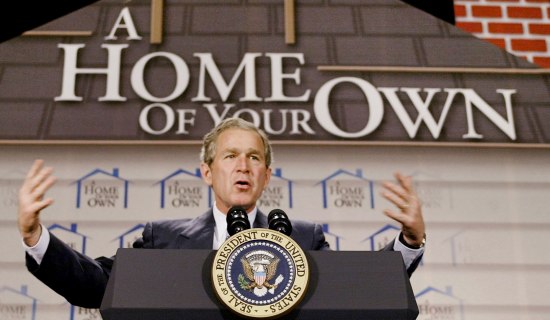
WASHINGTON : “We can put light where there’s darkness, and hope where there’s despondency in this country. And part of it is working together as a nation to encourage folks to own their own home.” — President George W. Bush, Oct. 15, 2002


It was Sept. 18. Lehman Brothers had just gone belly-up, overwhelmed by toxic mortgages. Bank of America had swallowed Merrill Lynch in a hastily arranged sale. Two days earlier, Bush had agreed to pump $85 billion into the failing insurance giant American International Group.


The president listened as Ben Bernanke, chairman of the Federal Reserve, laid out the latest terrifying news: The credit markets, gripped by panic, had frozen overnight, and banks were refusing to lend money.


Then his Treasury secretary, Henry Paulson Jr., told him that to stave off disaster, he would have to sign off on the biggest government bailout in history.


Bush, according to several people in the room, paused for a single, stunned moment to take it all in.


“How,” he wondered aloud, “did we get here?”


Eight years after arriving in Washington vowing to spread the dream of homeownership, Bush is leaving office, as he himself said recently, “faced with the prospect of a global meltdown” with roots in the housing sector he so ardently championed.


There are plenty of culprits, like lenders who peddled easy credit, consumers who took on mortgages they could not afford and Wall Street chieftains who loaded up on mortgage-backed securities without regard to the risk.


But the story of how we got here is partly one of Bush’s own making, according to a review of his tenure that included interviews with dozens of current and former administration officials.


From his earliest days in office, Bush paired his belief that Americans do best when they own their own home with his conviction that markets do best when let alone.


He pushed hard to expand homeownership, especially among minorities, an initiative that dovetailed with his ambition to expand the Republican tent — and with the business interests of some of his biggest donors. But his housing policies and hands-off approach to regulation encouraged lax lending standards.


Bush did foresee the danger posed by Fannie Mae and Freddie Mac, the government-sponsored mortgage finance giants. The president spent years pushing a recalcitrant Congress to toughen regulation of the companies, but was unwilling to compromise when his former Treasury secretary wanted to cut a deal. And the regulator Bush chose to oversee them — an old prep school buddy — pronounced the companies sound even as they headed toward insolvency.


As early as 2006, top advisers to Bush dismissed warnings from people inside and outside the White House that housing prices were inflated and that a foreclosure crisis was looming. And when the economy deteriorated, Bush and his team misdiagnosed the reasons and scope of the downturn; as recently as February, for example, Bush was still calling it a “rough patch.”


The result was a series of piecemeal policy prescriptions that lagged behind the escalating crisis.


“There is no question we did not recognize the severity of the problems,” said Al Hubbard, Bush’s former chief economics adviser, who left the White House in December 2007. “Had we, we would have attacked them.”


Looking back, Keith Hennessey, Bush’s current chief economics adviser, says he and his colleagues did the best they could “with the information we had at the time.” But Hennessey did say he regretted that the administration did not pay more heed to the dangers of easy lending practices. And both Paulson and his predecessor, John Snow, say the housing push went too far.


“The Bush administration took a lot of pride that homeownership had reached historic highs,” Snow said in an interview. “But what we forgot in the process was that it has to be done in the context of people being able to afford their house. We now realize there was a high cost.”


For much of the Bush presidency, the White House was preoccupied by terrorism and war; on the economic front, its pressing concerns were cutting taxes and privatizing Social Security. The housing market was a bright spot: ever-rising home values kept the economy humming, as owners drew down on their equity to buy consumer goods and pack their children off to college.


Lawrence Lindsay, Bush’s first chief economics adviser, said there was little impetus to raise alarms about the proliferation of easy credit that was helping Bush meet housing goals.


“No one wanted to stop that bubble,” Lindsay said. “It would have conflicted with the president’s own policies.”


Today, millions of Americans are facing foreclosure, homeownership rates are virtually no higher than when Bush took office, Fannie and Freddie are in a government conservatorship, and the bailout cost to taxpayers could run in the trillions.


As the economy has shed jobs — 533,000 last month alone — and his party has been punished by irate voters, the weakened president has granted his Treasury secretary extraordinary leeway in managing the crisis.


Never once, Paulson said in a recent interview, has Bush overruled him. “I’ve got a boss,” he explained, who “understands that when you’re dealing with something as unprecedented and fast-moving as this we need to have a different operating style.”


Paulson and other senior advisers to Bush say the administration has responded well to the turmoil, demonstrating flexibility under difficult circumstances. “There is not any playbook,” Paulson said.


The president declined to be interviewed for this article. But in recent weeks Bush has shared his views of how the nation came to the brink of economic disaster. He cites corporate greed and market excesses fueled by a flood of foreign cash — “Wall Street got drunk,” he has said — and the policies of past administrations. He blames Congress for failing to reform Fannie and Freddie. Last week, Fox News asked Bush if he was worried about being the Herbert Hoover of the 21st century.


“No,” Bush replied. “I will be known as somebody who saw a problem and put the chips on the table to prevent the economy from collapsing.”


But in private moments, aides say, the president is looking inward. During a recent ride aboard Marine One, the presidential helicopter, Bush sounded a reflective note.


“We absolutely wanted to increase homeownership,” Tony Fratto, his deputy press secretary, recalled him saying. “But we never wanted lenders to make bad decisions.”


A policy gone awry


Darrin West could not believe it. The president of the United States was standing in his living room.


It was June 17, 2002, a day West recalls as “the highlight of my life.” Bush, in Atlanta to unveil a plan to increase the number of minority homeowners by 5.5 million, was touring Park Place South, a development of starter homes in a neighborhood once marked by blight and crime.


West had patrolled there as a police officer, and now he was the proud owner of a $130,000 town house, bought with an adjustable-rate mortgage and a $20,000 government loan as his down payment — just the sort of creative public-private financing Bush was promoting.


“Part of economic security,” Bush declared that day, “is owning your own home.”


A lot has changed since then. West, beset by personal problems, left Atlanta. Unable to sell his home for what he owed, he said, he gave it back to the bank last year. Like other communities across America, Park Place South has been hit with a foreclosure crisis affecting at least 10 percent of its 232 homes, according to Masharn Wilson, a developer who led Bush’s tour.


“I just don’t think what he envisioned was actually carried out,” she said.


Park Place South is, in microcosm, the story of a well-intentioned policy gone awry. Advocating homeownership is hardly novel; the Clinton administration did it, too. For Bush, it was part of his vision of an “ownership society,” in which Americans would rely less on the government for health care, retirement and shelter. It was also good politics, a way to court black and Hispanic voters.


But for much of Bush’s tenure, government statistics show, incomes for most families remained relatively stagnant while housing prices skyrocketed. That put homeownership increasingly out of reach for first-time buyers like West.


So Bush had to, in his words, “use the mighty muscle of the federal government” to meet his goal. He proposed affordable housing tax incentives. He insisted that Fannie Mae and Freddie Mac meet ambitious new goals for low-income lending.


Concerned that down payments were a barrier, Bush persuaded Congress to spend up to $200 million a year to help first-time buyers with down payments and closing costs.


And he pushed to allow first-time buyers to qualify for federally insured mortgages with no money down. Republican congressional leaders and some housing advocates balked, arguing that homeowners with no stake in their investments would be more prone to walk away, as West did. Many economic experts, including some in the White House, now share that view.


The president also leaned on mortgage brokers and lenders to devise their own innovations. “Corporate America,” he said, “has a responsibility to work to make America a compassionate place.”


And corporate America, eyeing a lucrative market, delivered in ways Bush might not have expected, with a proliferation of too-good-to-be-true teaser rates and interest-only loans that were sold to investors in a loosely regulated environment.


“This administration made decisions that allowed the free market to operate as a barroom brawl instead of a prize fight,” said L. William Seidman, who advised Republican presidents and led the savings and loan bailout in the 1990s. “To make the market work well, you have to have a lot of rules.”


But Bush populated the financial system’s alphabet soup of oversight agencies with people who, like him, wanted fewer rules, not more.


Like minds on laissez-faire


The president’s first chairman of the Securities and Exchange Commission promised a “kinder, gentler” agency. The second was pushed out amid industry complaints that he was too aggressive. Under its current leader, the agency failed to police the catastrophic decisions that toppled the investment bank Bear Stearns and contributed to the current crisis, according to a recent inspector general’s report.


As for Bush’s banking regulators, they once brandished a chain saw over a 9,000-page pile of regulations as they promised to ease burdens on the industry. When states tried to use consumer protection laws to crack down on predatory lending, the comptroller of the currency blocked the effort, asserting that states had no authority over national banks.


The administration won that fight at the Supreme Court. But Roy Cooper, North Carolina’s attorney general, said, “They took 50 sheriffs off the beat at a time when lending was becoming the Wild West.”


The president did push rules aimed at forcing lenders to more clearly explain loan terms. But the White House shelved them in 2004, after industry-friendly members of Congress threatened to block confirmation of his new housing secretary.


In the 2004 election cycle, mortgage bankers and brokers poured nearly $847,000 into Bush’s re-election campaign, more than triple their contributions in 2000, according to the nonpartisan Center for Responsive Politics. The administration did not finalize the new rules until last month.


Among the Republican Party’s top 10 donors in 2004 was Roland Arnall. He founded Ameriquest, then the nation’s largest lender in the subprime market, which focuses on less creditworthy borrowers. In July 2005, the company agreed to set aside $325 million to settle allegations in 30 states that it had preyed on borrowers with hidden fees and ballooning payments. It was an early signal that deceptive lending practices, which would later set off a wave of foreclosures, were widespread.


Andrew Card Jr., Bush’s former chief of staff, said White House aides discussed Ameriquest’s troubles, though not what they might portend for the economy. Bush had just nominated Arnall as his ambassador to the Netherlands, and the White House was primarily concerned with making sure he would be confirmed.


“Maybe I was asleep at the switch,” Card said in an interview.


Brian Montgomery, the Federal Housing Administration commissioner, understood the significance. His agency insures home loans, traditionally for the same low-income minority borrowers Bush wanted to help. When he arrived in June 2005, he was shocked to find those customers had been lured away by the “fool’s gold” of subprime loans. The Ameriquest settlement, he said, reinforced his concern that the industry was exploiting borrowers.


In December 2005, Montgomery drafted a memo and brought it to the White House. “I don’t think this is what the president had in mind here,” he recalled telling Ryan Streeter, then the president’s chief housing policy analyst.


It was an opportunity to address the risky subprime lending practices head on. But that was never seriously discussed. More senior aides, like Karl Rove, Bush’s chief political strategist, were wary of overly regulating an industry that, Rove said in an interview, provided “a valuable service to people who could not otherwise get credit.” While he had some concerns about the industry’s practices, he said, “it did provide an opportunity for people, a lot of whom are still in their houses today.”


The White House pursued a narrower plan offered by Montgomery that would have allowed the FHA to loosen standards so it could lure back subprime borrowers by insuring similar, but safer, loans. It passed the House but died in the Senate, where Republican senators feared that the agency would merely be mimicking the private sector’s risky practices — a view Rove said he shared.


Looking back at the episode, Montgomery broke down in tears. While he acknowledged that the bill did not get to the root of the problem, he said he would “go to my grave believing” that at least some homeowners might have been spared foreclosure.


Today, administration officials say it is fair to ask whether Bush’s ownership push backfired. Paulson said the administration, like others before it, “over-incented housing.” Hennessey put it this way: “I would not say too much emphasis on expanding homeownership. I would say not enough early focus on easy lending practices.”


‘We told you so’


Armando Falcon Jr. was preparing to take on a couple of giants.


A soft-spoken Texan, Falcon ran the Office of Federal Housing Enterprise Oversight, a tiny government agency that oversaw Fannie Mae and Freddie Mac, two pillars of the American housing industry. In February 2003, he was finishing a blockbuster report that warned the pillars could crumble.


Created by Congress, Fannie and Freddie — called GSE’s, for government-sponsored entities — bought trillions of dollars’ worth of mortgages to hold or sell to investors as guaranteed securities. The companies were also Washington powerhouses, stuffing lawmakers’ campaign coffers and hiring bare-knuckled lobbyists.


Falcon’s report outlined a worst-case situation in which Fannie and Freddie could default on debt, setting off “contagious illiquidity in the market” — in other words, a financial meltdown. He also raised red flags about the companies’ soaring use of derivatives, the complex financial instruments that economic experts now blame for spreading the housing collapse.


Today, the White House cites that report — and its subsequent effort to better regulate Fannie and Freddie — as evidence that it foresaw the crisis and tried to avert it. Bush officials recently wrote up a talking points memo headlined “GSE’s — We Told You So.”


But the back story is more complicated. To begin with, on the day Falcon issued his report, the White House tried to fire him.


At the time, Fannie and Freddie were allies in the president’s quest to drive up homeownership rates; Franklin Raines, then Fannie’s chief executive, has fond memories of visiting Bush in the Oval Office and flying aboard Air Force One to a housing event. “They loved us,” he said.


So when Falcon refused to deep-six his report, Raines took his complaints to top Treasury officials and the White House. “I’m going to do what I need to do to defend my company and my position,” Raines told Falcon.


Days later, as Falcon was in New York preparing to deliver a speech about his findings, his cellphone rang. It was the White House personnel office, he said, telling him he was about to be unemployed.


His warnings were buried in the next day’s news coverage, trumped by the White House announcement that Bush would replace Falcon, a Democrat appointed by Bill Clinton, with Mark Brickell, a leader in the derivatives industry that Falcon’s report had flagged.


It was not until 2003, when Freddie became embroiled in an accounting scandal, that the White House took on the companies in earnest. Bush decided to quit the long-standing practice of rewarding supporters with high-paying appointments to the companies’ boards — “political plums,” in Rove’s words. He also withdrew Brickell’s nomination and threw his support behind Falcon, beginning an intense effort to give his little regulatory agency more power.


Falcon lacked explicit authority to limit the size of the companies’ mammoth investment portfolios, or tell them how much capital they needed to guard against losses. White House officials wanted that to change. They also wanted the power to put the companies into receivership, hoping that would end what Card, the former chief of staff, called “the myth of government backing,” which gave the companies a competitive edge because investors assumed the government would not let them fail.


By the spring of 2005 a deal with Congress seemed within reach, Snow, the former Treasury secretary, said in an interview.


Michael Oxley, an Ohio Republican and then-chairman of the House Financial Services Committee, had produced what Snow viewed as “a pretty darned good bill,” a watered-down version of what the president sought. But at the urging of Card and the White House economics team, the president decided to hold out for a tougher bill in the Senate.


Card said he feared that Snow was “more interested in the deal than the result.” When the bill passed the House, the president issued a statement opposing it, effectively killing any chance of compromise. Oxley was furious.


“The problem with those guys at the White House, they had all the answers and they didn’t think they had to listen to anyone, including the Treasury secretary,” Oxley said in a recent interview. “They were driving the ideological train. He was in the caboose, and they were in the engine room.”


Card and Hennessey said they had no regrets. They are convinced, Hennessey said, that the Oxley bill would have produced “the worst of all possible outcomes,” the illusion of reform without the substance.


Still, some former White House and Treasury officials continue to debate whether Bush’s all-or-nothing approach scuttled a measure that, while imperfect, might have given an aggressive regulator enough power to keep the companies from failing.


Snow, for one, calls Oxley “a hero,” adding, “He saw the need to move. It didn’t get done. And it’s too bad, because I think if it had, I think we could well have avoided a big contributor to the current crisis.”


Unheeded warnings


Jason Thomas had a nagging feeling.


The New Century Financial Corp., a huge subprime lender whose mortgages were bundled into securities sold around the world, was headed for bankruptcy in March 2007. Thomas, an economic analyst for Bush, was responsible for determining whether it was a hint of things to come.


At 29, Thomas had followed a fast-track career path that took him from a Buffalo meatpacking plant, where he worked as a statistician, to the White House. He was seen as a whiz kid, “a brilliant guy,” his former boss, Hubbard, says.


As Thomas began digging into New Century’s failure that spring, he became fixated on a particular statistic, the rent-to-own ratio.


Typically, as home prices increase, rental costs rise proportionally. But Thomas sent charts to top White House and Treasury officials showing that the monthly cost of owning far outpaced the cost to rent. To Thomas, it was a sign that housing prices were wildly inflated and bound to plunge, a condition that could set off a foreclosure crisis as conventional and subprime borrowers with little equity found they owed more than their houses were worth.


It was not the Bush team’s first warning. The previous year, Lindsay, the former chief economics adviser, returned to the White House to tell his old colleagues that housing prices were headed for a crash. But housing values are hard to evaluate, and Lindsay had a reputation as a market pessimist, said Hubbard, adding, “I thought, ‘He’s always a bear.’ “


In retrospect, Hubbard said, Lindsay was “absolutely right,” and Thomas’s charts “should have been a signal.”


Instead, the prevailing view at the White House was that the problems in the housing market were limited to subprime borrowers unable to make their payments as their adjustable mortgages reset to higher rates. That belief was shared by Bush’s new Treasury secretary, Paulson.


Paulson, a former chairman of the Wall Street firm Goldman Sachs, had been given unusual power; he had accepted the job only after the president guaranteed him that Treasury, not the White House, would have the dominant role in shaping economic policy. That shift merely continued an imbalance of power that stifled robust policy debate, several former Bush aides say.


Throughout the spring of 2007, Paulson declared that “the housing market is at or near the bottom,” with the problem “largely contained.” That position underscored nearly every action the Bush administration took in the ensuing months as it offered one limited response after another.


By that August, the problems had spread beyond New Century. Credit was tightening, amid questions about how heavily banks were invested in securities linked to mortgages. Still, Bush predicted that the turmoil would resolve itself with a “soft landing.”


The plan Bush announced on Aug. 31 reflected that belief. Called “FHA Secure,” it aimed to help about 80,000 homeowners refinance their loans. Montgomery, the housing commissioner, said that he knew the modest program was not enough — the White House later expanded the agency’s rescue role — and that he would be “flying the plane and fixing it at the same time.”


That fall, Representative Rahm Emanuel, a leading Democrat, former investment banker and now the incoming chief of staff to President-elect Barack Obama, warned the White House it was not doing enough. He said he told Joshua Bolten, Bush’s chief of staff, and Paulson in a series of phone calls that the credit crisis would get “deep and serious” and that the only answer was big, internationally coordinated government intervention.


“You got to strangle this thing and suffocate it,” he recalled saying.


Instead, Bush developed Hope Now, a voluntary public-private partnership to help struggling homeowners refinance loans. And he worked with Congress to pass a stimulus package that sent taxpayers $150 billion in tax rebates.


In a speech to the Economic Club of New York in March 2008, he cautioned against Washington’s temptation “to say that anything short of a massive government intervention in the housing market amounts to inaction,” adding that government action could make it harder for the markets to recover.


Dominoes Start to Fall


Within days, Bear Sterns collapsed, prompting the Federal Reserve to engineer a hasty sale. Some economic experts, including Timothy Geithner, the president of the New York Federal Reserve Bank (and Obama’s choice for Treasury secretary) feared that Fannie Mae and Freddie Mac could be the next to fall.


Bush was still leaning on Congress to revamp the tiny agency that oversaw the two companies, and had acceded to Paulson’s request for the negotiating room that he had denied Snow. Still, there was no deal.


Over the previous two years, the White House had effectively set the agency adrift. Falcon left in 2005 and was replaced by a temporary director, who was in turn replaced by James Lockhart, a friend of Bush from their days at Andover, and a former deputy commissioner of the Social Security Administration who had once run a software company.


In an Oval Office meeting on March 17, however, Paulson barely mentioned the idea, according to several people present. He wanted to use the troubled companies to unlock the frozen credit market by allowing Fannie and Freddie to buy more mortgage-backed securities from overburdened banks. To that end, Lockhart’s office planned to lift restraints on the companies’ huge portfolios — a decision derided by former White House and Treasury officials who had worked so hard to limit them.


But Paulson told Bush the companies would shore themselves up later by raising more capital.


“Can they?” Bush asked.


“We’re hoping so,” the Treasury secretary replied.


That turned out to be incorrect, and did not surprise Thomas, the Bush economic adviser. Throughout that spring and summer, he warned the White House and Treasury that, in the stark words of one e-mail message, “Freddie Mac is in trouble.” And Lockhart, he charged, was allowing the company to cover up its insolvency with dubious accounting maneuvers.


But Lockhart continued to offer reassurances. In a July appearance on CNBC, he declared that the companies were well managed and “worsts were not coming to worst.” An infuriated Thomas sent a fresh round of e-mail messages accusing Lockhart of “pimping for the stock prices of the undercapitalized firms he regulates.”


Lockhart defended himself, insisting in an interview that he was aware of the companies’ vulnerabilities, but did not want to rattle markets.


“A regulator,” he said, “does not air dirty laundry in public.”


Soon afterward, the companies’ stocks lost half their value in a single day, prompting Congress to quickly give Paulson the power to spend $200 billion to prop them up and to finally pass Bush’s long-sought reform bill, but it was too late. In September, the government seized control of Freddie Mac and Fannie Mae.


In an interview, Paulson said the administration had no justification to take over the companies any sooner. But Falcon disagreed: “They absolutely could have if they had thought there was a real danger.”


By Sept. 18, when Bush and his team had their fateful meeting in the Roosevelt Room after the failure of Lehman Brothers and the emergency rescue of AIG, Paulson was warning of an economic calamity greater than the Great Depression. Suddenly, historic government intervention seemed the only option. When Paulson spelled out what would become a $700 billion plan to rescue the nation’s banking system, the president did not hesitate.


“Is that enough?” Bush asked.


“It’s a lot,” the Treasury secretary recalled replying. “It will make a difference.” And in any event, he told Bush, “I don’t think we can get more.”


As the meeting wrapped up, a handful of aides retreated to the White House Situation Room to call Vice President Dick Cheney in Florida, where he was attending a fund-raiser. Cheney had long played a leading role in economic policy, though housing was not a primary interest, and like Bush he had a deep aversion to government intervention in the market. Nonetheless, he backed the bailout, convinced that too many Americans would suffer if Washington did nothing.


Bush typically darts out of such meetings quickly. But this time, he lingered, patting people on the back and trying to soothe his downcast staff. “During times of adversity, he bucks everybody up,” Paulson said.


It was not the end of the failures or government interventions; the administration has since stepped in to rescue Citigroup and, just last week, the Detroit automakers. With 31 days left in office, Bush says he will leave it to historians to analyze “what went right and what went wrong,” as he put it in a speech last week to the American Enterprise Institute.


Bush said he was too focused on the present to do much looking back.


“It turns out,” he said, “this isn’t one of the presidencies where you ride off into the sunset, you know, kind of waving goodbye.”


The global financial system was teetering on the edge of collapse when President George W. Bush and his economics team huddled in the Roosevelt Room of the White House for a briefing that, in the words of one participant, “scared the hell out of everybody.”


New Rules For February 20, 2009 | Real Time With Bill Maher

Obama, Politics, Wall Street

Bill Maher With Ron Paul | Real Time | February 20, 2009

Banking, Bullshit, Credit Default Swaps, Deficit Hawks Activate, FDR, GOP, Keynesian, Libertarian Assholes, Politics, Real Time, Ron Paul, Texas, Wall Street

Real Time With Bill Maher | Opening Monologue | February 20, 2009

Academy Awards, bailout, Banking, Barack Obama, Comedy, Politics, Real Time, Religulous, Ron Paul, Wall Street

Government Bailout Hits $8.5 trillion

Adjustable Rate Mortgages, AIG, Alan Greenspan, bailout, Banking Regulation, Banks, Ben Bernanke, Bernie Madoff, BofA, Citi, Credit, Credit Default Swaps, Fannie Mae, Federal Reserve, Finance, Freddy Mac, Henry Paulson, Lehman, Merrill, Mrs. Andrea Mitchell, Treasury, Wachovia, Wall Street, World Savings

chia-obama-animated-21

Kathleen Pender

The San Francisco Chronicle

November 26, 2008

The federal government committed an additional $800 billion to two new loan programs on Tuesday, bringing its cumulative commitment to financial rescue initiatives to a staggering $8.5 trillion, according to Bloomberg News.

That sum represents almost 60 percent of the nation’s estimated gross domestic product.

Given the unprecedented size and complexity of these programs and the fact that many have never been tried before, it’s impossible to predict how much they will cost taxpayers. The final cost won’t be known for many years.

The money has been committed to a wide array of programs, including loans and loan guarantees, asset purchases, equity investments in financial companies, tax breaks for banks, help for struggling homeowners and a currency stabilization fund.

Most of the money, about $5.5 trillion, comes from the Federal Reserve, which as an independent entity does not need congressional approval to lend money to banks or, in “unusual and exigent circumstances,” to other financial institutions.

To stimulate lending, the Fed said on Tuesday it will purchase up to $600 billion in mortgage debt issued or backed by Fannie Mae, Freddie Mac and government housing agencies. It also will lend up to $200 billion to holders of securities backed by consumer and small-business loans. All but $20 billion of that $800 billion represents new commitments, a Fed spokeswoman said.

About $1.1 trillion of the $8.5 trillion is coming from the Treasury Department, including $700 billion approved by Congress in dramatic fashion under the Troubled Asset Relief Program.

The rest of the commitments are coming from the Federal Deposit Insurance Corp. and the Federal Housing Administration.

Only about $3.2 trillion of the $8.5 trillion has been tapped so far, according to Bloomberg. Some of it might never be.

Relatively little of the money represents direct outlays of cash with no strings attached, such as the $168 billion in stimulus checks mailed last spring.

Where it’s going

Most of the money is going into loans or loan guarantees, asset purchases or stock investments on which the government could see some return.

“If the economy were to miraculously recover, the taxpayer could make money. That’s not my best guess or even a likely scenario,” but it’s not inconceivable, says Anil Kashyap, a professor at the University of Chicago’s Booth School of Business.

The risk/reward ratio for taxpayers varies greatly from program to program.

For example, the first deal the government made when it bailed out insurance giant AIG had little risk and a lot of potential upside for taxpayers, Kashyap said. “Then it turned out the situation (at AIG) was worse than realized, and the terms were so brutal (to AIG) that we had to renegotiate. Now we have given them a lot more credit on more generous terms.”

Kashyap says the worst deal for taxpayers could be the Citigroup deal announced late Sunday. The government agreed to buy an additional $20 billion in preferred stock and absorb up to $249 billion in losses on troubled assets owned by Citi.

Given that Citigroup’s entire market value on Friday was $20.5 billion, “instead of taking that $20 billion in preferred shares we could have bought the company,” he says.

It’s hard to say how much the overall rescue attempt will add to the annual deficit or the national debt because the government accounts for each program differently.

If the Treasury borrows money to finance a program, that money adds to the federal debt and must eventually be paid off, with interest, says Diane Lim Rogers, chief economist with the Concord Coalition, a nonpartisan group that aims to eliminate federal deficits.

The federal debt held by the public has risen to $6.4 trillion from $5.5 trillion at the end of August. (Total debt, including that owed to Social Security and other government agencies, stands at more than $10 trillion.)

However, a $1 billion increase in the federal debt does not necessarily increase the annual budget deficit by $1 billion because it is expected to be repaid over time, Rogers said.

Annual deficit

A deficit arises when the government’s expenditures exceed its revenues in a particular year. Some estimate that the federal deficit will exceed $1 trillion this fiscal year as a result of the economic slowdown and efforts to revive it.

The Fed’s activities to shore up the financial system do not show up directly on the federal budget, although they can have an impact. The Fed lends money from its own balance sheet or by essentially creating new money. It has been doing both this year.

The problem is, “if you print money all the time, the money becomes worth less,” Rogers says. This usually leads to higher inflation and higher interest rates. The value of the dollar also falls because foreign investors become less willing to invest in the United States.

Today, interest rates are relatively low and the dollar has been mostly strengthening this year because U.S. Treasury securities “are still for the moment a very safe thing to be investing in because the financial market is so unstable,” Rogers said. “Once we stabilize the stock market, people will not be so enamored of clutching onto Treasurys.”

At that point, interest rates and inflation will rise. Increased borrowing by the Treasury will also put upward pressure on interest rates.

Deflation a big concern

Today, however, the Fed is more worried about deflation than inflation and is willing to flood the market with money if necessary to prevent an economic collapse.

Federal Reserve Chairman Ben Bernanke “has ordered the helicopters to get ready,” said Axel Merk, president of Merk Investments. “The helicopters are hovering and the first cash is making it through the seams. Soon, a door may be opened.”

Rogers says her biggest fear is not hyperinflation and the social unrest it could unleash. “I’m more worried about a lot of federal dollars being committed and not having much to show for it. My worst fear is we are leaving our children with a huge debt burden and not much left to pay it back.”

Economic rescue

Key dates in the federal government’s campaign to alleviate the economic crisis.

March 11: The Federal Reserve announces a rescue package to provide up to $200 billion in loans to banks and investment houses and let them put up risky mortgage-backed securities as collateral.

March 16: The Fed provides a $29 billion loan to JPMorgan Chase & Co. as part of its purchase of investment bank Bear Stearns.

July 30: President Bush signs a housing bill including $300 billion in new loan authority for the government to back cheaper mortgages for troubled homeowners.

Sept. 7: The Treasury takes over mortgage giants Fannie Mae and Freddie Mac, putting them into a conservatorship and pledging up to $200 billion to back their assets.

Sept. 16: The Fed injects $85 billion into the failing American International Group, one of the world’s largest insurance companies.

Sept. 16: The Fed pumps $70 billion more into the nation’s financial system to help ease credit stresses.

Sept. 19: The Treasury temporarily guarantees money market funds against losses up to $50 billion.

Oct. 3: President Bush signs the $700 billion economic bailout package. Treasury Secretary Henry Paulson says the money will be used to buy distressed mortgage-related securities from banks.

Oct. 6: The Fed increases a short-term loan program, saying it is boosting short-term lending to banks to $150 billion.

Oct. 7: The Fed says it will start buying unsecured short-term debt from companies, and says that up to $1.3 trillion of the debt may qualify for the program.

Oct. 8: The Fed agrees to lend AIG $37.8 billion more, bringing total to about $123 billion.

Oct. 14: The Treasury says it will use $250 billion of the $700 billion bailout to inject capital into the banks, with $125 billion provided to nine of the largest.

Oct. 14: The FDIC says it will temporarily guarantee up to a total of $1.4 trillion in loans between banks.

Oct. 21: The Fed says it will provide up to $540 billion in financing to provide liquidity for money market mutual funds.

Nov. 10: The Treasury and Fed replace the two loans provided to AIG with a $150 billion aid package that includes an infusion of $40 billion from the government’s bailout fund.

Nov. 12: Paulson says the government will not buy distressed mortgage-related assets, but instead will concentrate on injecting capital into banks.

Nov. 17: Treasury says it has provided $33.6 billion in capital to another 21 banks. So far, the government has invested $158.6 billion in 30 banks.

Sunday: The Treasury says it will invest $20 billion in Citigroup Inc., on top of $25 billion provided Oct. 14. The Treasury, Fed and FDIC also pledge to backstop large losses Citigroup might absorb on $306 billion in real estate-related assets.

Tuesday: The Fed says it will purchase up to $600 billion more in mortgage-related assets and will lend up to $200 billion to the holders of securities backed by various types of consumer loans.

Source: Associated Press
Net Worth runs Tuesdays, Thursdays and Sundays. E-mail Kathleen Pender at kpender@sfchronicle.com.


Design a site like this with WordPress.com
Get started