Paul Krugman: "On the Edge"

Barack Obama, D.C., Economy, Federal Reserve, Finance, GOP, Larry Summers, Media, Paul Krugman, Politics, Republicans, Stimulus Bill, Tim Geithner
February 6, 2009
Op-Ed Columnist
On the Edge

A not-so-funny thing happened on the way to economic recovery. Over the last two weeks, what should have been a deadly serious debate about how to save an economy in desperate straits turned, instead, into hackneyed political theater, with Republicans spouting all the old clichés about wasteful government spending and the wonders of tax cuts.

It’s as if the dismal economic failure of the last eight years never happened — yet Democrats have, incredibly, been on the defensive. Even if a major stimulus bill does pass the Senate, there’s a real risk that important parts of the original plan, especially aid to state and local governments, will have been emasculated.

Somehow, Washington has lost any sense of what’s at stake — of the reality that we may well be falling into an economic abyss, and that if we do, it will be very hard to get out again.

It’s hard to exaggerate how much economic trouble we’re in. The crisis began with housing, but the implosion of the Bush-era housing bubble has set economic dominoes falling not just in the United States, but around the world.

Consumers, their wealth decimated and their optimism shattered by collapsing home prices and a sliding stock market, have cut back their spending and sharply increased their saving — a good thing in the long run, but a huge blow to the economy right now. Developers of commercial real estate, watching rents fall and financing costs soar, are slashing their investment plans. Businesses are canceling plans to expand capacity, since they aren’t selling enough to use the capacity they have. And exports, which were one of the U.S. economy’s few areas of strength over the past couple of years, are now plunging as the financial crisis hits our trading partners.

Meanwhile, our main line of defense against recessions — the Federal Reserve’s usual ability to support the economy by cutting interest rates — has already been overrun. The Fed has cut the rates it controls basically to zero, yet the economy is still in free fall.

It’s no wonder, then, that most economic forecasts warn that in the absence of government action we’re headed for a deep, prolonged slump. Some private analysts predict double-digit unemployment. The Congressional Budget Office is slightly more sanguine, but its director, nonetheless, recently warned that “absent a change in fiscal policy … the shortfall in the nation’s output relative to potential levels will be the largest — in duration and depth — since the Depression of the 1930s.”

Worst of all is the possibility that the economy will, as it did in the ’30s, end up stuck in a prolonged deflationary trap.

We’re already closer to outright deflation than at any point since the Great Depression. In particular, the private sector is experiencing widespread wage cuts for the first time since the 1930s, and there will be much more of that if the economy continues to weaken.

As the great American economist Irving Fisher pointed out almost 80 years ago, deflation, once started, tends to feed on itself. As dollar incomes fall in the face of a depressed economy, the burden of debt becomes harder to bear, while the expectation of further price declines discourages investment spending. These effects of deflation depress the economy further, which leads to more deflation, and so on.

And deflationary traps can go on for a long time. Japan experienced a “lost decade” of deflation and stagnation in the 1990s — and the only thing that let Japan escape from its trap was a global boom that boosted the nation’s exports. Who will rescue America from a similar trap now that the whole world is slumping at the same time?

Would the Obama economic plan, if enacted, ensure that America won’t have its own lost decade? Not necessarily: a number of economists, myself included, think the plan falls short and should be substantially bigger. But the Obama plan would certainly improve our odds. And that’s why the efforts of Republicans to make the plan smaller and less effective — to turn it into little more than another round of Bush-style tax cuts — are so destructive.

So what should Mr. Obama do? Count me among those who think that the president made a big mistake in his initial approach, that his attempts to transcend partisanship ended up empowering politicians who take their marching orders from Rush Limbaugh. What matters now, however, is what he does next.

It’s time for Mr. Obama to go on the offensive. Above all, he must not shy away from pointing out that those who stand in the way of his plan, in the name of a discredited economic philosophy, are putting the nation’s future at risk. The American economy is on the edge of catastrophe, and much of the Republican Party is trying to push it over that edge.

Obama's Campaign Manager and Elizabeth Edwards Get Book Deals

Barack Obama, David Plouffe, Elizabeth Edwards, John Edwards, The Audacity to Win: The Inside Story and Lessons of Barack Obama's Historic Victory

CBS NEWS’ HOTSHEET

hotsheet

David Plouffe, Barack Obama’s campaign manager, and Elizabeth Edwards, whose husband John ran for president last year and later admitted an extramarital affair, have both secured book deals, the Associated Press reports.

Plouffe’s seven-figure deal is for a book on the presidential election entitled “The Audacity to Win: The Inside Story and Lessons of Barack Obama’s Historic Victory.”

In a statement, publisher Viking said it would examine “the deliberations about whether to run against long odds, the epic primary battle with Hillary Clinton, the drama of the general election campaign against John McCain and the strategic roads taken — and not taken.”

It will “also detail the business lessons to be learned from the formation and the functioning of an unprecedented $1 billion start-up — use of technology, crisis management, grass roots, and personnel management.”

Edwards’ book, entitled “Resilience,” will be released in May. The publisher is not releasing details about what Edwards covers in the book, but she has plenty to work with: Her continuing fight against breast cancer, her experiences during her husband’s run for the Democratic presidential nomination, and the fallout from John Edwards’ admission of an affair with a video producer.

“She has always been a kind of candid and honest writer, and people can expect that of her in her new book,” said her publisher’s publicity director.

Edwards published a book in 2006 called “Saving Graces” in which she discussed her fight against cancer and the death of her son 10 years earlier. She has not discussed her husband’s affair in detail since it was revealed last August.

Billions in Drug and Organized Crime 'Dirty Money' Funneled Into Bernie Madoff's Operation

Barack Obama, Wall Street
WASHINGTON, Feb. 4, 2009


(CBS) By CBS News chief investigative correspondent Armen Keteyian and Investigative Producer Laura Stricker.


main
On Capitol Hill Wednesday, the financial analyst who first blew the whistle on Bernie Madoff back in 2000 went public for the first time, stunning lawmakers with the full scope of the $50 billion fraud.
CBS News correspondent Armen Keteyian reports.

In two hours of riveting, no-holds barred testimony, Harry Markopolos revealed the depth – and danger – of his nine-year fight to expose the Madoff scandal.

Markopolos said at one point he feared for his life.

“He would have known my name and, he knew he had a team tracking him. I didn’t think I was long for this world,” he said.

One reason: Bernie Madoff was among the “most powerful men” on Wall Street.

Another: In 2002 Markopolos said he discovered billions of dollars in “dirty money” was being funneled into Madoff Securities through a series of off-shore accounts.

“When you’re that big and that secretive, you’re going to attract a lot of organized crime money, and which we … now know came from the Russian mob and the Latin-American drug cartel,” Markopolos said.


A 162-page document filed with the U.S. Bankruptcy Court in Manhattan late Wednesday lists several thousand of the people and entities that handed money over to Madoff to “invest”. Among the victims are some very well-known personalities – and Madoff’s own defense lawyer. Click here to read more.


Markopolos said he began his crusade back in late 1999, when he was asked by his employer to see if he could match an investment strategy that produced unusually steady returns – like Madoff’s.

“It took me about five minutes to figure out that he was a fraud,” Markopolos said.

Despite “gift wrapping” evidence of the largest Ponzi scheme in history, Markopolos ran into a stone wall at the SEC. It was an agency, he charged, was unwilling and incapable of following his leads.

“I gave them a road map and a flashlight to find the fraud, and they didn’t go where I told them to go,” Markopolos said.

And he wasn’t the only one warning the feds.

This anonymous letter sent in April 2006 to the head of the SEC was obtained exclusively by CBS News.

In it, SEC Chairman Christopher Cox is told that Madoff keeps two “sets of records. The most interesting of which is on his computer which is always on his person.”

The letter was sent to Cox once on Dec. 6, 2006, and then again on April 26, 2006. The second letter has a note at the top saying, “Dear Sir, this is sent in the event you did not receive the original.”

The letter is also stamped, “Received: 2006 March 31, Chairman’s Correspondence Unit.” The anonymous writer says Madoff is perpetrating a “scandal of major proportion …”

But again, nothing happened.

Hardly surprising to former SEC Commissioner Paul Atkins, who told CBS News “higher ups” pushed investigators into cases that made headlines and careers.

“They were actively discouraged from going after Ponzi schemes, pump-and-dump schemes, and things that were considered small cases,” Paul Atkins, former SEC commissioner, said. “Actively discouraged by their superiors.”

As to the question of whether Bernie Madoff pulled off $50 billion worth of fraud all by himself?

Markopolos had a very simple answer: “No.”

© MMIX, CBS Interactive Inc. All Rights Reserved.

White House: Priority Is Legislation That "Doesn't Signal A Change In Our Overall Stance on Trade

AFL-CIO, Barack Obama, Bob Baugh, CAFTA, Free Trade, Larry Summers, NAFTA, Ohio, Pennsylvania, Robert Gibbs, Trade, White House, Wisconsin, WTO

Daschle Withdraws His Nomination to Health and Human Services

Barack Obama, Charles Schumer, Edward Kennedy, HHS, John Kerry, Patrick Leahy, Robert Gibbs, Senate, South Dakota, Taxes, Tom Daschle

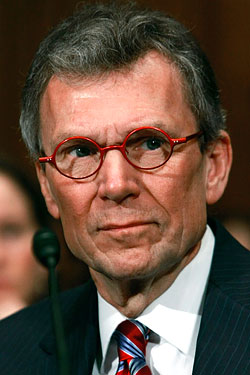
20090202_tom_250x375

(CNN) — Former Sen. Tom Daschle has withdrawn his nomination to head the Department of Health and Human Services, according to a statement Tuesday from the White House.

Daschle had been fighting to save his nomination as HHS secretary following controversy over his tax records and questions over his work in a field that some consider lobbying.

In a statement announcing his withdrawal, Daschle said it was an honor to be chosen to lead the reform of America’s health care system.

“But if 30 years of exposure to the challenges inherent in our system has taught me anything, it has taught me that this work will require a leader who can operate with the full faith of Congress and the American people, and without distraction,” he said.

“Right now, I am not that leader, and will not be a distraction. The focus of Congress should be on the urgent business of moving the president’s economic agenda forward, including affordable health care for every American.”

The Obama administration had stood by his side, and fellow Democrats lined up behind him, but Daschle’s problems, coupled with other nominees’ issues, gave critics ammunition to question President Obama’s call for a “new era of responsibility.”

The president said Tuesday he accepts Daschle’s decision “with sadness and regret.”

“Tom made a mistake, which he has openly acknowledged. He has not excused it, nor do I. But that mistake, and this decision, cannot diminish the many contributions Tom has made to this country, from his years in the military to his decades of public service. Now we must move forward, with our plan to lift this economy and put people back to work,” Obama said in a statement.

Daschle’s resignation came hours after Nancy Killefer’s withdrawal as Obama’s chief performance officer, a new post in the administration.

Officials said privately the reason for Killefer’s withdrawal was unspecified tax issues. The much-touted post was designed to scrub the federal budget.

Daschle, the former Senate majority leader, apologized Monday for failing to pay his taxes in full. He said earlier he was “deeply embarrassed” for a series of errors that included failing to report $15,000 in charitable donations, unreported car service and more than $80,000 in unreported income from consulting.

Daschle recently filed amended tax returns and paid more than $140,000 in back taxes and interest for 2005-2007.

A New York Times editorial on Tuesday called for Daschle to withdraw.

The paper’s editorial board particularly took issue with Daschle saying he identified the unpaid taxes in June but did not pay them until his nomination for the top post at the Department of Health and Human Services.

The editorial also criticized Daschle for generating a sizable income from health-related industries while working in the private sector.

“Mr. Daschle is another in a long line of politicians who move cozily between government and industry. We don’t know that his industry ties would influence his judgments on health issues, but they could potentially throw a cloud over health care reform,” the editorial said.

Shortly after news of the tax quandary broke, a number of Democratic senators released statements expressing their support for Daschle, including Sens. John Kerry of Massachusetts, Charles Schumer of New York, Patrick Leahy of Vermont and Edward Kennedy of Massachusetts. In their opinions, Daschle identified the problem and corrected it.

Daschle’s supporters said that given his record of three decades of public service, he was still the right man for the job.

“One cannot underestimate how widely admired Tom Daschle is in Washington for his integrity, for his public service. And many, many Democrats look to him as one of the favorite people. He’s got a lot of support in this White House, starting with the president,” said David Gergen, a senior political analyst for CNN.

Obama and Daschle have a longstanding relationship. Daschle endorsed Obama for the Democratic presidential nomination in February 2007 — nearly 11 months before the first contest. Daschle was also considered to be a contender for Obama’s No. 2 spot.

Daschle also has a history with members of Congress. He represented South Dakota in the House of Representatives for four terms, and he served in the Senate for three terms. He was the Senate majority leader from June 2001 to January 2003, and was the minority leader before losing his re-election bid in 2004.

Daschle’s work in his post-Senate years was also a point of contention on his path to confirmation.

After leaving the Senate, Daschle went on to serve as a special public policy adviser at the law firm Alston & Bird.

According to the firm’s Web site, Daschle advised clients on “issues related to financial services, health care, energy, telecommunications and taxes.”

His work, for which he reportedly made millions, seemed to contradict Obama’s strict rules on lobbyists working in his administration.

Promising “a new era of openness in our country,” Obama signed executive orders relating to ethics guidelines for staff members as one of his first acts in office.

“If you are a lobbyist entering my administration, you will not be able to work on matters you lobbied on, or in the agencies you lobbied during the previous two years,” the president said.

The administration had defended its choice of Daschle, pointing out that he was not technically a lobbyist.

“If you’re not registered to lobby, you can’t be a lobbyist,” said White House press secretary Robert Gibbs, according to Time.com. Time.com: When is a lobbyist not a lobbyist?

Daschle and Kellifer were not the first of Obama’s nominees to come under scrutiny.

Before Tim Geithner was confirmed as treasury secretary, he was questioned over concerns involving his personal taxes and the immigration status of a former housekeeper.

New Mexico Gov. Bill Richardson also withdrew his nomination to be commerce secretary, citing the distraction of a federal investigation into ties to a company that has done business with his state.

Given Obama’s pledge for “unprecedented transparency, rigorous oversight and clear accountability,” some said the controversy surrounding Obama’s appointments are calling into question the president’s vetting process.

“Mr. President, your picks to help run the federal government don’t have to be perfect, but is it too much to ask that they pay like everyone else, to keep that same government functioning? And more importantly, that they don’t wait until everyone, including you, is watching?” CNN’s Campbell Brown wrote in a commentary. Read the commentary

Asked if the president is embarrassed by the slew of appointment problems, Gibbs was quick to negate that idea.

“No, I don’t think that — that we believe there’s any problem in the vetting,” Gibbs said Monday.


Stiglitz Calls Bad Bank Idea "Cash For Trash"

Bad Bank, Barack Obama, Columbia University, Davos, George Soros, Good Bank, Jamie Dimon, Joseph Stiglitz, JPMorgan Chase & Co, National Debt, Stimulus Package, Tim Geithner

BLOOMBERG

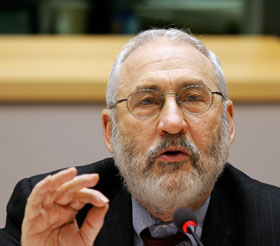
stiglitz_73457812

Feb. 1 (Bloomberg) — Nobel laureate Joseph Stiglitz said any decision by President Barack Obama to establish a so-called bad bank to rid financial companies of toxic assets risks swelling the national debt.

Obama’s administration is moving closer to buying the illiquid assets currently clogging bank’s balance sheets and preventing them from boosting lending, people familiar with the matter said this week.

That amounts to swapping taxpayers’ “cash for trash,” Stiglitz said yesterday in a panel discussion at the World Economic Forum in Davos, Switzerland. “You shouldn’t chase good money after bad. We’re talking about a national debt that’s very hard to manage.”

Stiglitz, a professor at Columbia University in New York and a former adviser to President Bill Clinton, says the plan would leave taxpayers paying for years of excess lending by banks. It would also deprive the government of money that would have been better spent shoring up Social Security, he said.

Whether a bad bank would accelerate an end to the financial crisis split delegates attending the Davos talks. JPMorgan Chase & Co. Chief Executive Officer Jamie Dimon said such an operation would help if “executed well.” Billionaire investor George Soros said in an interview that “it’s not the measure that would turn the situation around and enable banks to lend.”

Obama Plan

Obama said yesterday he’s readying a plan to unlock credit markets and lower mortgage rates. Under the initiative, the government would buy some tainted securities and insure the banks against losses on the rest.

“Soon my Treasury secretary, Timothy Geithner, will announce a new strategy for reviving our financial system that gets credit flowing to businesses and families,” Obama said in his weekly radio address.

Stiglitz drew criticism from panel participant Angel Gurria, head of the Organization for Economic Cooperation and Development, who says a bad bank is necessary for lending to resume.

“I agree about the moral, ethical fallout, but you’ve got to face the music and someone has to take the loss,” said Gurria, Mexico’s former finance minister. “It’s the only way to jumpstart the economy.”

Bank losses worldwide from toxic U.S.-originated assets may double to $2.2 trillion, the International Monetary Fund said in a report released Jan. 28.

John Monks, general secretary of the European Trade Union Confederation, told the same audience that governments are getting “close to straining the patience of the public and voters” by repeatedly extending lifelines to banks.

Philippines President Gloria Arroyo urged Obama to make a quick decision on his plan.

“We want Americans to do something,” she said at the session, which was called “Rebooting the Global Economy.” “We can discuss what to do but the worst thing is to do nothing.”

Is There a White House Baby on the Way?

Barack Obama, Michelle Obama, Perez, Romors, White House

PD*26386224

CBS NEWS

Celebrity blogger Perez Hilton has rarely let facts get in the way of gossip. Still, his latest and apparently baseless speculation about Michelle Obama has generated international baby buzz.

On Wednesday, an item appeared on PerezHilton.com (filed under Baby Blabber – Conspiracy Corner) with the headline: “White House Baby???”

“We’re hearing talk in D.C. that Michelle Obama is pregnant,” the post read.

Despite Hilton’s blunt disclaimer (“this is completely unconfirmed”), the rumor has picked up steam. A Google search for the words “Michelle Obama” and “pregnant” churns out 826,000 results. Meanwhile, Gawker has begun scrutinizing recent photos of the First Lady for signs of pregnancy.

The speculation has also spread overseas. News outlets from England to Australia pounced on the news.

So did the gambling world. In the wake of the rumor, Ireland’s biggest bookmaker Paddy Power slashed the odds on Michelle Obama giving birth this year from 10-1 to 2-1. You can also wager on the sex of the baby and even if the birth will produce multiple babies (it’s 20-1 that Michelle Obama will have twins and 10,000-1 that she will have octuplets).

Paddy Power’s Ken Robertson tells CBSNews.com that at this very moment, there are 166 bets on “Yes, there will be a new first baby” (for a total stake of 2412 Euros) and 222 bets on “No, there will not be a new first baby” (for a total stake of €3996).

Of course, the baby bets also include what the Obamas would name their third child, after Sasha and Malia. Barack Jr. is the favorite at 3-1; Michelle is 10-1; and the 250-1 long shots include Paris, Perez and Jesus.

Roberston says so far the most widely backed name for the new baby is Barack Jr., which has 98 bets for a total stake of €784.

If the dubious rumor does prove to be true, the baby would be only the second born in the White House. That sole distinction now belongs to the daughter of President Grover Cleveland, who was born in 1893. Her name? Esther.

Rezco Sentencing Indefinately Postponed

Barack Obama, Chicago, Corruption, Tony Rezco
December 16, 2008


A federal judge has indefinitely postponed the Jan. 6 sentencing for Tony Rezko, the prominent political fund-raiser and former adviser to Gov. Blagojevich.

The move this morning came after Rezko lawyers asked U.S. District Judge Amy St. Eve last week to throw out the sentencing date.

Rezko’s request comes as he restarts talks with federal prosecutors. Those talks hit a stumbling block as Rezko asked to be let out of solitary confinement at the downtown federal lockup. He asked for a rushed sentencing in January.

But last week’s revelation that the government has recordings in the governor’s case, appeared to change Rezko’s mind about cooperating.

Rezko’s lawyers did not ask for a new sentencing date at this morning’s hearing

There's a New Sheriff in Town and He's Not Wearing a Cowboy Hat

Barack Obama, Bonuses, Federal Reserve, Jobs, Michelle Obama, Treasury, Unemployment, Wall Street

lilly

You know you can whine all day about the idea that no matter what President Obama does in the next couple of years- we’re all in for some rough times- and you’d be right.

But there’s just no accounting for the feeling an American citizen gets after a day like today- miserable, pissed off and yet hopeful that at last, someone is Finally in charge.

The very first bill that President Barack Obama signed into law protects American workers on a day that unemployment benefits climbed to a record number of claims. Lilly Ledbetter worked alongside her male Goodyear plant supervisors for twenty years making less money because she was a female. She stood behind the President as he signed the legislation.

Mrs. Obama, who made her first public comments since becoming First Lady said: “She knew unfairness when she saw it, and was willing to do something about it because it was the right thing to do — plain and simple,”

The President explained that he wanted his daughters to be treated equally and valued for their talents in the workplace.

Later in the day he met with Vice President Biden amd Treasury Secretary Geithner and then addressed the press about the report that Wall Street bonuses are the same as 2004.

Barack Obama leaned forward in his gold and blue striped antique chair and ripped in to Wall Street:

“Shameless”

“There will be times for them to make profits and there will be time for them to get bonuses — now is not that time,” Obama said. “The American people understand that we’ve got a big hole that we’ve got to dig ourselves out of, but they don’t like the idea that people are digging a bigger hole even as they’re asked to fill it up.”

It’s nice to have a living, working brain back in the Oval Office.

JT

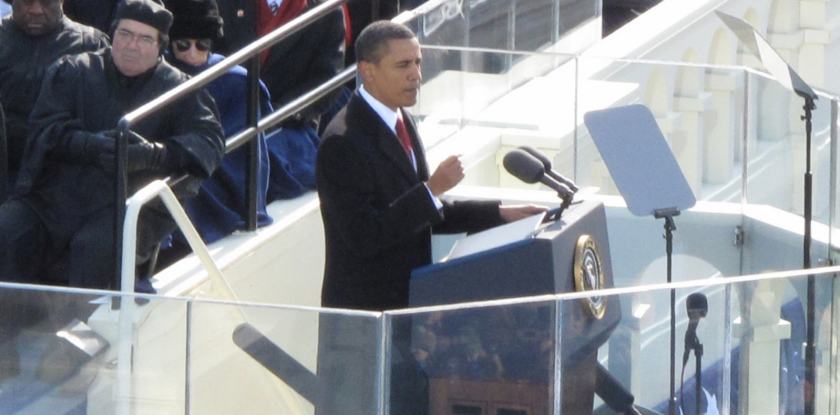
Inauguration 2009

Barack Obama, Inauguration
B.O. by Tullycast

B.O. by Tullycast

john-tully-in-dc