Barack Obama
We are the most powerful nation in the world. There is no excuse, only corruption.
Alberto Gonzales, Albritton Communications, Ari Fleisher, Baker Botts, Barack Obama, Beck, Brewster Jennings, Brit Hume, Broadcatching, Broder, Carlyle Group, Childhood Literacy, CIA, D.C., David Frum, David Gregory, David Ignatius, Dick Cheney, Eisenhower, Executive Power, George Stephanapoulos, George W. Bush, Halliburton, Health Care, Housing, Hunger, Infant Mortality, Iran, Iraq, John Harris, Justice Department, K Street, Karl Rove, KBR, Kellogg Brown Root, Krauthammer, Kristol, Limbaugh, Lobbyists, Meet The Press, Michael Gerson, Michael Wolff, Military Industrial Complex, Neocons, New York Times, O'Reilly, Pentagon, Politico, Ronald Reagan, Scooter Libby, Think-Tanks, Tim Russert, Torture, Valerie Plame, Vanity Fair, Washington Post, Will, WiretappingWe are the most powerful nation in the world. There is no excuse, only corruption.
On a Plane Ride Home From Paris Sitting Next to a Douchebag With an Ed Hardy Shirt Reading Glenn Beck's Book
Alberto Gonzales, Albritton Communications, Ari Fleisher, Baker Botts, Barack Obama, Beck, Brewster Jennings, Brit Hume, Broadcatching, Broder, Carlyle Group, Childhood Literacy, CIA, D.C., David Brooks, David Frum, David Gregory, David Ignatius, Dick Cheney, Duct Tape, Eisenhower, Executive Power, George Stephanapoulos, George Stephanopoulos, George W. Bush, George Will, Haditha, Halliburton, Health Care, Housing, Hunger, Infant Mortality, Iran, Iraq
1441!
by John Tully
The New York Herald Sun
July 26, 2009
Whether it was Michael Wolff’s “piece” in Vanity Fair on Politico or the Paris tap water that produced the explosive diarrhea on a hot sweaty July night in the City of Lights, we’ll never know…
Time moves both slow and fast in these Dog Days of Summer and the memory hole of the past eight bloody years is fading and digging deeper.
I take you back to the city of D.C.
A few years ago…
A quaint city, soon to written about like Rome, gilded on their own lily and pathetic to boot.
Sucked in to television, watching the camera moves, editing, and heavy music to a story about a mom and a dad and a wife who lose their little/big man to a fiery explosion in Iraq. The soldier leaves a “just in case” final video for his bride, tells her of his deep love, and urges her to go on with life: “get married, have kids” It’s a noble gesture from a brave young man and the camera cuts to the weeping widow watching the tape.
The evening news comes on and the 80 year-old man who marched against Iraq in a February freeze watches a report on two dead Marines and 17 Iraqi dead civilians . Remember seeing that look on the face of the Marines’ mother or the site of yet another widow with two babies that finally punches the gut.
At this point in the war, President Bush hadn’t been to one funeral service for them.
Remember.
Remember banned television cameras at the arrival of the bodies from Germany, at the base in Delaware .
The cowering, obedient press corpse giving the President a free pass after 9/11 and the Administration using it to make the United States less safe, less secure, and spoil environmental and geopolitical progress for years to come.
Remembering Television and Freedom Fries and Terror Alerts here in Paris 6 years later, the mind once again boggles and crunches the serious, sad, mistaken war of choice that ignored all plans and warnings of consequences.
Powered by arrogance and breathtaking hubris and television’s Meet The Press and This Week With Will for the latest talking points of the day.
MR. RUSSERT: All right, this way: Should the blogs, talk radio, cable TV—should people lower their voices, and, and, and control their rhetoric?
Remember that very same week when the Vice-President poked a fat finger in the eye of Russia while the Bush Administration reflexively rejected the first written communication from Iran in seventeen years. Neither Vice President Cheney’s speech or the letter was ever mentioned on either program.
Mr. Bush and Mr. Cheney had blown the cover of longtime C.I.A. agent Valerie Plame who it turns out was working on nuclear proliferation. Her contacts through front company Brewster Jennings were actively working the underground nukes world. That intel might have been helpful that very same week in dealing with Iran.
Instead, the latest Cool-Kids Media Club Memes emerged: “Anger on the Blogs”
That’s right. Three different allusions to blogs and anger on both Meet The Press and This Week complete with an obligatory question from Tim Russert to new/old ham Newt Gingrich.
Schmuck David Brooks, perpetual mealy-mouthed defender of the Bush administration throwing out his shoulder shrugging off the incident at Haditha in front of two shocked Marines: Mark Shields and Jim Lehrer.
Remember when columnist Tony Blankley said the war protests were organized by the communist party and the Press corps labeled Al Gore as Crazy for his pre-war criticism about invading Iraq.
How about when war hero Max Cleland was derisively compared to both Osama Bin Laden and Saddam Hussein in a television advertisement by his republican opponent, Saxby Chambliss during their Senate race? Mr. Cleland lost his legs and an arm during Vietnam but the republican claimed the democrat was soft on National Security. Mr. Chambliss sat out the war with a bad knee.
Go back in time and recall when Assistant Secretary of Defense Paul Wolfowitz had no idea how many Americans had been killed in Iraq and called the idea of two hundred thousand troops needed in Iraq as “wildly off the mark”
It’s apparent that there Was Not a massive intelligence failure and the administration indeed was warned about the vagueness of the information about Iraq.
Remember that classic “Everybody thought-even-France and Germany” song about W.M.D.’s.
The Memory-Hole pieces together the events of the past six years but can never illuminate fully how one of the most brilliant countries in history could now be cowardly defending war atrocities and blaming, as Mr. Blankley said that very same week about the incident at Haditha: “Over reporting by a gleeful media is more damaging than any single fact”
Come to think of it-maybe that gleeful, fluffy, Politico piece that completely failed to mention the publication’s Reagan connection was responsible for that gut bomb the other night.
Either way, I’m still sick as a dog.
JT
Paris, France


Big Banks Get Big Time Changes
AIG, Banking, Barack Obama, Bear Stearns, Citibank, Federal Reserve, Goldman Sachs, Larry Summers, Merrill Lynch, Tim Geithner, Treasury, Wall Street, Washington Mutual
Jun 17, 7:13 PM (ET)
By JIM KUHNHENN and MARTIN CRUTSINGER
ASSOCIATED PRESS
WASHINGTON (AP) – From simple home loans to Wall Street’s most exotic schemes, the government would impose and enforce sweeping new “rules of the road” for the nation’s battered financial system under an overhaul proposed Wednesday by President Barack Obama.
Aimed at preventing a repeat of the worst economic crisis in seven decades, the changes would begin to reverse a determined campaign pressed in the 1980s by President Ronald Reagan to cut back on federal regulations.
Obama’s plan would do little to streamline the alphabet soup of agencies that oversee the financial sector. But it calls for fundamental shifts in authority that would eliminate one regulatory agency, create another and both enhance and undercut the authority of the powerful Federal Reserve.
The new agency, a consumer protection office, would specifically take over oversight of mortgages, requiring that lenders give customers the option of “plain vanilla” plans with straightforward and affordable terms. Lenders who repackage loans and sell them to investors as securities would be required to retain 5 percent of the credit risk – a figure some analysts believe is too low.
In all, the Obama’s broad proposal cheered consumer advocates and dismayed the banking industry with its proposed creation of a regulator to protect consumers in all their banking transactions, from mortgages to credit cards. Large insurers protested the administration’s decision not to impose a standard, federal regulation on the insurance industry, leaving it to the separate states as at present. Mutual funds succeeded in staying under the jurisdiction of the Securities and Exchange Commission instead of the new consumer protection agency.
Obama cast his proposals as an attempt to find a middle ground between the benefits and excesses of capitalism.
“We are called upon to put in place those reforms that allow our best qualities to flourish – while keeping those worst traits in check,” Obama said.
The president’s plan lands in the lap of a Congress already preoccupied by historic health care legislation, consideration of a new Supreme Court justice and other major issues. Still, Obama has set an ambitious schedule, pushing lawmakers to adopt a new regulatory regime by year’s end.
“We’ll have it done this year,” pledged Sen. Chris Dodd, D-Conn., chairman of the Senate Banking Committee.
“Absolutely,” agreed Rep. Barney Frank, D-Mass., chairman of the House Financial Services Committee.
But fissures quickly developed.
Dodd, who had been at Obama’s side in the East Room of the White House for the announcement, raised questions about one of the plan’s key features – giving the Federal Reserve authority to oversee the largest and most interconnected players in the financial world.
“There’s not a lot of confidence in the Fed at this point,” Dodd said.
Obama’s proposal would require the Federal Reserve, which now can independently use emergency powers to bail out failing banks, to first obtain Treasury Department approval before extending credit to institutions in “unusual and exigent circumstances,” a change designed to mollify critics who say the Fed should be more accountable in exercising its powers as a lender of last resort.
But the proposal also would do away with a restriction imposed on the Fed in 1999 when Congress lifted Depression-era restrictions that allowed banks to get into securities and insurance businesses. The Fed, as the regulator for the larger financial holding companies, had been prohibited from examining or imposing restrictions on those firms’ subsidiaries. Obama’s proposal specifically lifts that restriction, giving the Fed the ability to duplicate and even overrule other regulators. At the same time, the new consumer agency would take away some of the Fed’s authority.
Fed defenders argue that none of the major institutional collapses – AIG, Bear Stearns, Lehman Bros., Merrill Lynch or Countrywide – were supervised by the Federal Reserve. Critics argue the Fed failed to crack down on dubious mortgage practices that were at the heart of the crisis.
Administration officials concede their plan responds to the current crisis- in national security terms, it prepares them to fight the last war. But they also insist that a central tenet of their plan is a requirement that from now on financial institutions will have to keep more money in reserve – the best hedge against another meltdown.
That may appear to be a no-brainer: If banks and other large institutions have more money, they won’t be vulnerable if their risky bets go bad.
However, banking regulators have been arguing for years over implementation of an international standard for bank capital. Geithner said Wednesday hoped to move on enhanced capital standards “in parallel with the rest of the world.”
Obama’s overall plan, laid out in an 88-page white paper, was the result of extensive consultations with members of Congress, regulators and industry groups and represented a compromise from bolder ideas the administration ended up abandoning because of heavy opposition.
The plan had its share of winners and losers, both inside and outside government.
Sheila Bair, the chair of the Federal Deposit Insurance Corp., lost her campaign to have a regulatory council, not the Fed, regulate large firms whose failure could undermine the entire system. SEC Chairman Mary Schapiro also had expressed support for Bair’s push for a more powerful risk council.
The regulatory overhaul ended up eliminating only one agency, the Office of Thrift Supervision, generally considered a weak link among current banking regulators. The OTS oversaw the American International Group, whose business insuring exotic securities blew up last fall, prompting a $182 billion federal bailout.
The failure to merge all four current banking agencies into one super regulator could open the door for big banks to continue to exploit weak links in the current system. Sen. Charles Schumer of New York, a leading Democratic voice on Wall Street issues, praised the administration’s plan but said he would consider further consolidation.
“We’re removing one major agency-shopping opportunity, but there’s a real potential for others,” said Patricia McCoy, a law professor at the University of Connecticut who has studied bank failures.
—
Associated Press writers Marcy Gordon, Anne Flaherty, Jeannine Aversa and Stevenson Jacobs contributed to this report.
Americans Heart Torture
Al Hunt, Barack Obama, David Addington, Dick Cheney, Elliot Abrams, George W. Bush, Guantanamo, John Yoo, Margaret Carlson, Scooter Libby, Steven Bradbury, Torture, village -Speak. Kate O'Beirne, WaterboardingVodpod videos no longer available.
Feeling the Hate In Jerusalem on Eve of Obama's Cairo Address
Barack Obama, Egypt, Israel, Jerusalem, Middle East"There Will Be No Investigation of Torture" Declares Village
Abu-Ghraib, Barack Obama, C.I.A., Dick Cheney, George W. Bush, Guantanamo, Illegal Wiretapping, Jay Bubee, John Yoo, Nancy Pelosi, Steven Bradbury, Torture, Valerie PlameNew Rules From Bill Maher For May 15, 2009
Barack Obama, Dick Cheney, G.O.P., Nancy Pelosi, Politics, Torture, Tullycast, Wall Street, YoutubeRepublicans Defend Torture With Two Tasty Words: Nancy Pelosi
Abu Graib, Barack Obama, Dick Cheney, George W. Bush, Guantanamo, Nancy Pelosi, Torture, WaterboardingPelosi and Torture
AFTER DOWNING STREET
By John Nichols – www.thenation.com
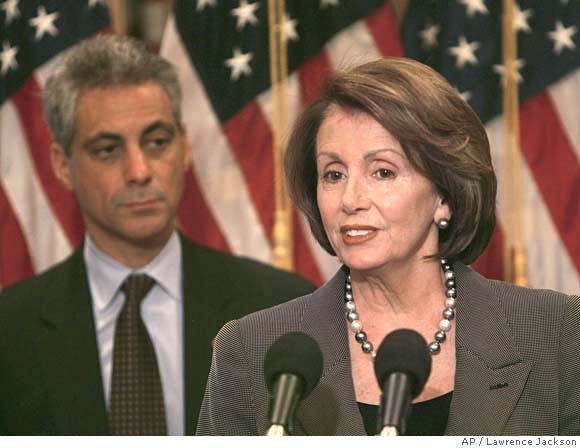
That House Speaker Nancy Pelosi has been a disappointing leader for House Democrats, few serious observers of the congressional condition will deny. But now, she appears to be something more troubling: a serious hindrance to the fight against the use of the crudest and most objectionable torture techniques.
Democrats and Republicans with a conscience have gotten a good deal of traction in recent months in their battle to identify the use by U.S. interrogators of waterboarding – a technique that simulates drowning in order to cause extreme mental distress to prisoners — as what it is: torture. Arizona Senator John McCain, a GOP presidential contender, has been particularly powerful in his denunciations of this barbarous endeavor. And Senate Intelligence Committee chair Jay Rockefeller, D-West Virginia, and key members of the Senate Judiciary Committee have effectively pressed the issue on a number of fronts.
Now, however, comes the news that Pelosi knew as early as 2002 that the U.S. was using waterboarding and other torture techniques and, far from objecting, appears to have cheered the tactics on.
The Washington Post reports that Pelosi, who was then a senior member of the House Intelligence Committee, was were informed by CIA officials at a secret briefing in September 2002, that waterboarding and other forms of torture were being used on suspected al-Queda operatives. That’s bad. Even worse is the revelation that Pelosi was apparently supportive of the initiative.
According to the news reports, Pelosi has no complaint about waterboarding during a closed-door session she attended with Florida Congressman Porter Goss, a Republican who would go on to head the Central Intelligence Agency, Kansas Republican Senator Pat Roberts and Florida Democratic Senator Bob Graham.
“The reaction in the room was not just approval, but encouragement,” recalls Goss.
How encouraging? It is reported that two of the legislators demanded to know if waterboarding and other methods that were being employed “were tough enough” forms of torture to produced the desired levels of mental anguish to force information from suspects who, under the Geneva Conventions and the U.S. Constitution, cannot be subjected to cruel or unusual punishment.
Was Pelosi one of the “tough-enough” cheerleaders for waterboarding? That is not clear, as the speaker has refused to comment directly regarding her knowledge of torture techniques and encouragement of their use. Another member of the House who is closely allied wit Pelosi did tell the Post, however, that the California Democrat attended the session, recalled that waterboarding was discussed, and “did not object” at the time to that particular torture technique.
If this is the case, Pelosi has provided aid and comfort to the Bush administration’s efforts to deviate not just from the standards set by international agreements regarding war crimes but from the provision of the Bill of Rights that establishes basic requirements with regard to the treatment of prisoners who in the custody of the United States.
Those deviations are precisely the sort of impeachable offenses that Pelosi has said are “off the table.” Her association with the administration on the matter of torture necessarily calls into question the speaker’s credibility on questions of how and when to hold the administration to account. It also begs a more mundane political question: At a point when Republicans like John McCain are earning points with their forthright stances against waterboarding, isn’t the credibility and the potential effectiveness of the House Democratic Caucus as an honest player in the debate profoundly harmed by the involvement of its leader in behind-the-scenes meetings that by all accounts encouraged the use of that technique?
 The New York Herald Sun