What We Should Learn from Jim Cramer vs. The Daily Show’s Jon Stewart

AIG, Bear Stearns, Ben Bernanke, Citibank, CNBC, Cramer+Stewart, Credit Default Swaps, Deep Capture, Derivatives, Dick Fuld, Gradient Analytics, Hedge Funds, Henry Paulson, Jim Cramer, Jon Stewart, Lehman Brothers, Maria Bartiromo, Mortgage Crisis, Overstock, Patrick Byrne

::What We Should Learn from Jim Cramer vs. the Daily Show’s Jon Stewart::

hp3

March 12th, 2009 by Patrick Byrne

What should we learn from the fact that “The Daily Show’s” Jon Stewart has in four evenings (1 2 3 and 4) exposed Jim Cramer in a way that, in any sane world, he would have been exposed a decade ago? To answer that, consider these associated facts: while the Jim Cramer constellation of journalists (Mitchell’s Media Mob) backed each other up while covering-up the subject of criminally abusive short selling by hedge funds to whom they were close, four channels of the media broke rank:

  1. Two years ago Bloomberg did a half-hour documentary that broke away from the Party Line;
  2. Liz Moyer at Forbes has covered the real issues fairly and diligently, and another Forbes reporter named Nathan Vardi took a good swipe at the story (”Sewer Pipes“);
  3. Rolling Out Magazine (”an UrbanStyle Weekly serving the African American community”) called me up a couple years ago and did precisely the fair, non-disorted interview of which the remainder of the New York financial media was entirely incapable;
  4. Now, “The Daily Show” has broken ranks by stating the obvious: there are journalists shilling for favored hedge funds.

Could the lesson be that the first news organizations that can break ranks with the Party Line are either fringe (”Rolling Out Magazine” and “The Daily Show”) or the properties of billionaires (Bloomberg and Forbes) who cannot be intimidated?

Perhaps someday, a journalist will look into the pressures that were brought on news organizations (e.g., on Bloomberg leading up to their running “Phantom Shares”). Just a few weeks ago I got the  story, again, from a journalist: “I was working on a story about naked short selling and Deep Capture. Then, suddenly I was stopped. It’s weird because I have been a journalist here for 9 years. I have built a great reputation with my editor, and have never had a story interfered with. But I got a couple months into this story, and suddenly I was stopped from above. I’ve never seen that happen before.” I replied, If you only knew how many times a journalist has said that to me in the last couple years….

Link

The Real Scandal That Will Bring Jim Cramer Down: The Story of Deep Capture

AIG, Bear Stearns, Ben Bernanke, Citibank, CNBC, Cramer+Stewart, Credit Default Swaps, Deep Capture, Derivatives, Dick Fuld, Gradient Analytics, Hedge Funds, Henry Paulson, Jim Cramer, Jon Stewart, Lehman Brothers, Maria Bartiromo, Mortgage Crisis, Overstock, Patrick Byrne

The Columbia School of Journalism is our nation’s finest. They grant the Pulitzer Prize, and their journal, The Columbia Journalism Review, is the profession’s gold standard. CJR reporters are high priests of a decaying temple, tending a flame in a land going dark.

dick-fuldIn 2006 a CJR editor (a seasoned journalist formerly with Time magazine in Asia, The Wall Street Journal Europe, and The Far Eastern Economic Review) called me to discuss suspicions he was forming about the US financial media. I gave him leads but warned, “Chasing this will take you down a rabbit hole with no bottom.” For months he pursued his story against pressure and threats he once described as, “something out of a Hollywood B movie, but unlike the movies, the evil corporations fighting the journalist are not thugs burying toxic waste, they are Wall Street and the financial media itself.”

His exposé reveals a circle of corruption enclosing venerable Wall Street banks, shady offshore financiers, and suspiciously compliant reporters at The Wall Street Journal, Fortune, CNBC, and The New York Times. If you ever wonder how reporters react when a journalist investigates them (answer: like white-collar crooks they dodge interviews, lie, and hide behind lawyers), or if financial corruption interests you, then this is for you. It makes Grisham read like a book of bedtime stories, and exposes a scandal that may make Enron look like an afternoon tea.

By Patrick M. Byrne

Deep Capture Reporter

Make a pot of strong coffee and read this incredible story

Unedited | Cramer Vs. Stewart | Part Three

AIG, Bear Stearns, Ben Bernanke, Citibank, CNBC, Cramer+Stewart, Credit Default Swaps, Deep Capture, Derivatives, Dick Fuld, Gradient Analytics, Hedge Funds, Henry Paulson, Jim Cramer, Jon Stewart, Lehman Brothers, Maria Bartiromo, Mortgage Crisis, Overstock, Patrick Byrne

Unedited | Cramer Vs. Stewart | Part Three

Vodpod videos no longer available.

Part Two | Cramer Vs. Stewart | Unedited

AIG, Bear Stearns, Ben Bernanke, Citibank, CNBC, Cramer+Stewart, Credit Default Swaps, Derivatives, Dick Fuld, Gradient Analytics, Hedge Funds, Henry Paulson, Jim Cramer, Jon Stewart, Lehman Brothers, Maria Bartiromo, Mortgage Crisis, Overstock, Patrick Byrne

Part Two | Cramer Vs. Stewart | Unedited

Vodpod videos no longer available.

Part One | Cramer Vs. Stewart | Unedited

AIG, Bear Stearns, Ben Bernanke, Citibank, CNBC, Cramer+Stewart, Credit Default Swaps, Derivatives, Dick Fuld, Gradient Analytics, Hedge Funds, Henry Paulson, Jim Cramer, Jon Stewart, Lehman Brothers, Maria Bartiromo, Mortgage Crisis, Overstock, Patrick Byrne

Part One | Cramer Vs. Stewart | Unedited

Vodpod videos no longer available.

Intro | Cramer Vs. Stewart | Unedited

AIG, Bear Stearns, Ben Bernanke, Citibank, CNBC, Cramer+Stewart, Credit Default Swaps, Deep Capture, Derivatives, Dick Fuld, Gradient Analytics, Hedge Funds, Henry Paulson, Jim Cramer, Jon Stewart, Lehman Brothers, Maria Bartiromo, Mortgage Crisis, Overstock, Patrick Byrne

Intro | Cramer Vs. Stewart | The Complete Interview -Unedited

Vodpod videos no longer available.

Propping Up a House of Cards

AIG, Bear Stearns, BofA, Citi, Credit Default Swaps, Derivatives, Financial Instruments, Lehman, Merrill
February 28, 2009
Talking Business

vegas

Next week, perhaps as early as Monday, the American International Group is going to report the largest quarterly loss in history. Rumors suggest it will be around $60 billion, which will affirm, yet again, A.I.G.’s sorry status as the most crippled of all the nation’s wounded financial institutions. The recent quarterly losses suffered by Merrill Lynch and Citigroup — “only” $15.4 billion and $8.3 billion, respectively — pale by comparison.

At the same time A.I.G. reveals its loss, the federal government is also likely to announce — yet again! — a new plan to save A.I.G., the third since September. So far the government has thrown $150 billion at the company, in loans, investments and equity injections, to keep it afloat. It has softened the terms it set for the original $85 billion loan it made back in September. To ease the pressure even more, the Federal Reserve actually runs a facility that buys toxic assets that A.I.G. had insured. A.I.G. effectively has been nationalized, with the government owning a hair under 80 percent of the stock. Not that it’s worth very much; A.I.G. shares closed Friday at 42 cents.

Donn Vickrey, who runs the independent research firm Gradient Analytics, predicts that A.I.G. is going to cost taxpayers at least $100 billion more before it finally stabilizes, by which time the company will almost surely have been broken into pieces, with the government owning large chunks of it. A quarter of a trillion dollars, if it comes to that, is an astounding amount of money to hand over to one company to prevent it from going bust. Yet the government feels it has no choice: because of A.I.G.’s dubious business practices during the housing bubble it pretty much has the world’s financial system by the throat.

If we let A.I.G. fail, said Seamus P. McMahon, a banking expert at Booz & Company, other institutions, including pension funds and American and European banks “will face their own capital and liquidity crisis, and we could have a domino effect.” A bailout of A.I.G. is really a bailout of its trading partners — which essentially constitutes the entire Western banking system.

I don’t doubt this bit of conventional wisdom; after the calamity that followed the fall of Lehman Brothers, which was far less enmeshed in the global financial system than A.I.G., who would dare allow the world’s biggest insurer to fail? Who would want to take that risk? But that doesn’t mean we should feel resigned about what is happening at A.I.G. In fact, we should be furious. More than even Citi or Merrill, A.I.G. is ground zero for the practices that led the financial system to ruin.

“They were the worst of them all,” said Frank Partnoy, a law professor at the University of San Diego and a derivatives expert. Mr. Vickrey of Gradient Analytics said, “It was extreme hubris, fueled by greed.” Other firms used many of the same shady techniques as A.I.G., but none did them on such a broad scale and with such utter recklessness. And yet — and this is the part that should make your blood boil — the company is being kept alive precisely because it behaved so badly.

When you start asking around about how A.I.G. made money during the housing bubble, you hear the same two phrases again and again: “regulatory arbitrage” and “ratings arbitrage.” The word “arbitrage” usually means taking advantage of a price differential between two securities — a bond and stock of the same company, for instance — that are related in some way. When the word is used to describe A.I.G.’s actions, however, it means something entirely different. It means taking advantage of a loophole in the rules. A less polite but perhaps more accurate term would be “scam.”

As a huge multinational insurance company, with a storied history and a reputation for being extremely well run, A.I.G. had one of the most precious prizes in all of business: an AAA rating, held by no more than a dozen or so companies in the United States. That meant ratings agencies believed its chance of defaulting was just about zero. It also meant it could borrow more cheaply than other companies with lower ratings.

To be sure, most of A.I.G. operated the way it always had, like a normal, regulated insurance company. (Its insurance divisions remain profitable today.) But one division, its “financial practices” unit in London, was filled with go-go financial wizards who devised new and clever ways of taking advantage of Wall Street’s insatiable appetite for mortgage-backed securities. Unlike many of the Wall Street investment banks, A.I.G. didn’t specialize in pooling subprime mortgages into securities. Instead, it sold credit-default swaps.

These exotic instruments acted as a form of insurance for the securities. In effect, A.I.G. was saying if, by some remote chance (ha!) those mortgage-backed securities suffered losses, the company would be on the hook for the losses. And because A.I.G. had that AAA rating, when it sprinkled its holy water over those mortgage-backed securities, suddenly they had AAA ratings too. That was the ratings arbitrage. “It was a way to exploit the triple A rating,” said Robert J. Arvanitis, a former A.I.G. executive who has since become a leading A.I.G. critic.

Why would Wall Street and the banks go for this? Because it shifted the risk of default from themselves to A.I.G., and the AAA rating made the securities much easier to market. What was in it for A.I.G.? Lucrative fees, naturally. But it also saw the fees as risk-free money; surely it would never have to actually pay up. Like everyone else on Wall Street, A.I.G. operated on the belief that the underlying assets — housing — could only go up in price.

That foolhardy belief, in turn, led A.I.G. to commit several other stupid mistakes. When a company insures against, say, floods or earthquakes, it has to put money in reserve in case a flood happens. That’s why, as a rule, insurance companies are usually overcapitalized, with low debt ratios. But because credit-default swaps were not regulated, and were not even categorized as a traditional insurance product, A.I.G. didn’t have to put anything aside for losses. And it didn’t. Its leverage was more akin to an investment bank than an insurance company. So when housing prices started falling, and losses started piling up, it had no way to pay them off. Not understanding the real risk, the company grievously mispriced it.

Second, in many of its derivative contracts, A.I.G. included a provision that has since come back to haunt it. It agreed to something called “collateral triggers,” meaning that if certain events took place, like a ratings downgrade for either A.I.G. or the securities it was insuring, it would have to put up collateral against those securities. Again, the reasons it agreed to the collateral triggers was pure greed: it could get higher fees by including them. And again, it assumed that the triggers would never actually kick in and the provisions were therefore meaningless. Those collateral triggers have since cost A.I.G. many, many billions of dollars. Or, rather, they’ve cost American taxpayers billions.

The regulatory arbitrage was even seamier. A huge part of the company’s credit-default swap business was devised, quite simply, to allow banks to make their balance sheets look safer than they really were. Under a misguided set of international rules that took hold toward the end of the 1990s, banks were allowed use their own internal risk measurements to set their capital requirements. The less risky the assets, obviously, the lower the regulatory capital requirement.

How did banks get their risk measures low? It certainly wasn’t by owning less risky assets. Instead, they simply bought A.I.G.’s credit-default swaps. The swaps meant that the risk of loss was transferred to A.I.G., and the collateral triggers made the bank portfolios look absolutely risk-free. Which meant minimal capital requirements, which the banks all wanted so they could increase their leverage and buy yet more “risk-free” assets. This practice became especially rampant in Europe. That lack of capital is one of the reasons the European banks have been in such trouble since the crisis began.

At its peak, the A.I.G. credit-default business had a “notional value” of $450 billion, and as recently as September, it was still over $300 billion. (Notional value is the amount A.I.G. would owe if every one of its bets went to zero.) And unlike most Wall Street firms, it didn’t hedge its credit-default swaps; it bore the risk, which is what insurance companies do.

It’s not as if this was some Enron-esque secret, either. Everybody knew the capital requirements were being gamed, including the regulators. Indeed, A.I.G. openly labeled that part of the business as “regulatory capital.” That is how they, and their customers, thought of it.

There’s more, believe it or not. A.I.G. sold something called 2a-7 puts, which allowed money market funds to invest in risky bonds even though they are supposed to be holding only the safest commercial paper. How could they do this? A.I.G. agreed to buy back the bonds if they went bad. (Incredibly, the Securities and Exchange Commission went along with this.) A.I.G. had a securities lending program, in which it would lend securities to investors, like short-sellers, in return for cash collateral. What did it do with the money it received? Incredibly, it bought mortgage-backed securities. When the firms wanted their collateral back, it had sunk in value, thanks to A.I.G.’s foolish investment strategy. The practice has cost A.I.G. — oops, I mean American taxpayers — billions.

Here’s what is most infuriating: Here we are now, fully aware of how these scams worked. Yet for all practical purposes, the government has to keep them going. Indeed, that may be the single most important reason it can’t let A.I.G. fail. If the company defaulted, hundreds of billions of dollars’ worth of credit-default swaps would “blow up,” and all those European banks whose toxic assets are supposedly insured by A.I.G. would suddenly be sitting on immense losses. Their already shaky capital structures would be destroyed. A.I.G. helped create the illusion of regulatory capital with its swaps, and now the government has to actually back up those contracts with taxpayer money to keep the banks from collapsing. It would be funny if it weren’t so awful.

I asked Mr. Arvanitis, the former A.I.G. executive, if the company viewed what it had done during the bubble as a form of gaming the system. “Oh no,” he said, “they never thought of it as abuse. They thought of themselves as satisfying their customers.”

That’s either a remarkable example of the power of rationalization, or they were lying to themselves, figuring that when the house of cards finally fell, somebody else would have to clean it up.

That would be us, the taxpayers.
Bank of America Throws Ten Million Dollar Super Bowl Party

AIG, Bank of america, Banking, Bear Stearns, CDS, Citibank, Derivatives, Finance, Hedge Funds, Merrill, Sports Business

T H I N K  P R O G R E S S

news

Just weeks ago, the federal government extended $20 billion to Bank of America to keep it afloat, bringing its total in federal bailout dollars received to $45 billion. ABC News reports, however, that the bank managed to scrounge up millions of dollars to be an NFL sponsor and for “a five day carnival-like” Super Bowl party just outside the stadium:

The event — known as the NFL Experience — was 850,000 square feet of sports games and interactive entertainment attractions for football fans and was blanketed in Bank of America logos and marketing calls to sign up for football-themed banking products. […]

The bank refused to tell ABC News how much it is spending as an NFL corporate sponsor, but insiders have put the figure at close to $10 million. The NFL Experience was on top of that and was inked last summer, according to the bank.

The NFL said it was a “multi-million dollar” event and that it was also spending money to put on the event. A Super Bowl insider said the tents alone cost over $800,000.

The Huffington Post notes that this is the latest in a series of bailed-out banks that continue to spend lavishly on sports sponsorships.

Wall Street Bonuses Are Same As 2004

AIG, Banking, Bear Stearns, CDS, Citi, Executive Pay, Finance, Merrill, Wall Street, Wall Street bailout
January 29, 2009

What Red Ink? Wall Street Paid Hefty Bonuses

Wall Street ArrestBy almost any measure, 2008 was a complete disaster for Wall Street — except, that is, when the bonuses arrived.
Despite crippling losses, multibillion-dollar bailouts and the passing of some of the most prominent names in the business, employees at financial companies in New York, the now-diminished world capital of capital, collected an estimated $18.4 billion in bonuses for the year.

That was the sixth-largest haul on record, according to a report released Wednesday by the New York State comptroller.

While the payouts paled next to the riches of recent years, Wall Street workers still took home about as much as they did in 2004, when the Dow Jones industrial average was flying above 10,000, on its way to a record high.

Some bankers took home millions last year even as their employers lost billions.

The comptroller’s estimate, a closely watched guidepost of the annual December-January bonus season, is based largely on personal income tax collections. It excludes stock option awards that could push the figures even higher.

The state comptroller, Thomas P. DiNapoli, said it was unclear if banks had used taxpayer money for the bonuses, a possibility that strikes corporate governance experts, and indeed many ordinary Americans, as outrageous. He urged the Obama administration to examine the issue closely.

“The issue of transparency is a significant one, and there needs to be an accounting about whether there was any taxpayer money used to pay bonuses or to pay for corporate jets or dividends or anything else,” Mr. DiNapoli said in an interview.

Granted, New York’s bankers and brokers are far poorer than they were in 2006, when record deals, and the record profits they generated, ushered in an era of Wall Street hyperwealth. All told, bonuses fell 44 percent last year, from $32.9 billion in 2007, the largest decline in dollar terms on record.

But the size of that downturn partly reflected the lofty heights to which bonuses had soared during the bull market. At many banks, those payouts were based on profits that turned out to be ephemeral. Throughout the financial industry, years of earnings have vanished in the flames of the credit crisis.

According to Mr. DiNapoli, the brokerage units of New York financial companies lost more than $35 billion in 2008, triple their losses in 2007. The pain is unlikely to end there, and Wall Street is betting that the Obama administration will move swiftly to buy some of banks’ troubled assets to encourage reluctant banks to make loans.

Many corporate governance experts, investors and lawmakers question why financial companies that have accepted taxpayer money paid any bonuses at all. Financial industry executives argue that they need to pay their best workers well in order to keep them, but with many banks cutting jobs, job options are dwindling, even for stars.

Lucian A. Bebchuk, a professor at Harvard Law School and expert on executive compensation, called the 2008 bonus figure “disconcerting.” Bonuses, he said, are meant to reward good performance and retain employees. But Wall Street disbursed billions despite staggering losses and a shrinking job market.

“This was neither the sixth-best year in terms of aggregate profits, nor was it the sixth-most-difficult year in terms of retaining employees,” Professor Bebchuk said.

Echoing Mr. DiNapoli, Professor Bebchuk said he was concerned that banks might be using taxpayer money to subsidize bonuses or dividends to stockholders. “What the government has been trying to do is shore up capital, and any diversion of capital out of banks, whether in the form of dividends or large payments to employees, really undermines what we are trying to do,” he said.

Jesse M. Brill, a lawyer and expert on executive compensation, said government bailout programs like the Troubled Asset Relief Program, or TARP, should be made more transparent.

“We are all flying in the dark,” Mr. Brill said. “Companies can simply say they are trying to do their best to comply with compensation limits without providing any of the details that the public is entitled to.”

Bonuses paid by one troubled Wall Street firm, Merrill Lynch, have come under particular scrutiny during the last week.

Andrew M. Cuomo, the New York attorney general, has issued subpoenas to John A. Thain, Merrill’s former chief executive, and to an executive at Bank of America, which recently acquired Merrill, asking for information about Merrill’s decision to pay $4 billion to $5 billion in bonuses despite new, gaping losses that forced Bank of America to seek a second financial lifeline from Washington.

A Treasury Department official said that in the coming weeks, the department would take action to further ensure taxpayer money is not used to pay bonuses.

Even though Wall Street spent billions on bonuses, New York firms squeezed rank-and-file executives harder than many companies in other fields. Outside the financial industry, many corporate executives received fatter bonuses in 2008, even as the economy lost 2.6 million jobs. According to data from Equilar, a compensation research firm, the average performance-based bonuses for top executives, other than the chief executive, at 132 companies with revenues of more than $1 billion increased by 14 percent, to $265,594, in the 2008 fiscal year.

For New York State and New York City, however, the leaner times on Wall Street will hurt, Mr. DiNapoli said.

Mr. DiNapoli said the average Wall Street bonus declined 36.7 percent, to $112,000. That is smaller than the overall 44 percent decline because the money was spread among a smaller pool following thousands of job losses.

The comptroller said the reduction in bonuses would cost New York State nearly $1 billion in income tax revenue and cost New York City $275 million.

On Wall Street, where money is the ultimate measure, some employees apparently feel slighted by their diminished bonuses. A poll of 900 financial industry employees released on Wednesday by eFinancialCareers.com, a job search Web site, found that while nearly eight out of 10 got bonuses, 46 percent thought they deserved more.

Paul J. Sullivan contributed reporting.

The 20 Senators Who Voted For Wall Street Bailout But Against Auto Industry Rescue

AIG, bailout, Bear Stearns, Ben Bernanke, Biden, Citi, Congress, Credit Default Swaps, D.C. Lobbyists, Detroit, District Of Corruption, Douchebaggery, Federal Reserve, Greenspan, Hank Paulson, Hedge Funds, Kerry. Auto Industry, Lehman, Merrill, Summers, Tim Geitner, Treasury, Wall Street

THINK PROGRESS DEC 12, 2008

artmaryschapirosecgi1

Last night, the Senate failed to approve the auto rescue package, voting 52-35 in favor of proceeding on the bill — just eight short of the 60 votes that were needed. Over on the Wonk Room, Dan Weiss takes a look at the 20 senators who voted for the Wall Street bailout but voted against the auto rescue last night (as well as the 10 others who skipped the vote last night, but voted for the financial bailout):

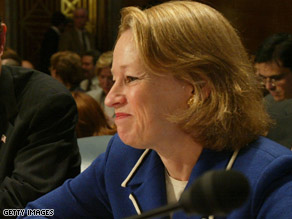
New SEC Chief Mary Schapiro/Getty

Yes to TARP, No to auto Yes to TARP, Absent for auto
Sen. Max Baucus (D-MT)
Sen. Robert Bennett (R-UT)
Sen. Richard Burr (R-NC)
Sen. Saxby Chambliss (R-GA)
Sen. Tom Coburn (R-OK)
Sen. Norm Coleman (R-MN)
Sen. Bob Corker (R-TN)
Sen. John Ensign (R-NV)
Sen. Chuck Grassley (R-IA)
Sen. Judd Gregg (R-NH)
Sen. Orrin Hatch (R-UT)
Sen. Kay Hutchison (R-TX)
Sen. John Isakson (R-GA)
Sen. Jon Kyl (R-AZ)
Sen. Blanche Lincoln (D-AR)
Sen. Mel Martinez (R-FL)
Sen. John McCain (R-AZ)
Sen. Mitch McConnell (R-KY)
Sen. Lisa Murkowski (R-AK)
Sen. John Thune (R-SD)
Sen. Lamar Alexander (R-TN)
Sen. Joe Biden (D-DE)
Sen. John Cornyn (R-TX)
Sen. Larry Craig (R-ID)
Sen. Lindsey Graham (R-SC)
Sen. Chuck Hagel (R-NE)
Sen. John Kerry (D-MA)
Sen. Gordon Smith (R-OR)
Sen.Ted Stevens (R-AK)
Sen. John Sununu (R-NH)

Biden was tending to transition duties, while Kerry was in Poznan, Poland, participating in U.N. climate change talks. Alexander was home recovering from surgery. Why did these other Senators feel auto workers weren’t as deserving as Wall Street? We’d like to know. If you see statements from them, please let us know by email or in the comments section.

UpdateSen. Jim Bunning (R-KY), a Hall of Fame baseball pitcher in his heyday, was scheduled to appear Sunday at a sports card show in Taylor, Michigan to sign autographs. “But Bunning was kicked off the schedule after he helped derail an auto-industry loan package in the Senate Thursday night.” (HT: TP commenter cali)