The Official Failures of Rebuilding Iraq

Bechtel, Blackwater, CACI, Commission on Wartime Contracting, Congress, Dick Cheney, DOD, Erik Prince, George W. Bush, Halliburton, Irag, Iraqi Infrastructure, KBR, Lobbyists, Pentagon, Senate, Stuart Bowen Jr., Water
Official history details failures of rebuilding Iraq
Sunday, December 14, 2008
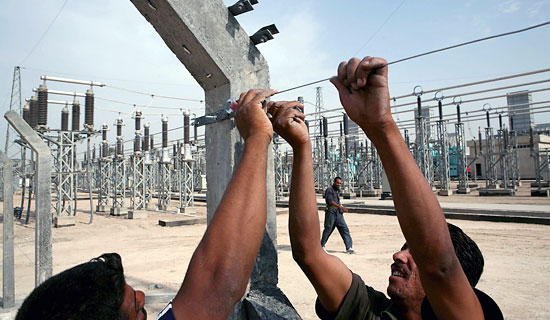
14iraq550

BAGHDAD: An unpublished, 513-page federal history of the U.S.-led reconstruction of Iraq depicts an effort crippled before the invasion by Pentagon planners who were hostile to the idea of rebuilding a foreign country, and then molded into a $100 billion failure by bureaucratic turf wars, spiraling violence and ignorance of the basic elements of Iraqi society and infrastructure.

“Hard Lessons: The Iraq Reconstruction Experience,” the first official account of its kind, is circulating in draft form here and in Washington among a tight circle of technical reviewers, policy experts and senior officials. It also concludes that when the reconstruction began to lag – particularly in the critical area of rebuilding the Iraqi police and army – the Pentagon simply put out inflated measures of progress to cover up the failures.

In one passage, for example, former Secretary of State Colin Powell is quoted as saying that in the months after the 2003 invasion, the Defense Department “kept inventing numbers of Iraqi security forces – the number would jump 20,000 a week! ‘We now have 80,000, we now have 100,000, we now have 120,000.”‘

Powell’s assertion that the Pentagon inflated the number of competent Iraqi security forces is backed up by Lieutenant General Ricardo Sanchez, the former commander of ground troops in Iraq, and L. Paul Bremer 3rd, the top civilian administrator until an Iraqi government took over in June 2004.

Among the overarching conclusions of the history is that five years after embarking on its largest foreign reconstruction project since the Marshall Plan in Europe after World War II, the U.S. government has in place neither the policies and technical capacity nor the organizational structure that would be needed to undertake such a program on anything approaching this scale.

The bitterest message of all for the reconstruction program may be the way the history ends. The hard figures on basic services and industrial production compiled for the report reveal that for all the money spent and promises made, the rebuilding effort never did much more than restore what was destroyed during the invasion and the convulsive looting that followed.

By mid-2008, the history says, $117 billion had been spent on the reconstruction of Iraq, including some $50 billion in U.S. taxpayer money.

The history contains a catalog of new revelations that show the chaotic and often poisonous atmosphere prevailing in the reconstruction effort.

When the Office of Management and Budget balked at the U.S. occupation authority’s abrupt request for about $20 billion in new reconstruction money in August 2003, a veteran Republican lobbyist working for the authority made a bluntly partisan appeal to Joshua Bolten, then the Office of Management and Budget director and now the White House chief of staff. “To delay getting our funds would be a political disaster for the President,” wrote the lobbyist, Tom Korologos. “His election will hang for a large part on show of progress in Iraq and without the funding this year, progress will grind to a halt.” With administration backing, Congress allocated the money later that year.

In an illustration of the hasty and haphazard planning, a civilian official at the U.S. Agency for International Development was at one point given four hours to determine how many miles of Iraqi roads would need to be reopened and repaired. The official searched through the agency’s reference library, and his estimate went directly into a master plan. Whatever the quality of the agency’s plan, it eventually began running what amounted to a parallel reconstruction effort in the provinces that had little relation with the rest of the U.S. effort.

Money for many of the local construction projects still under way is divided up by a spoils system controlled by neighborhood politicians and tribal chiefs. “Our district council chairman has become the Tony Soprano of Rasheed, in terms of controlling resources,” said a U.S. Embassy official working in a dangerous Baghdad neighborhood, referring to the popular TV mob boss. “‘You will use my contractor or the work will not get done.”‘

The United States could soon have reason to consult this cautionary tale of deception, waste and poor planning, as both troop levels and reconstruction efforts in Afghanistan are likely to be stepped up under the new administration.

The incoming Obama administration’s rebuilding experts are expected to focus on smaller-scale projects and emphasize political and economic reform. Still, such programs do not address one of the history’s main contentions: that the reconstruction effort has failed because no single agency in the U.S. government has responsibility for the job.

Five years after the invasion of Iraq, the history concludes, “the government as a whole has never developed a legislatively sanctioned doctrine or framework for planning, preparing and executing contingency operations in which diplomacy, development and military action all figure.”

“Hard Lessons” was compiled by the Office of the Special Inspector General for Iraq Reconstruction, led by Stuart Bowen Jr., a Republican lawyer who regularly travels to Iraq and has a staff of engineers and auditors based here. Copies of several drafts of the history were provided to reporters at The New York Times and ProPublica by two people outside the inspector general’s office who have read the draft but are not authorized to comment publicly.

Bowen’s deputy, Ginger Cruz, declined to comment for publication on the substance of the history. But she said it would be presented Feb. 2 at the first hearing of the Commission on Wartime Contracting, which was created this year as a result of legislation sponsored by Senators Jim Webb of Virginia and Claire McCaskill of Missouri, both Democrats.

The manuscript is based on about 500 new interviews, as well as more than 600 audits, inspections and investigations on which Bowen’s office has reported individually over the years. Laid out for the first time in a connected history, the material forms the basis for broad judgments on the entire rebuilding program.

In the preface, Bowen gives a searing critique of what he calls the “blinkered and disjointed prewar planning for Iraq’s reconstruction” and the botched expansion of the program from a modest initiative to improve Iraqi services to a multibillion-dollar enterprise.

Bowen also swipes at the endless revisions and reversals of the program, which at various times gyrated from a focus on giant construction projects led by large Western contractors to modest community-based initiatives carried out by local Iraqis. While Bowen concedes that deteriorating security had a hand in spoiling the program’s hopes, he suggests, as he has in the past, that the program did not need much outside help to do itself in.

Despite years of studying the program, Bowen writes that he still has not found a good answer to the question of why the program was even pursued as soaring violence made it untenable. “Others will have to provide that answer,” Bowen writes.

“But beyond the security issue stands another compelling and unavoidable answer: The U.S. government was not adequately prepared to carry out the reconstruction mission it took on in mid-2003,” he concludes.

The history cites some projects as successes. The review praises community outreach efforts by the Agency for International Development, the Treasury Department’s plan to stabilize the Iraqi dinar after the invasion and a joint effort by the Departments of State and Defense to create local rebuilding teams.

But the portrait that emerges overall is one of a program’s officials operating by the seat of their pants in the middle of a critical enterprise abroad, where the reconstruction was supposed to convince the Iraqi citizenry of U.S. good will and support the new democracy with lights that turned on and taps that flowed with clean water. Mostly, it is a portrait of a program that seemed to grow exponentially as even those involved from the inception of the effort watched in surprise.

On the eve of the invasion, as it began to dawn on a few U.S. officials that the price for rebuilding Iraq would be vastly greater than they had been told, the degree of miscalculation was illustrated in an encounter between Donald Rumsfeld, then the defense secretary, and Jay Garner, the retired lieutenant general who had hastily been named the chief of what would be a short-lived civilian authority called the Office of Reconstruction and Humanitarian Assistance.

The history records how Garner presented Rumsfeld with several alternative rebuilding plans, including one that would include projects across Iraq.

“What do you think that’ll cost?” Rumsfeld asked of the more expansive plan.

“I think it’s going to cost billions of dollars,” Garner said.

“My friend,” Rumsfeld replied, “if you think we’re going to spend a billion dollars of our money over there, you are sadly mistaken.”

In a way he never anticipated, Rumsfeld turned out to be correct: Before that year was out, the United States had appropriated more than $20 billion for the reconstruction, which would indeed involve projects across the entire country.

Rumsfeld declined comment on the report, but a spokesman, Keith Urbahn, said quotes attributed to him in the document “appear to be accurate.” Powell also declined to comment.

The secondary effects of the invasion and its aftermath were among the most important factors that radically changed the outlook. Tables in the history show that measures of things like the production of electricity and oil; public access to potable water, mobile and landline telephone service; and the presence of Iraqi security forces all plummeted at least 70 percent, and in some cases all the way to zero, in the weeks after the invasion. Subsequent tables in the history give a fast-forward view of what happened as the avalanche of money tumbled into Iraq over the next five years. By the time a sovereign Iraqi government took over from the Americans in June 2004, none of those services – with a single exception, mobile phones – had returned to prewar levels. And by the time of the security improvements in 2007 and 2008, electricity output had, at best, a precarious 10 percent lead on its levels under Saddam Hussein; oil production was still below prewar levels; and access to potable water had increased about 30 percent, although with the nation’s ruined piping system it was unclear how much actually reached people’s homes uncontaminated.

Whether the rebuilding effort could have succeeded in a less violent setting will never be known. In April 2004, thousands of the Iraqi security forces that had been oversold by the Pentagon were overrun, abruptly mutinied or simply abandoned their posts as the insurgency broke out, sending Iraq down a violent path from which it has never completely recovered.

At the end of his narrative, Bowen chooses a line from “Great Expectations” by Charles Dickens as the epitaph of the U.S.-led attempt to rebuild Iraq: “We spent as much money as we could, and got as little for it as people could make up their minds to give us.”

James Glanz reported from Baghdad, and T. Christian Miller, of the nonprofit investigative Web site ProPublica, reported from Washington.

Guess What? That Whole "Limit on Executive Pay" Thingy in Bailout is Bunk

401k, AIG, bailout, Banking, Bankruptcy, Barack Obama, Barney Frank, Bear Stearns, Bernanke, Bernie Madoff, Citi, Congress, Corporate Greed, D.C., Executive Pay, Lehman, Merrill, Morgan Stanley, Mortgage Backed Securities, U.S. Congress, U.S. Senate, U.S. Treasury, Wall Street

Executive Pay Limits May Prove Toothless
Loophole in Bailout Provision Leaves Enforcement in Doubt

By Amit R. Paley
Washington Post Staff Writer
Monday, December 15, 2008; A01

248_4890

Congress wanted to guarantee that the $700 billion financial bailout would limit the eye-popping pay of Wall Street executives, so lawmakers included a mechanism for reviewing executive compensation and penalizing firms that break the rules.

But at the last minute, the Bush administration insisted on a one-sentence change to the provision, congressional aides said. The change stipulated that the penalty would apply only to firms that received bailout funds by selling troubled assets to the government in an auction, which was the way the Treasury Department had said it planned to use the money.

Now, however, the small change looks more like a giant loophole, according to lawmakers and legal experts. In a reversal, the Bush administration has not used auctions for any of the $335 billion committed so far from the rescue package, nor does it plan to use them in the future. Lawmakers and legal experts say the change has effectively repealed the only enforcement mechanism in the law dealing with lavish pay for top executives.

“The flimsy executive-compensation restrictions in the original bill are now all but gone,” said Sen. Charles E. Grassley (Iowa), ranking Republican on of the Senate Finance Committee.

The modification reflects how the rapidly shifting nature of the crisis and the government’s response to it have led to unexpected results that are just now beginning to be understood. The Government Accountability Office, the investigative arm of Congress, issued a critical report this month about the financial industry rescue package that said it was unclear how the Treasury would determine whether banks were following the executive-compensation rules.

Michele A. Davis, spokeswoman for the Treasury, said the agency is working to develop a policy for how it will enforce the executive-compensation rules. She would not say when the guidance would be issued or what penalties it might impose. But she said the companies promised to follow the rules in contracts with the department.

The final legislation contained unprecedented restrictions on executive compensation for firms accepting money from the bailout fund. The rules limited incentives that encourage top executives to take excessive risks, provided for the recovery of bonuses based on earnings that never materialize and prohibited “golden parachute” severance pay. But several analysts said that perhaps the most effective provision was the ban on companies deducting more than $500,000 a year from their taxable income for compensation paid to their top five executives.

That tax provision, which amended the Internal Revenue Code, was the only part of the law that contained an explicit enforcement mechanism. The provision means the IRS must review the pay of those executives as part of its normal review of tax filings. If a company does not comply, the IRS can impose a tax penalty. The law did not create an enforcement mechanism for reviewing the other restrictions on executive pay.

If a firm violates the executive-compensation limits, department officials said, the Treasury could seek damages, go to court to force compliance, or even rescind the contracts and recover the bailout money. “We therefore have all the remedies available to us for a breach of contract,” Davis wrote in an e-mail.

Legal experts said those efforts could be complicated if the Treasury outlines the penalties after companies have received bailout money. David M. Lynn, former chief counsel of the Securities and Exchange Commission‘s division of corporation finance, said courts have sometimes placed limits on the government’s ability to impose penalties if there was no fair warning.

“Treasury might find its hands tied down the road,” said Lynn, who is also co-author of “The Executive Compensation Disclosure Treatise and Reporting Guide.”

Congressional leaders are also concerned that the Treasury might simply choose not to enforce the rules or be unwilling to impose financial penalties that could further weaken a firm and send the economy deeper into a tailspin.

The Bush administration at first opposed any restrictions on executive pay, congressional aides said. The original three-page bailout proposal presented to lawmakers in September contained no mention of such limits. “Treasury was pretty clear that they thought doing this exec-comp stuff would limit the effectiveness of the program,” said a Democratic congressional aide involved in the negotiations, who, like others interviewed for this story, spoke on condition of anonymity. “They felt companies might not take part if we put in these rules.”

Congressional leaders disagreed. By the morning of Saturday, Sept. 27, the final day of marathon negotiations on the bill, draft language relating to taxes and containing the enforcement provision applied to all companies participating in the bailout programs, Democratic and Republican congressional aides said. But then Treasury Secretary Henry M. Paulson Jr. and his deputies began pushing for the compensation rules to differentiate between companies whose assets are purchased at auction and those whose assets or equity are purchased directly by the government, the aides said.

Congressional leaders from both parties thought Paulson wanted the distinction for extraordinary cases like American International Group, which the government seized in September. He wanted to be able to push executives out of companies that the government controlled and have the flexibility to bring in strong new executives, said one senior congressional aide.

“The argument that they were making at the time is that the direct investment was going to be used only in circumstances where the company was AIGed, so to speak,” said a senior Democratic congressional aide.

Davis, the Treasury spokeswoman, confirmed that the Treasury pushed to place fewer restrictions on executives at companies receiving capital infusions, but she gave a different explanation. She said many of those firms are more stable and are being encouraged to participate in the bailout to strengthen the overall system. “The provisions for failing institutions should come with more onerous conditions than those for healthy institutions whose participation benefits the entire system,” she said.

Lawmakers agreed to the Treasury’s request that the measure apply only to executives at companies whose assets were bought by the government through auctions. In the executive-compensation tax section, a new sentence saying that eventually was inserted.

Meanwhile, Paulson repeatedly told lawmakers that he did not plan to use bailout funds to inject capital directly into financial institutions. Privately, however, his staff was developing plans to do just that, Paulson acknowledged in an interview.

Although lawmakers hailed the rules as unprecedented new limits on executive pay, several were unhappy that the law was not stricter.

Under pressure from Congress, the Treasury issued regulations in October on executive compensation and applied the tax-deduction limits to all companies receiving bailout funds, although the legislation did not require it for firms that received direct capital injections. But the Treasury failed to issue guidelines requiring the IRS or any other agency to enforce the rules, and it also failed to explain how the restrictions would be enforced.

The Treasury’s regulations also instructed firms to disclose more compensation information to the Securities and Exchange Commission. But officials at the SEC do not think they have the authority to force companies to disclose the kind of pay information required by the bailout law, according to people familiar with the matter, though they hope companies will cooperate. John Nester, an SEC spokesman, declined to comment.

Senators on the Finance Committee have expressed concern to Paulson and are now considering whether they should amend the law to apply the enforcement mechanism to all firms participating in the bailout.

The Nationalization of the Auto Industry?

Auto Industry, Big Three, Congress, Nationalization, Senate
International Herald Tribune
Taking risks with bailout for U.S. automakers
Tuesday, December 9, 2008

WASHINGTON: When President-elect Barack Obama talked on Sunday about realigning the American automobile industry he was quick to offer a caution, lest he sound more like the incoming leader of France, or perhaps Japan.

“We don’t want government to run companies,” Obama told Tom Brokaw on “Meet the Press.” “Generally, government historically hasn’t done that very well.”

09auto550

But what Obama went on to describe was a long-term government bailout that would be conditioned on government oversight. It could mean that the government would mandate, or at least heavily influence, what kind of cars companies make, what mileage and environmental standards they must meet and what large investments they are permitted to make — to recreate an industry that Obama said “actually works, that actually functions.”

It all sounds perilously close to a word that no one in Obama’s camp wants to be caught uttering: nationalization.

Not since Harry Truman seized America’s steel mills in 1952 rather than allow a strike to imperil the conduct of the Korean War has Washington toyed with nationalization, or its functional equivalent, on this kind of scale. Obama may be thinking what Truman told his staff: “The president has the power to keep the country from going to hell.” (The Supreme Court thought differently and forced Truman to relinquish control.)

The fact that there is so little protest in the air now — certainly less than Truman heard — reflects the desperation of the moment. But it is a strategy fraught with risks.

The first, of course, is the one the president-elect himself highlighted. Government’s record as a corporate manager is miserable, which is why the world has been on a three-decade-long privatization kick, turning national railroads, national airlines and national defense industries into private companies.

The second risk is that if the effort fails, and the American car companies collapse or are auctioned off in pieces to foreign competitors, taxpayers may lose the billions about to be spent.

And the third risk — one barely discussed so far — is that in trying to save the nation’s carmakers, the United States is violating at least the spirit of what it has preached around the world for two decades. The United States has demanded that nations treat American companies on their soil the same way they treat their home-grown industries, a concept called “national treatment.”

Yet so far, there is no talk of offering aid to Toyota, Honda, BMW or the other foreign automakers that have built factories on American soil, employed American workers and managed to make a profit doing so.

“If Japan was doing this, we’d be threatening billions of dollars in retaliation,” said Jeffrey Garten, a professor at the Yale School of Management, who as under secretary of commerce in the 1990s was one of many government officials who tried in vain to get Detroit prepared for a world of international competition. “In fact, when they did something a lot more subtle, we threatened exactly that,” referring to calls for import restrictions.

Garten said he was stunned by the scope of the intervention that Washington was now considering. “I don’t know that we’ve seen anything like this since the government told the automakers what kind of tanks to make during World War II,” he said. “And that was just for the duration of the war — this could be for much, much longer.”

It is hard to measure just what kind of chances Obama may be taking with this plan, in part because so many parts of it are still in motion.

In the short term, Democrats are floating the idea of linking $15 billion in immediate loans to the designation of a “car czar” who, in doling out the money, could require or veto big transactions or investments — essentially a one-man board of directors. The White House indicates that President George W. Bush, who has spent his entire presidency proclaiming that the government’s role is to create an environment that spurs free enterprise and minimizes government regulation, would very likely sign the rescue plan.

The first $15 billion and the car czar who oversees it, however, are only the beginning. “After that, we’re in uncharted water,” said Malcolm Salter, a professor emeritus at Harvard Business School who has studied the auto industry for two decades and, until a few years ago, was an adviser to General Motors and Ford. “Think about this: Who in the federal government would have the tremendous insight needed to fix this industry?”

Depending on how the longer-term revamping of the industry proceeds, Washington could become a major shareholder in the Big Three, it could provide loans, or, in one course that Obama seemed to hint at on Sunday, it could organize what amounts to a “structured bankruptcy.” In that case, the government would convene the creditors, the unions, the shareholders and the company’s management, and apportion a share of the hit to each of them. If that “consensus building” sounds a lot like the role of the Japanese Ministry of International Trade and Industry in the 1970s and the 1980s, well, it is.

To promote the Japanese car industry on the way up, the trade ministry nudged companies toward consolidation, and even tried to mandate which parts of the market each could go into. (Soichiro Honda, the founder of the company, rebelled when bureaucrats told him he was supposed to limit himself to making motorcycles.) By the 1980s, Congress was denouncing this as “industrial policy,” and arguing that it put American makers at a competitive disadvantage — and polluted free enterprise.

Now, it is Congress doing exactly that, but this time as emergency surgery. Other nations will doubtless complain, or begin doing the same for their own companies. “We’re at this moment in history, in which the Chinese are touting that their system is better than ours” with their mix of capitalism and state control, said Garten, who has long experience in Asia. “And our response, it looks like, is to begin replicating what they’ve been doing.”

Lobbyists Jonesing U.S. Treasury For Helping Of Sweet Bailout Pie

Barack Obama, community banks, Congress, Henry Paulson Jr, Lobbyists, Treasury Department, U.S. Treasury

International Herald Tribune

12lobby550

IHT DOT COM

DEELICIOUS!!

Lobbyists swarm the U.S. Treasury for a helping of bailout pie

Wednesday, November 12, 2008

WASHINGTON: When the U.S. government said it would spend $700 billion to rescue the American financial industry, it seemed to be an ocean of money. But after one of the biggest lobbying free-for-alls in memory, it suddenly looks like a dwindling pool.

Many new supplicants are lining up for an infusion of capital as billions of dollars are channeled to other beneficiaries like the American International Group, and possibly soon American Express.

Of the initial $350 billion that Congress freed up, out of the $700 billion in bailout money contained in the law that passed last month, the Treasury Department has committed all but $60 billion. The shrinking pie — and the growing uncertainty over who qualifies — has thrown Washington’s legal and lobbying establishment into a mad scramble.

The Treasury Department is under siege by an army of hired guns for banks, savings and loan associations and insurers — as well as for improbable candidates like a Hispanic business group representing plumbing and home-heating specialists. That last group wants the Treasury to hire its members as contractors to take care of houses that the government may end up owning through buying distressed mortgages.

The lobbying frenzy worries many traditional bankers — the original targets of the rescue program — who fear that it could blur, or even undermine, the government’s effort to stabilize the financial system after its worst crisis since the 1930s.

Among the most rattled are community bankers.

“By the time they get to the community banks, there may not be enough money left,” said Edward Yingling, the president of the American Bankers Association. “The marketplace is looking at this so rapidly that those who have the money first may have some advantage.”

Adding to the frenzy is the possibility that the next Congress and White House could change the rules further. President-elect Barack Obama has added his voice by proposing that the struggling automakers get U.S. government aid, which could mean giving them access to the fund — something the Treasury secretary, Henry Paulson Jr., has resisted.

Despite the line outside its door, the Treasury is not worried about running out of money, according to a senior official. It has no plans to ask lawmakers to free the second $350 billion of the rescue package during the special session of Congress that could begin next week.

That could limit the pot of money available, at least until the next Congress is sworn in next January. Meanwhile, the list of candidates for a piece of the bailout keeps growing.

On Monday, the Treasury announced it would inject an additional $40 billion into AIG, amid signs that the government’s original bailout plan was putting too much strain on the company. American Express won approval Monday to transform itself into a bank holding company, making the giant marketer of credit cards eligible for an infusion.

Then there is the National Marine Manufacturers Association, which is asking whether boat financing companies might be eligible for aid to ensure that dealers have access to credit to stock their showrooms with boats — costs have gone up as the credit markets have calcified. Using much the same rationale, the National Automobile Dealers Association is pleading that car dealers get consideration, too.

“Unfortunately, I don’t have a lot of good news for them individually,” said Jeb Mason, who as the Treasury’s liaison to the business community is the first port-of-call for lobbyists. “The government shouldn’t be in the business of picking winners and losers among industries.”

Mason, 32, a lanky Texan in black cowboy boots who once worked in the White House for Karl Rove, shook his head over the dozens of phone calls and e-mail messages he gets every week. “I was telling a friend, ‘this must have been how the Politburo felt,’ ” he said.

The congressional bailout law gave the Treasury broad authority to decide how to spend the $700 billion. Under the terms of the $250 billion capital purchase program announced last month, cash infusions are available to “qualifying U.S. banks, savings associations, and certain bank and savings and loan holding companies, engaged only in financial activities.”

That definition has grown to include private banks and insurers like Allstate and MetLife, which own savings and loans. It may also encompass industrial lenders like GE Capital and GMAC, the financing arm of General Motors, provided they win approval to reclassify themselves as a bank or savings and loan holding company.

The Treasury set a deadline of Friday for institutions to apply for capital investments, which has meant a grueling few weeks for already overworked officials like Mason.

“Jeb is like the customer service agent at Verizon when the power lines go down,” said Robert Nichols, president of the Financial Services Forum, a trade group for big institutions like Citigroup, Fidelity and Allstate Insurance, some of which have received U.S. government money.

The influential independent and community bankers group, which represents smaller institutions, won an extension of the deadline for privately held banks while the Treasury considers a way for them to participate in its program as well.

The Treasury, several industry executives said, wants to avoid too strict a definition of eligible institutions, in case the Obama administration decides it wants to tweak the requirements for an investment, or even overhaul the rescue program.

Several lobbyists said the Treasury’s model contract acknowledges the possibility that Congress could impose new requirements on recipients of the money, and some Democratic lawmakers have talked about further restricting executive compensation, shareholder dividends or other uses of the money as part of the deal.

“We are like a tenant signing a lease contract with the landlord where the landlord can come back and change the terms after the fact, and in fact we are going to have a new landlord in a couple of weeks,” said Yingling of the bankers association.

The first wave of lobbying came in early October when Paulson announced the plan to buy troubled mortgage-related assets from banks. The Treasury said it would hire several outside firms to handle the purchases, and would dispense with U.S. contracting rules.

Law and lobbying firms that specialize in government contracting fired off dispatches to clients and potential clients explaining opportunities in the new program. Capitalizing on the surge of interest, several large firms, including Patton Boggs; Akin Gump; P & L Gates; Fried, Frank, Harris, Shriver & Jacobson; and Alston & Bird, have set up financial rescue shops.

Alston & Bird, for example, highlights its two biggest stars — former Senator Bob Dole and former Senator Tom Daschle. Dole “knows Hank Paulson very well” and has been “very helpful” with the financial rescue groups, said David Brown, an Alston & Bird partner involved in its effort.

“And of course, Senator Daschle is national co-chair of the Obama campaign,” Brown added, noting that because Daschle is not a registered lobbyist, his involvement is limited to “high level advisory and strategic advice.”

Ambac Financial Group, in the relatively obscure bond insurance business, never needed lobbyists before, said Diane Adams, a managing director. But its clients persuaded the company to hire two Washington veterans — Edward Kutler and John O’Rourke — who helped arrange a recent meeting with Phillip Swagel, an assistant Treasury secretary. “We haven’t really asked for much in the past,” Adams said.

Initially, the banks reacted coolly to the prospect of the government taking direct stakes in them. They worried about restrictions on executive pay, and whether there would be a stigma attached. In conference calls with industry groups, Mason helped explain the Treasury proposal — a job he and his colleagues did well, judging by the change of heart among banks.

“The biggest surprise was how quickly it went from ‘I don’t need this,’ to ‘How do I get in?’ ” said Michele Davis, the head of public affairs at the Treasury, who is Mason’s boss.

Underscoring the many ways companies can take part in the rescue fund, the Hispanic Chamber of Commerce and other Hispanic business groups met with Paulson to push for minority contracts in asset management, legal, accounting, mortgage services and maintenance jobs, like plumbing and masonry.

“They are going to need a lot of folks in minority communities that are able to service their own communities,” said David Ferreira, head of government relations for the Hispanic Chamber of Commerce.

As the automakers have pushed for U.S. government help, the trade groups for car dealerships and even boat dealerships are pressing their own cases. They argue that showrooms are feeling a squeeze between higher borrowing costs to finance their inventory and slowing consumer sales to move it out the door.

“We have been encouraged by reports that Secretary Paulson is looking to broaden the program,” said Mathew Dunn, head of government relations for the National Marine Manufacturers Association.

On Friday, the automobile dealers sent Paulson a letter urging him to keep them in mind.

“A well-capitalized, financially sound dealer network is essential to the success of every automobile manufacturer,” wrote Annette Sykora, a car dealer in Slaton, Texas, and the chairwoman of the National Automobile Dealers Association. “Any government intervention should include provisions to preserve the viability of dealers.”

Some , Mason said, had called him even though they did not have any clients looking to get into the program or worried about its restrictions. They were merely seeking intelligence on which industries would be deemed eligible for assistance. He suspects they were representing hedge funds that wanted to trade on that information.

First Presidential Debate | September 26, 2008 | Complete

Barack Obama, Bush, Congress, Duke Ziebert, Election 2008, Financial Crisis, Goldman Sachs, Iraq, Jim Lehrer, Joe Biden, John McCain, Merrill Lynch, Morgan Stanley, Mortgage Crisis, Politics, Video, Wall Street, Youtube

Long Island Threatens To Secede From New York State [vid]

Congress, D.C., Film and Video, Giuliani, New York, Tullycast

The Long Island Project 


clear-purple.gif