British Troops Are Like: "We're Out of Iraq, Cheerio"

Al-Maliki, Baghdad, Basra, Britain, George W. Bush, Iraq, Old Europe

(CNN) — British troops will begin leaving Iraq in May, more than six years after joining the U.S.-led invasion that ousted former dictator Saddam Hussein, Britain and Iraq announced Wednesday.

The British mission will wrap up by the end of May, with the last troops withdrawing over the next two months, British Prime Minister Gordon Brown and his Iraqi counterpart, Nuri al-Maliki, said in a joint statement during Brown’s visit Wednesday to Baghdad.hemp-96

The pair said the partnership between the two countries would continue. Brown — on his fourth trip to Iraq as prime minister — said British troops had made a huge contribution and given people an economic stake in the future of Iraq.

Brown’s previously unannounced visit comes three days after a similar trip by President Bush, who was forced to duck when an Iraqi journalist threw a pair of shoes at him during an appearance Sunday with al-Maliki.

Britain was the leading U.S. ally during the invasion of Iraq, and still has about 4,000 troops based outside the southern city of Basra. About 140,000 U.S. troops remain in Iraq.

Besides the U.S. and Britain, five nations — Albania, Australia, El Salvador, Estonia and Romania — maintain fewer than 2,000 troops total in Iraq, according to the Multi-National Force-Iraq Web site.

In their statement, Brown and al-Maliki said: “The role played by the UK combat forces is drawing to a close. These forces will have completed their tasks in the first half of 2009 and will then leave Iraq.”

On Tuesday, the Iraqi council of ministers agreed to a new resolution allowing troops to remain in the country until the end of July. It sets the end of May as the final date for combat operations.

Speaking at a press conference after the talks, Brown said: “We have agreed today that the mission will end no later than May 31 next year. Our troops will be coming home within the next two months [after that].

“The biggest reduction will be at the end part of the period we are talking about.”

Brown added: “It is important to remember we have been engaged in the most difficult and challenging of work: the tasks of overthrowing a dictatorship, the task of building a democracy for the future and defending it against terrorism.

“We have made a huge contribution and of course given people an economic stake in the future of Iraq. We leave Iraq a better place.

“I am proud of the contribution British forces have made. They are the pride of Britain and the best in the world.”

Al-Maliki confirmed that the agreement included a provision for the Iraqi government to request an extension of the British military presence. However, both leaders indicated that it was not expected to be used.

Like the United States, Britain has been negotiating with the Iraqi government on the future of its military presence there. Ahead of Brown’s arrival, Britain’s Ministry of Defense said those talks were making “good progress.”

Air Chief Marshal Sir Jock Stirrup, chief of the defense staff, is accompanying Brown on the visit.

Also Wednesday in Baghdad, a double bombing in a commercial district killed 18 people and wounded dozens of others, with police officers among the casualties, an Iraqi Interior Ministry official said.

The first explosion was a car bomb, followed by a roadside bomb that targeted traffic police responding to the initial blast, the official said. Three of the dead were police officers, the official said. Another 52 people, including eight police, were wounded.

Karl Rove on Path To Jail After Refusing To Show Up For Subpoena

Executive Privilege, George W. Bush, Jerry Nadler, Judiciary Commitee, Karl Rove

Dick Cheney is Fairly Pleased With His Eight Bloody Years

Afghanistan, Dick Cheney, George W. Bush, Iraq, War Criminal

The outgoing US vice-president, Dick Cheney, last night gave an unapologetic assessment of his eight years in office, defending the invasion of Iraq, the US prison camp at Guantánamo Bay, secret wiretapping and the extreme interrogation method known as waterboarding.

images

In his first television interview since the presidential election in November, Cheney displayed no regrets and gave no ground to his many critics within America and around the world. He summed up his record by saying: “I think, given the circumstances we’ve had to deal with, we’ve done pretty well.”

He told ABC News he stood by the most controversial policies of the Bush administration, and urged president-elect Barack Obama to think hard before undoing them. Asked about the use of torture on terror suspects, he replied: “We don’t do torture. We never have. It’s not something this administration subscribes to.”

Later in the same interview, Cheney was asked whether the use of waterboarding in the interrogation of the alleged mastermind of the September 11 attacks, Khaled Sheikh Mohammed, had been appropriate. He replied: “I do.”

Waterboarding is a technique that induces the sensation of drowning, and is widely regarded as a form of torture. It was used on three high-level al-Qaida suspects, including Mohammed, but has since been banned by the US.

Cheney was chosen in 2000 by George Bush to be his vice-president; he did not put his own name forward for the job. He has since turned into one of the most divisive and reviled vice-presidents in US history, amassing to his office enormous powers and devising a stream of controversial policies.

Despite the vitriol he has attracted, and Bush’s historically low approval rating of just 29%, Cheney was still able to joke about his term in the White House.

He referred to a comment from Hillary Clinton likening him to the Star Wars character Darth Vader. “I asked my wife about that, if that didn’t bother her. She said, no, it humanises you.”

But his lack of any introspection over the decisions made under his watch – in contrast to Bush who recently said he had been sorry about the false intelligence over Iraq – will renew Cheney’s reputation as a combatant and uncompromising vice-president.

Though no weapons of mass destruction were ever found, he insisted that Saddam Hussein had had the capability to produce them.

“He had the technology, he had the people. This was a bad actor and the country’s better off, the world’s better off with Saddam gone. We made the right decision,” he said.

On Guantánamo, he challenged the incoming Obama administration to think hard about what he claimed were the “hardcore” detainees still being held at the Cuban base.

“What are you going to do with those prisoners?” he said, adding: “I don’t know any other nation in the world that would do what we’ve done in terms of taking care of people who are avowed enemies.”

He also defended the use of secret wiretapping of suspects that was carried out without court warrant.

“It’s worked. It’s been successful. It was legal from the very beginning.”

Given the role of hate-figure that Cheney has acquired over the years among the American left, many US liberals will be dismayed to hear him say that he largely approves of the cabinet put together by the president-elect.

He praised the decision to keep Robert Gates as defence secretary as “excellent” and predicted that General Jim Jones would be “very, very effective” as national security adviser.

He even complimented his old adversary, Hillary Clinton, Obama’s choice as secretary of state, saying “she’s tough, she’s smart, she works very hard and she may turn out to be just what President Obama needs.”

Cheney has 34 days left in office. This will be his fourth transition out of government and back to private life. He said he was not ready to retire yet, but did want to spend more time with his family. “Got some rivers I want to face. Maybe write a book. I haven’t decided yet.”

Thousands Line Up For Free Food In San Francisco

George W. Bush, Homelessness, San Francisco, The Economy

Wednesday, December 17, 2008

sf-food

(12-16) 13:47 PST SAN FRANCISCO — Never have so many people waited so long in San Francisco for a chicken.

Not only a chicken, but cans of pears, corn, carrots and tomatoes, plus a sack of pinto beans.

The line Tuesday for the annual grocery giveaway at Glide Memorial United Methodist Church was longer than anyone could remember. It stretched beyond the liquor store on the corner, past a half dozen residence hotels, up and down the aisles of a parking lot and along the far side of the massage parlor. It coiled back on itself like a cobra.

“We may run out of food,” said the Rev. Cecil Williams, who this year appeared to mean it. “The line is all the way around the block, twice over. We’re trying to rush things along so the line doesn’t come back on itself three times.”

Six thousand sacks of groceries were handed out. The first thousand came with a turkey. The rest came with a chicken. A lot of people were willing to show up before dawn in rainy 40-degree weather, to make sure they got the turkey instead of the less weighty, if not lesser, bird.

Four hundred volunteers in red T-shirts began passing out the food at 7 a.m., about a half hour earlier than scheduled. By 8 a.m., the turkeys were gone and it was chickens only.

Williams stood on the sidewalk in front of his fabled Tenderloin church, directing traffic. In the race for the turkeys, a woman in a motorized wheelchair nearly plowed over a woman in a walker, along with Williams.

“Just a minute here,” said Williams. “Take it easy. Please.”

Inside the church, volunteers were loading up the sacks in an assembly line that would do credit to whatever’s left of the ones in Detroit. Sarah Anderson, who was perched on two cases of canned corn while she loaded cans from a third case into the sacks, marveled at the versatility of canned corn.

“You can sit on it and then you can eat it,” she said.

Aaron Harris, who was lifting 48 cans of tomato sauce at a time, said it’s important to do something good when times are bad.

“People are hurting right now,” he said. “It’s good to give back.”

Outside, the line was so long that dozens of volunteers were required to make sure it stayed orderly. There was also a line for the three outhouses that had been set up in the middle of Ellis Street.

At the end of the food line, John Sorensen and a pal, Danny Holliday, were waiting for their sacks.

“Times are tougher than ever,” said Sorensen, an unemployed construction worker. “I used to be able to find some kind of work. Not now.”

Holliday, an out-of-work waiter, said standing in line for free groceries “is kind of a new thing to me.”

“I’m broke all the time right now,” he said. “So this really helps.”

Across Ellis Street in front of Boeddeker Park, recipients conducted the usual swapping. Homeless people without access to kitchens were less than excited about a sack of uncooked pinto beans and more than willing to trade for a can of cooked vegetables. Deals went down by the dozens.

“OK, gimme the beans and the rice,” said one man in a denim coat to another man in a knit cap. “You get the peas, corn and carrots.”

E-mail Steve Rubenstein at srubenstein@sfchronicle.com.

Sneaky George W. Bush Pushing Through Dozens of Last-Minute Legislative Scams

Coal, D.C. Lobbyists, EPA, George W. Bush, National Parks

THE OBSERVER

PAUL HARRIS

DEC 14 2008

chinatown110ec

After spending eight years at the helm of one of the most ideologically driven administrations in American history, George W. Bush is ending his presidency in characteristically aggressive fashion, with a swath of controversial measures designed to reward supporters and enrage opponents.

By the time he vacates the White House, he will have issued a record number of so-called ‘midnight regulations’ – so called because of the stealthy way they appear on the rule books – to undermine the administration of Barack Obama, many of which could take years to undo.

Dozens of new rules have already been introduced which critics say will diminish worker safety, pollute the environment, promote gun use and curtail abortion rights. Many rules promote the interests of large industries, such as coal mining or energy, which have energetically supported Bush during his two terms as president. More are expected this week.

America’s attention is focused on the fate of the beleaguered car industry, still seeking backing in Washington for a multi-billion-dollar bail-out. But behind the scenes, the ‘midnight’ rules are being rushed through with little fanfare and minimal media attention. None of them would be likely to appeal to the incoming Obama team.

The regulations cover a vast policy area, ranging from healthcare to car safety to civil liberties. Many are focused on the environment and seek to ease regulations that limit pollution or restrict harmful industrial practices, such as dumping strip-mining waste.

The Bush moves have outraged many watchdog groups. ‘The regulations we have seen so far have been pretty bad,’ said Matt Madia, a regulatory policy analyst at OMB Watch. ‘The effects of all this are going to be severe.’

Bush can pass the rules because of a loophole in US law allowing him to put last-minute regulations into the Code of Federal Regulations, rules that have the same force as law. He can carry out many of his political aims without needing to force new laws through Congress. Outgoing presidents often use the loophole in their last weeks in office, but Bush has done this far more than Bill Clinton or his father, George Bush sr. He is on track to issue more ‘midnight regulations’ than any other previous president.

Many of these are radical and appear to pay off big business allies of the Republican party. One rule will make it easier for coal companies to dump debris from strip mining into valleys and streams. The process is part of an environmentally damaging technique known as ‘mountain-top removal mining’. It involves literally removing the top of a mountain to excavate a coal seam and pouring the debris into a valley, which is then filled up with rock. The new rule will make that dumping easier.

Another midnight regulation will allow power companies to build coal-fired power stations nearer to national parks. Yet another regulation will allow coal-fired stations to increase their emissions without installing new anti-pollution equipment.

The Environmental Defence Fund has called the moves a ‘fire sale of epic size for coal’. Other environmental groups agree. ‘The only motivation for some of these rules is to benefit the business interests that the Bush administration has served,’ said Ed Hopkins, a director of environmental quality at the Sierra Club. A case in point would seem to be a rule that opens up millions of acres of land to oil shale extraction, which environmental groups say is highly pollutant.

There is a long list of other new regulations that have gone onto the books. One lengthens the number of hours that truck drivers can drive without rest. Another surrenders government control of rerouting the rail transport of hazardous materials around densely populated areas and gives it to the rail companies.

One more chips away at the protection of endangered species. Gun control is also weakened by allowing loaded and concealed guns to be carried in national parks. Abortion rights are hit by allowing healthcare workers to cite religious or moral grounds for opting out of carrying out certain medical procedures.

A common theme is shifting regulation of industry from government to the industries themselves, essentially promoting self-regulation. One rule transfers assessment of the impact of ocean-fishing away from federal inspectors to advisory groups linked to the fishing industry. Another allows factory farms to self-regulate disposal of pollutant run-off.

The White House denies it is sabotaging the new administration. It says many of the moves have been openly flagged for months. The spate of rules is going to be hard for Obama to quickly overcome. By issuing them early in the ‘lame duck’ period of office, the Bush administration has mostly dodged 30- or 60-day time limits that would have made undoing them relatively straightforward.

Obama’s team will have to go through a more lengthy process of reversing them, as it is forced to open them to a period of public consulting. That means that undoing the damage could take months or even years, especially if corporations go to the courts to prevent changes.

At the same time, the Obama team will have a huge agenda on its plate as it inherits the economic crisis. Nevertheless, anti-midnight regulation groups are lobbying Obama’s transition team to make sure Bush’s new rules are changed as soon as possible. ‘They are aware of this. The transition team has a list of things they want to undo,’ said Madia.

The Official Failures of Rebuilding Iraq

Bechtel, Blackwater, CACI, Commission on Wartime Contracting, Congress, Dick Cheney, DOD, Erik Prince, George W. Bush, Halliburton, Irag, Iraqi Infrastructure, KBR, Lobbyists, Pentagon, Senate, Stuart Bowen Jr., Water
Official history details failures of rebuilding Iraq
Sunday, December 14, 2008
14iraq550

BAGHDAD: An unpublished, 513-page federal history of the U.S.-led reconstruction of Iraq depicts an effort crippled before the invasion by Pentagon planners who were hostile to the idea of rebuilding a foreign country, and then molded into a $100 billion failure by bureaucratic turf wars, spiraling violence and ignorance of the basic elements of Iraqi society and infrastructure.

“Hard Lessons: The Iraq Reconstruction Experience,” the first official account of its kind, is circulating in draft form here and in Washington among a tight circle of technical reviewers, policy experts and senior officials. It also concludes that when the reconstruction began to lag – particularly in the critical area of rebuilding the Iraqi police and army – the Pentagon simply put out inflated measures of progress to cover up the failures.

In one passage, for example, former Secretary of State Colin Powell is quoted as saying that in the months after the 2003 invasion, the Defense Department “kept inventing numbers of Iraqi security forces – the number would jump 20,000 a week! ‘We now have 80,000, we now have 100,000, we now have 120,000.”‘

Powell’s assertion that the Pentagon inflated the number of competent Iraqi security forces is backed up by Lieutenant General Ricardo Sanchez, the former commander of ground troops in Iraq, and L. Paul Bremer 3rd, the top civilian administrator until an Iraqi government took over in June 2004.

Among the overarching conclusions of the history is that five years after embarking on its largest foreign reconstruction project since the Marshall Plan in Europe after World War II, the U.S. government has in place neither the policies and technical capacity nor the organizational structure that would be needed to undertake such a program on anything approaching this scale.

The bitterest message of all for the reconstruction program may be the way the history ends. The hard figures on basic services and industrial production compiled for the report reveal that for all the money spent and promises made, the rebuilding effort never did much more than restore what was destroyed during the invasion and the convulsive looting that followed.

By mid-2008, the history says, $117 billion had been spent on the reconstruction of Iraq, including some $50 billion in U.S. taxpayer money.

The history contains a catalog of new revelations that show the chaotic and often poisonous atmosphere prevailing in the reconstruction effort.

When the Office of Management and Budget balked at the U.S. occupation authority’s abrupt request for about $20 billion in new reconstruction money in August 2003, a veteran Republican lobbyist working for the authority made a bluntly partisan appeal to Joshua Bolten, then the Office of Management and Budget director and now the White House chief of staff. “To delay getting our funds would be a political disaster for the President,” wrote the lobbyist, Tom Korologos. “His election will hang for a large part on show of progress in Iraq and without the funding this year, progress will grind to a halt.” With administration backing, Congress allocated the money later that year.

In an illustration of the hasty and haphazard planning, a civilian official at the U.S. Agency for International Development was at one point given four hours to determine how many miles of Iraqi roads would need to be reopened and repaired. The official searched through the agency’s reference library, and his estimate went directly into a master plan. Whatever the quality of the agency’s plan, it eventually began running what amounted to a parallel reconstruction effort in the provinces that had little relation with the rest of the U.S. effort.

Money for many of the local construction projects still under way is divided up by a spoils system controlled by neighborhood politicians and tribal chiefs. “Our district council chairman has become the Tony Soprano of Rasheed, in terms of controlling resources,” said a U.S. Embassy official working in a dangerous Baghdad neighborhood, referring to the popular TV mob boss. “‘You will use my contractor or the work will not get done.”‘

The United States could soon have reason to consult this cautionary tale of deception, waste and poor planning, as both troop levels and reconstruction efforts in Afghanistan are likely to be stepped up under the new administration.

The incoming Obama administration’s rebuilding experts are expected to focus on smaller-scale projects and emphasize political and economic reform. Still, such programs do not address one of the history’s main contentions: that the reconstruction effort has failed because no single agency in the U.S. government has responsibility for the job.

Five years after the invasion of Iraq, the history concludes, “the government as a whole has never developed a legislatively sanctioned doctrine or framework for planning, preparing and executing contingency operations in which diplomacy, development and military action all figure.”

“Hard Lessons” was compiled by the Office of the Special Inspector General for Iraq Reconstruction, led by Stuart Bowen Jr., a Republican lawyer who regularly travels to Iraq and has a staff of engineers and auditors based here. Copies of several drafts of the history were provided to reporters at The New York Times and ProPublica by two people outside the inspector general’s office who have read the draft but are not authorized to comment publicly.

Bowen’s deputy, Ginger Cruz, declined to comment for publication on the substance of the history. But she said it would be presented Feb. 2 at the first hearing of the Commission on Wartime Contracting, which was created this year as a result of legislation sponsored by Senators Jim Webb of Virginia and Claire McCaskill of Missouri, both Democrats.

The manuscript is based on about 500 new interviews, as well as more than 600 audits, inspections and investigations on which Bowen’s office has reported individually over the years. Laid out for the first time in a connected history, the material forms the basis for broad judgments on the entire rebuilding program.

In the preface, Bowen gives a searing critique of what he calls the “blinkered and disjointed prewar planning for Iraq’s reconstruction” and the botched expansion of the program from a modest initiative to improve Iraqi services to a multibillion-dollar enterprise.

Bowen also swipes at the endless revisions and reversals of the program, which at various times gyrated from a focus on giant construction projects led by large Western contractors to modest community-based initiatives carried out by local Iraqis. While Bowen concedes that deteriorating security had a hand in spoiling the program’s hopes, he suggests, as he has in the past, that the program did not need much outside help to do itself in.

Despite years of studying the program, Bowen writes that he still has not found a good answer to the question of why the program was even pursued as soaring violence made it untenable. “Others will have to provide that answer,” Bowen writes.

“But beyond the security issue stands another compelling and unavoidable answer: The U.S. government was not adequately prepared to carry out the reconstruction mission it took on in mid-2003,” he concludes.

The history cites some projects as successes. The review praises community outreach efforts by the Agency for International Development, the Treasury Department’s plan to stabilize the Iraqi dinar after the invasion and a joint effort by the Departments of State and Defense to create local rebuilding teams.

But the portrait that emerges overall is one of a program’s officials operating by the seat of their pants in the middle of a critical enterprise abroad, where the reconstruction was supposed to convince the Iraqi citizenry of U.S. good will and support the new democracy with lights that turned on and taps that flowed with clean water. Mostly, it is a portrait of a program that seemed to grow exponentially as even those involved from the inception of the effort watched in surprise.

On the eve of the invasion, as it began to dawn on a few U.S. officials that the price for rebuilding Iraq would be vastly greater than they had been told, the degree of miscalculation was illustrated in an encounter between Donald Rumsfeld, then the defense secretary, and Jay Garner, the retired lieutenant general who had hastily been named the chief of what would be a short-lived civilian authority called the Office of Reconstruction and Humanitarian Assistance.

The history records how Garner presented Rumsfeld with several alternative rebuilding plans, including one that would include projects across Iraq.

“What do you think that’ll cost?” Rumsfeld asked of the more expansive plan.

“I think it’s going to cost billions of dollars,” Garner said.

“My friend,” Rumsfeld replied, “if you think we’re going to spend a billion dollars of our money over there, you are sadly mistaken.”

In a way he never anticipated, Rumsfeld turned out to be correct: Before that year was out, the United States had appropriated more than $20 billion for the reconstruction, which would indeed involve projects across the entire country.

Rumsfeld declined comment on the report, but a spokesman, Keith Urbahn, said quotes attributed to him in the document “appear to be accurate.” Powell also declined to comment.

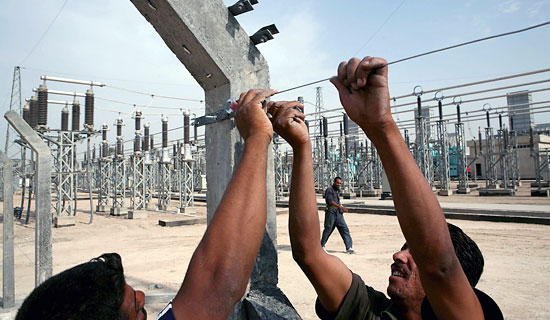
The secondary effects of the invasion and its aftermath were among the most important factors that radically changed the outlook. Tables in the history show that measures of things like the production of electricity and oil; public access to potable water, mobile and landline telephone service; and the presence of Iraqi security forces all plummeted at least 70 percent, and in some cases all the way to zero, in the weeks after the invasion. Subsequent tables in the history give a fast-forward view of what happened as the avalanche of money tumbled into Iraq over the next five years. By the time a sovereign Iraqi government took over from the Americans in June 2004, none of those services – with a single exception, mobile phones – had returned to prewar levels. And by the time of the security improvements in 2007 and 2008, electricity output had, at best, a precarious 10 percent lead on its levels under Saddam Hussein; oil production was still below prewar levels; and access to potable water had increased about 30 percent, although with the nation’s ruined piping system it was unclear how much actually reached people’s homes uncontaminated.

Whether the rebuilding effort could have succeeded in a less violent setting will never be known. In April 2004, thousands of the Iraqi security forces that had been oversold by the Pentagon were overrun, abruptly mutinied or simply abandoned their posts as the insurgency broke out, sending Iraq down a violent path from which it has never completely recovered.

At the end of his narrative, Bowen chooses a line from “Great Expectations” by Charles Dickens as the epitaph of the U.S.-led attempt to rebuild Iraq: “We spent as much money as we could, and got as little for it as people could make up their minds to give us.”

James Glanz reported from Baghdad, and T. Christian Miller, of the nonprofit investigative Web site ProPublica, reported from Washington.
At Strange Welcoming Ceremony in Iraq, Shoes Fly and President Bush Ducks

George W. Bush, Iraq

Shoes thrown at Bush on Iraq trip

A surprise visit by US President George Bush to Iraq has been overshadowed by an incident in which two shoes were thrown at him during a news conference.

An Iraqi journalist was wrestled to the floor by security guards after he called Mr Bush “a dog” and threw his footwear, just missing the president.

The US president has now continued to Afghanistan to inspect troops there.

He arrived before dawn at Bagram air force base, and is due to hold talks with President Hamid Karzai.

Earlier in Baghdad, Mr Bush and Iraqi PM Nouri Maliki signed the new security agreement between their countries.

The pact calls for US troops to leave Iraq in 2011 – eight years after the 2003 invasion that has in part defined the Bush presidency.

Speaking just over five weeks before he hands over power to Barack Obama, Mr Bush also said the war in Iraq was not over and more work remained to be done.

His previously unannounced visit came a day after Defence Secretary Robert Gates told US troops the Iraq mission was in its “endgame”.

‘Size 10’

In the middle of the news conference with Mr Maliki, Iraqi television journalist Muntadar al-Zaidi stood up and shouted “this is a goodbye kiss from the Iraqi people, dog,” before hurling a shoe at Mr Bush which narrowly missed him.

Showing the soles of shoes to someone is a sign of contempt in Arab culture.

With his second shoe, which the president also managed to dodge, Mr Zaidi said: “This is for the widows and orphans and all those killed in Iraq.”

Mr Zaidi, a correspondent for Cairo-based al-Baghdadiya TV, was then wrestled to the ground by security personnel and hauled away.

“If you want the facts, it’s a size 10 shoe that he threw,” Mr Bush joked afterwards.

Al-Baghdadiya’s bureau chief told the Associated Press that he had no idea what prompted Mr Zaidi to attack President Bush, although reports say he was once kidnapped by a militia and beaten up.

“I am trying to reach Muntadar since the incident, but in vain,” said Fityan Mohammed. “His phone is switched off.”

Correspondents said the attack was symbolic. Iraqis threw shoes and used them to beat Saddam Hussein’s statue after his overthrow.

‘American security’

Mr Bush’s first stop upon arriving in Baghdad was the Iraqi presidential palace in the heavily-fortified Green Zone, where he held talks with President Jalal Talabani.

“The work hasn’t been easy but it’s been necessary for American security, Iraqi hope and world peace,” Mr Bush said during his talks with Mr Talabani.

The Iraqi president called Mr Bush “a great friend for the Iraqi people, who helped us liberate our country”.

The BBC’s Humphrey Hawksley, in Baghdad, says the key issue at present is exactly how American troops will withdraw within the next three years and what sort of Iraq they will leave behind.

The US media has just published details of a US government report saying that post invasion reconstruction of Iraq was crippled by bureaucratic turf wars and an ignorance of the basic elements of Iraqi society.

The report is circulating among US officials in draft form, says the New York Times.

It reveals details of a reconstruction effort that cost more than $100bn (£67bn) and only succeeded in restoring what was destroyed in the invasion and the widespread looting that followed it, the newspaper said.

Troop promises

Mr Bush’s visit, unannounced in advance and conducted under tight security, follows the approval last month of a security pact between Washington and Baghdad that calls for US troops to be withdrawn from Iraq by the end of 2011.

US troops are first to withdraw from Iraqi cities, including Baghdad, by June next year.

Defence Secretary Gates said on Saturday that “the process of the drawdown” had begun.

“We are, I believe, in terms of the American commitment, in the endgame here in Iraq,” he told US troops at an airbase near Baghdad.

Mr Gates has been picked to stay on as defence secretary by President-elect Barack Obama.

President Bush leaves the White House in less than six weeks. He said in a recent interview with ABC News that the biggest regret of his presidency was the false intelligence that Iraq had weapons of mass destruction.

Finding these was one of the key justifications for the invasion. None were ever found.

Mr Obama has promised to bring home US combat troops from Iraq in a little over a year from when he takes office in January.

More than 4,200 US troops and tens of thousands of Iraqi civilians and security personnel have been killed since the invasion in 2003.

There are currently about 149,000 US soldiers in Iraq, down from last year’s peak of 170,000 after extra troops were poured in to deal with a worsening security situation.

As Mr Bush arrived in Baghdad, Gen David Petraeus, the head of the US Central Command, which includes Iraq, said attacks in the country had dropped from 180 a day in June 2007 to 10 a day now.

In a sign of modest security gains in Iraq, Mr Bush was welcomed with a formal arrival ceremony – a flourish that was not part of his previous three visits.

He arrived in the country on Air Force One, which landed at Baghdad International Airport in the afternoon, after a secretive Saturday night departure from Washington on an 11-hour flight.

Blackwater Guards Charged With Manslaughter

Bechtel, CACI, Carlyle Group, Dick Cheney, District Of Corruption, DOD, Eric Prince, George W. Bush, Halliburton, Justice Department, KBR, Pentagon, Rumsfeld

Dispatch from Baghdad

THE LOS ANGELES TIMES

(God Bless You Guys)

Iraqis applaud charges against Blackwater guards

The shooting that killed at least 17 in a Baghdad traffic circle last year resonates strongly among Iraqis, who believe it was unjustified and are eager for justice.

By Tina Susman and Usama Redha

December 10, 2008

Reporting from Baghdad — The traffic circle hums on a cool and sunny afternoon, as motorists round the center median with its fake orange palm tree that sparkles at night, blooming flower beds and chunky sculpture.

On such a calm day in Baghdad, it is hard to imagine the carnage that erupted here in Nisoor Square in September 2007, when Blackwater Worldwide security guards killed at least 17 Iraqis in a hail of machine-gun bullets and grenades, but the evidence remains.
43796439
Bullet holes pock the small shelter where traffic cops dived for cover. Splotches scar the wall of a school off the square that prosecutors say was hit by American gunfire. Memories rankle people familiar with the story, which still resonates powerfully in Iraq even as the legal repercussions have shifted to courthouses thousands of miles away in the U.S.

Five Blackwater employees, all of them U.S. military veterans, were charged Monday with manslaughter and attempted manslaughter in the case, which strained U.S.-Iraqi relations and galvanized Iraqi opposition to the Western security companies that had operated with impunity here.

Starting Jan. 1, private security details such as Blackwater will be subject to Iraqi jurisdiction if accused of crimes committed while off American bases, a change demanded by Iraq’s government after the Blackwater incident and others involving different companies that resulted in civilian deaths on a smaller scale.

The current Blackwater defendants won’t face trial in Iraq, but they could face decades in prison in the United States if convicted, something that pleases Iraqis such as Ali Abdul Ali.

“This is good,” said Ali, an unemployed military veteran. “It means no one is above the law, even if he’s an element of foreign forces. It also means the victims will get justice.”

Ali, who comes often to an abandoned bus stop near Nisoor Square to sit in the sunshine and think about life, has a friend whose mother was among 20 Iraqis shot and wounded in the incident. Like other Iraqis in the circle that day, the friend said the shooting was unjustified, he said.

“These people were armed and they were shooting innocent people,” Ali said.

That’s not how the Blackwater guards tell it. They say their convoy came under attack as they escorted U.S. State Department officials and that they fired in self-defense.

In the square Tuesday, the sound of gunfire was constant and clear over the cacophony of car engines, tooting horns and sirens from the intimidating convoys that still tear through the circle, but it was from an Iraqi police firing range nearby.

Police officers stationed in the circle were happy to discuss the Blackwater case and to show off the bullet holes from that day. One of them quickly interrupted his lunch of beans, rice and bread to weigh in.

“I heard about [the charges against the Blackwater employees] yesterday on the news,” said the officer, who like his colleagues was not authorized to speak to reporters and would not give a name. “Because they killed 17 innocent people, of course they should be arrested.”

The policeman, who has worked this spot for five years, was not in the square the day of the shooting but came to work the next day to see wrecked cars, blood-stained streets, bullet casings. He pointed to a section of gnarled concrete in the busy street a few feet away.

“That’s where the doctor and her son died,” he said, referring to Mahasin Mohssen Khadum Khazali and her son, Ahmed Haitham Ahmed Rubaie, who were in a white sedan that the Blackwater guards said they suspected of being rigged to explode.

“Justice should be served. These victims — their rights should be taken into consideration,” said another policeman, edging in front of the first cop and quickly taking over the conversation. This officer said that if the Blackwater guards are convicted, they should die.

“This is the law of God. In the Arab world, anyone who kills someone, he should be killed,” he said.

They scoffed at the idea that the guards might have felt genuinely threatened because of the situation in Baghdad at the time. Violence was far worse then, when attacks on U.S. forces were daily events. That month, 70 foreign troops, including 66 Americans, were killed across Iraq, according to the independent website icasualties.org. Last month, the total was 17.

“This place is surrounded. It is secure,” the second officer said, noting the national guard base on one side of the square and another government building on the other. “It’s impossible” that anyone could have felt threatened, he said.

Minutes later, a U.S. military convoy entered the circle. Civilian traffic ground to a halt to let the vehicles pass, but they stopped midway through. A group of U.S. soldiers walked toward the Iraqi police.

“Let’s have it,” one of them sternly said to a U.S. journalist who had been filming the square, referring to the memory chip of his video camera.

The soldier uttered an obscenity about filming the convoy but backed off without taking the memory chip after another American intervened, satisfied that the journalists were more interested in the scene at the square, not the convoy that had rolled into view.

Afterward, one policeman joked that it was good the journalists were of the “same tribe” as the soldiers. If they’d been Iraqis, he said, they would have been locked up.

Susman and Redha are Times staff writers.

tina.susman@latimes.com