The Mad Dog Leaves Mike and Heads to Satellite Radio

Stories

FROM THE BEST PAPER IN LONG ISLAND NEW YORK:NEWSDAY

After 19 years, Russo leaves “Mike and the Mad Dog”

BY NEIL BEST

neil.best@newsday.com

8:31 AM EDT, August 15, 2008

“Mike and the Mad Dog,” a New York sports talk radio institution for nearly two decades, has been disconnected.

WFAN abruptly ended the 19-year-old show late yesterday afternoon when it announced to the media that co-host Chris Russo has left the station, leaving Mike Francesa to carry on without him.

Russo had hoped to do a farewell show, but WFAN opted to part ways immediately after releasing him from a contract that would have run through next spring.

The announcement was made after Francesa left the air yesterday, but he said he will answer all questions about it on today’s show.

The news did not come as a surprise; Newsday first reported June 22 that the show likely would end before Labor Day. But it still was an emotional moment for the longtime duo.

“It’s kind of a sad day,” Russo said last night. “It’s a very strange day in my life.”

Said Francesa: “I think it has to sink in. It’ll be very different when I finally get back in the fall.”

He will be on solo today as scheduled; Russo is on vacation.

The reasons for the breakup are multi-faceted, and somewhat murky.

Operations manager Mark Chernoff said all parties agreed “the show has kind of run its course.” But Russo said that was true only to a point.

He said he could have carried on but was motivated to explore other opportunities.

“Basically, I’m looking for a different challenge in my life,” Russo said. “I’m 48 years of age. This might be the last chance I’m going to get for a challenge if I want to take it.”

Russo swore on his children’s lives that he has no firm agreement or contract, but industry sources say he is likely to land at Sirius Satellite Radio for a lucrative deal worth up to $15 million over five years.

“I have four or five options,” he said. “Sirius would be one of them … Obviously, I’m not stupid. I’m not going to leave FAN unless I have something relatively secure.”

Because there will be no farewell show, their final joint appearance was an Aug. 5 remote at Giants camp in Albany. Other than that day, they had not spoken for weeks until Wednesday.

“I told him if I don’t re-sign [with WFAN], it has nothing to do with him and I,” Russo said.

Francesa said the two agreed to talk again when Russo cleans out his office next week.

The hosts’ relationship has been strained in recent months, and at least to some extent, they apparently were ready to move on from each other as well as the show.

“I think the relationship was part of this,” Francesa said, “but I think in the end this was probably more of a different vision about what the future may hold.”

At the same time the station announced that Russo was leaving, it announced a new contract for Francesa, whose deal was believed to be expiring around the end of the year.

Francesa said he will have control over the new-look show, which will unfold in the coming weeks. He will not have a co-host, but he will not sit alone for 5½ hours a day.

“I expect nothing less than to be successful, but I understand it’s a great challenge,” Francesa said. “It won’t be a co-hosting situation. It will be my show, but I want to have personalities and other opinions and other voices.”

Francesa and Russo were the undisputed stars of WFAN after Don Imus was fired last year. Chernoff tried his best to keep them together.

He sat them down in May and again in July before the All-Star Game, the latter time “to see if things were OK. I thought they were, but obviously, there were things that made it tough.”

He said he is confident that Francesa can succeed without Russo.

“Mike’s a strong personality who brings an awful lot to the table,” Chernoff said.

Said Russo: “I’m going to miss the station, the heartbeat, the day-in-and-day-out buzz of New York sports.”

Said Francesa: “I would expect as we get distance from it, we’ll be very proud of what we built and accomplished. But I do also look forward to this [new show].”

Lower East Side Shul Board Sells Out To Developers; Historians Cry Foul

Stories

FROM THE NY TIMES

CITY ROOM BLOG

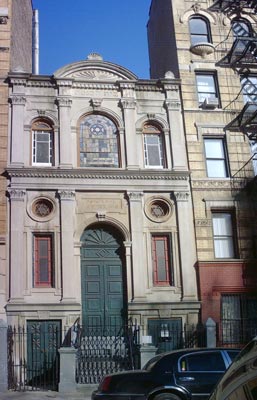
This much can be agreed on: An Orthodox congregation established by Eastern European Jews in 1888 occupies a lovely but crumbling neo-Classical building with a two-story Victorian Gothic interior at 415 East Sixth Street, between First Avenue and Avenue A, on the Lower East Side — a neighborhood where real estate prices have been soaring, placing pressure on owners of old buildings to sell their property to developers for retail and commercial uses.

Everything else — including even the question of how to correctly render the name of the synagogue — is contentious in a bitter dispute that has erupted in recent weeks over the fate of the building.

This afternoon, the Greenwich Village Society for Historic Preservation, the Lower East Side Conservancy and several other nonprofit groups held a news conference outside the synagogue, to draw attention to a plan by the synagogue’s board to enter a partnership with a developer, which would demolish the structure and replace it with a mixed-use building that would contain apartments, as well as a new synagogue. In a letter [pdf] to the city’s Landmarks Preservation Commission, the society has called for the synagogue to be designated a landmark, which would prevent it from being demolished.

The congregation has filed demolition plans with the city’s Department of Buildings, but insists that it wants to preserve the character of the congregation and that the current structure is in desperate disrepair. The demolition plans were reported by The Villager, a weekly newspaper, late last month. The synagogue’s board voted on July 7 to approve a deal with the Kushner Companies, which would build a new six-story building on the site, with a synagogue on the first two floors and 10 apartments on the top four stories.

It is not quite clear when the building at 415 East Sixth Street was constructed, but twoarticles in The Times from November 1903 refer to the building as a “four-story dwelling,” and a January 1911 article said the building had been the home of “wholesale confectioners.”

In any event, the Adas Yisroel Anshe Mezritch, or Congregation Mezritch, which was founded in 1888, drastically renovated the building and began using it as a synagogue in 1910. The society said in a statement:

The handsome neo-Classical building (which has an even more impressive interior) was one of the Lower East Side’s many “tenement synagogues,” so named because they filled narrow lots sandwiched between tenements and served the poor immigrants who populated the surrounding buildings. While a few such tenement synagogue buildings remain in the East Village, including the former Beth Hamedrash Hagadol Anshe Ungarn Synagogue at 242 East Seventh Street, which was recently landmarked by the city, Congregation Mezritch Synagogue appears to be the sole remaining operating tenement synagogue in the East Village, and thus is an important link to what was once perhaps the most significant Jewish community in America.

Andrew Berman, executive director of the historic preservation society, said that “buildings like this — at once humble and grand — really speak to the profound aspirations of the generations of immigrants who came through the Lower East Side, and the impact they had and continue to have upon our city and country.”

In a statement, Shelley Ackerman, whose father, Pesach Ackerman, has been the synagogue’s rabbi for more than 40 years, defended the board’s plans. She said:

Our synagogue is not and never has been for sale. The pending proposal (if in fact it moves forward) would help to preserve Anshe Meseritz and provide a much more comfortable, welcoming, and accessible space for our beloved congregants. We are acting along these lines to guarantee the securing and survival of this synagogue.

Those who instigate these activities are fueled by a romantic notion of preserving an old structure, one in desperate need of renovation. And without that renovation is likely to fall. Some are motivated by ignorance, others by greed.

Dozens of other beautiful similar (landmark-worthy) synagogues in much better or worse shape than this one on the Lower East Side have been sold and/or destroyed in the last 20 years. These sales were motivated by the greed of a few parties who benefited. In almost every case, the synagogue in question did not. This case is completely different. There is no sale pending, only air rights to build apartments that will provide needed income to sustain the synagogue and congregation going forward.

In a phone interview, Ms. Ackerman said the synagogue was in an advanced state of disrepair. The exterior steps are so steep as to be unusable during inclement weather, she said. Parts of the interior are crumbling. There are inadequate bathrooms, poor climate control and no kitchen, she added.

The hubbub has become personal — and divided the 40 or so members of the congregation.

“Anyone who is familiar with Rabbi Ackerman’s role in the synagogue for the last 40 years knows that despite no wages, he has been present seven days a week and has done everything within his power to make sure that the synagogue survives,” his daughter said in the statement. “He is devoted to the preservation of his temple and would never do anything to endanger the future of the synagogue.”

Several former or current members of the congregation have weighed in on the side of the preservationists, including Joel Kaplan, executive director of United Jewish Council of the East Side, and William E. Rapfogel, chief executive of the Metropolitan Council on Jewish Poverty.

Freda Fried, whose father was active in the synagogue for decades and whose mother was on its board, said the board’s vote in July was held on a Monday morning after the July 4 holiday weekend. “It provided little information about the sale in its mailing, so members could do any due diligence or even consider it important to give a proxy to anyone else,” she said. “If there was a real process and search for a development partner, little or no information was provided about any other choices.”

Gerard Wolfe, a retired art historian credited with “rediscovery” of the Eldridge Street Synagogue, called the Mezeritz synagogue “a jewel,” and added, in a statement, “Its demolition would be an irretrievable, unforgivable loss.”

Andrew S. Dolkart, a professor of historic preservation at Columbia who is not involved in the dispute, said the East Sixth Street building was an outstanding example of vernacular architecture and reflected the neo-Classical influence of the 1897 synagogue built by Congregation Shearith Israel, also known as the Spanish and Portuguese Synagogue.

“It wasn’t designed by a sophisticated architect,” Professor Dolkart said. “It wasn’t a pioneering building. It was an architect who was looking at what sophisticated designers were doing and then adapting it in an inexpensive and not so sophisticated manner, to create a kind of folk classicism, almost.”

In a phone interview, Professor Dolkart said he favored preserving the Lower East Side structure, because cities should preserve “architecture that not only reflects the lives and history of the rich, but also the incredibly history of common people in New York.”

The New York Yankees Finally Find Their Soul in the Middle of the Dog Days of Summer

Stories
August 18, 2008
Yankees 15, Royals 6

Yankee Home Runs Help Mussina Overcome a Shaky Start

Yankees Manager Joe Girardi
frequently refers to himself as an optimist. That posture has been
tested the last three weeks, as the Yankees floundered while nearly
playing themselves out of the wild-card race.

Girardi hoped that the Yankees’ untidy 13-inning victory on Saturday
might be the start of something. The Yankees often have not measured up
to Girardi’s positive outlook, and things certainly did not look good
Sunday when the Royals scored three runs off Mike Mussina in the top of the first inning.

But Alex Rodriguez and Xavier Nady homered in a six-run first, and Jason Giambi
added a grand slam in the second — all off Kansas City starter Brian
Bannister — as the Yankees rolled, 15-6, for their first series victory
since taking two of three at Boston on July 25-27.

Four Yankees homers overcame a shaky beginning by Mussina, who gave
up hits to four of his first five hitters to trail, 3-0. Billy Butler’s
broken-bat double drove in two runs. But Mussina allowed only two more
hits, and no more runs, in his six-inning stint to improve to 16-7.

Rodriguez, who finished with five runs batted in, homered to the
entrance of Monument Park to tie the game. With two out, the next four
Yankees combined for the cycle to produce three more runs.

Nady sliced a home run off the right-field foul screen. Robinson Canó
singled and, by running hard on contact (something he does not always
do), scored on José Molina’s double to left. While Canó slumped in the
dugout gasping for breath, Brett Gardner — who delivered the
game-winning single in the 13th inning on Saturday — hit a run-scoring
triple to right center. Both Canó and Gardner slid in ahead of
off-target throws, Gardner headfirst.

The first inning took 35 minutes. And so did the second inning, exactly, though the Royals did not score.

Derek Jeter, who had four hits, opened the Yankee second with a single. Bannister walked Bobby Abreu
and Rodriguez before Giambi homered into the bleachers in right-center.
Bannister gave up two more singles, to Nady and Canó, before Kansas
City Manager Trey Hillman pulled him.

Rodriguez tacked on run-scoring singles in the third and the seventh.

Royals reliever Jeff Fulchino drilled Jeter in the upper left arm
with a 1-2 fastball in the seventh. Jeter, in pain, walked to first,
but stayed in the game and scored on Abreu’s double. Cody Ransom,
pinch-hitting for Giambi, added a two-run homer in his first at-bat as
a Yankee.

Comedian Bernie Mack is Dead at Age 50

Stories
August 9, 2008

Bernie Mac Is Dead, Publicist Says

Filed at 9:28 a.m. ET

CHICAGO (AP) — A publicist says Emmy and Golden Globe nominated actor and comedian Bernie Mac has died at age 50.

Publicist Danica Smith says Bernie Mac died early Saturday at a hospital in the Chicago area of complications due to pneumonia.

The comedian suffered from sarcoidosis, an inflammatory lung disease that produces tiny lumps of cells in the body’s organs, but he had said the condition went into remission in 2005. He recently had been hospitalized and treated for pneumonia.

Mac had starring roles in “Ocean’s Eleven,” “Bad Santa,” “Charlie’s Angels: Full Throttle” and “Transformers.”

The comedian drew critical and popular acclaim with his Fox television series “The Bernie Mac Show,” which aired more than 100 episodes from 2001 to 2006.

Citicorp and Merrill Lynch Buy Back $17 Billion in Bunk Securities

Stories
August 7, 2008

2 Banks Will Buy Back $17 Billion in Securities

Two Wall Street giants agreed on Thursday to buy back more than $17 billion of auction-rate securities that were improperly sold to retail customers, likely paving the way for other banks and brokerage firms to take similar actions.

Citigroup reached a settlement Thursday morning with state and federal regulators, agreeing to buy back about $7.3 billion of auction-rate securities that it sold to retail customers and pay a $100 million fine for its conduct.

Merrill Lynch said it would buy back about $10 billion in auction-rate investments that it sold to retail investors, a move that gets ahead of regulators investigating the company.

Neither firm agreed to reimburse institutional investors, though both said they were trying to resolve similar problems with those customers.

Regulators have been investigating at least a dozen Wall Street firms for their role in the sales and marketing of so-called auction-rate investments, and analysts expect a wave of settlements in the next few months.

Bank of America, the largest retail bank, said Thursday that it had also received subpoenas from federal and state regulators related to sales of auction-rate securities. The investments are preferred shares or debt instruments with rates that reset regularly, usually every week, in auctions overseen by the brokerage firms that originally sold them.

The $300 billion market for the investments collapsed in February, trapping investors who had been told that the securities were safe and easy to cash in.

Citigroup’s settlement with state and federal regulators included a fine of as much as $100 million.

In a statement, the New York attorney general Andrew Cuomo said that Citigroup would buy back, by Nov. 5. auction-rate securities from individual investors, charities and small- and mid-sized businesses. These customers, about 40,000 nationwide, have been unable to sell their securities since Feb. 12, the statement said.

In a similar case in Massachusetts, Morgan Stanley reached an agreement with the attorney’s general office on Thursday to reimburse the cities of New Bedford and Hopkinton $1.5 million for the investments in the securities, the Massachusetts attorney general Martha Coakley said in a statement.

As part of the settlement, Citigroup agreed to a public arbitration process to resolve claims of consequential damages suffered by retail investors.

The bank, one of Wall Street’s biggest auction-rate securities dealers, will pay the $100 million to the New York attorney general’s office and a task force of 12 state regulators, led by the Texas State Securities Board. Each group would exact a $50 million penalty.

The federal Securities and Exchange Commission also participated in the settlement talks but elected not to exact a penalty, pending its own investigation.

The settlement follows several days of meetings between Citigroup and the state and federal regulators, and reflects Citigroup’s desire to put its auction-rate securities troubles behind it.

Thursday’s settlement has implications for other Wall Street firms, with the Citigroup deal serving as a benchmark for the industry. Two other banks, UBS and Merrill Lynch, are under investigation by several groups of regulators. But unlike Citigroup, UBS faces additional accusations that at least one of its executives engaged in insider trading.

Citigroup shares were down about 3.5 percent Thursday; Morgan Stanley shares were down less than one percent.

Jenny Anderson contributed reporting.

Hail To The Redskins at the Pro Football Hall Of Fame

Stories

“Hail To The Redskins- Hail Victory….

Braves On The Warpath- Fight For Old D.C.!

A Class Reunion in Canton

Partisan Crowd Cheers Monk, Green On Induction Day

By Mike Wise
Washington Post Staff Writer
Sunday, August 3, 2008; D01

CANTON, Ohio, Aug. 2 — They came from the District and beyond to see them. Way beyond. Some of the pilgrimages began in Orange County, Calif., and others in Murphy, N.C., where a white-haired couple began driving through the Blue Ridge Mountains some nine hours earlier.

“After all the memories, we had to see them go in,” Bill Garrod said as his wife, Nancy, nodded in agreement, hours before Art Monk and Darrell Green were to be enshrined in the Pro Football Hall of Fame on Saturday.

And the moment the last Class of 2008 inductee took the stage, their patience was rewarded for those $4 gallons of gas and hours on sweltering freeways — just as Monk’s patience the past eight years was rewarded.

For 4 minutes 4 seconds before Monk spoke — an applause lasting nearly three times as long as that for any other honoree — the steadiest and most reliable wide receiver to play pro football in Washington took in the chants, smiles and unconditional love heaped upon him.

“Thank you, thank you,” Monk kept saying, happily unable to quiet the applause from the announced crowd of 16,654 at Fawcett Stadium, about 15,000 of whom wore burgundy and gold.

Green had spoken nearly an hour earlier, drawing a monstrous ovation as fireworks cascaded behind him. He was the third inductee to be honored and the first Redskin introduced.

Bill Garrod wore one of those Super Bowl T-shirts with the caricatured mugs of Redskins players from another era. There was Charles Mann, Earnest Byner, Ricky Sanders and, of course, the ebullient and grinning Green. Bill spoke of seeing Eddie LeBaron play at Griffith Stadium in the 1950s the way others spoke of the magic and majesty of RFK in the 1980s and early 1990s.

They overwhelmed this lush, northeastern Ohio town about an hour south of Cleveland with numbers and passion, thousands of fans clad in burgundy and gold hats, jerseys, assorted paraphernalia and, yes, Halloween masks. They dwarfed other Hall of Fame inductees’ fans, transforming Canton into a rollicking yet respectful RFK tailgate.

Soon after the national anthem, 2007 inductee Michael Irvin took the podium and was booed long and lustily, as if the former Dallas Cowboys wideout were still standing across the line of scrimmage from Green. According to NFL broadcaster and former coach Steve Mariucci, the crowd was “95 percent Washington Redskin jerseys!”

The fans’ journey to the cradle of professional football to pay homage to Monk and Green began less in a place than a time, when the Redskins were frequently atop the NFL, led by groups of men nicknamed the Fun Bunch and the Hogs. Among the most skilled were Green, the loquacious, lightning-quick cornerback who played longer for the Redskins than any player, and Monk, the sure-handed wide receiver who let his solid play speak for him.

Monk and Green were enshrined with former New England Patriots linebacker Andre Tippett; Gary Zimmerman, an offensive lineman for the Minnesota Vikings and Denver Broncos; Fred Dean, the pass-rushing demon of the San Diego Chargers and San Francisco 49ers; and Kansas City Chiefs cornerback Emmitt Thomas, who also mentored Green and Monk for eight seasons as a Redskins assistant.

Monk’s selection in February to Canton was the culmination of a rejection process that went on for almost a decade, as other, more showy wide receivers and less-accomplished players received enough votes for enshrinement. Monk resigned himself to being known as the durable yet often unspectacular pro, the guy who did not have enough go-long highlights to impress a suddenly pass-happy league.

Never mind Monk held the NFL’s career record for receptions for two years, had five seasons with more than 1,000 receiving yards and that he caught seven passes for 113 yards in Super Bowl XXVI. For seven years, it didn’t matter.

“I think the first year was probably the worst, because there was so much anticipation from my community, all the fans, just saying, ‘Oh, you’ve got it made, you’re a shoo-in,’ ” Monk said Friday during an interview session. “And when you start hearing that and you start believing it and when it didn’t happen, it was a disappointment.”

“It’s taken eight years,” Monk added. “But regardless of how long it’s taken, it’s good to be here.”

Green’s induction came almost as quickly as the blinding speed of the player four times named the NFL’s fastest man. He was enshrined the first year he was eligible.

Before every split time was news at an NFL combine and every team had an army of strength and speed coaches, Green once ran a 40-yard dash in an unheard-of time of 4.17 seconds.

He played 20 years with the Redskins, an NFL record for years spent with one team equaled only by former Rams offensive lineman Jackie Slater. Monk’s 295 games with Washington remains a milestone for a player with one team in one city. His seven Pro Bowl selections were buttressed by 54 career interceptions.

The fans who invaded Canton this weekend all had their favorite Green and Monk moments, ranging from Green’s spectacular punt return against the Chicago Bears in a 1988 playoff game — he winced in pain from a rib injury as he crossed the goal line — to Monk’s record-setting reception against the Denver Broncos at RFK Stadium on “Monday Night Football” in 1992, after which Monk’s teammates interrupted the game to carry him on their shoulders.

“So I guess that would be the most memorable for me,” Monk said.

A Los Angeles Rams fan, standing near Redskins fans, volunteered he had never imagined Eric Dickerson being caught from behind by any player in his prime, but that he remembered Green tracking down the tailback and dragging him to the ground.

Dan Bee, who came from Orange County, Calif., with his wife, Stephanie, said the play that sticks in his mind is Green knocking away a pass against the Minnesota Vikings on fourth down near the goal line at the end of a playoff game, sending the Redskins to Super Bowl XXII in 1988.

Keith McCoy and David Sutherland, both 24 and best friends growing up in Northern Virginia, simply remember attending Monk’s camp four straight summers, how gracious the three-time Pro Bowl wide receiver was to impressionable youths like themselves. “He signed autographs, took pictures, talked to us, everything,” McCoy said.

Monk was presented by his son, James Arthur Monk Jr. Green’s presenter was also his son, Jared, whom he and his wife were going to name Darrell Green Jr. before changing their minds a month before he was born.

“I’m so grateful because he’s his own man,” Green said. “I’m more proud of my son being my son than I am being in the Hall of Fame.”

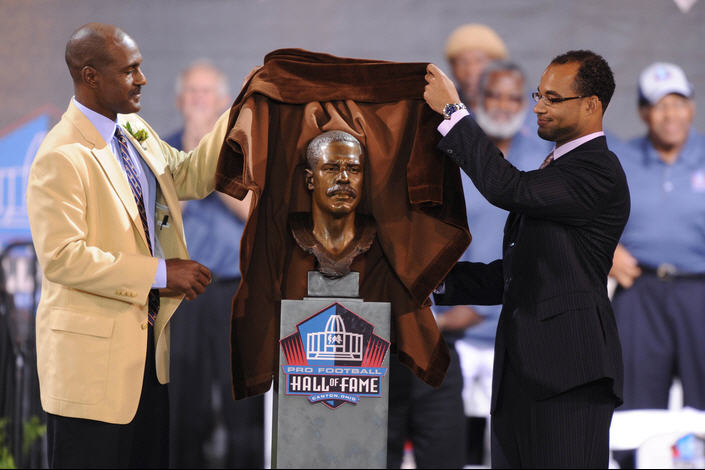
Inside the Hall of Fame, through the maze of exhibits and grainy NFL Films, thousands more burgundy-and-gold-clad people made their way to the bronzed-bust room, where they snapped photos of Joe Gibbs’s likeness. This, too, was part of the journey to pro football’s Mecca. For this day, they wouldn’t be anywhere else.

I Don’t Think You’re Acting Right You Don’t Think It’s Showing…

Stories

I don’t think you’re acting right

You don’t think it’s showing…

Joseph Walsh Kicking Rear-End

Yankee Slugger Bobby Murcer's Life Celebrated in Oklahoma

Stories

EDMOND – “Celebrating the Life of Bobby Murcer,” a memorial service for the late New York Yankees slugger from Oklahoma City, was a celebration of one man’s goodness, graciousness and kindness. And a little bit about what a ballplayer he was as well.

The service at the Memorial Road Church of Christ, subtitled “Yankee for Life, Oklahoman at Heart,” flew by in what seemed like a lot less than the actual one hour and 45 minutes.

The Yankees chartered a flight to Oklahoma City from the Dallas area, where they are playing a series with the Texas Rangers. Among the some 2,000 attending Wednesday’s memorial were Reggie Jackson, Derek Jeter, Andy Pettitte and Yankees manager Joe Girardi.

“I can see my father right now, up in heaven, in his rocking chair, shaking his head in amazement that we are all here today just for him,” Todd Murcer said.

With his voice beginning to break, Todd Murcer later added: “My father understood what was important. He often told me, ‘Treat people with respect, encourage those around you, make the most of every day.’ Watching him live by those words proved to be the greatest lesson of all.”

Kent Allen, former minister at Memorial Road, pointed out that Wednesday’s memorial was 29 years ago, to the day, since Murcer gave a eulogy at Thurman Munson’s funeral. And that night Murcer had a three-run home run and, in the bottom of the ninth, a two-run single, driving in all of the Yankees’ runs in a 5-4 win against Baltimore.

“What a game, what a life, what a man,” Allen said, adding that Munson’s widow, Diana, was at Wednesday’s service.

Former Yankees publicist Marty Appel apologized for unfairly plugging Murcer as the next Mickey Mantle when he replaced The Mick in center field.

“He connected with the fans from day one,” Appel said. “He had an easy, Oklahoma politeness and a modesty that isn’t normally associated with elite athletes. He was a fans’ player and he was a players’ player.

“He was just terrific kid who was handed an oversized assignment and he handled it with grace and honesty and dignity, as he did everything until the very end… He made you a better person just to know him. No man ever wore the New York Yankee uniform better, and in this measure he is, in fact, right there with Babe and Lou and Joe and Mickey. He had Yankee DNA. A Yankee for life. The most beloved Yankee of his time.”

Murcer’s former pastor at Quail Springs Church of Christ, Ronnie White, noted that today is the 25th anniversary of Bobby Murcer Day at Yankee Stadium. The minister also noted how important family was to the Yankees star.

“If you didn’t know Bobby very well you would think that baseball was it for Bobby,” White said. “Not even close. Family was it for Bobby. He was a family man from start to finish…. Baseball was what Bobby did, but it wasn’t who he was.”

A NASA astronaut, Army Col. Doug Wheelock, traveled all the way from Russia to speak at the Murcer memorial. He had traveled much further with one of Murcer’s Yankee jerseys – about 6.24 million miles – while aboard the Discovery space shuttle in October and November of last year, and on a Mount Everest trek last May. Murcer was Wheelock’s boyhood idol, and they became friends last year.

“The way he lived his life was just magical,” said Wheelock, who presented Kay Murcer with the jersey that went into space, and baseball cards he had also taken along to the Murcer’s children, Todd and Tori.

Michael Kay, who was Murcer’s broadcast partner, said he grew up as a Yankees fan, and especially a Murcer fan.

“If I could draw up a prototype of what I wanted my idol to be,” Kay said, “Bobby Murcer lived up to being that person… Bobby Murcer was the most genuine famous person that I have ever met.”

Aaron Gaberman, a 13-year-old Yankees fan who met Murcer as both were being treated for brain cancer, said he continues to play and love baseball.

“But now I have a greater purpose in playing baseball,” Gaberman said. “I’m playing for Bobby now… Bobby is now my guardian angel.”

Murcer’s agent, Steve Lefkowitz, mentioned one time when the slugger stopped to sign some autographs — after police had kept some kids from getting signatures.

“About a block from the stadium a car stopped and out stepped Bobby Murcer,” Lefkowitz said. “He said, ‘Hey, guys, want an autograph?’

“Bobby knew his place on earth was special, because that’s the way he carried himself. Not a trace of arrogance, just enjoying what he did and trying to make people feel as good as he did all the time.”

Greyhound Scraps Ads After Canada Bus Beheading

Stories

By ROB GILLIES

Associated Press Writer

TORONTO (AP) – Greyhound has scrapped an ad campaign that extolled the relaxing upside of bus travel after one of its passengers was accused of beheading and cannibalizing another traveler.

The ad’s tag line was “There’s a reason you’ve never heard of ‘bus rage.”’

Greyhound spokeswoman Abby Wambaugh said Wednesday a billboard and some tunnel posters near a bus terminal in Toronto are still up and would be removed later in the day.

“Greyhound knows how important it is to get these removed and we are doing everything possible,” Wambaugh said. “This is something that we immediately asked to be done last week, realizing that these could be offensive.”

Vince Weiguang Li, who immigrated to Canada from China in 2004, is charged with second-degree murder in the death of 22-year-old carnival worker Tim McLean. He has yet to enter a plea.

Thirty-seven passengers were aboard the Greyhound from Edmonton, Alberta, to Winnipeg, Manitoba, as it traveled at night along a desolate stretch of the TransCanada Highway about 12 miles from Portage La Prairie, Manitoba. Witnesses said Li attacked McLean unprovoked, stabbing him dozens of times.

As horrified passengers fled the bus, Li severed McLean’s head, displaying it to some of the passengers outside the bus, witnesses said.

A police officer at the scene reported seeing the attacker hacking off pieces of the victim’s body and eating them, according to a police report.

Wambaugh said the ads only appeared in Canada and that some in Ontario and western Canada have already been removed. About 20,000 inserts of the Greyhound ads were scheduled to be put into an Alberta Summer Games handbook but they stopped the presses.