Daschle Withdraws His Nomination to Health and Human Services

Barack Obama, Charles Schumer, Edward Kennedy, HHS, John Kerry, Patrick Leahy, Robert Gibbs, Senate, South Dakota, Taxes, Tom Daschle

20090202_tom_250x375

(CNN) — Former Sen. Tom Daschle has withdrawn his nomination to head the Department of Health and Human Services, according to a statement Tuesday from the White House.

Daschle had been fighting to save his nomination as HHS secretary following controversy over his tax records and questions over his work in a field that some consider lobbying.

In a statement announcing his withdrawal, Daschle said it was an honor to be chosen to lead the reform of America’s health care system.
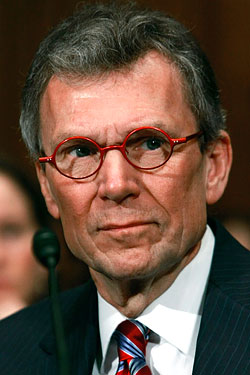
“But if 30 years of exposure to the challenges inherent in our system has taught me anything, it has taught me that this work will require a leader who can operate with the full faith of Congress and the American people, and without distraction,” he said.

“Right now, I am not that leader, and will not be a distraction. The focus of Congress should be on the urgent business of moving the president’s economic agenda forward, including affordable health care for every American.”

The Obama administration had stood by his side, and fellow Democrats lined up behind him, but Daschle’s problems, coupled with other nominees’ issues, gave critics ammunition to question President Obama’s call for a “new era of responsibility.”

The president said Tuesday he accepts Daschle’s decision “with sadness and regret.”

“Tom made a mistake, which he has openly acknowledged. He has not excused it, nor do I. But that mistake, and this decision, cannot diminish the many contributions Tom has made to this country, from his years in the military to his decades of public service. Now we must move forward, with our plan to lift this economy and put people back to work,” Obama said in a statement.

Daschle’s resignation came hours after Nancy Killefer’s withdrawal as Obama’s chief performance officer, a new post in the administration.

Officials said privately the reason for Killefer’s withdrawal was unspecified tax issues. The much-touted post was designed to scrub the federal budget.

Daschle, the former Senate majority leader, apologized Monday for failing to pay his taxes in full. He said earlier he was “deeply embarrassed” for a series of errors that included failing to report $15,000 in charitable donations, unreported car service and more than $80,000 in unreported income from consulting.

Daschle recently filed amended tax returns and paid more than $140,000 in back taxes and interest for 2005-2007.

A New York Times editorial on Tuesday called for Daschle to withdraw.

The paper’s editorial board particularly took issue with Daschle saying he identified the unpaid taxes in June but did not pay them until his nomination for the top post at the Department of Health and Human Services.

The editorial also criticized Daschle for generating a sizable income from health-related industries while working in the private sector.

“Mr. Daschle is another in a long line of politicians who move cozily between government and industry. We don’t know that his industry ties would influence his judgments on health issues, but they could potentially throw a cloud over health care reform,” the editorial said.

Shortly after news of the tax quandary broke, a number of Democratic senators released statements expressing their support for Daschle, including Sens. John Kerry of Massachusetts, Charles Schumer of New York, Patrick Leahy of Vermont and Edward Kennedy of Massachusetts. In their opinions, Daschle identified the problem and corrected it.

Daschle’s supporters said that given his record of three decades of public service, he was still the right man for the job.

“One cannot underestimate how widely admired Tom Daschle is in Washington for his integrity, for his public service. And many, many Democrats look to him as one of the favorite people. He’s got a lot of support in this White House, starting with the president,” said David Gergen, a senior political analyst for CNN.

Obama and Daschle have a longstanding relationship. Daschle endorsed Obama for the Democratic presidential nomination in February 2007 — nearly 11 months before the first contest. Daschle was also considered to be a contender for Obama’s No. 2 spot.

Daschle also has a history with members of Congress. He represented South Dakota in the House of Representatives for four terms, and he served in the Senate for three terms. He was the Senate majority leader from June 2001 to January 2003, and was the minority leader before losing his re-election bid in 2004.

Daschle’s work in his post-Senate years was also a point of contention on his path to confirmation.

After leaving the Senate, Daschle went on to serve as a special public policy adviser at the law firm Alston & Bird.

According to the firm’s Web site, Daschle advised clients on “issues related to financial services, health care, energy, telecommunications and taxes.”

His work, for which he reportedly made millions, seemed to contradict Obama’s strict rules on lobbyists working in his administration.

Promising “a new era of openness in our country,” Obama signed executive orders relating to ethics guidelines for staff members as one of his first acts in office.

“If you are a lobbyist entering my administration, you will not be able to work on matters you lobbied on, or in the agencies you lobbied during the previous two years,” the president said.

The administration had defended its choice of Daschle, pointing out that he was not technically a lobbyist.

“If you’re not registered to lobby, you can’t be a lobbyist,” said White House press secretary Robert Gibbs, according to Time.com. Time.com: When is a lobbyist not a lobbyist?

Daschle and Kellifer were not the first of Obama’s nominees to come under scrutiny.

Before Tim Geithner was confirmed as treasury secretary, he was questioned over concerns involving his personal taxes and the immigration status of a former housekeeper.

New Mexico Gov. Bill Richardson also withdrew his nomination to be commerce secretary, citing the distraction of a federal investigation into ties to a company that has done business with his state.

Given Obama’s pledge for “unprecedented transparency, rigorous oversight and clear accountability,” some said the controversy surrounding Obama’s appointments are calling into question the president’s vetting process.

“Mr. President, your picks to help run the federal government don’t have to be perfect, but is it too much to ask that they pay like everyone else, to keep that same government functioning? And more importantly, that they don’t wait until everyone, including you, is watching?” CNN’s Campbell Brown wrote in a commentary. Read the commentary

Asked if the president is embarrassed by the slew of appointment problems, Gibbs was quick to negate that idea.

“No, I don’t think that — that we believe there’s any problem in the vetting,” Gibbs said Monday.


Hillary Kicking Arse and Taking Names at State Department

Afghanistan, Democratic, Hillary Clinton, Iran, Jacob Lew, Laura D'Andrea Tyson, Middle East, Pakistan, State Department

Clinton moves to widen role of State Department

hillary_vmedmobile_logo

Tuesday, December 23, 2008

WASHINGTON: Even before taking office, Hillary Rodham Clinton is seeking to build a more powerful State Department, with a bigger budget, high-profile special envoys to trouble spots and an expanded role in dealing with global economic issues at a time of crisis.

Clinton is recruiting Jacob Lew, the budget director under President Bill Clinton, as one of two deputies, according to people close to the Obama transition team. Lew’s focus, they said, would be on increasing the share of financing that goes to the diplomatic corps.

He and James Steinberg, a deputy national security adviser in the Clinton administration, are to be Hillary Clinton’s chief lieutenants.

Nominations of deputy secretaries, like Clinton’s, would be subject to confirmation by the Senate.

The incoming administration is also likely to name several envoys, officials said, reviving a practice of the Clinton administration, when Richard Holbrooke, Dennis Ross and other diplomats played a central role in mediating disputes in the Balkans and the Middle East.

As Clinton puts together her senior team, officials said, she is also trying to carve out a bigger role for the State Department in economic affairs, where the Treasury has dominated during the Bush years. She has sought advice from Laura D’Andrea Tyson, an economist who headed Bill Clinton’s Council of Economic Advisers.

The steps seem intended to strengthen the role of diplomacy after a long stretch, particularly under Secretary of State Colin Powell, in which the Pentagon, the vice president’s office and even the intelligence agencies held considerable sway over U.S. foreign policy.

Given Hillary Clinton’s prominence, expanding the department’s portfolio could bring on conflict with other powerful cabinet members.

Clinton and President-elect Barack Obama have not settled on specific envoys or missions, although Ross’s name has been mentioned as a possible Middle East envoy, as have those of Holbrooke and Martin Indyk, a former U.S. ambassador to Israel.

The Bush administration has made relatively little use of special envoys. Secretary of State Condoleezza Rice has personally handled most peacemaking initiatives, which has meant a punishing schedule of Middle East missions, often with meager results.

“There’s no question that there is a reinvention of the wheel here,” said Aaron David Miller, a public policy analyst at the Woodrow Wilson International Center for Scholars. “But it’s geared not so much as a reaction to Bush as to a fairly astute analysis of what’s going to work in foreign policy.”

With so many problems, including Pakistan, Iran and Afghanistan, Miller said it made sense for the White House to farm out some of the diplomatic heavy lifting.

In addition to the Middle East, one Democratic foreign policy adviser said, Holbrooke might be considered for an appointment as special envoy to Afghanistan and Pakistan, and possibly Iran. The adviser said the decision had not been made.

A transition official dismissed as “speculation” reports in Indian newspapers that Obama was considering appointing Bill Clinton as a special envoy to deal with Kashmir issues.

But another transition official confirmed that Obama’s foreign policy advisers were discussing the possibility of appointing a special envoy to India. Steinberg, who is the dean of the Lyndon B. Johnson School of Public Affairs at the University of Texas, would probably coordinate the work of any special envoys, the official said.

The recruitment of Lew – for a position that was not filled in the Bush administration – suggests that Hillary Clinton is determined to win a larger share of financial resources for the department. Lew, a well-connected figure who was once an aide to the House speaker Thomas O’Neill, now works for Citigroup in a unit that oversees hedge funds.

“If we’re going to re-establish diplomacy as the critical tool in America’s arsenal,” a senior transition official said, “you need someone who can work both the budget and management side. He has very strong relations on the Hill; he knows the inner workings of how to manage a big enterprise.”

The official, who spoke on condition of anonymity because the discussions were private, said Clinton was being supported in her push for more resources by Defense Secretary Robert Gates and by Obama’s incoming national security adviser, General James Jones Jr.

For years, some Pentagon officials have complained that jobs like the economic reconstruction in Afghanistan and Iraq have been added to the military’s burden when they could have been handled by a robust foreign service.

“The Pentagon would like to turn functionality over to civilian resources, but the resources are not there,” the official said. “We’re looking to have a State Department that has what it needs.”

Clinton’s push for a more vigorous economic team, one of her advisers said, stems from her conviction that the State Department needs to play a part in the recovery from the global financial crisis.

Economic issues also underpin some of the most important diplomatic relationships, notably with China.

In recent years, the Treasury Department, led by Henry Paulson Jr., has dominated policy toward China. Paulson leads a “strategic economic dialogue” with China that involves several agencies. It is not yet clear who will pick up that role in the Obama administration, although Vice President-elect Joseph Biden Jr. is frequently mentioned as a possibility.

Israel Threatens 'Disproportionate' Response to Rockets

Gaza, Hamas, Israel, Palestinian

janda

Sunday, February 1, 2009

JERUSALEM: Gaza militants launched two rockets into southern Israel early Sunday, drawing a threat of “disproportionate” military retaliation from Israel’s prime minister and further straining a cease-fire that ended Israel’s devastating Gaza offensive two weeks ago.

There were no casualties from the rockets, though one projectile landed near a kindergarten in a community near Gaza, said a police spokesman, Micky Rosenfeld.

The recent Israeli offensive was aimed at halting years of rocket attacks, and the military declared a cease-fire on Jan. 18 after declaring its goals had been achieved.

But on Sunday the rockets, which followed sporadic rocket fire and the killing of an Israeli soldier in a border bombing attack last week, illustrated the difficulties of achieving a complete end to the attacks. Despite years of efforts, Israel’s high-tech military still has not found a solution to stopping the projectiles.

Speaking to his cabinet on Sunday, Israel’s outgoing prime minister, Ehud Olmert, said Israel would respond “when and where we choose.”

The government’s position, Olmert said, is that “if there is shooting at residents of the south, there will be an Israeli response that will be harsh and disproportionate by its nature to the shooting at residents of Israel and at our forces.”

Hamas has not taken responsibility for any of the new attacks, which have been claimed by smaller militant groups. But Israel says it holds Hamas, which has ruled Gaza since seizing power in June 2007, responsible for all attacks emanating from Gaza.

The rocket strikes come just over a week before Israel holds a parliamentary election. Tzipi Livni, the foreign minister and one of the leaders behind the operation, has replaced Olmert as head of the centrist Kadima party and is the only serious challenger to the front-runner, the hard-line Likud leader, Benjamin Netanyahu, according to recent opinion polls.

Netanyahu has been campaigning on a platform that calls for a tough stance against Hamas, and he stands to benefit if Israelis conclude that the offensive failed to achieve its goal of making residents of southern Israel safer.

Since ending the offensive, Israel has conducted retaliatory strikes and pounded tunnels Hamas uses to smuggle in weapons from Egypt. Israeli forces have also shot and killed three men whom Palestinians identified as farmers along the Gaza-Israel border.

One of Israel’s main concerns is that Hamas could continue smuggling weapons into Gaza through tunnels under the Egypt border. Israel is pushing Egypt to do more to crack down on the flow of weapons, and internationally backed anti-smuggling efforts are at the center of attempts to win a lasting cease-fire in Gaza.

Gaza is still struggling to recover from the punishing three-week offensive, which left swaths of the territory damaged and nearly 1,300 people dead, more than half of them civilians, according to Gaza officials. Thirteen Israelis were killed, including three civilians.

Hamas officials in Cairo were set to meet with Egyptian mediators on Sunday. The Palestinian president, Mahmoud Abbas, will meet Egyptian officials in Cairo on Monday. The official Palestinian news agency, Wafa, said that a visit by Abbas to the Czech Republic planned for Monday would have to be rescheduled.

Stiglitz Calls Bad Bank Idea "Cash For Trash"

Bad Bank, Barack Obama, Columbia University, Davos, George Soros, Good Bank, Jamie Dimon, Joseph Stiglitz, JPMorgan Chase & Co, National Debt, Stimulus Package, Tim Geithner

BLOOMBERG

stiglitz_73457812

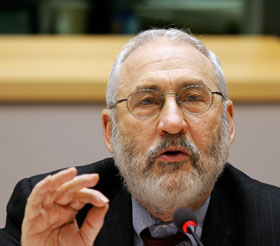
Feb. 1 (Bloomberg) — Nobel laureate Joseph Stiglitz said any decision by President Barack Obama to establish a so-called bad bank to rid financial companies of toxic assets risks swelling the national debt.

Obama’s administration is moving closer to buying the illiquid assets currently clogging bank’s balance sheets and preventing them from boosting lending, people familiar with the matter said this week.

That amounts to swapping taxpayers’ “cash for trash,” Stiglitz said yesterday in a panel discussion at the World Economic Forum in Davos, Switzerland. “You shouldn’t chase good money after bad. We’re talking about a national debt that’s very hard to manage.”

Stiglitz, a professor at Columbia University in New York and a former adviser to President Bill Clinton, says the plan would leave taxpayers paying for years of excess lending by banks. It would also deprive the government of money that would have been better spent shoring up Social Security, he said.

Whether a bad bank would accelerate an end to the financial crisis split delegates attending the Davos talks. JPMorgan Chase & Co. Chief Executive Officer Jamie Dimon said such an operation would help if “executed well.” Billionaire investor George Soros said in an interview that “it’s not the measure that would turn the situation around and enable banks to lend.”

Obama Plan

Obama said yesterday he’s readying a plan to unlock credit markets and lower mortgage rates. Under the initiative, the government would buy some tainted securities and insure the banks against losses on the rest.

“Soon my Treasury secretary, Timothy Geithner, will announce a new strategy for reviving our financial system that gets credit flowing to businesses and families,” Obama said in his weekly radio address.

Stiglitz drew criticism from panel participant Angel Gurria, head of the Organization for Economic Cooperation and Development, who says a bad bank is necessary for lending to resume.

“I agree about the moral, ethical fallout, but you’ve got to face the music and someone has to take the loss,” said Gurria, Mexico’s former finance minister. “It’s the only way to jumpstart the economy.”

Bank losses worldwide from toxic U.S.-originated assets may double to $2.2 trillion, the International Monetary Fund said in a report released Jan. 28.

John Monks, general secretary of the European Trade Union Confederation, told the same audience that governments are getting “close to straining the patience of the public and voters” by repeatedly extending lifelines to banks.

Philippines President Gloria Arroyo urged Obama to make a quick decision on his plan.

“We want Americans to do something,” she said at the session, which was called “Rebooting the Global Economy.” “We can discuss what to do but the worst thing is to do nothing.”

Is There a White House Baby on the Way?

Barack Obama, Michelle Obama, Perez, Romors, White House

PD*26386224

CBS NEWS

Celebrity blogger Perez Hilton has rarely let facts get in the way of gossip. Still, his latest and apparently baseless speculation about Michelle Obama has generated international baby buzz.

On Wednesday, an item appeared on PerezHilton.com (filed under Baby Blabber – Conspiracy Corner) with the headline: “White House Baby???”

“We’re hearing talk in D.C. that Michelle Obama is pregnant,” the post read.

Despite Hilton’s blunt disclaimer (“this is completely unconfirmed”), the rumor has picked up steam. A Google search for the words “Michelle Obama” and “pregnant” churns out 826,000 results. Meanwhile, Gawker has begun scrutinizing recent photos of the First Lady for signs of pregnancy.

The speculation has also spread overseas. News outlets from England to Australia pounced on the news.

So did the gambling world. In the wake of the rumor, Ireland’s biggest bookmaker Paddy Power slashed the odds on Michelle Obama giving birth this year from 10-1 to 2-1. You can also wager on the sex of the baby and even if the birth will produce multiple babies (it’s 20-1 that Michelle Obama will have twins and 10,000-1 that she will have octuplets).

Paddy Power’s Ken Robertson tells CBSNews.com that at this very moment, there are 166 bets on “Yes, there will be a new first baby” (for a total stake of 2412 Euros) and 222 bets on “No, there will not be a new first baby” (for a total stake of €3996).

Of course, the baby bets also include what the Obamas would name their third child, after Sasha and Malia. Barack Jr. is the favorite at 3-1; Michelle is 10-1; and the 250-1 long shots include Paris, Perez and Jesus.

Roberston says so far the most widely backed name for the new baby is Barack Jr., which has 98 bets for a total stake of €784.

If the dubious rumor does prove to be true, the baby would be only the second born in the White House. That sole distinction now belongs to the daughter of President Grover Cleveland, who was born in 1893. Her name? Esther.

England Gets Slammed With Worst Snowstorm in 18 Years

Crazy Weather, England, London

Despite five days of severe weather warnings, transport bosses still appeared to have been completely caught out as up to a foot of snow fell across the country, bringing rail, air and road networks to a halt.

They faced a growing public backlash as one in five workers was left stranded at home, at an estimated cost to the economy of £1.2billion.

In London, all bus services were cancelled for the first time in living memory, as a network which had carried on running during the Blitz – and during much worse conditions in 1963 – proved unable to deal with six inches of snow. Cancelled Tube trains added to the chaos in the capital.

Heathrow, Gatwick, London City, Luton, Stansted, Southampton and Birmingham airports were closed for all or part of the day, causing knock-on delays at most regional airports. At Heathrow, a Cyprus Air passenger jet skidded off the taxiway, coming to rest with its front wheel on the grass.

Debates in the Houses of Parliament finished early while some parts of the building did not open as staff could not get in. As hundreds of train services and flights were stopped and drivers faced treacherous conditions on ungritted roads, angry commuters demanded to know why the severe weather warnings had not been properly heeded.

Nigel Humphries, of the Association of British Drivers, said there could be no excuse for the failure of transport authorities to prepare for “entirely predictable weather conditions”.

The British Chambers of Commerce said a “clear lack of preparation” had cost business dearly.

With more snow predicted today and further flurries expected later in the week, Britain’s battered economy could suffer up to £3billion in lost productivity by the end of the week.Snowstorms which swept the country overnight and during the day had first been forecast by the Met Office last Wednesday, when it issued a severe weather warning accurately predicting the blizzards.

Yet local councils and transport authorities were still accused of failing to put adequate plans in place to deal with the weather.

The nature of the response was summed up in London, where main roads had been gritted by Transport for London, keeping them clear, but suburban roads leading to bus depots had not been gritted, stranding the city’s entire bus fleet, which is used by six million people a day.Tens of thousands of commuters braved the cold to walk to work instead, with some even skiing through the capital.

The Highways Agency and local councils were also heavily criticised by motorists for failing to put down enough grit on major roads, including the M25, where a 53-mile tailback built up yesterday morning between junction 19 at Watford and junction 8 at Reigate.

At one stage, it was estimated that there were 1,000 miles of tailbacks across the country.

The Local Government Association said councils had been overwhelmed by the relentless snowfalls, which had covered roads as quickly as they could be cleared, meaning the grit had less impact.

The Highways Agency blamed lorry drivers for clogging up major routes after ignoring advice to stay off the roads.

But David Frost, the director-general of the British Chambers of Commerce, said the collapse of the transport network was unacceptable.

He said: “People of my generation saw much worse winters than this in the 1960s and 1970s, yet things kept going. Why can’t we cope now?

“This weather was forecast five days ago – it’s not as if we suddenly woke up to find six inches of snow outside, and it’s clear that not enough preparation has been done.”

Susie Squire, of the TaxPayers’ Alliance pressure group, said the excuses simply wouldn’t wash with the public.

“Recent conditions do not merit total shutdown, and rail companies, councils and other authorities should have been able to cope,” she said.

“Many other first-world countries keep going in much worse conditions. People see their fares go up and up, and yet services seem to remain at the same sub-standard level.”

Boris Johnson, the Mayor of London, blamed “some of the most challenging weather conditions” for two decades for the disruption.

He said: “The difficulty really has been that the volume of snow has been so huge that you can put down the grit but then it simply snows over it again and you run the risk of unleashing a 12-ton bus on to heavily packed snow or ice and turning it into a lethal weapon.”

But his predecessor, Ken Livingstone, said Londoners had a right to ask why buses had stopped running and 10 of the 11 Tube lines had been crippled. “Boris should have been on the phone from Thursday, when the warnings first started, making sure everyone was prepared for the snowfall,” he said.

“Every few years in the early 1980s we had chaos with the weather but the buses always came out. It’s quite clear the borough councils, either because they wouldn’t pay overtime on a Sunday or because they have cut everything back to the bone, didn’t grit properly, even though there was plenty of advance warning.”

Two brothers died on Snowdon in North Wales after becoming stranded on the mountain as the weather closed in on Sunday night. They are thought to have fallen 700ft. Motoring organisations, meanwhile, said accidents on the roads were “too numerous” to catalogue.

Emergency services were so stretched by the number of road accidents and weather-related emergencies that London Ambulance service said it could only deal with life-threatening incidents.

More than 2,000 schools closed nationwide, operations had to be cancelled at hospitals and many courts and other public buildings shut down. The Federation of Small Businesses estimated that six million people – a fifth of the workforce – had stayed home, costing the economy £1.2 billion in wages and lost sales.

Conditions are unlikely to improve before the weekend, as temperatures are expected to remain below freezing in most parts of the country, turning snow and slush to ice, with yet more snow expected during the rest of the week.

The AA is telling drivers to keep warm clothes in their cars in case of breakdowns. A spokesman said attendants had seen stranded motorists “flirting with hypothermia” by going out unprepared.

Bank of America Throws Ten Million Dollar Super Bowl Party

AIG, Bank of america, Banking, Bear Stearns, CDS, Citibank, Derivatives, Finance, Hedge Funds, Merrill, Sports Business

T H I N K  P R O G R E S S

news

Just weeks ago, the federal government extended $20 billion to Bank of America to keep it afloat, bringing its total in federal bailout dollars received to $45 billion. ABC News reports, however, that the bank managed to scrounge up millions of dollars to be an NFL sponsor and for “a five day carnival-like” Super Bowl party just outside the stadium:

The event — known as the NFL Experience — was 850,000 square feet of sports games and interactive entertainment attractions for football fans and was blanketed in Bank of America logos and marketing calls to sign up for football-themed banking products. […]

The bank refused to tell ABC News how much it is spending as an NFL corporate sponsor, but insiders have put the figure at close to $10 million. The NFL Experience was on top of that and was inked last summer, according to the bank.

The NFL said it was a “multi-million dollar” event and that it was also spending money to put on the event. A Super Bowl insider said the tents alone cost over $800,000.

The Huffington Post notes that this is the latest in a series of bailed-out banks that continue to spend lavishly on sports sponsorships.

Totally Unofficial Daytona 500 Entry List

Daytona 500, Ganassi. Stock Car, Motorsports, Nascar, Petty, Robby Gordon

From the great  JAYSKI’S SILLYSEASON

updated on 2/2/2009

119991

NASCAR Sprint Cup Series
TOTALLY UNOFFICIAL Entry List
Daytona 500
Daytona International Speedway

<!– From NASCAR.com
–>

Car# Driver Manu Sponsor Owner
1 00 David Reutimann Toyota Aaron’s Dream Machine Robert Kauffman
2 1 Martin Truex Jr. Chevy Bass Pro Shops / Tracker Teresa Earnhardt
3 2 Kurt Busch Dodge Miller Lite Walter Czarnecki
4 5 Mark Martin Chevy Kellogg’s / CARQUEST Mary Hendrick
5 6 David Ragan Ford UPS Mike Dee
6 07 Casey Mears Chevy Jack Daniel’s Richard Childress
7 7 Robby Gordon Toyota Jim Beam Robby Gordon
8 08 Boris Said Ford TBA John Carter
9 8 Aric Almirola Chevy TBA Teresa Earnhardt
10 09 Brad Keselowski Chevy Miccosukee Resort & Gaming James Finch
11 9 Kasey Kahne Dodge Budweiser George Gillett, Jr
12 11 Denny Hamlin Toyota FedEx J D Gibbs
13 12 David Stremme Dodge Penske Racing Roger Penske
14 14 Tony Stewart
Past Champ 1 (2005)
Chevy Old Spice/Office Depot Tony Stewart
15 16 Greg Biffle Ford 3M Jack Roush
16 17 Matt Kenseth Ford DEWALT John Henry
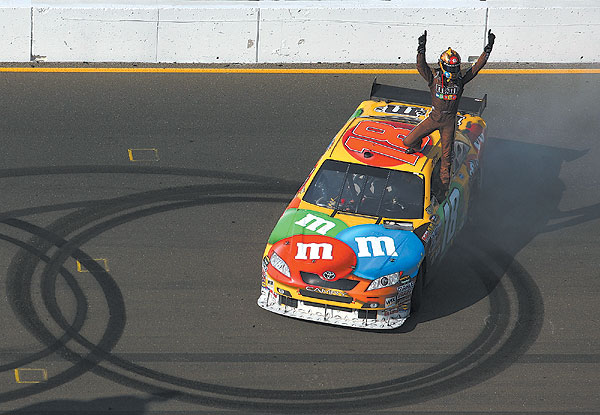
17 18 Kyle Busch Toyota M&M’s Joe Gibbs
18 19 Elliott Sadler Dodge Stanley Tools Ray Evernham
19 20 Joey Logano # Toyota Home Depot Joe Gibbs
20 21 Bill Elliott
Past Champ 3 (1988)
Ford Motorcraft Glen Wood
21 23 Mike Skinner Chevy TBA Robert Richardson Sr.
22 24 Jeff Gordon Chevy DuPont Rick Hendrick
23 26 Jamie McMurray Ford Crown Royal Geoff Smith
24 27 Kirk Shelmerdine Toyota TBA Kirk Shelmerdine
25 28 Travis Kvapil Ford TBA Doug Yates
26 29 Kevin Harvick Chevy Shell / Pennzoil Richard Childress
27 31 Jeff Burton Chevy Caterpillar Richard Childress
28 33 Clint Bowyer Chevy Cheerios Richard Childress
29 34 John Andretti Chevy TBA Bob Jenkins
Chip Ganassi
30 36 Scott Riggs Toyota TBA Tommy Baldwin
31 39 Ryan Newman Chevy US Army Tony Stewart
32 41 Jeremy Mayfield Toyota ? Jeremy Mayfield
33 42 Juan Montoya Chevy Target Chip Ganassi
34 43 Reed Sorenson Dodge Air Force Richard Petty
35 44 A.J. Allmendinger Dodge Valvoline George Gillett, Jr
36 46 Carl Long Dodge Romeo Guest Danielle Long
37 47 Marcos Ambrose Toyota Little Debbie Tad Geschickter
38 48 Jimmie Johnson Chevy Lowe’s Jeff Gordon
39 51 Kelly Bires Dodge TBA David Bean
40 55 Michael Waltrip Toyota NAPA Auto Parts Michael Waltrip
41 57? Norm Benning Chevy TBA Norm Benning
42 60 James Hylton Dodge ? Mark Simo
43 64 Geoff Bodine Toyota ? Todd Bodine
Geoff Bodine
Larry Gunselman
44 66 Terry Labonte
Past Champ 2 (1996)
Toyota Window World Prism Motorsports
Phil Parsons
Randy Humphrey
45 71 Mike Wallace Chevy TBA Kevin Buckler
46 75 Derrike Cope Dodge TBA Derrike Cope
47 77 Sam Hornish Jr. Dodge Mobil 1 Roger Penske
48 78 Regan Smith Chevy Furniture Row Barney Visser
49 82 Scott Speed # Toyota Red Bull Dietrich Mateschitz
50 83 Brian Vickers Toyota Red Bull Dietrich Mateschitz
51 87 Joe Nemechek Toyota ? Joe Nemechek
52 88 Dale Earnhardt Jr. Chevy AMP Energy / National Guard Rick Hendrick
53 96 Bobby Labonte Ford Ask.com Max Jones
54 98 Paul Menard Ford Menards Doug Yates
55 99 Carl Edwards Ford Afflac Jack Roush
Could to be added
22 ? Toyota ? Maury Guant
37 Tony Raines ?Chevy ? Brad Jenkins

Goldman Sachs Tax Rate Drops to 1%- From 6 Billion to 14 Million

Banking Fraud, Finance, Goldman Sachs, Tax Fraud, Wall Street

By Christine Harper Dec. 16

(Bloomberg)

delayed

Goldman Sachs Group Inc., which got $10 billion and debt guarantees from the U.S. government in October, expects to pay $14 million in taxes worldwide for 2008 compared with $6 billion in 2007. The company’s effective income tax rate dropped to 1 percent from 34.1 percent, New York-based Goldman Sachs said today in a statement. The firm reported a $2.3 billion profit for the year after paying $10.9 billion in employee compensation and benefits.

Goldman Sachs, which today reported its first quarterly loss since going public in 1999, lowered its rate with more tax credits as a percentage of earnings and because of “changes in geographic earnings mix,” the company said. The rate decline looks “a little extreme,” said Robert Willens, president and chief executive officer of tax and accounting advisory firm Robert Willens LLC. “I was definitely taken aback,” Willens said. “Clearly they have taken steps to ensure that a lot of their income is earned in lower-tax jurisdictions.” U.S. Representative Lloyd Doggett, a Texas Democrat who serves on the tax-writing House Ways and Means Committee, said steps by Goldman Sachs and other banks shifting income to countries with lower taxes is cause for concern. “This problem is larger than Goldman Sachs,” Doggett said. “With the right hand out begging for bailout money, the left is hiding it offshore.” In the first nine months of the fiscal year, Goldman had planned to pay taxes at a 25.1 percent rate, the company said today. A fourth-quarter tax credit of $1.48 billion was 41 percent of the company’s pretax loss in the period, higher than many analysts expected. David Trone, an analyst at Fox-Pitt Kelton Cochran Caronia Waller, expected the fourth-quarter tax credit to be 28 percent. The tax-rate decline may raise some eyebrows because of the support the U.S. government has provided to Goldman Sachs and other companies this year, Willens said. “It’s not very good public relations,” he said.

Politico Becomes Official Shit-Stirrer of Obama Administration

Beltway Groupthink, DC Press, Jonathan Martin, Nancy Pelosi, Politico, Rahm Emmanuel, Steny Hoyer

Pelosi lays down the law with Rahm
By: John Bresnahan

December 16, 2008

bama


In a recent conversation with House Speaker Nancy Pelosi, Rahm Emanuel offered some advice on a Democratic House leadership race. Pelosi’s response, according to several Democratic sources: It is “an internal House Democratic Caucus matter, and we’ll handle it.”

Democratic insiders say there’s no animosity between Pelosi and Emanuel, who’s leaving his post as chairman of the House Democratic Caucus to become the next White House chief of staff.

But the speaker is laying down the law nonetheless.

In talks with Emanuel and others, sources say, Pelosi has “set parameters” for what she wants from Barack Obama and his White House staff — no surprises, and no backdoor efforts to go around her and other Democratic leaders by cutting deals with moderate New Democrats or conservative Blue Dogs.

Specifically, Pelosi has told Emanuel that she wants to know when representatives of the incoming administration have any contact with her rank-and-file Democrats — and why, sources say.

During the Bush years, the White House set policy, and Republicans on Capitol Hill were expected to follow it. Former Speaker Dennis Hastert (R-Ill.) occasionally lashed out at former White House chief of staff Andy Card or other senior administration aides when he felt they had gone too far. But in general, Republican lawmakers followed Bush’s lead on every major legislative battle, from Iraq to tax and spending bills to anti-terror policies. With the exception of immigration reform, the House fight over the $700 billion Wall Street bailout package and last week’s meltdown over a bailout for the Big Three automakers, Bush got what he wanted from Congress, especially within his own party.

Pelosi and Senate Majority Leader Harry Reid (D-Nev.) are signaling that they won’t tolerate a repeat with a Democrat in the White House and Democratic majorities in the House and the Senate.

Pelosi “is not going to allow Obama to triangulate her,” said a Democratic source close to the leadership. “It’s not going to happen to her.”

Pelosi’s mantra, in a way, is “no surprises.” The speaker wants to be told when Reid is communicating with the Blue Dogs or other factions with her caucus, and she expects the same from Obama when he arrives in the Oval Office, said Democratic sources.

“We certainly are in frequent communication with the [Obama] transition team,” said Brendan Daly, Pelosi’s communications director. Daly noted that Pelosi and Emanuel have long-standing ties — she appointed him to head up the Democratic Congressional Campaign Committee at the start of 2005 — and added that Emanuel often speaks directly with John Lawrence, Pelosi’s chief of staff.

Daly said Pelosi will work closely with Obama and Reid to craft an economic stimulus package early next year, as well as other economic recovery legislation.

“She and President-elect Obama have the same goals,” Daly added. “It’s a matter of working together to get things done.”

Pelosi herself said the same about Obama in an interview with Bloomberg’s Al Hunt last week, stating that “our priorities are the same about creating good-paying jobs.”

But it won’t always be that easy. Capitol Hill veterans predict that, no matter how much goodwill there is at the start of a new administration, there are always battles over policy and legislative priorities between the White House and Congress.

“There is tension. There is going to be tension,” said a Democratic veteran of Capitol Hill. “This is not Hastert. She wants to know what they are up to.”

The Emanuel-Pelosi relationship is a complex one that defies easy explanation. Emanuel was a rising star inside the Democratic Caucus — with many members convinced he would be speaker one day — until Obama tapped him for the West Wing job. In large part, Emanuel owed his rise to Pelosi, who put him in charge of the DCCC, where he helped lead the Democrats back to the House majority after 12 years out of power.

From the DCCC, Emanuel moved up to the chairmanship of the caucus. But both he and Pelosi had stocked the DCCC with their own loyalists after the 2006 election, and they both tried to influence campaign strategy as subtly as possible through these surrogates. At the same time, Emanuel was often jockeying with other members on major legislation, including immigration reform and the Wall Street bailout, but rarely without the speaker’s blessing.

Pelosi sometimes resisted Emanuel’s desire to always be on the attack, but she did respect his insight and his willingness to work hard to achieve legislative and political goals. She refused to back Emanuel when he made noises about running for majority whip, the post now held by Rep. Jim Clyburn (D-S.C.). But when Obama approached him about the chief of staff job, Emanuel consulted Pelosi first.

Yet the two will find themselves on different ends of Pennsylvania Avenue next year, and that will change the nature of their current relationship profoundly.

“Look, they have different goals now,” said an aide to one top Democrat. “Her job is to protect her members; his job is protect Obama. Those can’t always be the same thing.”

This source added: “I think they will do what they can to work together, but these are two strong-willed people who are used to getting their way. There’s bound to be some areas of disagreement. We’ll just have to see how they handle it.”